WAVE SPEED ON A STRING
By:Aysha Allard Brown
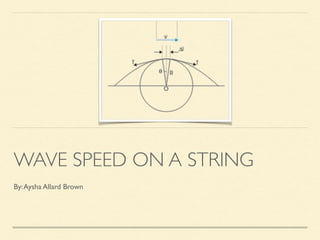
WAVE SPEED ON A STRING
The speed of a wave depends on the elastic and inertial properties of the
medium it is in
We can determine the elastic property of a string by finding the tension force in
the string (Ft)
We can determine the inertial property by finding the linear mass density (μ)
Increasing the tension, also referred to as the restoring force, increases the
movement of the string
As we increase the linear mass density, the amount of inertia increases which
decreases the movement of the string
EQUATIONS
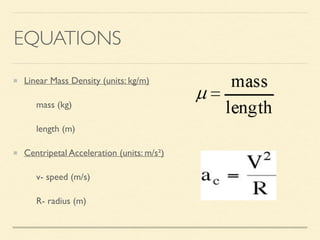
Linear Mass Density (units: kg/m)
mass (kg)
length (m)
Centripetal Acceleration (units: m/s²)
v- speed (m/s)
R- radius (m)
EQUATIONS
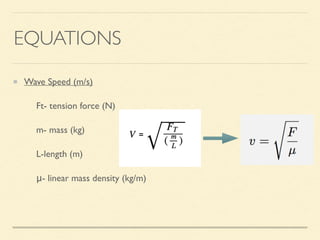
Wave Speed (m/s)
Ft- tension force (N)
m- mass (kg)
L-length (m)
μ- linear mass density (kg/m)
QUESTION #1
A guitar string has a mass of 230g and a length of 1.2m. What
must the tension of the string be to send a wave along the string at
a speed of 45.0 m/s?
SOLUTION (PT.1)
• The first step is to convert
each variable into the correct
units (length in m, mass in kg,
and velocity in m/s).
• Next, we can use the
following equation to solve
for the linear mass density.
SOLUTION (PT.2)
We can substitute the value we
obtained for μ into the following
equation:
Next, we can rearrange this
equation in order to solve for the
tension force.
Lastly, we plug in the values we
have for the speed and the linear
mass density of the string in order
to solve for the tension force.
QUESTION #2
Two children are playing with a jump rope which is attached at one end to a pole. The first child
moves his hands up and down, which creates a steady pulse in the jump rope. They decide to
have a competition to see who can make the pulse move the fastest. How can the second child
make the pulse in the jump rope move faster?
A. He could tighten the string tension.
B. He could loosen the string tension.
C. He could move their hand up and down slower.
D. He could move their hands up and down a larger distance as they generate the pulse.
E. He could use a heavier string.
F. He could use a lighter string.
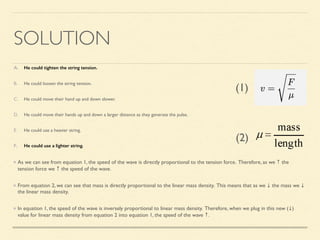
SOLUTION
A. He could tighten the string tension.
B. He could loosen the string tension.
C. He could move their hand up and down slower.
D. He could move their hands up and down a larger distance as they generate the pulse.
E. He could use a heavier string.
F. He could use a lighter string.
As we can see from equation 1, the speed of the wave is directly proportional to the tension force. Therefore, as we ↑ the
tension force we ↑ the speed of the wave.
From equation 2, we can see that mass is directly proportional to the linear mass density. This means that as we ↓ the mass we ↓
the linear mass density.
In equation 1, the speed of the wave is inversely proportional to linear mass density. Therefore, when we plug in this new (↓)
value for linear mass density from equation 2 into equation 1, the speed of the wave ↑.
(1)
(2)
YOUTUBEVIDEO
https://www.youtube.com/watch?v=oAd0BTgGwJw
Thank you.

Wave Speed on a String

  • 1.
    WAVE SPEED ONA STRING By:Aysha Allard Brown
  • 2.
    WAVE SPEED ONA STRING The speed of a wave depends on the elastic and inertial properties of the medium it is in We can determine the elastic property of a string by finding the tension force in the string (Ft) We can determine the inertial property by finding the linear mass density (μ) Increasing the tension, also referred to as the restoring force, increases the movement of the string As we increase the linear mass density, the amount of inertia increases which decreases the movement of the string
  • 3.
    EQUATIONS Linear Mass Density(units: kg/m) mass (kg) length (m) Centripetal Acceleration (units: m/s²) v- speed (m/s) R- radius (m)
  • 4.
    EQUATIONS Wave Speed (m/s) Ft-tension force (N) m- mass (kg) L-length (m) μ- linear mass density (kg/m)
  • 5.
    QUESTION #1 A guitarstring has a mass of 230g and a length of 1.2m. What must the tension of the string be to send a wave along the string at a speed of 45.0 m/s?
  • 6.
    SOLUTION (PT.1) • Thefirst step is to convert each variable into the correct units (length in m, mass in kg, and velocity in m/s). • Next, we can use the following equation to solve for the linear mass density.
  • 7.
    SOLUTION (PT.2) We cansubstitute the value we obtained for μ into the following equation: Next, we can rearrange this equation in order to solve for the tension force. Lastly, we plug in the values we have for the speed and the linear mass density of the string in order to solve for the tension force.
  • 8.
    QUESTION #2 Two childrenare playing with a jump rope which is attached at one end to a pole. The first child moves his hands up and down, which creates a steady pulse in the jump rope. They decide to have a competition to see who can make the pulse move the fastest. How can the second child make the pulse in the jump rope move faster? A. He could tighten the string tension. B. He could loosen the string tension. C. He could move their hand up and down slower. D. He could move their hands up and down a larger distance as they generate the pulse. E. He could use a heavier string. F. He could use a lighter string.
  • 9.
    SOLUTION A. He couldtighten the string tension. B. He could loosen the string tension. C. He could move their hand up and down slower. D. He could move their hands up and down a larger distance as they generate the pulse. E. He could use a heavier string. F. He could use a lighter string. As we can see from equation 1, the speed of the wave is directly proportional to the tension force. Therefore, as we ↑ the tension force we ↑ the speed of the wave. From equation 2, we can see that mass is directly proportional to the linear mass density. This means that as we ↓ the mass we ↓ the linear mass density. In equation 1, the speed of the wave is inversely proportional to linear mass density. Therefore, when we plug in this new (↓) value for linear mass density from equation 2 into equation 1, the speed of the wave ↑. (1) (2)
  • 10.
  • 11.