Students apply the processes of scientific investigation and design, conduct,
communicate about, and evaluate such investigations. Students know and are
able to:


   1. Ask questions and state hypotheses using prior scientific knowledge to help design
   and guide development and implementation of a scientific investigation

   2. Select and use appropriate technologies to gather, process, and analyze data and to
   report information related to an investigation

   3. Identify major sources of error or uncertainty within an investigation (for example:
   particular measuring devices and experimental procedures)

   4.   Recognize and analyze alternative explanations and models

   5. Construct and revise scientific explanations and models, using evidence, logic, and
   experiments that include identifying and controlling variables

   6.   Communicate and evaluate scientific thinking that leads to particular conclusions.
Students know and understand common properties, forms, and changes in
matter and energy. Students know and can demonstrate understanding
that:

   1.   Elements can be organized by their physical and chemical properties

   2. The special configuration of atoms and the structure of the atoms in a molecule
   determine the chemical properties of the substance

   3. There are observable and measurable physical and chemical properties that allow
   one to compare, contrast, and separate substances

   4. Word and chemical equations are used to relate observed changes in matter to its
   composition and structure

   5. Quantitative relationships involved with thermal energy can be identified, measured,
   calculated and analyzed

   6. Energy can be transferred through a variety of mechanisms and in any change some
   energy is lost as heat

   7. Light and sound waves have distinct properties; frequency, wavelengths and
   amplitude
8. Quantities that demonstrate conservation of mass and conservation of energy in
physical interactions can be measured and calculated.

9. Newton’s Three Laws of Motion explain the relationship between the forces acting on
an object, the object’s mass, and changes in its motion.
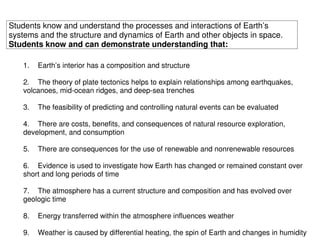
Students know and understand the processes and interactions of Earth’s
systems and the structure and dynamics of Earth and other objects in space.
Students know and can demonstrate understanding that:

   1.   Earth’s interior has a composition and structure

   2. The theory of plate tectonics helps to explain relationships among earthquakes,
   volcanoes, mid-ocean ridges, and deep-sea trenches

   3.   The feasibility of predicting and controlling natural events can be evaluated

   4. There are costs, benefits, and consequences of natural resource exploration,
   development, and consumption

   5.   There are consequences for the use of renewable and nonrenewable resources

   6. Evidence is used to investigate how Earth has changed or remained constant over
   short and long periods of time

   7. The atmosphere has a current structure and composition and has evolved over
   geologic time

   8.   Energy transferred within the atmosphere influences weather

   9.   Weather is caused by differential heating, the spin of Earth and changes in humidity
10. There are interrelationships between the circulation of oceans and weather and
climate.

11. There are factors that may influence weather patterns and climate and their effects
within ecosystems

12. Water and other Earth systems interact

13. Continental water resources are replenished and purified through the hydrologic
cycle.

14. Gravity governs the motions observed in the Solar System and beyond.

15. There is electromagnetic radiation produced by the Sun and other stars

16. Stars differ from each other in mass, color, temperature and age

17. The scales of size and separation of components of the Solar System are complex.
Students understand that the nature of science involves a particular way of
building knowledge and making meaning of the natural world. Students know
and can demonstrate understanding that:

   1.   Print and visual media can be evaluated for scientific evidence, bias, or opinion

   2. Identify reasons why consensus and peer review are essential to the scientific
   process.

   3. Graphs, equations or other models are used to analyze systems involving change
   and constancy

   4.   There are cause-effect relationships within systems

   5. Scientific knowledge changes and accumulates over time; usually the changes that
   take place are small modifications of prior knowledge but major shifts in the scientific
   view of how the world works do occur.

   6. Interrelationships among science, technology and human activity lead to further
   discoveries that impact the world in positive and negative ways

   7.   There is a difference between a scientific theory and a scientific hypothesis

Standards

  • 1.
    Students apply theprocesses of scientific investigation and design, conduct, communicate about, and evaluate such investigations. Students know and are able to: 1. Ask questions and state hypotheses using prior scientific knowledge to help design and guide development and implementation of a scientific investigation 2. Select and use appropriate technologies to gather, process, and analyze data and to report information related to an investigation 3. Identify major sources of error or uncertainty within an investigation (for example: particular measuring devices and experimental procedures) 4. Recognize and analyze alternative explanations and models 5. Construct and revise scientific explanations and models, using evidence, logic, and experiments that include identifying and controlling variables 6. Communicate and evaluate scientific thinking that leads to particular conclusions.
  • 2.
    Students know andunderstand common properties, forms, and changes in matter and energy. Students know and can demonstrate understanding that: 1. Elements can be organized by their physical and chemical properties 2. The special configuration of atoms and the structure of the atoms in a molecule determine the chemical properties of the substance 3. There are observable and measurable physical and chemical properties that allow one to compare, contrast, and separate substances 4. Word and chemical equations are used to relate observed changes in matter to its composition and structure 5. Quantitative relationships involved with thermal energy can be identified, measured, calculated and analyzed 6. Energy can be transferred through a variety of mechanisms and in any change some energy is lost as heat 7. Light and sound waves have distinct properties; frequency, wavelengths and amplitude
  • 3.
    8. Quantities thatdemonstrate conservation of mass and conservation of energy in physical interactions can be measured and calculated. 9. Newton’s Three Laws of Motion explain the relationship between the forces acting on an object, the object’s mass, and changes in its motion.
  • 4.
    Students know andunderstand the processes and interactions of Earth’s systems and the structure and dynamics of Earth and other objects in space. Students know and can demonstrate understanding that: 1. Earth’s interior has a composition and structure 2. The theory of plate tectonics helps to explain relationships among earthquakes, volcanoes, mid-ocean ridges, and deep-sea trenches 3. The feasibility of predicting and controlling natural events can be evaluated 4. There are costs, benefits, and consequences of natural resource exploration, development, and consumption 5. There are consequences for the use of renewable and nonrenewable resources 6. Evidence is used to investigate how Earth has changed or remained constant over short and long periods of time 7. The atmosphere has a current structure and composition and has evolved over geologic time 8. Energy transferred within the atmosphere influences weather 9. Weather is caused by differential heating, the spin of Earth and changes in humidity
  • 5.
    10. There areinterrelationships between the circulation of oceans and weather and climate. 11. There are factors that may influence weather patterns and climate and their effects within ecosystems 12. Water and other Earth systems interact 13. Continental water resources are replenished and purified through the hydrologic cycle. 14. Gravity governs the motions observed in the Solar System and beyond. 15. There is electromagnetic radiation produced by the Sun and other stars 16. Stars differ from each other in mass, color, temperature and age 17. The scales of size and separation of components of the Solar System are complex.
  • 6.
    Students understand thatthe nature of science involves a particular way of building knowledge and making meaning of the natural world. Students know and can demonstrate understanding that: 1. Print and visual media can be evaluated for scientific evidence, bias, or opinion 2. Identify reasons why consensus and peer review are essential to the scientific process. 3. Graphs, equations or other models are used to analyze systems involving change and constancy 4. There are cause-effect relationships within systems 5. Scientific knowledge changes and accumulates over time; usually the changes that take place are small modifications of prior knowledge but major shifts in the scientific view of how the world works do occur. 6. Interrelationships among science, technology and human activity lead to further discoveries that impact the world in positive and negative ways 7. There is a difference between a scientific theory and a scientific hypothesis