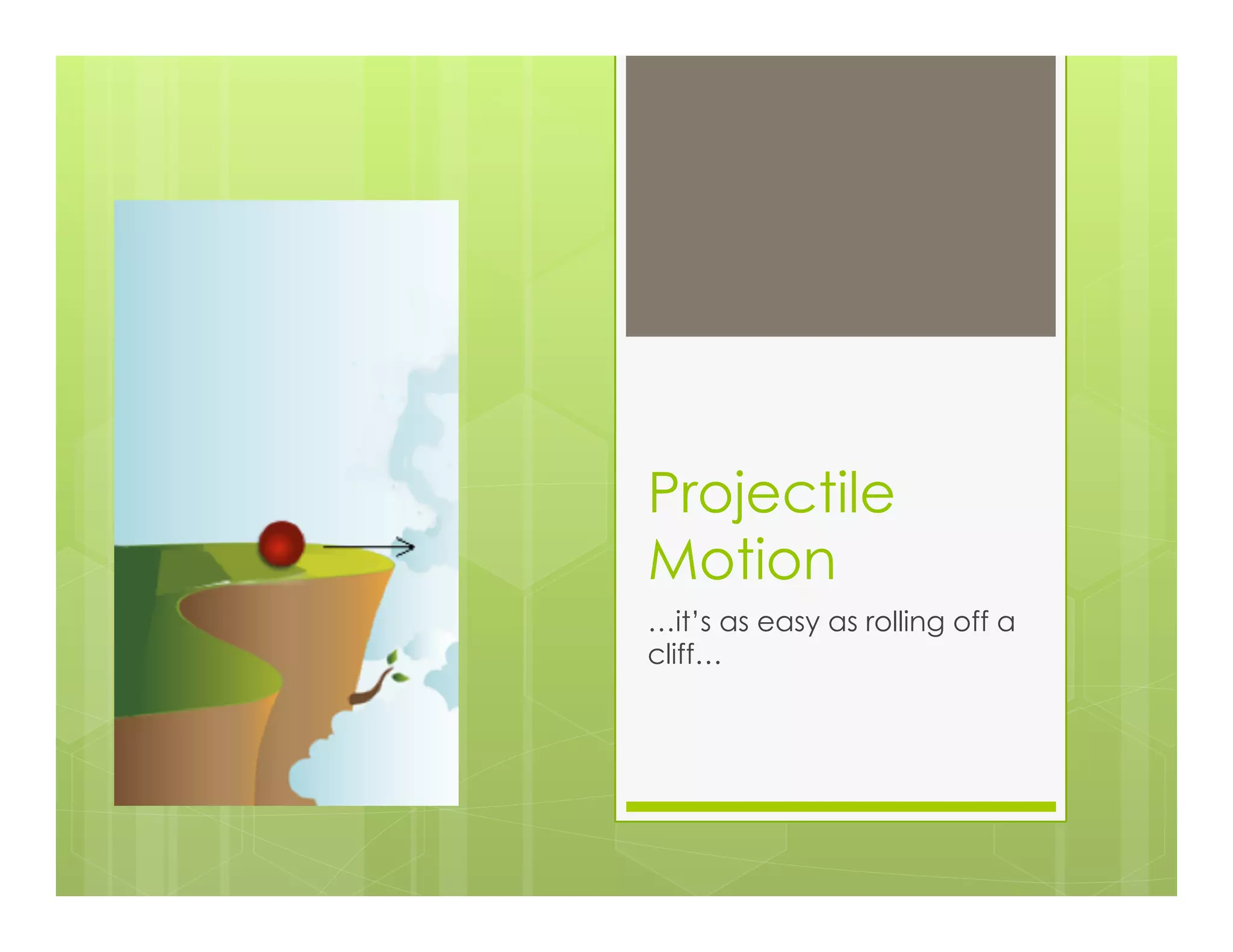
Projectile
Motion
…it’s as easy as rolling off a
cliff…
Prediction
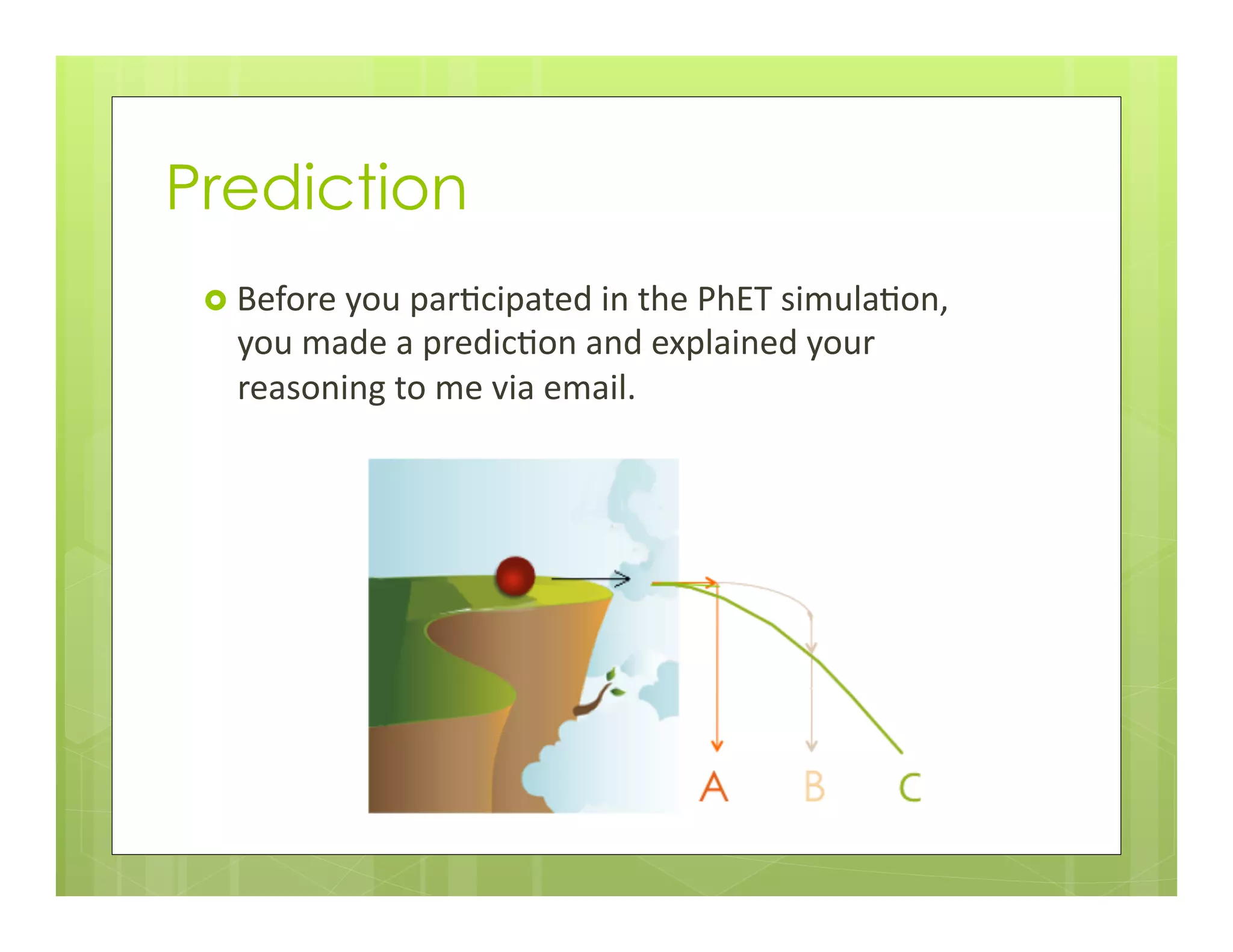
›  Before	
  you	
  par+cipated	
  in	
  the	
  PhET	
  simula+on,	
  
you	
  made	
  a	
  predic+on	
  and	
  explained	
  your	
  
reasoning	
  to	
  me	
  via	
  email.	
  
A Little History…
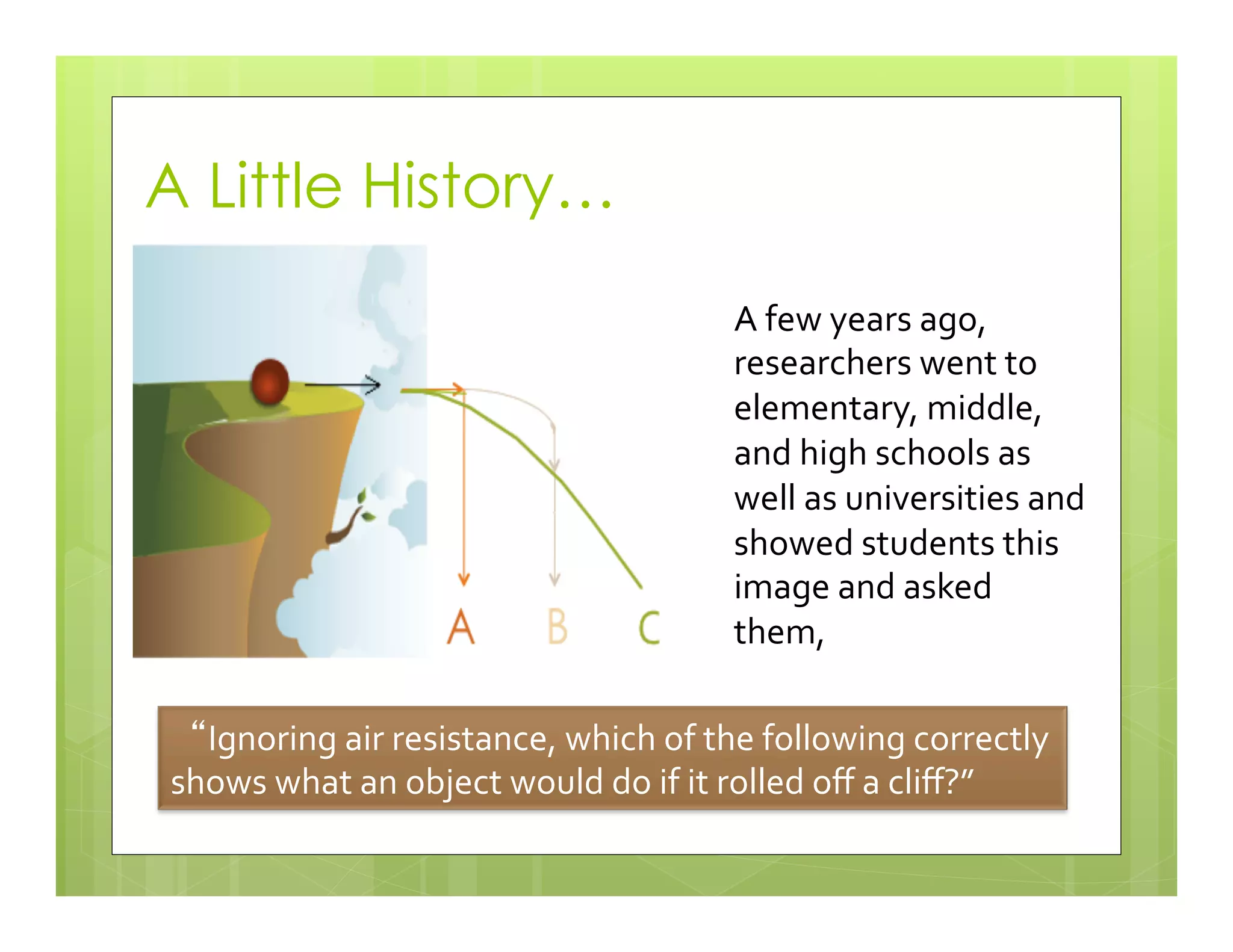
A	
  few	
  years	
  ago,	
  
researchers	
  went	
  to	
  
elementary,	
  middle,	
  
and	
  high	
  schools	
  as	
  
well	
  as	
  universities	
  and	
  
showed	
  students	
  this	
  
image	
  and	
  asked	
  
them,	
  	
  
Ignoring	
  air	
  resistance,	
  which	
  of	
  the	
  following	
  correctly	
  
shows	
  what	
  an	
  object	
  would	
  do	
  if	
  it	
  rolled	
  off	
  a	
  cliff?”	
  
The Results
›  The	
  breakdown	
  of	
  answers	
  they	
  got	
  was	
  almost	
  exactly	
  
the	
  same	
  at	
  all	
  ages.	
  
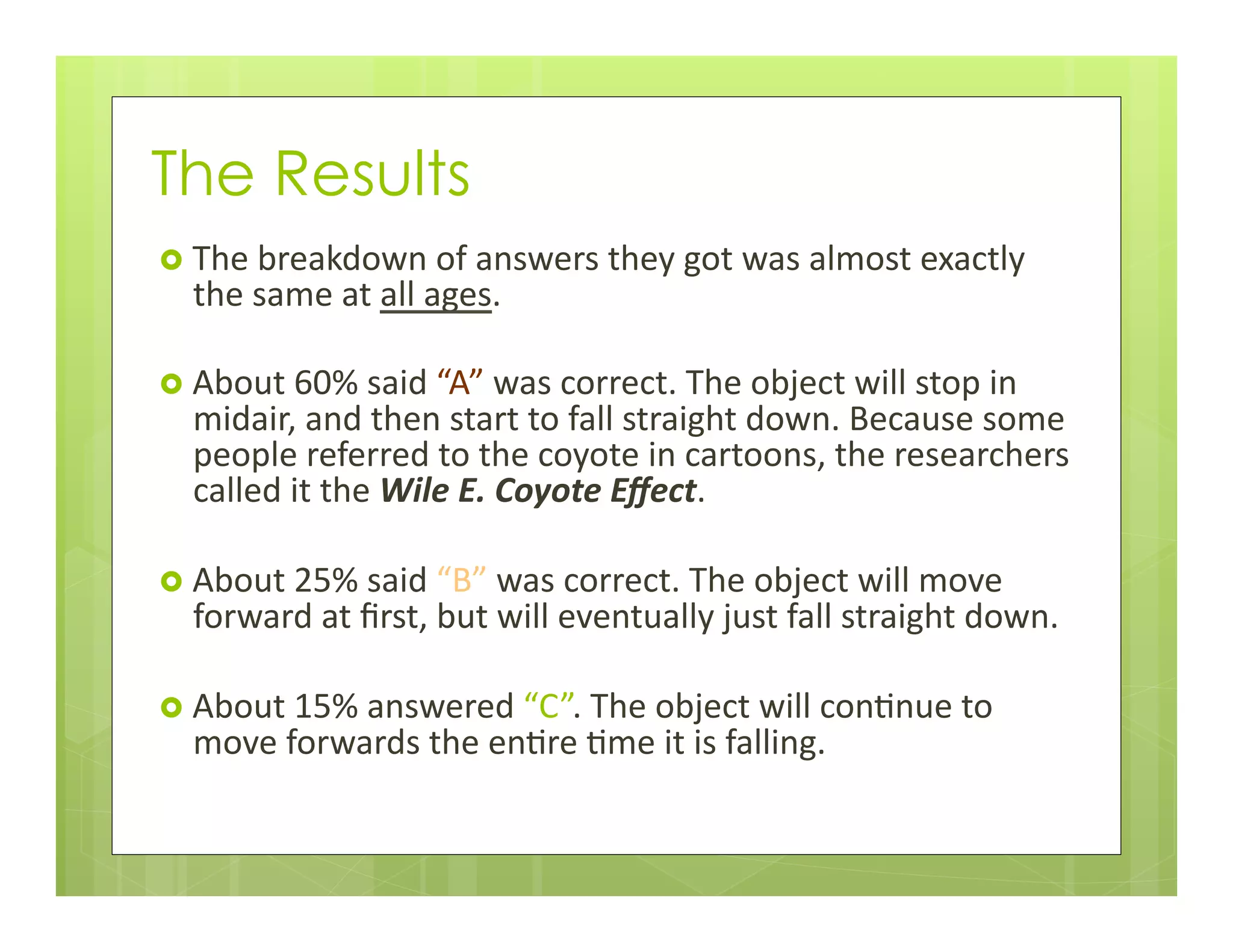
›  About	
  60%	
  said	
  “A”	
  was	
  correct.	
  The	
  object	
  will	
  stop	
  in	
  
midair,	
  and	
  then	
  start	
  to	
  fall	
  straight	
  down.	
  Because	
  some	
  
people	
  referred	
  to	
  the	
  coyote	
  in	
  cartoons,	
  the	
  researchers	
  
called	
  it	
  the	
  Wile	
  E.	
  Coyote	
  Effect.	
  	
  
›  About	
  25%	
  said	
  “B”	
  was	
  correct.	
  The	
  object	
  will	
  move	
  
forward	
  at	
  first,	
  but	
  will	
  eventually	
  just	
  fall	
  straight	
  down.	
  
›  About	
  15%	
  answered	
  “C”.	
  The	
  object	
  will	
  con+nue	
  to	
  
move	
  forwards	
  the	
  en+re	
  +me	
  it	
  is	
  falling.	
  	
  
So What’s the Correct Answer?
›  I’m	
  not	
  going	
  to	
  tell	
  you.	
  We’ll	
  revisit	
  the	
  ques+on	
  
at	
  the	
  end	
  of	
  these	
  notes.	
  J	
  
Observations	
  from	
  the	
  Simulation
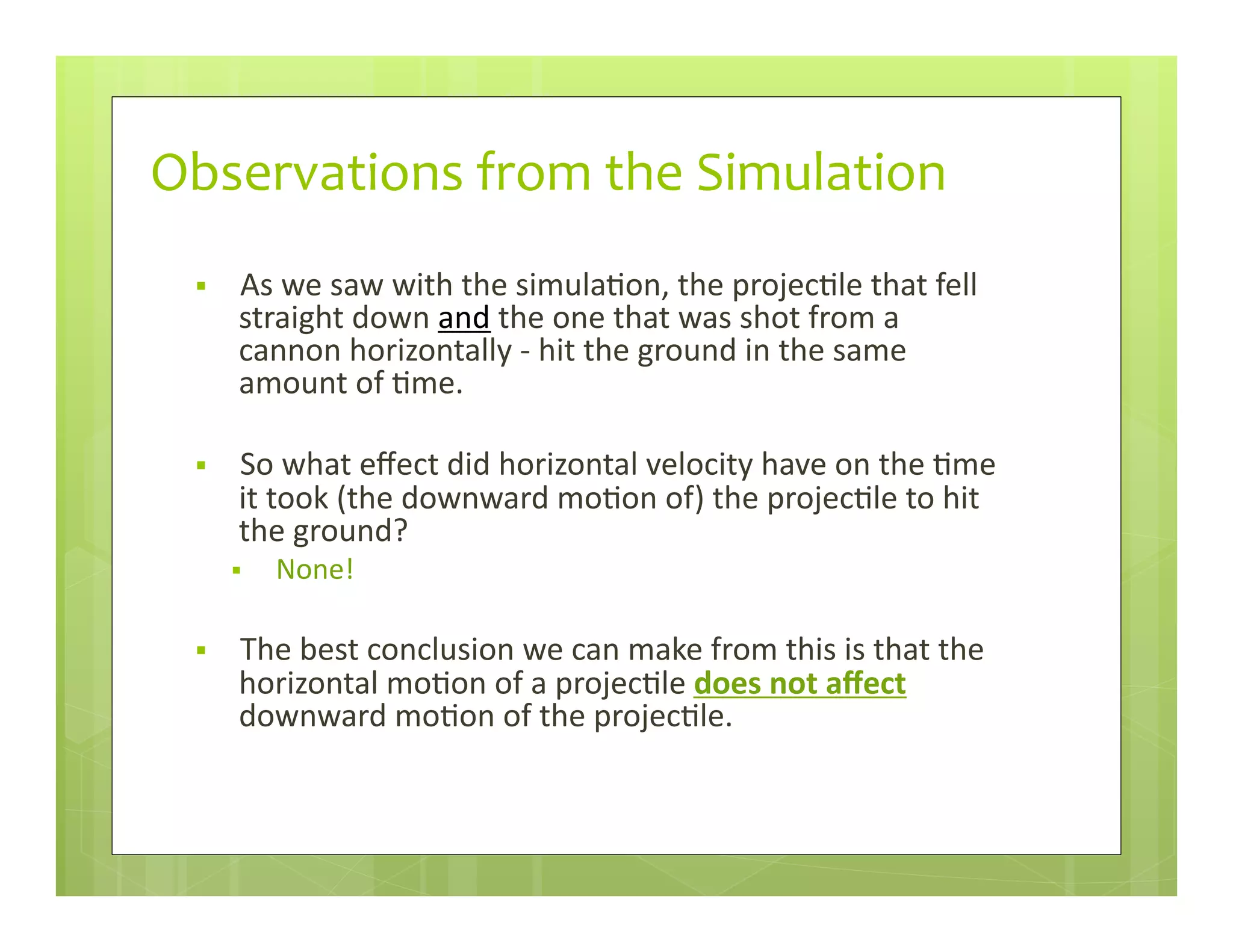
§  As	
  we	
  saw	
  with	
  the	
  simula+on,	
  the	
  projec+le	
  that	
  fell	
  
straight	
  down	
  and	
  the	
  one	
  that	
  was	
  shot	
  from	
  a	
  
cannon	
  horizontally	
  -­‐	
  hit	
  the	
  ground	
  in	
  the	
  same	
  
amount	
  of	
  +me.	
  
§  So	
  what	
  effect	
  did	
  horizontal	
  velocity	
  have	
  on	
  the	
  +me	
  
it	
  took	
  (the	
  downward	
  mo+on	
  of)	
  the	
  projec+le	
  to	
  hit	
  
the	
  ground?	
  
§  None!	
  
§  The	
  best	
  conclusion	
  we	
  can	
  make	
  from	
  this	
  is	
  that	
  the	
  
horizontal	
  mo+on	
  of	
  a	
  projec+le	
  does	
  not	
  affect	
  
downward	
  mo+on	
  of	
  the	
  projec+le.	
  
Observations	
  from	
  the	
  lab	
  
›  Intui+on	
  will	
  tell	
  you	
  that	
  the	
  horizontally	
  
launched	
  object	
  will	
  “hang”	
  in	
  the	
  air.	
  
›  But…	
  
›  YOUR	
  INTUITION	
  (at	
  least	
  in	
  this	
  case)	
  IS	
  WRONG!	
  
›  Here’s	
  a	
  video	
  
›  Here’s	
  another	
  video	
  
Horizontal and Vertical Motion
›  The	
  most	
  important	
  thing	
  you	
  can	
  remember	
  
about	
  projec+le	
  mo+on	
  is	
  this:	
  
›  Horizontal	
  and	
  Ver+cal	
  mo+on	
  are	
  completely,	
  
100%	
  INDEPENDENT	
  of	
  each	
  other	
  –	
  even	
  when	
  
they	
  are	
  happening	
  at	
  the	
  same	
  +me.	
  
›  Your	
  lab	
  ques+on	
  was,	
  “How	
  does	
  ini+al	
  velocity	
  
affect	
  the	
  amount	
  of	
  +me	
  it	
  takes	
  a	
  horizontally-­‐
launched	
  object	
  to	
  reach	
  the	
  ground?”	
  
Does Horizontal Affect Vertical?
›  The	
  short	
  answer	
  to	
  the	
  lab	
  ques+on	
  is:	
  
›  It	
  Doesn’t!	
  The	
  horizontal	
  mo+on	
  of	
  the	
  projec+le	
  is	
  
unaffected	
  by	
  the	
  downward	
  (ver+cal)	
  force	
  of	
  
gravity.	
  
›  What	
  does	
  affect	
  how	
  long	
  it	
  takes	
  an	
  object	
  to	
  hit	
  
the	
  ground	
  (ignoring	
  air	
  resistance)?	
  
›  One	
  thing	
  and	
  one	
  thing	
  only…	
  
›  The	
  height	
  it	
  is	
  launched	
  from!	
  
Looking at velocity vectors
›  On	
  the	
  next	
  slide,	
  we’re	
  going	
  to	
  look	
  at	
  the	
  paths	
  
two	
  projec+les	
  follow.	
  One	
  projec+le	
  is	
  shot	
  out	
  of	
  
a	
  cannon,	
  the	
  other	
  is	
  dropped	
  at	
  exactly	
  the	
  
same	
  moment.	
  
›  yes,	
  just	
  like	
  the	
  lab	
  J	
  
›  When	
  going	
  through	
  the	
  slide,	
  remember:	
  
›  velocity	
  is	
  a	
  vector	
  (has	
  magnitude	
  &	
  direc+on)	
  
›  gravity	
  is	
  a	
  constant	
  force	
  
›  constant	
  forces	
  cause	
  accelera+on	
  
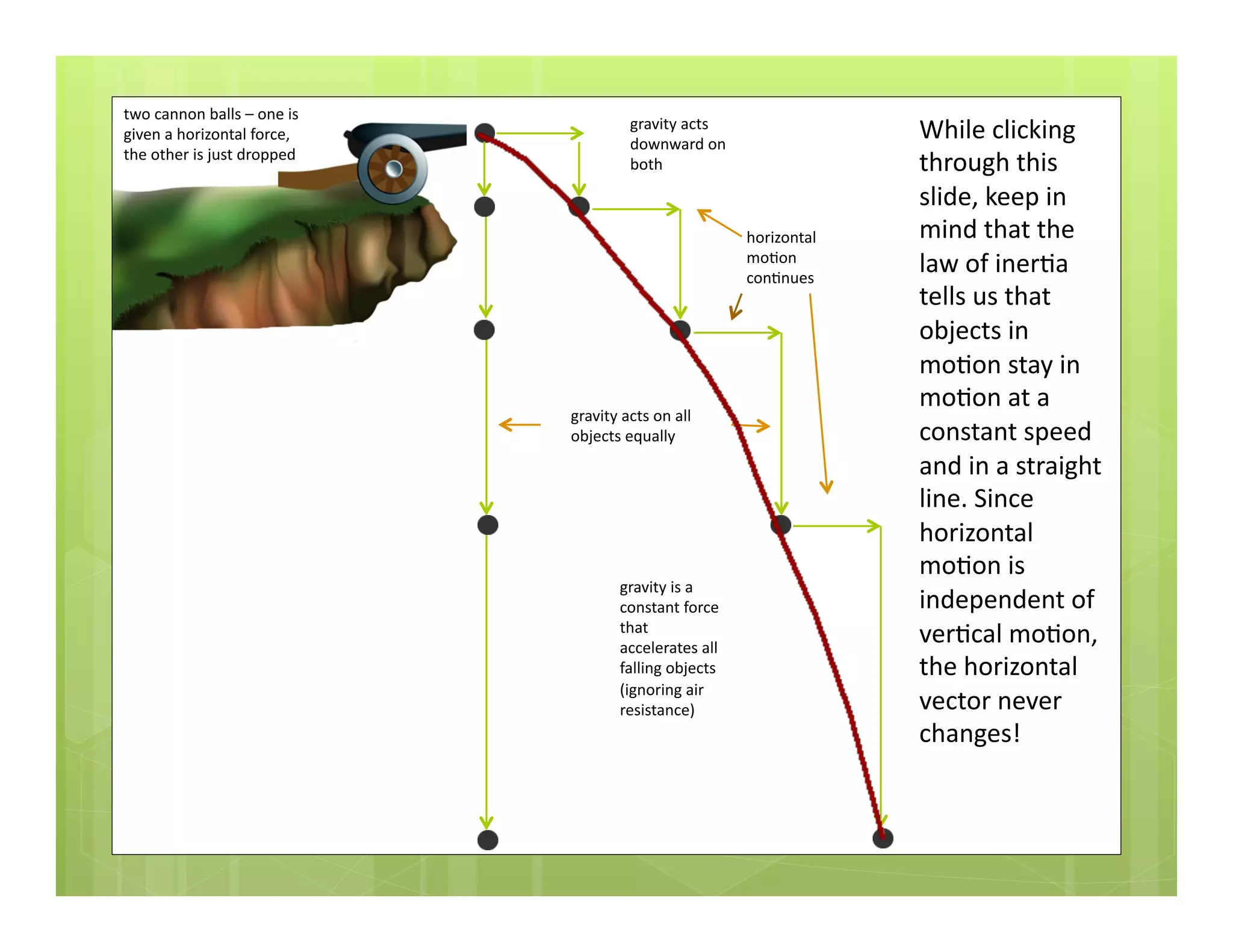
While	
  clicking	
  
through	
  this	
  
slide,	
  keep	
  in	
  
mind	
  that	
  the	
  
law	
  of	
  iner+a	
  
tells	
  us	
  that	
  
objects	
  in	
  
mo+on	
  stay	
  in	
  
mo+on	
  at	
  a	
  
constant	
  speed	
  
and	
  in	
  a	
  straight	
  
line.	
  Since	
  
horizontal	
  
mo+on	
  is	
  
independent	
  of	
  
ver+cal	
  mo+on,	
  
the	
  horizontal	
  
vector	
  never	
  
changes!	
  
two	
  cannon	
  balls	
  –	
  one	
  is	
  
given	
  a	
  horizontal	
  force,	
  
the	
  other	
  is	
  just	
  dropped	
  
gravity	
  acts	
  
downward	
  on	
  
both	
  
horizontal	
  
mo+on	
  
con+nues	
  
gravity	
  is	
  a	
  
constant	
  force	
  
that	
  
accelerates	
  all	
  
falling	
  objects	
  
(ignoring	
  air	
  
resistance)	
  
gravity	
  acts	
  on	
  all	
  
objects	
  equally	
  
Back to the cliff…
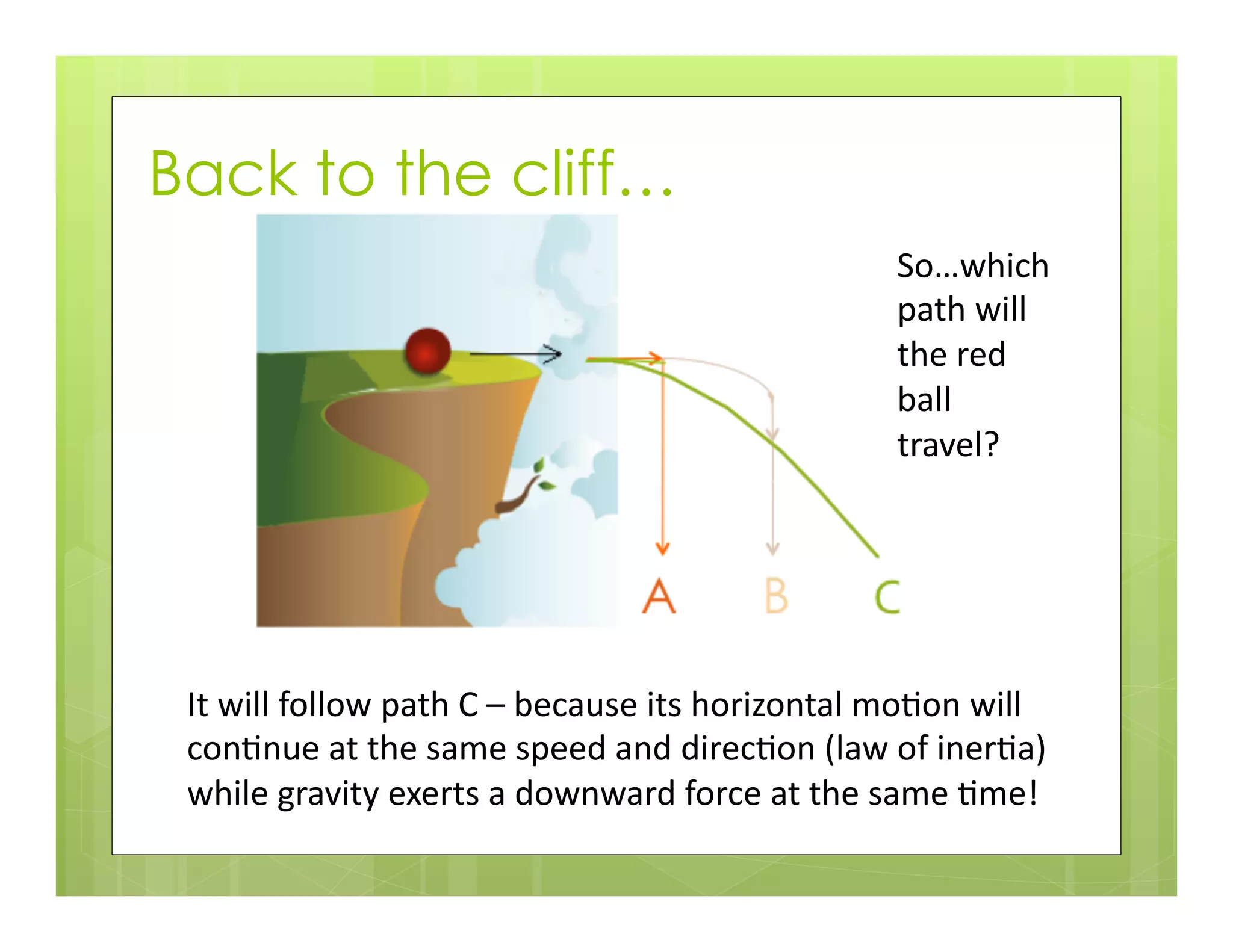
So…which	
  
path	
  will	
  
the	
  red	
  
ball	
  
travel?	
  
It	
  will	
  follow	
  path	
  C	
  –	
  because	
  its	
  horizontal	
  mo+on	
  will	
  
con+nue	
  at	
  the	
  same	
  speed	
  and	
  direc+on	
  (law	
  of	
  iner+a)	
  
while	
  gravity	
  exerts	
  a	
  downward	
  force	
  at	
  the	
  same	
  +me!	
  
Reflection
›  As	
  we	
  saw	
  with	
  the	
  ball	
  and	
  the	
  cliff	
  ques+on,	
  many	
  
people	
  –	
  even	
  highly	
  educated	
  people	
  –	
  have	
  
misconcep+ons	
  about	
  falling	
  objects	
  versus	
  objects	
  
with	
  a	
  high	
  horizontal	
  velocity.	


›  Ask	
  five	
  of	
  your	
  friends	
  or	
  family	
  members	
  which	
  
bullet	
  will	
  stay	
  in	
  the	
  air	
  longer:	
  one	
  shot	
  from	
  a	
  pistol	
  
or	
  one	
  dropped	
  from	
  pistol	
  height.	
  (Obviously,	
  don’t	
  
ask	
  students	
  in	
  this	
  class	
  or	
  physics	
  majors	
  J)	
  
Reflection
›  On	
  the	
  discussion	
  board	
  page,	
  join	
  the	
  discussion	
  
about	
  why	
  you	
  think	
  most	
  people	
  have	
  the	
  
misconcep+on	
  that	
  a	
  bullet	
  fired	
  from	
  a	
  gun	
  will	
  
“hang”	
  in	
  the	
  air.	
  What	
  is	
  it	
  about	
  a	
  bullet	
  from	
  a	
  gun	
  
(or	
  an	
  arrow	
  from	
  a	
  bow	
  and	
  arrow,	
  or	
  a	
  cannon	
  ball	
  
out	
  of	
  a	
  cannon,	
  etc.)	
  that	
  makes	
  it	
  so	
  hard	
  to	
  believe	
  
that	
  gravity	
  acts	
  on	
  it	
  exactly	
  the	
  same	
  way	
  gravity	
  
acts	
  on	
  an	
  object	
  with	
  no	
  horizontal	
  velocity	
  (ie,	
  one	
  
that	
  is	
  dropped)?	
  
›  Make	
  one	
  original	
  post	
  and	
  respond	
  to	
  at	
  least	
  two	
  
other	
  student’s	
  posts.	
  

Projectile Motion Part 1

  • 1.
    Projectile Motion …it’s as easyas rolling off a cliff…
  • 2.
    Prediction ›  Before  you  par+cipated  in  the  PhET  simula+on,   you  made  a  predic+on  and  explained  your   reasoning  to  me  via  email.  
  • 3.
    A Little History… A  few  years  ago,   researchers  went  to   elementary,  middle,   and  high  schools  as   well  as  universities  and   showed  students  this   image  and  asked   them,     Ignoring  air  resistance,  which  of  the  following  correctly   shows  what  an  object  would  do  if  it  rolled  off  a  cliff?”  
  • 4.
    The Results ›  The  breakdown  of  answers  they  got  was  almost  exactly   the  same  at  all  ages.   ›  About  60%  said  “A”  was  correct.  The  object  will  stop  in   midair,  and  then  start  to  fall  straight  down.  Because  some   people  referred  to  the  coyote  in  cartoons,  the  researchers   called  it  the  Wile  E.  Coyote  Effect.     ›  About  25%  said  “B”  was  correct.  The  object  will  move   forward  at  first,  but  will  eventually  just  fall  straight  down.   ›  About  15%  answered  “C”.  The  object  will  con+nue  to   move  forwards  the  en+re  +me  it  is  falling.    
  • 5.
    So What’s theCorrect Answer? ›  I’m  not  going  to  tell  you.  We’ll  revisit  the  ques+on   at  the  end  of  these  notes.  J  
  • 6.
    Observations  from  the  Simulation §  As  we  saw  with  the  simula+on,  the  projec+le  that  fell   straight  down  and  the  one  that  was  shot  from  a   cannon  horizontally  -­‐  hit  the  ground  in  the  same   amount  of  +me.   §  So  what  effect  did  horizontal  velocity  have  on  the  +me   it  took  (the  downward  mo+on  of)  the  projec+le  to  hit   the  ground?   §  None!   §  The  best  conclusion  we  can  make  from  this  is  that  the   horizontal  mo+on  of  a  projec+le  does  not  affect   downward  mo+on  of  the  projec+le.  
  • 7.
    Observations  from  the  lab   ›  Intui+on  will  tell  you  that  the  horizontally   launched  object  will  “hang”  in  the  air.   ›  But…   ›  YOUR  INTUITION  (at  least  in  this  case)  IS  WRONG!   ›  Here’s  a  video   ›  Here’s  another  video  
  • 8.
    Horizontal and VerticalMotion ›  The  most  important  thing  you  can  remember   about  projec+le  mo+on  is  this:   ›  Horizontal  and  Ver+cal  mo+on  are  completely,   100%  INDEPENDENT  of  each  other  –  even  when   they  are  happening  at  the  same  +me.   ›  Your  lab  ques+on  was,  “How  does  ini+al  velocity   affect  the  amount  of  +me  it  takes  a  horizontally-­‐ launched  object  to  reach  the  ground?”  
  • 9.
    Does Horizontal AffectVertical? ›  The  short  answer  to  the  lab  ques+on  is:   ›  It  Doesn’t!  The  horizontal  mo+on  of  the  projec+le  is   unaffected  by  the  downward  (ver+cal)  force  of   gravity.   ›  What  does  affect  how  long  it  takes  an  object  to  hit   the  ground  (ignoring  air  resistance)?   ›  One  thing  and  one  thing  only…   ›  The  height  it  is  launched  from!  
  • 10.
    Looking at velocityvectors ›  On  the  next  slide,  we’re  going  to  look  at  the  paths   two  projec+les  follow.  One  projec+le  is  shot  out  of   a  cannon,  the  other  is  dropped  at  exactly  the   same  moment.   ›  yes,  just  like  the  lab  J   ›  When  going  through  the  slide,  remember:   ›  velocity  is  a  vector  (has  magnitude  &  direc+on)   ›  gravity  is  a  constant  force   ›  constant  forces  cause  accelera+on  
  • 11.
    While  clicking   through  this   slide,  keep  in   mind  that  the   law  of  iner+a   tells  us  that   objects  in   mo+on  stay  in   mo+on  at  a   constant  speed   and  in  a  straight   line.  Since   horizontal   mo+on  is   independent  of   ver+cal  mo+on,   the  horizontal   vector  never   changes!   two  cannon  balls  –  one  is   given  a  horizontal  force,   the  other  is  just  dropped   gravity  acts   downward  on   both   horizontal   mo+on   con+nues   gravity  is  a   constant  force   that   accelerates  all   falling  objects   (ignoring  air   resistance)   gravity  acts  on  all   objects  equally  
  • 12.
    Back to thecliff… So…which   path  will   the  red   ball   travel?   It  will  follow  path  C  –  because  its  horizontal  mo+on  will   con+nue  at  the  same  speed  and  direc+on  (law  of  iner+a)   while  gravity  exerts  a  downward  force  at  the  same  +me!  
  • 13.
    Reflection ›  As  we  saw  with  the  ball  and  the  cliff  ques+on,  many   people  –  even  highly  educated  people  –  have   misconcep+ons  about  falling  objects  versus  objects   with  a  high  horizontal  velocity.     ›  Ask  five  of  your  friends  or  family  members  which   bullet  will  stay  in  the  air  longer:  one  shot  from  a  pistol   or  one  dropped  from  pistol  height.  (Obviously,  don’t   ask  students  in  this  class  or  physics  majors  J)  
  • 14.
    Reflection ›  On  the  discussion  board  page,  join  the  discussion   about  why  you  think  most  people  have  the   misconcep+on  that  a  bullet  fired  from  a  gun  will   “hang”  in  the  air.  What  is  it  about  a  bullet  from  a  gun   (or  an  arrow  from  a  bow  and  arrow,  or  a  cannon  ball   out  of  a  cannon,  etc.)  that  makes  it  so  hard  to  believe   that  gravity  acts  on  it  exactly  the  same  way  gravity   acts  on  an  object  with  no  horizontal  velocity  (ie,  one   that  is  dropped)?   ›  Make  one  original  post  and  respond  to  at  least  two   other  student’s  posts.