Standardization Activities on
Cloud Computing


                         Seungyun LEE, Ph.D
            Convenor of ISO/IEC JTC 1 SC38/SGCC
ISSUE #1

Understanding of
Cloud Computing


Standardization Activities on
Cloud Computing
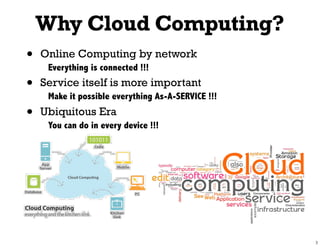
Why Cloud Computing?
•   Online Computing by network
     Everything is connected !!!
•   Service itself is more important
     Make it possible everything As-A-SERVICE !!!
•   Ubiquitous Era
     You can do in every device !!!
Cloud Computing
     Today
Do we need only 6 computers?
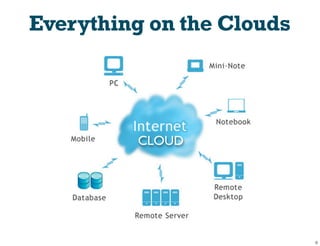
Everything on the Clouds


         CLOUD
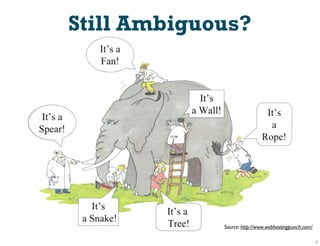
Still Ambiguous?


             Source: http://www.webhostingpunch.com/
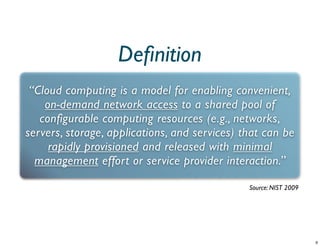
Definition
 “Cloud computing is a model for enabling convenient,
    on-demand network access to a shared pool of
   configurable computing resources (e.g., networks,
servers, storage, applications, and services) that can be
     rapidly provisioned and released with minimal
  management effort or service provider interaction.”

                                               Source: NIST 2009
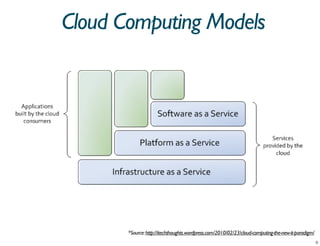
Cloud Computing Models


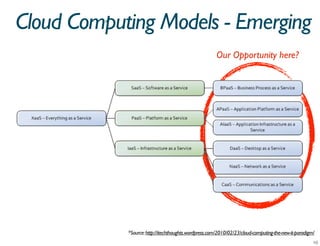
       *Source: http://itechthoughts.wordpress.com/2010/02/23/cloud-computing-the-new-it-paradigm/
Cloud Computing Models - Emerging
                                                       Our Opportunity here?


            *Source: http://itechthoughts.wordpress.com/2010/02/23/cloud-computing-the-new-it-paradigm/
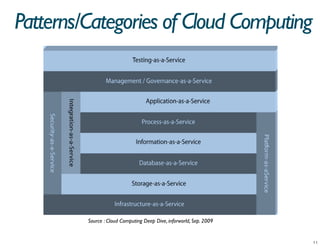
Patterns/Categories of Cloud Computing


         Source : Cloud Computing Deep Dive, inforworld, Sep. 2009
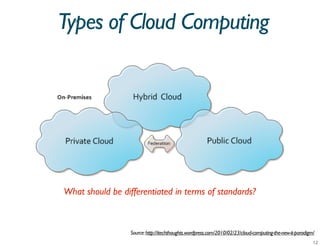
Types of Cloud Computing


What should be differentiated in terms of standards?


                  Source: http://itechthoughts.wordpress.com/2010/02/23/cloud-computing-the-new-it-paradigm/
ISSUE #2

Issues on
Cloud Computing


Standardization Activities on
Cloud Computing
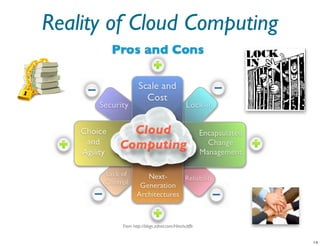
Reality of Cloud Computing
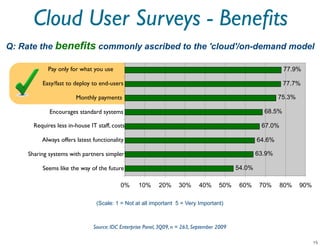
Cloud User Surveys - Benefits
Q: Rate the benefits commonly ascribed to the 'cloud'/on-demand model

            Pay only for what you use                                                                         77.9%

         Easy/fast to deploy to end-users                                                                     77.7%

                       Monthly payments                                                                     75.3%

            Encourages standard systems                                                               68.5%

      Requires less in-house IT staff, costs                                                         67.0%

         Always offers latest functionality                                                         64.6%

    Sharing systems with partners simpler                                                           63.9%

         Seems like the way of the future                                                   54.0%

                                          0%      10%      20%     30%      40%      50%     60%     70%     80%    90%

                                (Scale: 1 = Not at all important 5 = Very Important)


                              Source: IDC Enterprise Panel, 3Q09, n = 263, September 2009
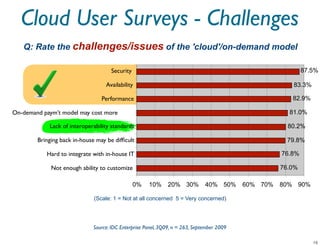
Cloud User Surveys - Challenges
   Q: Rate the challenges/issues of the 'cloud'/on-demand model

                                    Security                                                                 87.5%

                                  Availability                                                          83.3%

                                 Performance                                                            82.9%

On-demand paym’t model may cost more                                                                   81.0%

            Lack of interoperability standards                                                         80.2%

        Bringing back in-house may be difficult                                                        79.8%

           Hard to integrate with in-house IT                                                        76.8%

             Not enough ability to customize                                                         76.0%

                                               0%    10%      20% 30%         40% 50%      60% 70%   80% 90%

                              (Scale: 1 = Not at all concerned 5 = Very concerned)


                             Source: IDC Enterprise Panel, 3Q09, n = 263, September 2009
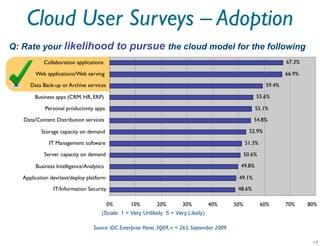
Cloud User Surveys – Adoption
Q: Rate your likelihood                        to pursue the cloud model for the following
            Collaboration applications                                                                                  67.3%

        Web applications/Web serving                                                                                    66.9%

      Data Back-up or Archive services                                                                          59.4%

        Business apps (CRM, HR, ERP)                                                                      55.6%

            Personal productivity apps                                                                    55.1%

   Data/Content Distribution services                                                                    54.8%

           Storage capacity on demand                                                                   52.9%

              IT Management software                                                                  51.3%

            Server capacity on demand                                                                 50.6%

        Business Intelligence/Analytics                                                           49.8%

   Application dev/test/deploy platform                                                          49.1%
                IT/Information Security                                                          48.6%

                                          0%      10%         20%        30%        40%         50%           60%       70%     80%
                                      (Scale: 1 = Very Unlikely 5 = Very Likely)

                                  Source: IDC Enterprise Panel, 3Q09, n = 263, September 2009
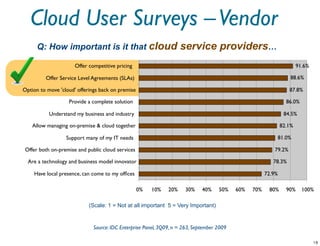
Cloud User Surveys – Vendor
      Q: How important is it that cloud                              service providers…
                      Offer competitive pricing                                                                         91.6%

         Offer Service Level Agreements (SLAs)                                                                      88.6%

Option to move 'cloud' offerings back on premise                                                                   87.8%

                   Provide a complete solution                                                                    86.0%

           Understand my business and industry                                                                   84.5%

    Allow managing on-premise & cloud together                                                                  82.1%

                  Support many of my IT needs                                                               81.0%

Offer both on-premise and public cloud services                                                            79.2%

  Are a technology and business model innovator                                                            78.3%

    Have local presence, can come to my offices                                                          72.9%

                                                   0%   10%    20%    30%     40%    50%    60%   70%    80%      90%     100%

                            (Scale: 1 = Not at all important 5 = Very Important)


                              Source: IDC Enterprise Panel, 3Q09, n = 263, September 2009
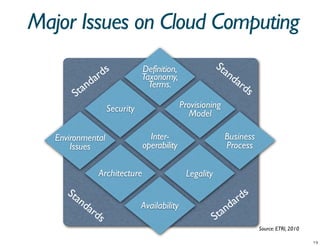
Major Issues on Cloud Computing
                                                         St
                ds            Definition,                     an
              ar              Taxonomy,                          da
          tand                  Terms.                             rd
                                                                     s
        S
                   Security                  Provisioning
                                               Model

   Environmental                Inter-                        Business
       Issues                 operability                     Process

               Architecture                   Legality
      St                                                         ds
        an                                                     ar
           da                 Availability                   nd
             rd                                            ta
               s                                         S
                                                                         Source: ETRI, 2010
ISSUE #3

Standardization
Activities


Standardization Activities on
Cloud Computing
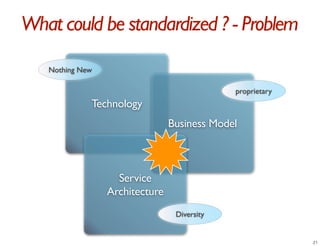
What could be standardized ? - Problem

   Nothing New

                                             proprietary
             Technology
                                Business Model


                   Service
                 Architecture
                                 Diversity
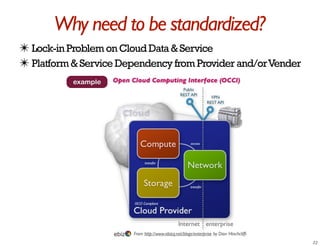
Why need to be standardized?
✴ Lock-in Problem on Cloud Data & Service
✴ Platform & Service Dependency from Provider and/or Vender
           example
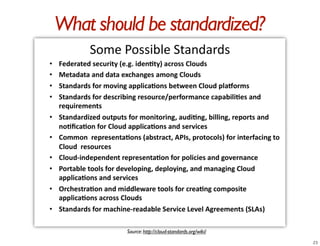
What should be standardized?


         Source: http://cloud-standards.org/wiki/
JTC1
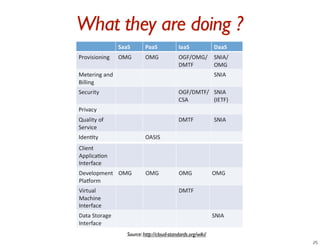
What they are doing ?


      Source: http://cloud-standards.org/wiki/
JTC1

     ISO/IEC JTC 1 SC38 / SGCC
Title:	

 Distributed Application Platforms and Services (DAPS)
Scope:	

Standardization for interoperable Distributed Application
Platform and services including:
•	

 Web Services, Service Oriented Architecture (SOA), and
•	

 Cloud Computing.

As per the JTC 1 Directives, SC 38 establishes its own substructure at
its first meeting in Beijing China, May 2010
 •   Web Service WG
 •   Service Oriented Architecture (SOA) WG
 •   Cloud Computing SG
JTC1

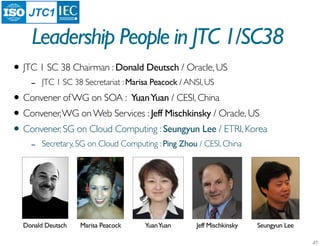
    Leadership People in JTC 1/SC38
• JTC 1 SC 38 Chairman : Donald Deutsch / Oracle, US
    -   JTC 1 SC 38 Secretariat : Marisa Peacock / ANSI, US

• Convener of WG on SOA : Yuan Yuan / CESI, China
• Convener, WG on Web Services : Jeff Mischkinsky / Oracle, US
• Convener, SG on Cloud Computing : Seungyun Lee / ETRI, Korea
    -   Secretary, SG on Cloud Computing : Ping Zhou / CESI, China


  Donald Deutsch   Marisa Peacock     Yuan Yuan      Jeff Mischkinsky   Seungyun Lee
JTC1

           ISO/IEC JTC 1 SC38 / SGCC
Terms of References for SGCC
 i. Provide a taxonomy, terminology and value proposition for Cloud Computing.
 ii. Assess the current state of standardization in Cloud Computing within JTC 1
     and in other SDOs and consortia beginning with document JTC 1 N 9687*.
 iii. Document standardization market/business/user requirements and the
      challenges to be addressed.
 iv. Liaise and collaborate with relevant SDOs and consortia related to Cloud
     Computing.
 v. Hold open meetings to gather requirements as needed from a wide range of
    interested organizations.
 vi. Provide a report of activities and recommendations to SC 38.
  *N9687: Report of JTC 1/SWG-Planning on possible future work on Cloud Computing in JTC 1 (2009)


                                                                                 Source: Resolution of ISO/IEC JTC 1 SC 38 Plenary
JTC1

         ISO/IEC JTC 1 SC38 / SGCC
Meeting Results & Plan
 •   1st JTC 1 SC38 meeting (12~14th May 2010, Beijing) *done
        •   Approval of SGCC as well as convenor & secretary
        •   Discussion for SGCC Report document
 •   2nd JTC 1 SC38 meeting (27th Sep. ~ 1st Oct 2010, NY)
        •   1st Draft of SGCC report (investigate current activity &
            recommendations)
 •   JTC 1 Plenary (Nov. 2010, Belfast Ireland)
        •   Decide how to handle the SGCC for future
ITU-T Focus Group Cloud
Terms of References for FG Cloud
• Scope
 i. identify potential impacts on standards development and priorities for standards
    needed to promote and facilitate telecommunication/ICT support for cloud
    computing
 ii. investigate the need for future study items for fixed and mobile networks in the
    scope of ITU-T
 iii. analyze which components would benefit most from interoperability and
    standardization
 iv. familiarize ITU-T and standardization communities with emerging attributes and
    challenges of telecommunication/ICT support for cloud computing
 v. analyze the rate of change for cloud computing attributes, functions and features
    for the purpose of assessing the appropriate timing of standardization of
    telecommunication/ICT in support of cloud computing

                                                 Source: http://www.itu.int/ITU-T/focusgroups/cloud/tor.html
ITU-T Focus Group Cloud
Terms of References for FG Cloud (con’t)
• FG Objective
    The objective of the Focus Group is to collect and document information and
    concepts that would be helpful for developing Recommendations to support cloud
    computing services/applications from a telecommunication/ICT perspective.
•   Specific tasks and deliverables
    - Benefits of cloud computing from telecommunication/ICT perspectives
    - Gap analysis of ITU-T standards for telecommunication/ICT to support cloud
        computing
    -   Collect and summarize vision and value propositions of cloud computing with a
        focus on telecommunication/ICT aspects
    -   Leverage expertise within the ITU-T in building telecom networks to take
        advantage of cloud concepts and capabilities
    -   Terminology and taxonomy and to develop new definition when necessary
    -   Analysis of telecommunication/ICT networking requirements functions and
        capabilities to support cloud computing services/applications (for both fixed and
        mobile)
    -   Use cases of services and reference models for telecommunication/ICT to support
        cloud computing
    -   Roadmap to guide further developments of relevant ITU-T Recommendations.
                                                    Source: http://www.itu.int/ITU-T/focusgroups/cloud/tor.html
ITU-T Focus Group Cloud
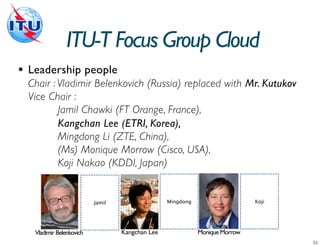
•   Leadership people
    Chair : Vladimir Belenkovich (Russia) replaced with Mr. Kutukov
    Vice Chair :
            Jamil Chawki (FT Orange, France),
            Kangchan Lee (ETRI, Korea),
            Mingdong Li (ZTE, China),
            (Ms) Monique Morrow (Cisco, USA),
            Koji Nakao (KDDI, Japan)


                            Jamil                  Mingdong                    Koji


     Vladimir Belenkovich           Kangchan Lee              Monique Morrow
ITU-T Focus Group Cloud
Meeting Results & Plan
 •   1st FG Cloud meeting (14~17th June 2010, Geneva) *done
        •   Draft deliverables: Draft deliverable on Introduction to the cloud
            ecosystem: Definitions, taxonomies, and use cases
        •   Liaison documents to SDOs, CSA, ISO/IEC JTC 1 SC38
        •   Updates for “Repository on activities in Cloud Computing
            Standardization (Version 1.1, June 2010)”
 •   2nd FG Cloud meeting (2~6th September 2010, Geneva)
        •   Updates for FG Cloud deliverables ITU-T FG Cloud
ITU-T SG13 Q.23 | new Question
•   Questions
    -   What new Recommendations should be developed for Cloud Computing with
        telecommunication perspectives?
    -   Coordination of the Cloud Computing in cooperation with ITU-T SGs and with
        other SDOs e.g., the ISO/IEC JTC 1.
•    Tasks
    - Identify issues that are interesting in SG13 such as definition and value
       proposition of Cloud Computing and development of related new
       Recommendations
    - Identify classification of Cloud based service such as Fixed Cloud, Personal
       Cloud, Mobile Cloud, etc. and development of related new Recommendations
    - Coordination on Cloud Computing issues with Questions in ITU-T SG13
    - Collaboration with ITU-T Focus Group on Cloud Computing (FG Cloud)
•    Leadership
    - Dr. Kangchan Lee, ETRI Korea
ISSUE #4


Conclusion Remarks


Standardization Activities on
Cloud Computing
We must know what happen outside first !
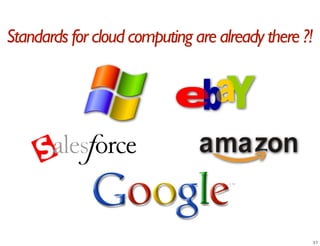
Standards for cloud computing are already there ?!
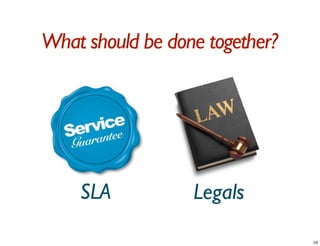
What should be done together?


    SLA           Legals
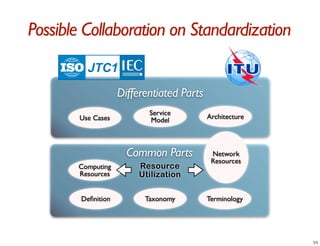
Possible Collaboration on Standardization
          JTC1
                    Differentiated Parts
                           Service
        Use Cases          Model           Architecture


                      Common Parts          Network
                                            Resources
       Computing         Resource
       Resources         Utilization

        Definition         Taxonomy         Terminology
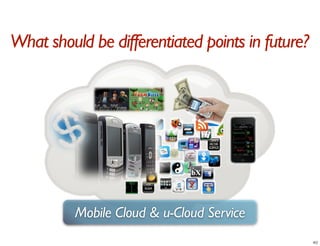
What should be differentiated points in future?


          Mobile Cloud & u-Cloud Service
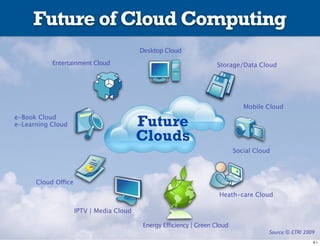
Future of Cloud Computing
                                          Desktop Cloud
           Entertainment Cloud                                      Storage/Data Cloud


                                                                               Mobile Cloud
e-Book Cloud
e-Learning Cloud                          Future
                                          Clouds
                                                                            Social Cloud


      Cloud Office
                                                                     Heath-care Cloud

                     IPTV | Media Cloud

                                          Energy Efficiency | Green Cloud
                                                                                       Source: © ETRI 2009
Thank You
Seungyun Lee / Ph.D.
Leader of Service Convergence Standards Research Team,
Standards Research Center, ETRI
Convener of ISO/IEC JTC 1 SC38 / SGCC | Study Group on Cloud Computing
Manager of W3C Korea Office
Office. +82-42-860-5508, Mobile. +82-10-8720-2954
syl@etri.re.kr, syl@w3.org, bluse2@gmail.com
twitter @seungyun

Standardization Activities on Cloud Computing

  • 1.
    Standardization Activities on CloudComputing Seungyun LEE, Ph.D Convenor of ISO/IEC JTC 1 SC38/SGCC
  • 2.
    ISSUE #1 Understanding of CloudComputing Standardization Activities on Cloud Computing
  • 3.
    Why Cloud Computing? • Online Computing by network Everything is connected !!! • Service itself is more important Make it possible everything As-A-SERVICE !!! • Ubiquitous Era You can do in every device !!!
  • 4.
  • 5.
    Do we needonly 6 computers?
  • 6.
    Everything on theClouds CLOUD
  • 7.
    Still Ambiguous? Source: http://www.webhostingpunch.com/
  • 8.
    Definition “Cloud computingis a model for enabling convenient, on-demand network access to a shared pool of configurable computing resources (e.g., networks, servers, storage, applications, and services) that can be rapidly provisioned and released with minimal management effort or service provider interaction.” Source: NIST 2009
  • 9.
    Cloud Computing Models *Source: http://itechthoughts.wordpress.com/2010/02/23/cloud-computing-the-new-it-paradigm/
  • 10.
    Cloud Computing Models- Emerging Our Opportunity here? *Source: http://itechthoughts.wordpress.com/2010/02/23/cloud-computing-the-new-it-paradigm/
  • 11.
    Patterns/Categories of CloudComputing Source : Cloud Computing Deep Dive, inforworld, Sep. 2009
  • 12.
    Types of CloudComputing What should be differentiated in terms of standards? Source: http://itechthoughts.wordpress.com/2010/02/23/cloud-computing-the-new-it-paradigm/
  • 13.
    ISSUE #2 Issues on CloudComputing Standardization Activities on Cloud Computing
  • 14.
  • 15.
    Cloud User Surveys- Benefits Q: Rate the benefits commonly ascribed to the 'cloud'/on-demand model Pay only for what you use 77.9% Easy/fast to deploy to end-users 77.7% Monthly payments 75.3% Encourages standard systems 68.5% Requires less in-house IT staff, costs 67.0% Always offers latest functionality 64.6% Sharing systems with partners simpler 63.9% Seems like the way of the future 54.0% 0% 10% 20% 30% 40% 50% 60% 70% 80% 90% (Scale: 1 = Not at all important 5 = Very Important) Source: IDC Enterprise Panel, 3Q09, n = 263, September 2009
  • 16.
    Cloud User Surveys- Challenges Q: Rate the challenges/issues of the 'cloud'/on-demand model Security 87.5% Availability 83.3% Performance 82.9% On-demand paym’t model may cost more 81.0% Lack of interoperability standards 80.2% Bringing back in-house may be difficult 79.8% Hard to integrate with in-house IT 76.8% Not enough ability to customize 76.0% 0% 10% 20% 30% 40% 50% 60% 70% 80% 90% (Scale: 1 = Not at all concerned 5 = Very concerned) Source: IDC Enterprise Panel, 3Q09, n = 263, September 2009
  • 17.
    Cloud User Surveys– Adoption Q: Rate your likelihood to pursue the cloud model for the following Collaboration applications 67.3% Web applications/Web serving 66.9% Data Back-up or Archive services 59.4% Business apps (CRM, HR, ERP) 55.6% Personal productivity apps 55.1% Data/Content Distribution services 54.8% Storage capacity on demand 52.9% IT Management software 51.3% Server capacity on demand 50.6% Business Intelligence/Analytics 49.8% Application dev/test/deploy platform 49.1% IT/Information Security 48.6% 0% 10% 20% 30% 40% 50% 60% 70% 80% (Scale: 1 = Very Unlikely 5 = Very Likely) Source: IDC Enterprise Panel, 3Q09, n = 263, September 2009
  • 18.
    Cloud User Surveys– Vendor Q: How important is it that cloud service providers… Offer competitive pricing 91.6% Offer Service Level Agreements (SLAs) 88.6% Option to move 'cloud' offerings back on premise 87.8% Provide a complete solution 86.0% Understand my business and industry 84.5% Allow managing on-premise & cloud together 82.1% Support many of my IT needs 81.0% Offer both on-premise and public cloud services 79.2% Are a technology and business model innovator 78.3% Have local presence, can come to my offices 72.9% 0% 10% 20% 30% 40% 50% 60% 70% 80% 90% 100% (Scale: 1 = Not at all important 5 = Very Important) Source: IDC Enterprise Panel, 3Q09, n = 263, September 2009
  • 19.
    Major Issues onCloud Computing St ds Definition, an ar Taxonomy, da tand Terms. rd s S Security Provisioning Model Environmental Inter- Business Issues operability Process Architecture Legality St ds an ar da Availability nd rd ta s S Source: ETRI, 2010
  • 20.
  • 21.
    What could bestandardized ? - Problem Nothing New proprietary Technology Business Model Service Architecture Diversity
  • 22.
    Why need tobe standardized? ✴ Lock-in Problem on Cloud Data & Service ✴ Platform & Service Dependency from Provider and/or Vender example
  • 23.
    What should bestandardized? Source: http://cloud-standards.org/wiki/
  • 24.
  • 25.
    What they aredoing ? Source: http://cloud-standards.org/wiki/
  • 26.
    JTC1 ISO/IEC JTC 1 SC38 / SGCC Title: Distributed Application Platforms and Services (DAPS) Scope: Standardization for interoperable Distributed Application Platform and services including: • Web Services, Service Oriented Architecture (SOA), and • Cloud Computing. As per the JTC 1 Directives, SC 38 establishes its own substructure at its first meeting in Beijing China, May 2010 • Web Service WG • Service Oriented Architecture (SOA) WG • Cloud Computing SG
  • 27.
    JTC1 Leadership People in JTC 1/SC38 • JTC 1 SC 38 Chairman : Donald Deutsch / Oracle, US - JTC 1 SC 38 Secretariat : Marisa Peacock / ANSI, US • Convener of WG on SOA : Yuan Yuan / CESI, China • Convener, WG on Web Services : Jeff Mischkinsky / Oracle, US • Convener, SG on Cloud Computing : Seungyun Lee / ETRI, Korea - Secretary, SG on Cloud Computing : Ping Zhou / CESI, China Donald Deutsch Marisa Peacock Yuan Yuan Jeff Mischkinsky Seungyun Lee
  • 28.
    JTC1 ISO/IEC JTC 1 SC38 / SGCC Terms of References for SGCC i. Provide a taxonomy, terminology and value proposition for Cloud Computing. ii. Assess the current state of standardization in Cloud Computing within JTC 1 and in other SDOs and consortia beginning with document JTC 1 N 9687*. iii. Document standardization market/business/user requirements and the challenges to be addressed. iv. Liaise and collaborate with relevant SDOs and consortia related to Cloud Computing. v. Hold open meetings to gather requirements as needed from a wide range of interested organizations. vi. Provide a report of activities and recommendations to SC 38. *N9687: Report of JTC 1/SWG-Planning on possible future work on Cloud Computing in JTC 1 (2009) Source: Resolution of ISO/IEC JTC 1 SC 38 Plenary
  • 29.
    JTC1 ISO/IEC JTC 1 SC38 / SGCC Meeting Results & Plan • 1st JTC 1 SC38 meeting (12~14th May 2010, Beijing) *done • Approval of SGCC as well as convenor & secretary • Discussion for SGCC Report document • 2nd JTC 1 SC38 meeting (27th Sep. ~ 1st Oct 2010, NY) • 1st Draft of SGCC report (investigate current activity & recommendations) • JTC 1 Plenary (Nov. 2010, Belfast Ireland) • Decide how to handle the SGCC for future
  • 30.
    ITU-T Focus GroupCloud Terms of References for FG Cloud • Scope i. identify potential impacts on standards development and priorities for standards needed to promote and facilitate telecommunication/ICT support for cloud computing ii. investigate the need for future study items for fixed and mobile networks in the scope of ITU-T iii. analyze which components would benefit most from interoperability and standardization iv. familiarize ITU-T and standardization communities with emerging attributes and challenges of telecommunication/ICT support for cloud computing v. analyze the rate of change for cloud computing attributes, functions and features for the purpose of assessing the appropriate timing of standardization of telecommunication/ICT in support of cloud computing Source: http://www.itu.int/ITU-T/focusgroups/cloud/tor.html
  • 31.
    ITU-T Focus GroupCloud Terms of References for FG Cloud (con’t) • FG Objective The objective of the Focus Group is to collect and document information and concepts that would be helpful for developing Recommendations to support cloud computing services/applications from a telecommunication/ICT perspective. • Specific tasks and deliverables - Benefits of cloud computing from telecommunication/ICT perspectives - Gap analysis of ITU-T standards for telecommunication/ICT to support cloud computing - Collect and summarize vision and value propositions of cloud computing with a focus on telecommunication/ICT aspects - Leverage expertise within the ITU-T in building telecom networks to take advantage of cloud concepts and capabilities - Terminology and taxonomy and to develop new definition when necessary - Analysis of telecommunication/ICT networking requirements functions and capabilities to support cloud computing services/applications (for both fixed and mobile) - Use cases of services and reference models for telecommunication/ICT to support cloud computing - Roadmap to guide further developments of relevant ITU-T Recommendations. Source: http://www.itu.int/ITU-T/focusgroups/cloud/tor.html
  • 32.
    ITU-T Focus GroupCloud • Leadership people Chair : Vladimir Belenkovich (Russia) replaced with Mr. Kutukov Vice Chair : Jamil Chawki (FT Orange, France), Kangchan Lee (ETRI, Korea), Mingdong Li (ZTE, China), (Ms) Monique Morrow (Cisco, USA), Koji Nakao (KDDI, Japan) Jamil Mingdong Koji Vladimir Belenkovich Kangchan Lee Monique Morrow
  • 33.
    ITU-T Focus GroupCloud Meeting Results & Plan • 1st FG Cloud meeting (14~17th June 2010, Geneva) *done • Draft deliverables: Draft deliverable on Introduction to the cloud ecosystem: Definitions, taxonomies, and use cases • Liaison documents to SDOs, CSA, ISO/IEC JTC 1 SC38 • Updates for “Repository on activities in Cloud Computing Standardization (Version 1.1, June 2010)” • 2nd FG Cloud meeting (2~6th September 2010, Geneva) • Updates for FG Cloud deliverables ITU-T FG Cloud
  • 34.
    ITU-T SG13 Q.23| new Question • Questions - What new Recommendations should be developed for Cloud Computing with telecommunication perspectives? - Coordination of the Cloud Computing in cooperation with ITU-T SGs and with other SDOs e.g., the ISO/IEC JTC 1. • Tasks - Identify issues that are interesting in SG13 such as definition and value proposition of Cloud Computing and development of related new Recommendations - Identify classification of Cloud based service such as Fixed Cloud, Personal Cloud, Mobile Cloud, etc. and development of related new Recommendations - Coordination on Cloud Computing issues with Questions in ITU-T SG13 - Collaboration with ITU-T Focus Group on Cloud Computing (FG Cloud) • Leadership - Dr. Kangchan Lee, ETRI Korea
  • 35.
    ISSUE #4 Conclusion Remarks StandardizationActivities on Cloud Computing
  • 36.
    We must knowwhat happen outside first !
  • 37.
    Standards for cloudcomputing are already there ?!
  • 38.
    What should bedone together? SLA Legals
  • 39.
    Possible Collaboration onStandardization JTC1 Differentiated Parts Service Use Cases Model Architecture Common Parts Network Resources Computing Resource Resources Utilization Definition Taxonomy Terminology
  • 40.
    What should bedifferentiated points in future? Mobile Cloud & u-Cloud Service
  • 41.
    Future of CloudComputing Desktop Cloud Entertainment Cloud Storage/Data Cloud Mobile Cloud e-Book Cloud e-Learning Cloud Future Clouds Social Cloud Cloud Office Heath-care Cloud IPTV | Media Cloud Energy Efficiency | Green Cloud Source: © ETRI 2009
  • 42.
    Thank You Seungyun Lee/ Ph.D. Leader of Service Convergence Standards Research Team, Standards Research Center, ETRI Convener of ISO/IEC JTC 1 SC38 / SGCC | Study Group on Cloud Computing Manager of W3C Korea Office Office. +82-42-860-5508, Mobile. +82-10-8720-2954 syl@etri.re.kr, syl@w3.org, bluse2@gmail.com twitter @seungyun