Standard Form Of A Linear Programming
Problem, Geometry Of Linear
Programming Problems
Introduction to Linear Programming
Linear programming is a method for
optimizing a linear objective function
subject to linear constraints.
It is widely used in various fields such as
economics, engineering, and military
applications.
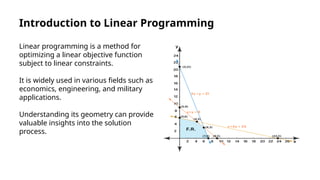
Understanding its geometry can provide
valuable insights into the solution
process.
Definition of Linear Programming
Linear programming involves
maximizing or minimizing a linear
objective function.
The function is subject to a set of linear
inequalities or equations known as
constraints.
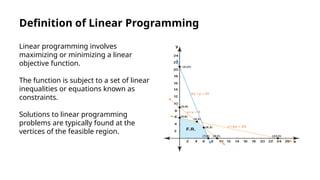
Solutions to linear programming
problems are typically found at the
vertices of the feasible region.
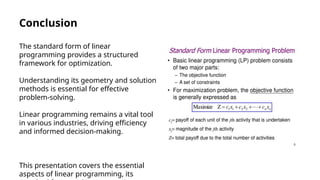
Standard Form Definition
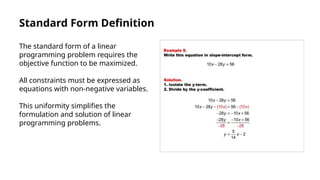
The standard form of a linear
programming problem requires the
objective function to be maximized.
All constraints must be expressed as
equations with non-negative variables.
This uniformity simplifies the
formulation and solution of linear
programming problems.
Standard Form Structure
A standard form linear programming
problem can be expressed as follows:
maximize ( c^T x ).
Subject to the constraints ( Ax = b )
and ( x geq 0 ).
Here, ( c ) is the coefficient vector, ( x )
is the variable vector, and ( A ) and 
( b ) represent the constraints.
Objective Function in Standard Form
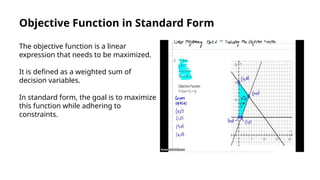
The objective function is a linear
expression that needs to be maximized.
It is defined as a weighted sum of
decision variables.
In standard form, the goal is to maximize
this function while adhering to
constraints.
Constraints in Standard Form
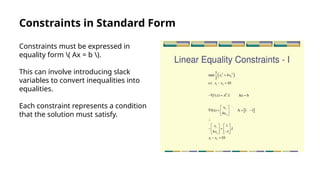
Constraints must be expressed in
equality form ( Ax = b ).
This can involve introducing slack
variables to convert inequalities into
equalities.
Each constraint represents a condition
that the solution must satisfy.
Non-Negativity Constraints
Non-negativity constraints ensure that
the decision variables cannot take
negative values.
This is crucial for many practical
problems where negative solutions are
infeasible.
The non-negativity condition is included
in the standard form as ( x geq 0 ).
Feasible Region
The feasible region is the set of all
possible points that satisfy the
constraints.
It is typically bounded by the constraints
in the form of lines or planes in
geometric space.
The feasible region may be empty if no
solutions satisfy all constraints.
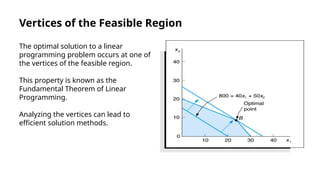
Vertices of the Feasible Region
The optimal solution to a linear
programming problem occurs at one of
the vertices of the feasible region.
This property is known as the
Fundamental Theorem of Linear
Programming.
Analyzing the vertices can lead to
efficient solution methods.
Geometry of Linear Programming
The geometry of linear programming
involves understanding the shapes
formed by constraints.
Each constraint corresponds to a line (or
plane) in geometric space that divides
the space into feasible and infeasible
areas.
Visualizing these shapes aids in
comprehending the problem structure
and potential solutions.
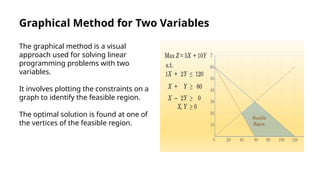
Graphical Method for Two Variables
The graphical method is a visual
approach used for solving linear
programming problems with two
variables.
It involves plotting the constraints on a
graph to identify the feasible region.
The optimal solution is found at one of
the vertices of the feasible region.
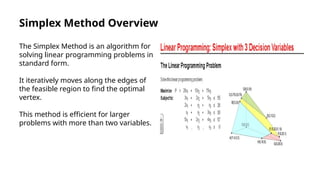
Simplex Method Overview
The Simplex Method is an algorithm for
solving linear programming problems in
standard form.
It iteratively moves along the edges of
the feasible region to find the optimal
vertex.
This method is efficient for larger
problems with more than two variables.
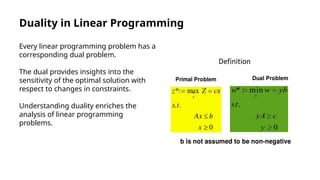
Duality in Linear Programming
Every linear programming problem has a
corresponding dual problem.
The dual provides insights into the
sensitivity of the optimal solution with
respect to changes in constraints.
Understanding duality enriches the
analysis of linear programming
problems.
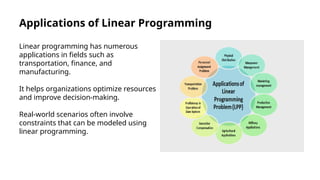
Applications of Linear Programming
Linear programming has numerous
applications in fields such as
transportation, finance, and
manufacturing.
It helps organizations optimize resources
and improve decision-making.
Real-world scenarios often involve
constraints that can be modeled using
linear programming.
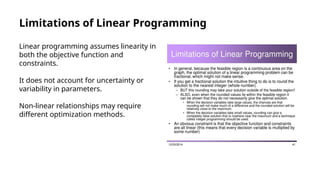
Limitations of Linear Programming
Linear programming assumes linearity in
both the objective function and
constraints.
It does not account for uncertainty or
variability in parameters.
Non-linear relationships may require
different optimization methods.
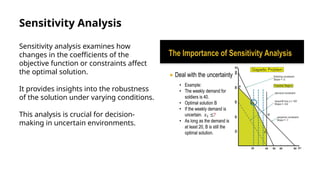
Sensitivity Analysis
Sensitivity analysis examines how
changes in the coefficients of the
objective function or constraints affect
the optimal solution.
It provides insights into the robustness
of the solution under varying conditions.
This analysis is crucial for decision-
making in uncertain environments.
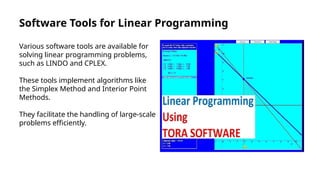
Software Tools for Linear Programming
Various software tools are available for
solving linear programming problems,
such as LINDO and CPLEX.
These tools implement algorithms like
the Simplex Method and Interior Point
Methods.
They facilitate the handling of large-scale
problems efficiently.
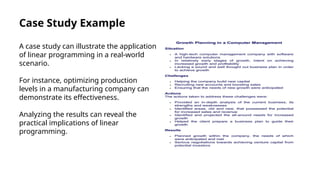
Case Study Example
A case study can illustrate the application
of linear programming in a real-world
scenario.
For instance, optimizing production
levels in a manufacturing company can
demonstrate its effectiveness.
Analyzing the results can reveal the
practical implications of linear
programming.
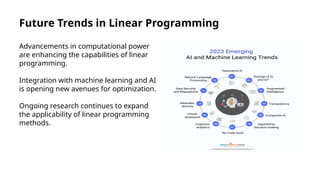
Future Trends in Linear Programming
Advancements in computational power
are enhancing the capabilities of linear
programming.
Integration with machine learning and AI
is opening new avenues for optimization.
Ongoing research continues to expand
the applicability of linear programming
methods.
Conclusion
The standard form of linear
programming provides a structured
framework for optimization.
Understanding its geometry and solution
methods is essential for effective
problem-solving.
Linear programming remains a vital tool
in various industries, driving efficiency
and informed decision-making.
This presentation covers the essential
aspects of linear programming, its

Standard Form Of A Linear Programming Problem, Geometry Of Linear Programming Problems.pptx

  • 1.
    Standard Form OfA Linear Programming Problem, Geometry Of Linear Programming Problems
  • 2.
    Introduction to LinearProgramming Linear programming is a method for optimizing a linear objective function subject to linear constraints. It is widely used in various fields such as economics, engineering, and military applications. Understanding its geometry can provide valuable insights into the solution process.
  • 3.
    Definition of LinearProgramming Linear programming involves maximizing or minimizing a linear objective function. The function is subject to a set of linear inequalities or equations known as constraints. Solutions to linear programming problems are typically found at the vertices of the feasible region.
  • 4.
    Standard Form Definition Thestandard form of a linear programming problem requires the objective function to be maximized. All constraints must be expressed as equations with non-negative variables. This uniformity simplifies the formulation and solution of linear programming problems.
  • 5.
    Standard Form Structure Astandard form linear programming problem can be expressed as follows: maximize ( c^T x ). Subject to the constraints ( Ax = b ) and ( x geq 0 ). Here, ( c ) is the coefficient vector, ( x ) is the variable vector, and ( A ) and ( b ) represent the constraints.
  • 6.
    Objective Function inStandard Form The objective function is a linear expression that needs to be maximized. It is defined as a weighted sum of decision variables. In standard form, the goal is to maximize this function while adhering to constraints.
  • 7.
    Constraints in StandardForm Constraints must be expressed in equality form ( Ax = b ). This can involve introducing slack variables to convert inequalities into equalities. Each constraint represents a condition that the solution must satisfy.
  • 8.
    Non-Negativity Constraints Non-negativity constraintsensure that the decision variables cannot take negative values. This is crucial for many practical problems where negative solutions are infeasible. The non-negativity condition is included in the standard form as ( x geq 0 ).
  • 9.
    Feasible Region The feasibleregion is the set of all possible points that satisfy the constraints. It is typically bounded by the constraints in the form of lines or planes in geometric space. The feasible region may be empty if no solutions satisfy all constraints.
  • 10.
    Vertices of theFeasible Region The optimal solution to a linear programming problem occurs at one of the vertices of the feasible region. This property is known as the Fundamental Theorem of Linear Programming. Analyzing the vertices can lead to efficient solution methods.
  • 11.
    Geometry of LinearProgramming The geometry of linear programming involves understanding the shapes formed by constraints. Each constraint corresponds to a line (or plane) in geometric space that divides the space into feasible and infeasible areas. Visualizing these shapes aids in comprehending the problem structure and potential solutions.
  • 12.
    Graphical Method forTwo Variables The graphical method is a visual approach used for solving linear programming problems with two variables. It involves plotting the constraints on a graph to identify the feasible region. The optimal solution is found at one of the vertices of the feasible region.
  • 13.
    Simplex Method Overview TheSimplex Method is an algorithm for solving linear programming problems in standard form. It iteratively moves along the edges of the feasible region to find the optimal vertex. This method is efficient for larger problems with more than two variables.
  • 14.
    Duality in LinearProgramming Every linear programming problem has a corresponding dual problem. The dual provides insights into the sensitivity of the optimal solution with respect to changes in constraints. Understanding duality enriches the analysis of linear programming problems.
  • 15.
    Applications of LinearProgramming Linear programming has numerous applications in fields such as transportation, finance, and manufacturing. It helps organizations optimize resources and improve decision-making. Real-world scenarios often involve constraints that can be modeled using linear programming.
  • 16.
    Limitations of LinearProgramming Linear programming assumes linearity in both the objective function and constraints. It does not account for uncertainty or variability in parameters. Non-linear relationships may require different optimization methods.
  • 17.
    Sensitivity Analysis Sensitivity analysisexamines how changes in the coefficients of the objective function or constraints affect the optimal solution. It provides insights into the robustness of the solution under varying conditions. This analysis is crucial for decision- making in uncertain environments.
  • 18.
    Software Tools forLinear Programming Various software tools are available for solving linear programming problems, such as LINDO and CPLEX. These tools implement algorithms like the Simplex Method and Interior Point Methods. They facilitate the handling of large-scale problems efficiently.
  • 19.
    Case Study Example Acase study can illustrate the application of linear programming in a real-world scenario. For instance, optimizing production levels in a manufacturing company can demonstrate its effectiveness. Analyzing the results can reveal the practical implications of linear programming.
  • 20.
    Future Trends inLinear Programming Advancements in computational power are enhancing the capabilities of linear programming. Integration with machine learning and AI is opening new avenues for optimization. Ongoing research continues to expand the applicability of linear programming methods.
  • 21.
    Conclusion The standard formof linear programming provides a structured framework for optimization. Understanding its geometry and solution methods is essential for effective problem-solving. Linear programming remains a vital tool in various industries, driving efficiency and informed decision-making. This presentation covers the essential aspects of linear programming, its

Editor's Notes

  • #2 Image source: https://d138zd1ktt9iqe.cloudfront.net
  • #3 Image source: https://d138zd1ktt9iqe.cloudfront.net
  • #4 Image source: https://i.pinimg.com
  • #5 Image source: https://i.ytimg.com
  • #6 Image source: https://i.ytimg.com
  • #7 Image source: https://image.slideserve.com
  • #8 Image source: https://www.researchgate.net
  • #9 Image source: https://study.com
  • #10 Image source: https://www.w3schools.blog
  • #11 Image source: https://calcworkshop.com
  • #12 Image source: https://i.ytimg.com
  • #13 Image source: https://mrscarlettsehs.weebly.com
  • #14 Image source: https://image.slidesharecdn.com
  • #15 Image source: https://i0.wp.com
  • #16 Image source: https://image.slideserve.com
  • #17 Image source: https://image1.slideserve.com
  • #18 Image source: https://i.ytimg.com
  • #19 Image source: https://professays.com
  • #20 Image source: https://datasciencedojo.com
  • #21 Image source: https://image.slideserve.com