Developing A Linear
Programming
Model:
A Comprehensive
Homework Blueprint
Linear Programming is an essential mathematical optimization technique and is commonly applied in
areas such as statistics and operational research, and management. Whether your tasks involve
managing production schedules, working on budgets or optimizing resources, linear programming
knowledge is vital. This presentation offers a step-by-step guide that students can follow as they work
through the process of creating a Linear Programming Model effectively, backed by real-world
examples, helpful resources, andexpert tips.
Introduction to
Linear Programming
Linear programming is an optimization technique to realize the best solution for the given mathematical
problem, where its constraints are described using linear relationship. It is applied in different fields
including economics, business, engineering, and military applications, in order to improve the processes
andmake right decisions.
Key Components of a Linear Programming Model
❑ Objective Function: This means that the optimization is usually performed with an aim
of maximizing or minimizing a particular value.
❑ Decision Variables: The values that the decision-makers are going to decide in order to
optimize the objective function.
❑ Constraints: These are the conditions or constraints to decision variables in the form of
linear equations or inequalities.
❑ Non-Negativity Restriction: The decision variables cannot be negative which implies that
the values of the decision variables will be greater than zero..
Steps in Developing a
Linear Programming Model
❑ Identify the Objective: Define what needs to be maximized or minimized, such as profit, cost, time,
or resources.
❑ Determine the Decision Variables: These are the unknowns that you want to solve for. For
instance, if you are deciding how much of two products to produce, these amounts would be your
decisionvariables.
❑ Formulate the Objective Function: Express the objective in terms of the decision variables. For
example, if your goal is to maximize profit, your objective function could be Z=c1x1+c2x2 , where c1 and
c2 are the profits per unit of productsx1 andx2, respectively.
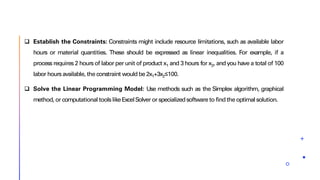
❑ Establish the Constraints: Constraints might include resource limitations, such as available labor
hours or material quantities. These should be expressed as linear inequalities. For example, if a
process requires 2 hours of labor per unit of product x1 and 3 hours for x2, and you have a total of 100
labor hoursavailable, the constraint wouldbe 2x1+3x2≤100.
❑ Solve the Linear Programming Model: Use methods such as the Simplex algorithm, graphical
method, or computational toolslikeExcelSolver or specializedsoftware to findthe optimalsolution.
Example: A Simple
Linear Programming Model
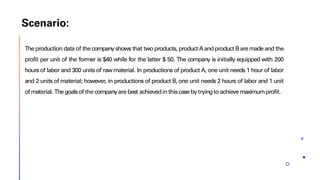
Scenario:
Theproduction data of the companyshows that two products, productAandproduct Baremade and the
profit per unit of the former is $40 while for the latter $ 50. The company is initially equipped with 200
hours of labor and 300 units of rawmaterial. In productions of product A, one unit needs 1 hour of labor
and 2 units of material; however, in productions of product B, one unit needs 2 hours of labor and 1 unit
of material. Thegoalsof the companyare best achievedinthiscase bytryingto achievemaximumprofit.
Step-by-Step Solution:
1. Objective Function: Maximize Z=40x1+50x2 where x1 and x2 are the quantities of product
A and B, respectively.
2. Constraints:
• Labor: 1x1+2x2≤200
• Material: 2x1+1x2≤300
• Non-Negativity: x1,x2≥0
3. Solution: Solving the model using graphical or simplex method gives the optimal
production levels of products A and B that maximize profit while satisfying all
constraints.
Tools and Software
for Linear Programming
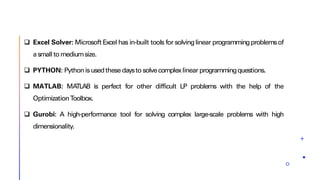
❑ Excel Solver: Microsoft Excel has in-built tools for solvinglinear programmingproblemsof
asmall tomediumsize.
❑ PYTHON: Pythonisusedthese daysto solvecomplexlinear programmingquestions.
❑ MATLAB: MA
TLAB is perfect for other difficult LP problems with the help of the
OptimizationToolbox.
❑ Gurobi: A high-performance tool for solving complex large-scale problems with high
dimensionality.
Helpful Resources & Textbooks
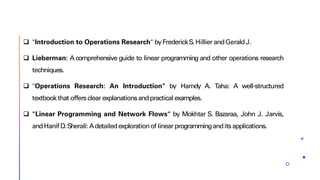
❑ "Introduction to Operations Research" byFrederickS. Hillier andGeraldJ.
❑ Lieberman: A comprehensive guide to linear programming and other operations research
techniques.
❑ "Operations Research: An Introduction" by Hamdy A. Taha: A well-structured
textbook that offersclear explanationsandpractical examples.
❑ "Linear Programming and Network Flows" by Mokhtar S. Bazaraa, John J. Jarvis,
andHanif D.Sherali: Adetailedexplorationof linear programmingandits applications.
Common Pitfalls in Linear
Programming Homework
❑ Misidentifying the Objective Function: Clarify the goals that you are seeking to
optimize.
❑ Incorrectly Formulating Constraints: Make sure that constraints do reflect the problem
inquestion.
❑ Overlooking Non-Negativity: It is very important to incorporate the non-negativity
constraints of decisionvariables.
❑ Misinterpreting the Solution: When solving, understand the results appropriately in
order to applythemto the real-worldsituation.
Linear Programming
Homework Help Service
Stuck with linear programming assignments? Our Linear Programming
Homework Help service provides assistance to help students understand Linear
Programming concepts and complete assignments easily. We have a team of
efficient tutors who explain every step, which means that not only you will be able
to complete your assignments before the deadline, but you will also understand
the material. Whether you're dealing with complex multi-variable problems or
simple two-variable models, our service can help you:
Benefits of Our Service
❑ Expert guidance: Our team comprises of academic experts who have the best
understandingof linear programming.
❑ Timely delivery: We ensure that your assignments are completed long before the
deadlineto addressanydoubts or issues
❑ Customized solutions: Get solutions from tutors that are customized according to the
specific instructionsof the assignment andthe coursework.
Conclusion
Linear Programming is an essential concept for students in statistics and management, as it
provides a systematic way of handling optimization. This ppt provides a clear structure on how
youcan create robust LPmodels andsolve tricky problems that youmayencounter duringyour
coursework. Make good use of the suggested resources, aids, and professional assistance to
performwell onyour assignments andclasses.
Remember that learning linear programming does not only aid you in academics but will also
giveyouthe skillsthat arevaluable inproblemsolvinginbusinessandjobs.
THANK YOU
+44-166-626-0813
homework@statisticshelpdesk.com
www.statisticshelpdesk.com

Developing a Linear Programming Model - Comprehensive Homework Solution Blueprint

  • 1.
    Developing A Linear Programming Model: AComprehensive Homework Blueprint
  • 2.
    Linear Programming isan essential mathematical optimization technique and is commonly applied in areas such as statistics and operational research, and management. Whether your tasks involve managing production schedules, working on budgets or optimizing resources, linear programming knowledge is vital. This presentation offers a step-by-step guide that students can follow as they work through the process of creating a Linear Programming Model effectively, backed by real-world examples, helpful resources, andexpert tips.
  • 3.
  • 4.
    Linear programming isan optimization technique to realize the best solution for the given mathematical problem, where its constraints are described using linear relationship. It is applied in different fields including economics, business, engineering, and military applications, in order to improve the processes andmake right decisions.
  • 5.
    Key Components ofa Linear Programming Model ❑ Objective Function: This means that the optimization is usually performed with an aim of maximizing or minimizing a particular value. ❑ Decision Variables: The values that the decision-makers are going to decide in order to optimize the objective function. ❑ Constraints: These are the conditions or constraints to decision variables in the form of linear equations or inequalities. ❑ Non-Negativity Restriction: The decision variables cannot be negative which implies that the values of the decision variables will be greater than zero..
  • 6.
    Steps in Developinga Linear Programming Model
  • 7.
    ❑ Identify theObjective: Define what needs to be maximized or minimized, such as profit, cost, time, or resources. ❑ Determine the Decision Variables: These are the unknowns that you want to solve for. For instance, if you are deciding how much of two products to produce, these amounts would be your decisionvariables. ❑ Formulate the Objective Function: Express the objective in terms of the decision variables. For example, if your goal is to maximize profit, your objective function could be Z=c1x1+c2x2 , where c1 and c2 are the profits per unit of productsx1 andx2, respectively.
  • 8.
    ❑ Establish theConstraints: Constraints might include resource limitations, such as available labor hours or material quantities. These should be expressed as linear inequalities. For example, if a process requires 2 hours of labor per unit of product x1 and 3 hours for x2, and you have a total of 100 labor hoursavailable, the constraint wouldbe 2x1+3x2≤100. ❑ Solve the Linear Programming Model: Use methods such as the Simplex algorithm, graphical method, or computational toolslikeExcelSolver or specializedsoftware to findthe optimalsolution.
  • 9.
    Example: A Simple LinearProgramming Model
  • 10.
    Scenario: Theproduction data ofthe companyshows that two products, productAandproduct Baremade and the profit per unit of the former is $40 while for the latter $ 50. The company is initially equipped with 200 hours of labor and 300 units of rawmaterial. In productions of product A, one unit needs 1 hour of labor and 2 units of material; however, in productions of product B, one unit needs 2 hours of labor and 1 unit of material. Thegoalsof the companyare best achievedinthiscase bytryingto achievemaximumprofit.
  • 11.
    Step-by-Step Solution: 1. ObjectiveFunction: Maximize Z=40x1+50x2 where x1 and x2 are the quantities of product A and B, respectively. 2. Constraints: • Labor: 1x1+2x2≤200 • Material: 2x1+1x2≤300 • Non-Negativity: x1,x2≥0 3. Solution: Solving the model using graphical or simplex method gives the optimal production levels of products A and B that maximize profit while satisfying all constraints.
  • 12.
    Tools and Software forLinear Programming
  • 13.
    ❑ Excel Solver:Microsoft Excel has in-built tools for solvinglinear programmingproblemsof asmall tomediumsize. ❑ PYTHON: Pythonisusedthese daysto solvecomplexlinear programmingquestions. ❑ MATLAB: MA TLAB is perfect for other difficult LP problems with the help of the OptimizationToolbox. ❑ Gurobi: A high-performance tool for solving complex large-scale problems with high dimensionality.
  • 14.
  • 15.
    ❑ "Introduction toOperations Research" byFrederickS. Hillier andGeraldJ. ❑ Lieberman: A comprehensive guide to linear programming and other operations research techniques. ❑ "Operations Research: An Introduction" by Hamdy A. Taha: A well-structured textbook that offersclear explanationsandpractical examples. ❑ "Linear Programming and Network Flows" by Mokhtar S. Bazaraa, John J. Jarvis, andHanif D.Sherali: Adetailedexplorationof linear programmingandits applications.
  • 16.
    Common Pitfalls inLinear Programming Homework
  • 17.
    ❑ Misidentifying theObjective Function: Clarify the goals that you are seeking to optimize. ❑ Incorrectly Formulating Constraints: Make sure that constraints do reflect the problem inquestion. ❑ Overlooking Non-Negativity: It is very important to incorporate the non-negativity constraints of decisionvariables. ❑ Misinterpreting the Solution: When solving, understand the results appropriately in order to applythemto the real-worldsituation.
  • 18.
  • 19.
    Stuck with linearprogramming assignments? Our Linear Programming Homework Help service provides assistance to help students understand Linear Programming concepts and complete assignments easily. We have a team of efficient tutors who explain every step, which means that not only you will be able to complete your assignments before the deadline, but you will also understand the material. Whether you're dealing with complex multi-variable problems or simple two-variable models, our service can help you:
  • 20.
    Benefits of OurService ❑ Expert guidance: Our team comprises of academic experts who have the best understandingof linear programming. ❑ Timely delivery: We ensure that your assignments are completed long before the deadlineto addressanydoubts or issues ❑ Customized solutions: Get solutions from tutors that are customized according to the specific instructionsof the assignment andthe coursework.
  • 21.
  • 22.
    Linear Programming isan essential concept for students in statistics and management, as it provides a systematic way of handling optimization. This ppt provides a clear structure on how youcan create robust LPmodels andsolve tricky problems that youmayencounter duringyour coursework. Make good use of the suggested resources, aids, and professional assistance to performwell onyour assignments andclasses. Remember that learning linear programming does not only aid you in academics but will also giveyouthe skillsthat arevaluable inproblemsolvinginbusinessandjobs.
  • 23.