The CARE CERTIFICATE
1
Awareness of Mental Health,
Dementia & Learning
Disability
Standard
2
Learning outcomes
9.1 Understand the needs and experiences of people with mental health
conditions, dementia or learning disabilities
9.2 Understand the importance of promoting positive health and
wellbeing for an individual who may have a mental health condition,
dementia or a learning disability
9.3 Understand the adjustments that may be necessary in care delivery
relating to an individual who may have a mental health condition,
dementia or learning disability
9.4 Understand the importance of early detection of
mental health needs, dementia and learning disabilities
9.5 Understand legal frameworks, policy
and guidelines relating to mental health needs,
dementia and learning disabilities
9.6 Understand the meaning of mental capacity in
relation to how care is provided
Standard
3
Awareness of Mental Health, Dementia &
Learning Disability
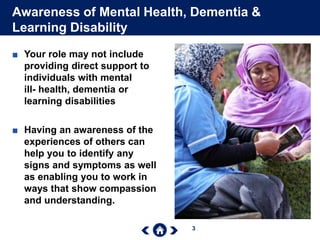
■ Your role may not include
providing direct support to
individuals with mental
ill- health, dementia or
learning disabilities
■ Having an awareness of the
experiences of others can
help you to identify any
signs and symptoms as well
as enabling you to work in
ways that show compassion
and understanding.
4
Mental Health Conditions
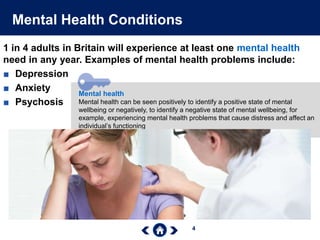
1 in 4 adults in Britain will experience at least one mental health
need in any year. Examples of mental health problems include:
■ Depression
■ Anxiety
■ Psychosis
Mental health
Mental health can be seen positively to identify a positive state of mental
wellbeing or negatively, to identify a negative state of mental wellbeing, for
example, experiencing mental health problems that cause distress and affect an
individual’s functioning
5
Depression
An individual experiencing depression will feel emotions such
as hopelessness and negativity that don’t go away.
The symptoms of depression
• Can last weeks, months or longer
• Affects how individuals see themselves
• Can lead to people stopping engagement in social life, family
life or work
6
Anxiety
Individuals living with anxiety find it hard to control their
worries. Symptoms can be:
■ Physical
■ Psychological
■ Cognitive
■ Behavioural or social.
Psychological
Psychological symptoms relate to feelings and emotions, it includes how the mind looks at things
and how this can affect behaviour.
Cognitive
Cognitive or cognition refers to our brains and how we think about things; how we process, use
and store information we take in through our senses.
7
Psychosis
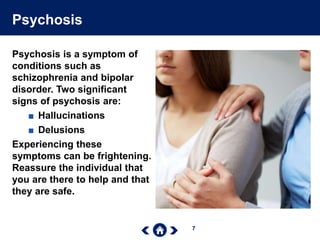
Psychosis is a symptom of
conditions such as
schizophrenia and bipolar
disorder. Two significant
signs of psychosis are:
■ Hallucinations
■ Delusions
Experiencing these
symptoms can be frightening.
Reassure the individual that
you are there to help and that
they are safe.
8
Causes of mental health problems
An individual may experience a mental health need as a
result of:
■ a traumatic event
■ a chemical imbalance in the brain
■ genetics.
Chemical imbalance
The chemicals or hormones that affect our emotions and behaviour may be
lower or higher than they should be.
9
Dementia
A word used to cover many
different conditions that
affect the brain. These
conditions cause a decline or
reduction in abilities,
including:
■ memory
■ thinking
■ reasoning
■ communicating
10
Supporting individuals with dementia
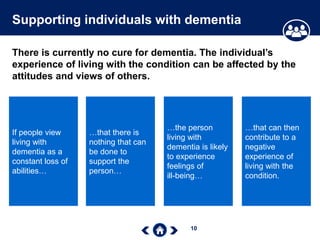
There is currently no cure for dementia. The individual’s
experience of living with the condition can be affected by the
attitudes and views of others.
If people view
living with
dementia as a
constant loss of
abilities…
…that there is
nothing that can
be done to
support the
person…
…the person
living with
dementia is likely
to experience
feelings of
ill-being…
…that can then
contribute to a
negative
experience of
living with the
condition.
11
Types of dementia
The two most common types of dementia are:
Alzheimer’s disease
In individuals with Alzheimer’s
disease a bad protein develops in the
brain causing damage to the brain
cells and their connections.
Vascular dementia
Vascular dementia is caused by
oxygen failing to get to the brain cells
as a result of problems with the
blood supply (the vascular system).
Dementia will affect each individual differently depending on
the type of dementia they have and the support they receive.
12
Learning disabilities
The cause of learning disabilities is not always known but
they can be due to:
■ Complications during birth
■ Genetic conditions
■ Illness or injury in childhood
An individual with a learning disability may have difficulty
■ Understanding information
■ Learning new skills
■ Communicating
■ Living independently.
13
The impact of learning disabilities
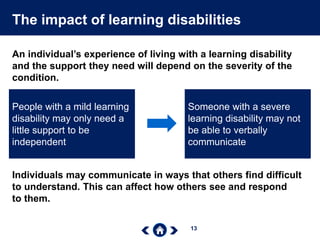
An individual’s experience of living with a learning disability
and the support they need will depend on the severity of the
condition.
People with a mild learning
disability may only need a
little support to be
independent
Someone with a severe
learning disability may not
be able to verbally
communicate
Individuals may communicate in ways that others find difficult
to understand. This can affect how others see and respond
to them.
14
Supporting people with learning disabilities
Every individual is unique with
different needs, preferences, life
history and experiences.
The support provided must:
■ Be person centred to meet
their specific needs
■ Develop and enable them to
develop their skills and
become more independent.
15
Promoting positive attitudes
The stigma associated with mental health problems, dementia
or learning disabilities can lead to feelings of loneliness and
being left out of society. Positive attitudes can be promoted by:
■ Reducing stigma by ensuring that individuals are not
isolated in social situations
■ Promoting wellbeing for those living with the condition
■ Identifying and building on the individual’s skills and
abilities
■ Providing opportunities for individuals to feel empowered
and in control.
16
The social model of disability
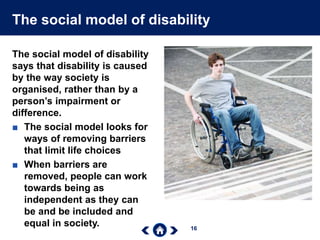
says that disability is caused
by the way society is
organised, rather than by a
person’s impairment or
difference.
■ The social model looks for
ways of removing barriers
that limit life choices
■ When barriers are
removed, people can work
towards being as
independent as they can
be and be included and
equal in society.
17
Barriers
These could include
■ The environment – such as signs for information
■ The impact of people’s attitudes such as stereotyping
■ The impact of an organisation’s approach such as ways of
working that are set to meet the needs of the organisation
rather than the individual
18
Adaptations
The individual’s changing needs may need to be assessed to
identify adaptations which can support them to live their
lives more independently. Adaptations could include:
■ environmental support
■ emotional support
■ practical information or additional services.
19
Reporting concerns
■ If you think someone is developing symptoms of a mental health
problem or dementia, or if their care and support needs have
changed and need reassessing, you should record this
information and pass it on
■ It is important to follow your agreed ways of working on recording
to reduce lost or misinterpreted information.
Agreed ways of working
This refers to organisational policies and procedures. This includes those less
formally documented by individual employers and the self-employed as well as
formal policies such as the Dignity Code and Compassion in Practice.
20
Early diagnosis
Similarities between conditions can mean that conditions are
sometimes mistaken.
Psychosis
Depression/
mood
disorders
Anxiety Dementia
Learning
disabilities
■Confusion as
a result of
hallucinations
and delusions
■Lack of
insight and
self-awareness
■Problems
with sleeping
■Change in
mood/
personality
■Problems
with sleeping
■Change in
mood/
personality
■Problems
with sleeping
■Confusion as
a result of
memory loss
■Change in
mood/
personality
■Problems
with verbal
communication
■Problems
with sleeping
■Confusion due
to difficulties
with memory or
relating to
information
■Lack of insight
and self-
awareness
■Problems with
verbal
communication
21
Adapting care and support
Care and support must be person centred and will need to
be reviewed and adapted to meet the changing needs of the
individual.
It may be necessary to develop your skills so that you can
provide effective care and support. For example:
■ Developing skills to support people to communicate such
as Makaton
■ Learning how to use assistive technology
Individuals also need support to learn how to use this
technology in order to live independently.
22
Legislation
Legislation and polices promote human rights,
inclusion, equal life chances and citizenship of
individuals with mental health needs, dementia or
learning disabilities.
These include:
■ The Human Rights Act 1998
■ The Care Act 2014
■ The Data Protection Act 1998
■ The Safeguarding Adults National Framework
■ The Fundamental Standards of Quality and Safety
■ Mental Health Act 1983 (MHA)
■ Mental Capacity Act 2005 (MCA)
23
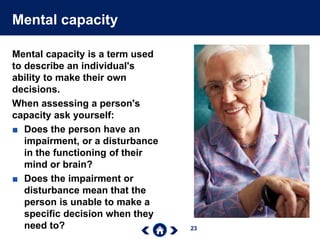
Mental capacity
Mental capacity is a term used
to describe an individual's
ability to make their own
decisions.
When assessing a person's
capacity ask yourself:
■ Does the person have an
impairment, or a disturbance
in the functioning of their
mind or brain?
■ Does the impairment or
disturbance mean that the
person is unable to make a
specific decision when they
need to?
24
The Mental Capacity Act 2005
You must assume that individuals
can make a decisions unless they
are unable to do one or more of
the following:
■ Understand information given
to them
■ Retain information long enough
to make the decision
■ Weigh up the information
available
■ Communicate their decision.
25
Knowledge check
Which of the answers below describes the emotions
experienced by someone living with major depression?
Hallucinations and delusions
Feelings of sadness that
don’t last long
Feelings of hopelessness that do
not go away
Extreme happiness followed
by sadness
Click to reveal answer
26
Knowledge check
What should you do if you are concerned that an individual’s
needs have changed and need to be reassessed?
Raise your concerns following
reporting procedures and agreed
ways of working
Do nothing, the matter is confidential
Discuss your concerns with
your family or friends
Contact the Care Quality Commission
to report your concerns immediately
Click to reveal answer
27
Knowledge check
Which of the following is a benefit of the early diagnosis of a
mental health condition, dementia or a learning disability
important?
It allows people to develop
stigma and stereotypes
It enables the social model of
disability to be put in place
It enables the individual and their
family to plan for their future care
and support needs
It allows the individual to get
a second opinion
Click to reveal answer

Standard 9

  • 1.
    The CARE CERTIFICATE 1 Awarenessof Mental Health, Dementia & Learning Disability Standard
  • 2.
    2 Learning outcomes 9.1 Understandthe needs and experiences of people with mental health conditions, dementia or learning disabilities 9.2 Understand the importance of promoting positive health and wellbeing for an individual who may have a mental health condition, dementia or a learning disability 9.3 Understand the adjustments that may be necessary in care delivery relating to an individual who may have a mental health condition, dementia or learning disability 9.4 Understand the importance of early detection of mental health needs, dementia and learning disabilities 9.5 Understand legal frameworks, policy and guidelines relating to mental health needs, dementia and learning disabilities 9.6 Understand the meaning of mental capacity in relation to how care is provided Standard
  • 3.
    3 Awareness of MentalHealth, Dementia & Learning Disability ■ Your role may not include providing direct support to individuals with mental ill- health, dementia or learning disabilities ■ Having an awareness of the experiences of others can help you to identify any signs and symptoms as well as enabling you to work in ways that show compassion and understanding.
  • 4.
    4 Mental Health Conditions 1in 4 adults in Britain will experience at least one mental health need in any year. Examples of mental health problems include: ■ Depression ■ Anxiety ■ Psychosis Mental health Mental health can be seen positively to identify a positive state of mental wellbeing or negatively, to identify a negative state of mental wellbeing, for example, experiencing mental health problems that cause distress and affect an individual’s functioning
  • 5.
    5 Depression An individual experiencingdepression will feel emotions such as hopelessness and negativity that don’t go away. The symptoms of depression • Can last weeks, months or longer • Affects how individuals see themselves • Can lead to people stopping engagement in social life, family life or work
  • 6.
    6 Anxiety Individuals living withanxiety find it hard to control their worries. Symptoms can be: ■ Physical ■ Psychological ■ Cognitive ■ Behavioural or social. Psychological Psychological symptoms relate to feelings and emotions, it includes how the mind looks at things and how this can affect behaviour. Cognitive Cognitive or cognition refers to our brains and how we think about things; how we process, use and store information we take in through our senses.
  • 7.
    7 Psychosis Psychosis is asymptom of conditions such as schizophrenia and bipolar disorder. Two significant signs of psychosis are: ■ Hallucinations ■ Delusions Experiencing these symptoms can be frightening. Reassure the individual that you are there to help and that they are safe.
  • 8.
    8 Causes of mentalhealth problems An individual may experience a mental health need as a result of: ■ a traumatic event ■ a chemical imbalance in the brain ■ genetics. Chemical imbalance The chemicals or hormones that affect our emotions and behaviour may be lower or higher than they should be.
  • 9.
    9 Dementia A word usedto cover many different conditions that affect the brain. These conditions cause a decline or reduction in abilities, including: ■ memory ■ thinking ■ reasoning ■ communicating
  • 10.
    10 Supporting individuals withdementia There is currently no cure for dementia. The individual’s experience of living with the condition can be affected by the attitudes and views of others. If people view living with dementia as a constant loss of abilities… …that there is nothing that can be done to support the person… …the person living with dementia is likely to experience feelings of ill-being… …that can then contribute to a negative experience of living with the condition.
  • 11.
    11 Types of dementia Thetwo most common types of dementia are: Alzheimer’s disease In individuals with Alzheimer’s disease a bad protein develops in the brain causing damage to the brain cells and their connections. Vascular dementia Vascular dementia is caused by oxygen failing to get to the brain cells as a result of problems with the blood supply (the vascular system). Dementia will affect each individual differently depending on the type of dementia they have and the support they receive.
  • 12.
    12 Learning disabilities The causeof learning disabilities is not always known but they can be due to: ■ Complications during birth ■ Genetic conditions ■ Illness or injury in childhood An individual with a learning disability may have difficulty ■ Understanding information ■ Learning new skills ■ Communicating ■ Living independently.
  • 13.
    13 The impact oflearning disabilities An individual’s experience of living with a learning disability and the support they need will depend on the severity of the condition. People with a mild learning disability may only need a little support to be independent Someone with a severe learning disability may not be able to verbally communicate Individuals may communicate in ways that others find difficult to understand. This can affect how others see and respond to them.
  • 14.
    14 Supporting people withlearning disabilities Every individual is unique with different needs, preferences, life history and experiences. The support provided must: ■ Be person centred to meet their specific needs ■ Develop and enable them to develop their skills and become more independent.
  • 15.
    15 Promoting positive attitudes Thestigma associated with mental health problems, dementia or learning disabilities can lead to feelings of loneliness and being left out of society. Positive attitudes can be promoted by: ■ Reducing stigma by ensuring that individuals are not isolated in social situations ■ Promoting wellbeing for those living with the condition ■ Identifying and building on the individual’s skills and abilities ■ Providing opportunities for individuals to feel empowered and in control.
  • 16.
    16 The social modelof disability The social model of disability says that disability is caused by the way society is organised, rather than by a person’s impairment or difference. ■ The social model looks for ways of removing barriers that limit life choices ■ When barriers are removed, people can work towards being as independent as they can be and be included and equal in society.
  • 17.
    17 Barriers These could include ■The environment – such as signs for information ■ The impact of people’s attitudes such as stereotyping ■ The impact of an organisation’s approach such as ways of working that are set to meet the needs of the organisation rather than the individual
  • 18.
    18 Adaptations The individual’s changingneeds may need to be assessed to identify adaptations which can support them to live their lives more independently. Adaptations could include: ■ environmental support ■ emotional support ■ practical information or additional services.
  • 19.
    19 Reporting concerns ■ Ifyou think someone is developing symptoms of a mental health problem or dementia, or if their care and support needs have changed and need reassessing, you should record this information and pass it on ■ It is important to follow your agreed ways of working on recording to reduce lost or misinterpreted information. Agreed ways of working This refers to organisational policies and procedures. This includes those less formally documented by individual employers and the self-employed as well as formal policies such as the Dignity Code and Compassion in Practice.
  • 20.
    20 Early diagnosis Similarities betweenconditions can mean that conditions are sometimes mistaken. Psychosis Depression/ mood disorders Anxiety Dementia Learning disabilities ■Confusion as a result of hallucinations and delusions ■Lack of insight and self-awareness ■Problems with sleeping ■Change in mood/ personality ■Problems with sleeping ■Change in mood/ personality ■Problems with sleeping ■Confusion as a result of memory loss ■Change in mood/ personality ■Problems with verbal communication ■Problems with sleeping ■Confusion due to difficulties with memory or relating to information ■Lack of insight and self- awareness ■Problems with verbal communication
  • 21.
    21 Adapting care andsupport Care and support must be person centred and will need to be reviewed and adapted to meet the changing needs of the individual. It may be necessary to develop your skills so that you can provide effective care and support. For example: ■ Developing skills to support people to communicate such as Makaton ■ Learning how to use assistive technology Individuals also need support to learn how to use this technology in order to live independently.
  • 22.
    22 Legislation Legislation and policespromote human rights, inclusion, equal life chances and citizenship of individuals with mental health needs, dementia or learning disabilities. These include: ■ The Human Rights Act 1998 ■ The Care Act 2014 ■ The Data Protection Act 1998 ■ The Safeguarding Adults National Framework ■ The Fundamental Standards of Quality and Safety ■ Mental Health Act 1983 (MHA) ■ Mental Capacity Act 2005 (MCA)
  • 23.
    23 Mental capacity Mental capacityis a term used to describe an individual's ability to make their own decisions. When assessing a person's capacity ask yourself: ■ Does the person have an impairment, or a disturbance in the functioning of their mind or brain? ■ Does the impairment or disturbance mean that the person is unable to make a specific decision when they need to?
  • 24.
    24 The Mental CapacityAct 2005 You must assume that individuals can make a decisions unless they are unable to do one or more of the following: ■ Understand information given to them ■ Retain information long enough to make the decision ■ Weigh up the information available ■ Communicate their decision.
  • 25.
    25 Knowledge check Which ofthe answers below describes the emotions experienced by someone living with major depression? Hallucinations and delusions Feelings of sadness that don’t last long Feelings of hopelessness that do not go away Extreme happiness followed by sadness Click to reveal answer
  • 26.
    26 Knowledge check What shouldyou do if you are concerned that an individual’s needs have changed and need to be reassessed? Raise your concerns following reporting procedures and agreed ways of working Do nothing, the matter is confidential Discuss your concerns with your family or friends Contact the Care Quality Commission to report your concerns immediately Click to reveal answer
  • 27.
    27 Knowledge check Which ofthe following is a benefit of the early diagnosis of a mental health condition, dementia or a learning disability important? It allows people to develop stigma and stereotypes It enables the social model of disability to be put in place It enables the individual and their family to plan for their future care and support needs It allows the individual to get a second opinion Click to reveal answer

Editor's Notes

  • #6 Additional Information Symptoms of depression can last for a couple of weeks, a number of months or longer. Living with depression can affect how an individual sees themselves. This can lead to them not engaging in a social life, with family or their work. Depression is a treatable illness with recognised symptoms. Having the opportunity to talk and share how they feel can help some people.
  • #7 Additional Information Physical symptoms such as increased heart rate, difficulty breathing and dizziness Psychological symptoms such as feeling a loss of control, thinking that you might die or have a heart attack, and feelings of wanting to escape or run away Cognitive symptoms such as changes to your thought processes, thinking negative thoughts repeatedly Behavioural or social symptoms such as not wanting to leave the house, abusing substances such as alcohol or drugs or behaving in ways that affect your relationships. Individuals may stop going out with friends, or to places such as the supermarket, as they are worried about how they might feel when they are there. There are treatments which help alleviate the symptoms of anxiety such as cognitive behavioural therapy (CBT). This helps someone to talk about their condition and manage the effects by trying to change the way they think.
  • #8 Additional Information NHS Choices say that around 3 in 100 people will have at least one experience of psychosis. Schizophrenia: This condition can be described as having a break from reality, when it is difficult to understand what is real and what is in their own thoughts. Symptoms could include: hallucinations, delusions and changes in behaviour. Bipolar disorder: This condition affects a person’s moods and means they can go from one extreme mood to another alongside having feelings of depression. Hallucinations: where a person sees or hears things that aren’t real but are very real to them. They can also include feeling, smelling or tasting things that aren’t real. Delusions: where a person believes things that aren’t true, for example believing that someone is spying on them.
  • #9 Additional Information A traumatic event, such as an accident, a death in the family or as a result of war (Post Traumatic Stress Disorder (PTSD) A chemical imbalance in the brain Genetics, for example, a person’s additional needs may be due to their DNA. www.nhs.uk/news/2013/02February/Pages/Five-mental-disorders-genetic-links.aspx
  • #10 Additional information The Alzheimer’s Society estimate there are over 100 different conditions that fall under the dementia umbrella. Someone who experiences dementia may feel confused, frustrated and frightened. A common symptom is short term memory loss; the individual finds it difficult to remember recent events or conversations. This can lead to them repeating stories or asking the same question over and over again. Dementia is often thought to be a condition that only affects older people. However, dementia can affect anyone, at any age. The Alzheimer’s Society estimates that there are more than 40,000 people under the age of 65 living with dementia.
  • #11 Activity Ask the health and social care worker/s to consider how the support provided could affect the experience of a person who has dementia. Use one of the scenarios below or use one of your own. Scenario 1 Josie has dementia. She values her independence but is finding it increasingly difficult to remember where things are in her home and when to take her medication. a) The worker supporting her tells her that living with dementia is a slippery slope and things are only going to get worse for her. b) The worker supporting her suggests that they arrange for her to have an assessment of her needs and research ways of supporting her to remain in her own home for longer such as labelling cupboards and using dosette boxes. Scenario 2 William has been living with dementia for some years. He is admitted to hospital after a fall. Workers supporting William don’t ask him about what he wants. They tell him not to worry, that he will be looked after and that the medical professionals know what to do for the best. They do not involve him in day to day decisions or in decisions about his care. Workers supporting William talk to him about what he wants and what he needs. He and his support network are involved in all decisions from his rehabilitation treatment and adaptations to support him to live as independently as possible to day-to-day decisions about what to eat and what to wear. Answers should include: Working in negative ways could lead to the individual experiencing feelings of despair and depression. Ignoring the individual’s wishes means that the worker is not working in a person centred way. The individual may feel that they are no longer in control of her own life or of the care that they receive. They may have feelings of hopelessness, worthlessness and experience a loss of a loss of self esteem. Working in positive ways that show respect for the individual’s wishes will help to promote the individual's feeling of self-worth, dignity and self-esteem. They will be more likely to engage in therapies and support groups that can improve their experience of living with the condition.
  • #13 Additional Information The cause of learning disabilities is not always known but they can be due to: Complications during birth which can lead to lack of oxygen Genetic conditions such as Down’s Syndrome which happens as a result of an extra chromosome. This leads to impairments in both cognitive ability and physical growth that range from mild to moderate developmental disabilities Illness or injury in childhood which has affected the brain such as meningitis. In most cases living with a learning disability will have a lifelong impact but this will vary depending on the type of learning disability and the severity of the condition.
  • #16 Activity Ask the health and social care worker/s for examples of how they can promote positive attitudes in their own workplace.
  • #17 Activity Ask the health and social care worker/s for some examples of barriers that could limit an individual’s choices and stop them being included in society. Possible answer include: The environment, for example, is a building accessible for a person who uses a wheelchair? The impact of people’s attitudes, for example, stereotyping all people with dementia as the same and assuming they will all be affected in the same way The impact of an organisation’s approach, for example, ways of working that are set to meet the needs of the organisation rather than the individual.
  • #18 Additional Information Environmental support: such as adding handrails for support in the bathroom, labelling rooms and cupboards and dosette systems to remind people to take medication. Emotional support: for both the person living with the condition and their family or carers. This might involve arranging a befriender or a counselling service. Practical information or additional services: about an individual’s condition, illness, financial and legal issues and opportunities to plan ahead should also be available. Forums, charities, helplines or support groups are all useful sources of support and information.
  • #19 Additional Information Environmental support: such as adding handrails for support in the bathroom, labelling rooms and cupboards and dosette systems to remind people to take medication. Emotional support: for both the person living with the condition and their family or carers. This might involve arranging a befriender or a counselling service. Practical information or additional services: about an individual’s condition, illness, financial and legal issues and opportunities to plan ahead should also be available. Forums, charities, helplines or support groups are all useful sources of support and information.
  • #20 Additional Information When recording information there are a number of points to consider: Ensure the information is accurate It should be clear, concise, and legible It should be non-ambiguous and state facts not opinions or assumptions The person involved should be given the opportunity to contribute Apply the principles of the Data Protection Act and maintain confidentiality.
  • #21 Activity Ask the health and social care workers to think about why it is important that conditions are diagnosed as early as possible. Answers should include: Clear up uncertainty. It can be upsetting living with symptoms like memory loss and changes in personality, particularly if you don’t understand why they are happening. As there are a number of conditions that have similar symptoms it is important that an accurate diagnosis is made. Whilst this can be difficult to hear it can clear up uncertainty and help someone to feel more in control. Help the individual and their family and friends to plan. Planning for the future provides the opportunity to consider, discuss and record wishes and decisions. This is known as advance care planning; the individual makes plans about what they wish to happen while they are most able to be involved and make decisions. Identify possible treatments and therapies. An individual may want to consider taking medication such as anti-dementia drugs or anti-depressants. They may also benefit from therapies such as counselling or cognitive behaviour therapy. Provide the right information, resources and support. Through accessing information at an early stage someone can make best use of what is available such as support groups. They can also identify financial support that they may be entitled to.
  • #22 Additional information Those living with mental health needs, dementia or a learning disability are more vulnerable to abuse. You should follow your agreed ways of working to make sure each individual is best protected from harm or abuse.
  • #23 Additional Information Human Rights Act 1998: This identifies the fundamental rights and freedoms that all individuals have access to in the UK. It ensures that those with mental health needs, dementia or learning disabilities are also treated fairly and with respect. www.legislation.gov.uk/ukpga/1998/42/contents Care Act 2014: This puts a general duty on local authorities to promote the wellbeing of individuals. The Act makes sure that care and support provided to those with mental health needs, dementia and learning disabilities provides for their physical, mental and emotional wellbeing. It puts the focus on prevention and ensuring things don’t get worse for an individual; providing information to ensure people can make informed decisions and ensuring there are a range of services available to meet people’s needs. www.gov.uk/government/publications/care-act-2014-part-1-factsheets Data Protection Act 1998: This ensures that public bodies maintain the protection of data. The Data Protection Act makes sure that personal data held by organisations is kept confidential, not kept longer than necessary and is accurate. This includes data about an individual’s health or condition. The Act gives individuals the right to see the data and information held about them. www.gov.uk/data-protection/the-data-protection-act Safeguarding Adults National Framework: Safeguarding adults is about promoting people’s welfare and keeping them safe from harm and abuse. Individuals living with a mental health need, dementia and learning disability are particularly vulnerable and therefore services need to ensure they are working to maintain their safety. www.adass.org.uk/adassmedia/stories/Publications/Guidance/safeguarding.pdf Fundamental Standards of Quality and Safety: A guide developed by the Care Quality Commission (CQC) that describes the fundamental standards of quality and safety that people using health and social care services can expect. No health without mental health – Which sets out the government’s plans to improve people’s mental health and wellbeing in England including identifying the services and support that is available. The Mental Health Act – This Act ensures that processes are followed ensuring that individuals are not inappropriately detained or treated, including those with mental health conditions, dementia or learning disability. The Act also ensures that people with a serious mental health need can be treated without their consent when necessary to ensure the person does not harm themselves or others. The Equality Act – The is Act provides legal protection from discrimination in the workplace and in wider society for those with protected characteristics which include disability. In addition, the Act states that reasonable adjustments to the workplace or place. The Mental Capacity Act This Act protects people who need care or treatment but may lack the mental capacity to make decisions for themselves. Everyone has the right to make their own decisions, and the Act says we must assume a person can unless an assessment is done which proves otherwise, whether or not we agree with that decision. When someone doesn’t have mental capacity, the person deciding for them must do so in the person’s best interests. Care and treatment of people who lack capacity must be the least restrictive of their rights and freedom possible (deprivation of liberty safeguards). The act applies to people aged 16 and over in England and Wales. It also provides guidance to support people who need to make decisions on behalf of someone else.
  • #24 Additional Information Does the person have an impairment, or a disturbance in the functioning of their mind or brain? This can include, for example, conditions associated with mental illness, concussion, or symptoms of drug or alcohol abuse. If so, 2. Does the impairment or disturbance mean that the person is unable to make a specific decision when they need to? You should offer appropriate and practical support to achieve this before applying this stage of the test.
  • #25 Additional Information There are five key principles that everyone must follow when assessing capacity, these are: Always assume that the person can make their own decision Ensure all possible support is provided to make sure the person can make their own decision Do not assume someone cannot make a decision because you feel they are making an unwise or unsafe decision If it has been identified that the person cannot make a decision, someone can make a decision that is deemed to be in that person’s best interest If a person makes a decision on behalf of the individual, this must be the least restrictive option. A Mental Capacity assessment is decision-specific and the principles must be applied to individual decisions. It is important to remember that an individual may lack the capacity to make a specific complex decision but this does not mean that they lack capacity to make all decisions.
  • #26 Trainer should ask class why they chose the correct answer. Feedback A – Hallucinations and delusions are symptoms which are associated with psychosis and psychotic episodes. B – Most people experience feelings of sadness at some point in their life however major depression is characterised by long term feelings of hopelessness and negativity. C – Feelings of hopelessness and negativity that do not go away quickly are a symptom of major depression D – Extremes of emotion are common symptoms of bipolar disorder.
  • #27 Trainer should ask class why they chose the correct answer. Feedback A – It is important that the individual’s care and support meets their individual, changing needs. You should raise your concerns with the people who need to know following agreed ways of working to reduce lost or misinterpreted information. B – If you are concerned that an individual's care and support needs are not being met you should report your concerns C – You should only share information with those who ‘need to know’ that is, those who are involved in providing care and support D – You should follow the agreed ways of working for your organisation. If the needs of the individual remain unmet you may need to follow the whistleblowing procedure.
  • #28 Trainer should ask class why they chose the correct answer. Feedback A – Stigma and stereotypes should be challenged whenever they are identified. Early diagnosis enables the individual to get appropriate care and support and enables them and their families to make plans for the future. B – The social model of disability states that disability is caused by the way society is organised, rather than by a person’s impairment or difference. Early diagnosis enables the individual to get appropriate care and support and enables them and their families to make plans for the future. C – Early diagnosis enables the individual to get appropriate care and support and enables them and their families to make plans for the future. It also ends uncertainty and enables people to find appropriate therapies and treatments. D – The individual could get a second opinion however, some of the major benefits of early diagnosis are getting appropriate care and support and making plans for the future.