From	
  Stakeholder	
  to	
  Time	
  Management	
  
A	
  Guide	
  for	
  Product	
  Managers	


Becky	
  Yelland	


BACKGROUND	
  
•  13	
  years	
  of	
  delivery	
  &	
  team	
  management	
  experience	
  
•  8	
  years	
  in	
  product	
  management	
  role,	
  4	
  senior	
  level	
  
EXPERIENCE	
  
•  InteracGve	
  TV/Gaming	
  and	
  BeJng	
  
•  Broadcast	
  Media	
  
•  Personal	
  Media/Publishing	
  
•  SaaS/Mobile	
  in	
  Digital	
  MarkeGng	
  
•  Financial	
  Services/News	
  
What	
  are	
  the	
  keys	
  to	
  being	
  a	
  successful	
  product	
  manager?	


CommunicaGon	


RelaGonships	
  
You	
  are	
  only	
  as	
  good	
  as	
  your	
  last	
  delivery.....	
  
If	
  your	
  team	
  look	
  good	
  –	
  YOU	
  look	
  good	
  
Looking	
  busy	
  does	
  not	
  
mean	
  you	
  are	
  being	
  
producGve!	
  
Product	
  Manager	
  Tool	
  Kits	
  for	
  success:	


#1	
  –	
  Stakeholder	
  Management	


#2	
  –	
  People	
  Management	


#3	
  –	
  Time	
  Management	


Stakeholder	
  Management	
  
SH:	
  Engagement	
  Cycle	
  

People	
  Management	
  
SH:	
  Analysis	
  

SH:	
  Managing	
  SH	
  

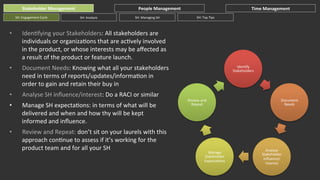
• 

Document	
  Needs:	
  Knowing	
  what	
  all	
  your	
  stakeholders	
  
need	
  in	
  terms	
  of	
  reports/updates/informaGon	
  in	
  
order	
  to	
  gain	
  and	
  retain	
  their	
  buy	
  in	
  

• 

Analyse	
  SH	
  influence/interest:	
  Do	
  a	
  RACI	
  or	
  similar	
  

• 

Manage	
  SH	
  expectaGons:	
  in	
  terms	
  of	
  what	
  will	
  be	
  
delivered	
  and	
  when	
  and	
  how	
  thy	
  will	
  be	
  kept	
  
informed	
  and	
  influence.	
  

• 

Review	
  and	
  Repeat:	
  don’t	
  sit	
  on	
  your	
  laurels	
  with	
  this	
  
approach	
  conGnue	
  to	
  assess	
  if	
  it’s	
  working	
  for	
  the	
  
product	
  team	
  and	
  for	
  all	
  your	
  SH	
  

SH:	
  Top	
  Tips	
  

IdenGfying	
  your	
  Stakeholders:	
  All	
  stakeholders	
  are	
  
individuals	
  or	
  organizaGons	
  that	
  are	
  acGvely	
  involved	
  
in	
  the	
  product,	
  or	
  whose	
  interests	
  may	
  be	
  affected	
  as	
  
a	
  result	
  of	
  the	
  product	
  or	
  feature	
  launch.	
  

• 

Time	
  Management	
  

IdenGfy	
  
Stakeholders	
  

Review	
  and	
  
Repeat	
  

Manage	
  
Stakeholder	
  
ExpectaGons	
  

Document	
  
Needs	
  

Analyse	
  
Stakeholder	
  
Influence/	
  
Interest	
  
Stakeholder	
  Management	
  
SH:	
  Engagement	
  Cycle	
  
Why	
  do	
  Analysis?	
  

People	
  Management	
  
SH:	
  Managing	
  SH	
  

SH:	
  Analysis	
  
What	
  is	
  RACI	
  and	
  how	
  to	
  use	
  

Time	
  Management	
  
SH:	
  Top	
  Tips	
  

Different	
  Stakeholders	
  

WHY	
  DO	
  A	
  STAKEHOLDER	
  ANAYLSIS?	
  
A	
  stakeholder	
  analysis	
  can	
  help	
  a	
  product	
  team	
  to	
  idenGfy:	
  
•  The	
  interests	
  of	
  all	
  stakeholders,	
  who	
  may	
  affect	
  or	
  be	
  affected	
  by	
  the	
  product	
  or	
  feature	
  
•  PotenGal	
  issues	
  that	
  could	
  disrupt	
  the	
  product	
  delivery	
  
•  Key	
  people	
  to	
  engage	
  during	
  	
  rollout	
  
•  Individuals	
  and	
  groups	
  that	
  should	
  be	
  encouraged	
  to	
  parGcipate	
  in	
  different	
  stages	
  of	
  the	
  product	
  
delivery	
  
•  CommunicaGon	
  planning	
  &	
  stakeholder	
  management	
  strategy	
  should	
  be	
  done	
  up	
  front	
  
•  Managing	
  negaGve	
  stakeholders	
  
•  Engaging	
  stakeholders	
  throughout	
  the	
  project	
  life	
  cycle	
  is	
  a	
  key	
  to	
  (but	
  not	
  a	
  guarantee	
  of)	
  success.	
  
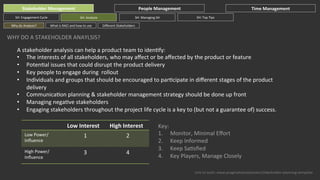
Low	
  Interest	
  

High	
  Interest	
  

Low	
  Power/
Influence	
  

1	
  

2	
  

High	
  Power/
Influence	
  

3	
  

4	
  

Key:	
  
1.  Monitor,	
  Minimal	
  Effort	
  
2.  Keep	
  Informed	
  
3.  Keep	
  SaGsfied	
  
4.  Key	
  Players,	
  Manage	
  Closely	
  
Link	
  to	
  tools:	
  www.pragmaGcproducteer/stakeholder-­‐planning-­‐template	
  
Stakeholder	
  Management	
  
SH:	
  Engagement	
  Cycle	
  
Why	
  do	
  Analysis?	
  

People	
  Management	
  
SH:	
  Managing	
  SH	
  

SH:	
  Analysis	
  
What	
  is	
  RACI	
  and	
  how	
  to	
  use	
  

Time	
  Management	
  
SH:	
  Top	
  Tips	
  

Different	
  Stakeholders	
  

RACI	
  DEFINITIONS:	
  
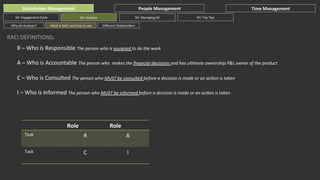
R	
  –	
  Who	
  is	
  Responsible	
  The	
  person	
  who	
  is	
  assigned	
  to	
  do	
  the	
  work	


A	
  –	
  Who	
  is	
  Accountable	
  The	
  person	
  who	
  	
  makes	
  the	
  financial	
  decisions	
  and	
  has	
  ul6mate	
  ownership	
  P&L	
  owner	
  of	
  the	
  product	


C	
  –	
  Who	
  is	
  Consulted	
  The	
  person	
  who	
  MUST	
  be	
  consulted	
  before	
  a	
  decision	
  is	
  made	
  or	
  an	
  ac6on	
  is	
  taken	


I	
  –	
  Who	
  is	
  Informed	
  The	
  person	
  who	
  MUST	
  be	
  informed	
  before	
  a	
  decision	
  is	
  made	
  or	
  an	
  ac6on	
  is	
  taken	
  

Role	
  

Role	
  

Task	
  

R	
  

A	
  

Task	
  

C	
  

I	
  
Stakeholder	
  Management	
  
SH:	
  Engagement	
  Cycle	
  
Why	
  do	
  Analysis?	
  

People	
  Management	
  
SH:	
  Top	
  Tips	
  

SH:	
  Managing	
  SH	
  

SH:	
  Analysis	
  
What	
  is	
  RACI	
  and	
  how	
  to	
  use	
  

Time	
  Management	
  

Different	
  Stakeholders	
  

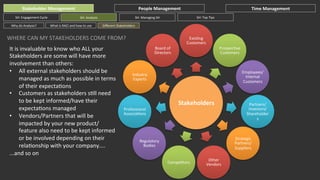
WHERE	
  CAN	
  MY	
  STAKEHOLDERS	
  COME	
  FROM?	
  
It	
  is	
  invaluable	
  to	
  know	
  who	
  ALL	
  your	
  
Stakeholders	
  are	
  some	
  will	
  have	
  more	
  
involvement	
  than	
  others:	
  
•  All	
  external	
  stakeholders	
  should	
  be	
  
managed	
  as	
  much	
  as	
  possible	
  in	
  terms	
  
of	
  their	
  expectaGons	
  
•  Customers	
  as	
  stakeholders	
  sGll	
  need	
  
to	
  be	
  kept	
  informed/have	
  their	
  
expectaGons	
  managed	
  
•  Vendors/Partners	
  that	
  will	
  be	
  
impacted	
  by	
  your	
  new	
  product/
feature	
  also	
  need	
  to	
  be	
  kept	
  informed	
  
or	
  be	
  involved	
  depending	
  on	
  their	
  
relaGonship	
  with	
  your	
  company....	
  
...and	
  so	
  on	
  

Board	
  of	
  
Directors	
  

ExisGng	
  
Customers	
  

ProspecGve	
  
Customers	
  

Employees/	
  
Internal	
  
Customers	
  

Industry	
  
Experts	
  

Professional	
  
AssociaGons	
  

Stakeholders	
  

Partners/	
  	
  
Investors/	
  
Shareholder
s	
  

Strategic	
  
Partners/	
  
Suppliers	
  

Regulatory	
  
Bodies	
  

CompeGtors	
  

Other	
  
Vendors	
  
Stakeholder	
  Management	
  
SH:	
  Engagement	
  Cycle	
  
Managing	
  ExpectaGons	
  

People	
  Management	
  
SH:	
  Analysis	
  

SH:	
  Managing	
  SH	
  

Time	
  Management	
  
SH:	
  Top	
  Tips	
  

Supporters/Opponents	
  

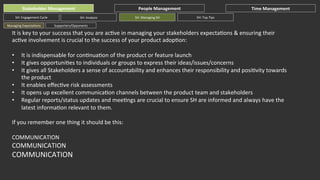
It	
  is	
  key	
  to	
  your	
  success	
  that	
  you	
  are	
  acGve	
  in	
  managing	
  your	
  stakeholders	
  expectaGons	
  &	
  ensuring	
  their	
  
acGve	
  involvement	
  is	
  crucial	
  to	
  the	
  success	
  of	
  your	
  product	
  adopGon:	


•  It	
  is	
  indispensable	
  for	
  conGnuaGon	
  of	
  the	
  product	
  or	
  feature	
  launch	
  
•  It	
  gives	
  opportuniGes	
  to	
  individuals	
  or	
  groups	
  to	
  express	
  their	
  ideas/issues/concerns	
  
•  It	
  gives	
  all	
  Stakeholders	
  a	
  sense	
  of	
  accountability	
  and	
  enhances	
  their	
  responsibility	
  and	
  posiGvity	
  towards	
  
the	
  product	
  
•  It	
  enables	
  effecGve	
  risk	
  assessments	
  
•  It	
  opens	
  up	
  excellent	
  communicaGon	
  channels	
  between	
  the	
  product	
  team	
  and	
  stakeholders	
  
•  Regular	
  reports/status	
  updates	
  and	
  meeGngs	
  are	
  crucial	
  to	
  ensure	
  SH	
  are	
  informed	
  and	
  always	
  have	
  the	
  
latest	
  informaGon	
  relevant	
  to	
  them.	
  
If	
  you	
  remember	
  one	
  thing	
  it	
  should	
  be	
  this:	


COMMUNICATION	
  

COMMUNICATION	
  

COMMUNICATION	
  
Stakeholder	
  Management	
  
SH:	
  Engagement	
  Cycle	
  
Managing	
  ExpectaGons	
  

People	
  Management	
  
SH:	
  Managing	
  SH	
  

SH:	
  Analysis	
  

Time	
  Management	
  
SH:	
  Top	
  Tips	
  

Supporters/Opponents	
  

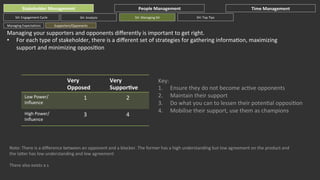
Managing	
  your	
  supporters	
  and	
  opponents	
  differently	
  is	
  important	
  to	
  get	
  right.	
  
•  For	
  each	
  type	
  of	
  stakeholder,	
  there	
  is	
  a	
  different	
  set	
  of	
  strategies	
  for	
  gathering	
  informaGon,	
  maximizing	
  
support	
  and	
  minimizing	
  opposiGon	
  

Very	
  
Opposed	
  

Very	
  
SupporHve	
  

Low	
  Power/
Influence	
  

1	
  

2	
  

High	
  Power/
Influence	
  

3	
  

4	
  

Key:	
  
1.  Ensure	
  they	
  do	
  not	
  become	
  acGve	
  opponents	
  
2.  Maintain	
  their	
  support	
  
3.  Do	
  what	
  you	
  can	
  to	
  lessen	
  their	
  potenGal	
  opposiGon	
  
4.  Mobilise	
  their	
  support,	
  use	
  them	
  as	
  champions	
  

Note:	
  There	
  is	
  a	
  difference	
  between	
  an	
  opponent	
  and	
  a	
  blocker.	
  The	
  former	
  has	
  a	
  high	
  understanding	
  but	
  low	
  agreement	
  on	
  the	
  product	
  and	
  
the	
  laher	
  has	
  low	
  understanding	
  and	
  low	
  agreement	


There	
  also	
  exists	
  a	
  s	
  
Stakeholder	
  Management	
  
SH:	
  Engagement	
  Cycle	
  

People	
  Management	
  
SH:	
  Analysis	
  

SH:	
  Managing	
  SH	
  

Time	
  Management	
  
SH:	
  Top	
  Tips	
  

TIP	
  #1	
  
When	
  planning	
  a	
  sign	
  off	
  meeGng	
  or	
  gate	
  meeGng	
  ensure	
  you	
  have	
  engaged	
  with	
  all	
  SH	
  individually	
  before	
  the	
  
group	
  meeGng	
  so	
  there	
  are	
  NO	
  SURPRISES	
  for	
  any	
  of	
  the	
  SH,	
  get	
  their	
  individual	
  buy	
  in,	
  and	
  update	
  the	
  deck	
  
according	
  to	
  their	
  input/advice/concerns	
  etc	


TIP	
  #2	
  
If	
  you	
  are	
  doing	
  a	
  presentaGon	
  at	
  a	
  gate	
  review	
  or	
  update,	
  consider	
  including	
  individual	
  SH	
  views	
  or	
  opinion	
  (or	
  
sound	
  bites)	
  in	
  one	
  of	
  the	
  slides	
  –	
  see	
  this	
  work	
  it’s	
  magic!	


TIP	
  #3	
  	
  
Create	
  regular	
  1:1	
  catch	
  ups	
  with	
  your	
  SH	
  to	
  inform	
  them	
  specifically	
  of	
  the	
  product	
  status	
  (this	
  should	
  be	
  on	
  
top	
  of	
  regular	
  reports/emails	
  you	
  send	
  to	
  all	
  SH	


If	
  you	
  do	
  these	
  your	
  SH	
  will	
  all	
  feel:	
  
• 	
  Engaged	
  
• 	
  Informed	
  
• 	
  &	
  part	
  of	
  the	
  process	
  
Stakeholder	
  Management	
  
PM:	
  	
  Trust	
  &	
  Influencing	
  

People	
  Management	
  
PM:	
  Delivering	
  

Time	
  Management	
  

PM:	
  Top	
  Tips	
  

TRUST	
  
• 
• 
• 

The	
  best	
  way	
  to	
  ensure	
  that	
  people	
  trust	
  you,	
  is	
  that	
  you	
  trust	
  them	
  
Do	
  not	
  assume	
  if	
  you	
  are	
  product	
  owner	
  people	
  will	
  automaGcally	
  trust	
  that	
  you	
  know	
  best	
  –	
  you	
  need	
  to	
  
work	
  hard	
  to	
  know	
  your	
  product	
  beher	
  than	
  anyone	
  else.	
  
You	
  need	
  to	
  trust	
  others	
  to	
  do	
  the	
  job	
  they’ve	
  been	
  employed	
  to	
  do	
  

INFLUENCING	
  
• 
• 

In	
  your	
  product	
  teams,	
  as	
  product	
  owner	
  you	
  may	
  by	
  default	
  have	
  a	
  level	
  of	
  influence.	
  Never	
  misuse	
  this.	
  
If	
  you	
  are	
  struggling	
  to	
  maintain	
  a	
  level	
  of	
  influence,	
  ask	
  yourself	
  why?	
  Have	
  you	
  wrihen	
  clear	
  specificaGons?	
  
Have	
  you	
  built	
  up	
  and	
  are	
  you	
  maintaining	
  your	
  keyrelaGonships	
  adequately?	
  	
  
Stakeholder	
  Management	
  
PM:	
  	
  Trust	
  &	
  Influencing	
  

People	
  Management	
  
PM:	
  Delivering	
  

Time	
  Management	
  

PM:	
  Top	
  Tips	
  

DRIVING	
  DRIVING	
  DRIVING	
  
• 

As	
  product	
  owner	
  you	
  need	
  to	
  be	
  the	
  one	
  driving	
  things	
  forward,	
  pushing	
  and	
  cajoling	
  where	
  necessary	
  to	
  
keep	
  the	
  energy	
  going.	
  If	
  you	
  lose	
  the	
  energy	
  you	
  not	
  only	
  lose	
  the	
  control	
  but	
  risk	
  the	
  Gmely	
  delivery	
  of	
  the	
  
product/feature	
  

CONTROL	
  
• 

There	
  are	
  many	
  ways	
  you	
  can	
  maintain	
  control:	
  
•  WRITE	
  YOUR	
  OWN	
  SPECS/REQUIREMENTS	
  –	
  DO	
  NOT	
  be	
  tempted	
  to	
  let	
  your	
  dev	
  lead	
  do	
  these	
  for	
  
you....	
  
•  The	
  Devil	
  is	
  in	
  the	
  detail	
  –	
  as	
  soon	
  as	
  you	
  lose	
  sight	
  of	
  the	
  detail	
  –	
  you	
  lose	
  an	
  element	
  of	
  control	
  
•  MeeGng	
  Minutes:	
  it	
  sounds	
  boring,	
  but	
  if	
  you	
  take	
  minutes/send	
  out	
  minutes	
  and	
  control	
  the	
  acGons	
  
and	
  flow	
  of	
  informaGon	
  –	
  you	
  are	
  in	
  the	
  driving	
  seat	
  

NB	
  –	
  Control	
  is	
  not	
  about	
  ownership	
  it’s	
  about	
  accountability	
  –	
  if	
  you	
  are	
  accountable	
  for	
  the	
  delivery	
  of	
  a	
  product	
  	
  
then	
  you	
  need	
  to	
  be	
  in	
  control	
  .....there	
  is	
  no	
  use	
  blaming	
  geJng	
  lost	
  on	
  the	
  back	
  seat	
  driver	
  you	
  are	
  both	
  the	
  
navigator	
  and	
  the	
  one	
  driving	
  the	
  car!	
  
Stakeholder	
  Management	
  
PM:	
  	
  Trust	
  &	
  Influencing	
  

People	
  Management	
  
PM:	
  Delivering	
  

Time	
  Management	
  

PM:	
  Top	
  Tips	
  

TIP	
  #1	
  
Be	
  on	
  Gme	
  to	
  meeGngs,	
  prepare	
  before	
  meeGngs,	
  take	
  minutes	
  and	
  send	
  out	
  notes/acGons	
  to	
  all	
  present	
  as	
  
well	
  as	
  any	
  necessary	
  no	
  shows/stakeholders	


TIP	
  #2	
  
Take	
  the	
  Gme	
  to	
  know	
  your	
  product	
  beher	
  than	
  anyone	
  else,	
  both	
  in	
  terms	
  of	
  what	
  you	
  are	
  delivering,	
  what	
  
your	
  compeGtors	
  are	
  delivering	
  and	
  what	
  your	
  customers	
  are	
  asking	
  for....	
  Your	
  influence	
  as	
  a	
  product	
  owner	
  
should	
  be	
  from	
  ALL	
  perspecGves	
  that	
  maher	


TIP	
  #3	
  	
  
Build	
  up	
  and	
  maintain	
  your	
  key	
  relaGonships	
  in	
  your	
  product	
  team	
  but	
  also	
  beyond.	
  Take	
  the	
  Gme	
  to	
  get	
  to	
  
know	
  the	
  support	
  team,	
  sales	
  teams	
  the	
  people	
  on	
  the	
  front	
  line	
  –	
  get	
  invited	
  to	
  customer	
  meeGngs,	
  spend	
  the	
  
Gme	
  looking	
  at	
  the	
  BUGs	
  and	
  ERs	
  coming	
  through	
  the	
  support	
  team	


“If	
  you	
  can’t	
  explain	
  it	
  simply,	
  then	
  you	
  don’t	
  understand	
  it	
  well	
  enough”	
  
Albert	
  Einstein	
  

“The	
  secret	
  of	
  my	
  influence	
  has	
  always	
  been	
  that	
  it	
  remained	
  a	
  secret.”	
  
Salvador	
  Dali	
  

“It’s	
  not	
  that	
  I	
  am	
  so	
  smart,	
  it’s	
  just	
  I	
  stay	
  with	
  problems	
  longer.”	
  
Albert	
  Einstein	
  
Stakeholder	
  Management	
  
TM:	
  	
  Self	
  Mgt	
  

TM:	
  MeeGng	
  Mgt	
  

People	
  Management	
  
TM:	
  PrioriGsaGon	
  

Time	
  Management	
  
TM:	
  Top	
  Tips	
  

LISTS	
  LISTS	
  LISTS:	
  
Write	
  everything	
  down	
  –	
  no	
  one	
  can	
  remember	
  everything!	
  
• 

Make	
  daily	
  to	
  do	
  lists	
  and	
  categorise	
  them:	
  Must	
  do	
  today,	
  do	
  today	
  if	
  have	
  Gme,	
  only	
  do	
  if	
  finish	
  
everything	
  else	
  or	
  can	
  stay	
  late!	
  
•  Review	
  your	
  daily	
  to	
  do	
  list	
  at	
  the	
  start	
  of	
  the	
  day,	
  or	
  the	
  end	
  of	
  the	
  day	
  before.	
  

TOOLS	
  FOR	
  THE	
  JOB:	
  
• 

Use	
  a	
  tool	
  for	
  all	
  your	
  acGons	


  is	
  a	
  great/free	
  online	
  tool	
  for	
  this.	
  
• 

You	
  can	
  also	
  consider	
  using	


  or	
  other	
  online	
  collaboraGon	
  tools	
  to	
  manage	
  your	
  Gme	
  and	
  your	
  product	
  
teams	
  workload	
  

• 

Set	
  reminders	
  in	
  Outlook	
  or	
  your	
  email/meeGng	
  tool	
  to	
  ensure	
  you	
  don’t	
  miss	
  a	
  deadline	
  

• 

Block	
  Gme	
  out	
  in	
  your	
  day	
  to	
  complete	
  criGcal	
  tasks,	
  spec	
  wriGng,	
  SH	
  presentaGons	
  etc	
  
Stakeholder	
  Management	
  
TM:	
  	
  Self	
  Mgt	
  

TM:	
  MeeGng	
  Mgt	
  

People	
  Management	
  
TM:	
  PrioriGsaGon	
  

Time	
  Management	
  
TM:	
  Top	
  Tips	
  

MEETINGS	
  FOR	
  MEETINGS	
  SAKE:	
  
• 
• 
• 
• 
• 

Consider	
  all	
  your	
  meeGngs	
  carefully.	
  Do	
  not	
  book	
  meeGngs	
  for	
  the	
  sake	
  of	
  having	
  a	
  meeGng	
  
All	
  meeGngs	
  should	
  have	
  a	
  clearly	
  defined	
  purpose	
  and	
  agenda	
  
Only	
  invite	
  essenGal	
  people	
  to	
  the	
  meeGng	
  
If	
  you	
  need	
  a	
  decision	
  made	
  in	
  a	
  meeGng	
  make	
  sure	
  you	
  make	
  this	
  clear	
  in	
  the	
  invite	
  and	
  up	
  front	
  in	
  the	
  
meeGng,	
  review	
  that	
  you	
  have	
  the	
  right	
  decision	
  makers	
  present	
  –	
  if	
  not	
  don’t	
  be	
  afraid	
  to	
  cut	
  the	
  meeGng	
  
short	
  and	
  re	
  arrange	
  
If	
  you	
  finish	
  early	
  then	
  call	
  end	
  to	
  the	
  meeGng	
  don’t	
  fill	
  the	
  full	
  Gme	
  allocated	
  as	
  a	
  maher	
  of	
  course	
  

MEETING	
  LENGTH	
  IS	
  KEY:	
  
• 
• 

• 

Don’t	
  over	
  esGmate	
  Gme	
  needed	
  for	
  meeGngs	
  and	
  don’t	
  be	
  afraid	
  to	
  call	
  15	
  minute	
  meeGngs	
  
Stand	
  up	
  meeGngs	
  are	
  a	
  great	
  way	
  to	
  cut	
  out	
  the	
  chit	
  chat	
  –	
  not	
  all	
  meeGngs	
  are	
  about	
  relaGonship	
  
building	
  
•  If	
  you	
  do	
  not	
  have	
  a	
  stand	
  up	
  meeGng	
  room/area	
  in	
  your	
  office	
  then	
  create	
  one	
  by	
  the	
  water	
  
cooler/printer/recepGon	
  area	
  etc	
  
Start	
  the	
  meeGng	
  on	
  Gme,	
  and	
  try	
  not	
  to	
  play	
  catch	
  up	
  when	
  people	
  come	
  in	
  late	
  –	
  tell	
  them	
  anything	
  
they	
  missed	
  will	
  be	
  in	
  the	
  meeGng	
  notes	
  including	
  any	
  of	
  their	
  acGons!	
  They	
  will	
  soon	
  learn	
  and	
  turn	
  up	
  
on	
  Gme...	
  
Stakeholder	
  Management	
  
TM:	
  	
  Self	
  Mgt	
  

TM:	
  MeeGng	
  Mgt	
  

People	
  Management	
  
TM:	
  PrioriGsaGon	
  

Time	
  Management	
  
TM:	
  Top	
  Tips	
  

PRIORITISE	
  YOUR	
  TIME:	
  
• 

• 

Every	
  day	
  as	
  your	
  review	
  your	
  to	
  do	
  list	
  make	
  sure	
  you	
  prioriGse	
  your	
  tasks	
  in	
  accordance	
  with:	
  
•  Quick	
  Wins	
  –	
  High	
  Impact	
  
•  More	
  involved	
  tasks	
  –	
  High	
  Impact	
  
•  Quick	
  Wins	
  –	
  Mid	
  Impact	
  and	
  so	
  on....	
  (Impact	
  on	
  product	
  delivery	
  and	
  stakeholder	
  expectaGons....	
  
Move	
  unfinished	
  tasks	
  to	
  the	
  top	
  of	
  the	
  next	
  days	
  queue	
  and	
  always	
  review	
  the	
  urgency	
  day	
  to	
  day.	
  

TOOLS	
  FIT	
  FOR	
  PURPOSE:	
  
• 
• 

Use	
  online	
  tools	
  to	
  prioriGse	
  your	
  work	
  load	
  e.g.	
  
Use	
  Outlook	
  to	
  prioriGse	
  emails	
  you	
  need	
  to	
  respond	
  to.	
  	
  
•  Create	
  rules	
  to	
  put	
  into	
  folders	
  or	
  colour	
  emails	
  from	
  stakeholders	
  differently	
  
•  Have	
  a	
  folder	
  ‘Respond	
  to	
  Today’	
  make	
  all	
  emails	
  ‘unread’	
  as	
  you	
  move	
  them	
  into	
  here	
  so	
  you	
  have	
  a	
  
full	
  tally	
  visible	
  
•  A	
  ‘Read	
  Later’	
  or	
  ‘Respond	
  to	
  this	
  week’	
  	
  for	
  less	
  urgent	
  tasks	
  can	
  also	
  help	
  
Stakeholder	
  Management	
  
TM:	
  	
  Self	
  Mgt	
  

TM:	
  MeeGng	
  Mgt	
  

People	
  Management	
  
TM:	
  PrioriGsaGon	
  

Time	
  Management	
  
TM:	
  Top	
  Tips	
  

TIP	
  #1	
  
Don’t	
  let	
  your	
  day	
  be	
  dictated	
  by	
  ad	
  hoc	
  requests	
  –	
  if	
  they	
  come	
  in	
  then	
  put	
  them	
  into	
  your	
  prioriGsed	
  list	
  along	
  
with	
  everything	
  else....(so	
  easy	
  to	
  NOT	
  do	
  this!)	


TIP	
  #2	
  
Everything	
  in	
  Gme	
  management	
  will	
  go	
  off	
  kilter	
  if	
  your	
  stakeholder	
  management	
  is	
  not	
  best	
  pracGce.	
  If	
  you	
  
have	
  not	
  managed	
  your	
  stakeholder	
  expectaGons	
  well	
  then	
  your	
  day/week/month	
  could	
  be	
  adversely	
  impact	
  
and	
  spiral	
  out	
  of	
  your	
  control	
  if	
  you	
  have	
  to	
  jump	
  to	
  respond	
  to	
  unreasonable	
  requests	
  or	
  unplanned	
  work	


TIP	
  #3	
  	
  
Don’t	
  be	
  afraid	
  to	
  say	
  no,	
  as	
  long	
  as	
  there	
  is	
  good	
  reason	
  people	
  will	
  understand	
  and	
  if	
  not	
  explain	
  what	
  you	
  are	
  
doing	
  takes	
  priority	
  and	
  why	


Any	
  QuesGons?	


Thanks	


Becky	
  Yelland	


www.pragmaGcproducteer.com	
  
becky@pragmaGcproducteer.com	


Product Stakeholder to Time Management

  • 1.
    From  Stakeholder  to  Time  Management   A  Guide  for  Product  Managers     Becky  Yelland    
  • 2.
    BACKGROUND   •  13  years  of  delivery  &  team  management  experience   •  8  years  in  product  management  role,  4  senior  level   EXPERIENCE   •  InteracGve  TV/Gaming  and  BeJng   •  Broadcast  Media   •  Personal  Media/Publishing   •  SaaS/Mobile  in  Digital  MarkeGng   •  Financial  Services/News  
  • 3.
    What  are  the  keys  to  being  a  successful  product  manager?         CommunicaGon     RelaGonships  
  • 4.
    You  are  only  as  good  as  your  last  delivery.....   If  your  team  look  good  –  YOU  look  good   Looking  busy  does  not   mean  you  are  being   producGve!  
  • 5.
    Product  Manager  Tool  Kits  for  success:     #1  –  Stakeholder  Management     #2  –  People  Management     #3  –  Time  Management          
  • 6.
    Stakeholder  Management   SH:  Engagement  Cycle   People  Management   SH:  Analysis   SH:  Managing  SH   •  Document  Needs:  Knowing  what  all  your  stakeholders   need  in  terms  of  reports/updates/informaGon  in   order  to  gain  and  retain  their  buy  in   •  Analyse  SH  influence/interest:  Do  a  RACI  or  similar   •  Manage  SH  expectaGons:  in  terms  of  what  will  be   delivered  and  when  and  how  thy  will  be  kept   informed  and  influence.   •  Review  and  Repeat:  don’t  sit  on  your  laurels  with  this   approach  conGnue  to  assess  if  it’s  working  for  the   product  team  and  for  all  your  SH   SH:  Top  Tips   IdenGfying  your  Stakeholders:  All  stakeholders  are   individuals  or  organizaGons  that  are  acGvely  involved   in  the  product,  or  whose  interests  may  be  affected  as   a  result  of  the  product  or  feature  launch.   •  Time  Management   IdenGfy   Stakeholders   Review  and   Repeat   Manage   Stakeholder   ExpectaGons   Document   Needs   Analyse   Stakeholder   Influence/   Interest  
  • 7.
    Stakeholder  Management   SH:  Engagement  Cycle   Why  do  Analysis?   People  Management   SH:  Managing  SH   SH:  Analysis   What  is  RACI  and  how  to  use   Time  Management   SH:  Top  Tips   Different  Stakeholders   WHY  DO  A  STAKEHOLDER  ANAYLSIS?   A  stakeholder  analysis  can  help  a  product  team  to  idenGfy:   •  The  interests  of  all  stakeholders,  who  may  affect  or  be  affected  by  the  product  or  feature   •  PotenGal  issues  that  could  disrupt  the  product  delivery   •  Key  people  to  engage  during    rollout   •  Individuals  and  groups  that  should  be  encouraged  to  parGcipate  in  different  stages  of  the  product   delivery   •  CommunicaGon  planning  &  stakeholder  management  strategy  should  be  done  up  front   •  Managing  negaGve  stakeholders   •  Engaging  stakeholders  throughout  the  project  life  cycle  is  a  key  to  (but  not  a  guarantee  of)  success.   Low  Interest   High  Interest   Low  Power/ Influence   1   2   High  Power/ Influence   3   4   Key:   1.  Monitor,  Minimal  Effort   2.  Keep  Informed   3.  Keep  SaGsfied   4.  Key  Players,  Manage  Closely   Link  to  tools:  www.pragmaGcproducteer/stakeholder-­‐planning-­‐template  
  • 8.
    Stakeholder  Management   SH:  Engagement  Cycle   Why  do  Analysis?   People  Management   SH:  Managing  SH   SH:  Analysis   What  is  RACI  and  how  to  use   Time  Management   SH:  Top  Tips   Different  Stakeholders   RACI  DEFINITIONS:   R  –  Who  is  Responsible  The  person  who  is  assigned  to  do  the  work     A  –  Who  is  Accountable  The  person  who    makes  the  financial  decisions  and  has  ul6mate  ownership  P&L  owner  of  the  product     C  –  Who  is  Consulted  The  person  who  MUST  be  consulted  before  a  decision  is  made  or  an  ac6on  is  taken     I  –  Who  is  Informed  The  person  who  MUST  be  informed  before  a  decision  is  made  or  an  ac6on  is  taken   Role   Role   Task   R   A   Task   C   I  
  • 9.
    Stakeholder  Management   SH:  Engagement  Cycle   Why  do  Analysis?   People  Management   SH:  Top  Tips   SH:  Managing  SH   SH:  Analysis   What  is  RACI  and  how  to  use   Time  Management   Different  Stakeholders   WHERE  CAN  MY  STAKEHOLDERS  COME  FROM?   It  is  invaluable  to  know  who  ALL  your   Stakeholders  are  some  will  have  more   involvement  than  others:   •  All  external  stakeholders  should  be   managed  as  much  as  possible  in  terms   of  their  expectaGons   •  Customers  as  stakeholders  sGll  need   to  be  kept  informed/have  their   expectaGons  managed   •  Vendors/Partners  that  will  be   impacted  by  your  new  product/ feature  also  need  to  be  kept  informed   or  be  involved  depending  on  their   relaGonship  with  your  company....   ...and  so  on   Board  of   Directors   ExisGng   Customers   ProspecGve   Customers   Employees/   Internal   Customers   Industry   Experts   Professional   AssociaGons   Stakeholders   Partners/     Investors/   Shareholder s   Strategic   Partners/   Suppliers   Regulatory   Bodies   CompeGtors   Other   Vendors  
  • 10.
    Stakeholder  Management   SH:  Engagement  Cycle   Managing  ExpectaGons   People  Management   SH:  Analysis   SH:  Managing  SH   Time  Management   SH:  Top  Tips   Supporters/Opponents   It  is  key  to  your  success  that  you  are  acGve  in  managing  your  stakeholders  expectaGons  &  ensuring  their   acGve  involvement  is  crucial  to  the  success  of  your  product  adopGon:     •  It  is  indispensable  for  conGnuaGon  of  the  product  or  feature  launch   •  It  gives  opportuniGes  to  individuals  or  groups  to  express  their  ideas/issues/concerns   •  It  gives  all  Stakeholders  a  sense  of  accountability  and  enhances  their  responsibility  and  posiGvity  towards   the  product   •  It  enables  effecGve  risk  assessments   •  It  opens  up  excellent  communicaGon  channels  between  the  product  team  and  stakeholders   •  Regular  reports/status  updates  and  meeGngs  are  crucial  to  ensure  SH  are  informed  and  always  have  the   latest  informaGon  relevant  to  them.   If  you  remember  one  thing  it  should  be  this:     COMMUNICATION   COMMUNICATION   COMMUNICATION  
  • 11.
    Stakeholder  Management   SH:  Engagement  Cycle   Managing  ExpectaGons   People  Management   SH:  Managing  SH   SH:  Analysis   Time  Management   SH:  Top  Tips   Supporters/Opponents   Managing  your  supporters  and  opponents  differently  is  important  to  get  right.   •  For  each  type  of  stakeholder,  there  is  a  different  set  of  strategies  for  gathering  informaGon,  maximizing   support  and  minimizing  opposiGon   Very   Opposed   Very   SupporHve   Low  Power/ Influence   1   2   High  Power/ Influence   3   4   Key:   1.  Ensure  they  do  not  become  acGve  opponents   2.  Maintain  their  support   3.  Do  what  you  can  to  lessen  their  potenGal  opposiGon   4.  Mobilise  their  support,  use  them  as  champions   Note:  There  is  a  difference  between  an  opponent  and  a  blocker.  The  former  has  a  high  understanding  but  low  agreement  on  the  product  and   the  laher  has  low  understanding  and  low  agreement     There  also  exists  a  s  
  • 12.
    Stakeholder  Management   SH:  Engagement  Cycle   People  Management   SH:  Analysis   SH:  Managing  SH   Time  Management   SH:  Top  Tips   TIP  #1   When  planning  a  sign  off  meeGng  or  gate  meeGng  ensure  you  have  engaged  with  all  SH  individually  before  the   group  meeGng  so  there  are  NO  SURPRISES  for  any  of  the  SH,  get  their  individual  buy  in,  and  update  the  deck   according  to  their  input/advice/concerns  etc     TIP  #2   If  you  are  doing  a  presentaGon  at  a  gate  review  or  update,  consider  including  individual  SH  views  or  opinion  (or   sound  bites)  in  one  of  the  slides  –  see  this  work  it’s  magic!     TIP  #3     Create  regular  1:1  catch  ups  with  your  SH  to  inform  them  specifically  of  the  product  status  (this  should  be  on   top  of  regular  reports/emails  you  send  to  all  SH     If  you  do  these  your  SH  will  all  feel:   •   Engaged   •   Informed   •   &  part  of  the  process  
  • 13.
    Stakeholder  Management   PM:    Trust  &  Influencing   People  Management   PM:  Delivering   Time  Management   PM:  Top  Tips   TRUST   •  •  •  The  best  way  to  ensure  that  people  trust  you,  is  that  you  trust  them   Do  not  assume  if  you  are  product  owner  people  will  automaGcally  trust  that  you  know  best  –  you  need  to   work  hard  to  know  your  product  beher  than  anyone  else.   You  need  to  trust  others  to  do  the  job  they’ve  been  employed  to  do   INFLUENCING   •  •  In  your  product  teams,  as  product  owner  you  may  by  default  have  a  level  of  influence.  Never  misuse  this.   If  you  are  struggling  to  maintain  a  level  of  influence,  ask  yourself  why?  Have  you  wrihen  clear  specificaGons?   Have  you  built  up  and  are  you  maintaining  your  keyrelaGonships  adequately?    
  • 14.
    Stakeholder  Management   PM:    Trust  &  Influencing   People  Management   PM:  Delivering   Time  Management   PM:  Top  Tips   DRIVING  DRIVING  DRIVING   •  As  product  owner  you  need  to  be  the  one  driving  things  forward,  pushing  and  cajoling  where  necessary  to   keep  the  energy  going.  If  you  lose  the  energy  you  not  only  lose  the  control  but  risk  the  Gmely  delivery  of  the   product/feature   CONTROL   •  There  are  many  ways  you  can  maintain  control:   •  WRITE  YOUR  OWN  SPECS/REQUIREMENTS  –  DO  NOT  be  tempted  to  let  your  dev  lead  do  these  for   you....   •  The  Devil  is  in  the  detail  –  as  soon  as  you  lose  sight  of  the  detail  –  you  lose  an  element  of  control   •  MeeGng  Minutes:  it  sounds  boring,  but  if  you  take  minutes/send  out  minutes  and  control  the  acGons   and  flow  of  informaGon  –  you  are  in  the  driving  seat   NB  –  Control  is  not  about  ownership  it’s  about  accountability  –  if  you  are  accountable  for  the  delivery  of  a  product     then  you  need  to  be  in  control  .....there  is  no  use  blaming  geJng  lost  on  the  back  seat  driver  you  are  both  the   navigator  and  the  one  driving  the  car!  
  • 15.
    Stakeholder  Management   PM:    Trust  &  Influencing   People  Management   PM:  Delivering   Time  Management   PM:  Top  Tips   TIP  #1   Be  on  Gme  to  meeGngs,  prepare  before  meeGngs,  take  minutes  and  send  out  notes/acGons  to  all  present  as   well  as  any  necessary  no  shows/stakeholders     TIP  #2   Take  the  Gme  to  know  your  product  beher  than  anyone  else,  both  in  terms  of  what  you  are  delivering,  what   your  compeGtors  are  delivering  and  what  your  customers  are  asking  for....  Your  influence  as  a  product  owner   should  be  from  ALL  perspecGves  that  maher     TIP  #3     Build  up  and  maintain  your  key  relaGonships  in  your  product  team  but  also  beyond.  Take  the  Gme  to  get  to   know  the  support  team,  sales  teams  the  people  on  the  front  line  –  get  invited  to  customer  meeGngs,  spend  the   Gme  looking  at  the  BUGs  and  ERs  coming  through  the  support  team      
  • 16.
    “If  you  can’t  explain  it  simply,  then  you  don’t  understand  it  well  enough”   Albert  Einstein   “The  secret  of  my  influence  has  always  been  that  it  remained  a  secret.”   Salvador  Dali   “It’s  not  that  I  am  so  smart,  it’s  just  I  stay  with  problems  longer.”   Albert  Einstein  
  • 17.
    Stakeholder  Management   TM:    Self  Mgt   TM:  MeeGng  Mgt   People  Management   TM:  PrioriGsaGon   Time  Management   TM:  Top  Tips   LISTS  LISTS  LISTS:   Write  everything  down  –  no  one  can  remember  everything!   •  Make  daily  to  do  lists  and  categorise  them:  Must  do  today,  do  today  if  have  Gme,  only  do  if  finish   everything  else  or  can  stay  late!   •  Review  your  daily  to  do  list  at  the  start  of  the  day,  or  the  end  of  the  day  before.   TOOLS  FOR  THE  JOB:   •  Use  a  tool  for  all  your  acGons                          is  a  great/free  online  tool  for  this.   •  You  can  also  consider  using                                                                                          or  other  online  collaboraGon  tools  to  manage  your  Gme  and  your  product   teams  workload   •  Set  reminders  in  Outlook  or  your  email/meeGng  tool  to  ensure  you  don’t  miss  a  deadline   •  Block  Gme  out  in  your  day  to  complete  criGcal  tasks,  spec  wriGng,  SH  presentaGons  etc  
  • 18.
    Stakeholder  Management   TM:    Self  Mgt   TM:  MeeGng  Mgt   People  Management   TM:  PrioriGsaGon   Time  Management   TM:  Top  Tips   MEETINGS  FOR  MEETINGS  SAKE:   •  •  •  •  •  Consider  all  your  meeGngs  carefully.  Do  not  book  meeGngs  for  the  sake  of  having  a  meeGng   All  meeGngs  should  have  a  clearly  defined  purpose  and  agenda   Only  invite  essenGal  people  to  the  meeGng   If  you  need  a  decision  made  in  a  meeGng  make  sure  you  make  this  clear  in  the  invite  and  up  front  in  the   meeGng,  review  that  you  have  the  right  decision  makers  present  –  if  not  don’t  be  afraid  to  cut  the  meeGng   short  and  re  arrange   If  you  finish  early  then  call  end  to  the  meeGng  don’t  fill  the  full  Gme  allocated  as  a  maher  of  course   MEETING  LENGTH  IS  KEY:   •  •  •  Don’t  over  esGmate  Gme  needed  for  meeGngs  and  don’t  be  afraid  to  call  15  minute  meeGngs   Stand  up  meeGngs  are  a  great  way  to  cut  out  the  chit  chat  –  not  all  meeGngs  are  about  relaGonship   building   •  If  you  do  not  have  a  stand  up  meeGng  room/area  in  your  office  then  create  one  by  the  water   cooler/printer/recepGon  area  etc   Start  the  meeGng  on  Gme,  and  try  not  to  play  catch  up  when  people  come  in  late  –  tell  them  anything   they  missed  will  be  in  the  meeGng  notes  including  any  of  their  acGons!  They  will  soon  learn  and  turn  up   on  Gme...  
  • 19.
    Stakeholder  Management   TM:    Self  Mgt   TM:  MeeGng  Mgt   People  Management   TM:  PrioriGsaGon   Time  Management   TM:  Top  Tips   PRIORITISE  YOUR  TIME:   •  •  Every  day  as  your  review  your  to  do  list  make  sure  you  prioriGse  your  tasks  in  accordance  with:   •  Quick  Wins  –  High  Impact   •  More  involved  tasks  –  High  Impact   •  Quick  Wins  –  Mid  Impact  and  so  on....  (Impact  on  product  delivery  and  stakeholder  expectaGons....   Move  unfinished  tasks  to  the  top  of  the  next  days  queue  and  always  review  the  urgency  day  to  day.   TOOLS  FIT  FOR  PURPOSE:   •  •  Use  online  tools  to  prioriGse  your  work  load  e.g.   Use  Outlook  to  prioriGse  emails  you  need  to  respond  to.     •  Create  rules  to  put  into  folders  or  colour  emails  from  stakeholders  differently   •  Have  a  folder  ‘Respond  to  Today’  make  all  emails  ‘unread’  as  you  move  them  into  here  so  you  have  a   full  tally  visible   •  A  ‘Read  Later’  or  ‘Respond  to  this  week’    for  less  urgent  tasks  can  also  help  
  • 20.
    Stakeholder  Management   TM:    Self  Mgt   TM:  MeeGng  Mgt   People  Management   TM:  PrioriGsaGon   Time  Management   TM:  Top  Tips   TIP  #1   Don’t  let  your  day  be  dictated  by  ad  hoc  requests  –  if  they  come  in  then  put  them  into  your  prioriGsed  list  along   with  everything  else....(so  easy  to  NOT  do  this!)     TIP  #2   Everything  in  Gme  management  will  go  off  kilter  if  your  stakeholder  management  is  not  best  pracGce.  If  you   have  not  managed  your  stakeholder  expectaGons  well  then  your  day/week/month  could  be  adversely  impact   and  spiral  out  of  your  control  if  you  have  to  jump  to  respond  to  unreasonable  requests  or  unplanned  work     TIP  #3     Don’t  be  afraid  to  say  no,  as  long  as  there  is  good  reason  people  will  understand  and  if  not  explain  what  you  are   doing  takes  priority  and  why    
  • 21.
    Any  QuesGons?     Thanks     Becky  Yelland     www.pragmaGcproducteer.com   becky@pragmaGcproducteer.com