1
Chapter 11
Entry and Expansion
2
Learning Objectives
To learn how firms gradually progress
through an internationalization process.
To understand the strategic effects of
internationalization.
To study the various modes of entering
international markets.
To understand the role and functions of
international intermediaries.
To learn about the opportunities and
challenges of cooperative market
development.
3
International
Management
Successful international managers tend
to:
Be active
Be aggressive
Display a high degree of international orientation
Managerial commitment is critical
because foreign market penetration
requires a vast amount of market
development activity, sensitivity toward
foreign environments, research, and
4
The Steps to Developing
International Commitment
Become aware of
international business
opportunities.
Determine the degree of the
firm’s internationalization.
Decide the timing of when to
start the internationalization
process and how quickly it
should progress.
5
Motivations for Going
International
Proactive Motivations
Profit advantage
Unique products
Technological
advantage
Exclusive information
Tax benefit
Economies of scale
Reactive Motivations
Competitive pressures
Overproduction
Declining domestic
sales
Excess capacity
Saturated domestic
markets
Proximity to customers
and ports
6
Psychological Distance
Sometimes cultural variables, legal
factors, and other societal norms make
a foreign market that is geographically
close seem psychologically distant.
The two major issues of psychological
distance are:
Some of the distance seen by firms is based
on perception rather than reality.
Closer psychological proximity makes it easier
for firms to enter markets.
7
Profit Risk During Early
Internationalization
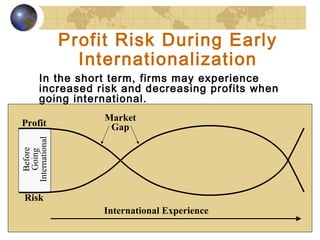
In the short term, firms may experience
increased risk and decreasing profits when
going international.
Profit
Risk
Market
Gap
International Experience
Before
Going
International
8
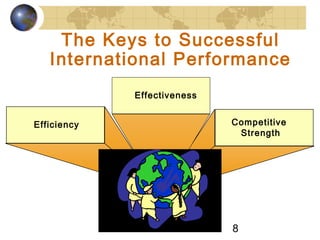
The Keys to Successful
International Performance
Efficiency Competitive
Strength
Effectiveness
9
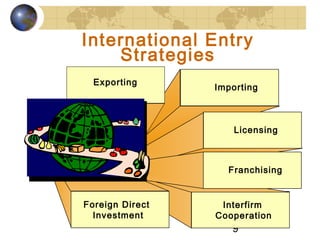
International Entry
Strategies
Licensing
Franchising
Interfirm
Cooperation
Foreign Direct
Investment
Importing
Exporting
10
Exporting and Importing
Firms can export and import using two
methods:
Indirect involvement means that the firm
participates in international business through
an intermediary and does not deal with foreign
customers or markets.
Direct involvement means that the firm works
with foreign customers or markets with the
opportunity to develop a relationship.
Firms decide on the desired method by
implementing transaction cost theory.
11
International Intermediaries
Importers and exporters often use
international intermediaries who
provide assistance in:
Documentation
Financing
Transportation
Identification of foreign suppliers and trading
companies
Providing business contacts
12
Export Management
Companies
Firms that specialize in
performing international
business services for other
companies are known as
export management
companies (EMCs)
The two primary roles of
EMCs are:
Agents
Distributors
13
Trading Companies
Trading companies help firms by importing,
exporting, countertrading, investing, and
manufacturing.
The sogashosha of Japan are the most powerful
trading companies in the world for four reasons:
They efficiently gather, evaluate, and translate market
information into business opportunities.
Economies of scale give them preferential treatment.
They operate around the world, not just Japan.
They have vast quantities of capital.
In the U.S., export trading company legislation is
designed to improve the export performance of
small and medium-sized firms.
14
Facilitators
Facilitators are entities outside the firm
that assist in the process of going
international by supplying knowledge and
information.
Private sector facilitators include:
Banks
Accounting firms
Consulting firms
Public sector facilitators include:
Departments of commerce
Export-Import Banks
Educational Institutions
15
Licensing
Under a licensing agreement, one firm
permits another to use its intellectual
property for compensation designated as
royalty.
The property licensed may include:
Patents
Trademarks
Copyrights
Technology
Technical know-how
Specific business skills
16
Benefits and Costs of
Licensing
Benefits
It requires neither capital
investment nor detailed
involvement with foreign
customers.
It capitalizes on research
and development already
conducted.
It helps avoid host country
regulations applicable to
equity ventures.
Costs
It is a very limited form of
foreign market
participation.
It does not guarantee a
basis for future expansion.
The licensor may create its
own competitor.
17
Franchising
Franchising is the granting of the right by a
parent company to another independent
entity to do business in a prescribed manner.
The major forms of franchising are:
Manufacturer-retailer systems such as car dealerships,
Manufacturer-wholesaler systems such as soft drink,
companies
Service-firm retailer systems such as fast-food outlets.
To be successful, the firm must offer unique
products or propositions, and a high degree
of standardization.
18
Key Reasons for
Franchising
Market Potential
Financial Gain Saturated Domestic
Markets
19
Interfirm Cooperation
A strategic alliance is an arrangement
between two or more companies with a
common business objective.
To better compete, many companies form
strategic alliances with suppliers, customers,
competitors, and companies in other
industries to achieve goals.
Reasons for interfirm cooperation include:
Market development
To share risk or resources
To block and co-opt competitors
20
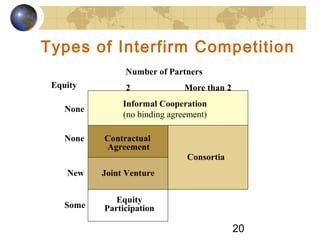
Types of Interfirm Competition
Number of Partners
2 More than 2Equity
None
None
New
Some
Informal Cooperation
(no binding agreement)
Contractual
Agreement
Joint Venture
Consortia
Equity
Participation
21
Contractual Agreements
Strategic alliance partners may join forces for
R&D, marketing, production, licensing, cross-
licensing, cross-market activities, or
outsourcing.
Contract manufacturing allows the
corporation to separate the physical
production of goods from the R&D and
marketing stages.
Management contracts involve selling one’s
expertise in running a company while
avoiding the risk or benefit of ownership.
A turnkey operation is a contractual
agreement that permits a client to acquire a
complete system following its completion.
22
Equity Participation
Some companies have acquired
minority ownerships in
companies that have strategic
importance for them.
Reasons for engaging in equity
participation include:
It ensures supplier ability
It builds working relationships
It creates market entry and support of
global operations
23
Joint Ventures
A joint venture involves the participation of
two or more companies in an enterprise in
which each party contributes assets, has
some equity, and shares risk.
The 3 reasons for establishing a joint
venture are:
Government policy or legislation.
One partner’s needs for another partner’s skills.
One partner’s needs for another partner’s attributes or
assets.
The key to a joint venture is the sharing of a
common business objective.
24
Consortia
To combat the high costs and
risks of research and
development, research consortia
have emerged in the United
States, Japan, and Europe.
The Joint Research and
Development Act of 1984 allows
domestic and foreign firms to
participate in joint basic research
efforts without the fear of antitrust
action.
Since this act passed, over 100
consortia have been registered in
the United States.
25
Managerial
Considerations
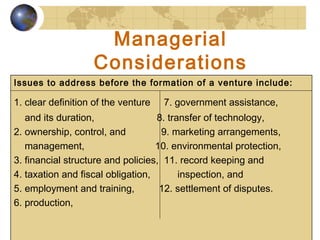
Issues to address before the formation of a venture include:
1. clear definition of the venture 7. government assistance,
and its duration, 8. transfer of technology,
2. ownership, control, and 9. marketing arrangements,
management, 10. environmental protection,
3. financial structure and policies, 11. record keeping and
4. taxation and fiscal obligation, inspection, and
5. employment and training, 12. settlement of disputes.
6. production,
26
Full Ownership
For some firms, foreign direct investment
requires full ownership. Reasons include:
An ethnocentric approach
Financial concerns
In order to make a rational decision about
the extent of ownership, management must
evaluate the extent to which total control is
important to the success of its international
marketing activities.
Increasingly, the international environment is
hostile to full ownership by multinational
firms.
27
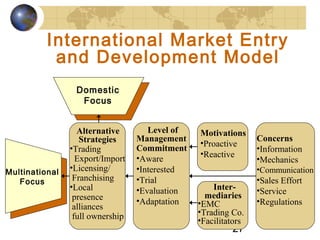
International Market Entry
and Development Model
Domestic
Focus
Multinational
Focus
Alternative
Strategies
•Trading
Export/Import
•Licensing/
Franchising
•Local
presence
alliances
full ownership
Level of
Management
Commitment
•Aware
•Interested
•Trial
•Evaluation
•Adaptation
Motivations
•Proactive
•Reactive
Inter-
mediaries
•EMC
•Trading Co.
•Facilitators
Concerns
•Information
•Mechanics
•Communication
•Sales Effort
•Service
•Regulations

International Business Chapter 11

  • 1.
  • 2.
    2 Learning Objectives To learnhow firms gradually progress through an internationalization process. To understand the strategic effects of internationalization. To study the various modes of entering international markets. To understand the role and functions of international intermediaries. To learn about the opportunities and challenges of cooperative market development.
  • 3.
    3 International Management Successful international managerstend to: Be active Be aggressive Display a high degree of international orientation Managerial commitment is critical because foreign market penetration requires a vast amount of market development activity, sensitivity toward foreign environments, research, and
  • 4.
    4 The Steps toDeveloping International Commitment Become aware of international business opportunities. Determine the degree of the firm’s internationalization. Decide the timing of when to start the internationalization process and how quickly it should progress.
  • 5.
    5 Motivations for Going International ProactiveMotivations Profit advantage Unique products Technological advantage Exclusive information Tax benefit Economies of scale Reactive Motivations Competitive pressures Overproduction Declining domestic sales Excess capacity Saturated domestic markets Proximity to customers and ports
  • 6.
    6 Psychological Distance Sometimes culturalvariables, legal factors, and other societal norms make a foreign market that is geographically close seem psychologically distant. The two major issues of psychological distance are: Some of the distance seen by firms is based on perception rather than reality. Closer psychological proximity makes it easier for firms to enter markets.
  • 7.
    7 Profit Risk DuringEarly Internationalization In the short term, firms may experience increased risk and decreasing profits when going international. Profit Risk Market Gap International Experience Before Going International
  • 8.
    8 The Keys toSuccessful International Performance Efficiency Competitive Strength Effectiveness
  • 9.
  • 10.
    10 Exporting and Importing Firmscan export and import using two methods: Indirect involvement means that the firm participates in international business through an intermediary and does not deal with foreign customers or markets. Direct involvement means that the firm works with foreign customers or markets with the opportunity to develop a relationship. Firms decide on the desired method by implementing transaction cost theory.
  • 11.
    11 International Intermediaries Importers andexporters often use international intermediaries who provide assistance in: Documentation Financing Transportation Identification of foreign suppliers and trading companies Providing business contacts
  • 12.
    12 Export Management Companies Firms thatspecialize in performing international business services for other companies are known as export management companies (EMCs) The two primary roles of EMCs are: Agents Distributors
  • 13.
    13 Trading Companies Trading companieshelp firms by importing, exporting, countertrading, investing, and manufacturing. The sogashosha of Japan are the most powerful trading companies in the world for four reasons: They efficiently gather, evaluate, and translate market information into business opportunities. Economies of scale give them preferential treatment. They operate around the world, not just Japan. They have vast quantities of capital. In the U.S., export trading company legislation is designed to improve the export performance of small and medium-sized firms.
  • 14.
    14 Facilitators Facilitators are entitiesoutside the firm that assist in the process of going international by supplying knowledge and information. Private sector facilitators include: Banks Accounting firms Consulting firms Public sector facilitators include: Departments of commerce Export-Import Banks Educational Institutions
  • 15.
    15 Licensing Under a licensingagreement, one firm permits another to use its intellectual property for compensation designated as royalty. The property licensed may include: Patents Trademarks Copyrights Technology Technical know-how Specific business skills
  • 16.
    16 Benefits and Costsof Licensing Benefits It requires neither capital investment nor detailed involvement with foreign customers. It capitalizes on research and development already conducted. It helps avoid host country regulations applicable to equity ventures. Costs It is a very limited form of foreign market participation. It does not guarantee a basis for future expansion. The licensor may create its own competitor.
  • 17.
    17 Franchising Franchising is thegranting of the right by a parent company to another independent entity to do business in a prescribed manner. The major forms of franchising are: Manufacturer-retailer systems such as car dealerships, Manufacturer-wholesaler systems such as soft drink, companies Service-firm retailer systems such as fast-food outlets. To be successful, the firm must offer unique products or propositions, and a high degree of standardization.
  • 18.
    18 Key Reasons for Franchising MarketPotential Financial Gain Saturated Domestic Markets
  • 19.
    19 Interfirm Cooperation A strategicalliance is an arrangement between two or more companies with a common business objective. To better compete, many companies form strategic alliances with suppliers, customers, competitors, and companies in other industries to achieve goals. Reasons for interfirm cooperation include: Market development To share risk or resources To block and co-opt competitors
  • 20.
    20 Types of InterfirmCompetition Number of Partners 2 More than 2Equity None None New Some Informal Cooperation (no binding agreement) Contractual Agreement Joint Venture Consortia Equity Participation
  • 21.
    21 Contractual Agreements Strategic alliancepartners may join forces for R&D, marketing, production, licensing, cross- licensing, cross-market activities, or outsourcing. Contract manufacturing allows the corporation to separate the physical production of goods from the R&D and marketing stages. Management contracts involve selling one’s expertise in running a company while avoiding the risk or benefit of ownership. A turnkey operation is a contractual agreement that permits a client to acquire a complete system following its completion.
  • 22.
    22 Equity Participation Some companieshave acquired minority ownerships in companies that have strategic importance for them. Reasons for engaging in equity participation include: It ensures supplier ability It builds working relationships It creates market entry and support of global operations
  • 23.
    23 Joint Ventures A jointventure involves the participation of two or more companies in an enterprise in which each party contributes assets, has some equity, and shares risk. The 3 reasons for establishing a joint venture are: Government policy or legislation. One partner’s needs for another partner’s skills. One partner’s needs for another partner’s attributes or assets. The key to a joint venture is the sharing of a common business objective.
  • 24.
    24 Consortia To combat thehigh costs and risks of research and development, research consortia have emerged in the United States, Japan, and Europe. The Joint Research and Development Act of 1984 allows domestic and foreign firms to participate in joint basic research efforts without the fear of antitrust action. Since this act passed, over 100 consortia have been registered in the United States.
  • 25.
    25 Managerial Considerations Issues to addressbefore the formation of a venture include: 1. clear definition of the venture 7. government assistance, and its duration, 8. transfer of technology, 2. ownership, control, and 9. marketing arrangements, management, 10. environmental protection, 3. financial structure and policies, 11. record keeping and 4. taxation and fiscal obligation, inspection, and 5. employment and training, 12. settlement of disputes. 6. production,
  • 26.
    26 Full Ownership For somefirms, foreign direct investment requires full ownership. Reasons include: An ethnocentric approach Financial concerns In order to make a rational decision about the extent of ownership, management must evaluate the extent to which total control is important to the success of its international marketing activities. Increasingly, the international environment is hostile to full ownership by multinational firms.
  • 27.
    27 International Market Entry andDevelopment Model Domestic Focus Multinational Focus Alternative Strategies •Trading Export/Import •Licensing/ Franchising •Local presence alliances full ownership Level of Management Commitment •Aware •Interested •Trial •Evaluation •Adaptation Motivations •Proactive •Reactive Inter- mediaries •EMC •Trading Co. •Facilitators Concerns •Information •Mechanics •Communication •Sales Effort •Service •Regulations