STAGES IN
HUMAN
DEVELOPMENT
BLOOPERS IN STAGES OF HUMAN
DEVELOPMENT
CTTO
0-2 • “Pa-cute-an kuno”
3-8 • Paramihan ng toys
9-18 • Pataasan ng Grades
19-25 • Padamihan ng Syota
26-35 • Pagandahan ng Asawa
36-45 • Palakihan ng Income
46-55 • Padamihan ng Kabit
56-70 • Padamihan ng Sakit
70+ • Pabonggahan ng Libing
IDENTITY
FORMATION
U N D E R S TA N D I N G C U L T U R E , S O C I E T Y A N D
P O L I T I C S
SENSE OF SELF
•Who am I?
–self-concept – beliefs
•How Good am I as a person?
–self-esteem - worthiness
–From 1-10, how good are you as a person?
SELF-CONCEPT
•Self-concept or self-identity is the sum of a
being's knowledge and understanding of
their self.
IDENTITY FORMATION
•is the development of an individual’s distinct
personality, which is regarded as a persisting
entity in a particular stage of life by which a
person is recognized or known.
IDENTITY
•Consisting of separate and distinct parts.
•It is an ever-evolving core within our
culture, loved ones, those we cared for,
people who have harmed, the deeds
done (good and ill) to self and others,
experiences lived, and choices made
come together to form who we are at
this moment.
IDENTITY
•Consisting of separate and distinct
parts.
•It is an ever-evolving core within our
culture, loved ones, those we cared
people who have harmed, the deeds
done (good and ill) to self and others,
experiences lived, and choices made
come together to form who we are at
this moment.
THEORIES OF IDENTITY FORMATION
• “Psychosocial
Development”
Erik
Erikson’s
• “Identity Status
Theory”
James
Marcia’s
ERIK ERIKSON
•Father abandoned before born.
•Irregular work in Europe without
an identity.
•Took a job as a teacher for
children.
•Took name as Erikson (son of
himself) symbolizing full
attainment of sense of identity.
ERIKSON’S THEORY
•Erikson's belief is that throughout each
person's lifetime, they experience
different crises or conflicts.
ERIK ERIKSON’S
Stages of
Psychosocial
Development
PSYCHOSOCIAL DEVELOPMENT
•Psychosocial: Development of self in
relationship to society
–Psycho: Mental processes
–Social: Relating to society
Dr. K. A. Korb
University of Jos
ERIKSON’S STAGES OF
PSYCHOSOCIAL DEVELOPMENT
•Each stage is characterized by a crisis
–Crisis: a psychosocial challenge
that presents opportunities for
development
ERIK ERIKSON
–Focus on Crisis Resolution
•At each stage a crisis must be resolved
•If the crisis is not resolved, the
individual may lack the positive
characteristic in the stage.
“WHAT YOU ARE NOW
AND WHAT YOU HAVE
BECOME,
IS A PRODUCT OF YOUR
PAST EXPERIENCES”
ERIKSON’S STAGES OF PSYCHOSOCIAL DEVELOPMENT
Stage Age (years) Crisis
Infancy 0-1 Trust vs. Mistrust
Early Childhood 2-3 Autonomy vs. Shame &
Doubt
Preschool 4-5 Initiative vs. Guilt
School Age 6-12 Industry vs. Inferiority
Adolescence 13-19 Identity vs. Role Confusion
Early Adulthood 20-40 Intimacy vs. Isolation
Middle
Adulthood
41-65 Generativity vs. Stagnation
1. TRUST VS. MISTRUST
•Birth – 1yr. (Infancy)
–Basic trust develops when needs are met
(Attachment)
–Loving relationship is formed with
caregiver
–Important event: Feeding
TRUST VS. MISTRUST
This stage is all about fulfilling needs. The
baby needs to trust the world around them to
take care of their needs.
If we can trust someone now, then we can
trust others in the future.
This sense of trust or mistrust can affect us
throughout the rest of our lives.
2. AUTONOMY VS. SHAME AND DOUBT
•2 – 3 years (Early Childhood)
–Learning to do things for
oneself
–Development of physical
activities (ex. walking)
–Important event: toilet training
AUTONOMY VS. SHAME & DOUBT
“It is OKAY to be me?”
stage.
AUTONOMY VS. SHAME & DOUBT
Autonomy means being your own boss. Here a
toddler tries to control their own bodies by toilet
training and their environment, by always saying
"NO!!!!". Sometimes they do poopy in their pants
or get yelled at by their parents, causing shame
and doubt in their own abilities. We are then able
to face the later challenges of life.
3. INITIATIVE VS. GUILT
4 – 5 years (Preschool)
–Preschoolers learn to initiate
tasks
–One becomes more independent
INITIATIVE VS. GUILT
“is it okay for me to do
what I do?” stage
INITIATIVE VS. GUILT
Here the key word in a child's life changes from "No!" to
why?". In this stage children want to understand the
world and they ask too many darn questions!!!! If their
initiative in questioning the world is encouraged, then
they will feel comfortable with expressing their curiosity
throughout the rest of their life. If we discourage them
and tell them to shut up, then they will feel guilty about
their questioning and avoid being inquisitive later.
4. INDUSTRY VS. INFERIORITY
6-12 years – (School Age)
–Child completes tasks
themselves
–Learning on your own
–Important Event: school
INDUSTRY VS. INFERIORITY
This is where most children begin formal education
(what we call school). For the first time children are
being formally evaluated. If a child raises their hand
in class and answers a question correctly, then
he/she will feel industrious (competent). If he/she
tries to answer a question but stutters to get out
the wrong answer, and other students all start
making fun of his/her speech impediment, then the
child will feel inferior.
5. IDENTITY VS. ROLE CONFUSION
•13 - 19 years old – (Adolescence)
–Teens refine sense of self
–Test new roles and incorporate them
into an identity
–Important events: forming relationships
with friends
IDENTITY VS. ROLE CONFUSION
In adolescence, Erikson believed that a teenager’s
main social need is to discover his or her social
identity. While searching for your identity, you
may try out different roles, like trying to fit into
various social and support groups, soul
searching, late night thoughts and talks with
friends. You should be trying to find a stable
sense of self now, or Erikson believed you may
have an identity confusion later.
6. INTIMACY VS. ISOLATION
•21-40 years old (Early Adulthood)
–Young adults develop intimate
relationships
–Gaining the capacity for intimate love
–Important event: forming love and/or
strong relationships
INTIMACY VS. ISOLATION
Young adults (early 20s into early 30s) are
trying to balance their career efforts (work,
school or self-improvement) with the need to
be in an intimate relationship with another
person. How much time should I spend
looking for a relationship? What if I don't find
anybody? What if I am all alone for the rest of
my life?
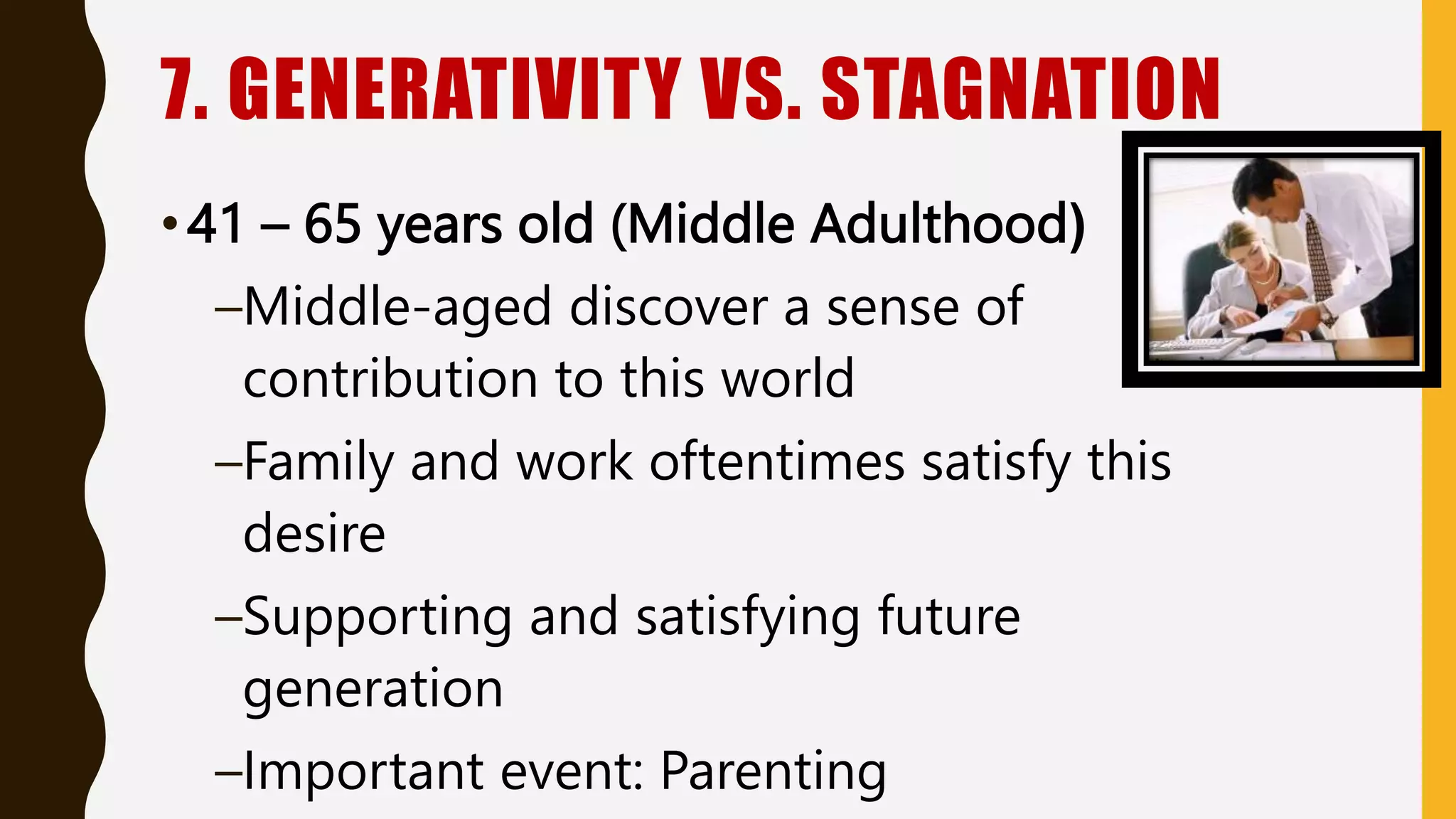
7. GENERATIVITY VS. STAGNATION
•41 – 65 years old (Middle Adulthood)
–Middle-aged discover a sense of
contribution to this world
–Family and work oftentimes satisfy this
desire
–Supporting and satisfying future
generation
–Important event: Parenting
GENERATIVITY VS. STAGNATION
Erikson believed that by the time we reach our
mid 30s to mid 50s we start to really examine our
lives and see if it is going the way we planned it
or did it take a drastic turn. This is where some
people take drastic steps and change their lives.
You could see a lot of late divorces or extreme
changes in clothes or cars- we call this
experience a mid life crisis.
8. EGO INTEGRITY VS. DESPAIR
•65 + (Late Adulthood)
–Reflection on entire life
–Did I contribute to this world?
–Sense of fulfillment
EGO INTEGRITY VS. DESPAIR
Towards the end of our lives we look back
and evaluate ourselves. Did we live a good
life? Leave behind a legacy of friends or
family? Or did we waste our time playing
Madden 2023 on Playstation 7?
If we feel like there were many lost
opportunities along the way we may fall into
despair.
EVALUATION OF ERIKSON’S THEORY
•Theory does attempt to show development
throughout life span
•Children and adults may overcome problems
that occur during development
•Stages are more descriptive than explanatory
Maddy Brink
What does Erik Erikson believe regarding identity?
• Even from infancy, babies are forming their identities
through their interactions with their mothers
• Identity is formed based on many series of conflicts
• People go through eight stages of conflicts in coming to
terms with the world
• In order to have a healthy sense of the world, children
must learn in each stage of life both a positive and
negative aspect of a conflict that arises from their
experience with the world, and emerge from each stage
with a favorable ratio of positive over negative. (ex. Trust
PREVIEW
•Imagine that your life has been chosen as
the subject of an upcoming television
show…
–Who are the main characters? What role do
they play?
JAMES MARCIA
Identity
Statuses
JAMES MARCIA
•created a structural interview designed
to classify adolescents into one of four
statuses of identity.
•The identity statuses are used to
describe and pinpoint the progression
of an adolescent's identity formation
process.
JAMES MARCIA’S VIEW OF
IDENTITY CRISIS
•Identity crisis occurs because individuals must
make commitments on important matters such
as occupation, religion, politics, etc.
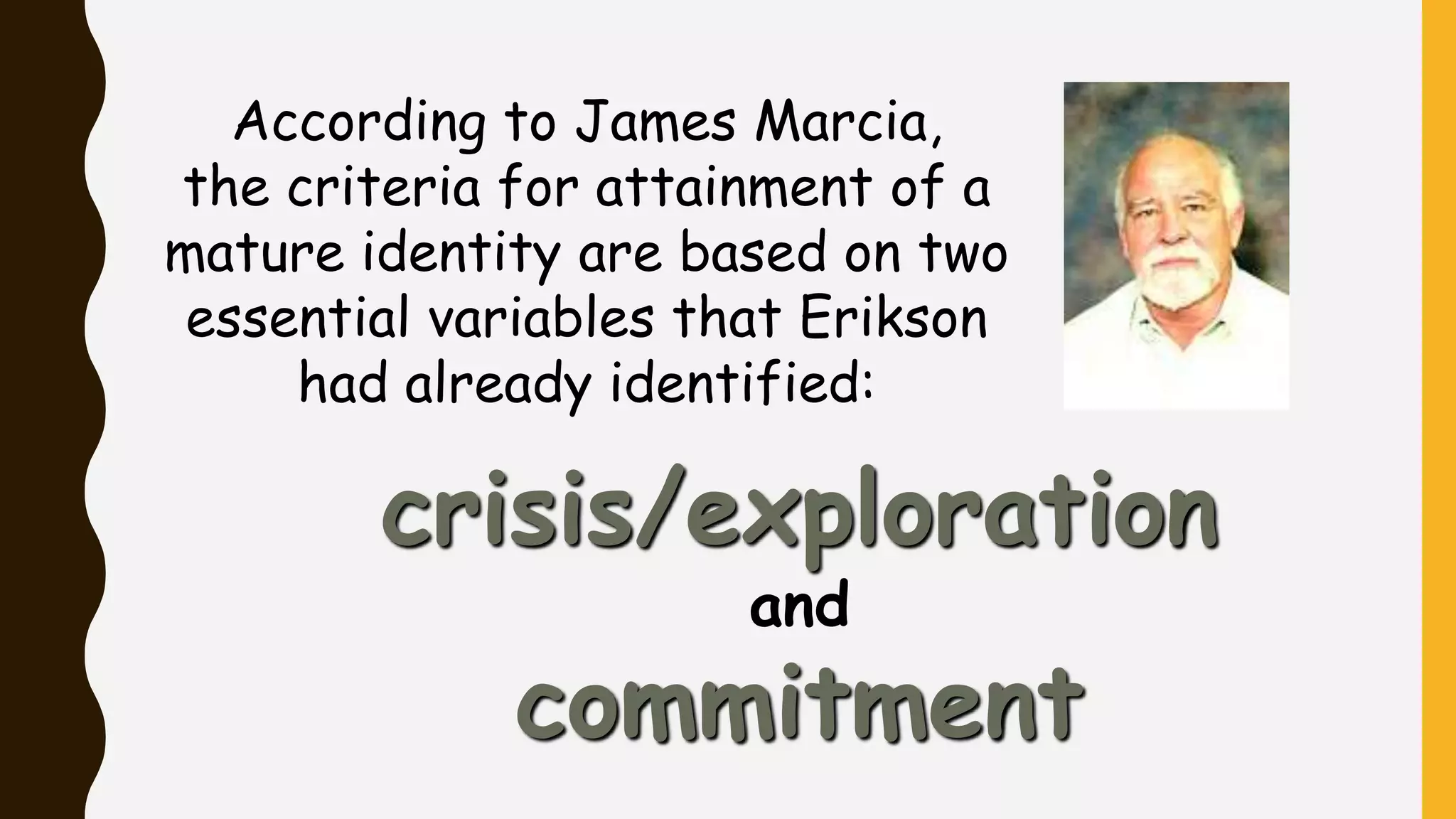
According to James Marcia,
the criteria for attainment of a
mature identity are based on two
essential variables that Erikson
had already identified:
crisis/exploration
and
commitment
CRISIS/EXPLORATION
•refers to the time during adolescence when
the individual actively examines developmental
opportunities, identity issues, and questions
parentally defined goals and values, and begins
to search for personally appropriate
alternatives with respect to occupation, goals,
values, and beliefs.
COMMITMENT
•pertains to the extent that the
individual is personally involved in, and
expresses allegiance to, self-chosen
aspirations, goals, values, beliefs, and
occupation
Four Identity
Statuses in James
Marcia's theory
Identity Diffusion Moratorium
Foreclosure Identity Achievement
No
Commitment
Commitment
No
Exploration Exploration
1. IDENTITY DIFFUSION
•The individual has not yet resolved their
identity crisis, failing to commit to any goals or
values and establish future life direction. In
adolescents, this stage is characterized by
disorganized thinking, procrastination, and
avoidance of issues and action.
IDENTITY CONFUSION OR
DIFFUSION
No Crisis / No Commitment
Identity Diffusion
“I don’t know what I
believe”
“I don’t worry about values ahead of time; I
decide things when they happen.”
Identity diffuse people do not know how they will
end up, nor do they care. They are just living for the
moment and give little thought to the future.
If diffuse people do not mature by adulthood – bad
news. They have little self-esteem and little
autonomy; they are usually disorganized,
complicated, and somewhat unethical. They are
withdrawn, wary of peers, and unfavorably received
2. IDENTITY FORECLOSURE
•This occurs when teenagers accept traditional
values and cultural norms, rather than
determining their own values. In other words,
the person conforms to an identity without
exploration as to what really suits them best. For
instance, teenagers might follow the values and
roles of their parents or cultural norms. They
might also foreclose on a negative identity, the
direct opposite of their parent's values or
IDENTITY FORECLOSURE
No Crisis / Commitment
FORECLOSURE
“I’ve known since I was
young what I wanted to
be.”
Foreclosed people commit to an identity, but they commit
to an identity that has been handed to them, usually by
some authority. This is natural at a young age, but often in
young adulthood, children of wealthy parents accept the
predetermined identities that their parents give them.
Foreclosed adults are characterized by a need for social
approval, poor results in stressful situations, stereotypical
relationships.
3. IDENTITY MORATORIUM
•This postpones identity achievement by
providing temporary shelter. This status
provides opportunities for exploration, either in
breadth or in depth. Examples of moratoria
common in American society include college or
the military.
IDENTITY MORATORIUM
Crisis / No Commitment
MORATORIUM
People in the moratorium status are exploring
their identities, but they have not yet
committed to any certain ideology yet. They
are experimenting and searching for a set of
ideas and beliefs to call their own.
MORATORIUM
Moratoriums are characterized by anxiety,
high self-esteem, internally oriented behavior,
cultural sophistication, a need for both
rebellion and acceptance, short deep
relationships, and favorable reception from
others.
4. IDENTITY ACHIEVEMENT
•This status is attained when the person has
solved the identity issues by making
commitments to goals, beliefs and values after
extensive exploration of different areas.
IDENTITY ACHIEVEMENT
Crisis / Commitment
Identity Achieved
People who achieved their identity have explored
their options and have committed to a certain
ideology that fits them. They have taken on a set of
values and beliefs that are all their own. “They
know not only who they are, they know how they
became that, and that they had a hand in the
becoming.” - James Marcia
These people are independent, smart, and
confident. They are generally well-received by
Identity Diffusion Moratorium
Foreclosure Identity Achievement
No
Commitment
Commitment
No
Exploration Exploration
OBJECTIVE MEASURE OF EGO IDENTITY STATUS
1. I haven’t chosen the occupation I really want to
get into, and I’m just working at what is available
until something better comes along.
2. When it comes to religion I just haven’t found
anything that appeals and I don’t really feel the
need to look.
3. My ideas about men’s and women’s roles are
identical to my parents’. What has worked for
them will obviously work for me.
4. There’s no single “life style” which appeals to me
more than another.
OBJECTIVE MEASURE OF EGO IDENTITY STATUS
5. There are a lot of different kinds of people. I’m
still exploring the many possibilities to find the
right kind of friends for me.
6. I sometimes join in recreational activities when
asked, but I rarely try anything on my own.
7. I date only people my parents would approve of.
8. My folks have always had their own political and
moral beliefs about issues like abortion and mercy
killing and I’ve always gone along accepting what
they have.
FOUR IDENTITY STATUSES: EXAMPLES
Identity Status Character from TV, Movie, or Book
Diffusion ?
Moratorium ?
Foreclosure ?
Achievement ?
Performance Task 2
1. Interview JHS and SHS students about their
Psychosocial Development Stages (what was created
in them) and we’ll see if we could determine what
Stage of Identity Status they are in.
2. Interview your PARENTS who can look back on their
lives to see the different stages, and how they
progressed from one to the next.
Interviews for JHS and SHS
Students.
• Determine what was created in their Psychosocial
Development and their identity status at present.
•Find characteristic behaviors/thought patterns in
each status
•See how much parents influence the children, even
as the children are no longer children
•See what types of crises made people change.
Interviews for Elementary Pupils.
•Determine status
•See who influences this age group the most
•Know why they believe what they believe
•Are they independent in their thoughts?
Interview for your Parents
•Did they have to go through all four statuses?
•What was the order of statuses?
•What caused them to move from one status to
another?
•What was a big crisis they faced and how did it
effect them?
INTERVIEW REQUIREMENTS
•1. WELL-DOCUMENTED
A. Questions and Answers in the interview will
be placed in a short bond paper with a White
Folder.
•2. VOICE RECORDER (supporting material)
•3. GROUFIE DURING AND AFTER INTERVIEW

WEEK 3 - IDENTITY_FORMATION.pptx

  • 1.
  • 2.
    BLOOPERS IN STAGESOF HUMAN DEVELOPMENT CTTO 0-2 • “Pa-cute-an kuno” 3-8 • Paramihan ng toys 9-18 • Pataasan ng Grades 19-25 • Padamihan ng Syota 26-35 • Pagandahan ng Asawa 36-45 • Palakihan ng Income 46-55 • Padamihan ng Kabit 56-70 • Padamihan ng Sakit 70+ • Pabonggahan ng Libing
  • 3.
    IDENTITY FORMATION U N DE R S TA N D I N G C U L T U R E , S O C I E T Y A N D P O L I T I C S
  • 4.
    SENSE OF SELF •Whoam I? –self-concept – beliefs •How Good am I as a person? –self-esteem - worthiness –From 1-10, how good are you as a person?
  • 5.
    SELF-CONCEPT •Self-concept or self-identityis the sum of a being's knowledge and understanding of their self.
  • 6.
    IDENTITY FORMATION •is thedevelopment of an individual’s distinct personality, which is regarded as a persisting entity in a particular stage of life by which a person is recognized or known.
  • 7.
    IDENTITY •Consisting of separateand distinct parts. •It is an ever-evolving core within our culture, loved ones, those we cared for, people who have harmed, the deeds done (good and ill) to self and others, experiences lived, and choices made come together to form who we are at this moment.
  • 8.
    IDENTITY •Consisting of separateand distinct parts. •It is an ever-evolving core within our culture, loved ones, those we cared people who have harmed, the deeds done (good and ill) to self and others, experiences lived, and choices made come together to form who we are at this moment.
  • 9.
    THEORIES OF IDENTITYFORMATION • “Psychosocial Development” Erik Erikson’s • “Identity Status Theory” James Marcia’s
  • 10.
    ERIK ERIKSON •Father abandonedbefore born. •Irregular work in Europe without an identity. •Took a job as a teacher for children. •Took name as Erikson (son of himself) symbolizing full attainment of sense of identity.
  • 11.
    ERIKSON’S THEORY •Erikson's beliefis that throughout each person's lifetime, they experience different crises or conflicts.
  • 12.
  • 13.
    PSYCHOSOCIAL DEVELOPMENT •Psychosocial: Developmentof self in relationship to society –Psycho: Mental processes –Social: Relating to society Dr. K. A. Korb University of Jos
  • 14.
    ERIKSON’S STAGES OF PSYCHOSOCIALDEVELOPMENT •Each stage is characterized by a crisis –Crisis: a psychosocial challenge that presents opportunities for development
  • 15.
    ERIK ERIKSON –Focus onCrisis Resolution •At each stage a crisis must be resolved •If the crisis is not resolved, the individual may lack the positive characteristic in the stage.
  • 16.
    “WHAT YOU ARENOW AND WHAT YOU HAVE BECOME, IS A PRODUCT OF YOUR PAST EXPERIENCES”
  • 17.
    ERIKSON’S STAGES OFPSYCHOSOCIAL DEVELOPMENT Stage Age (years) Crisis Infancy 0-1 Trust vs. Mistrust Early Childhood 2-3 Autonomy vs. Shame & Doubt Preschool 4-5 Initiative vs. Guilt School Age 6-12 Industry vs. Inferiority Adolescence 13-19 Identity vs. Role Confusion Early Adulthood 20-40 Intimacy vs. Isolation Middle Adulthood 41-65 Generativity vs. Stagnation
  • 18.
    1. TRUST VS.MISTRUST •Birth – 1yr. (Infancy) –Basic trust develops when needs are met (Attachment) –Loving relationship is formed with caregiver –Important event: Feeding
  • 19.
    TRUST VS. MISTRUST Thisstage is all about fulfilling needs. The baby needs to trust the world around them to take care of their needs. If we can trust someone now, then we can trust others in the future. This sense of trust or mistrust can affect us throughout the rest of our lives.
  • 20.
    2. AUTONOMY VS.SHAME AND DOUBT •2 – 3 years (Early Childhood) –Learning to do things for oneself –Development of physical activities (ex. walking) –Important event: toilet training
  • 21.
    AUTONOMY VS. SHAME& DOUBT “It is OKAY to be me?” stage.
  • 22.
    AUTONOMY VS. SHAME& DOUBT Autonomy means being your own boss. Here a toddler tries to control their own bodies by toilet training and their environment, by always saying "NO!!!!". Sometimes they do poopy in their pants or get yelled at by their parents, causing shame and doubt in their own abilities. We are then able to face the later challenges of life.
  • 23.
    3. INITIATIVE VS.GUILT 4 – 5 years (Preschool) –Preschoolers learn to initiate tasks –One becomes more independent
  • 24.
    INITIATIVE VS. GUILT “isit okay for me to do what I do?” stage
  • 25.
    INITIATIVE VS. GUILT Herethe key word in a child's life changes from "No!" to why?". In this stage children want to understand the world and they ask too many darn questions!!!! If their initiative in questioning the world is encouraged, then they will feel comfortable with expressing their curiosity throughout the rest of their life. If we discourage them and tell them to shut up, then they will feel guilty about their questioning and avoid being inquisitive later.
  • 26.
    4. INDUSTRY VS.INFERIORITY 6-12 years – (School Age) –Child completes tasks themselves –Learning on your own –Important Event: school
  • 27.
    INDUSTRY VS. INFERIORITY Thisis where most children begin formal education (what we call school). For the first time children are being formally evaluated. If a child raises their hand in class and answers a question correctly, then he/she will feel industrious (competent). If he/she tries to answer a question but stutters to get out the wrong answer, and other students all start making fun of his/her speech impediment, then the child will feel inferior.
  • 28.
    5. IDENTITY VS.ROLE CONFUSION •13 - 19 years old – (Adolescence) –Teens refine sense of self –Test new roles and incorporate them into an identity –Important events: forming relationships with friends
  • 29.
    IDENTITY VS. ROLECONFUSION In adolescence, Erikson believed that a teenager’s main social need is to discover his or her social identity. While searching for your identity, you may try out different roles, like trying to fit into various social and support groups, soul searching, late night thoughts and talks with friends. You should be trying to find a stable sense of self now, or Erikson believed you may have an identity confusion later.
  • 30.
    6. INTIMACY VS.ISOLATION •21-40 years old (Early Adulthood) –Young adults develop intimate relationships –Gaining the capacity for intimate love –Important event: forming love and/or strong relationships
  • 31.
    INTIMACY VS. ISOLATION Youngadults (early 20s into early 30s) are trying to balance their career efforts (work, school or self-improvement) with the need to be in an intimate relationship with another person. How much time should I spend looking for a relationship? What if I don't find anybody? What if I am all alone for the rest of my life?
  • 32.
    7. GENERATIVITY VS.STAGNATION •41 – 65 years old (Middle Adulthood) –Middle-aged discover a sense of contribution to this world –Family and work oftentimes satisfy this desire –Supporting and satisfying future generation –Important event: Parenting
  • 33.
    GENERATIVITY VS. STAGNATION Eriksonbelieved that by the time we reach our mid 30s to mid 50s we start to really examine our lives and see if it is going the way we planned it or did it take a drastic turn. This is where some people take drastic steps and change their lives. You could see a lot of late divorces or extreme changes in clothes or cars- we call this experience a mid life crisis.
  • 34.
    8. EGO INTEGRITYVS. DESPAIR •65 + (Late Adulthood) –Reflection on entire life –Did I contribute to this world? –Sense of fulfillment
  • 35.
    EGO INTEGRITY VS.DESPAIR Towards the end of our lives we look back and evaluate ourselves. Did we live a good life? Leave behind a legacy of friends or family? Or did we waste our time playing Madden 2023 on Playstation 7? If we feel like there were many lost opportunities along the way we may fall into despair.
  • 36.
    EVALUATION OF ERIKSON’STHEORY •Theory does attempt to show development throughout life span •Children and adults may overcome problems that occur during development •Stages are more descriptive than explanatory
  • 37.
    Maddy Brink What doesErik Erikson believe regarding identity? • Even from infancy, babies are forming their identities through their interactions with their mothers • Identity is formed based on many series of conflicts • People go through eight stages of conflicts in coming to terms with the world • In order to have a healthy sense of the world, children must learn in each stage of life both a positive and negative aspect of a conflict that arises from their experience with the world, and emerge from each stage with a favorable ratio of positive over negative. (ex. Trust
  • 38.
    PREVIEW •Imagine that yourlife has been chosen as the subject of an upcoming television show… –Who are the main characters? What role do they play?
  • 39.
  • 40.
    JAMES MARCIA •created astructural interview designed to classify adolescents into one of four statuses of identity. •The identity statuses are used to describe and pinpoint the progression of an adolescent's identity formation process.
  • 41.
    JAMES MARCIA’S VIEWOF IDENTITY CRISIS •Identity crisis occurs because individuals must make commitments on important matters such as occupation, religion, politics, etc.
  • 42.
    According to JamesMarcia, the criteria for attainment of a mature identity are based on two essential variables that Erikson had already identified: crisis/exploration and commitment
  • 43.
    CRISIS/EXPLORATION •refers to thetime during adolescence when the individual actively examines developmental opportunities, identity issues, and questions parentally defined goals and values, and begins to search for personally appropriate alternatives with respect to occupation, goals, values, and beliefs.
  • 44.
    COMMITMENT •pertains to theextent that the individual is personally involved in, and expresses allegiance to, self-chosen aspirations, goals, values, beliefs, and occupation
  • 45.
    Four Identity Statuses inJames Marcia's theory
  • 46.
    Identity Diffusion Moratorium ForeclosureIdentity Achievement No Commitment Commitment No Exploration Exploration
  • 47.
    1. IDENTITY DIFFUSION •Theindividual has not yet resolved their identity crisis, failing to commit to any goals or values and establish future life direction. In adolescents, this stage is characterized by disorganized thinking, procrastination, and avoidance of issues and action.
  • 48.
    IDENTITY CONFUSION OR DIFFUSION NoCrisis / No Commitment
  • 49.
    Identity Diffusion “I don’tknow what I believe” “I don’t worry about values ahead of time; I decide things when they happen.” Identity diffuse people do not know how they will end up, nor do they care. They are just living for the moment and give little thought to the future. If diffuse people do not mature by adulthood – bad news. They have little self-esteem and little autonomy; they are usually disorganized, complicated, and somewhat unethical. They are withdrawn, wary of peers, and unfavorably received
  • 50.
    2. IDENTITY FORECLOSURE •Thisoccurs when teenagers accept traditional values and cultural norms, rather than determining their own values. In other words, the person conforms to an identity without exploration as to what really suits them best. For instance, teenagers might follow the values and roles of their parents or cultural norms. They might also foreclose on a negative identity, the direct opposite of their parent's values or
  • 51.
  • 52.
    FORECLOSURE “I’ve known sinceI was young what I wanted to be.” Foreclosed people commit to an identity, but they commit to an identity that has been handed to them, usually by some authority. This is natural at a young age, but often in young adulthood, children of wealthy parents accept the predetermined identities that their parents give them. Foreclosed adults are characterized by a need for social approval, poor results in stressful situations, stereotypical relationships.
  • 53.
    3. IDENTITY MORATORIUM •Thispostpones identity achievement by providing temporary shelter. This status provides opportunities for exploration, either in breadth or in depth. Examples of moratoria common in American society include college or the military.
  • 54.
  • 55.
    MORATORIUM People in themoratorium status are exploring their identities, but they have not yet committed to any certain ideology yet. They are experimenting and searching for a set of ideas and beliefs to call their own.
  • 56.
    MORATORIUM Moratoriums are characterizedby anxiety, high self-esteem, internally oriented behavior, cultural sophistication, a need for both rebellion and acceptance, short deep relationships, and favorable reception from others.
  • 57.
    4. IDENTITY ACHIEVEMENT •Thisstatus is attained when the person has solved the identity issues by making commitments to goals, beliefs and values after extensive exploration of different areas.
  • 58.
  • 59.
    Identity Achieved People whoachieved their identity have explored their options and have committed to a certain ideology that fits them. They have taken on a set of values and beliefs that are all their own. “They know not only who they are, they know how they became that, and that they had a hand in the becoming.” - James Marcia These people are independent, smart, and confident. They are generally well-received by
  • 60.
    Identity Diffusion Moratorium ForeclosureIdentity Achievement No Commitment Commitment No Exploration Exploration
  • 61.
    OBJECTIVE MEASURE OFEGO IDENTITY STATUS 1. I haven’t chosen the occupation I really want to get into, and I’m just working at what is available until something better comes along. 2. When it comes to religion I just haven’t found anything that appeals and I don’t really feel the need to look. 3. My ideas about men’s and women’s roles are identical to my parents’. What has worked for them will obviously work for me. 4. There’s no single “life style” which appeals to me more than another.
  • 62.
    OBJECTIVE MEASURE OFEGO IDENTITY STATUS 5. There are a lot of different kinds of people. I’m still exploring the many possibilities to find the right kind of friends for me. 6. I sometimes join in recreational activities when asked, but I rarely try anything on my own. 7. I date only people my parents would approve of. 8. My folks have always had their own political and moral beliefs about issues like abortion and mercy killing and I’ve always gone along accepting what they have.
  • 63.
    FOUR IDENTITY STATUSES:EXAMPLES Identity Status Character from TV, Movie, or Book Diffusion ? Moratorium ? Foreclosure ? Achievement ?
  • 64.
    Performance Task 2 1.Interview JHS and SHS students about their Psychosocial Development Stages (what was created in them) and we’ll see if we could determine what Stage of Identity Status they are in. 2. Interview your PARENTS who can look back on their lives to see the different stages, and how they progressed from one to the next.
  • 65.
    Interviews for JHSand SHS Students. • Determine what was created in their Psychosocial Development and their identity status at present. •Find characteristic behaviors/thought patterns in each status •See how much parents influence the children, even as the children are no longer children •See what types of crises made people change.
  • 66.
    Interviews for ElementaryPupils. •Determine status •See who influences this age group the most •Know why they believe what they believe •Are they independent in their thoughts?
  • 67.
    Interview for yourParents •Did they have to go through all four statuses? •What was the order of statuses? •What caused them to move from one status to another? •What was a big crisis they faced and how did it effect them?
  • 68.
    INTERVIEW REQUIREMENTS •1. WELL-DOCUMENTED A.Questions and Answers in the interview will be placed in a short bond paper with a White Folder. •2. VOICE RECORDER (supporting material) •3. GROUFIE DURING AND AFTER INTERVIEW