STABILITY TESTING OF
PHYTOPHARMACEUTICALS
PRESENTED BY : PRATIK P KEDARE
ER.NO : 2408212160007
M-PHARMACY 1ST
SEM ( PA )
GUIDED BY : MRS.KHYATI PATEL
ASSISTANT PROFESSOR
PARUL INSTITUTE OF PHARMACY
Content’s
 Introduction
 Regulatory requirement
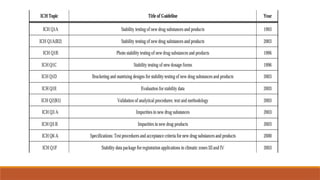
 Protocols
Drug stability
Drug stability means the ability of the pharmaceutical dosage form to maintain the physical,
chemical, therapeutic and microbial properties during the time of storage and usage by the
patient.
It is measured by the rate of change's that take place in the pharmaceutical dosage forms
Stability testing
Stability testing is utilized to determine if the quality of a drug substance or drug product is
altered over time by various environmental factors, such as light, temperature and humidity.
Introduction
Phytopharmaceuticals
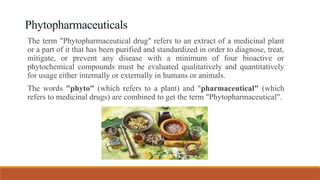
The term "Phytopharmaceutical drug" refers to an extract of a medicinal plant
or a part of it that has been purified and standardized in order to diagnose, treat,
mitigate, or prevent any disease with a minimum of four bioactive or
phytochemical compounds must be evaluated qualitatively and quantitatively
for usage either internally or externally in humans or animals.
The words "phyto" (which refers to a plant) and "pharmaceutical" (which
refers to medicinal drugs) are combined to get the term "Phytopharmaceutical".
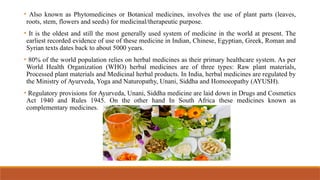
• Also known as Phytomedicines or Botanical medicines, involves the use of plant parts (leaves,
roots, stem, flowers and seeds) for medicinal/therapeutic purpose.
• It is the oldest and still the most generally used system of medicine in the world at present. The
earliest recorded evidence of use of these medicine in Indian, Chinese, Egyptian, Greek, Roman and
Syrian texts dates back to about 5000 years.
• 80% of the world population relies on herbal medicines as their primary healthcare system. As per
World Health Organization (WHO) herbal medicines are of three types: Raw plant materials,
Processed plant materials and Medicinal herbal products. In India, herbal medicines are regulated by
the Ministry of Ayurveda, Yoga and Naturopathy, Unani, Siddha and Homoeopathy (AYUSH).
• Regulatory provisions for Ayurveda, Unani, Siddha medicine are laid down in Drugs and Cosmetics
Act 1940 and Rules 1945. On the other hand In South Africa these medicines known as
complementary medicines.
Regulatory requirements & protocols
 Regulatory requirements are rules and
guidelines put forth by a governing body.
 These include standards for different products
like food safety and environmental protection,
regulations for how business operate, and that
protect consumers from monopolies or fraud.
 India, herbal medicines are regulated under the
Drug and Cosmetic Act (D and C) 1940 and
Rules 1945, where regulatory provisions for
Ayurveda, Unani, Siddha medicine are clearly
laid down. Ministry of Ayurveda, Yoga and
Naturopathy, Unani, Siddha and Homoeopathy
(AYUSH) is the regulatory authority and mandate
that any manufacture or marketing of herbal
drugs have to be done after obtaining
manufacturing license, as applicable.
 Schedule T Good Manufacturing Practices for
Ayurvedic, Siddha and Unani medicines
 In India for getting approval to manufacture or
sale of ASU drugs, manufacturer have to take
GMP certificate.
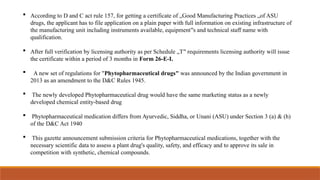
 According to D and C act rule 157, for getting a certificate of „Good Manufacturing Practices „of ASU
drugs, the applicant has to file application on a plain paper with full information on existing infrastructure of
the manufacturing unit including instruments available, equipment s and technical staff name with
‟
qualification.
 After full verification by licensing authority as per Schedule „T requirements licensing authority will issue
‟
the certificate within a period of 3 months in Form 26-E-I.
 A new set of regulations for "Phytopharmaceutical drugs" was announced by the Indian government in
2013 as an amendment to the D&C Rules 1945.
 The newly developed Phytopharmaceutical drug would have the same marketing status as a newly
developed chemical entity-based drug
 Phytopharmaceutical medication differs from Ayurvedic, Siddha, or Unani (ASU) under Section 3 (a) & (h)
of the D&C Act 1940
 This gazette announcement submission criteria for Phytopharmaceutical medications, together with the
necessary scientific data to assess a plant drug's quality, safety, and efficacy and to approve its sale in
competition with synthetic, chemical compounds.
• The information that must be included with a request to perform a clinical trial, import, or produce a
Phytopharmaceutical medicine in the nation is outlined in Schedule Y's Appendix I B.
• The pharmacological and safety details of the drug, human studies, and confirmatory clinical trials are
typical regulatory requirements for a Phytopharmaceutical medication's New Drug Application.
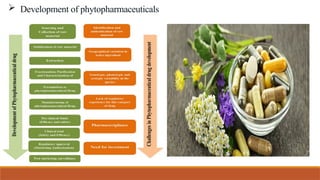
 Development of phytopharmaceuticals
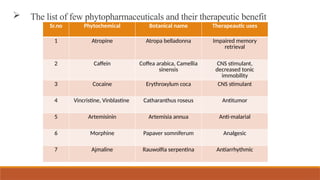
 The list of few phytopharmaceuticals and their therapeutic benefit
Sr.no Phytochemical Botanical name Therapeautic uses
1 Atropine Atropa belladonna Impaired memory
retrieval
2 Caffein Coffea arabica, Camellia
sinensis
CNS stimulant,
decreased tonic
immobility
3 Cocaine Erythroxylum coca CNS stimulant
4 Vincristine, Vinblastine Catharanthus roseus Antitumor
5 Artemisinin Artemisia annua Anti-malarial
6 Morphine Papaver somniferum Analgesic
7 Ajmaline Rauwolfia serpentina Antiarrhythmic
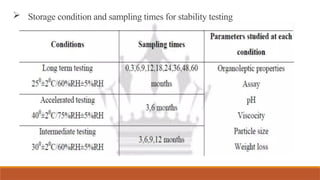
 Storage condition and sampling times for stability testing
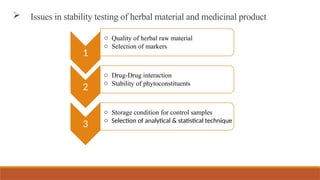
 Issues in stability testing of herbal material and medicinal product
1
o Quality of herbal raw material
o Selection of markers
2
o Drug-Drug interaction
o Stability of phytoconstituents
3
o Storage condition for control samples
o Selection of analytical & statistical technique
• Identification: Proper identification of the plant species is essential to ensure that the correct plant is
being used. This can be done through morphological, microscopic, and chemical analysis.
• Authentication: Verifying the authenticity of the plant material helps to prevent adulteration and
substitution with inferior or toxic species. DNA barcoding is a modern technique used for authentication.
• Standardization: Standardizing the content of active constituents in the raw material ensures
consistency from batch to batch. This is achieved through analytical techniques like HPLC and GC-MS.
• Contaminants: Testing for heavy metals, pesticides, and microbial contamination is crucial to ensure
the safety of the final product.
• Storage: Proper storage conditions, including temperature, humidity, and light exposure, are essential
to maintain the quality and potency of the raw materials.
 Quality of herbal raw material
 Selection of markers
The selection of markers for assessment of shelf-life of a herbal material/product is the most
challenging task during rational stability testing
A critical study of the available physicochemical stability reports on herbal materials and
products reveals that different research groups have used different markers for stability testing
of a herbal substance, preparation or the medicinal product.
Eg .For stability studies on Actaea racemosa, Budukh et al. used cimiracemosideA, actein, and
27-deoxyactein (triterpenes) as markers, whereas Jiang et al. used cimiracemoside-F, 3-epi-26-
deoxyactein, (triterpenes), and polyphenols as markers.
Comparative analysis of these two studies reveals that polyphenols are unstable compared to
triterpenes at higher temperatures.
As discussed above repeatedly, a herbal drug substance, preparation or medicinal product contains
numerous phytoconstituents of different chemical classes.
These constituents may undergo various inter- as well as intra-molecular reactions under the
influence of varied environmental conditions, such as heat, humidity, air and/or light during
processing, formulation and storage of the material
Phytoconstituents can degrade under the influence of these stress conditions, which
may, in turn, alter the therapeutic efficacy of the products
Phenolic compound like gallic acid are sensitive to alkaline and acidic environment.
Thus, the products containing gallic acid should be maintained at neutral pH
 Drug-Drug interaction
 Stability of phytoconstituents
• Herbal medicine products are also exposed to varied stress conditions before and
during production process as well as during storage
• Phytoconstituents can degrade under the influence of these stress conditions, which
may, in turn, alter the therapeutic efficacy of the products
• Curcumin undergoes extensive degradation under alkaline conditions to give furilic
acid and vanillin
• Phenolic compound like gallic acid are sensitive to alkaline and acidic environment.
Thus, the products containing gallic acid should be maintained at neutral pH
•Flavonol glycoside - (quercetin, kaempferol, and isorhamnetin) in Ginkgo biloba are
highly unstable to basic, oxidative, and thermal stressors, but stable under acidic
conditions
• These chemical changes are not perceptible from any possible alteration in physical
attributes of the product, and can be monitored by studying the changes in chemical
fingerprints using sophisticated analytical techniques
o Herbal raw materials usually do not come with a certificate of analysis.
o Therefore, it becomes imperative on the part of the product manufacturer to conduct various tests on
the raw material assure its identity and quality prior to the production of herbal medicinal products.
o Those tests become a guiding force for selecting appropriate tests for monitoring of stability of the
product
o With the help of modern analytical techniques like HPLC, HPTLC and by employing proper
guidelines it is possible to establish sound stability data for herbal products and predict their shelf life
which will help in global acceptability of herbal products.

 Test parameter protocol for stability testing
THANK YOU…
1.Stability Testing of Pharmaceutical Products - Comparison of Stability Testing Guidelines by
Hamid Khan, Musher Ali, Alka Ahuja and Javed Ali.
2. A review on stability testing guidelines of pharmaceutical products zothanpuii f*, rajesh r,
selvakumar k.
 Reference
3. Opportunities and Challenges in Development of Phytopharmaceutical Drug in India- A SWOT Analysis
Abhishek Singh1 , Muthusamy Kalaivani1,Priyanka Chaudhary1 , Sushma Srivastava1 , Ramesh Kumar
Goyal 2 , Suresh Kumar Gupta2 1 Indian Pharmacopoeia Commission, Ministry of Health and Family
Welfare (Govt. of India), Ghaziabad, Uttar Pradesh, INDIA.
4.Chemical markers for the quality control of herbal medicines: an overview:
https://www.ncbi.nlm.nih.gov/pmc/articles/PMC2488332/

STABILITY TESTING OF PHYTOPHARMACEUTICALS

  • 1.
    STABILITY TESTING OF PHYTOPHARMACEUTICALS PRESENTEDBY : PRATIK P KEDARE ER.NO : 2408212160007 M-PHARMACY 1ST SEM ( PA ) GUIDED BY : MRS.KHYATI PATEL ASSISTANT PROFESSOR PARUL INSTITUTE OF PHARMACY
  • 2.
  • 3.
    Drug stability Drug stabilitymeans the ability of the pharmaceutical dosage form to maintain the physical, chemical, therapeutic and microbial properties during the time of storage and usage by the patient. It is measured by the rate of change's that take place in the pharmaceutical dosage forms Stability testing Stability testing is utilized to determine if the quality of a drug substance or drug product is altered over time by various environmental factors, such as light, temperature and humidity. Introduction
  • 4.
    Phytopharmaceuticals The term "Phytopharmaceuticaldrug" refers to an extract of a medicinal plant or a part of it that has been purified and standardized in order to diagnose, treat, mitigate, or prevent any disease with a minimum of four bioactive or phytochemical compounds must be evaluated qualitatively and quantitatively for usage either internally or externally in humans or animals. The words "phyto" (which refers to a plant) and "pharmaceutical" (which refers to medicinal drugs) are combined to get the term "Phytopharmaceutical".
  • 5.
    • Also knownas Phytomedicines or Botanical medicines, involves the use of plant parts (leaves, roots, stem, flowers and seeds) for medicinal/therapeutic purpose. • It is the oldest and still the most generally used system of medicine in the world at present. The earliest recorded evidence of use of these medicine in Indian, Chinese, Egyptian, Greek, Roman and Syrian texts dates back to about 5000 years. • 80% of the world population relies on herbal medicines as their primary healthcare system. As per World Health Organization (WHO) herbal medicines are of three types: Raw plant materials, Processed plant materials and Medicinal herbal products. In India, herbal medicines are regulated by the Ministry of Ayurveda, Yoga and Naturopathy, Unani, Siddha and Homoeopathy (AYUSH). • Regulatory provisions for Ayurveda, Unani, Siddha medicine are laid down in Drugs and Cosmetics Act 1940 and Rules 1945. On the other hand In South Africa these medicines known as complementary medicines.
  • 7.
    Regulatory requirements &protocols  Regulatory requirements are rules and guidelines put forth by a governing body.  These include standards for different products like food safety and environmental protection, regulations for how business operate, and that protect consumers from monopolies or fraud.  India, herbal medicines are regulated under the Drug and Cosmetic Act (D and C) 1940 and Rules 1945, where regulatory provisions for Ayurveda, Unani, Siddha medicine are clearly laid down. Ministry of Ayurveda, Yoga and Naturopathy, Unani, Siddha and Homoeopathy (AYUSH) is the regulatory authority and mandate that any manufacture or marketing of herbal drugs have to be done after obtaining manufacturing license, as applicable.  Schedule T Good Manufacturing Practices for Ayurvedic, Siddha and Unani medicines  In India for getting approval to manufacture or sale of ASU drugs, manufacturer have to take GMP certificate.
  • 8.
     According toD and C act rule 157, for getting a certificate of „Good Manufacturing Practices „of ASU drugs, the applicant has to file application on a plain paper with full information on existing infrastructure of the manufacturing unit including instruments available, equipment s and technical staff name with ‟ qualification.  After full verification by licensing authority as per Schedule „T requirements licensing authority will issue ‟ the certificate within a period of 3 months in Form 26-E-I.  A new set of regulations for "Phytopharmaceutical drugs" was announced by the Indian government in 2013 as an amendment to the D&C Rules 1945.  The newly developed Phytopharmaceutical drug would have the same marketing status as a newly developed chemical entity-based drug  Phytopharmaceutical medication differs from Ayurvedic, Siddha, or Unani (ASU) under Section 3 (a) & (h) of the D&C Act 1940  This gazette announcement submission criteria for Phytopharmaceutical medications, together with the necessary scientific data to assess a plant drug's quality, safety, and efficacy and to approve its sale in competition with synthetic, chemical compounds.
  • 9.
    • The informationthat must be included with a request to perform a clinical trial, import, or produce a Phytopharmaceutical medicine in the nation is outlined in Schedule Y's Appendix I B. • The pharmacological and safety details of the drug, human studies, and confirmatory clinical trials are typical regulatory requirements for a Phytopharmaceutical medication's New Drug Application.
  • 10.
     Development ofphytopharmaceuticals
  • 11.
     The listof few phytopharmaceuticals and their therapeutic benefit Sr.no Phytochemical Botanical name Therapeautic uses 1 Atropine Atropa belladonna Impaired memory retrieval 2 Caffein Coffea arabica, Camellia sinensis CNS stimulant, decreased tonic immobility 3 Cocaine Erythroxylum coca CNS stimulant 4 Vincristine, Vinblastine Catharanthus roseus Antitumor 5 Artemisinin Artemisia annua Anti-malarial 6 Morphine Papaver somniferum Analgesic 7 Ajmaline Rauwolfia serpentina Antiarrhythmic
  • 12.
     Storage conditionand sampling times for stability testing
  • 13.
     Issues instability testing of herbal material and medicinal product 1 o Quality of herbal raw material o Selection of markers 2 o Drug-Drug interaction o Stability of phytoconstituents 3 o Storage condition for control samples o Selection of analytical & statistical technique
  • 14.
    • Identification: Properidentification of the plant species is essential to ensure that the correct plant is being used. This can be done through morphological, microscopic, and chemical analysis. • Authentication: Verifying the authenticity of the plant material helps to prevent adulteration and substitution with inferior or toxic species. DNA barcoding is a modern technique used for authentication. • Standardization: Standardizing the content of active constituents in the raw material ensures consistency from batch to batch. This is achieved through analytical techniques like HPLC and GC-MS. • Contaminants: Testing for heavy metals, pesticides, and microbial contamination is crucial to ensure the safety of the final product. • Storage: Proper storage conditions, including temperature, humidity, and light exposure, are essential to maintain the quality and potency of the raw materials.  Quality of herbal raw material
  • 15.
     Selection ofmarkers The selection of markers for assessment of shelf-life of a herbal material/product is the most challenging task during rational stability testing A critical study of the available physicochemical stability reports on herbal materials and products reveals that different research groups have used different markers for stability testing of a herbal substance, preparation or the medicinal product. Eg .For stability studies on Actaea racemosa, Budukh et al. used cimiracemosideA, actein, and 27-deoxyactein (triterpenes) as markers, whereas Jiang et al. used cimiracemoside-F, 3-epi-26- deoxyactein, (triterpenes), and polyphenols as markers. Comparative analysis of these two studies reveals that polyphenols are unstable compared to triterpenes at higher temperatures.
  • 16.
    As discussed aboverepeatedly, a herbal drug substance, preparation or medicinal product contains numerous phytoconstituents of different chemical classes. These constituents may undergo various inter- as well as intra-molecular reactions under the influence of varied environmental conditions, such as heat, humidity, air and/or light during processing, formulation and storage of the material Phytoconstituents can degrade under the influence of these stress conditions, which may, in turn, alter the therapeutic efficacy of the products Phenolic compound like gallic acid are sensitive to alkaline and acidic environment. Thus, the products containing gallic acid should be maintained at neutral pH  Drug-Drug interaction
  • 17.
     Stability ofphytoconstituents • Herbal medicine products are also exposed to varied stress conditions before and during production process as well as during storage • Phytoconstituents can degrade under the influence of these stress conditions, which may, in turn, alter the therapeutic efficacy of the products • Curcumin undergoes extensive degradation under alkaline conditions to give furilic acid and vanillin • Phenolic compound like gallic acid are sensitive to alkaline and acidic environment. Thus, the products containing gallic acid should be maintained at neutral pH •Flavonol glycoside - (quercetin, kaempferol, and isorhamnetin) in Ginkgo biloba are highly unstable to basic, oxidative, and thermal stressors, but stable under acidic conditions • These chemical changes are not perceptible from any possible alteration in physical attributes of the product, and can be monitored by studying the changes in chemical fingerprints using sophisticated analytical techniques
  • 18.
    o Herbal rawmaterials usually do not come with a certificate of analysis. o Therefore, it becomes imperative on the part of the product manufacturer to conduct various tests on the raw material assure its identity and quality prior to the production of herbal medicinal products. o Those tests become a guiding force for selecting appropriate tests for monitoring of stability of the product o With the help of modern analytical techniques like HPLC, HPTLC and by employing proper guidelines it is possible to establish sound stability data for herbal products and predict their shelf life which will help in global acceptability of herbal products.  Test parameter protocol for stability testing

  • 19.
  • 20.
    1.Stability Testing ofPharmaceutical Products - Comparison of Stability Testing Guidelines by Hamid Khan, Musher Ali, Alka Ahuja and Javed Ali. 2. A review on stability testing guidelines of pharmaceutical products zothanpuii f*, rajesh r, selvakumar k.  Reference 3. Opportunities and Challenges in Development of Phytopharmaceutical Drug in India- A SWOT Analysis Abhishek Singh1 , Muthusamy Kalaivani1,Priyanka Chaudhary1 , Sushma Srivastava1 , Ramesh Kumar Goyal 2 , Suresh Kumar Gupta2 1 Indian Pharmacopoeia Commission, Ministry of Health and Family Welfare (Govt. of India), Ghaziabad, Uttar Pradesh, INDIA. 4.Chemical markers for the quality control of herbal medicines: an overview: https://www.ncbi.nlm.nih.gov/pmc/articles/PMC2488332/