ELECTRON IONIZTION
PRESENTED BY : PRATIK PRAKASHRAO KEDARE
IONIZTION TECHNIQUE IN MASS
SPECTROSCOPY
MASTER OF PHARMACY 1ST
YEAR PARUL UNIVERSITY,GUJARAT
ELECTRON IONIZATION
• Electron ionization (EI, formerly known as electron impact ionization and electron bombardment
ionization) is the basis for one of the most efficient mass spectrometry methods for identifying a given
organic compound.
• It is an ionization method in which high energy electrons interact with atoms or molecules in solid or gas
phases to produce ions.
• This technique is considered to be a hard ionization method (high fragmentation) because it uses high-
energy electrons to generate ions.
• This leads to extensive fragmentation, which contributes to the structural determination of unknown
compounds.
• EI is useful for organic compounds with molecular weights below 600. In addition, several other thermally
stable and volatile compounds in solid, liquid and gas states can be detected with the use of this technique
when combined with various separation methods.
SCHEMATIC OF ELECTRON IONIZATION
INSTRUMENTATION
PRINCIPLE OF EI
• In general, the ion source is to convert the sample into ions to accelerate and focus the ions into an ion
beam that passes through the slit into the mass analyzer.
• The difference is obtained in the behavior of different ions in the electric or magnetic field, the mass
spectrum is obtained by separating the ions by the mass-to-charge ratio, and the qualitative and quantitative
results of the sample are obtained by analyzing the mass spectrum.
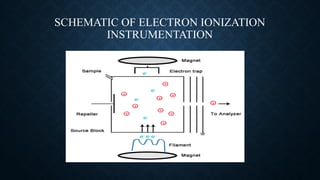
• The EI source is generally composed of a cathode (filament), an ion chamber, an electron receiver, and a set
of electrostatic lenses. Under high vacuum conditions, a current is applied to the filament to emit electrons,
and electrons are accelerated from the filament to the electron receiving end.
• In this process, the sample molecules collide with electrons in the ion chamber, causing the sample
molecules to ionize or fragment into fragments. In order to stabilize the generated ion current, the energy of
the electron beam is generally set to 70 eV, which results in a stable standard mass spectrum.
ADVANTAGES AND DISADVANTAGES OF EI
• The classic EI method has many advantages.
• EI is non-selective ionization and can be ionized as long as the sample can be
vaporized.
• EI has high ionization efficiency and sensitivity.
• EI spectrum provides a wealth of structural information and is the
ldquo;fingerprint& rdquo; of the compound.
• But there are some defects about EI.
• The EI source is not suitable for volatile, thermally unstable samples.
• Some compounds are fragile in EI mode and do not give an accurate mass spectra.
• The EI method can only detect positive ions and does not detect negative ions.
APPLICATION OF EI
• EI is frequently used to determine the structure of organic molecules.
• By breaking molecules into fragment ions, EI provides detailed fragmentation patterns that are
characteristic of the molecular structure
• These patterns are matched with databases for compound identification.
• EI is useful for both quantifying and identifying compounds in complex mixtures.
• Commonly employed in fields like environmental analysis, pharmaceuticals, and petrochemicals
•Detection of Contaminants: Identifies pesticide residues, toxins, or adulterants.
THANKYOU …

ELECTRON IONIZTION IN MASS SPECTROSCOPY.PPT

  • 1.
    ELECTRON IONIZTION PRESENTED BY: PRATIK PRAKASHRAO KEDARE IONIZTION TECHNIQUE IN MASS SPECTROSCOPY MASTER OF PHARMACY 1ST YEAR PARUL UNIVERSITY,GUJARAT
  • 2.
    ELECTRON IONIZATION • Electronionization (EI, formerly known as electron impact ionization and electron bombardment ionization) is the basis for one of the most efficient mass spectrometry methods for identifying a given organic compound. • It is an ionization method in which high energy electrons interact with atoms or molecules in solid or gas phases to produce ions. • This technique is considered to be a hard ionization method (high fragmentation) because it uses high- energy electrons to generate ions. • This leads to extensive fragmentation, which contributes to the structural determination of unknown compounds. • EI is useful for organic compounds with molecular weights below 600. In addition, several other thermally stable and volatile compounds in solid, liquid and gas states can be detected with the use of this technique when combined with various separation methods.
  • 3.
    SCHEMATIC OF ELECTRONIONIZATION INSTRUMENTATION
  • 4.
    PRINCIPLE OF EI •In general, the ion source is to convert the sample into ions to accelerate and focus the ions into an ion beam that passes through the slit into the mass analyzer. • The difference is obtained in the behavior of different ions in the electric or magnetic field, the mass spectrum is obtained by separating the ions by the mass-to-charge ratio, and the qualitative and quantitative results of the sample are obtained by analyzing the mass spectrum. • The EI source is generally composed of a cathode (filament), an ion chamber, an electron receiver, and a set of electrostatic lenses. Under high vacuum conditions, a current is applied to the filament to emit electrons, and electrons are accelerated from the filament to the electron receiving end. • In this process, the sample molecules collide with electrons in the ion chamber, causing the sample molecules to ionize or fragment into fragments. In order to stabilize the generated ion current, the energy of the electron beam is generally set to 70 eV, which results in a stable standard mass spectrum.
  • 5.
    ADVANTAGES AND DISADVANTAGESOF EI • The classic EI method has many advantages. • EI is non-selective ionization and can be ionized as long as the sample can be vaporized. • EI has high ionization efficiency and sensitivity. • EI spectrum provides a wealth of structural information and is the ldquo;fingerprint& rdquo; of the compound. • But there are some defects about EI. • The EI source is not suitable for volatile, thermally unstable samples. • Some compounds are fragile in EI mode and do not give an accurate mass spectra. • The EI method can only detect positive ions and does not detect negative ions.
  • 6.
    APPLICATION OF EI •EI is frequently used to determine the structure of organic molecules. • By breaking molecules into fragment ions, EI provides detailed fragmentation patterns that are characteristic of the molecular structure • These patterns are matched with databases for compound identification. • EI is useful for both quantifying and identifying compounds in complex mixtures. • Commonly employed in fields like environmental analysis, pharmaceuticals, and petrochemicals •Detection of Contaminants: Identifies pesticide residues, toxins, or adulterants.
  • 7.