NFC-IET-MULTAN
SSP - Nutritional Solutions to Sustainable Yields
 Sulfur demand of crops can be met by Using Fertilizers like Single
Super Phosphate
 DAP is dependent of Global Phos Acid suppliers and availability
depends on global swings
 SSP could easily meet P requirement while simultaneously supplying
S, Ca and micro–nutrients to Crops
 SSP also helps to protect the soil from disintegration
 SSP use in Sulphur deficient crops increases the crop yield by 15-
25%
SSP MANUFACTURING PROCESS
 Raw Material
 The phosphate rock, imported from Nauru, Jordan and
Morocco is mainly fluorapatite, Ca5(PO4)3F and is
equivalent to 70 - 85% Ca3(PO4)2 by weight.
 The actual composition of the phosphate rock varies with
the source.
 The sulfuric acid is produced on the site.
 The reactions occurring during the production of single
superphosphate are complex and are
 usually summarized as follows:
 1. Ca5(PO4)3F + 5H2SO4 → 5CaSO4 + 3H3PO4 + HF
 2. Ca5(PO4)3F + 7H3PO4 + 5H2O → 5Ca(H2PO4)2
 .H2O + HF
 These reactions can be combined to give the overall equation:
 2Ca5(PO4)3F + 7H2SO4 + 3H2O → 7CaSO4 + 3Ca(H2PO4)2 + H2O +
2HF
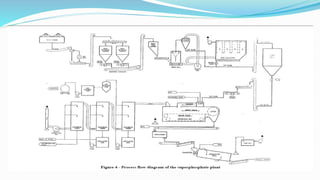
 The production of superphosphate consists of three
distinct steps.
 Step 1 - Phosphate rock blending and grinding
 Step 2 - Superphosphate manufacturing
 Step 3 - Granulation
Step 1 - Phosphate rock blending and grinding
 Phosphate rock from different sources have different
phosphate, fluoride and silica contents. These rocks are
mixed in the blending plant to produce a product with a
total phosphate concentration of 15%. The phosphate rock
mixture is passed through a hammer mill which reduces
the particle size to 0.5cm or less.
 The coarsely ground rock is then passed through an air
swept roller mill (Bradley Mill) to attain a rock grist of
Step 2 - Superphosphate manufacture
 The ground rock and sulfuric acid are reacted in a
horizontal mixer. The feed rates are approximately:
 Phosphate rock - 25 tonnes/hour
 98% Sulfuric acid - 14.5 tonnes/hour
 Water - 6 tonnes/hour
 A continuous flow of the sloppy mix drops out of the mixer into the
Broadfield Den.
The den consists of a slowly moving floor (approx. 300 mm/min)
to enable setting of the cake and reciprocating sides, which
prevent the superphosphate adhering to the walls. The partially
matured superphosphate cake is cut out of the den with a rotating
cutter wheel after a retention time of approximately 30 minutes.
Step 3 - Granulation
 The granulation process is important in producing
superphosphate of the required physical properties.
 The granulation circuit consists of a pulveriser, granulation
drum and classifier. The pulveriser breaks up any lumps in the
product before it is fed to the granulation drum. The
granulation drum rolls and agglomerates the superphosphate
to form granules.
 The incline of the drum and the feed rate determine the
retention time and bed depth. The granules are passed
out of the end of the drum and through a classifier (wire
screen).
 Oversize granules (>6 mm) are recycled through the drum
via the pulveriser while the finished product is conveyed
to the product stores.
 The superphosphate continues to cure in the store for
about two weeks and the product is dressed (oversize is
passed through a hammer mill after screening) before
dispatch.
ENVIRONMENTAL IMPLICATIONS
 The most significant potential environmental hazards are
dust (from the grinding of phosphate rock) and gaseous
hydrofluosilicic acid (from the reaction between
hydrofluoric acid and silica or quartz) emissions. These
are both carefully monitored, and a dust catcher and gas
scrubber are used.
Ssp manufacturing

Ssp manufacturing

  • 2.
  • 3.
    SSP - NutritionalSolutions to Sustainable Yields  Sulfur demand of crops can be met by Using Fertilizers like Single Super Phosphate  DAP is dependent of Global Phos Acid suppliers and availability depends on global swings  SSP could easily meet P requirement while simultaneously supplying S, Ca and micro–nutrients to Crops  SSP also helps to protect the soil from disintegration  SSP use in Sulphur deficient crops increases the crop yield by 15- 25%
  • 4.
    SSP MANUFACTURING PROCESS Raw Material  The phosphate rock, imported from Nauru, Jordan and Morocco is mainly fluorapatite, Ca5(PO4)3F and is equivalent to 70 - 85% Ca3(PO4)2 by weight.  The actual composition of the phosphate rock varies with the source.  The sulfuric acid is produced on the site.
  • 5.
     The reactionsoccurring during the production of single superphosphate are complex and are  usually summarized as follows:  1. Ca5(PO4)3F + 5H2SO4 → 5CaSO4 + 3H3PO4 + HF  2. Ca5(PO4)3F + 7H3PO4 + 5H2O → 5Ca(H2PO4)2  .H2O + HF  These reactions can be combined to give the overall equation:  2Ca5(PO4)3F + 7H2SO4 + 3H2O → 7CaSO4 + 3Ca(H2PO4)2 + H2O + 2HF
  • 6.
     The productionof superphosphate consists of three distinct steps.  Step 1 - Phosphate rock blending and grinding  Step 2 - Superphosphate manufacturing  Step 3 - Granulation
  • 7.
    Step 1 -Phosphate rock blending and grinding  Phosphate rock from different sources have different phosphate, fluoride and silica contents. These rocks are mixed in the blending plant to produce a product with a total phosphate concentration of 15%. The phosphate rock mixture is passed through a hammer mill which reduces the particle size to 0.5cm or less.  The coarsely ground rock is then passed through an air swept roller mill (Bradley Mill) to attain a rock grist of
  • 8.
    Step 2 -Superphosphate manufacture  The ground rock and sulfuric acid are reacted in a horizontal mixer. The feed rates are approximately:  Phosphate rock - 25 tonnes/hour  98% Sulfuric acid - 14.5 tonnes/hour  Water - 6 tonnes/hour
  • 9.
     A continuousflow of the sloppy mix drops out of the mixer into the Broadfield Den. The den consists of a slowly moving floor (approx. 300 mm/min) to enable setting of the cake and reciprocating sides, which prevent the superphosphate adhering to the walls. The partially matured superphosphate cake is cut out of the den with a rotating cutter wheel after a retention time of approximately 30 minutes.
  • 10.
    Step 3 -Granulation  The granulation process is important in producing superphosphate of the required physical properties.  The granulation circuit consists of a pulveriser, granulation drum and classifier. The pulveriser breaks up any lumps in the product before it is fed to the granulation drum. The granulation drum rolls and agglomerates the superphosphate to form granules.
  • 11.
     The inclineof the drum and the feed rate determine the retention time and bed depth. The granules are passed out of the end of the drum and through a classifier (wire screen).  Oversize granules (>6 mm) are recycled through the drum via the pulveriser while the finished product is conveyed to the product stores.
  • 12.
     The superphosphatecontinues to cure in the store for about two weeks and the product is dressed (oversize is passed through a hammer mill after screening) before dispatch.
  • 13.
    ENVIRONMENTAL IMPLICATIONS  Themost significant potential environmental hazards are dust (from the grinding of phosphate rock) and gaseous hydrofluosilicic acid (from the reaction between hydrofluoric acid and silica or quartz) emissions. These are both carefully monitored, and a dust catcher and gas scrubber are used.