SSL certificates in the
Oracle Database without
surprises
UKOUG – December 2018
Nelson Calero
Today’s topics
• Security basis
• Use cases in the Oracle Database
1. SSL for database connections
2. Email from PL/SQL
3. Oracle Enterprise Manager
• Management
• Troubleshooting
2 © 2018 Pythian
Intended audience: DBAs and Developers
• Database Consultant at Pythian since 2014
• Working with Oracle tools and Linux environments since 1996
• DBA Oracle (2001) & MySQL (2005)
• Co-founder and President of the Oracle user Group of Uruguay (2009)
• LAOUC Director of events (2013)
• Computer Engineer (1998)
• Oracle ACE (2014), Oracle ACE Director (2017)
• Oracle Certified Professional 10g/11g/12c, OCE, Cloud DB & Infra
• Amazon Solutions Architect – Associate (2016)
• Google Cloud Architect (2017), Google Cloud Data Engineer (2017)
• Oracle University Instructor (2011)
• Blogger and speaker: Oracle Open World, Collaborate, OTN Tour, Regional conferences
About me
3 © 2018 Pythian
http://www.linkedin.com/in/ncalero @ncalerouy
3 Membership Tiers
• Oracle ACE Director
• Oracle ACE
• Oracle ACE Associate
bit.ly/OracleACEProgram
500+ Technical Experts
Helping Peers Globally
Connect:
Nominate yourself or someone you know: acenomination.oracle.com
@oracleace
Facebook.com/oracleaces
oracle-ace_ww@oracle.com
Security Basis
• SSL
• Public/private keys
• PKI
• Certificates
• CA
• Publicly trusted CA
7 © 2018 Pythian
• Signatures
• Certificate chain
• Certificate hierarchy
• Wallets
• Handshake
• Protocols in Oracle versions
Basis – Secure Sockets Layer
• SSL is the standard security technology for establishing an encrypted
link between a server and a client
• Provides network-level authentication, data encryption, and data
integrity, ensuring that all data passed between them remain private and
integral
• Examples:
– webserver and browser
– mail server and mail client
• Based on Public Key Cryptography using Public Key Infrastructure (PKI)
8 © 2018 Pythian
SSL with the Oracle database
• Since 10gR2 SSL/TLS are no longer part of the Advanced Security
Option
• Since 12c SSL/TLS is available in Oracle Standard Edition
• Enabled by default in Oracle Cloud Database services
9 © 2018 Pythian
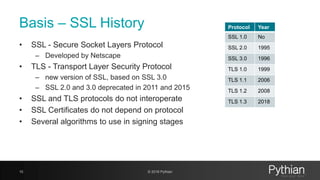
Basis – SSL History
• SSL - Secure Socket Layers Protocol
– Developed by Netscape
• TLS - Transport Layer Security Protocol
– new version of SSL, based on SSL 3.0
– SSL 2.0 and 3.0 deprecated in 2011 and 2015
• SSL and TLS protocols do not interoperate
• SSL Certificates do not depend on protocol
• Several algorithms to use in signing stages
10 © 2018 Pythian
Protocol Year
SSL 1.0 No
SSL 2.0 1995
SSL 3.0 1996
TLS 1.0 1999
TLS 1.1 2006
TLS 1.2 2008
TLS 1.3 2018
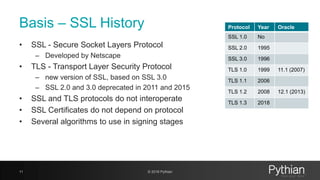
Basis – SSL History
• SSL - Secure Socket Layers Protocol
– Developed by Netscape
• TLS - Transport Layer Security Protocol
– new version of SSL, based on SSL 3.0
– SSL 2.0 and 3.0 deprecated in 2011 and 2015
• SSL and TLS protocols do not interoperate
• SSL Certificates do not depend on protocol
• Several algorithms to use in signing stages
11 © 2018 Pythian
Protocol Year Oracle
SSL 1.0 No
SSL 2.0 1995
SSL 3.0 1996
TLS 1.0 1999 11.1 (2007)
TLS 1.1 2006
TLS 1.2 2008 12.1 (2013)
TLS 1.3 2018
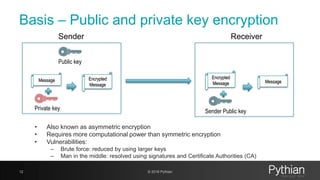
Basis – Public and private key encryption
• Also known as asymmetric encryption
• Requires more computational power than symmetric encryption
• Vulnerabilities:
– Brute force: reduced by using larger keys
– Man in the middle: resolved using signatures and Certificate Authorities (CA)
12 © 2018 Pythian
Sender Receiver
Private key
Public key
Message Encrypted
Message
Message
Encrypted
Message
Sender Public key
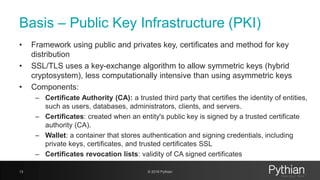
Basis – Public Key Infrastructure (PKI)
• Framework using public and privates key, certificates and method for key
distribution
• SSL/TLS uses a key-exchange algorithm to allow symmetric keys (hybrid
cryptosystem), less computationally intensive than using asymmetric keys
• Components:
– Certificate Authority (CA): a trusted third party that certifies the identity of entities,
such as users, databases, administrators, clients, and servers.
– Certificates: created when an entity's public key is signed by a trusted certificate
authority (CA).
– Wallet: a container that stores authentication and signing credentials, including
private keys, certificates, and trusted certificates SSL
– Certificates revocation lists: validity of CA signed certificates
13 © 2018 Pythian
Basis – Certificates
• Used for authentication
• Follows X.509 specification
• Associates public key with an organization’s details (AKA DN):
– A domain name, server name or hostname
– An organizational identity (i.e. company name) and location
• It also includes
– CA name, the CA signature, and the certificate effective dates
– Digital signature (explained later)
• They can be self-signed - for use in test environments
14 © 2018 Pythian
Basis – Certificate Authority (CA)
• A third party trusted by both of the communicating parties (e.g.
Verisign)
• Validates, identities and issue/revoke certificates
• The CA uses its private key to encrypt a message
• The CA public key is well known and does not have to be
authenticated each time it is accessed (browsers, wallets, etc.)
• Organization can use in-house CA (e.g. MS Certificate services)
15 © 2018 Pythian
Basis – Signature
• One-way hash of the data (certificate) encrypted with signer’s private
key – it cannot be reversed
• Receiver validates the integrity of the data:
– Receiver gets the data and signature
– Data is decrypted using sender’s public key
– Signature is decrypted using sender’s public key
– New signature is created using same algorithm
– Both new and received signature should match if data was not tampered
16 © 2018 Pythian
Basis – Publicly Trusted CAs
• A trusted third party (TTP) used as CA for the certificates
• Commercial
– Verisign, Digicert, GoDaddy
• Web browsers includes by default public keys of TTPs CA
• De-facto standard for websites, as certificates from non trusted CAs
are reported by default as dangerous
17 © 2018 Pythian
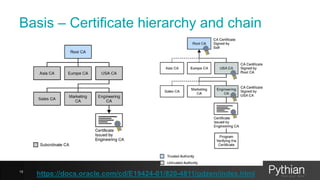
Basis – Certificate hierarchy and chain
18
https://docs.oracle.com/cd/E19424-01/820-4811/gdzen/index.html
Basis – Wallet
• A file storing authentication and signing credentials, including private
keys, certificates, and trusted certificates SSL needs.
• Oracle server and client using SSL needs a wallet file
– configured in sqlnet.ora, listener.ora, optional in tnsnames.ora (instead of sqlnet)
– Must be auto-login
• Managed with Oracle Wallet Manager and orapki tool
• Creation process for an SSL wallet:
– Generate a public-private pair
– Create a certificate request
– Submit the certificate request to the CA
– Import the signed server certificate into the wallet
– Install the wallet into the server
– Distribute server certificate to clients (exchange w/client)
19 © 2018 Pythian
Basis – SSL handshake in Oracle
1) The client and server establish which cipher suites to use.
This includes which encryption algorithms are used for data transfers.
2) The server sends its certificate to the client, and the client verifies that the server's
certificate was signed by a trusted CA. This step verifies the identity of the server.
3) Similarly, if client authentication is required, the client sends its own certificate to the
server, and the server verifies that the client's certificate was signed by a trusted CA.
4) The client and server exchange key information using public key cryptography. Based on
this information, each generates a session key. All subsequent communications between
the client and the server is encrypted and decrypted by using this session key and the
negotiated cipher suite.
20 © 2018 Pythian
Basis – SSL handshake in Oracle
Authentication:
• On a client, the user initiates an Oracle Net connection to the server by using SSL
• SSL performs the handshake between the client and the server
• If the handshake is successful, then the server verifies that the user has the appropriate
authorization to access the database
Possible configurations:
- Only the server authenticates itself to the client
- Both client and server authenticate themselves to each other
- Neither the client nor the server authenticates itself to the other, thus using the SSL
encryption feature by itself
21 © 2018 Pythian
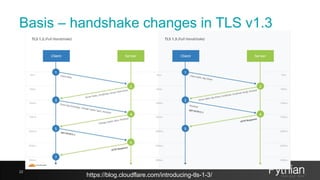
Basis – handshake changes in TLS v1.3
22
https://blog.cloudflare.com/introducing-tls-1-3/
Basis – Protocols in Oracle versions
Default TLS version included with Oracle releases:
– Oracle 11.1 - TLS 1.0
– Oracle 12.1 - TLS 1.2
PSUs include update/new algorithms, using MES SDK:
– 11.2.0.4.0 - BSAFE 6.3.2.2 and Certicom SSL plus 3.0 supported SSLv3 (SHA2)
– 12.1.0.2.0 - MESv405 supported TLSv1.2, FIPS 140-2 (MESv405 is deprecated).
– 12.2.0.2.0 - MESv415 supported TLSv1.2, FIPS 140-2 (validated).
– 18c – MES416
– 19c – MES4161
NOTE: no more one-off or overlay patches needed for MES (Doc ID 2274242.1)
11g Standard Edition: TCPS adapter needs to be enabled in oracle binaries before MES
bundle patch is applied using Note 1457854.1
23 © 2018 Pythian
Today’s topics
• Security basis
• Use cases in the Oracle Database
1. SSL for database connections
2. Email from PL/SQL
3. Oracle Enterprise Manager
• Management
• Troubleshooting
24 © 2018 Pythian
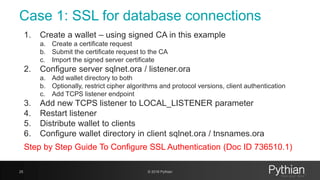
Case 1: SSL for database connections
1. Create a wallet – using signed CA in this example
a. Create a certificate request
b. Submit the certificate request to the CA
c. Import the signed server certificate
2. Configure server sqlnet.ora / listener.ora
a. Add wallet directory to both
b. Optionally, restrict cipher algorithms and protocol versions, client authentication
c. Add TCPS listener endpoint
3. Add new TCPS listener to LOCAL_LISTENER parameter
4. Restart listener
5. Distribute wallet to clients
6. Configure wallet directory in client sqlnet.ora / tnsnames.ora
Step by Step Guide To Configure SSL Authentication (Doc ID 736510.1)
25 © 2018 Pythian
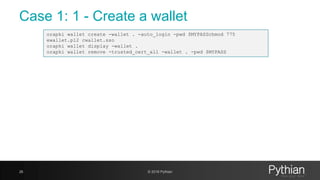
Case 1: 1 - Create a wallet
26 © 2018 Pythian
orapki wallet create -wallet . -auto_login -pwd $MYPASSchmod 775
ewallet.p12 cwallet.sso
orapki wallet display -wallet .
orapki wallet remove -trusted_cert_all -wallet . -pwd $MYPASS
Case 1: 1 - Create a wallet
27 © 2018 Pythian
orapki wallet create -wallet . -auto_login -pwd $MYPASSchmod 775
ewallet.p12 cwallet.sso
orapki wallet display -wallet .
orapki wallet remove -trusted_cert_all -wallet . -pwd $MYPASS
[oracle@myserver wallet2018]$ ls -lrt
total 0
[oracle@myserver wallet2018]$ orapki wallet create -wallet . -auto_login -pwd xxx
Oracle PKI Tool : Version 11.2.0.4.0 - Production
Copyright (c) 2004, 2013, Oracle and/or its affiliates. All rights reserved.
[oracle@myserver wallet2018]$ orapki wallet display -wallet .
Oracle PKI Tool : Version 11.2.0.4.0 - Production
Copyright (c) 2004, 2013, Oracle and/or its affiliates. All rights reserved.
Requested Certificates:
User Certificates:
Trusted Certificates:
Subject: OU=Class 1 Public Primary Certification Authority,O=VeriSign, Inc.,C=US
Subject: OU=Class 3 Public Primary Certification Authority,O=VeriSign, Inc.,C=US
Subject: OU=Class 2 Public Primary Certification Authority,O=VeriSign, Inc.,C=US
Subject: OU=Secure Server Certification Authority,O=RSA Data Security, Inc.,C=US
Subject: CN=GTE CyberTrust Global Root,OU=GTE CyberTrust Solutions, Inc.,O=GTE Corporation,C=US
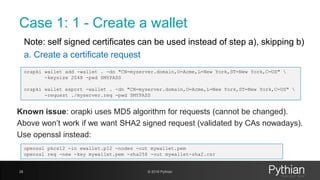
Case 1: 1 - Create a wallet
Note: self signed certificates can be used instead of step a), skipping b)
a. Create a certificate request
28 © 2018 Pythian
orapki wallet add -wallet . -dn "CN=myserver.domain,O=Acme,L=New York,ST=New York,C=US" 
-keysize 2048 -pwd $MYPASS
orapki wallet export -wallet . -dn "CN=myserver.domain,O=Acme,L=New York,ST=New York,C=US" 
-request ./myserver.req -pwd $MYPASS
Known issue: orapki uses MD5 algorithm for requests (cannot be changed).
Above won’t work if we want SHA2 signed request (validated by CAs nowadays).
Use openssl instead:
openssl pkcs12 -in ewallet.p12 -nodes -out mywallet.pem
openssl req -new -key mywallet.pem -sha256 -out mywallet-sha2.csr
Case 1: 1 - Create a wallet
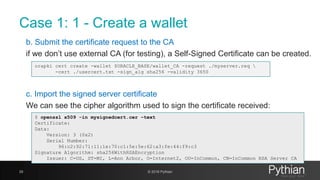
b. Submit the certificate request to the CA
if we don’t use external CA (for testing), a Self-Signed Certificate can be created.
c. Import the signed server certificate
We can see the cipher algorithm used to sign the certificate received:
29 © 2018 Pythian
$ openssl x509 -in mysignedcert.cer –text
Certificate:
Data:
Version: 3 (0x2)
Serial Number:
96:c2:92:71:11:1e:70:c1:5e:5e:62:a3:fe:44:f9:c3
Signature Algorithm: sha256WithRSAEncryption
Issuer: C=US, ST=MI, L=Ann Arbor, O=Internet2, OU=InCommon, CN=InCommon RSA Server CA
orapki cert create -wallet $ORACLE_BASE/wallet_CA -request ./myserver.req 
-cert ./usercert.txt -sign_alg sha256 -validity 3650
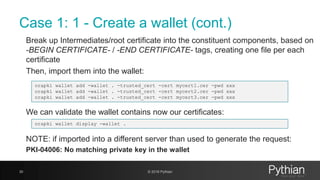
Case 1: 1 - Create a wallet (cont.)
Break up Intermediates/root certificate into the constituent components, based on
-BEGIN CERTIFICATE- / -END CERTIFICATE- tags, creating one file per each
certificate
Then, import them into the wallet:
We can validate the wallet contains now our certificates:
NOTE: if imported into a different server than used to generate the request:
PKI-04006: No matching private key in the wallet
30 © 2018 Pythian
orapki wallet add -wallet . -trusted_cert -cert mycert1.cer -pwd xxx
orapki wallet add -wallet . -trusted_cert -cert mycert2.cer -pwd xxx
orapki wallet add -wallet . -trusted_cert -cert mycert3.cer -pwd xxx
orapki wallet display -wallet .
Case 1: 2 - Configure server
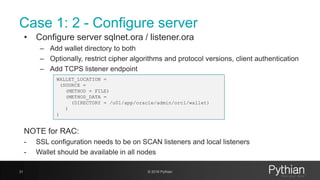
• Configure server sqlnet.ora / listener.ora
– Add wallet directory to both
– Optionally, restrict cipher algorithms and protocol versions, client authentication
– Add TCPS listener endpoint
NOTE for RAC:
- SSL configuration needs to be on SCAN listeners and local listeners
- Wallet should be available in all nodes
31 © 2018 Pythian
WALLET_LOCATION =
(SOURCE =
(METHOD = FILE)
(METHOD_DATA =
(DIRECTORY = /u01/app/oracle/admin/orcl/wallet)
)
)
Case 1: 2 – Add TCPS listener endpoints
32 © 2018 Pythian
[oracle@myserver ~]$ crsctl stat res -p |grep ENDPOINTS
ENDPOINTS=TCP:1521
ENDPOINTS=TCP:1521
ENDPOINTS=TCP:1521
ENDPOINTS=TCP:1521
ENDPOINTS=TCP:1521
[oracle@myserver ~]$ srvctl modify listener -p "TCP:1521/TCPS:2484"
[oracle@myserver ~]$ srvctl modify scan_listener -p "TCP:1521/TCPS:2484"
[oracle@myserver ~]$ crsctl stat res -p |grep -B20 ENDPOINTS | grep -e ENDPOINTS -e "^NAME="
NAME=ora.LISTENER.lsnr
ENDPOINTS=TCP:1521 TCPS:2484
NAME=ora.LISTENER_SCAN1.lsnr
ENDPOINTS=TCP:1521 TCPS:2484
NAME=ora.LISTENER_SCAN2.lsnr
ENDPOINTS=TCP:1521 TCPS:2484
NAME=ora.LISTENER_SCAN3.lsnr
ENDPOINTS=TCP:1521 TCPS:2484
NAME=ora.MGMTLSNR
ENDPOINTS=TCP:1521
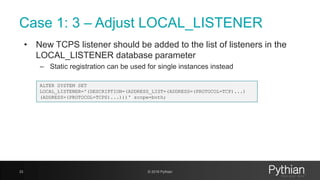
Case 1: 3 – Adjust LOCAL_LISTENER
• New TCPS listener should be added to the list of listeners in the
LOCAL_LISTENER database parameter
– Static registration can be used for single instances instead
33 © 2018 Pythian
ALTER SYSTEM SET
LOCAL_LISTENER='(DESCRIPTION=(ADDRESS_LIST=(ADDRESS=(PROTOCOL=TCP)...)
(ADDRESS=(PROTOCOL=TCPS)...)))' scope=both;
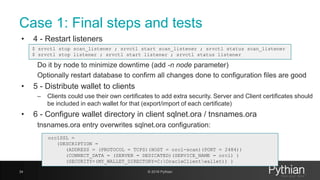
Case 1: Final steps and tests
• 4 - Restart listeners
Do it by node to minimize downtime (add -n node parameter)
Optionally restart database to confirm all changes done to configuration files are good
• 5 - Distribute wallet to clients
– Clients could use their own certificates to add extra security. Server and Client certificates should
be included in each wallet for that (export/import of each certificate)
• 6 - Configure wallet directory in client sqlnet.ora / tnsnames.ora
tnsnames.ora entry overwrites sqlnet.ora configuration:
34 © 2018 Pythian
$ srvctl stop scan_listener ; srvctl start scan_listener ; srvctl status scan_listener
$ srvctl stop listener ; srvctl start listener ; srvctl status listener
orclSSL =
(DESCRIPTION =
(ADDRESS = (PROTOCOL = TCPS)(HOST = orcl-scan)(PORT = 2484))
(CONNECT_DATA = (SERVER = DEDICATED)(SERVICE_NAME = orcl) )
(SECURITY=(MY_WALLET_DIRECTORY=C:OracleClientwallet)) )
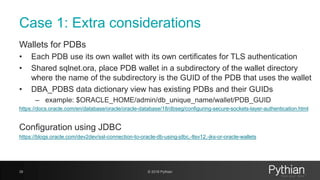
Case 1: Extra considerations
Wallets for PDBs
• Each PDB use its own wallet with its own certificates for TLS authentication
• Shared sqlnet.ora, place PDB wallet in a subdirectory of the wallet directory
where the name of the subdirectory is the GUID of the PDB that uses the wallet
• DBA_PDBS data dictionary view has existing PDBs and their GUIDs
– example: $ORACLE_HOME/admin/db_unique_name/wallet/PDB_GUID
https://docs.oracle.com/en/database/oracle/oracle-database/18/dbseg/configuring-secure-sockets-layer-authentication.html
Configuration using JDBC
https://blogs.oracle.com/dev2dev/ssl-connection-to-oracle-db-using-jdbc,-tlsv12,-jks-or-oracle-wallets
35 © 2018 Pythian
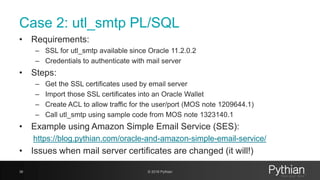
Case 2: utl_smtp PL/SQL
• Requirements:
– SSL for utl_smtp available since Oracle 11.2.0.2
– Credentials to authenticate with mail server
• Steps:
– Get the SSL certificates used by email server
– Import those SSL certificates into an Oracle Wallet
– Create ACL to allow traffic for the user/port (MOS note 1209644.1)
– Call utl_smtp using sample code from MOS note 1323140.1
• Example using Amazon Simple Email Service (SES):
https://blog.pythian.com/oracle-and-amazon-simple-email-service/
• Issues when mail server certificates are changed (it will!)
36 © 2018 Pythian
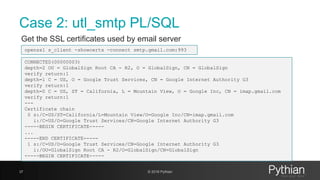
Case 2: utl_smtp PL/SQL
Get the SSL certificates used by email server
37 © 2018 Pythian
openssl s_client -showcerts -connect smtp.gmail.com:993
CONNECTED(00000003)
depth=2 OU = GlobalSign Root CA - R2, O = GlobalSign, CN = GlobalSign
verify return:1
depth=1 C = US, O = Google Trust Services, CN = Google Internet Authority G3
verify return:1
depth=0 C = US, ST = California, L = Mountain View, O = Google Inc, CN = imap.gmail.com
verify return:1
---
Certificate chain
0 s:/C=US/ST=California/L=Mountain View/O=Google Inc/CN=imap.gmail.com
i:/C=US/O=Google Trust Services/CN=Google Internet Authority G3
-----BEGIN CERTIFICATE-----
...
-----END CERTIFICATE-----
1 s:/C=US/O=Google Trust Services/CN=Google Internet Authority G3
i:/OU=GlobalSign Root CA - R2/O=GlobalSign/CN=GlobalSign
-----BEGIN CERTIFICATE-----
Case 3: Oracle Enterprise Manager
It has
• TLS protocol used by its components (OMS, Agent, WLS, OPMN, OHS)
• Ciphers used by SSL certificates on those ports
• Key strength of those certificates
All changes with versions:
• 12c: use MOS note 1602983.1 to enable usage of TLSv1.0 Protocol
• 13.1: EM Oracle Management Service is configured to use TLS v1.0, v1.1 and v1.2
protocols out-of-the-box
– It can be changed to restrict OMS to use specific protocols like TLS v1.1 or TLS
v1.2. Details in MOS note 2212006.1
• 13.2: TLS v1.2 is default
• 13.3: OMS has java version 1.7.0_171 out-of-the-box
38 © 2018 Pythian
Case 3: OEM fun – possible changes
OEM 12c: uses 10.3.6 WLS. Demo cert. has 512 bit keystrength signed with MD5withRSA
OEM 13c: uses 12.1.3 WLS. Demo cert. has 2048 bit keystrength signed with SHA256withRSA
We can make changes following steps from below notes:
• How to Check and Increase the Key Strength of Certificates Used in Enterprise Manager Grid Control
(Doc ID 1476567.1)
- EM 12c: How to Disable Weak SSLCipherSuites Used by Enterprise Manager 12c Cloud Control (Doc ID
1477287.1)
- New SSL Protocol and Cipher Options for Oracle Fusion Middleware's OPMN/ONS Component (Doc ID
1905314.1)
- Regenerating OEM 12c SSL certificates with Higher Keystrength and Signature Algorithm (Doc ID
1611578.1)
- WebLogic Server - Migrating a 1024-bit key certficate (CSR) to a 2048-bit key (Doc ID 949316.1)
- EM 13c, 12c: How to Configure Enterprise Manager's Weblogic Server (WLS) for Secure Socket Layer
Certificates (Doc ID 2220788.1)
39 © 2018 Pythian
Today’s topics
• Security basis
• Use cases in the Oracle Database
1. SSL for database connections
2. Email from PL/SQL
3. Oracle Enterprise Manager
• Management
• Troubleshooting
40 © 2018 Pythian
Management
• Certificates
– Create, sign and distribute
– Renew (before expiration date)
– Re-generate with different cipher suite (e.g.: SHA2)
– Wallets: create, import certificates, distribute to clients
• SQL*Net configuration
– Change cipher suites (SHA1, SHA2, etc.)
– Restrict protocol versions to use
• Oracle homes
– Patch server/clients to incorporate newer protocol versions and
cipher algorithms
41 © 2018 Pythian
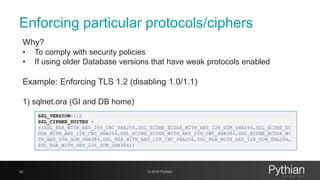
Enforcing particular protocols/ciphers
Why?
• To comply with security policies
• If using older Database versions that have weak protocols enabled
Example: Enforcing TLS 1.2 (disabling 1.0/1.1)
1) sqlnet.ora (GI and DB home)
42 © 2018 Pythian
SSL_VERSION=1.2
SSL_CIPHER_SUITES =
((SSL_RSA_WITH_AES_256_CBC_SHA256,SSL_ECDHE_ECDSA_WITH_AES_128_GCM_SHA256,SSL_ECDHE_EC
DSA_WITH_AES_128_CBC_SHA256,SSL_ECDHE_ECDSA_WITH_AES_256_CBC_SHA384,SSL_ECDHE_ECDSA_WI
TH_AES_256_GCM_SHA384,SSL_RSA_WITH_AES_128_CBC_SHA256,SSL_RSA_WITH_AES_128_GCM_SHA256,
SSL_RSA_WITH_AES_256_GCM_SHA384))
Enforcing particular protocols/ciphers (cont.)
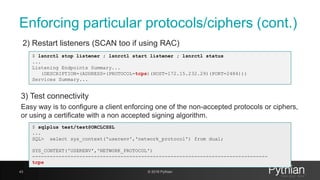
2) Restart listeners (SCAN too if using RAC)
43 © 2018 Pythian
$ lsnrctl stop listener ; lsnrctl start listener ; lsnrctl status
...
Listening Endpoints Summary...
(DESCRIPTION=(ADDRESS=(PROTOCOL=tcps)(HOST=172.15.232.29)(PORT=2484)))
Services Summary...
3) Test connectivity
Easy way is to configure a client enforcing one of the non-accepted protocols or ciphers,
or using a certificate with a non accepted signing algorithm.
$ sqlplus test/test@ORCLCSSL
...
SQL> select sys_context('userenv','network_protocol') from dual;
SYS_CONTEXT('USERENV','NETWORK_PROTOCOL')
--------------------------------------------------------------------------------
tcps
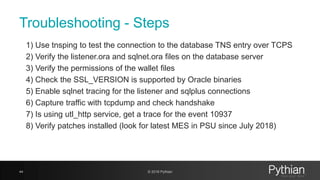
Troubleshooting - Steps
1) Use tnsping to test the connection to the database TNS entry over TCPS
2) Verify the listener.ora and sqlnet.ora files on the database server
3) Verify the permissions of the wallet files
4) Check the SSL_VERSION is supported by Oracle binaries
5) Enable sqlnet tracing for the listener and sqlplus connections
6) Capture traffic with tcpdump and check handshake
7) Is using utl_http service, get a trace for the event 10937
8) Verify patches installed (look for latest MES in PSU since July 2018)
44 © 2018 Pythian
Confirm protocols accepted
So far we have enabled SSL in the listener to use all available TLS protocols and signing
algorithms for our installed version. To check that:
45 © 2018 Pythian
[oracle@myhost ~]$ openssl s_client -host server-vip -port 2484
CONNECTED(00000003)
depth=3 C = SE, O = AddTrust AB, OU = AddTrust External TTP Network, CN = AddTrust External CA Root
…
SSL handshake has read 5942 bytes and written 573 bytes
---
New, TLSv1/SSLv3, Cipher is AES256-SHA
Server public key is 2048 bit
Secure Renegotiation IS supported
Compression: NONE
Expansion: NONE
SSL-Session:
Protocol : TLSv1
Cipher : AES256-SHA
Session-ID:
…
---
New, TLSv1/SSLv3, Cipher is RC4-SHA
Server public key is 1024 bit
…
SSL-Session:
Protocol : TLSv1
Cipher : RC4-SHA
Confirm protocols accepted
46 © 2018 Pythian
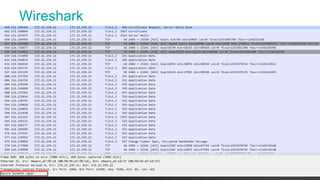
We can inspect the traffic:
- Enabling SQL*Net trace – no details about protocol used in handsake
- Use tcpdump and wireshark to confirm protocols and ciphers
[root@myserver ~]# tcpdump -nnvvXSs0 -i eth1 host myhost.mydomain -w /tmp/tcpdump.out
tcpdump: listening on eth1, link-type EN10MB (Ethernet), capture size 262144 bytes
Perform activity from client and stop capture:
SQL> select * from dual;
[root@myserver ~]# ^C 926 packets captured
926 packets received by filter
0 packets dropped by kernel
Open the generated file using wireshark.
- Mark the port used for SSL (Analyze -> Decode As -> Transport)
Wireshark
47 © 2018 Pythian
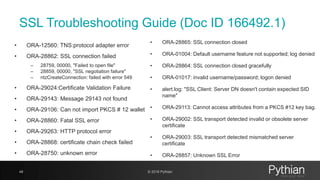
SSL Troubleshooting Guide (Doc ID 166492.1)
• ORA-12560: TNS:protocol adapter error
• ORA-28862: SSL connection failed
– 28759, 00000, "Failed to open file"
– 28859, 00000, "SSL negotiation failure"
– ntzCreateConnection: failed with error 549
• ORA-29024:Certificate Validation Failure
• ORA-29143: Message 29143 not found
• ORA-29106: Can not import PKCS # 12 wallet
• ORA-28860: Fatal SSL error
• ORA-29263: HTTP protocol error
• ORA-28868: certificate chain check failed
• ORA-28750: unknown error
48 © 2018 Pythian
• ORA-28865: SSL connection closed
• ORA-01004: Default username feature not supported; log denied
• ORA-28864: SSL connection closed gracefully
• ORA-01017: invalid username/password; logon denied
• alert.log: "SSL Client: Server DN doesn't contain expected SID
name"
• ORA-29113: Cannot access attributes from a PKCS #12 key bag.
• ORA-29002: SSL transport detected invalid or obsolete server
certificate
• ORA-29003: SSL transport detected mismatched server
certificate
• ORA-28857: Unknown SSL Error
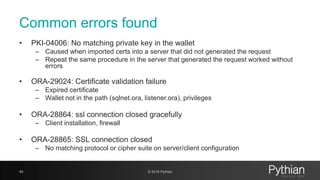
Common errors found
• PKI-04006: No matching private key in the wallet
– Caused when imported certs into a server that did not generated the request
– Repeat the same procedure in the server that generated the request worked without
errors
• ORA-29024: Certificate validation failure
– Expired certificate
– Wallet not in the path (sqlnet.ora, listener.ora), privileges
• ORA-28864: ssl connection closed gracefully
– Client installation, firewall
• ORA-28865: SSL connection closed
– No matching protocol or cipher suite on server/client configuration
49 © 2018 Pythian
THANK YOU
Questions?
50
calero@pythian.com
@ncalerouy
http://www.linkedin.com/in/ncalero
© 2017 Pythian
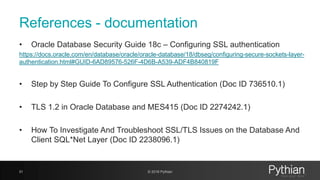
References - documentation
• Oracle Database Security Guide 18c – Configuring SSL authentication
https://docs.oracle.com/en/database/oracle/oracle-database/18/dbseg/configuring-secure-sockets-layer-
authentication.html#GUID-6AD89576-526F-4D6B-A539-ADF4B840819F
• Step by Step Guide To Configure SSL Authentication (Doc ID 736510.1)
• TLS 1.2 in Oracle Database and MES415 (Doc ID 2274242.1)
• How To Investigate And Troubleshoot SSL/TLS Issues on the Database And
Client SQL*Net Layer (Doc ID 2238096.1)
51 © 2018 Pythian

SSL certificates in the Oracle Database without surprises

  • 1.
    SSL certificates inthe Oracle Database without surprises UKOUG – December 2018 Nelson Calero
  • 2.
    Today’s topics • Securitybasis • Use cases in the Oracle Database 1. SSL for database connections 2. Email from PL/SQL 3. Oracle Enterprise Manager • Management • Troubleshooting 2 © 2018 Pythian Intended audience: DBAs and Developers
  • 3.
    • Database Consultantat Pythian since 2014 • Working with Oracle tools and Linux environments since 1996 • DBA Oracle (2001) & MySQL (2005) • Co-founder and President of the Oracle user Group of Uruguay (2009) • LAOUC Director of events (2013) • Computer Engineer (1998) • Oracle ACE (2014), Oracle ACE Director (2017) • Oracle Certified Professional 10g/11g/12c, OCE, Cloud DB & Infra • Amazon Solutions Architect – Associate (2016) • Google Cloud Architect (2017), Google Cloud Data Engineer (2017) • Oracle University Instructor (2011) • Blogger and speaker: Oracle Open World, Collaborate, OTN Tour, Regional conferences About me 3 © 2018 Pythian http://www.linkedin.com/in/ncalero @ncalerouy
  • 6.
    3 Membership Tiers •Oracle ACE Director • Oracle ACE • Oracle ACE Associate bit.ly/OracleACEProgram 500+ Technical Experts Helping Peers Globally Connect: Nominate yourself or someone you know: acenomination.oracle.com @oracleace Facebook.com/oracleaces oracle-ace_ww@oracle.com
  • 7.
    Security Basis • SSL •Public/private keys • PKI • Certificates • CA • Publicly trusted CA 7 © 2018 Pythian • Signatures • Certificate chain • Certificate hierarchy • Wallets • Handshake • Protocols in Oracle versions
  • 8.
    Basis – SecureSockets Layer • SSL is the standard security technology for establishing an encrypted link between a server and a client • Provides network-level authentication, data encryption, and data integrity, ensuring that all data passed between them remain private and integral • Examples: – webserver and browser – mail server and mail client • Based on Public Key Cryptography using Public Key Infrastructure (PKI) 8 © 2018 Pythian
  • 9.
    SSL with theOracle database • Since 10gR2 SSL/TLS are no longer part of the Advanced Security Option • Since 12c SSL/TLS is available in Oracle Standard Edition • Enabled by default in Oracle Cloud Database services 9 © 2018 Pythian
  • 10.
    Basis – SSLHistory • SSL - Secure Socket Layers Protocol – Developed by Netscape • TLS - Transport Layer Security Protocol – new version of SSL, based on SSL 3.0 – SSL 2.0 and 3.0 deprecated in 2011 and 2015 • SSL and TLS protocols do not interoperate • SSL Certificates do not depend on protocol • Several algorithms to use in signing stages 10 © 2018 Pythian Protocol Year SSL 1.0 No SSL 2.0 1995 SSL 3.0 1996 TLS 1.0 1999 TLS 1.1 2006 TLS 1.2 2008 TLS 1.3 2018
  • 11.
    Basis – SSLHistory • SSL - Secure Socket Layers Protocol – Developed by Netscape • TLS - Transport Layer Security Protocol – new version of SSL, based on SSL 3.0 – SSL 2.0 and 3.0 deprecated in 2011 and 2015 • SSL and TLS protocols do not interoperate • SSL Certificates do not depend on protocol • Several algorithms to use in signing stages 11 © 2018 Pythian Protocol Year Oracle SSL 1.0 No SSL 2.0 1995 SSL 3.0 1996 TLS 1.0 1999 11.1 (2007) TLS 1.1 2006 TLS 1.2 2008 12.1 (2013) TLS 1.3 2018
  • 12.
    Basis – Publicand private key encryption • Also known as asymmetric encryption • Requires more computational power than symmetric encryption • Vulnerabilities: – Brute force: reduced by using larger keys – Man in the middle: resolved using signatures and Certificate Authorities (CA) 12 © 2018 Pythian Sender Receiver Private key Public key Message Encrypted Message Message Encrypted Message Sender Public key
  • 13.
    Basis – PublicKey Infrastructure (PKI) • Framework using public and privates key, certificates and method for key distribution • SSL/TLS uses a key-exchange algorithm to allow symmetric keys (hybrid cryptosystem), less computationally intensive than using asymmetric keys • Components: – Certificate Authority (CA): a trusted third party that certifies the identity of entities, such as users, databases, administrators, clients, and servers. – Certificates: created when an entity's public key is signed by a trusted certificate authority (CA). – Wallet: a container that stores authentication and signing credentials, including private keys, certificates, and trusted certificates SSL – Certificates revocation lists: validity of CA signed certificates 13 © 2018 Pythian
  • 14.
    Basis – Certificates •Used for authentication • Follows X.509 specification • Associates public key with an organization’s details (AKA DN): – A domain name, server name or hostname – An organizational identity (i.e. company name) and location • It also includes – CA name, the CA signature, and the certificate effective dates – Digital signature (explained later) • They can be self-signed - for use in test environments 14 © 2018 Pythian
  • 15.
    Basis – CertificateAuthority (CA) • A third party trusted by both of the communicating parties (e.g. Verisign) • Validates, identities and issue/revoke certificates • The CA uses its private key to encrypt a message • The CA public key is well known and does not have to be authenticated each time it is accessed (browsers, wallets, etc.) • Organization can use in-house CA (e.g. MS Certificate services) 15 © 2018 Pythian
  • 16.
    Basis – Signature •One-way hash of the data (certificate) encrypted with signer’s private key – it cannot be reversed • Receiver validates the integrity of the data: – Receiver gets the data and signature – Data is decrypted using sender’s public key – Signature is decrypted using sender’s public key – New signature is created using same algorithm – Both new and received signature should match if data was not tampered 16 © 2018 Pythian
  • 17.
    Basis – PubliclyTrusted CAs • A trusted third party (TTP) used as CA for the certificates • Commercial – Verisign, Digicert, GoDaddy • Web browsers includes by default public keys of TTPs CA • De-facto standard for websites, as certificates from non trusted CAs are reported by default as dangerous 17 © 2018 Pythian
  • 18.
    Basis – Certificatehierarchy and chain 18 https://docs.oracle.com/cd/E19424-01/820-4811/gdzen/index.html
  • 19.
    Basis – Wallet •A file storing authentication and signing credentials, including private keys, certificates, and trusted certificates SSL needs. • Oracle server and client using SSL needs a wallet file – configured in sqlnet.ora, listener.ora, optional in tnsnames.ora (instead of sqlnet) – Must be auto-login • Managed with Oracle Wallet Manager and orapki tool • Creation process for an SSL wallet: – Generate a public-private pair – Create a certificate request – Submit the certificate request to the CA – Import the signed server certificate into the wallet – Install the wallet into the server – Distribute server certificate to clients (exchange w/client) 19 © 2018 Pythian
  • 20.
    Basis – SSLhandshake in Oracle 1) The client and server establish which cipher suites to use. This includes which encryption algorithms are used for data transfers. 2) The server sends its certificate to the client, and the client verifies that the server's certificate was signed by a trusted CA. This step verifies the identity of the server. 3) Similarly, if client authentication is required, the client sends its own certificate to the server, and the server verifies that the client's certificate was signed by a trusted CA. 4) The client and server exchange key information using public key cryptography. Based on this information, each generates a session key. All subsequent communications between the client and the server is encrypted and decrypted by using this session key and the negotiated cipher suite. 20 © 2018 Pythian
  • 21.
    Basis – SSLhandshake in Oracle Authentication: • On a client, the user initiates an Oracle Net connection to the server by using SSL • SSL performs the handshake between the client and the server • If the handshake is successful, then the server verifies that the user has the appropriate authorization to access the database Possible configurations: - Only the server authenticates itself to the client - Both client and server authenticate themselves to each other - Neither the client nor the server authenticates itself to the other, thus using the SSL encryption feature by itself 21 © 2018 Pythian
  • 22.
    Basis – handshakechanges in TLS v1.3 22 https://blog.cloudflare.com/introducing-tls-1-3/
  • 23.
    Basis – Protocolsin Oracle versions Default TLS version included with Oracle releases: – Oracle 11.1 - TLS 1.0 – Oracle 12.1 - TLS 1.2 PSUs include update/new algorithms, using MES SDK: – 11.2.0.4.0 - BSAFE 6.3.2.2 and Certicom SSL plus 3.0 supported SSLv3 (SHA2) – 12.1.0.2.0 - MESv405 supported TLSv1.2, FIPS 140-2 (MESv405 is deprecated). – 12.2.0.2.0 - MESv415 supported TLSv1.2, FIPS 140-2 (validated). – 18c – MES416 – 19c – MES4161 NOTE: no more one-off or overlay patches needed for MES (Doc ID 2274242.1) 11g Standard Edition: TCPS adapter needs to be enabled in oracle binaries before MES bundle patch is applied using Note 1457854.1 23 © 2018 Pythian
  • 24.
    Today’s topics • Securitybasis • Use cases in the Oracle Database 1. SSL for database connections 2. Email from PL/SQL 3. Oracle Enterprise Manager • Management • Troubleshooting 24 © 2018 Pythian
  • 25.
    Case 1: SSLfor database connections 1. Create a wallet – using signed CA in this example a. Create a certificate request b. Submit the certificate request to the CA c. Import the signed server certificate 2. Configure server sqlnet.ora / listener.ora a. Add wallet directory to both b. Optionally, restrict cipher algorithms and protocol versions, client authentication c. Add TCPS listener endpoint 3. Add new TCPS listener to LOCAL_LISTENER parameter 4. Restart listener 5. Distribute wallet to clients 6. Configure wallet directory in client sqlnet.ora / tnsnames.ora Step by Step Guide To Configure SSL Authentication (Doc ID 736510.1) 25 © 2018 Pythian
  • 26.
    Case 1: 1- Create a wallet 26 © 2018 Pythian orapki wallet create -wallet . -auto_login -pwd $MYPASSchmod 775 ewallet.p12 cwallet.sso orapki wallet display -wallet . orapki wallet remove -trusted_cert_all -wallet . -pwd $MYPASS
  • 27.
    Case 1: 1- Create a wallet 27 © 2018 Pythian orapki wallet create -wallet . -auto_login -pwd $MYPASSchmod 775 ewallet.p12 cwallet.sso orapki wallet display -wallet . orapki wallet remove -trusted_cert_all -wallet . -pwd $MYPASS [oracle@myserver wallet2018]$ ls -lrt total 0 [oracle@myserver wallet2018]$ orapki wallet create -wallet . -auto_login -pwd xxx Oracle PKI Tool : Version 11.2.0.4.0 - Production Copyright (c) 2004, 2013, Oracle and/or its affiliates. All rights reserved. [oracle@myserver wallet2018]$ orapki wallet display -wallet . Oracle PKI Tool : Version 11.2.0.4.0 - Production Copyright (c) 2004, 2013, Oracle and/or its affiliates. All rights reserved. Requested Certificates: User Certificates: Trusted Certificates: Subject: OU=Class 1 Public Primary Certification Authority,O=VeriSign, Inc.,C=US Subject: OU=Class 3 Public Primary Certification Authority,O=VeriSign, Inc.,C=US Subject: OU=Class 2 Public Primary Certification Authority,O=VeriSign, Inc.,C=US Subject: OU=Secure Server Certification Authority,O=RSA Data Security, Inc.,C=US Subject: CN=GTE CyberTrust Global Root,OU=GTE CyberTrust Solutions, Inc.,O=GTE Corporation,C=US
  • 28.
    Case 1: 1- Create a wallet Note: self signed certificates can be used instead of step a), skipping b) a. Create a certificate request 28 © 2018 Pythian orapki wallet add -wallet . -dn "CN=myserver.domain,O=Acme,L=New York,ST=New York,C=US" -keysize 2048 -pwd $MYPASS orapki wallet export -wallet . -dn "CN=myserver.domain,O=Acme,L=New York,ST=New York,C=US" -request ./myserver.req -pwd $MYPASS Known issue: orapki uses MD5 algorithm for requests (cannot be changed). Above won’t work if we want SHA2 signed request (validated by CAs nowadays). Use openssl instead: openssl pkcs12 -in ewallet.p12 -nodes -out mywallet.pem openssl req -new -key mywallet.pem -sha256 -out mywallet-sha2.csr
  • 29.
    Case 1: 1- Create a wallet b. Submit the certificate request to the CA if we don’t use external CA (for testing), a Self-Signed Certificate can be created. c. Import the signed server certificate We can see the cipher algorithm used to sign the certificate received: 29 © 2018 Pythian $ openssl x509 -in mysignedcert.cer –text Certificate: Data: Version: 3 (0x2) Serial Number: 96:c2:92:71:11:1e:70:c1:5e:5e:62:a3:fe:44:f9:c3 Signature Algorithm: sha256WithRSAEncryption Issuer: C=US, ST=MI, L=Ann Arbor, O=Internet2, OU=InCommon, CN=InCommon RSA Server CA orapki cert create -wallet $ORACLE_BASE/wallet_CA -request ./myserver.req -cert ./usercert.txt -sign_alg sha256 -validity 3650
  • 30.
    Case 1: 1- Create a wallet (cont.) Break up Intermediates/root certificate into the constituent components, based on -BEGIN CERTIFICATE- / -END CERTIFICATE- tags, creating one file per each certificate Then, import them into the wallet: We can validate the wallet contains now our certificates: NOTE: if imported into a different server than used to generate the request: PKI-04006: No matching private key in the wallet 30 © 2018 Pythian orapki wallet add -wallet . -trusted_cert -cert mycert1.cer -pwd xxx orapki wallet add -wallet . -trusted_cert -cert mycert2.cer -pwd xxx orapki wallet add -wallet . -trusted_cert -cert mycert3.cer -pwd xxx orapki wallet display -wallet .
  • 31.
    Case 1: 2- Configure server • Configure server sqlnet.ora / listener.ora – Add wallet directory to both – Optionally, restrict cipher algorithms and protocol versions, client authentication – Add TCPS listener endpoint NOTE for RAC: - SSL configuration needs to be on SCAN listeners and local listeners - Wallet should be available in all nodes 31 © 2018 Pythian WALLET_LOCATION = (SOURCE = (METHOD = FILE) (METHOD_DATA = (DIRECTORY = /u01/app/oracle/admin/orcl/wallet) ) )
  • 32.
    Case 1: 2– Add TCPS listener endpoints 32 © 2018 Pythian [oracle@myserver ~]$ crsctl stat res -p |grep ENDPOINTS ENDPOINTS=TCP:1521 ENDPOINTS=TCP:1521 ENDPOINTS=TCP:1521 ENDPOINTS=TCP:1521 ENDPOINTS=TCP:1521 [oracle@myserver ~]$ srvctl modify listener -p "TCP:1521/TCPS:2484" [oracle@myserver ~]$ srvctl modify scan_listener -p "TCP:1521/TCPS:2484" [oracle@myserver ~]$ crsctl stat res -p |grep -B20 ENDPOINTS | grep -e ENDPOINTS -e "^NAME=" NAME=ora.LISTENER.lsnr ENDPOINTS=TCP:1521 TCPS:2484 NAME=ora.LISTENER_SCAN1.lsnr ENDPOINTS=TCP:1521 TCPS:2484 NAME=ora.LISTENER_SCAN2.lsnr ENDPOINTS=TCP:1521 TCPS:2484 NAME=ora.LISTENER_SCAN3.lsnr ENDPOINTS=TCP:1521 TCPS:2484 NAME=ora.MGMTLSNR ENDPOINTS=TCP:1521
  • 33.
    Case 1: 3– Adjust LOCAL_LISTENER • New TCPS listener should be added to the list of listeners in the LOCAL_LISTENER database parameter – Static registration can be used for single instances instead 33 © 2018 Pythian ALTER SYSTEM SET LOCAL_LISTENER='(DESCRIPTION=(ADDRESS_LIST=(ADDRESS=(PROTOCOL=TCP)...) (ADDRESS=(PROTOCOL=TCPS)...)))' scope=both;
  • 34.
    Case 1: Finalsteps and tests • 4 - Restart listeners Do it by node to minimize downtime (add -n node parameter) Optionally restart database to confirm all changes done to configuration files are good • 5 - Distribute wallet to clients – Clients could use their own certificates to add extra security. Server and Client certificates should be included in each wallet for that (export/import of each certificate) • 6 - Configure wallet directory in client sqlnet.ora / tnsnames.ora tnsnames.ora entry overwrites sqlnet.ora configuration: 34 © 2018 Pythian $ srvctl stop scan_listener ; srvctl start scan_listener ; srvctl status scan_listener $ srvctl stop listener ; srvctl start listener ; srvctl status listener orclSSL = (DESCRIPTION = (ADDRESS = (PROTOCOL = TCPS)(HOST = orcl-scan)(PORT = 2484)) (CONNECT_DATA = (SERVER = DEDICATED)(SERVICE_NAME = orcl) ) (SECURITY=(MY_WALLET_DIRECTORY=C:OracleClientwallet)) )
  • 35.
    Case 1: Extraconsiderations Wallets for PDBs • Each PDB use its own wallet with its own certificates for TLS authentication • Shared sqlnet.ora, place PDB wallet in a subdirectory of the wallet directory where the name of the subdirectory is the GUID of the PDB that uses the wallet • DBA_PDBS data dictionary view has existing PDBs and their GUIDs – example: $ORACLE_HOME/admin/db_unique_name/wallet/PDB_GUID https://docs.oracle.com/en/database/oracle/oracle-database/18/dbseg/configuring-secure-sockets-layer-authentication.html Configuration using JDBC https://blogs.oracle.com/dev2dev/ssl-connection-to-oracle-db-using-jdbc,-tlsv12,-jks-or-oracle-wallets 35 © 2018 Pythian
  • 36.
    Case 2: utl_smtpPL/SQL • Requirements: – SSL for utl_smtp available since Oracle 11.2.0.2 – Credentials to authenticate with mail server • Steps: – Get the SSL certificates used by email server – Import those SSL certificates into an Oracle Wallet – Create ACL to allow traffic for the user/port (MOS note 1209644.1) – Call utl_smtp using sample code from MOS note 1323140.1 • Example using Amazon Simple Email Service (SES): https://blog.pythian.com/oracle-and-amazon-simple-email-service/ • Issues when mail server certificates are changed (it will!) 36 © 2018 Pythian
  • 37.
    Case 2: utl_smtpPL/SQL Get the SSL certificates used by email server 37 © 2018 Pythian openssl s_client -showcerts -connect smtp.gmail.com:993 CONNECTED(00000003) depth=2 OU = GlobalSign Root CA - R2, O = GlobalSign, CN = GlobalSign verify return:1 depth=1 C = US, O = Google Trust Services, CN = Google Internet Authority G3 verify return:1 depth=0 C = US, ST = California, L = Mountain View, O = Google Inc, CN = imap.gmail.com verify return:1 --- Certificate chain 0 s:/C=US/ST=California/L=Mountain View/O=Google Inc/CN=imap.gmail.com i:/C=US/O=Google Trust Services/CN=Google Internet Authority G3 -----BEGIN CERTIFICATE----- ... -----END CERTIFICATE----- 1 s:/C=US/O=Google Trust Services/CN=Google Internet Authority G3 i:/OU=GlobalSign Root CA - R2/O=GlobalSign/CN=GlobalSign -----BEGIN CERTIFICATE-----
  • 38.
    Case 3: OracleEnterprise Manager It has • TLS protocol used by its components (OMS, Agent, WLS, OPMN, OHS) • Ciphers used by SSL certificates on those ports • Key strength of those certificates All changes with versions: • 12c: use MOS note 1602983.1 to enable usage of TLSv1.0 Protocol • 13.1: EM Oracle Management Service is configured to use TLS v1.0, v1.1 and v1.2 protocols out-of-the-box – It can be changed to restrict OMS to use specific protocols like TLS v1.1 or TLS v1.2. Details in MOS note 2212006.1 • 13.2: TLS v1.2 is default • 13.3: OMS has java version 1.7.0_171 out-of-the-box 38 © 2018 Pythian
  • 39.
    Case 3: OEMfun – possible changes OEM 12c: uses 10.3.6 WLS. Demo cert. has 512 bit keystrength signed with MD5withRSA OEM 13c: uses 12.1.3 WLS. Demo cert. has 2048 bit keystrength signed with SHA256withRSA We can make changes following steps from below notes: • How to Check and Increase the Key Strength of Certificates Used in Enterprise Manager Grid Control (Doc ID 1476567.1) - EM 12c: How to Disable Weak SSLCipherSuites Used by Enterprise Manager 12c Cloud Control (Doc ID 1477287.1) - New SSL Protocol and Cipher Options for Oracle Fusion Middleware's OPMN/ONS Component (Doc ID 1905314.1) - Regenerating OEM 12c SSL certificates with Higher Keystrength and Signature Algorithm (Doc ID 1611578.1) - WebLogic Server - Migrating a 1024-bit key certficate (CSR) to a 2048-bit key (Doc ID 949316.1) - EM 13c, 12c: How to Configure Enterprise Manager's Weblogic Server (WLS) for Secure Socket Layer Certificates (Doc ID 2220788.1) 39 © 2018 Pythian
  • 40.
    Today’s topics • Securitybasis • Use cases in the Oracle Database 1. SSL for database connections 2. Email from PL/SQL 3. Oracle Enterprise Manager • Management • Troubleshooting 40 © 2018 Pythian
  • 41.
    Management • Certificates – Create,sign and distribute – Renew (before expiration date) – Re-generate with different cipher suite (e.g.: SHA2) – Wallets: create, import certificates, distribute to clients • SQL*Net configuration – Change cipher suites (SHA1, SHA2, etc.) – Restrict protocol versions to use • Oracle homes – Patch server/clients to incorporate newer protocol versions and cipher algorithms 41 © 2018 Pythian
  • 42.
    Enforcing particular protocols/ciphers Why? •To comply with security policies • If using older Database versions that have weak protocols enabled Example: Enforcing TLS 1.2 (disabling 1.0/1.1) 1) sqlnet.ora (GI and DB home) 42 © 2018 Pythian SSL_VERSION=1.2 SSL_CIPHER_SUITES = ((SSL_RSA_WITH_AES_256_CBC_SHA256,SSL_ECDHE_ECDSA_WITH_AES_128_GCM_SHA256,SSL_ECDHE_EC DSA_WITH_AES_128_CBC_SHA256,SSL_ECDHE_ECDSA_WITH_AES_256_CBC_SHA384,SSL_ECDHE_ECDSA_WI TH_AES_256_GCM_SHA384,SSL_RSA_WITH_AES_128_CBC_SHA256,SSL_RSA_WITH_AES_128_GCM_SHA256, SSL_RSA_WITH_AES_256_GCM_SHA384))
  • 43.
    Enforcing particular protocols/ciphers(cont.) 2) Restart listeners (SCAN too if using RAC) 43 © 2018 Pythian $ lsnrctl stop listener ; lsnrctl start listener ; lsnrctl status ... Listening Endpoints Summary... (DESCRIPTION=(ADDRESS=(PROTOCOL=tcps)(HOST=172.15.232.29)(PORT=2484))) Services Summary... 3) Test connectivity Easy way is to configure a client enforcing one of the non-accepted protocols or ciphers, or using a certificate with a non accepted signing algorithm. $ sqlplus test/test@ORCLCSSL ... SQL> select sys_context('userenv','network_protocol') from dual; SYS_CONTEXT('USERENV','NETWORK_PROTOCOL') -------------------------------------------------------------------------------- tcps
  • 44.
    Troubleshooting - Steps 1)Use tnsping to test the connection to the database TNS entry over TCPS 2) Verify the listener.ora and sqlnet.ora files on the database server 3) Verify the permissions of the wallet files 4) Check the SSL_VERSION is supported by Oracle binaries 5) Enable sqlnet tracing for the listener and sqlplus connections 6) Capture traffic with tcpdump and check handshake 7) Is using utl_http service, get a trace for the event 10937 8) Verify patches installed (look for latest MES in PSU since July 2018) 44 © 2018 Pythian
  • 45.
    Confirm protocols accepted Sofar we have enabled SSL in the listener to use all available TLS protocols and signing algorithms for our installed version. To check that: 45 © 2018 Pythian [oracle@myhost ~]$ openssl s_client -host server-vip -port 2484 CONNECTED(00000003) depth=3 C = SE, O = AddTrust AB, OU = AddTrust External TTP Network, CN = AddTrust External CA Root … SSL handshake has read 5942 bytes and written 573 bytes --- New, TLSv1/SSLv3, Cipher is AES256-SHA Server public key is 2048 bit Secure Renegotiation IS supported Compression: NONE Expansion: NONE SSL-Session: Protocol : TLSv1 Cipher : AES256-SHA Session-ID: … --- New, TLSv1/SSLv3, Cipher is RC4-SHA Server public key is 1024 bit … SSL-Session: Protocol : TLSv1 Cipher : RC4-SHA
  • 46.
    Confirm protocols accepted 46© 2018 Pythian We can inspect the traffic: - Enabling SQL*Net trace – no details about protocol used in handsake - Use tcpdump and wireshark to confirm protocols and ciphers [root@myserver ~]# tcpdump -nnvvXSs0 -i eth1 host myhost.mydomain -w /tmp/tcpdump.out tcpdump: listening on eth1, link-type EN10MB (Ethernet), capture size 262144 bytes Perform activity from client and stop capture: SQL> select * from dual; [root@myserver ~]# ^C 926 packets captured 926 packets received by filter 0 packets dropped by kernel Open the generated file using wireshark. - Mark the port used for SSL (Analyze -> Decode As -> Transport)
  • 47.
  • 48.
    SSL Troubleshooting Guide(Doc ID 166492.1) • ORA-12560: TNS:protocol adapter error • ORA-28862: SSL connection failed – 28759, 00000, "Failed to open file" – 28859, 00000, "SSL negotiation failure" – ntzCreateConnection: failed with error 549 • ORA-29024:Certificate Validation Failure • ORA-29143: Message 29143 not found • ORA-29106: Can not import PKCS # 12 wallet • ORA-28860: Fatal SSL error • ORA-29263: HTTP protocol error • ORA-28868: certificate chain check failed • ORA-28750: unknown error 48 © 2018 Pythian • ORA-28865: SSL connection closed • ORA-01004: Default username feature not supported; log denied • ORA-28864: SSL connection closed gracefully • ORA-01017: invalid username/password; logon denied • alert.log: "SSL Client: Server DN doesn't contain expected SID name" • ORA-29113: Cannot access attributes from a PKCS #12 key bag. • ORA-29002: SSL transport detected invalid or obsolete server certificate • ORA-29003: SSL transport detected mismatched server certificate • ORA-28857: Unknown SSL Error
  • 49.
    Common errors found •PKI-04006: No matching private key in the wallet – Caused when imported certs into a server that did not generated the request – Repeat the same procedure in the server that generated the request worked without errors • ORA-29024: Certificate validation failure – Expired certificate – Wallet not in the path (sqlnet.ora, listener.ora), privileges • ORA-28864: ssl connection closed gracefully – Client installation, firewall • ORA-28865: SSL connection closed – No matching protocol or cipher suite on server/client configuration 49 © 2018 Pythian
  • 50.
  • 51.
    References - documentation •Oracle Database Security Guide 18c – Configuring SSL authentication https://docs.oracle.com/en/database/oracle/oracle-database/18/dbseg/configuring-secure-sockets-layer- authentication.html#GUID-6AD89576-526F-4D6B-A539-ADF4B840819F • Step by Step Guide To Configure SSL Authentication (Doc ID 736510.1) • TLS 1.2 in Oracle Database and MES415 (Doc ID 2274242.1) • How To Investigate And Troubleshoot SSL/TLS Issues on the Database And Client SQL*Net Layer (Doc ID 2238096.1) 51 © 2018 Pythian