OPENNTF WEBINARS
June OpenNTF Webinar:
Domino V12 Certification
Manager
AGENDA
• Welcome – Howard Greenberg and Graham Acres
• Domino V12 Certification Manager – Daniel Nashed
• Q and A
THANKS TO THE OPENNTF SPONSORS
• HCL made a significant contribution to help our
organization
• Funds these webinars!
• Contests like Hackathons
• Running the organization
• Prominic donates all IT related services
• Cloud Hosting for OpenNTF
• Infrastructure management for HCL Domino and Atlassian
Servers
• System Administration for day-to-day operation
THIS IS OUR COMMUNITY
• Join us and get involved!
• We are all volunteers
• No effort is too small
• If your idea is bigger than you can do on your own, we
can connect you to a team to work on it
• Test or help or modify an existing project
• Write guides or documentation
• Add reviews on projects / stars on Snippets
JULY WEBINAR
• HCL Presents Keep, a new API for Domino
• Stephan Wissel and Paul Withers, HCL
• Thursday, July 15, 2021 at 11:00 AM (New York
time
• https://attendee.gotowebinar.com/register/
1378320704479499279
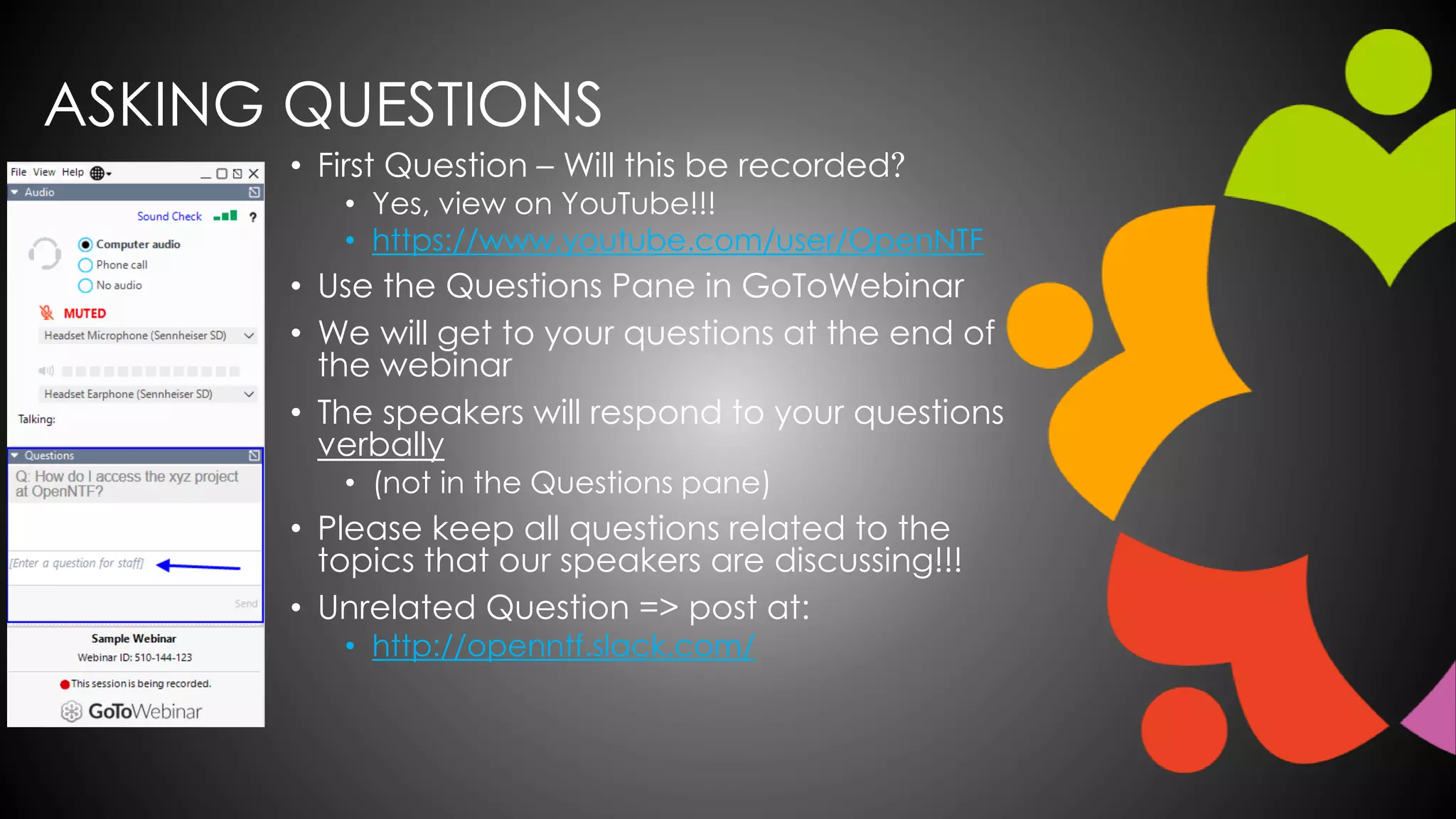
ASKING QUESTIONS
• First Question – Will this be recorded?
• Yes, view on YouTube!!!
• https://www.youtube.com/user/OpenNTF
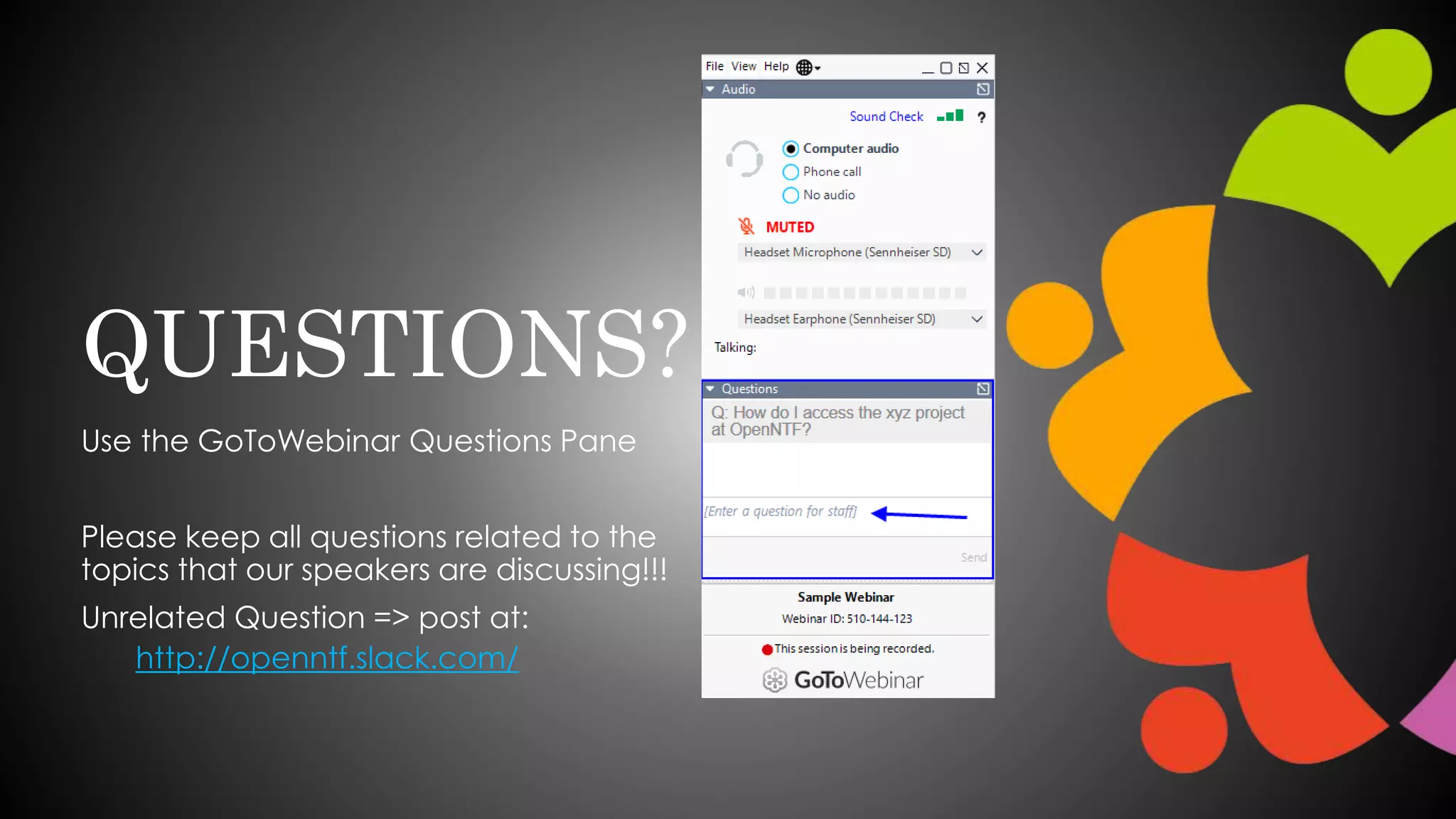
• Use the Questions Pane in GoToWebinar
• We will get to your questions at the end of
the webinar
• The speakers will respond to your questions
verbally
• (not in the Questions pane)
• Please keep all questions related to the
topics that our speakers are discussing!!!
• Unrelated Question => post at:
• http://openntf.slack.com/
Domino V12 Certificate
Management
Daniel Nashed
HCL Lifetime Ambassador
2 |
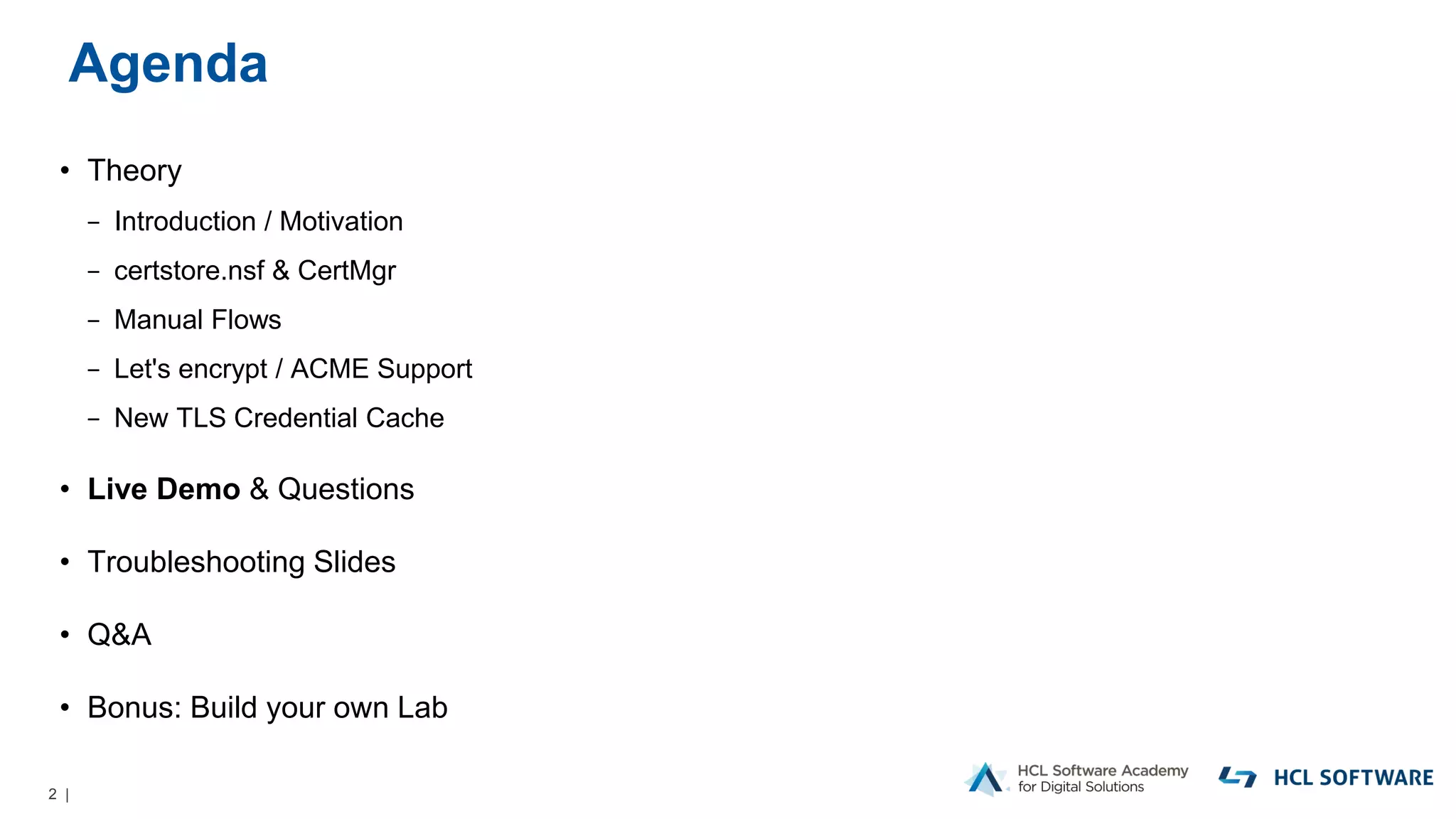
Agenda
• Theory
− Introduction / Motivation
− certstore.nsf & CertMgr
− Manual Flows
− Let's encrypt / ACME Support
− New TLS Credential Cache
• Live Demo & Questions
• Troubleshooting Slides
• Q&A
• Bonus: Build your own Lab
3 |
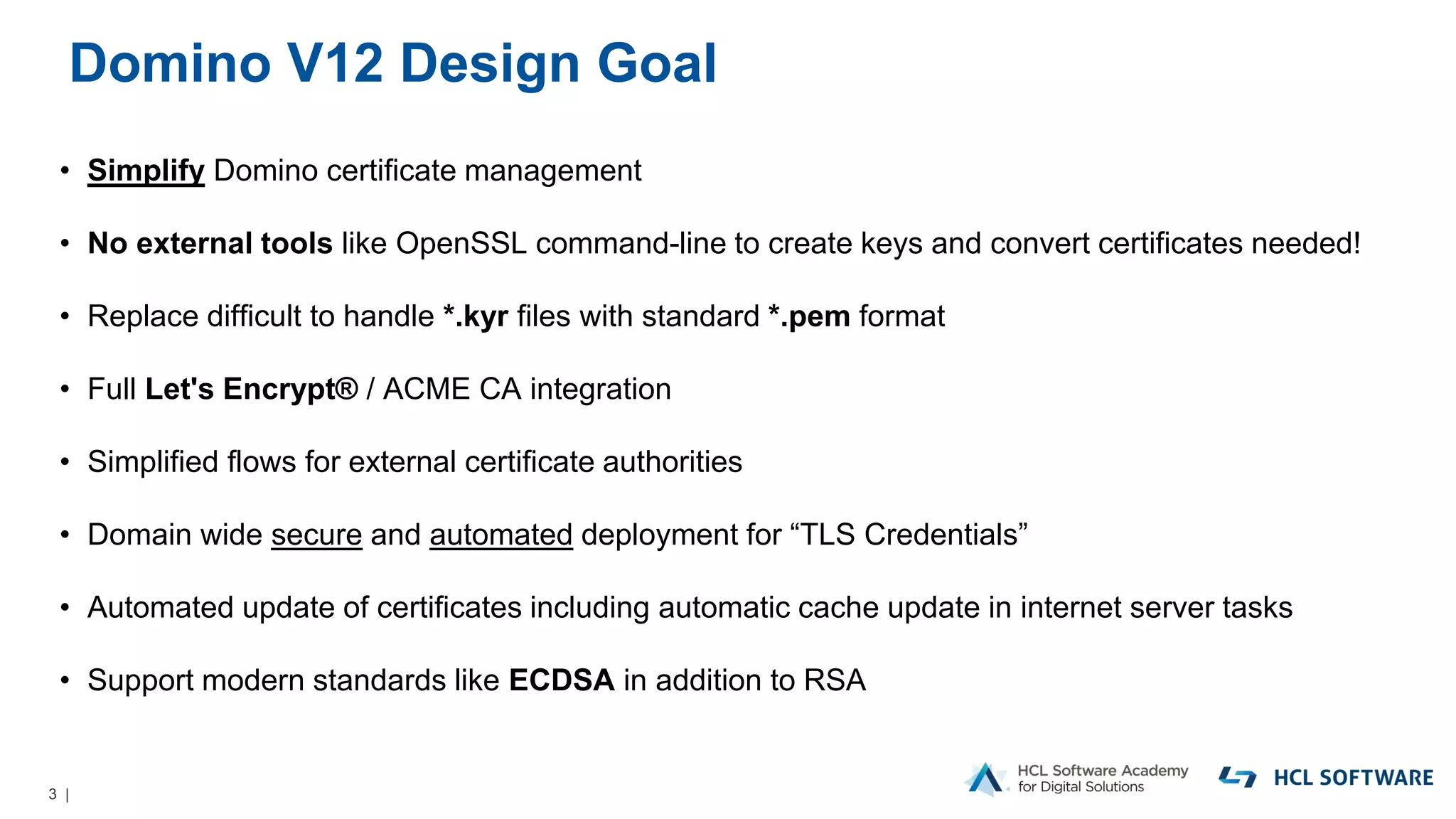
Domino V12 Design Goal
• Simplify Domino certificate management
• No external tools like OpenSSL command-line to create keys and convert certificates needed!
• Replace difficult to handle *.kyr files with standard *.pem format
• Full Let's Encrypt® / ACME CA integration
• Simplified flows for external certificate authorities
• Domain wide secure and automated deployment for “TLS Credentials”
• Automated update of certificates including automatic cache update in internet server tasks
• Support modern standards like ECDSA in addition to RSA
4 |
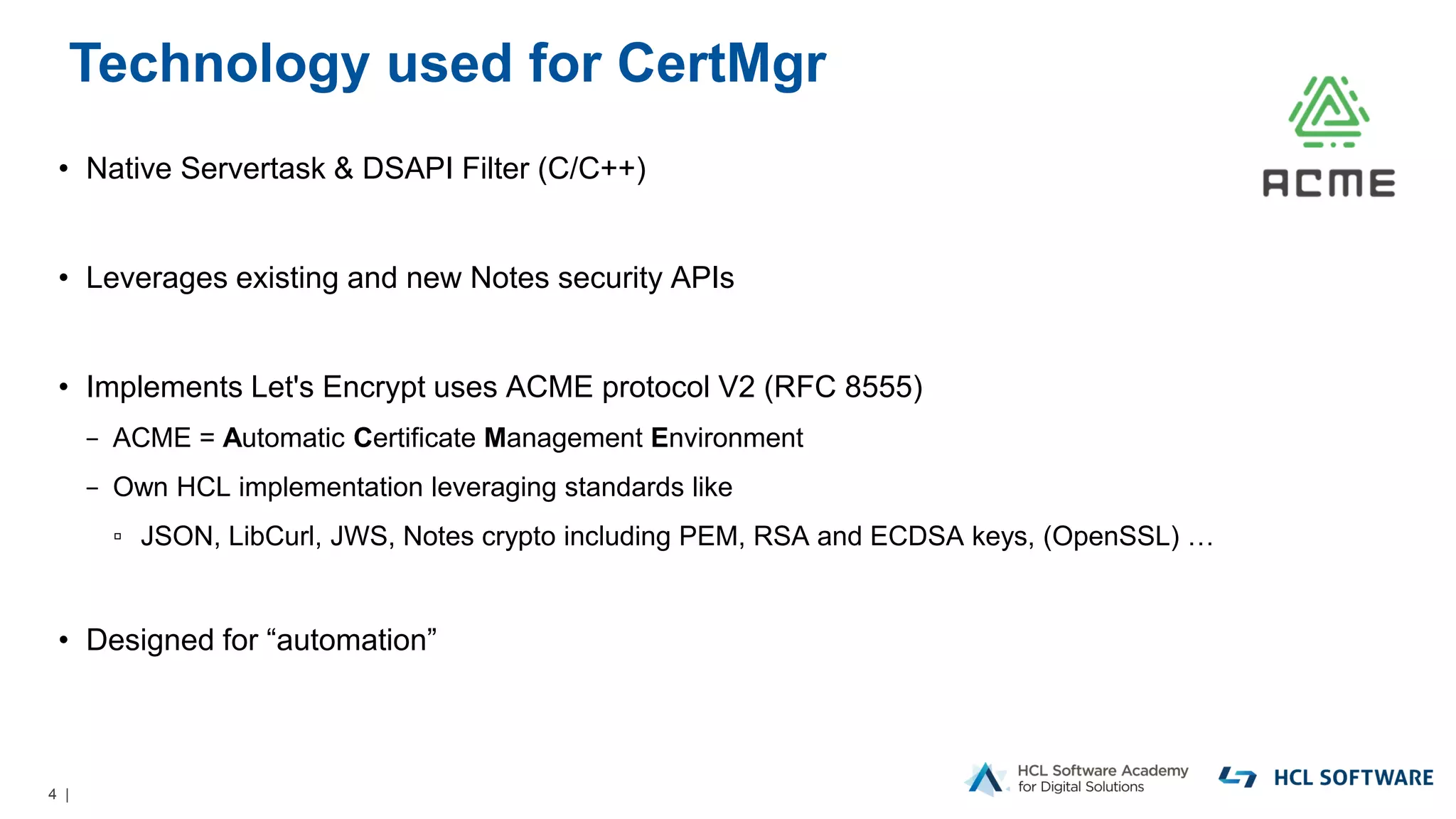
Technology used for CertMgr
• Native Servertask & DSAPI Filter (C/C++)
• Leverages existing and new Notes security APIs
• Implements Let's Encrypt uses ACME protocol V2 (RFC 8555)
− ACME = Automatic Certificate Management Environment
− Own HCL implementation leveraging standards like
▫ JSON, LibCurl, JWS, Notes crypto including PEM, RSA and ECDSA keys, (OpenSSL) …
• Designed for “automation”
5 |
Domain wide CertStore
Database & CertMgr
Privates Keys, Certificates,Trusted Roots
6 |
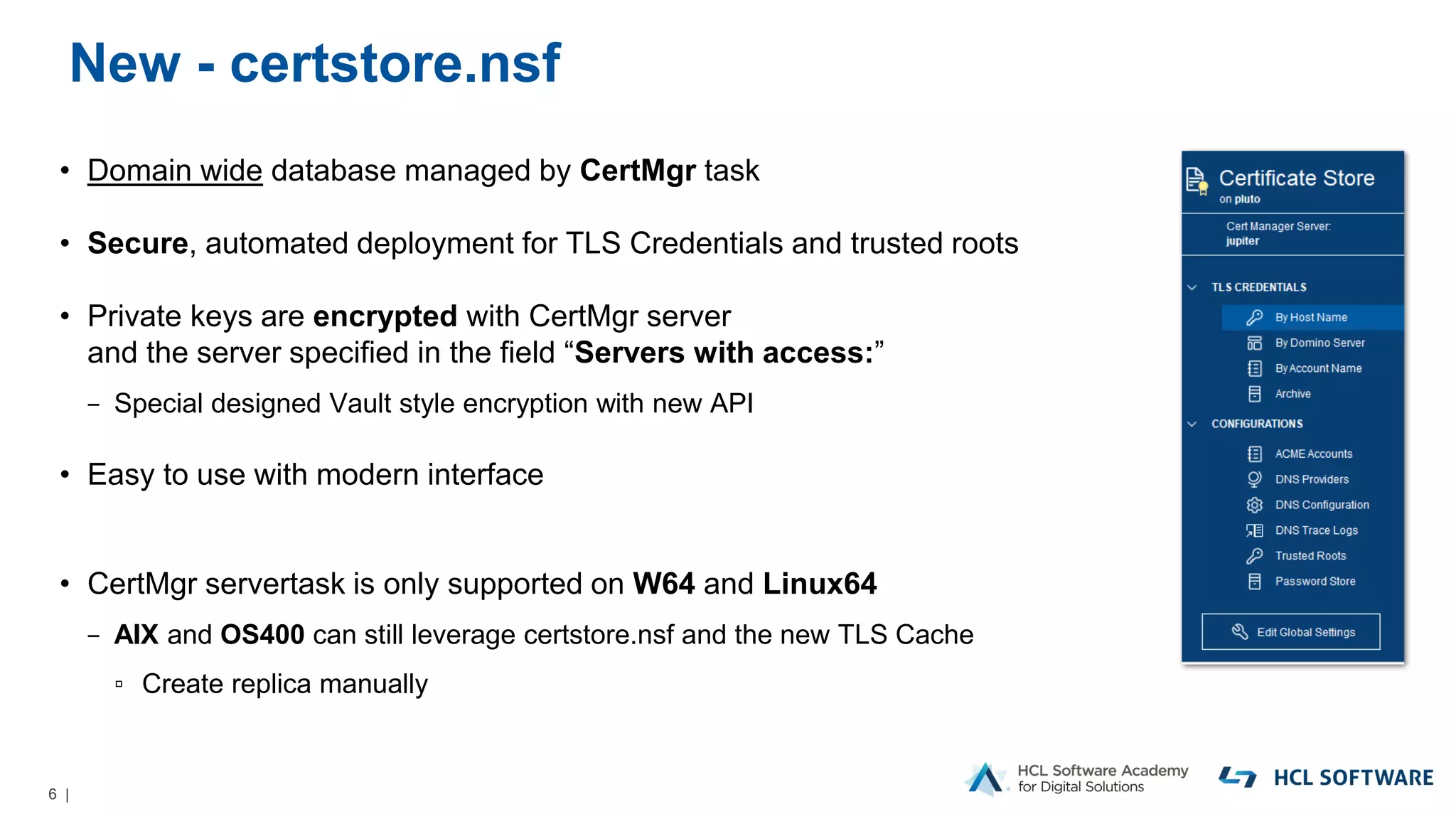
New - certstore.nsf
• Domain wide database managed by CertMgr task
• Secure, automated deployment for TLS Credentials and trusted roots
• Private keys are encrypted with CertMgr server
and the server specified in the field “Servers with access:”
− Special designed Vault style encryption with new API
• Easy to use with modern interface
• CertMgr servertask is only supported on W64 and Linux64
− AIX and OS400 can still leverage certstore.nsf and the new TLS Cache
▫ Create replica manually
7 |
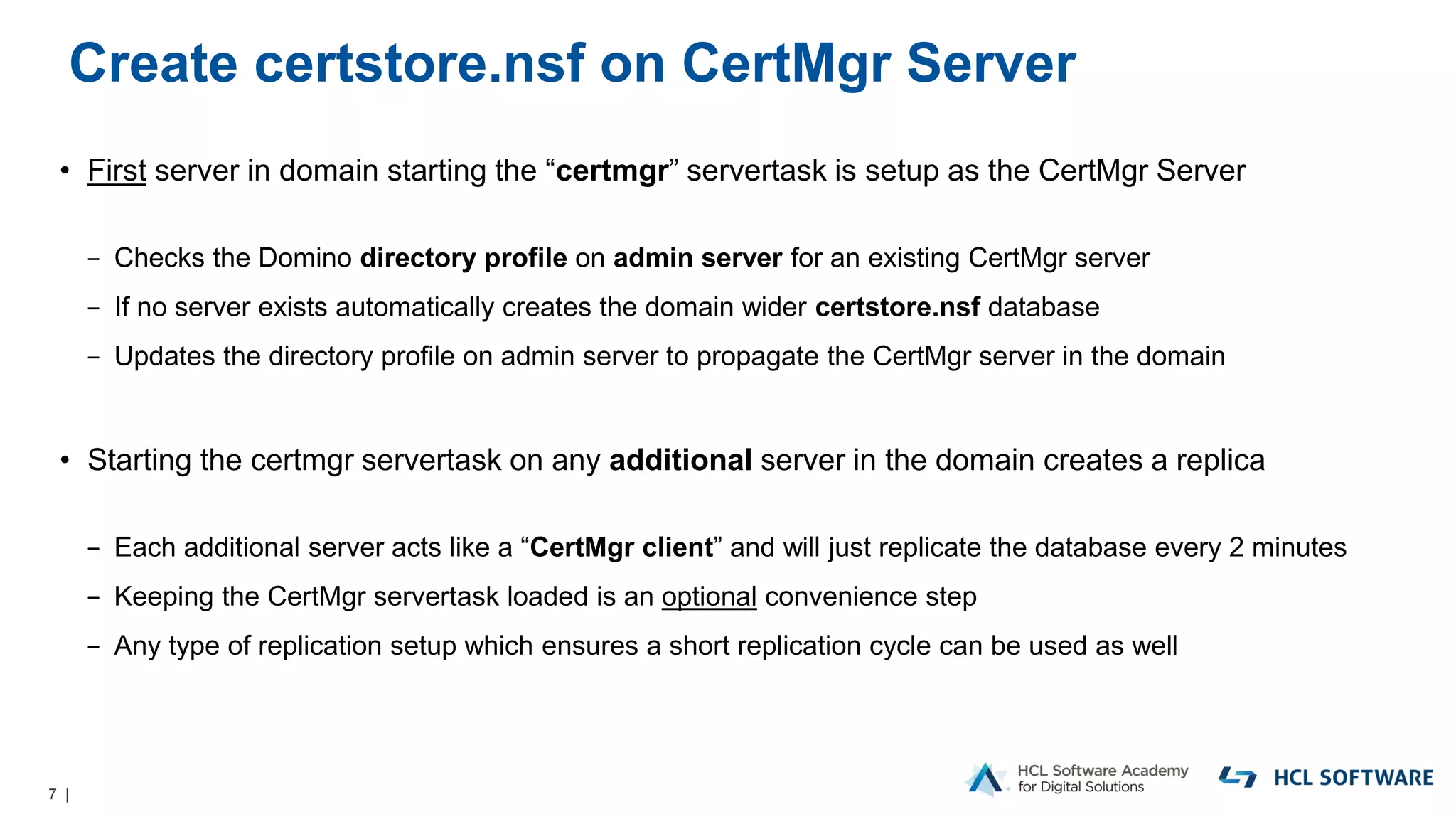
Create certstore.nsf on CertMgr Server
• First server in domain starting the “certmgr” servertask is setup as the CertMgr Server
− Checks the Domino directory profile on admin server for an existing CertMgr server
− If no server exists automatically creates the domain wider certstore.nsf database
− Updates the directory profile on admin server to propagate the CertMgr server in the domain
• Starting the certmgr servertask on any additional server in the domain creates a replica
− Each additional server acts like a “CertMgr client” and will just replicate the database every 2 minutes
− Keeping the CertMgr servertask loaded is an optional convenience step
− Any type of replication setup which ensures a short replication cycle can be used as well
8 |
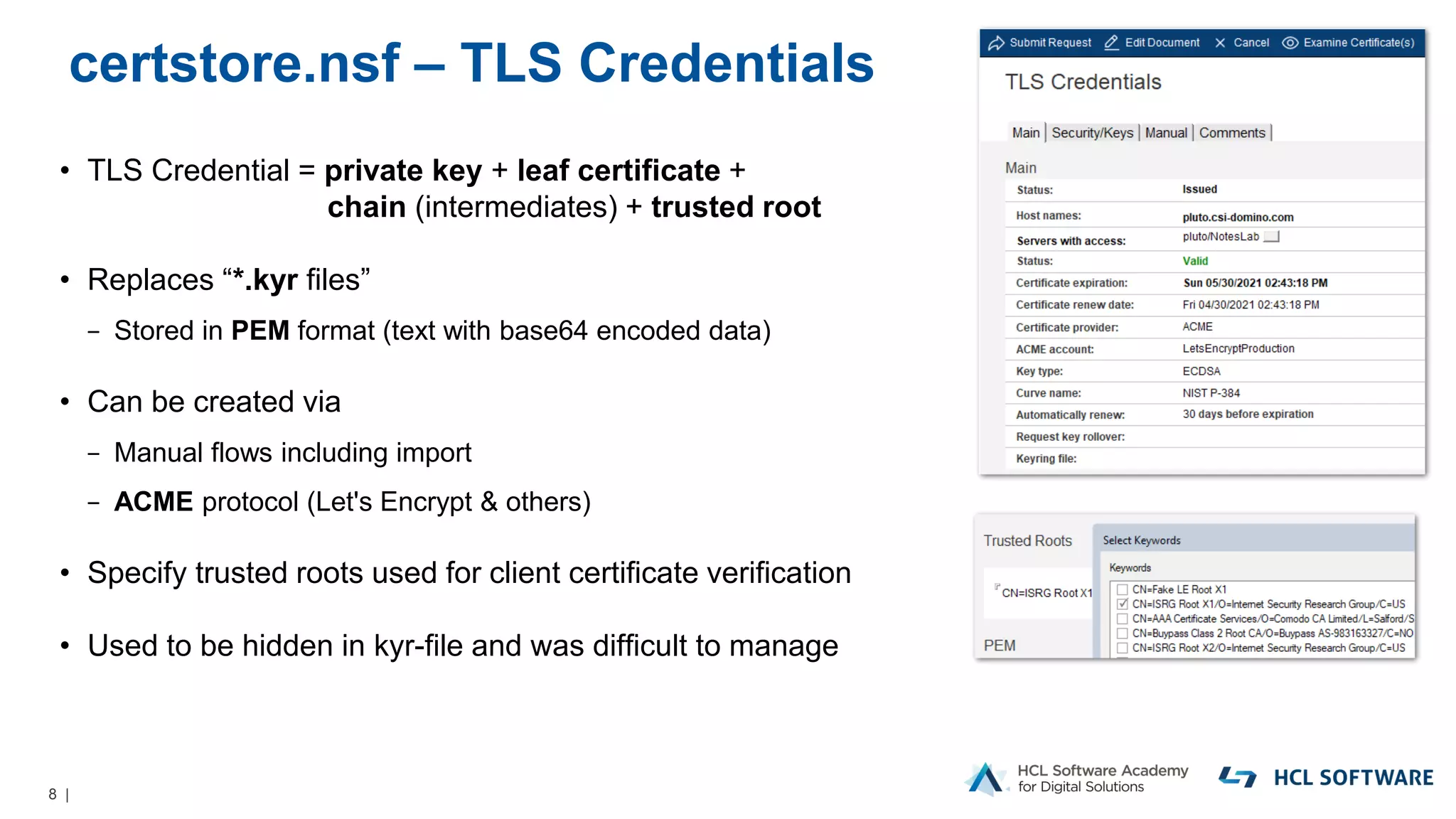
certstore.nsf – TLS Credentials
• TLS Credential = private key + leaf certificate +
chain (intermediates) + trusted root
• Replaces “*.kyr files”
− Stored in PEM format (text with base64 encoded data)
• Can be created via
− Manual flows including import
− ACME protocol (Let's Encrypt & others)
• Specify trusted roots used for client certificate verification
• Used to be hidden in kyr-file and was difficult to manage
9 |
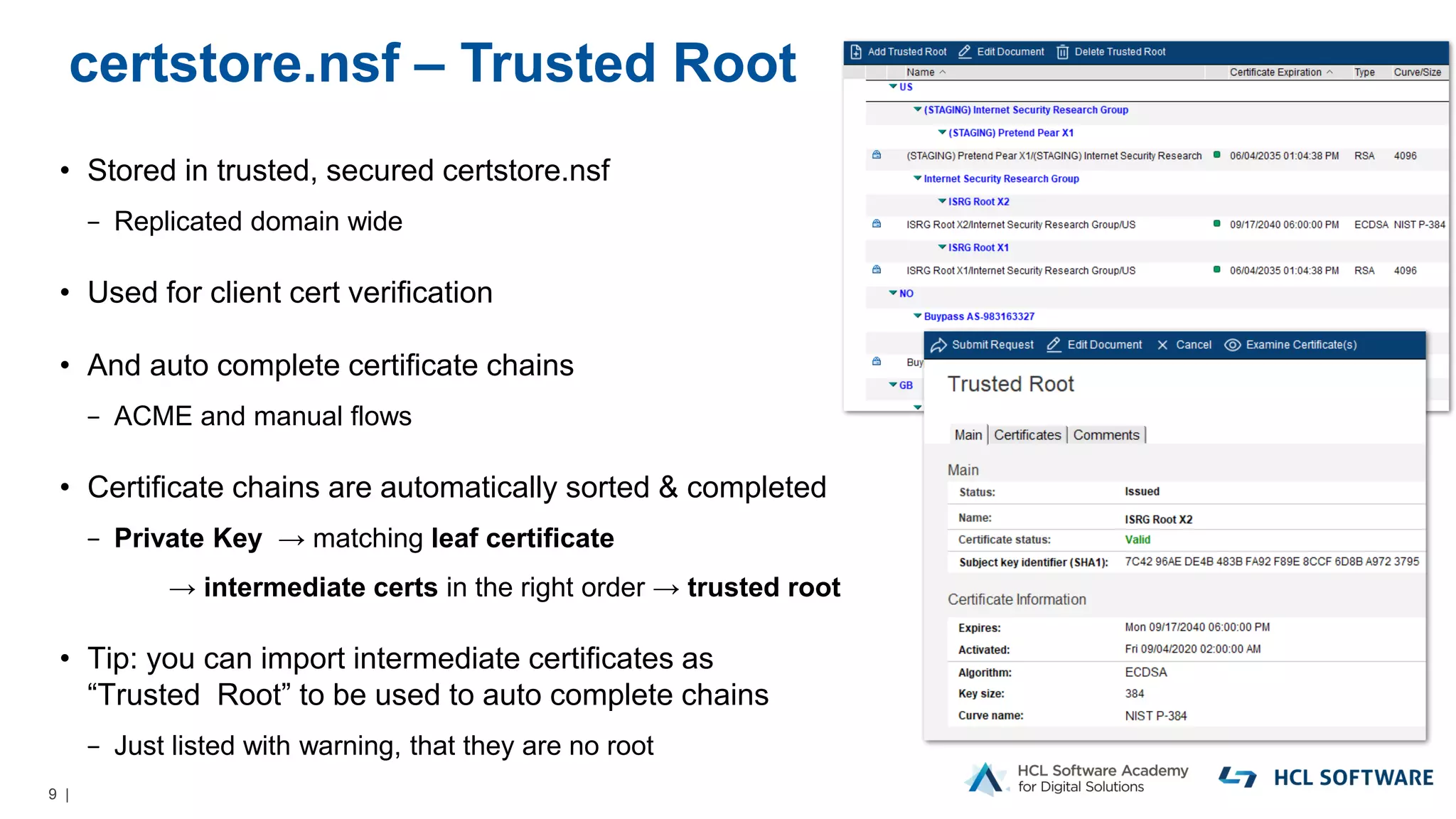
certstore.nsf – Trusted Root
• Stored in trusted, secured certstore.nsf
− Replicated domain wide
• Used for client cert verification
• And auto complete certificate chains
− ACME and manual flows
• Certificate chains are automatically sorted & completed
− Private Key → matching leaf certificate
→ intermediate certs in the right order → trusted root
• Tip: you can import intermediate certificates as
“Trusted Root” to be used to auto complete chains
− Just listed with warning, that they are no root
10 |
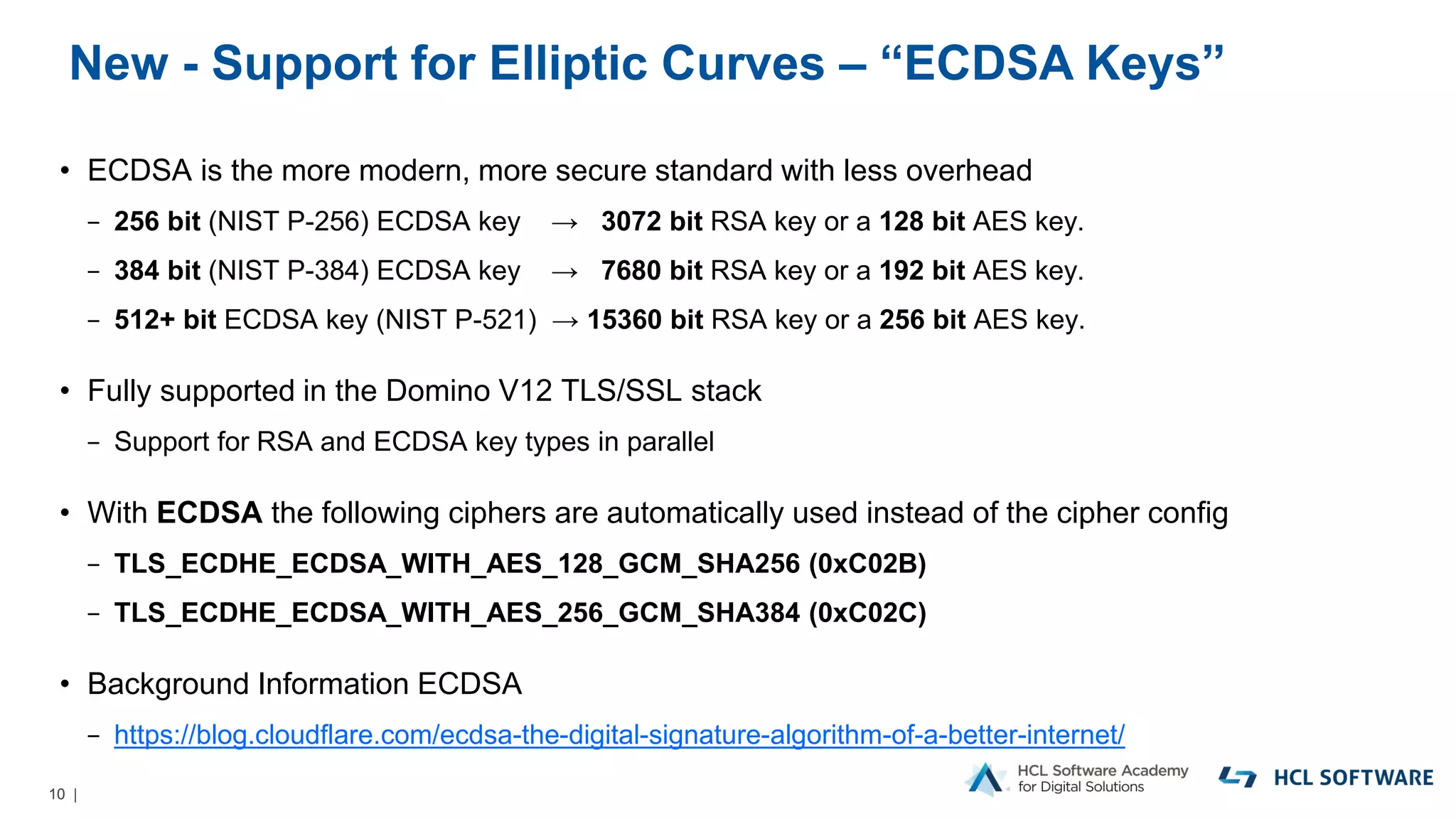
New - Support for Elliptic Curves – “ECDSA Keys”
• ECDSA is the more modern, more secure standard with less overhead
− 256 bit (NIST P-256) ECDSA key → 3072 bit RSA key or a 128 bit AES key.
− 384 bit (NIST P-384) ECDSA key → 7680 bit RSA key or a 192 bit AES key.
− 512+ bit ECDSA key (NIST P-521) → 15360 bit RSA key or a 256 bit AES key.
• Fully supported in the Domino V12 TLS/SSL stack
− Support for RSA and ECDSA key types in parallel
• With ECDSA the following ciphers are automatically used instead of the cipher config
− TLS_ECDHE_ECDSA_WITH_AES_128_GCM_SHA256 (0xC02B)
− TLS_ECDHE_ECDSA_WITH_AES_256_GCM_SHA384 (0xC02C)
• Background Information ECDSA
− https://blog.cloudflare.com/ecdsa-the-digital-signature-algorithm-of-a-better-internet/
11 |
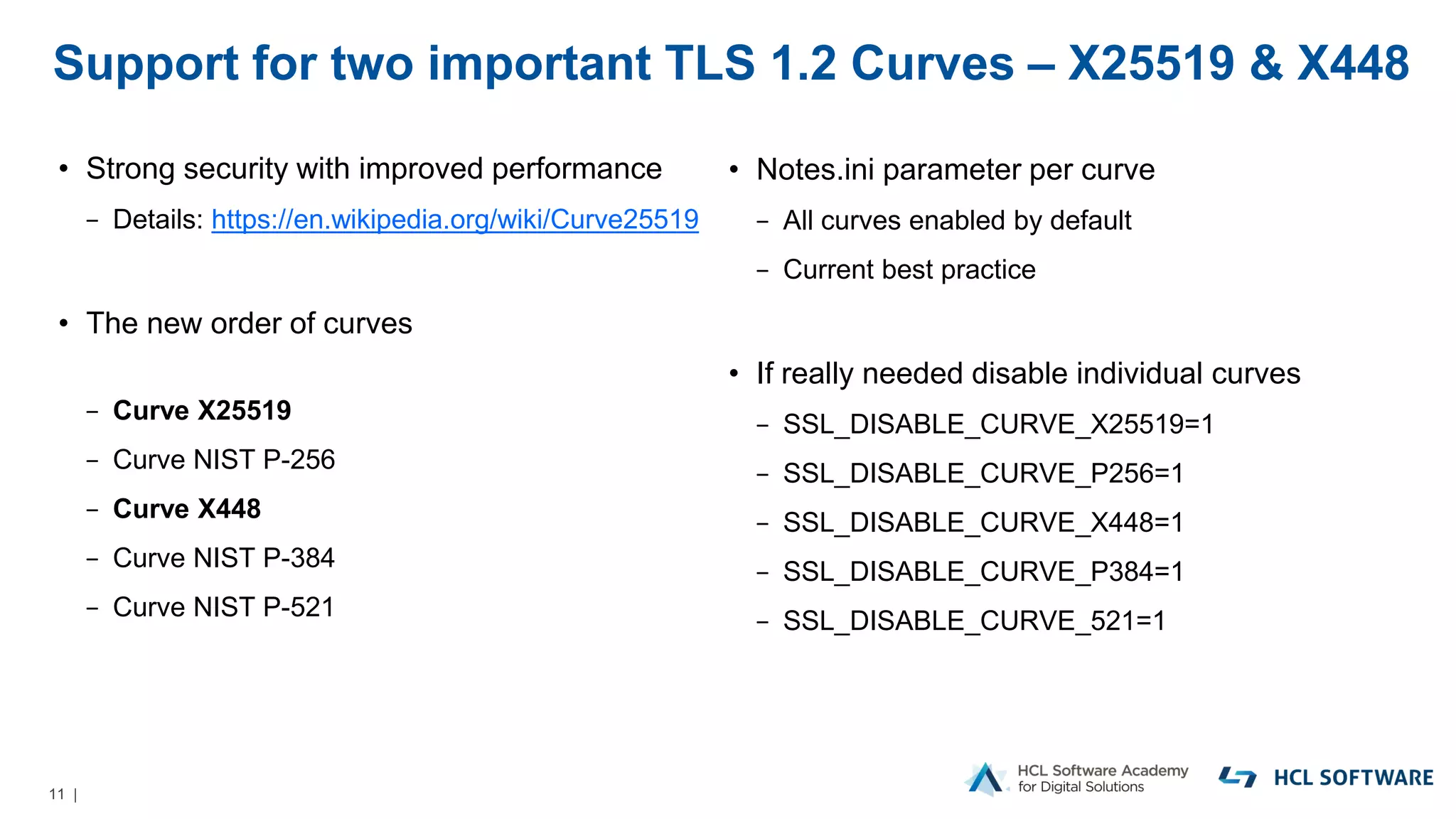
Support for two important TLS 1.2 Curves – X25519 & X448
• Strong security with improved performance
− Details: https://en.wikipedia.org/wiki/Curve25519
• The new order of curves
− Curve X25519
− Curve NIST P-256
− Curve X448
− Curve NIST P-384
− Curve NIST P-521
• Notes.ini parameter per curve
− All curves enabled by default
− Current best practice
• If really needed disable individual curves
− SSL_DISABLE_CURVE_X25519=1
− SSL_DISABLE_CURVE_P256=1
− SSL_DISABLE_CURVE_X448=1
− SSL_DISABLE_CURVE_P384=1
− SSL_DISABLE_CURVE_521=1
12 |
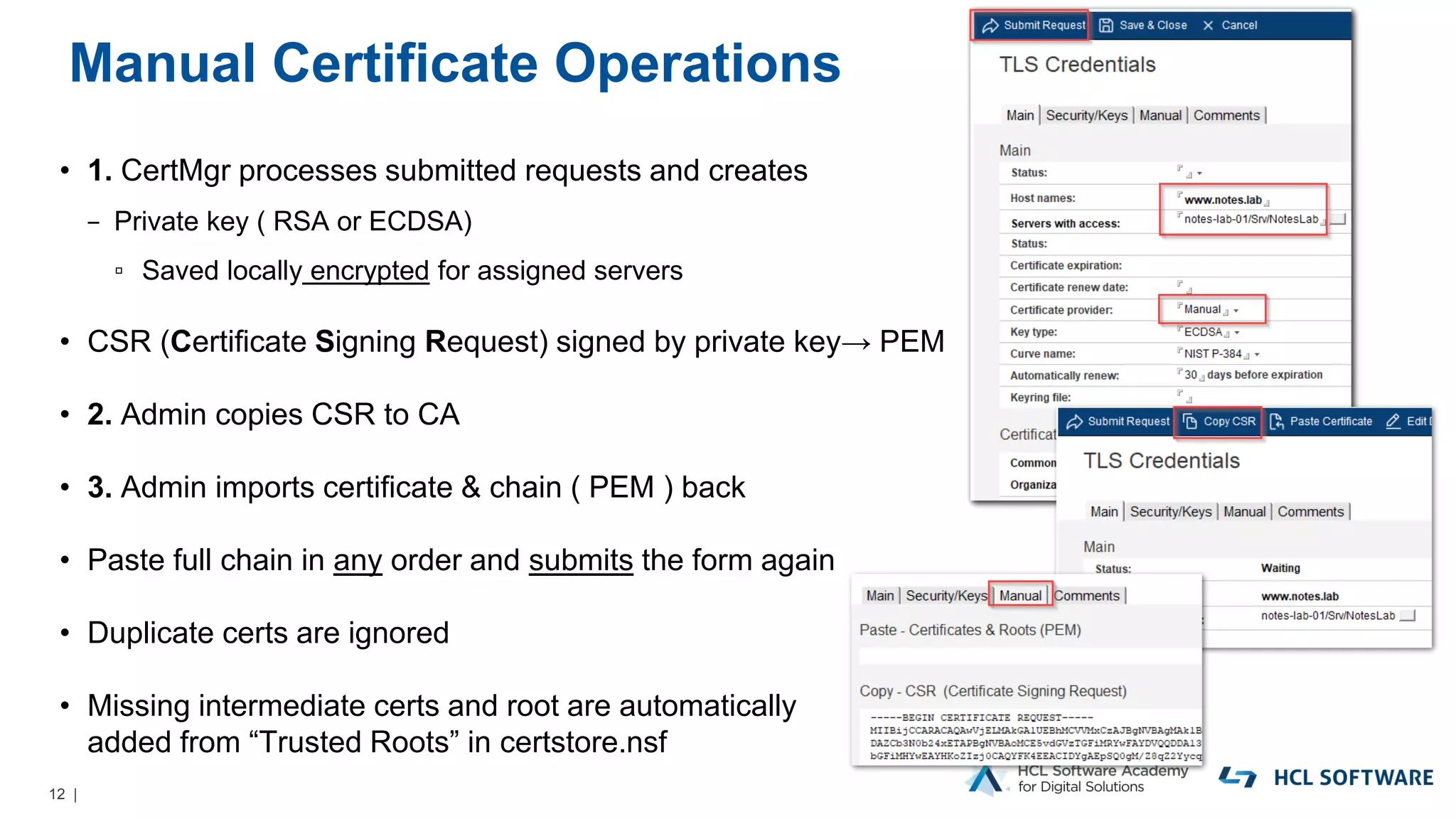
Manual Certificate Operations
• 1. CertMgr processes submitted requests and creates
− Private key ( RSA or ECDSA)
▫ Saved locally encrypted for assigned servers
• CSR (Certificate Signing Request) signed by private key→ PEM
• 2. Admin copies CSR to CA
• 3. Admin imports certificate & chain ( PEM ) back
• Paste full chain in any order and submits the form again
• Duplicate certs are ignored
• Missing intermediate certs and root are automatically
added from “Trusted Roots” in certstore.nsf
13 |
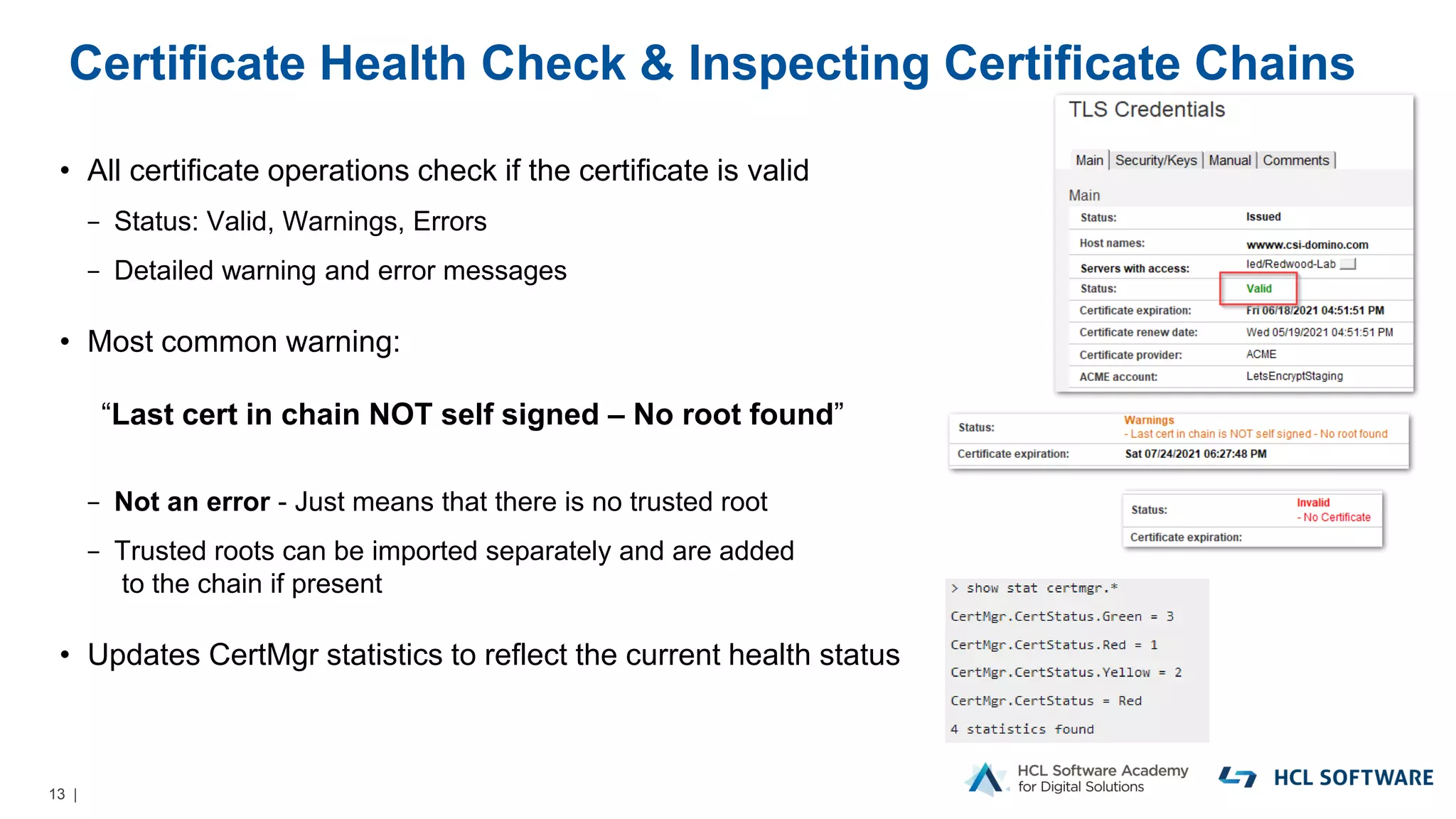
Certificate Health Check & Inspecting Certificate Chains
• All certificate operations check if the certificate is valid
− Status: Valid, Warnings, Errors
− Detailed warning and error messages
• Most common warning:
“Last cert in chain NOT self signed – No root found”
− Not an error - Just means that there is no trusted root
− Trusted roots can be imported separately and are added
to the chain if present
• Updates CertMgr statistics to reflect the current health status
14 |
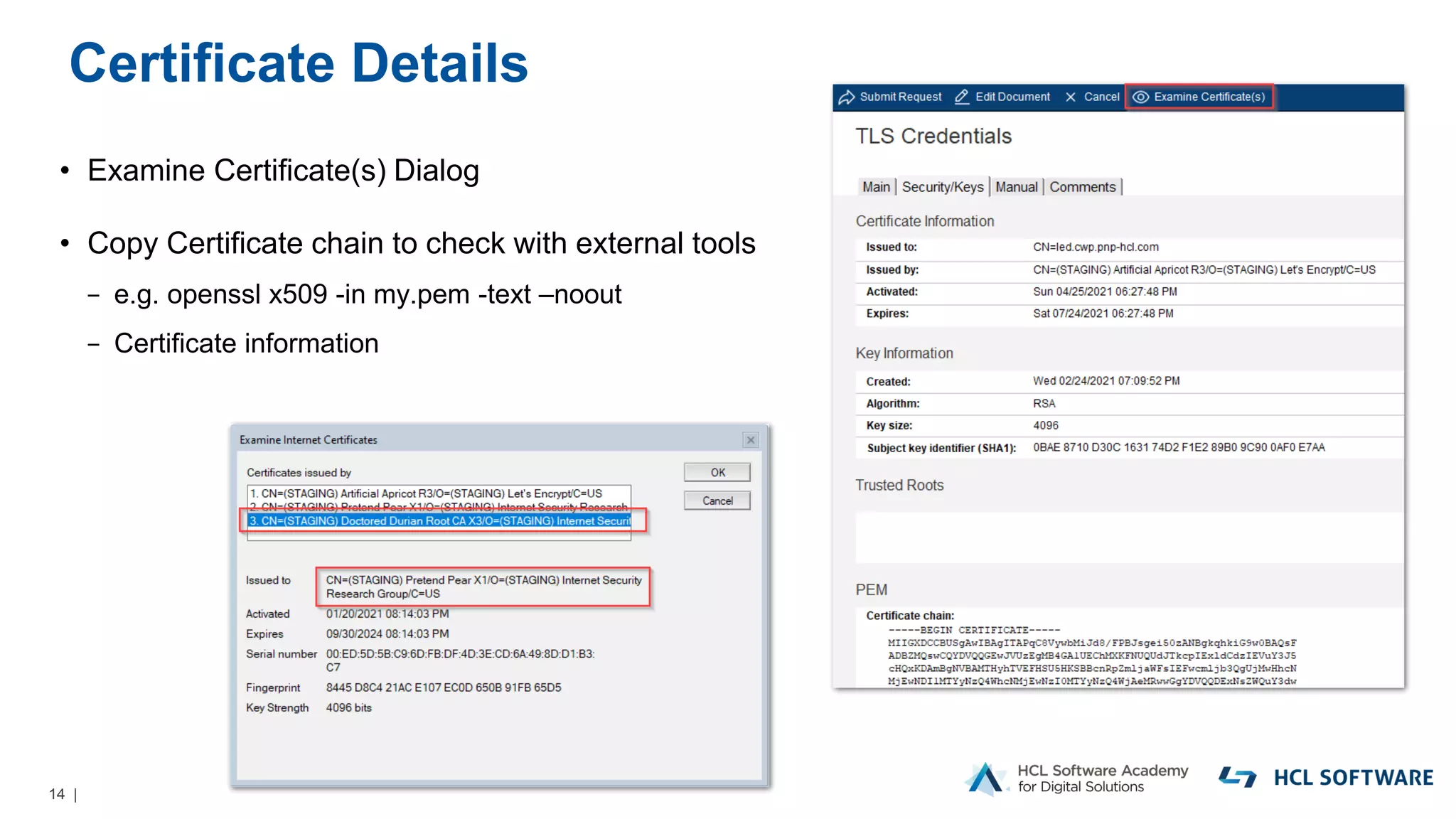
Certificate Details
• Examine Certificate(s) Dialog
• Copy Certificate chain to check with external tools
− e.g. openssl x509 -in my.pem -text –noout
− Certificate information
15 |
Let's Encrypt / ACME Support
Introduction and HTTP-01 Challenges
16 |
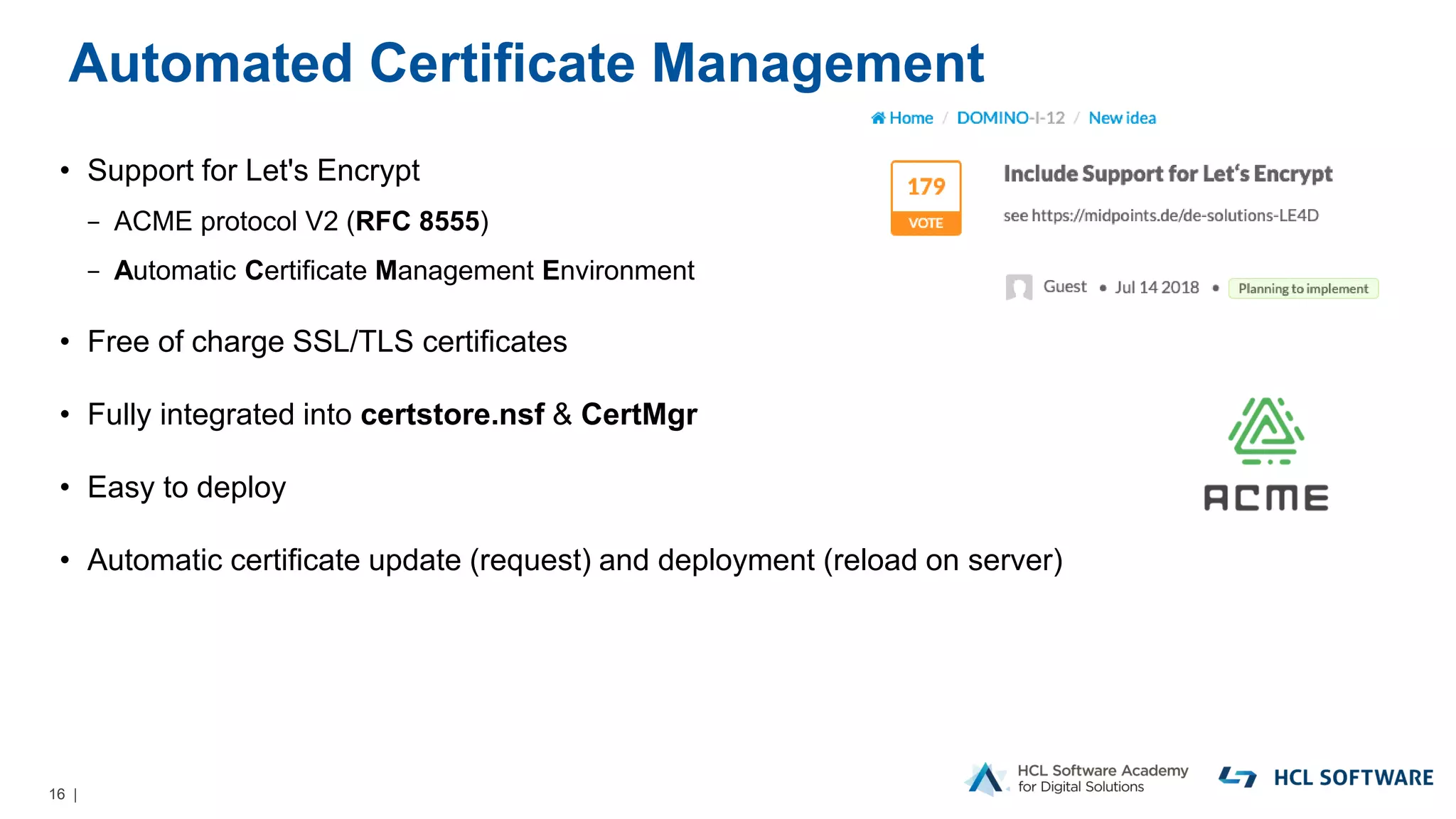
Automated Certificate Management
• Support for Let's Encrypt
− ACME protocol V2 (RFC 8555)
− Automatic Certificate Management Environment
• Free of charge SSL/TLS certificates
• Fully integrated into certstore.nsf & CertMgr
• Easy to deploy
• Automatic certificate update (request) and deployment (reload on server)
17 |
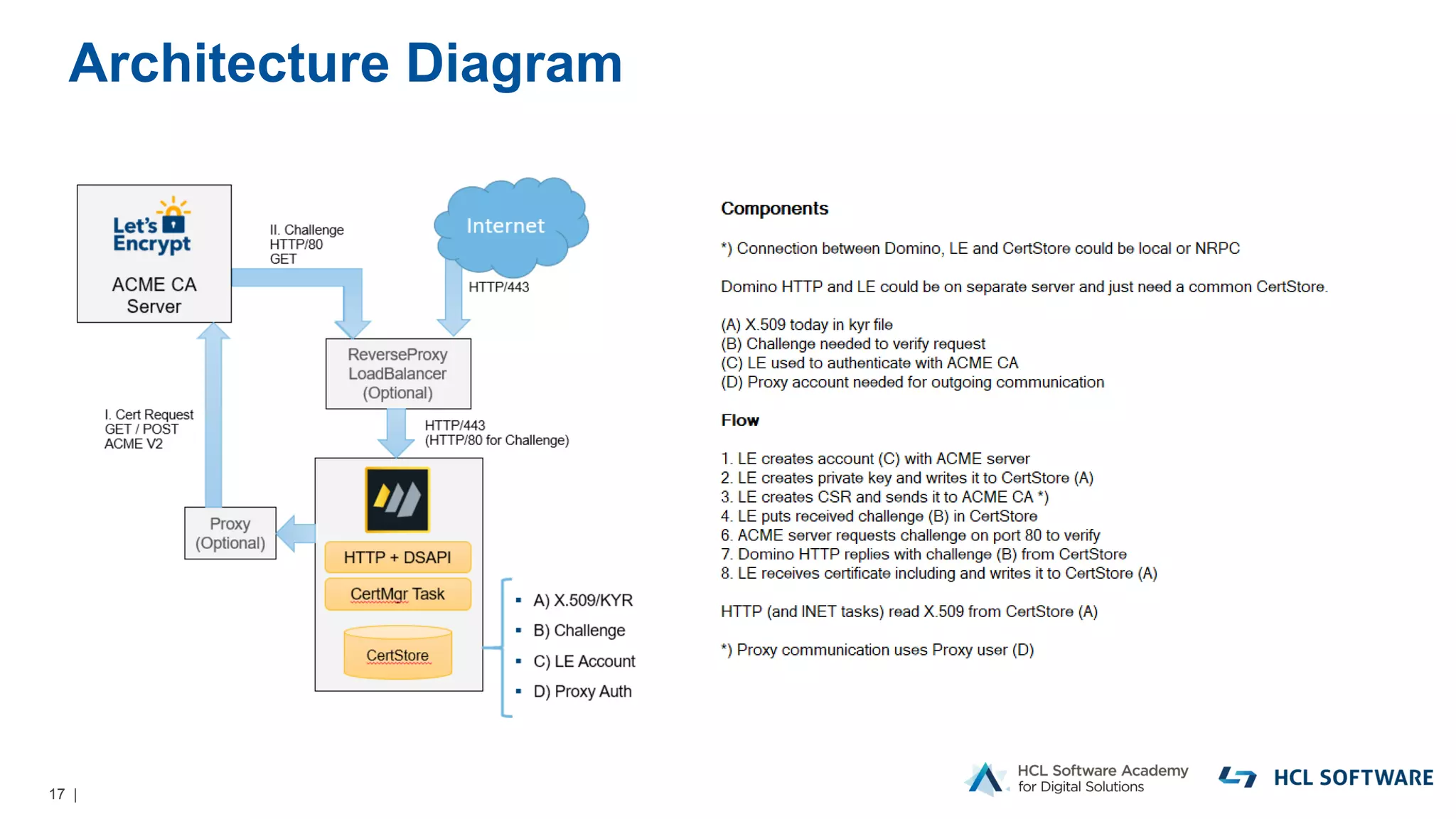
Architecture Diagram
18 |
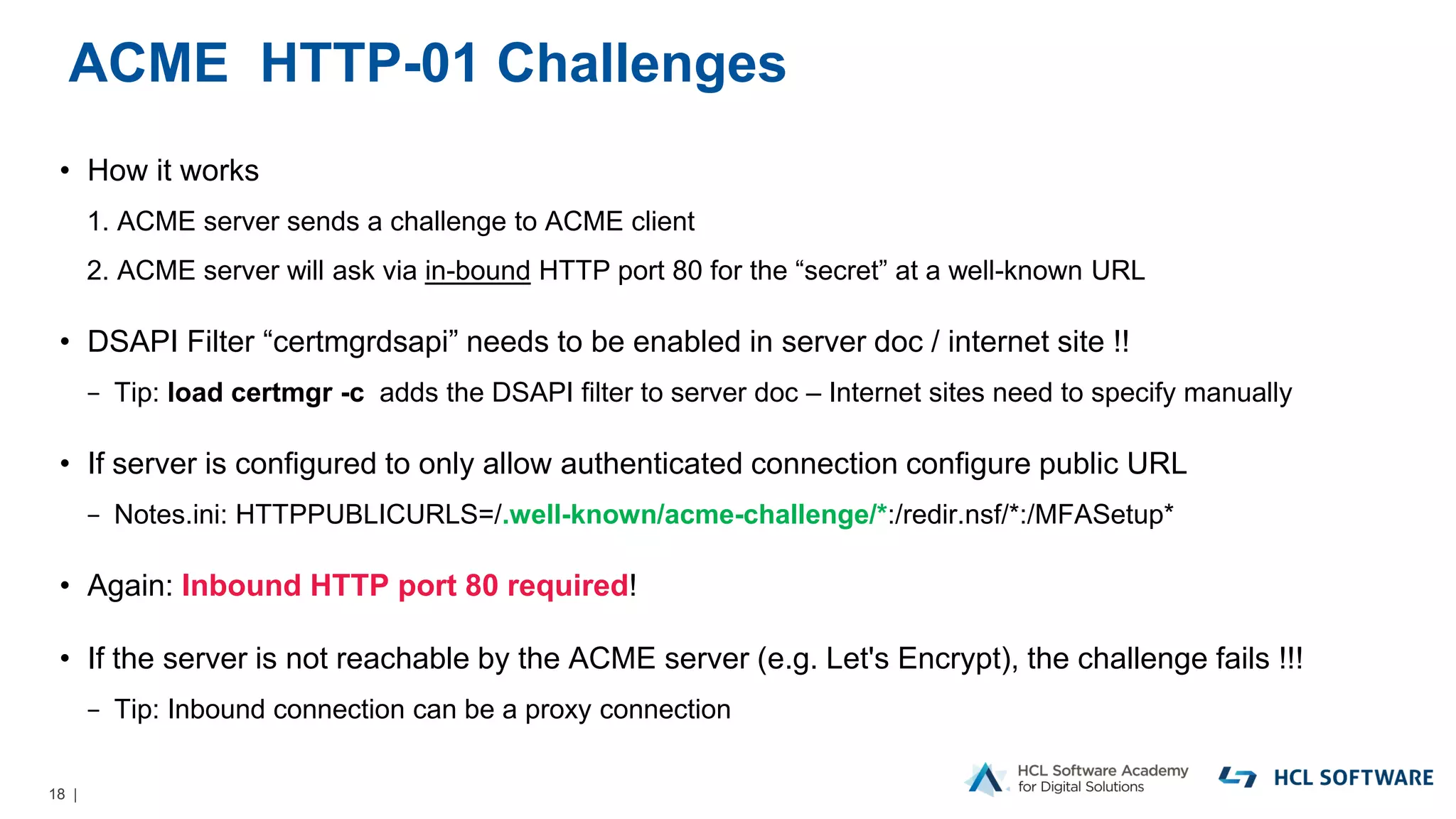
ACME HTTP-01 Challenges
• How it works
1. ACME server sends a challenge to ACME client
2. ACME server will ask via in-bound HTTP port 80 for the “secret” at a well-known URL
• DSAPI Filter “certmgrdsapi” needs to be enabled in server doc / internet site !!
− Tip: load certmgr -c adds the DSAPI filter to server doc – Internet sites need to specify manually
• If server is configured to only allow authenticated connection configure public URL
− Notes.ini: HTTPPUBLICURLS=/.well-known/acme-challenge/*:/redir.nsf/*:/MFASetup*
• Again: Inbound HTTP port 80 required!
• If the server is not reachable by the ACME server (e.g. Let's Encrypt), the challenge fails !!!
− Tip: Inbound connection can be a proxy connection
19 |
ACME Provider Let‘s Encrypt – included in template
• Let's Encrypt Staging
− https://letsencrypt.org/docs/staging-environment
− Should always be used for first steps testing connectivity
− Provides the same functionality like Let's Encrypt production
− Much higher limits for certificates and errors
• Let's Encrypt production
− https://letsencrypt.org
20 |
Additional tested ACME Providers
• ACME is a standard supported by more providers
• New ACME provider can be added using their published directory URL
• ZeroSSL *)
− https://zerossl.com
− Requires registration + external account binding (EAB)
• BuyPass *)
− https://buypass.com
21 |
On premise ACME CA
• SmallStep ACME CA
− https://smallstep.com/docs/tutorials/acme-challenge
• CA with ACME functionality
• Can also operate as “Sub-CA” for an existing corporate CA
• Good choice for internal customer deployments
• Another tested environment
• Directory URL configured depends on your deployment
• Setup on Docker in 10 minutes!
22 |
ACME DNS-01 Challenges
Background, Providers and Configuration
23 |
ACME DNS-01 Challenges & Wild Card Certificates
• Allows to request certificates without inbound internet connection
• ACME Challenge is stored in DNS TXT record
• Supports wild card certificates! e. g. *.acme.com
• Requires DNS provider API with outgoing HTTPS connection to DNS provider
− No inbound connection needed
− Can leverage outgoing proxy connections
• CertMgr server can request certificates for any server in the DNS domain
24 |
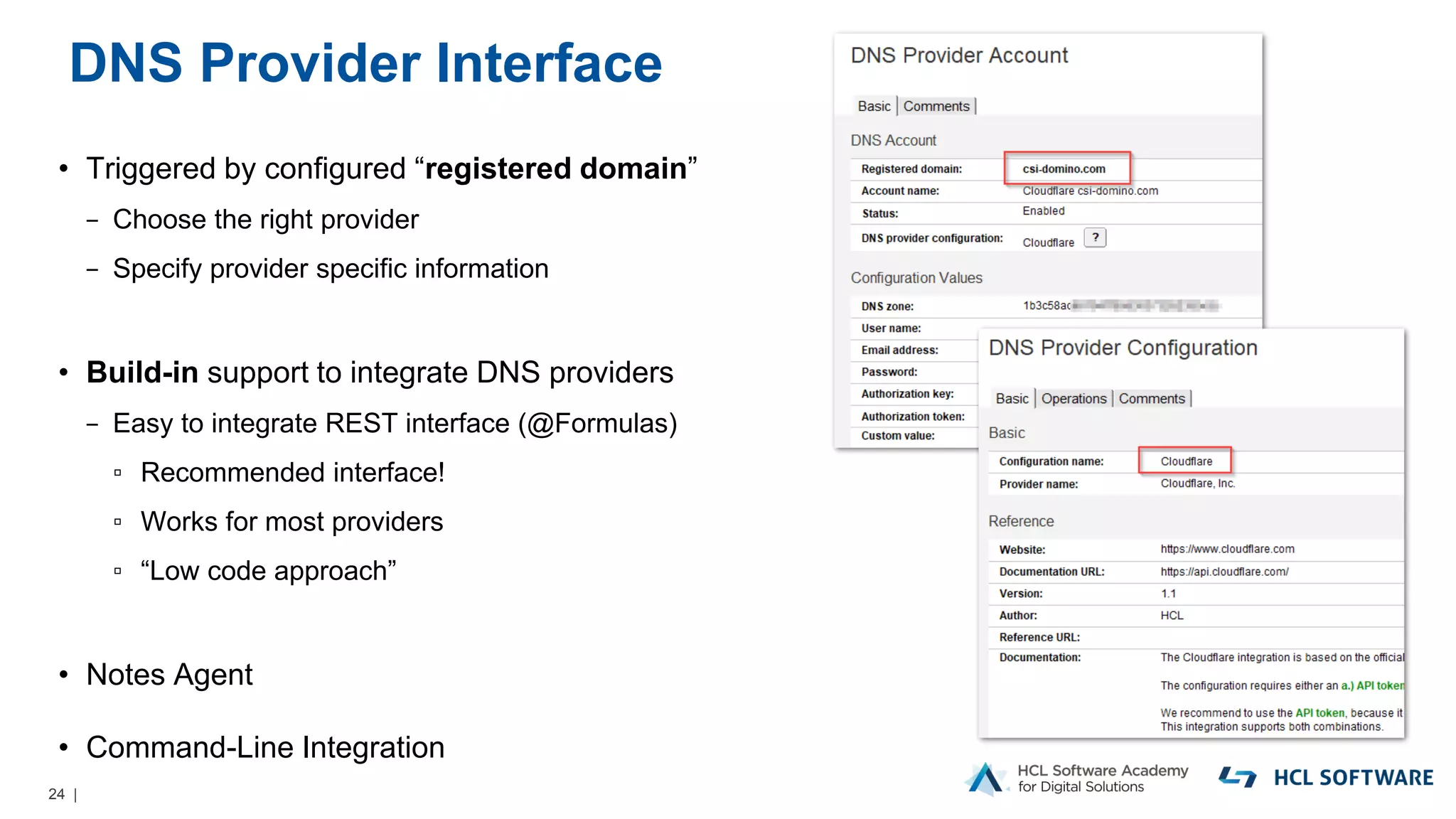
DNS Provider Interface
• Triggered by configured “registered domain”
− Choose the right provider
− Specify provider specific information
• Build-in support to integrate DNS providers
− Easy to integrate REST interface (@Formulas)
▫ Recommended interface!
▫ Works for most providers
▫ “Low code approach”
• Notes Agent
• Command-Line Integration
25 |
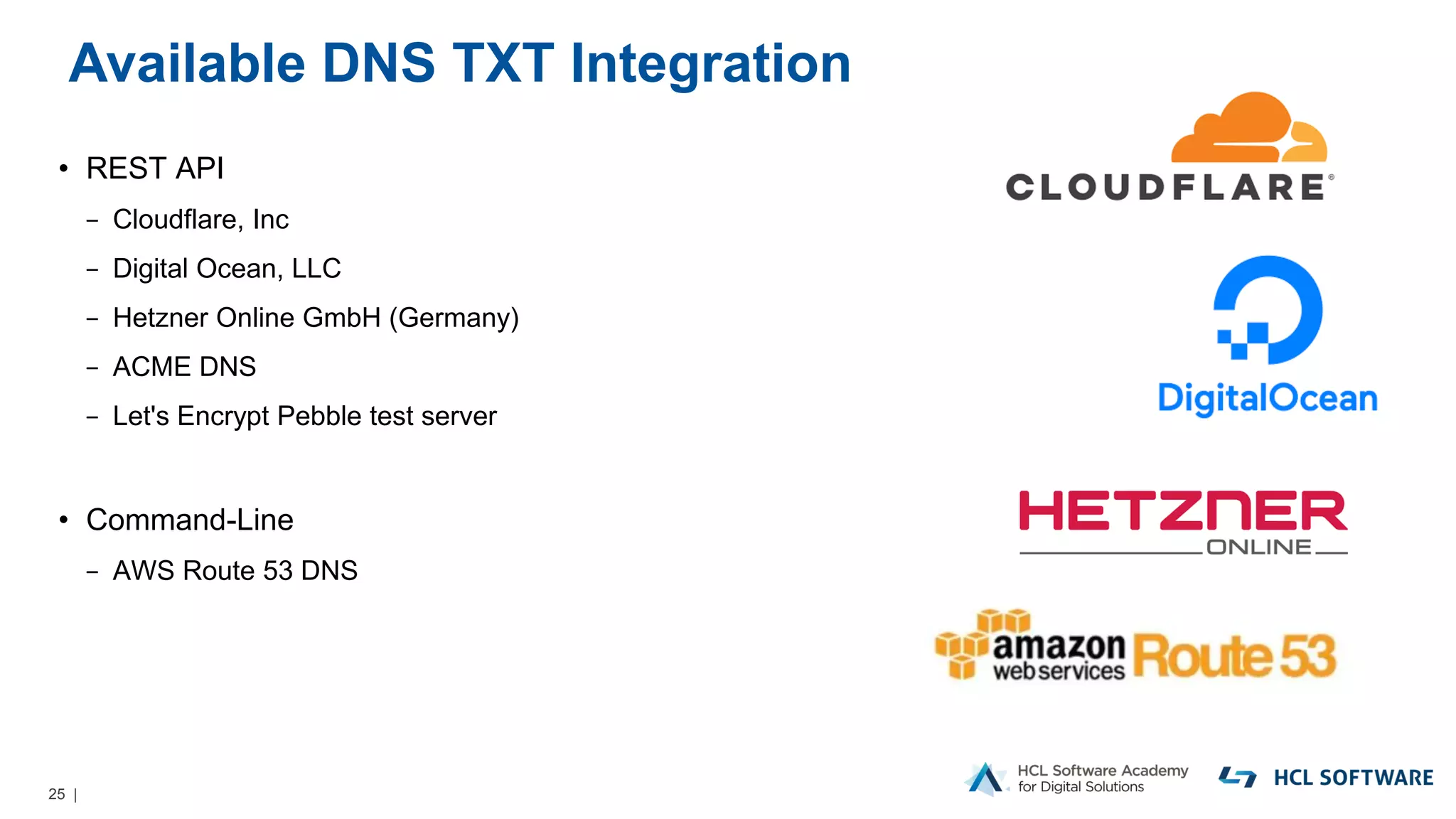
Available DNS TXT Integration
• REST API
− Cloudflare, Inc
− Digital Ocean, LLC
− Hetzner Online GmbH (Germany)
− ACME DNS
− Let's Encrypt Pebble test server
• Command-Line
− AWS Route 53 DNS
26 |
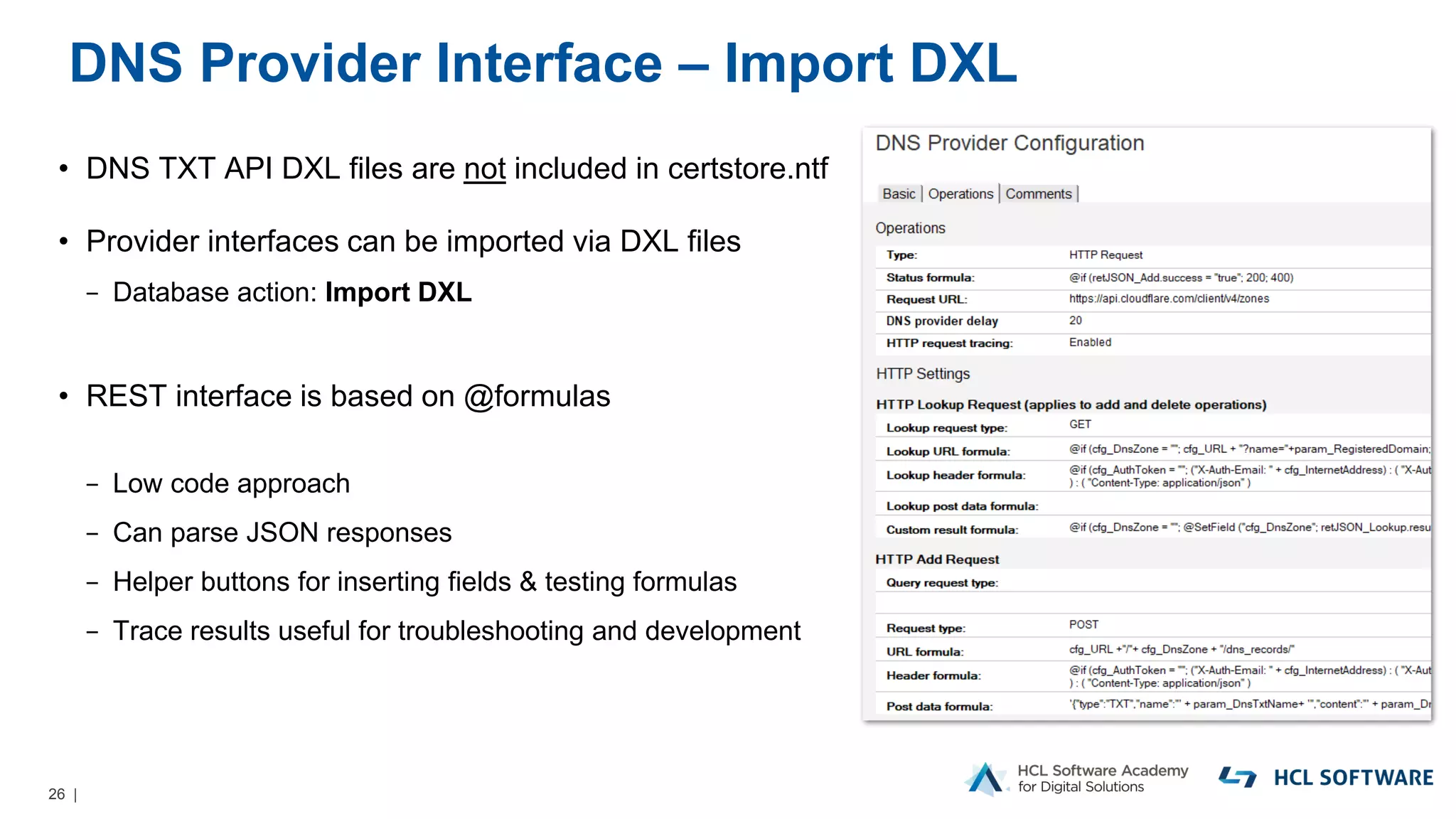
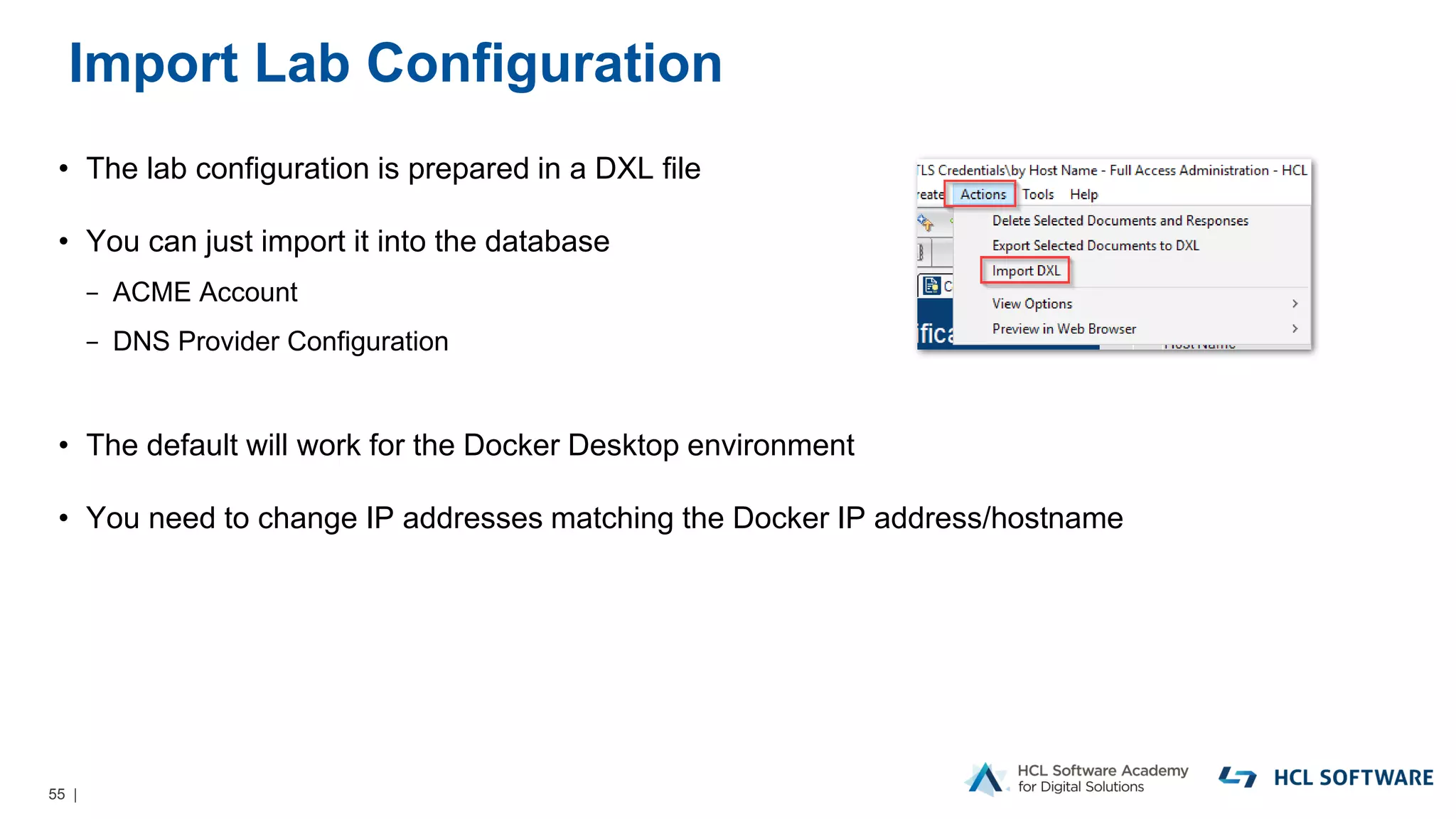
DNS Provider Interface – Import DXL
• DNS TXT API DXL files are not included in certstore.ntf
• Provider interfaces can be imported via DXL files
− Database action: Import DXL
• REST interface is based on @formulas
− Low code approach
− Can parse JSON responses
− Helper buttons for inserting fields & testing formulas
− Trace results useful for troubleshooting and development
27 |
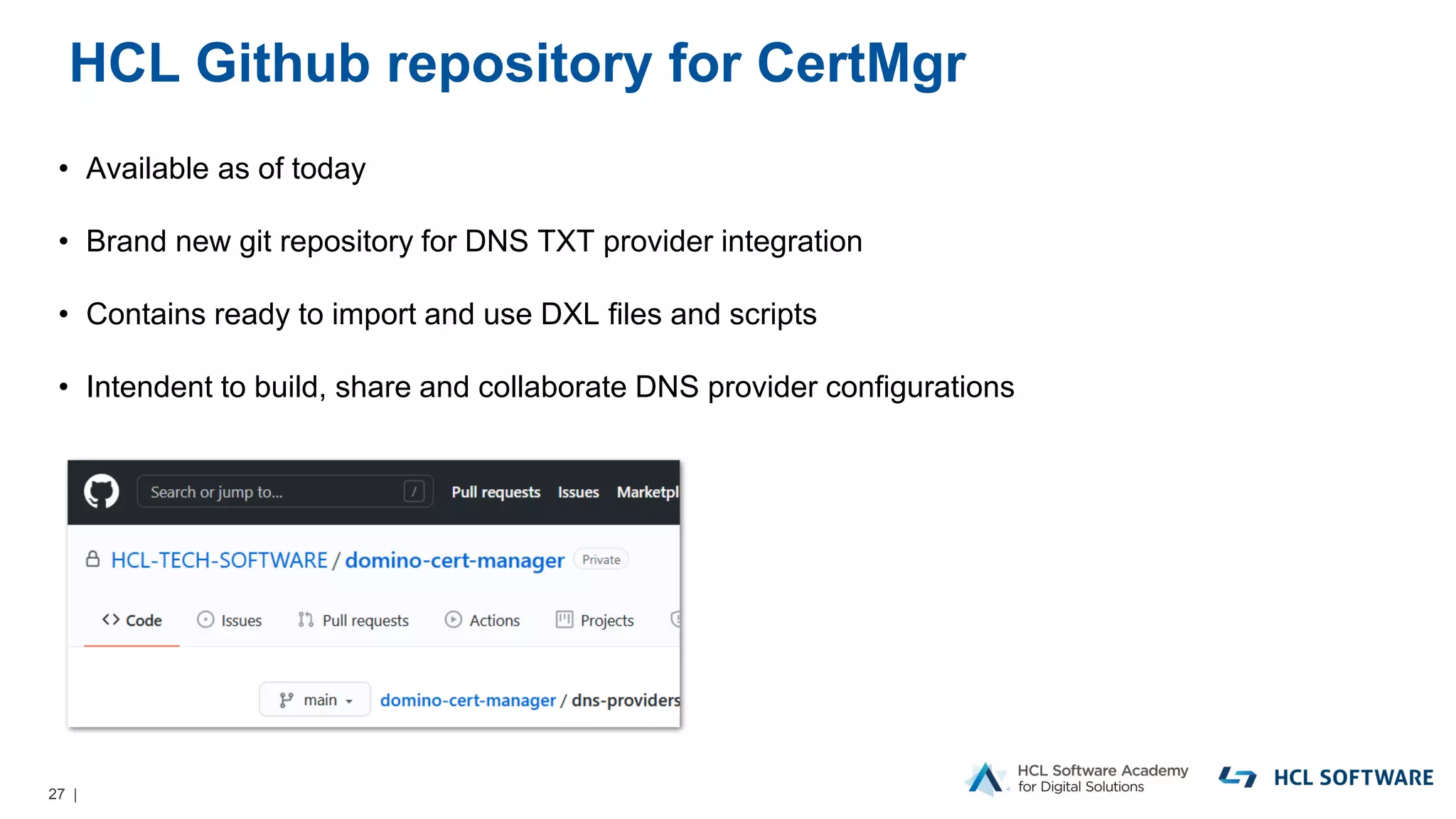
HCL Github repository for CertMgr
• Available as of today
• Brand new git repository for DNS TXT provider integration
• Contains ready to import and use DXL files and scripts
• Intendent to build, share and collaborate DNS provider configurations
28 |
Building DNS TXT API
Interfaces
29 |
Low code approach with REST API and JSON
• Many DNS providers offer a REST base interface to manage DNS records
• Modern interfaces with JSON payloads
• CertMgr preferred integration option: HTTP request with @Formulas
• Technology used
− @Formulas
− HTTP/HTTPs requests (via Curl build into the servertask)
− JSON parsing results (native in the servertask) and make results available to @forumulas
• @Formulas for different steps of the operation including lookups
− Most flows should need to be that complicated flows
• Add/Delete operation for DNS TXT flows
30 |
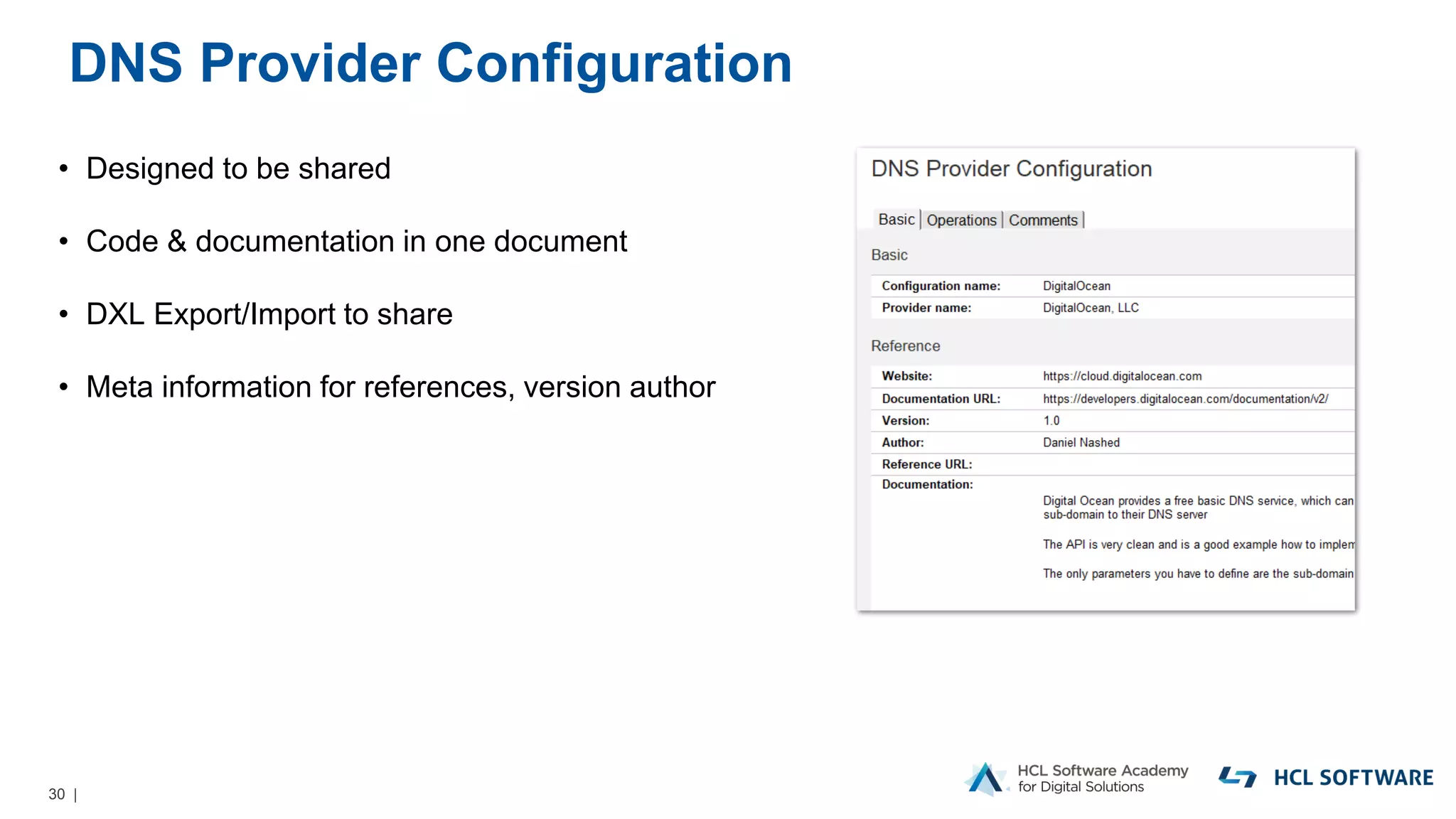
DNS Provider Configuration
• Designed to be shared
• Code & documentation in one document
• DXL Export/Import to share
• Meta information for references, version author
31 |
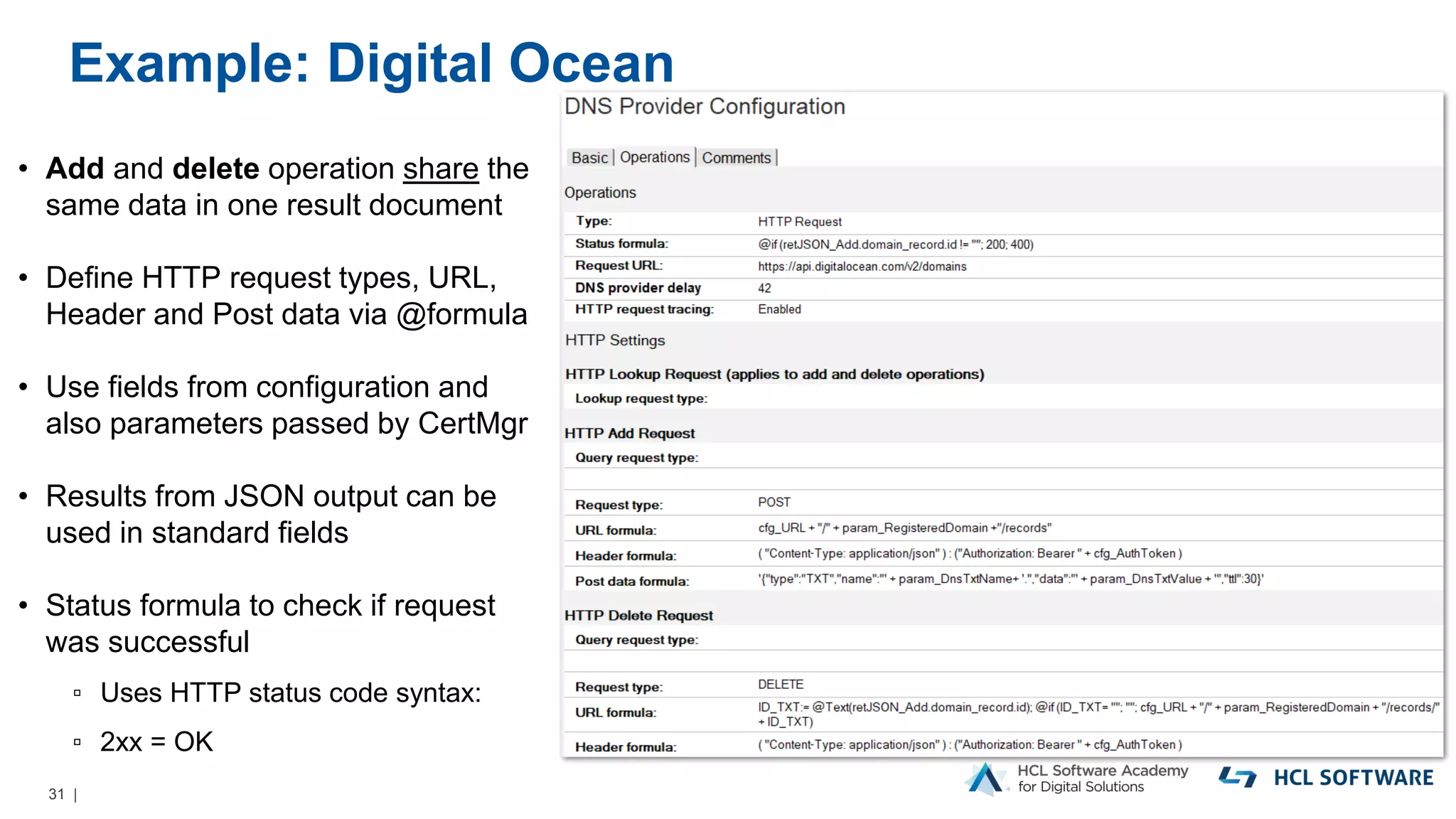
Example: Digital Ocean
• Add and delete operation share the
same data in one result document
• Define HTTP request types, URL,
Header and Post data via @formula
• Use fields from configuration and
also parameters passed by CertMgr
• Results from JSON output can be
used in standard fields
• Status formula to check if request
was successful
▫ Uses HTTP status code syntax:
▫ 2xx = OK
32 |
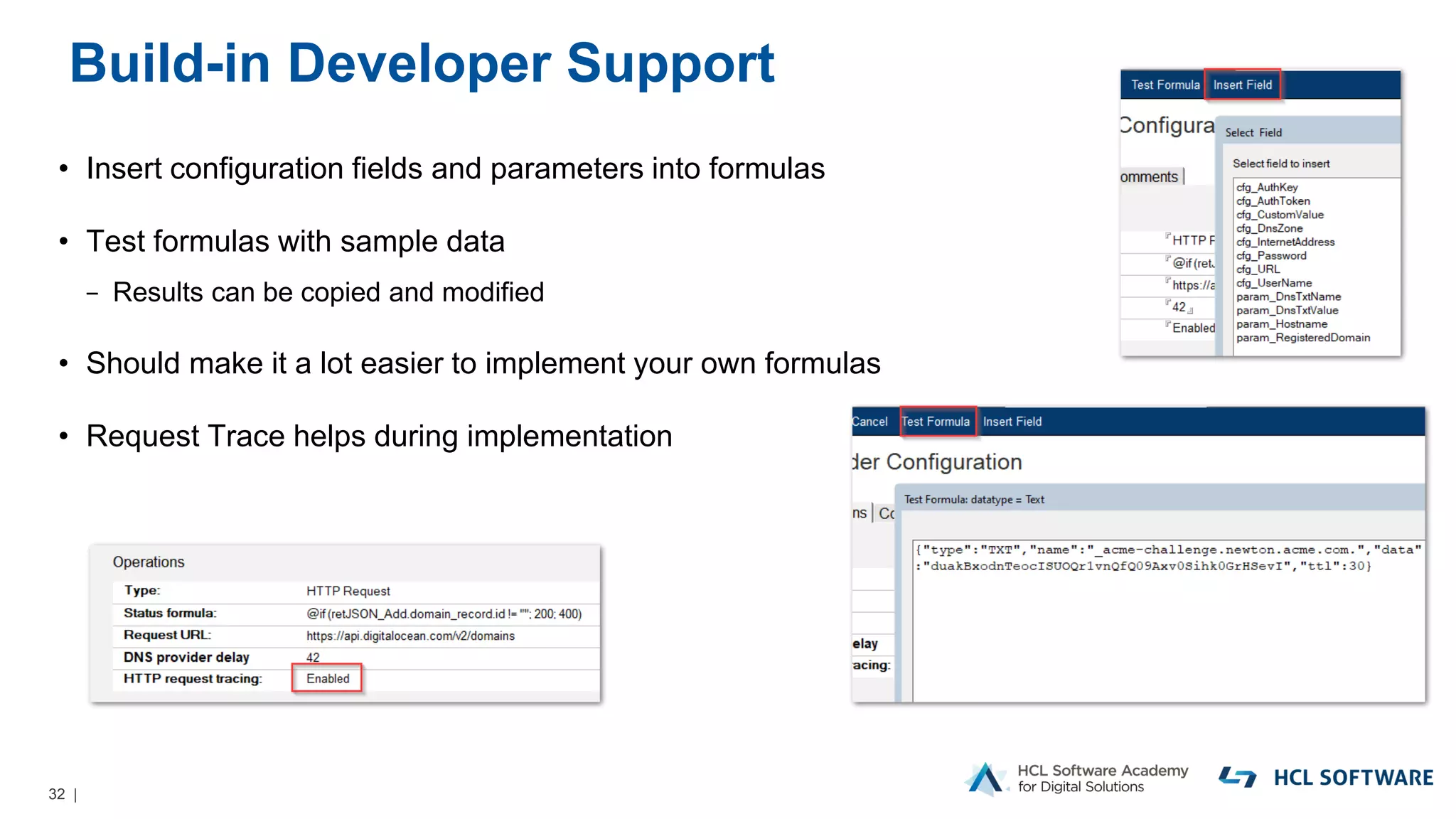
Build-in Developer Support
• Insert configuration fields and parameters into formulas
• Test formulas with sample data
− Results can be copied and modified
• Should make it a lot easier to implement your own formulas
• Request Trace helps during implementation
33 |
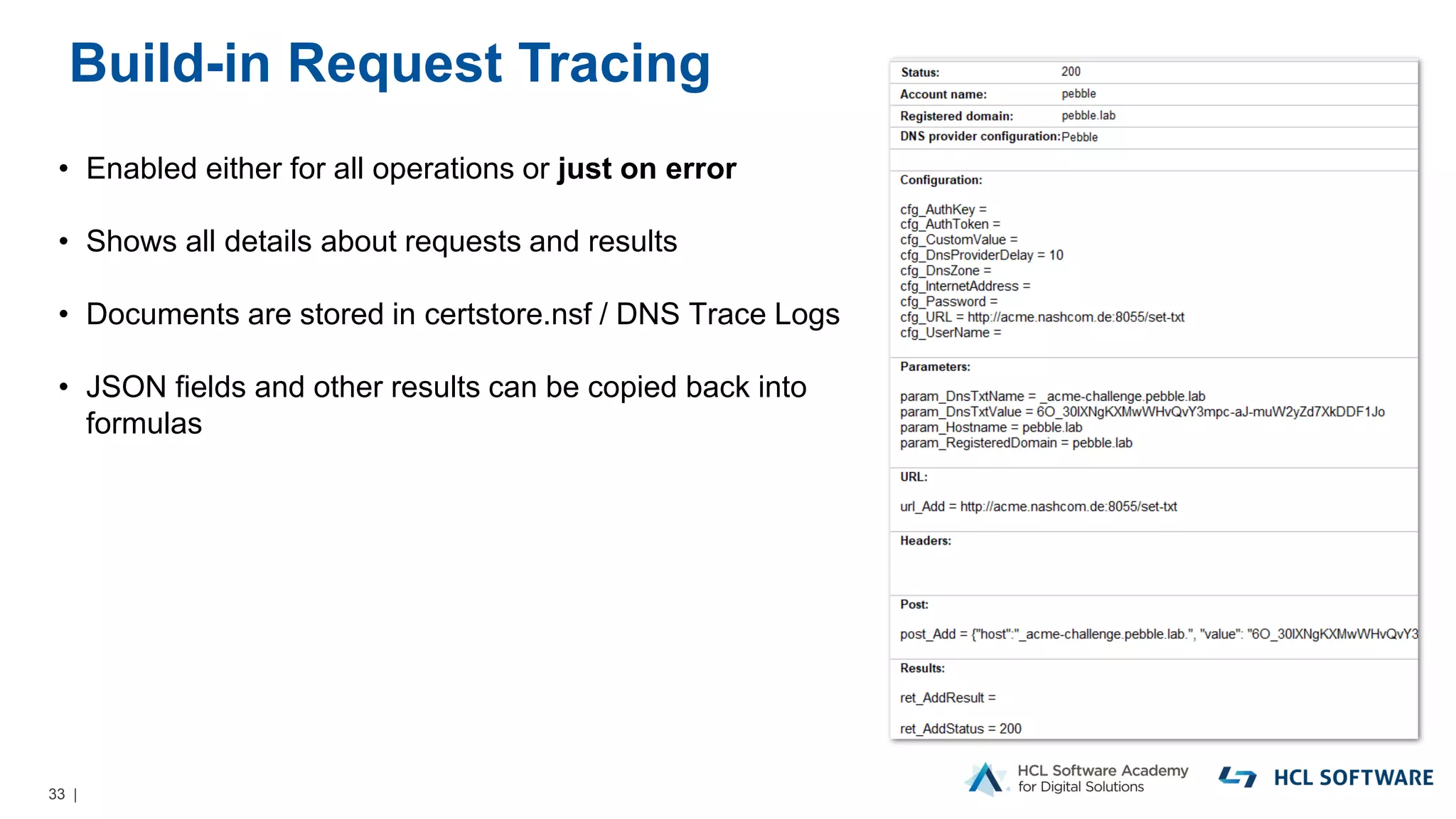
Build-in Request Tracing
• Enabled either for all operations or just on error
• Shows all details about requests and results
• Documents are stored in certstore.nsf / DNS Trace Logs
• JSON fields and other results can be copied back into
formulas
34 |
TLS Credentials Cache
New cache for RSA and ECDSA TLS Credentials
Mapping keyfiles for Internet Sites
35 |
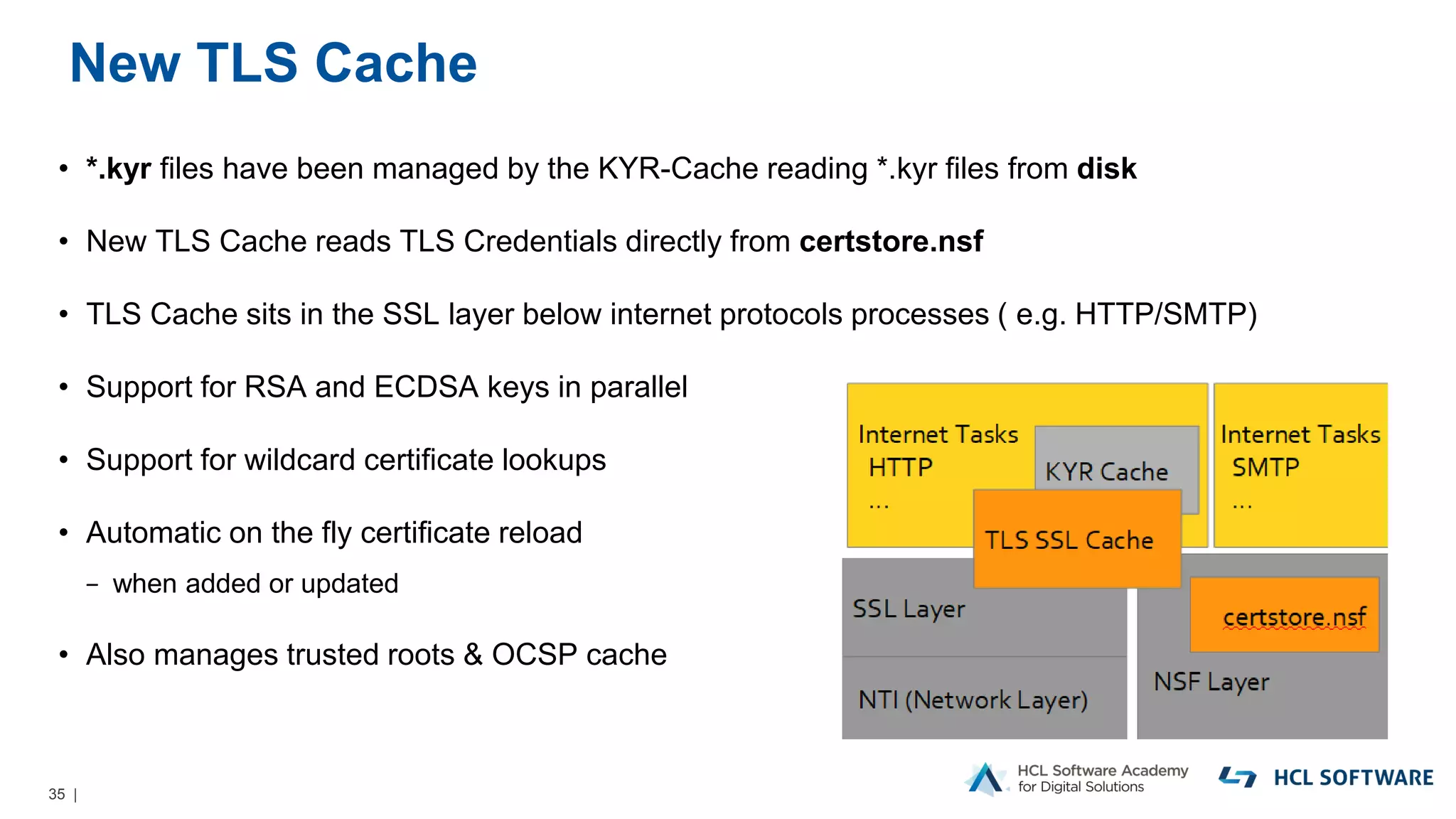
New TLS Cache
• *.kyr files have been managed by the KYR-Cache reading *.kyr files from disk
• New TLS Cache reads TLS Credentials directly from certstore.nsf
• TLS Cache sits in the SSL layer below internet protocols processes ( e.g. HTTP/SMTP)
• Support for RSA and ECDSA keys in parallel
• Support for wildcard certificate lookups
• Automatic on the fly certificate reload
− when added or updated
• Also manages trusted roots & OCSP cache
36 |
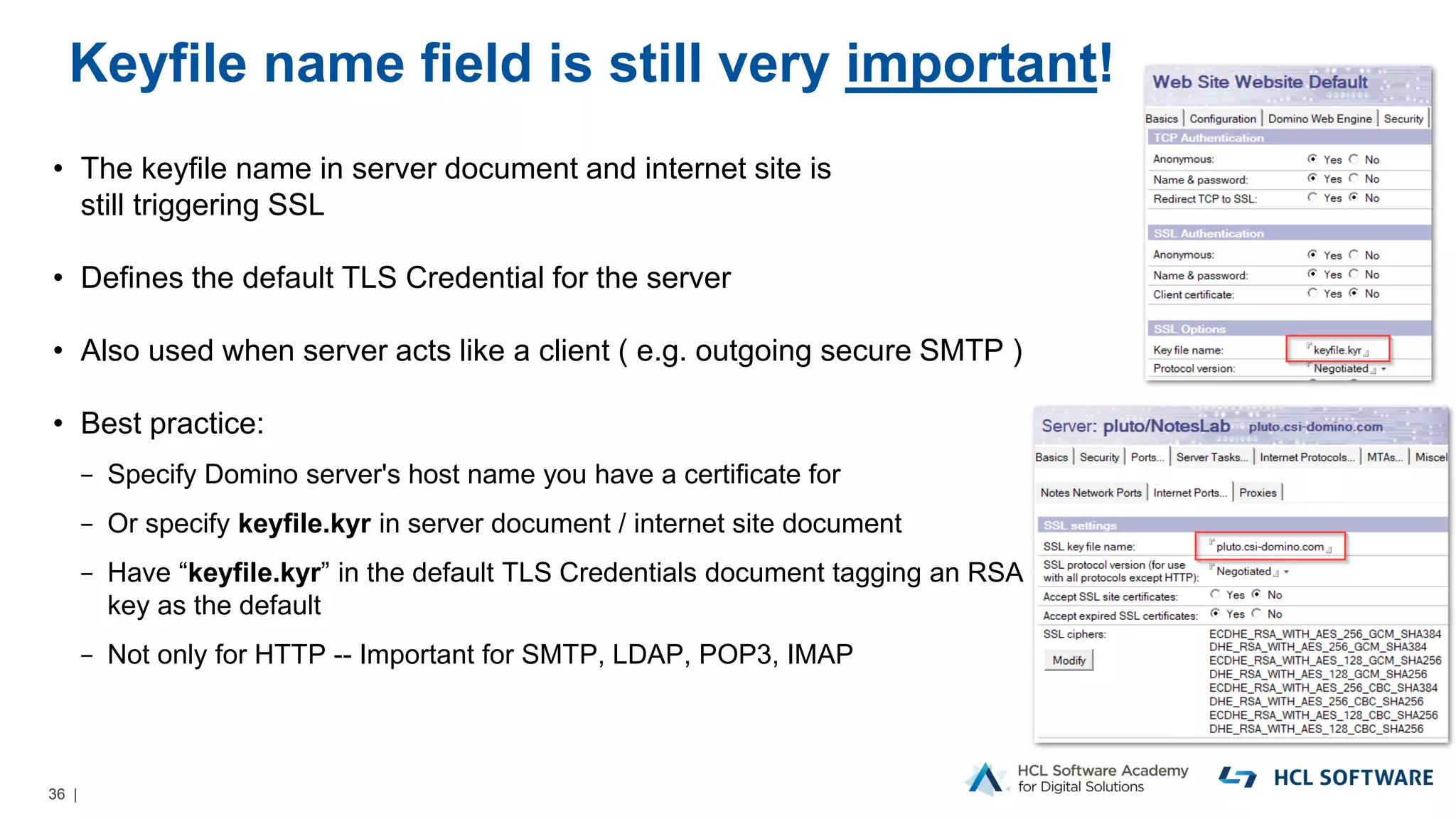
Keyfile name field is still very important!
• The keyfile name in server document and internet site is
still triggering SSL
• Defines the default TLS Credential for the server
• Also used when server acts like a client ( e.g. outgoing secure SMTP )
• Best practice:
− Specify Domino server's host name you have a certificate for
− Or specify keyfile.kyr in server document / internet site document
− Have “keyfile.kyr” in the default TLS Credentials document tagging an RSA
key as the default
− Not only for HTTP -- Important for SMTP, LDAP, POP3, IMAP
37 |
Demo Time
First Steps
Manual Flows
ACME Flows
Integrating with DNS TXT Providers
38 |
Known Limitations
Private Key Import and Export
39 |
TLS Credentials cannot be exported
• The private key of a TLS Credentials document is encrypted for security reasons
− Only CertMgr and “Servers with access:” can decrypt the key
• There is currently no option to export the private key
− A secure export is discussed for a future iteration
• Work-around
− For other Domains
▫ Copy server document into directory (or a DA directory) and encrypt for the server
▫ Add the server to “Servers with access:”
• Create the key outside and import the key to be used for manual or ACME flows
− As long as the key stays the same, the certificate can be merged with an existing key
40 |
Private keys cannot be imported via UI
• Most import operations would involve copy & paste or similar to transfer a private key
− By design today the only options to import private keys are available via server console
• Work around : Current import / migration options
− load certmgr -importkyr keyring.kyr
▫ Import one KeyRing file (*.kyr) to CertStore
− load certmgr -importkyr all
▫ Import all KeyRing files referenced from server doc & internet sites to CertStore
− load certmgr -importpem <file>
− Import file containing PEM encoded certificate chain and keys to CertStore
41 |
Troubleshooting
Settings, Logging, Debug Options
42 |
Global Settings
• Mainly used to set defaults for important settings
− For example: key type, key size, default ACME account and renewal interval
• Admin Server for CertMgr
− Should not be changed in global configuration document!
− Admin server is also stored in Directory profile “CertMgrServer” to publish in the domain
• Changing the admin server involves re-encryption of keys
• Migration via command-line option only!
− Load certmgr -MIGRATETOSERVER server-name
− Re-encrypts all private keys after checking all keys can be read
43 |
CertMgr Commands
• Tell certmgr process
− Skips the wait time between requests
• Tip to reduce the interval for testing
→ notes.ini CERTMGR_INTERVAL=2 (default: 30 seconds)
• Tell certmgr shutdown
− Waits until a running request is terminated and stops cleanly
− Recommended shutdown option
− Usually not a problem because of the small volume of operations during a day
44 |
Additional Notes.ini Parameter
• CertMgr_ReplicationInterval=n
− Default: 120 sec
− Used for client mode
• CertMgr_HealthCheckInterval=n
− Default 30 minutes
• CertMgr_CompactFreeSpace=n
− Default: 50%, Compacts database when specified percentage is free
• CertMgr_CompactDays=n
− Default: 30, Compacts database when not compacted since number of days
• CertMgr_ACCEPT_TOU=1
− Same as command-line option to confirm ACME provider terms of use – useful for automation
45 |
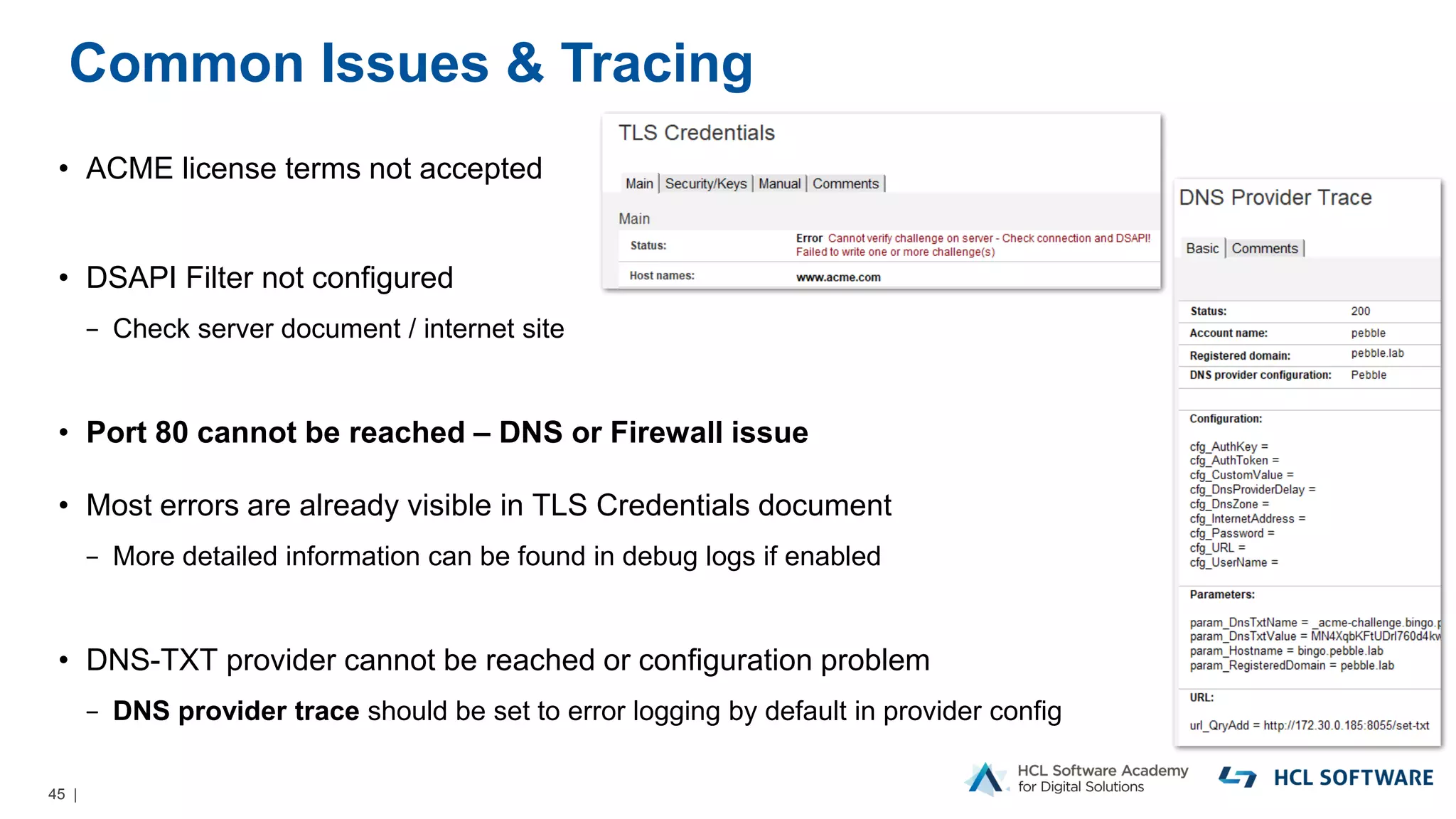
Common Issues & Tracing
• ACME license terms not accepted
• DSAPI Filter not configured
− Check server document / internet site
• Port 80 cannot be reached – DNS or Firewall issue
• Most errors are already visible in TLS Credentials document
− More detailed information can be found in debug logs if enabled
• DNS-TXT provider cannot be reached or configuration problem
− DNS provider trace should be set to error logging by default in provider config
46 |
Debugging and Troubleshooting Command Line
• -v = Verbose logging (log.nsf)
• -d = Debug mode
− IBM_TECHNICAL_SUPPORT/certmgr_debug_[..].log
• -l = Log all Curl I/O to file
− IBM_TECHNICAL_SUPPORT/certmgr_curl__[..].log
• -z = Connectivity test: Just get the ACME directory URLs and terminate
− Useful for testing internet connectivity
• Example: load certmgr -d -l
47 |
TLS Cache Logging and Debugging
• CERTSTORE_CACHELOG=1
− Recommended Starting point for all troubleshooting
− Logs most important events only
• CERTSTORE_CACHELOG=2
− Very detailed logging → Debug mode
• DEBUG_SSL_TLSCACHE=1 *)
− Debug SSL side of TLS Cache
• DEBUG_SSL_KYRCACHE=2 *)
• Debug SSL for old KYR Cache *) Task restart needed
48 |
DSAPI Debug Notes.ini Parameter
• DSAPI has no separate log file option
• Logging and debugging can be used to trace inbound challenge requests
• Notes.ini
− CERTMGR_DSAPIDEBUG=1
− CERTMGR_DSAPIVERBOSE=1
• Requires HTTP task restart ( restart task http )
49 |
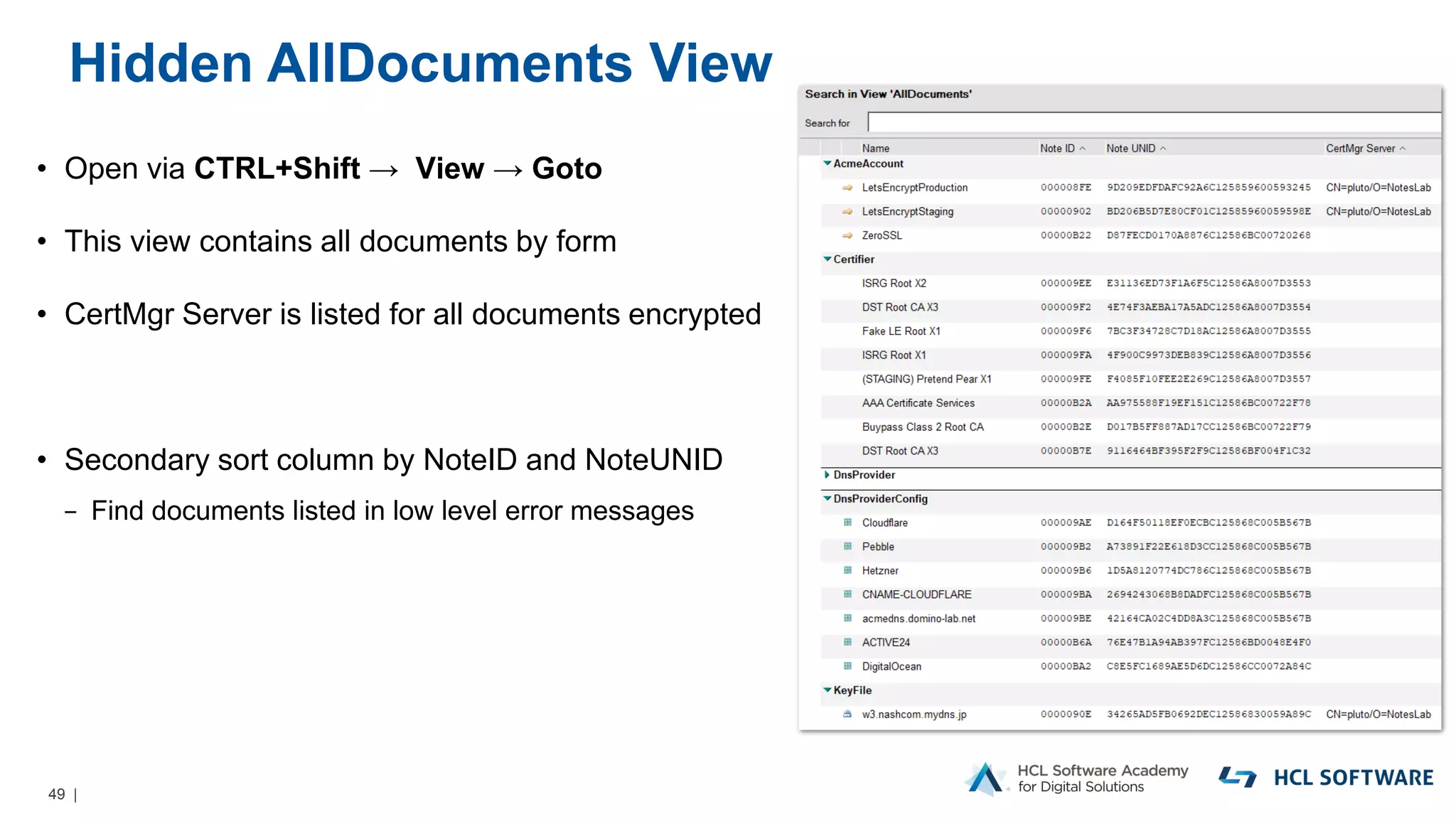
Hidden AllDocuments View
• Open via CTRL+Shift → View → Goto
• This view contains all documents by form
• CertMgr Server is listed for all documents encrypted
• Secondary sort column by NoteID and NoteUNID
− Find documents listed in low level error messages
50 |
HCL Domino CertMgr & certstore.nsf
Q&A
51 |
Building a Lab Environment
Domino on Docker with Let’s Encrypt Pebble
52 |
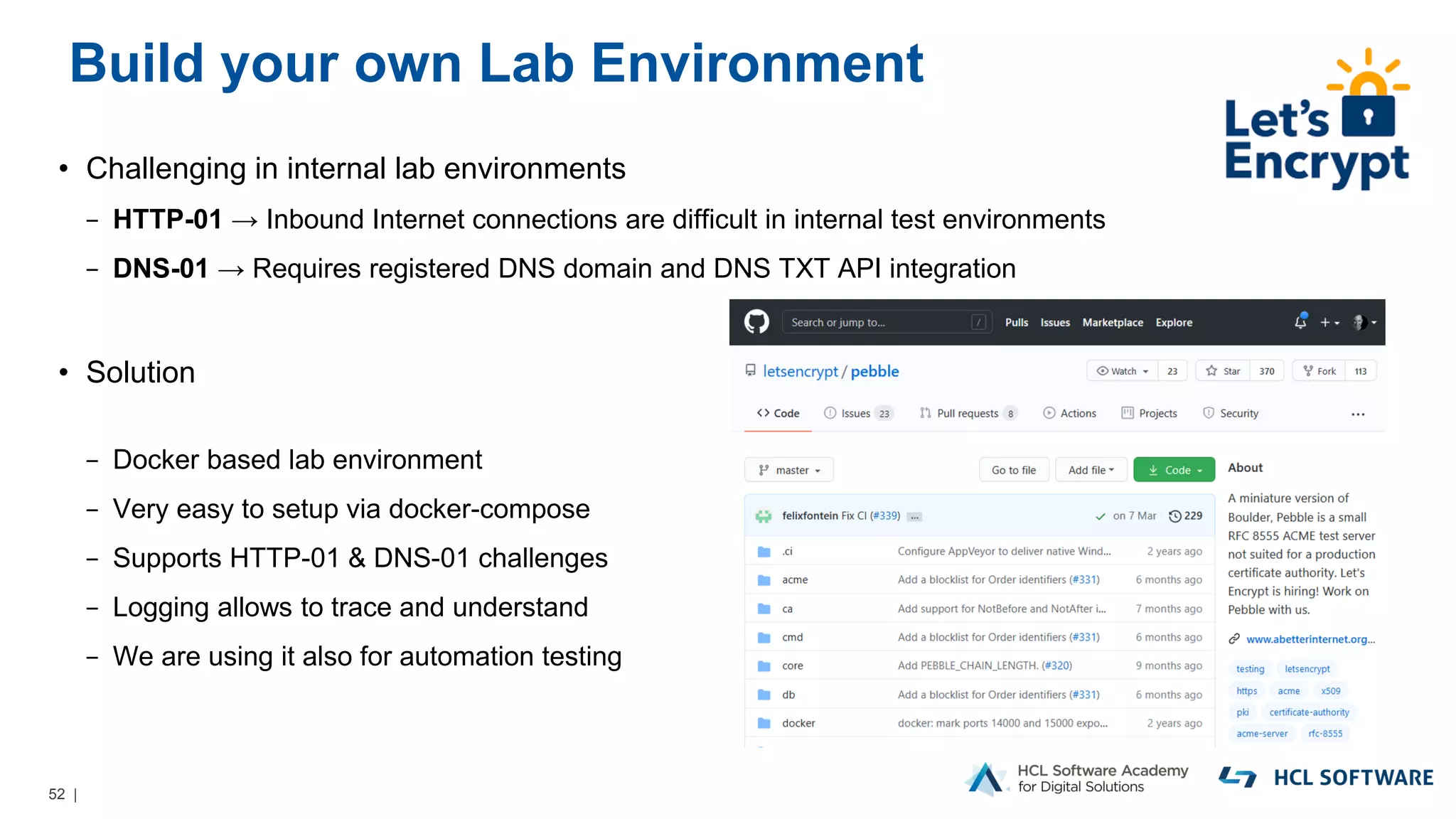
Build your own Lab Environment
• Challenging in internal lab environments
− HTTP-01 → Inbound Internet connections are difficult in internal test environments
− DNS-01 → Requires registered DNS domain and DNS TXT API integration
• Solution
− Docker based lab environment
− Very easy to setup via docker-compose
− Supports HTTP-01 & DNS-01 challenges
− Logging allows to trace and understand
− We are using it also for automation testing
53 |
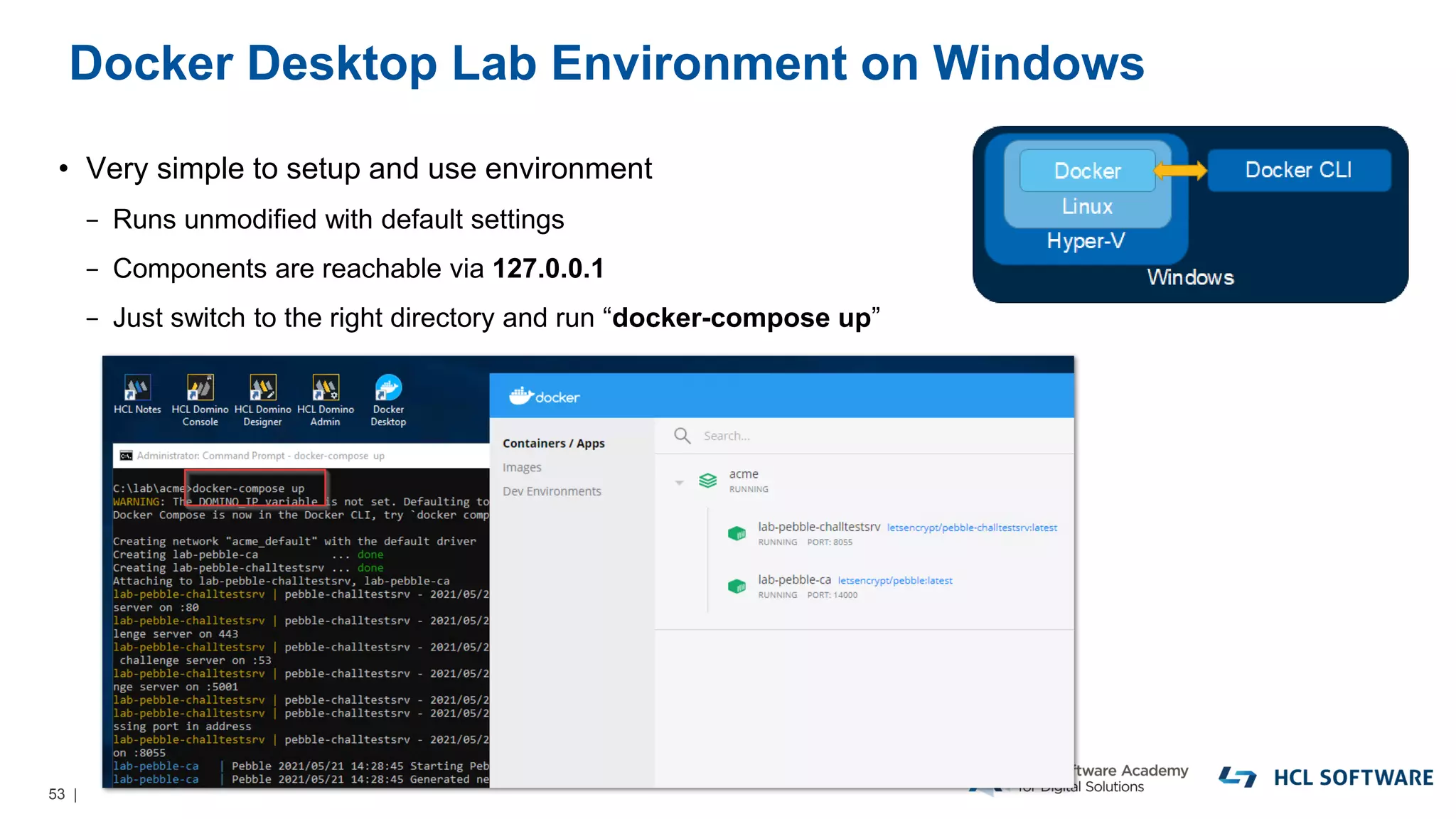
Docker Desktop Lab Environment on Windows
• Very simple to setup and use environment
− Runs unmodified with default settings
− Components are reachable via 127.0.0.1
− Just switch to the right directory and run “docker-compose up”
54 |
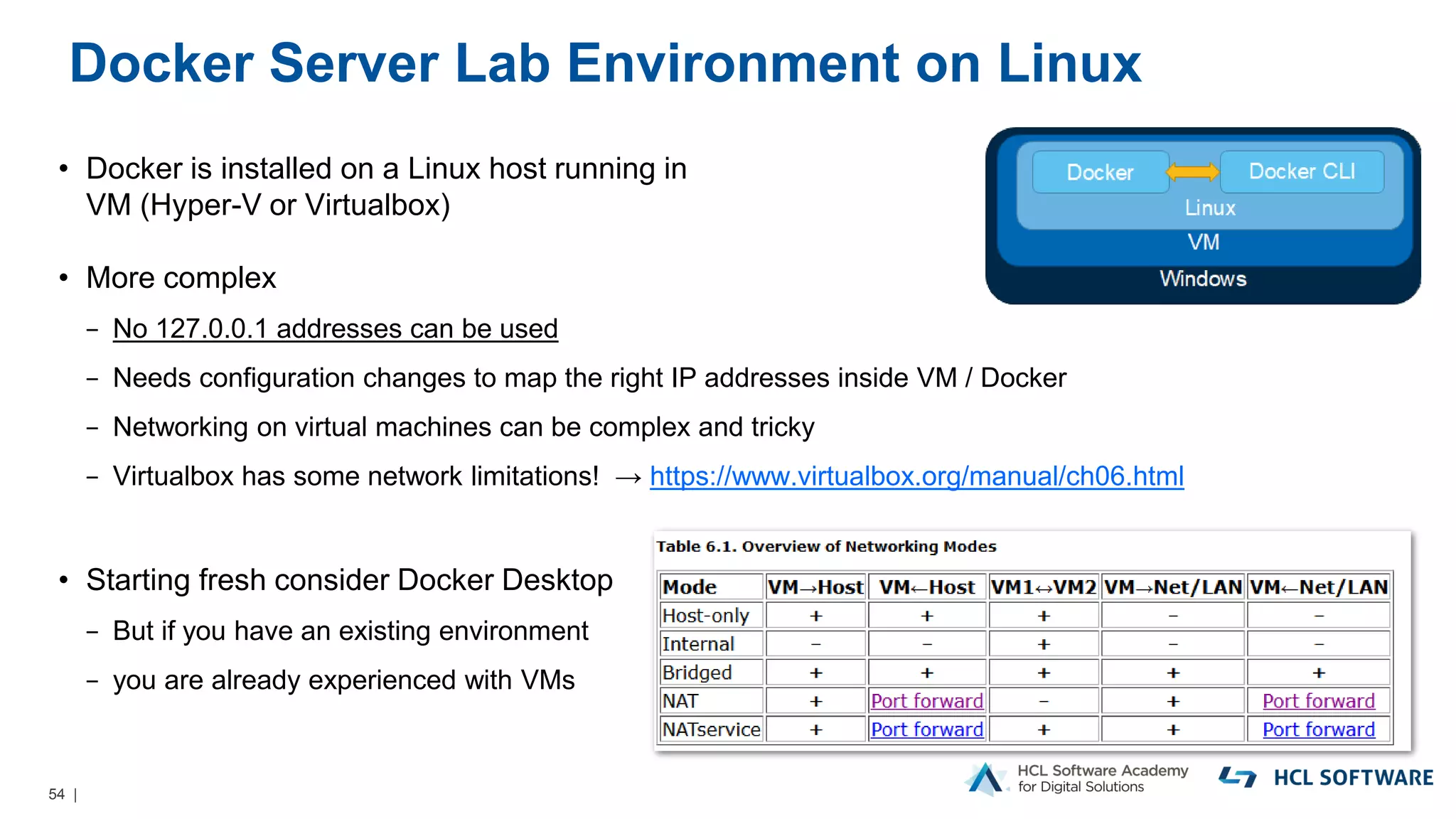
Docker Server Lab Environment on Linux
• Docker is installed on a Linux host running in
VM (Hyper-V or Virtualbox)
• More complex
− No 127.0.0.1 addresses can be used
− Needs configuration changes to map the right IP addresses inside VM / Docker
− Networking on virtual machines can be complex and tricky
− Virtualbox has some network limitations! → https://www.virtualbox.org/manual/ch06.html
• Starting fresh consider Docker Desktop
− But if you have an existing environment
− you are already experienced with VMs
55 |
Import Lab Configuration
• The lab configuration is prepared in a DXL file
• You can just import it into the database
− ACME Account
− DNS Provider Configuration
• The default will work for the Docker Desktop environment
• You need to change IP addresses matching the Docker IP address/hostname
56 |
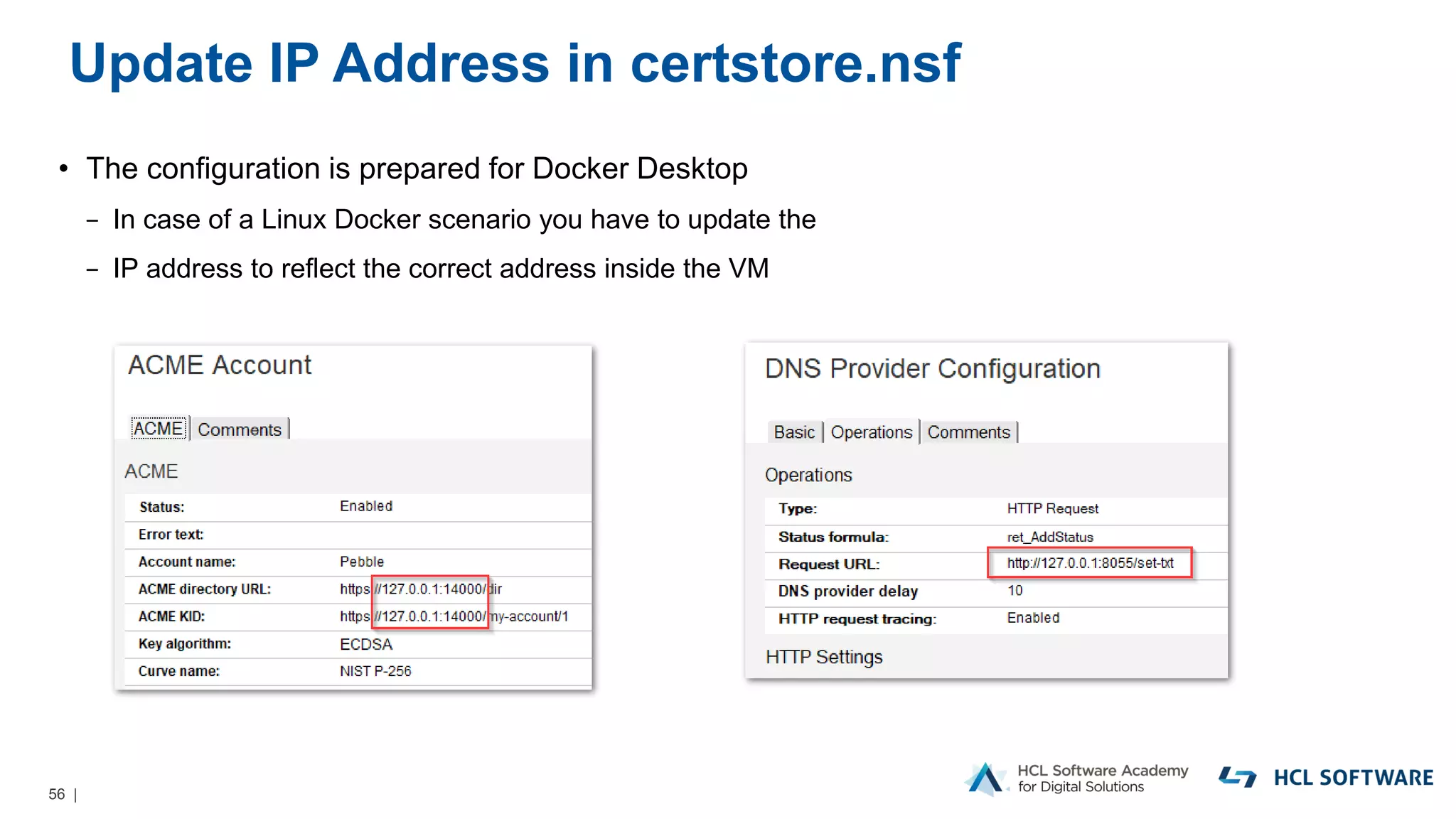
Update IP Address in certstore.nsf
• The configuration is prepared for Docker Desktop
− In case of a Linux Docker scenario you have to update the
− IP address to reflect the correct address inside the VM
57 |
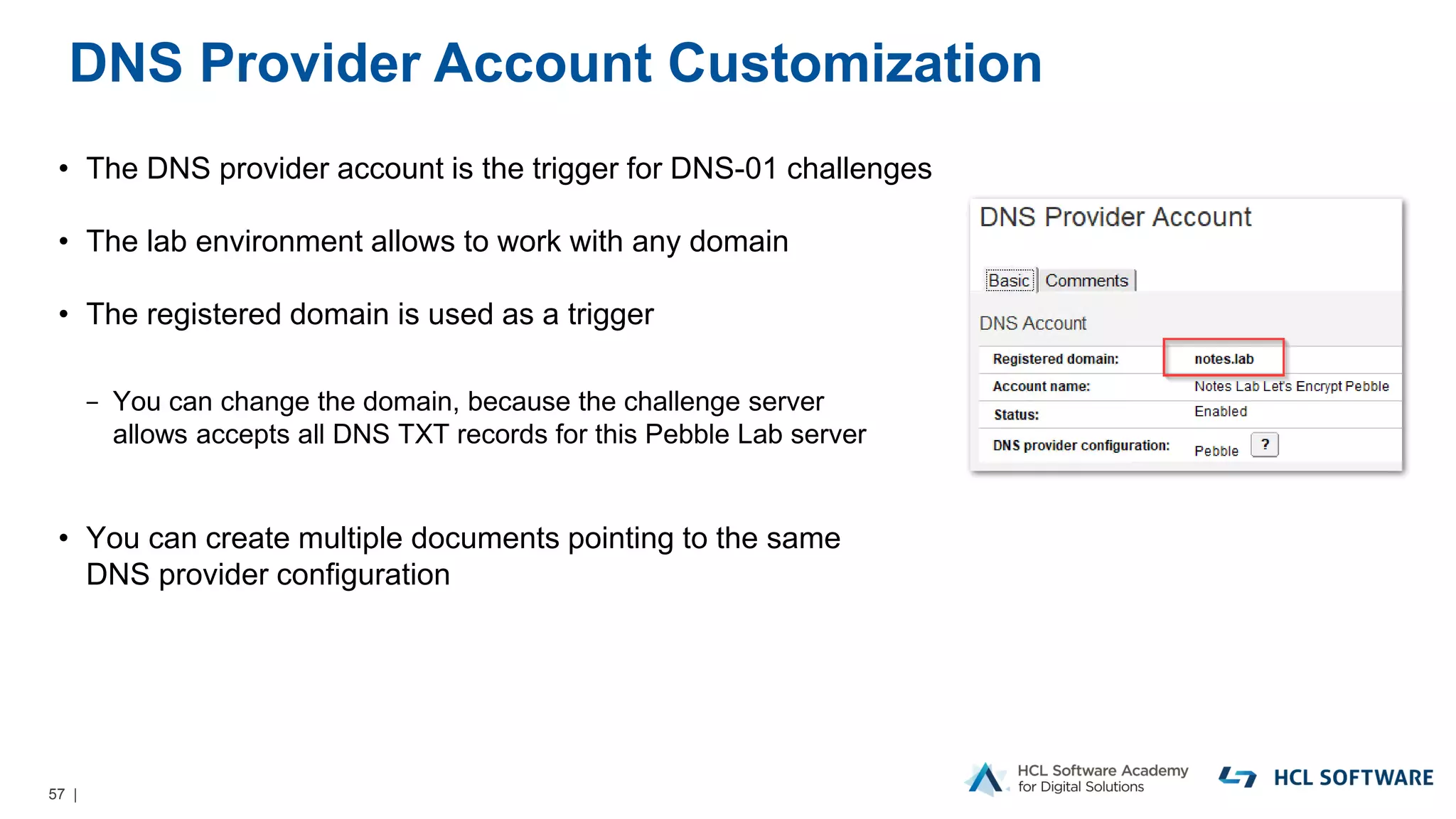
DNS Provider Account Customization
• The DNS provider account is the trigger for DNS-01 challenges
• The lab environment allows to work with any domain
• The registered domain is used as a trigger
− You can change the domain, because the challenge server
allows accepts all DNS TXT records for this Pebble Lab server
• You can create multiple documents pointing to the same
DNS provider configuration
58 |
Pebble Tips
• Import trusted root from Pebble server
− e.g curl -k https://127.0.0.1:15000/roots/0
• Pebble is designed for test and does not to store data permanently
− Docker container has no volume
− Root certificate and ACME account needs reset every time Pebble is restarted
• After restart you need to reset account
− Remove “ACME KID:”
− You will see error messages reminding you ;-)
$8.4 BILLION ENTERPRISE | 132,000 IDEAPRENEURS | 44 COUNTRIES
QUESTIONS?
Use the GoToWebinar Questions Pane
Please keep all questions related to the
topics that our speakers are discussing!!!
Unrelated Question => post at:
http://openntf.slack.com/

June OpenNTF Webinar - Domino V12 Certification Manager

  • 1.
    OPENNTF WEBINARS June OpenNTFWebinar: Domino V12 Certification Manager
  • 2.
    AGENDA • Welcome –Howard Greenberg and Graham Acres • Domino V12 Certification Manager – Daniel Nashed • Q and A
  • 3.
    THANKS TO THEOPENNTF SPONSORS • HCL made a significant contribution to help our organization • Funds these webinars! • Contests like Hackathons • Running the organization • Prominic donates all IT related services • Cloud Hosting for OpenNTF • Infrastructure management for HCL Domino and Atlassian Servers • System Administration for day-to-day operation
  • 4.
    THIS IS OURCOMMUNITY • Join us and get involved! • We are all volunteers • No effort is too small • If your idea is bigger than you can do on your own, we can connect you to a team to work on it • Test or help or modify an existing project • Write guides or documentation • Add reviews on projects / stars on Snippets
  • 5.
    JULY WEBINAR • HCLPresents Keep, a new API for Domino • Stephan Wissel and Paul Withers, HCL • Thursday, July 15, 2021 at 11:00 AM (New York time • https://attendee.gotowebinar.com/register/ 1378320704479499279
  • 6.
    ASKING QUESTIONS • FirstQuestion – Will this be recorded? • Yes, view on YouTube!!! • https://www.youtube.com/user/OpenNTF • Use the Questions Pane in GoToWebinar • We will get to your questions at the end of the webinar • The speakers will respond to your questions verbally • (not in the Questions pane) • Please keep all questions related to the topics that our speakers are discussing!!! • Unrelated Question => post at: • http://openntf.slack.com/
  • 7.
    Domino V12 Certificate Management DanielNashed HCL Lifetime Ambassador
  • 8.
    2 | Agenda • Theory −Introduction / Motivation − certstore.nsf & CertMgr − Manual Flows − Let's encrypt / ACME Support − New TLS Credential Cache • Live Demo & Questions • Troubleshooting Slides • Q&A • Bonus: Build your own Lab
  • 9.
    3 | Domino V12Design Goal • Simplify Domino certificate management • No external tools like OpenSSL command-line to create keys and convert certificates needed! • Replace difficult to handle *.kyr files with standard *.pem format • Full Let's Encrypt® / ACME CA integration • Simplified flows for external certificate authorities • Domain wide secure and automated deployment for “TLS Credentials” • Automated update of certificates including automatic cache update in internet server tasks • Support modern standards like ECDSA in addition to RSA
  • 10.
    4 | Technology usedfor CertMgr • Native Servertask & DSAPI Filter (C/C++) • Leverages existing and new Notes security APIs • Implements Let's Encrypt uses ACME protocol V2 (RFC 8555) − ACME = Automatic Certificate Management Environment − Own HCL implementation leveraging standards like ▫ JSON, LibCurl, JWS, Notes crypto including PEM, RSA and ECDSA keys, (OpenSSL) … • Designed for “automation”
  • 11.
    5 | Domain wideCertStore Database & CertMgr Privates Keys, Certificates,Trusted Roots
  • 12.
    6 | New -certstore.nsf • Domain wide database managed by CertMgr task • Secure, automated deployment for TLS Credentials and trusted roots • Private keys are encrypted with CertMgr server and the server specified in the field “Servers with access:” − Special designed Vault style encryption with new API • Easy to use with modern interface • CertMgr servertask is only supported on W64 and Linux64 − AIX and OS400 can still leverage certstore.nsf and the new TLS Cache ▫ Create replica manually
  • 13.
    7 | Create certstore.nsfon CertMgr Server • First server in domain starting the “certmgr” servertask is setup as the CertMgr Server − Checks the Domino directory profile on admin server for an existing CertMgr server − If no server exists automatically creates the domain wider certstore.nsf database − Updates the directory profile on admin server to propagate the CertMgr server in the domain • Starting the certmgr servertask on any additional server in the domain creates a replica − Each additional server acts like a “CertMgr client” and will just replicate the database every 2 minutes − Keeping the CertMgr servertask loaded is an optional convenience step − Any type of replication setup which ensures a short replication cycle can be used as well
  • 14.
    8 | certstore.nsf –TLS Credentials • TLS Credential = private key + leaf certificate + chain (intermediates) + trusted root • Replaces “*.kyr files” − Stored in PEM format (text with base64 encoded data) • Can be created via − Manual flows including import − ACME protocol (Let's Encrypt & others) • Specify trusted roots used for client certificate verification • Used to be hidden in kyr-file and was difficult to manage
  • 15.
    9 | certstore.nsf –Trusted Root • Stored in trusted, secured certstore.nsf − Replicated domain wide • Used for client cert verification • And auto complete certificate chains − ACME and manual flows • Certificate chains are automatically sorted & completed − Private Key → matching leaf certificate → intermediate certs in the right order → trusted root • Tip: you can import intermediate certificates as “Trusted Root” to be used to auto complete chains − Just listed with warning, that they are no root
  • 16.
    10 | New -Support for Elliptic Curves – “ECDSA Keys” • ECDSA is the more modern, more secure standard with less overhead − 256 bit (NIST P-256) ECDSA key → 3072 bit RSA key or a 128 bit AES key. − 384 bit (NIST P-384) ECDSA key → 7680 bit RSA key or a 192 bit AES key. − 512+ bit ECDSA key (NIST P-521) → 15360 bit RSA key or a 256 bit AES key. • Fully supported in the Domino V12 TLS/SSL stack − Support for RSA and ECDSA key types in parallel • With ECDSA the following ciphers are automatically used instead of the cipher config − TLS_ECDHE_ECDSA_WITH_AES_128_GCM_SHA256 (0xC02B) − TLS_ECDHE_ECDSA_WITH_AES_256_GCM_SHA384 (0xC02C) • Background Information ECDSA − https://blog.cloudflare.com/ecdsa-the-digital-signature-algorithm-of-a-better-internet/
  • 17.
    11 | Support fortwo important TLS 1.2 Curves – X25519 & X448 • Strong security with improved performance − Details: https://en.wikipedia.org/wiki/Curve25519 • The new order of curves − Curve X25519 − Curve NIST P-256 − Curve X448 − Curve NIST P-384 − Curve NIST P-521 • Notes.ini parameter per curve − All curves enabled by default − Current best practice • If really needed disable individual curves − SSL_DISABLE_CURVE_X25519=1 − SSL_DISABLE_CURVE_P256=1 − SSL_DISABLE_CURVE_X448=1 − SSL_DISABLE_CURVE_P384=1 − SSL_DISABLE_CURVE_521=1
  • 18.
    12 | Manual CertificateOperations • 1. CertMgr processes submitted requests and creates − Private key ( RSA or ECDSA) ▫ Saved locally encrypted for assigned servers • CSR (Certificate Signing Request) signed by private key→ PEM • 2. Admin copies CSR to CA • 3. Admin imports certificate & chain ( PEM ) back • Paste full chain in any order and submits the form again • Duplicate certs are ignored • Missing intermediate certs and root are automatically added from “Trusted Roots” in certstore.nsf
  • 19.
    13 | Certificate HealthCheck & Inspecting Certificate Chains • All certificate operations check if the certificate is valid − Status: Valid, Warnings, Errors − Detailed warning and error messages • Most common warning: “Last cert in chain NOT self signed – No root found” − Not an error - Just means that there is no trusted root − Trusted roots can be imported separately and are added to the chain if present • Updates CertMgr statistics to reflect the current health status
  • 20.
    14 | Certificate Details •Examine Certificate(s) Dialog • Copy Certificate chain to check with external tools − e.g. openssl x509 -in my.pem -text –noout − Certificate information
  • 21.
    15 | Let's Encrypt/ ACME Support Introduction and HTTP-01 Challenges
  • 22.
    16 | Automated CertificateManagement • Support for Let's Encrypt − ACME protocol V2 (RFC 8555) − Automatic Certificate Management Environment • Free of charge SSL/TLS certificates • Fully integrated into certstore.nsf & CertMgr • Easy to deploy • Automatic certificate update (request) and deployment (reload on server)
  • 23.
  • 24.
    18 | ACME HTTP-01Challenges • How it works 1. ACME server sends a challenge to ACME client 2. ACME server will ask via in-bound HTTP port 80 for the “secret” at a well-known URL • DSAPI Filter “certmgrdsapi” needs to be enabled in server doc / internet site !! − Tip: load certmgr -c adds the DSAPI filter to server doc – Internet sites need to specify manually • If server is configured to only allow authenticated connection configure public URL − Notes.ini: HTTPPUBLICURLS=/.well-known/acme-challenge/*:/redir.nsf/*:/MFASetup* • Again: Inbound HTTP port 80 required! • If the server is not reachable by the ACME server (e.g. Let's Encrypt), the challenge fails !!! − Tip: Inbound connection can be a proxy connection
  • 25.
    19 | ACME ProviderLet‘s Encrypt – included in template • Let's Encrypt Staging − https://letsencrypt.org/docs/staging-environment − Should always be used for first steps testing connectivity − Provides the same functionality like Let's Encrypt production − Much higher limits for certificates and errors • Let's Encrypt production − https://letsencrypt.org
  • 26.
    20 | Additional testedACME Providers • ACME is a standard supported by more providers • New ACME provider can be added using their published directory URL • ZeroSSL *) − https://zerossl.com − Requires registration + external account binding (EAB) • BuyPass *) − https://buypass.com
  • 27.
    21 | On premiseACME CA • SmallStep ACME CA − https://smallstep.com/docs/tutorials/acme-challenge • CA with ACME functionality • Can also operate as “Sub-CA” for an existing corporate CA • Good choice for internal customer deployments • Another tested environment • Directory URL configured depends on your deployment • Setup on Docker in 10 minutes!
  • 28.
    22 | ACME DNS-01Challenges Background, Providers and Configuration
  • 29.
    23 | ACME DNS-01Challenges & Wild Card Certificates • Allows to request certificates without inbound internet connection • ACME Challenge is stored in DNS TXT record • Supports wild card certificates! e. g. *.acme.com • Requires DNS provider API with outgoing HTTPS connection to DNS provider − No inbound connection needed − Can leverage outgoing proxy connections • CertMgr server can request certificates for any server in the DNS domain
  • 30.
    24 | DNS ProviderInterface • Triggered by configured “registered domain” − Choose the right provider − Specify provider specific information • Build-in support to integrate DNS providers − Easy to integrate REST interface (@Formulas) ▫ Recommended interface! ▫ Works for most providers ▫ “Low code approach” • Notes Agent • Command-Line Integration
  • 31.
    25 | Available DNSTXT Integration • REST API − Cloudflare, Inc − Digital Ocean, LLC − Hetzner Online GmbH (Germany) − ACME DNS − Let's Encrypt Pebble test server • Command-Line − AWS Route 53 DNS
  • 32.
    26 | DNS ProviderInterface – Import DXL • DNS TXT API DXL files are not included in certstore.ntf • Provider interfaces can be imported via DXL files − Database action: Import DXL • REST interface is based on @formulas − Low code approach − Can parse JSON responses − Helper buttons for inserting fields & testing formulas − Trace results useful for troubleshooting and development
  • 33.
    27 | HCL Githubrepository for CertMgr • Available as of today • Brand new git repository for DNS TXT provider integration • Contains ready to import and use DXL files and scripts • Intendent to build, share and collaborate DNS provider configurations
  • 34.
    28 | Building DNSTXT API Interfaces
  • 35.
    29 | Low codeapproach with REST API and JSON • Many DNS providers offer a REST base interface to manage DNS records • Modern interfaces with JSON payloads • CertMgr preferred integration option: HTTP request with @Formulas • Technology used − @Formulas − HTTP/HTTPs requests (via Curl build into the servertask) − JSON parsing results (native in the servertask) and make results available to @forumulas • @Formulas for different steps of the operation including lookups − Most flows should need to be that complicated flows • Add/Delete operation for DNS TXT flows
  • 36.
    30 | DNS ProviderConfiguration • Designed to be shared • Code & documentation in one document • DXL Export/Import to share • Meta information for references, version author
  • 37.
    31 | Example: DigitalOcean • Add and delete operation share the same data in one result document • Define HTTP request types, URL, Header and Post data via @formula • Use fields from configuration and also parameters passed by CertMgr • Results from JSON output can be used in standard fields • Status formula to check if request was successful ▫ Uses HTTP status code syntax: ▫ 2xx = OK
  • 38.
    32 | Build-in DeveloperSupport • Insert configuration fields and parameters into formulas • Test formulas with sample data − Results can be copied and modified • Should make it a lot easier to implement your own formulas • Request Trace helps during implementation
  • 39.
    33 | Build-in RequestTracing • Enabled either for all operations or just on error • Shows all details about requests and results • Documents are stored in certstore.nsf / DNS Trace Logs • JSON fields and other results can be copied back into formulas
  • 40.
    34 | TLS CredentialsCache New cache for RSA and ECDSA TLS Credentials Mapping keyfiles for Internet Sites
  • 41.
    35 | New TLSCache • *.kyr files have been managed by the KYR-Cache reading *.kyr files from disk • New TLS Cache reads TLS Credentials directly from certstore.nsf • TLS Cache sits in the SSL layer below internet protocols processes ( e.g. HTTP/SMTP) • Support for RSA and ECDSA keys in parallel • Support for wildcard certificate lookups • Automatic on the fly certificate reload − when added or updated • Also manages trusted roots & OCSP cache
  • 42.
    36 | Keyfile namefield is still very important! • The keyfile name in server document and internet site is still triggering SSL • Defines the default TLS Credential for the server • Also used when server acts like a client ( e.g. outgoing secure SMTP ) • Best practice: − Specify Domino server's host name you have a certificate for − Or specify keyfile.kyr in server document / internet site document − Have “keyfile.kyr” in the default TLS Credentials document tagging an RSA key as the default − Not only for HTTP -- Important for SMTP, LDAP, POP3, IMAP
  • 43.
    37 | Demo Time FirstSteps Manual Flows ACME Flows Integrating with DNS TXT Providers
  • 44.
    38 | Known Limitations PrivateKey Import and Export
  • 45.
    39 | TLS Credentialscannot be exported • The private key of a TLS Credentials document is encrypted for security reasons − Only CertMgr and “Servers with access:” can decrypt the key • There is currently no option to export the private key − A secure export is discussed for a future iteration • Work-around − For other Domains ▫ Copy server document into directory (or a DA directory) and encrypt for the server ▫ Add the server to “Servers with access:” • Create the key outside and import the key to be used for manual or ACME flows − As long as the key stays the same, the certificate can be merged with an existing key
  • 46.
    40 | Private keyscannot be imported via UI • Most import operations would involve copy & paste or similar to transfer a private key − By design today the only options to import private keys are available via server console • Work around : Current import / migration options − load certmgr -importkyr keyring.kyr ▫ Import one KeyRing file (*.kyr) to CertStore − load certmgr -importkyr all ▫ Import all KeyRing files referenced from server doc & internet sites to CertStore − load certmgr -importpem <file> − Import file containing PEM encoded certificate chain and keys to CertStore
  • 47.
  • 48.
    42 | Global Settings •Mainly used to set defaults for important settings − For example: key type, key size, default ACME account and renewal interval • Admin Server for CertMgr − Should not be changed in global configuration document! − Admin server is also stored in Directory profile “CertMgrServer” to publish in the domain • Changing the admin server involves re-encryption of keys • Migration via command-line option only! − Load certmgr -MIGRATETOSERVER server-name − Re-encrypts all private keys after checking all keys can be read
  • 49.
    43 | CertMgr Commands •Tell certmgr process − Skips the wait time between requests • Tip to reduce the interval for testing → notes.ini CERTMGR_INTERVAL=2 (default: 30 seconds) • Tell certmgr shutdown − Waits until a running request is terminated and stops cleanly − Recommended shutdown option − Usually not a problem because of the small volume of operations during a day
  • 50.
    44 | Additional Notes.iniParameter • CertMgr_ReplicationInterval=n − Default: 120 sec − Used for client mode • CertMgr_HealthCheckInterval=n − Default 30 minutes • CertMgr_CompactFreeSpace=n − Default: 50%, Compacts database when specified percentage is free • CertMgr_CompactDays=n − Default: 30, Compacts database when not compacted since number of days • CertMgr_ACCEPT_TOU=1 − Same as command-line option to confirm ACME provider terms of use – useful for automation
  • 51.
    45 | Common Issues& Tracing • ACME license terms not accepted • DSAPI Filter not configured − Check server document / internet site • Port 80 cannot be reached – DNS or Firewall issue • Most errors are already visible in TLS Credentials document − More detailed information can be found in debug logs if enabled • DNS-TXT provider cannot be reached or configuration problem − DNS provider trace should be set to error logging by default in provider config
  • 52.
    46 | Debugging andTroubleshooting Command Line • -v = Verbose logging (log.nsf) • -d = Debug mode − IBM_TECHNICAL_SUPPORT/certmgr_debug_[..].log • -l = Log all Curl I/O to file − IBM_TECHNICAL_SUPPORT/certmgr_curl__[..].log • -z = Connectivity test: Just get the ACME directory URLs and terminate − Useful for testing internet connectivity • Example: load certmgr -d -l
  • 53.
    47 | TLS CacheLogging and Debugging • CERTSTORE_CACHELOG=1 − Recommended Starting point for all troubleshooting − Logs most important events only • CERTSTORE_CACHELOG=2 − Very detailed logging → Debug mode • DEBUG_SSL_TLSCACHE=1 *) − Debug SSL side of TLS Cache • DEBUG_SSL_KYRCACHE=2 *) • Debug SSL for old KYR Cache *) Task restart needed
  • 54.
    48 | DSAPI DebugNotes.ini Parameter • DSAPI has no separate log file option • Logging and debugging can be used to trace inbound challenge requests • Notes.ini − CERTMGR_DSAPIDEBUG=1 − CERTMGR_DSAPIVERBOSE=1 • Requires HTTP task restart ( restart task http )
  • 55.
    49 | Hidden AllDocumentsView • Open via CTRL+Shift → View → Goto • This view contains all documents by form • CertMgr Server is listed for all documents encrypted • Secondary sort column by NoteID and NoteUNID − Find documents listed in low level error messages
  • 56.
    50 | HCL DominoCertMgr & certstore.nsf Q&A
  • 57.
    51 | Building aLab Environment Domino on Docker with Let’s Encrypt Pebble
  • 58.
    52 | Build yourown Lab Environment • Challenging in internal lab environments − HTTP-01 → Inbound Internet connections are difficult in internal test environments − DNS-01 → Requires registered DNS domain and DNS TXT API integration • Solution − Docker based lab environment − Very easy to setup via docker-compose − Supports HTTP-01 & DNS-01 challenges − Logging allows to trace and understand − We are using it also for automation testing
  • 59.
    53 | Docker DesktopLab Environment on Windows • Very simple to setup and use environment − Runs unmodified with default settings − Components are reachable via 127.0.0.1 − Just switch to the right directory and run “docker-compose up”
  • 60.
    54 | Docker ServerLab Environment on Linux • Docker is installed on a Linux host running in VM (Hyper-V or Virtualbox) • More complex − No 127.0.0.1 addresses can be used − Needs configuration changes to map the right IP addresses inside VM / Docker − Networking on virtual machines can be complex and tricky − Virtualbox has some network limitations! → https://www.virtualbox.org/manual/ch06.html • Starting fresh consider Docker Desktop − But if you have an existing environment − you are already experienced with VMs
  • 61.
    55 | Import LabConfiguration • The lab configuration is prepared in a DXL file • You can just import it into the database − ACME Account − DNS Provider Configuration • The default will work for the Docker Desktop environment • You need to change IP addresses matching the Docker IP address/hostname
  • 62.
    56 | Update IPAddress in certstore.nsf • The configuration is prepared for Docker Desktop − In case of a Linux Docker scenario you have to update the − IP address to reflect the correct address inside the VM
  • 63.
    57 | DNS ProviderAccount Customization • The DNS provider account is the trigger for DNS-01 challenges • The lab environment allows to work with any domain • The registered domain is used as a trigger − You can change the domain, because the challenge server allows accepts all DNS TXT records for this Pebble Lab server • You can create multiple documents pointing to the same DNS provider configuration
  • 64.
    58 | Pebble Tips •Import trusted root from Pebble server − e.g curl -k https://127.0.0.1:15000/roots/0 • Pebble is designed for test and does not to store data permanently − Docker container has no volume − Root certificate and ACME account needs reset every time Pebble is restarted • After restart you need to reset account − Remove “ACME KID:” − You will see error messages reminding you ;-)
  • 65.
    $8.4 BILLION ENTERPRISE| 132,000 IDEAPRENEURS | 44 COUNTRIES
  • 66.
    QUESTIONS? Use the GoToWebinarQuestions Pane Please keep all questions related to the topics that our speakers are discussing!!! Unrelated Question => post at: http://openntf.slack.com/