Jonatan Schwamberg Pontus Wiehager Ender Yunus Xiqing Deng Media Management Group 7b Case Study
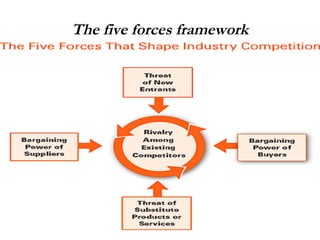
The five forces framework
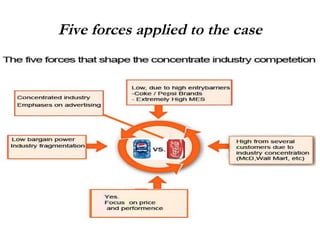
Five forces applied to the case
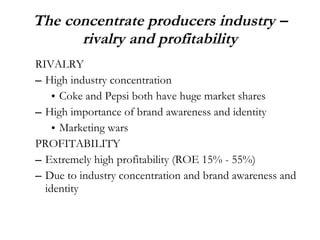
The concentrate producers industry – rivalry and profitability RIVALRY High industry concentration  Coke and Pepsi both have huge market shares High importance of brand awareness and identity Marketing wars PROFITABILITY Extremely high profitability (ROE 15% - 55%) Due to industry concentration and brand awareness and identity
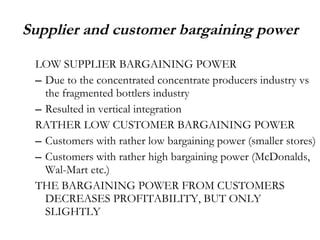
Supplier and customer bargaining power LOW SUPPLIER BARGAINING POWER Due to the concentrated concentrate producers industry vs the fragmented bottlers industry Resulted in vertical integration RATHER LOW CUSTOMER BARGAINING POWER Customers with rather low bargaining power (smaller stores) Customers with rather high bargaining power (McDonalds, Wal-Mart etc.) THE BARGAINING POWER FROM CUSTOMERS DECREASES PROFITABILITY, BUT ONLY SLIGHTLY
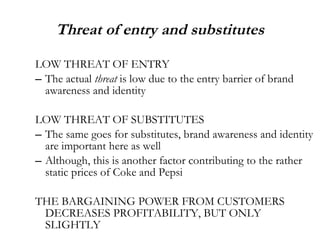
Threat of entry and substitutes LOW THREAT OF ENTRY The actual  threat  is low due to the entry barrier of brand awareness and identity LOW THREAT OF SUBSTITUTES The same goes for substitutes, brand awareness and identity are important here as well Although, this is another factor contributing to the rather static prices of Coke and Pepsi THE BARGAINING POWER FROM CUSTOMERS DECREASES PROFITABILITY, BUT ONLY SLIGHTLY
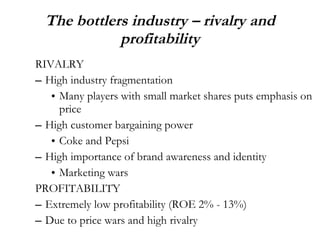
The bottlers industry – rivalry and profitability RIVALRY High industry fragmentation  Many players with small market shares puts emphasis on price  High customer bargaining power  Coke and Pepsi High importance of brand awareness and identity Marketing wars PROFITABILITY Extremely low profitability (ROE 2% - 13%) Due to price wars and high rivalry
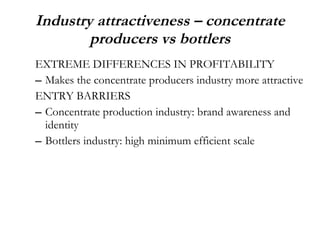
Industry attractiveness – concentrate producers vs bottlers EXTREME DIFFERENCES IN PROFITABILITY Makes the concentrate producers industry more attractive ENTRY BARRIERS Concentrate production industry: brand awareness and identity Bottlers industry: high minimum efficient scale
Future challenges INDUSTRY SPECIFIC CHALLENGES (source: 1) Diet related problems Food safety and consumer trust Global economy turndown 1.  http://www.htrends.com/report-2158332-Issues__Trends_And_Challenges_Facing_The_Food_And_Drink_Industry___Forecasts_To_____.html

Sse cola wars_7b_2011

  • 1.
    Jonatan Schwamberg PontusWiehager Ender Yunus Xiqing Deng Media Management Group 7b Case Study
  • 2.
    The five forcesframework
  • 3.
  • 4.
    The concentrate producersindustry – rivalry and profitability RIVALRY High industry concentration Coke and Pepsi both have huge market shares High importance of brand awareness and identity Marketing wars PROFITABILITY Extremely high profitability (ROE 15% - 55%) Due to industry concentration and brand awareness and identity
  • 5.
    Supplier and customerbargaining power LOW SUPPLIER BARGAINING POWER Due to the concentrated concentrate producers industry vs the fragmented bottlers industry Resulted in vertical integration RATHER LOW CUSTOMER BARGAINING POWER Customers with rather low bargaining power (smaller stores) Customers with rather high bargaining power (McDonalds, Wal-Mart etc.) THE BARGAINING POWER FROM CUSTOMERS DECREASES PROFITABILITY, BUT ONLY SLIGHTLY
  • 6.
    Threat of entryand substitutes LOW THREAT OF ENTRY The actual threat is low due to the entry barrier of brand awareness and identity LOW THREAT OF SUBSTITUTES The same goes for substitutes, brand awareness and identity are important here as well Although, this is another factor contributing to the rather static prices of Coke and Pepsi THE BARGAINING POWER FROM CUSTOMERS DECREASES PROFITABILITY, BUT ONLY SLIGHTLY
  • 7.
    The bottlers industry– rivalry and profitability RIVALRY High industry fragmentation Many players with small market shares puts emphasis on price High customer bargaining power Coke and Pepsi High importance of brand awareness and identity Marketing wars PROFITABILITY Extremely low profitability (ROE 2% - 13%) Due to price wars and high rivalry
  • 8.
    Industry attractiveness –concentrate producers vs bottlers EXTREME DIFFERENCES IN PROFITABILITY Makes the concentrate producers industry more attractive ENTRY BARRIERS Concentrate production industry: brand awareness and identity Bottlers industry: high minimum efficient scale
  • 9.
    Future challenges INDUSTRYSPECIFIC CHALLENGES (source: 1) Diet related problems Food safety and consumer trust Global economy turndown 1. http://www.htrends.com/report-2158332-Issues__Trends_And_Challenges_Facing_The_Food_And_Drink_Industry___Forecasts_To_____.html