By Tatjana Apanasevich,  [email_address] Erik Bergschöld, bergsc@kth.se Jeanette Finder, 40199@student.hhs.se Caroline Perman, 40205@student.hhs.se  2304 Media Management
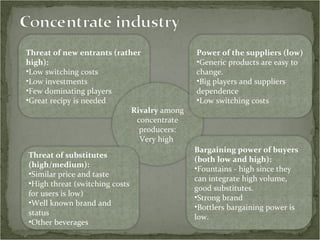
Threat of new entrants (rather high): Low switching costs Low investments Few dominating players Great recipy is needed Rivalry  among concentrate producers: Very high  Power of the suppliers (low) Generic products are easy to change.  Big players and suppliers dependence        Low switching costs Threat of substitutes (high/medium): Similar price and taste  High threat (switching costs for users is low) Well known brand and status Other beverages Bargaining power of buyers (both low and high): Fountains - high since they can integrate high volume, good substitutes.  Strong brand Bottlers bargaining power is low.
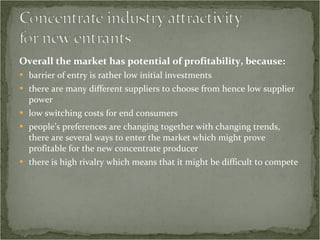
Overall the market has potential of profitability, because: barrier of entry is rather low initial investments there are many different suppliers to choose from hence low supplier power low switching costs for end consumers people’s preferences are changing together with changing trends, there are several ways to enter the market which might prove profitable for the new concentrate producer there is high rivalry which means that it might be difficult to compete
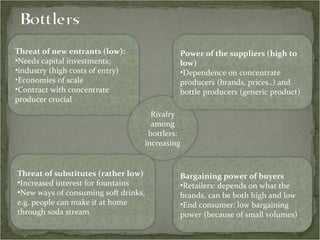
Threat of new entrants (low): Needs capital investments; industry (high costs of entry) Economies of scale  Contract with concentrate producer crucial Rivalry among bottlers: increasing Power of the suppliers (high to low) Dependence on concentrate producers (brands, prices..) and bottle producers (generic product) Threat of substitutes (rather low) Increased interest for fountains New ways of consuming soft drinks, e.g. people can make it at home through soda stream Bargaining power of buyers Retailers: depends on what the brands, can be both high and low End consumer: low bargaining power (because of small volumes)
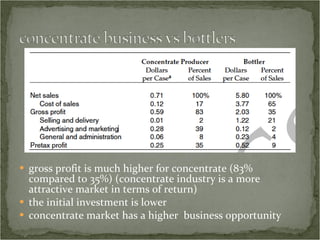
gross profit is much higher for concentrate (83% compared to 35%) (concentrate industry is a more attractive market in terms of return)  the initial investment is lower concentrate market has a higher  business opportunity
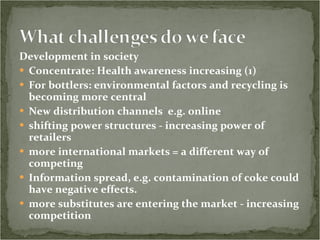
Development in society Concentrate: Health awareness increasing (1)         For bottlers: environmental factors and recycling is becoming more central        New distribution channels  e.g. online  shifting power structures - increasing power of retailers more international markets = a different way of competing         Information spread, e.g. contamination of coke could have negative effects. more substitutes are entering the market - increasing competition
decreasing margins  more marketing costs  keep up the competition, costly to differentiate
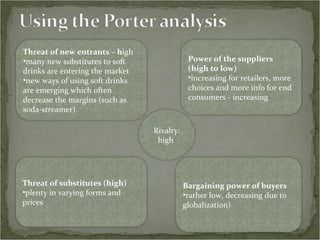
Threat of new entrants – h igh many new substitutes to soft drinks are entering the market  new ways of using soft drinks are emerging which often decrease the margins (such as soda-streamer). Rivalry: high  Power of the suppliers (high to low) increasing for retailers, more choices and more info for end consumers - increasing Threat of substitutes (high) plenty in varying forms and prices Bargaining power of buyers rather low, decreasing due to globalization)
Porter, ME, "What is Strategy" Porter, ME, “The Five Competitive Forces that Shape Competitive Strategy” Case: Cola Wars Continue

Sse cola_wars_6a_2011

  • 1.
    By Tatjana Apanasevich, [email_address] Erik Bergschöld, bergsc@kth.se Jeanette Finder, 40199@student.hhs.se Caroline Perman, 40205@student.hhs.se 2304 Media Management
  • 2.
    Threat of newentrants (rather high): Low switching costs Low investments Few dominating players Great recipy is needed Rivalry among concentrate producers: Very high Power of the suppliers (low) Generic products are easy to change. Big players and suppliers dependence        Low switching costs Threat of substitutes (high/medium): Similar price and taste High threat (switching costs for users is low) Well known brand and status Other beverages Bargaining power of buyers (both low and high): Fountains - high since they can integrate high volume, good substitutes. Strong brand Bottlers bargaining power is low.
  • 3.
    Overall the markethas potential of profitability, because: barrier of entry is rather low initial investments there are many different suppliers to choose from hence low supplier power low switching costs for end consumers people’s preferences are changing together with changing trends, there are several ways to enter the market which might prove profitable for the new concentrate producer there is high rivalry which means that it might be difficult to compete
  • 4.
    Threat of newentrants (low): Needs capital investments; industry (high costs of entry) Economies of scale Contract with concentrate producer crucial Rivalry among bottlers: increasing Power of the suppliers (high to low) Dependence on concentrate producers (brands, prices..) and bottle producers (generic product) Threat of substitutes (rather low) Increased interest for fountains New ways of consuming soft drinks, e.g. people can make it at home through soda stream Bargaining power of buyers Retailers: depends on what the brands, can be both high and low End consumer: low bargaining power (because of small volumes)
  • 5.
    gross profit ismuch higher for concentrate (83% compared to 35%) (concentrate industry is a more attractive market in terms of return) the initial investment is lower concentrate market has a higher business opportunity
  • 6.
    Development in societyConcentrate: Health awareness increasing (1)         For bottlers: environmental factors and recycling is becoming more central        New distribution channels  e.g. online shifting power structures - increasing power of retailers more international markets = a different way of competing         Information spread, e.g. contamination of coke could have negative effects. more substitutes are entering the market - increasing competition
  • 7.
    decreasing margins more marketing costs keep up the competition, costly to differentiate
  • 8.
    Threat of newentrants – h igh many new substitutes to soft drinks are entering the market new ways of using soft drinks are emerging which often decrease the margins (such as soda-streamer). Rivalry: high Power of the suppliers (high to low) increasing for retailers, more choices and more info for end consumers - increasing Threat of substitutes (high) plenty in varying forms and prices Bargaining power of buyers rather low, decreasing due to globalization)
  • 9.
    Porter, ME, "Whatis Strategy" Porter, ME, “The Five Competitive Forces that Shape Competitive Strategy” Case: Cola Wars Continue

Editor's Notes

  • #7 1) both a challenge and an opportunity depending on how well the companies in the industry adapts.