


Analyzing the external environment of the firm S V Horner 2009
Who cares? Overemphasis on internal characteristics Product obsolescence Missed opportunities for new product development Sears’ internal operating manual Neglect of external analysis Assumptions about external environment may become outdated  S V Horner 2009
Creating environmental awareness at organizational level Scanning Monitoring Competitive intelligence Forecasting S V Horner 2009
Scanning Surveillance of environment Anticipate future changes and detect changes under way Recognize patterns before competitors Act before changes occur (proactive) rather than responding afterwards (reactive) General top of the mind awareness of societal behaviors and business practices S V Horner 2009
Monitoring Tracking movement or changes in specific trends, sequences of events, or streams of activities Watching specific formal and informal indicators of future events Index of economic indicators Shipments by FedEx, UPS, DHL NAPM index  S V Horner 2009
Competitive intelligence Define and understand industry and identify rivals’ strengths and weaknesses Anticipate competitors’ moves and decrease own response time S V Horner 2009
Competitive intelligence Sources of competitive intelligence Business press Competitor pricing Competitors’ management backgrounds Open to seemingly unrelated bits of information that form patterns (Fuld & Co.’s client p. 46) Awareness of technological changes that threaten status quo (e.g., Encyclopaedia Brittanica) Avoid unethical and illegal behavior  S V Horner 2009
Environmental forecasting “ plausible projections about direction, scope, speed, and intensity of environmental change” (p. 42) Scenario analysis: human judgment combined with quantitative analysis S V Horner 2009
SWOT analysis Framework for identifying key elements of strategic context External elements Environmental opportunities for value creation Environmental threats to competitive position Internal elements Firm strengths: conditions in which firm excels Firm weaknesses: characteristics which firm may lack in comparison to competitors S V Horner 2009
The general environment External factors have profound influence on firm outcomes and entire industries Affects different industries differently Six segments of general environment: demographic, sociocultural, political/legal/, technological, economic, global S V Horner 2009
Demographic segment Numerical measurement of characteristics of a population Literally: description of people Age, income, ethnic composition, geographic distribution, etc. S V Horner 2009
Sociocultural segment Values, beliefs, attitudes of a society Distinct from, but related to, demographics Examples of values, beliefs, attitudes Concern over greenhouse gases Health consciousness (fitness, diets, etc.) S V Horner 2009
Political/legal segment Political processes, elections, legislation, regulation, adjudication Competition among individuals and groups for “voice” in public policy S V Horner 2009
Technological segment Growth in knowledge leading to new products and services and improvements in production and distribution Examples of technologies: genetic engineering, information technology, CAD/CAM, artificial intelligence, nanotechnology, mass production, assembly line production S V Horner 2009
Economic segment General economic conditions facing a firm and its industry General economic indicators Key economic indicators Stock market indices Other formal and informal indicators Describe effects on firm strategic direction S V Horner 2009
Global segment Relevant (and changing) new global markets International political events (e.g., changes in power, fall of Soviet rule, newly industrializing countries, terrorism) Cultural and institutional characteristics of global markets International organizations promote global economic integration (e.g., WTO, Transatlantic Business Dialogue) S V Horner 2009
Relationships among segments Segments are not totally distinct Segments are interrelated and mutually influencing S V Horner 2009
Competitive environment More direct influence on industry competition and firm profitability than general environment Consists of factors relevant to firm’s strategy – customers, suppliers, and competitors (both existing and potential) S V Horner 2009
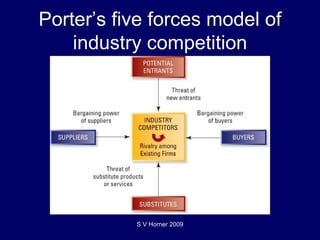
Porter’s five forces model of industry competition S V Horner 2009
Threat of new entrants Expands industry capacity and increases competition for market share May include start ups as well as existing firms expanding into new business Phillip Morris’ purchase of Miller Brewing Influenced by  barriers to entry  and anticipated  reactions  from existing competitors S V Horner 2009
Threat of new entrants High barriers to entry reduce threat 1) Economies of scale 2) Brand identity and product differentiation 3) Capital requirements 4) Switching costs 5) Access to distribution channels 6) Cost disadvantages independent of size 7) Government policy S V Horner 2009
Threat of new entrants Expected retaliation of existing competitors Deterrent to new entrants Opportunity for entrepreneurs in underserved niches S V Horner 2009
Bargaining power of buyers Bargaining power of  buyers of industry output  Motivated to negotiate for lower prices, quality, service, etc. Bargaining power of buyer groups a function of: Market situation Relative importance of purchases from the industry compared to its overall business S V Horner 2009
Bargaining power of buyers: factors Buyers are concentrated, or each one purchases a significant percentage of total industry sales.  The products that the buyers purchase represent a significant percentage of the buyers’ costs.  The products that the buyers purchase are standard or undifferentiated. Buyers face few switching costs and can freely change suppliers. S V Horner 2009
Bargaining power of buyers: factors Buyers earn low profits, creating pressure for them to reduce their purchasing costs. Buyers have the ability to engage in backward integration by becoming their own suppliers.  The industry’s product is relatively unimportant to the quality of the buyers’ products or services.  Buyers have complete information. S V Horner 2009
Bargaining power of suppliers Bargaining power of  suppliers of industry inputs  to charge higher prices, reduce quality of purchased goods/services Factors influencing bargaining of suppliers mirror those of the bargaining power of buyers S V Horner 2009
Bargaining power of suppliers : factors The supplying industry is dominated by one or a few companies.  There are no substitute products, weakening industry players in relation to their suppliers. The buying industry is not a major customer of the suppliers S V Horner 2009
Bargaining power of suppliers : factors The suppliers pose a credible threat of forward integration by “becoming their own customers.”  The suppliers’ products are differentiated or have built-in switching costs, thereby reducing the buyers’ ability to play one supplier against another. S V Horner 2009
Intensity of rivalry among existing competitors Jockeying for position among  producers  of industry output Tactics: Price competition Advertising battles Product introductions Customer service levels or warranties S V Horner 2009
Intensity of rivalry: structural factors 1) Numerous or equally balanced competitors 2) High fixed or storage costs 3) Slow industry growth 4) Lack of differentiation or low switching costs 5) Capacity increases in large increments (“clumpy”) 6) Diversity of competitors 7) High strategic stakes 8) High exit barriers S V Horner 2009
Threat of substitute products and services Substitutes  perform similar or same functions as existing industry products but have different characteristics Sugar producers face threats from producers of high fructose corn syrup Fiberglass producers face threats from producers of cellulose, rock wool, and styrofoam S V Horner 2009
Threat of substitute products and services Distinct from economics definition which defines  competing  products In strategic thinking, Coke and Pepsi are  competing  products; Coke and Snapple are  substitutes S V Horner 2009
Limitations of five forces model Industry often difficult to identify. Does not account for the role of strategic alliances/partnerships Some firms, most notably large ones, can often take steps to modify the industry structure Assumes industry factors, not firm resources, comprise the primary determinants of firm profit. Firms compete in many industries and markets and must be concerned with multiple industry structures. S V Horner 2009
Strategic groups Two assumptions: No two firms are totally identical No two firms are totally different Firms more similar to each other than to rest of industry may be identified as a strategic group S V Horner 2009
Strategic groups Dimensions of similarity Breadth of product line Geographic scope Price/quality Degree of vertical integration Type of distribution (e.g., dealer network, mass merchandisers, private label) Variety of strategic combinations in an industry S V Horner 2009
Strategic groups as a tool of industry analysis Identifies barriers to mobility protecting one group from competition from another Barriers to mobility Factors deterring entry of firms from one group into another (e.g., Wal-Mart and Nordstrom’s) Examples: technology, brand image, dealer network S V Horner 2009
Strategic groups as a tool of industry analysis Identifies groups whose competitive position may be marginal or tenuous (e.g., JCP and Sears stuck in the middle between Wal-Mart and Nieman Marcus) Helps chart future direction of firm’s strategies S V Horner 2009
Strategic groups as a tool of industry analysis Helps managers think through implications of each industry trend for strategic group as a whole e.g., variable effect of interest rates on strategic groups in automobile manufacturing (e.g., Porsche vs. Kia) S V Horner 2009
Summary Environmental analysis a necessary component of strategic planning Environmental awareness occurs through scanning, monitoring, competitive intelligence, environmental forecasting Two major components of environment General environment Competitive environment S V Horner 2009
Summary General environmental segments: demographic, sociocultural, political/legal, technological, economic, global Competitive environment: Five competitive forces (Porter’s five forces) Threat of new entrants, bargaining power of buyers, bargaining power of suppliers, threat of substitutes, intensity of rivalry Strategic groups S V Horner 2009

Dess chapter02

  • 1.
    Analyzing the externalenvironment of the firm S V Horner 2009
  • 2.
    Who cares? Overemphasison internal characteristics Product obsolescence Missed opportunities for new product development Sears’ internal operating manual Neglect of external analysis Assumptions about external environment may become outdated S V Horner 2009
  • 3.
    Creating environmental awarenessat organizational level Scanning Monitoring Competitive intelligence Forecasting S V Horner 2009
  • 4.
    Scanning Surveillance ofenvironment Anticipate future changes and detect changes under way Recognize patterns before competitors Act before changes occur (proactive) rather than responding afterwards (reactive) General top of the mind awareness of societal behaviors and business practices S V Horner 2009
  • 5.
    Monitoring Tracking movementor changes in specific trends, sequences of events, or streams of activities Watching specific formal and informal indicators of future events Index of economic indicators Shipments by FedEx, UPS, DHL NAPM index S V Horner 2009
  • 6.
    Competitive intelligence Defineand understand industry and identify rivals’ strengths and weaknesses Anticipate competitors’ moves and decrease own response time S V Horner 2009
  • 7.
    Competitive intelligence Sourcesof competitive intelligence Business press Competitor pricing Competitors’ management backgrounds Open to seemingly unrelated bits of information that form patterns (Fuld & Co.’s client p. 46) Awareness of technological changes that threaten status quo (e.g., Encyclopaedia Brittanica) Avoid unethical and illegal behavior S V Horner 2009
  • 8.
    Environmental forecasting “plausible projections about direction, scope, speed, and intensity of environmental change” (p. 42) Scenario analysis: human judgment combined with quantitative analysis S V Horner 2009
  • 9.
    SWOT analysis Frameworkfor identifying key elements of strategic context External elements Environmental opportunities for value creation Environmental threats to competitive position Internal elements Firm strengths: conditions in which firm excels Firm weaknesses: characteristics which firm may lack in comparison to competitors S V Horner 2009
  • 10.
    The general environmentExternal factors have profound influence on firm outcomes and entire industries Affects different industries differently Six segments of general environment: demographic, sociocultural, political/legal/, technological, economic, global S V Horner 2009
  • 11.
    Demographic segment Numericalmeasurement of characteristics of a population Literally: description of people Age, income, ethnic composition, geographic distribution, etc. S V Horner 2009
  • 12.
    Sociocultural segment Values,beliefs, attitudes of a society Distinct from, but related to, demographics Examples of values, beliefs, attitudes Concern over greenhouse gases Health consciousness (fitness, diets, etc.) S V Horner 2009
  • 13.
    Political/legal segment Politicalprocesses, elections, legislation, regulation, adjudication Competition among individuals and groups for “voice” in public policy S V Horner 2009
  • 14.
    Technological segment Growthin knowledge leading to new products and services and improvements in production and distribution Examples of technologies: genetic engineering, information technology, CAD/CAM, artificial intelligence, nanotechnology, mass production, assembly line production S V Horner 2009
  • 15.
    Economic segment Generaleconomic conditions facing a firm and its industry General economic indicators Key economic indicators Stock market indices Other formal and informal indicators Describe effects on firm strategic direction S V Horner 2009
  • 16.
    Global segment Relevant(and changing) new global markets International political events (e.g., changes in power, fall of Soviet rule, newly industrializing countries, terrorism) Cultural and institutional characteristics of global markets International organizations promote global economic integration (e.g., WTO, Transatlantic Business Dialogue) S V Horner 2009
  • 17.
    Relationships among segmentsSegments are not totally distinct Segments are interrelated and mutually influencing S V Horner 2009
  • 18.
    Competitive environment Moredirect influence on industry competition and firm profitability than general environment Consists of factors relevant to firm’s strategy – customers, suppliers, and competitors (both existing and potential) S V Horner 2009
  • 19.
    Porter’s five forcesmodel of industry competition S V Horner 2009
  • 20.
    Threat of newentrants Expands industry capacity and increases competition for market share May include start ups as well as existing firms expanding into new business Phillip Morris’ purchase of Miller Brewing Influenced by barriers to entry and anticipated reactions from existing competitors S V Horner 2009
  • 21.
    Threat of newentrants High barriers to entry reduce threat 1) Economies of scale 2) Brand identity and product differentiation 3) Capital requirements 4) Switching costs 5) Access to distribution channels 6) Cost disadvantages independent of size 7) Government policy S V Horner 2009
  • 22.
    Threat of newentrants Expected retaliation of existing competitors Deterrent to new entrants Opportunity for entrepreneurs in underserved niches S V Horner 2009
  • 23.
    Bargaining power ofbuyers Bargaining power of buyers of industry output Motivated to negotiate for lower prices, quality, service, etc. Bargaining power of buyer groups a function of: Market situation Relative importance of purchases from the industry compared to its overall business S V Horner 2009
  • 24.
    Bargaining power ofbuyers: factors Buyers are concentrated, or each one purchases a significant percentage of total industry sales. The products that the buyers purchase represent a significant percentage of the buyers’ costs. The products that the buyers purchase are standard or undifferentiated. Buyers face few switching costs and can freely change suppliers. S V Horner 2009
  • 25.
    Bargaining power ofbuyers: factors Buyers earn low profits, creating pressure for them to reduce their purchasing costs. Buyers have the ability to engage in backward integration by becoming their own suppliers. The industry’s product is relatively unimportant to the quality of the buyers’ products or services. Buyers have complete information. S V Horner 2009
  • 26.
    Bargaining power ofsuppliers Bargaining power of suppliers of industry inputs to charge higher prices, reduce quality of purchased goods/services Factors influencing bargaining of suppliers mirror those of the bargaining power of buyers S V Horner 2009
  • 27.
    Bargaining power ofsuppliers : factors The supplying industry is dominated by one or a few companies. There are no substitute products, weakening industry players in relation to their suppliers. The buying industry is not a major customer of the suppliers S V Horner 2009
  • 28.
    Bargaining power ofsuppliers : factors The suppliers pose a credible threat of forward integration by “becoming their own customers.” The suppliers’ products are differentiated or have built-in switching costs, thereby reducing the buyers’ ability to play one supplier against another. S V Horner 2009
  • 29.
    Intensity of rivalryamong existing competitors Jockeying for position among producers of industry output Tactics: Price competition Advertising battles Product introductions Customer service levels or warranties S V Horner 2009
  • 30.
    Intensity of rivalry:structural factors 1) Numerous or equally balanced competitors 2) High fixed or storage costs 3) Slow industry growth 4) Lack of differentiation or low switching costs 5) Capacity increases in large increments (“clumpy”) 6) Diversity of competitors 7) High strategic stakes 8) High exit barriers S V Horner 2009
  • 31.
    Threat of substituteproducts and services Substitutes perform similar or same functions as existing industry products but have different characteristics Sugar producers face threats from producers of high fructose corn syrup Fiberglass producers face threats from producers of cellulose, rock wool, and styrofoam S V Horner 2009
  • 32.
    Threat of substituteproducts and services Distinct from economics definition which defines competing products In strategic thinking, Coke and Pepsi are competing products; Coke and Snapple are substitutes S V Horner 2009
  • 33.
    Limitations of fiveforces model Industry often difficult to identify. Does not account for the role of strategic alliances/partnerships Some firms, most notably large ones, can often take steps to modify the industry structure Assumes industry factors, not firm resources, comprise the primary determinants of firm profit. Firms compete in many industries and markets and must be concerned with multiple industry structures. S V Horner 2009
  • 34.
    Strategic groups Twoassumptions: No two firms are totally identical No two firms are totally different Firms more similar to each other than to rest of industry may be identified as a strategic group S V Horner 2009
  • 35.
    Strategic groups Dimensionsof similarity Breadth of product line Geographic scope Price/quality Degree of vertical integration Type of distribution (e.g., dealer network, mass merchandisers, private label) Variety of strategic combinations in an industry S V Horner 2009
  • 36.
    Strategic groups asa tool of industry analysis Identifies barriers to mobility protecting one group from competition from another Barriers to mobility Factors deterring entry of firms from one group into another (e.g., Wal-Mart and Nordstrom’s) Examples: technology, brand image, dealer network S V Horner 2009
  • 37.
    Strategic groups asa tool of industry analysis Identifies groups whose competitive position may be marginal or tenuous (e.g., JCP and Sears stuck in the middle between Wal-Mart and Nieman Marcus) Helps chart future direction of firm’s strategies S V Horner 2009
  • 38.
    Strategic groups asa tool of industry analysis Helps managers think through implications of each industry trend for strategic group as a whole e.g., variable effect of interest rates on strategic groups in automobile manufacturing (e.g., Porsche vs. Kia) S V Horner 2009
  • 39.
    Summary Environmental analysisa necessary component of strategic planning Environmental awareness occurs through scanning, monitoring, competitive intelligence, environmental forecasting Two major components of environment General environment Competitive environment S V Horner 2009
  • 40.
    Summary General environmentalsegments: demographic, sociocultural, political/legal, technological, economic, global Competitive environment: Five competitive forces (Porter’s five forces) Threat of new entrants, bargaining power of buyers, bargaining power of suppliers, threat of substitutes, intensity of rivalry Strategic groups S V Horner 2009