Firewalls are essential but they’re not magic.
They work best as part of a 𝐥𝐚𝐲𝐞𝐫𝐞𝐝 𝐬𝐞𝐜𝐮𝐫𝐢𝐭𝐲 𝐬𝐭𝐫𝐚𝐭𝐞𝐠𝐲, not a standalone defense.
Visit us here - https://www.infosectrain.com/
Advantages and
Disadvantages ofFirewalls
2
What is a Firewall?
A firewall is a system of security devices (hardware or software) designed to
prevent attackers from obtaining unauthorized access to a network system. A
firewall also prevents malware from infecting the system by filtering out traffic it
considers to be unwanted.
How Does a Firewall Work?
A firewall is like a guard at the entrance. It keeps track of the latest attempt to get
into the network system and blocks malicious traffic or sources it does not know.
A firewall system operates according to the rules of network traffic. A firewall
only permits the incoming connections that it is provisioned to acknowledge. It
completes this by enabling or preventing specific data packets based on
pre-established network security rules. Firewalls allow only IP addresses from
trusted sources. IP addresses are significant since they identify a computer or
source, just like the home address identifies where you live.
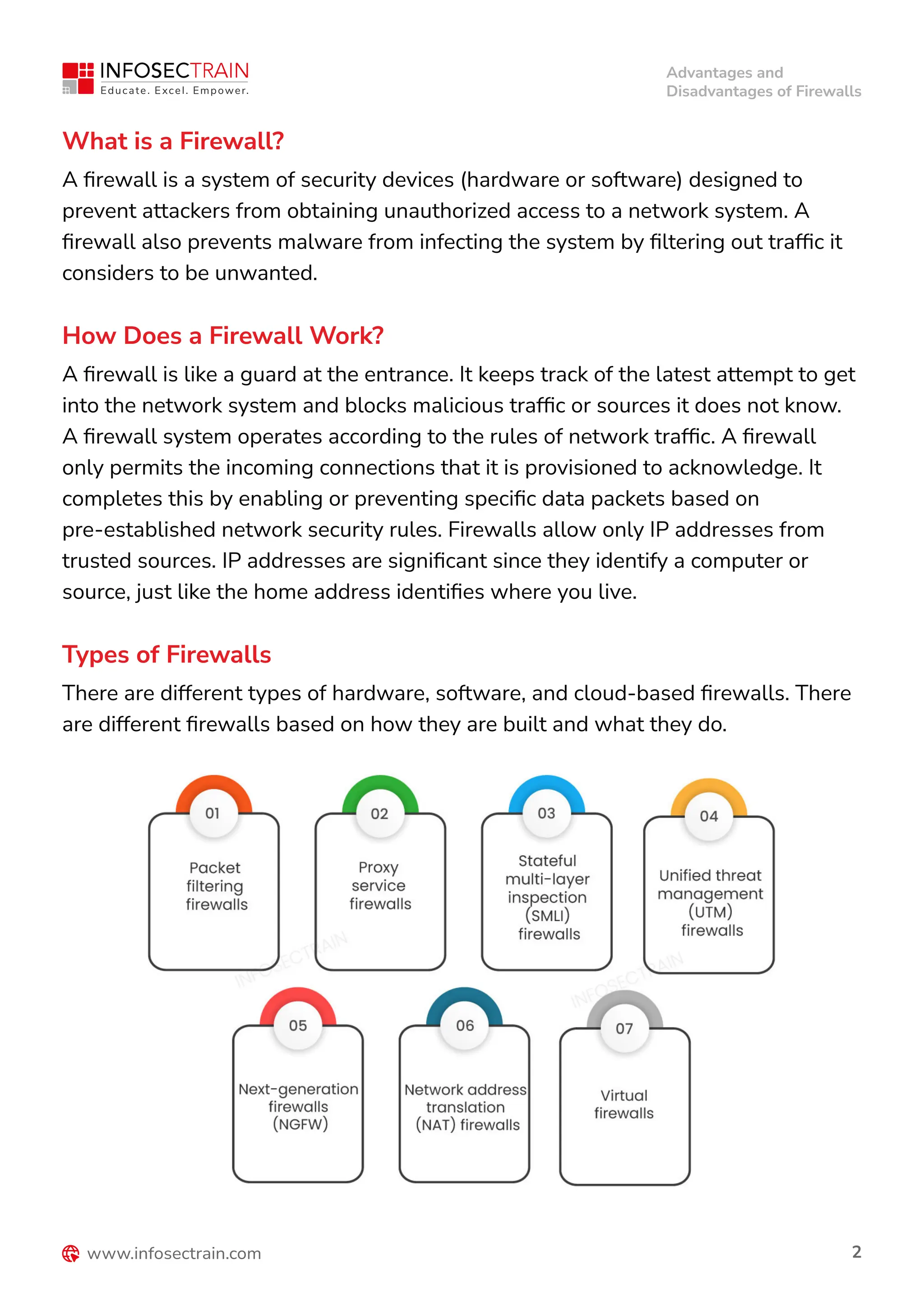
Types of Firewalls
There are different types of hardware, software, and cloud-based firewalls. There
are different firewalls based on how they are built and what they do.
3.
3
Advantages and
Disadvantages ofFirewalls
Advantages of Firewall
In this era of the internet, firewalls are considered one of the most significant
because of their different salient features. So here are some of the advantages of
firewalls.
1. Monitor Network Traffic
A firewall’s primary duty is to monitor the network traffic. When information
moves through a network, it occurs in small pieces called “packets.” The firewall
examines each of these packets for any potential threats. If the firewall detects
them, it will close them down instantly.
2. Protection Against Viruses
As we know, attackers use different types of malicious attacks to target the
network system, and malware, trojan, and virus attacks are some of those
malicious forms. These viruses, like trojans, sit silently in the system and monitor
the information or work we do. So, the firewall is designed and developed to act
as a protective wall between the network system and these malicious programs.
Firewalls have a security feature that is activated when it comes in contact with
such malicious programs.
3. Protection Against Malware
Trojans and other malicious software have become too sophisticated to be
conveniently avoided. For this reason, setting up a firewall and taking other
precautions against malware is essential.
4. Access Control
A firewall’s access policy can be implemented for particular hosts and services.
The attackers exploit several hosts; therefore, preventing such hosts from
accessing the system is preferable. This access policy can be enforced if users
believe they need protection against these types of unwanted access.
4.
Advantages and
Disadvantages ofFirewalls
4
5. Better Privacy
User privacy is one of the primary concerns. Hackers are always on the search
for a user’s personally identifiable information by searching through private data.
However, using a firewall can block many of a site’s services, like the domain
name service and the finger service. So, the hackers have no chance of getting
personal information. A firewall can also block the DNS information of the site
system. Due to this, the attacker could not see the names and IP addresses.
1. Cost
Undoubtedly, software firewalls are included with the newest and most
affordable operating systems, such as Windows 7, Windows 8, Windows 10,
and Windows 10.2. A few of the software firewalls include premium antivirus
software. In addition, the hardware firewall is considered costly in comparison to
others.
2. User Restrictions
Firewalls prevent unauthorized network access to your system without question.
This can be advantageous for the average user but can be problematic for large
organizations. The firewall’s policies must be stringent to prevent employees
from performing specific tasks. However, this strictness can sometimes lead to
a significant decline in the company’s overall productivity, potentially prompting
employees to resort to backdoor exploits.
3. Performance
Firewalls, especially software-based ones, can limit your system’s overall
performance. Factors determining a computer’s overall performance are
its processing speed and RAM capacity. When software firewalls operate
continuously in the origins, they consume more computing resources and RAM,
which can decrease system performance.
Disadvantages of Firewalls
Here are some of the disadvantages of firewalls.
5.
5
Advantages and
Disadvantages ofFirewalls
4. Complex Operations
Even though firewall maintenance is simplified for small companies, this is only
true for some organizations. Big businesses require a separate staff to operate
their firewalls, and these individuals ensure that the firewall’s security is sufficient
to protect the network from attackers.
5. Limited Protection Against Advanced Threats
Traditional firewalls primarily filter traffic based on ports, protocols, and IP
addresses. They may not effectively detect or prevent sophisticated threats like
advanced malware, zero-day exploits, or targeted attacks.
6.
Advantages and
Disadvantages ofFirewalls
6
Final Words
In network security, the concept of a firewall is relatively broad. If you want
to learn more about firewalls, check out InfosecTrain’s Network Security
training course.
InfosecTrain is a significant organization that provides training and
consulting services for IT security and technology worldwide. We have
always given the best quality and success rates, regardless of the need for
technical help, certification training, or specialized training.