Police in America
Chapter Eleven
Police Discretion

McGraw-Hill

© 2013 McGraw-Hill Companies. All Rights Reserved.
Discretion in Police Work
 Discretion is involved in several critical

decisions made by the police.

 Consider the following:







Domestic Violence Arrests
Mental Health Commitments
Traffic Tickets
Juvenile Court Referrals
Deadly Force
11-2
A Definition of Discretion


Definition of discretion
 Official action by a
criminal justice official,
based on that official’s
judgment about the best
course of action
 Discretion: The freedom
to act on one’s own
judgment; refers to the
latitude involved police
officers’ decision making.
11-3
Aspects of Police Discretion
 Street Level Bureaucrats

 Description for patrol officers because they
make decisions that produce actual police
policy as it affect citizens
 Decision to arrest makes them the
gatekeepers of the criminal justice system
 Police discretion determines public policy

11-4
Potential Abuse Of Discretion
 Discrimination
 Denial of Due Process
 Systematic Underenforcement of the Law
 Poor Personnel Management
 Inconsistent Policy

11-5
Proper Exercise of Discretion
 The Use of Good Judgment
 Efficient Use of Scare Police Resources
 Individualized Justice
 Sound Public Policy

11-6
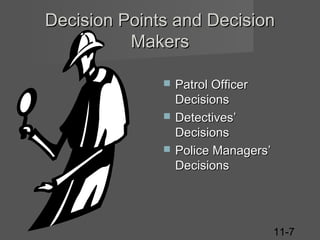
Decision Points and Decision
Makers




Patrol Officer
Decisions
Detectives’
Decisions
Police Managers’
Decisions

11-7
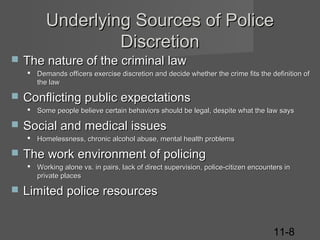
Underlying Sources of Police
Discretion


The nature of the criminal law
 Demands officers exercise discretion and decide whether the crime fits the definition of
the law



Conflicting public expectations
 Some people believe certain behaviors should be legal, despite what the law says



Social and medical issues
 Homelessness, chronic alcohol abuse, mental health problems



The work environment of policing
 Working alone vs. in pairs, lack of direct supervision, police-citizen encounters in
private places



Limited police resources
11-8
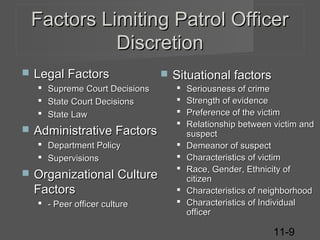
Factors Limiting Patrol Officer
Discretion


Legal Factors






Supreme Court Decisions
State Court Decisions
State Law

Administrative Factors
 Department Policy
 Supervisions



Organizational Culture
Factors
 - Peer officer culture



Situational factors










Seriousness of crime
Strength of evidence
Preference of the victim
Relationship between victim and
suspect
Demeanor of suspect
Characteristics of victim
Race, Gender, Ethnicity of
citizen
Characteristics of neighborhood
Characteristics of Individual
officer

11-9
Other Factors Influencing
Discretionary Decisions
 Organizational Factors

 Official Department policy
 Informal organizational culture
 Social and Political Factors

 Local Political Culture

11-10
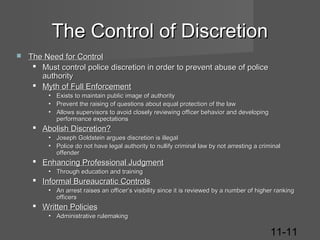
The Control of Discretion


The Need for Control
 Must control police discretion in order to prevent abuse of police
authority
 Myth of Full Enforcement
• Exists to maintain public image of authority
• Prevent the raising of questions about equal protection of the law
• Allows supervisors to avoid closely reviewing officer behavior and developing
performance expectations

 Abolish Discretion?
• Joseph Goldstein argues discretion is illegal
• Police do not have legal authority to nullify criminal law by not arresting a criminal
offender

 Enhancing Professional Judgment
• Through education and training

 Informal Bureaucratic Controls
• An arrest raises an officer’s visibility since it is reviewed by a number of higher ranking
officers

 Written Policies
• Administrative rulemaking

11-11
Administrative Rulemaking
 Administrative Rulemaking: Seeks to

guide the exercise of police discretion
through written departmental rules and the
requirement that officers complete written
reports on how they handled situations.
 Examples: Deadly force, domestic

violence, high speed pursuits.
11-12
Principles of Administrative
Rulemaking






Confining Discretion
 “fixing boundaries”
Structuring Discretion
 A rational system
for developing
policies
Checking Discretion
 Decisions are
reviewed by
another person

 Contributions of Written
Rules:
 Provide directions for
officers on how to
handle critical
incidents
 Promote consistent
performance
 Provide basis for
effective supervision
11-13
Impact of Administrative
Rulemaking


Has produced significant improvements in
policing
 Fyfe found that a restrictive policy on deadly force adopted by the NYC
police dept. in 1972 reduced weekly average no. of firearm discharges
by 29.1%
 Alpert’s study of high-speed pursuit policies found that where restrictive
policies were adopted, there was a reduction in the no. of pursuits,
accidents, and both officer and citizen injuries.
 In the LA Sheriff’s Dept. the no. of citizens bitten by K9 unit dogs
declined by 90% after the dept. put in place new controls over how dogs
could be deployed.

11-14
Insuring Compliance with Rules
 CALEA stands for Commission of

Accreditation for Law Enforcement
Agencies. Its book of rules is Accreditation
Standards for Law Enforcement Agencies .
 The primary simple strategy for ensuring
compliance is to require police officers to
file written reports after each incident and
to have those reports automatically
reviewed by supervisors.
11-15
Codifying Rules: The Standard
Operation Procedure (SOP) Manual
 SOP Manual

 Written rules and policies for a police dept.
 Central tool of modern police management
 Many departments place their SOP manuals
online to increase transparency and promote
openness
11-16
Systematic Rulemaking
 Davis and Goldstein argue that a

systematic approach allows the police to
anticipate problems before they become
crises
 Represents a professional approach to
planning
 Attempts to encourage systematic rulemaking
have been made through CALEA
accreditation Standards for Law Enforcement
Agencies
11-17
Citizen Oversight and Policymaking
 Policy Reviews

 Individual citizen complaints are analyzed to
determine whether the underlying cause was
a lack of policy (or a bad policy) on the part of
the police department
 Recommendations for new policy are made
as a result

11-18
The Limits of Administrative
Rulemaking
 It is impossible to write a rule that covers

every situation
 Formal rules may encourage evasion or
lying
 Written rules may only make the situation
worse and create uncertainty
 Elaborate rules may create a negative
atmosphere in the department
11-19

Walker-8-chapter-11

  • 1.
    Police in America ChapterEleven Police Discretion McGraw-Hill © 2013 McGraw-Hill Companies. All Rights Reserved.
  • 2.
    Discretion in PoliceWork  Discretion is involved in several critical decisions made by the police.  Consider the following:      Domestic Violence Arrests Mental Health Commitments Traffic Tickets Juvenile Court Referrals Deadly Force 11-2
  • 3.
    A Definition ofDiscretion  Definition of discretion  Official action by a criminal justice official, based on that official’s judgment about the best course of action  Discretion: The freedom to act on one’s own judgment; refers to the latitude involved police officers’ decision making. 11-3
  • 4.
    Aspects of PoliceDiscretion  Street Level Bureaucrats  Description for patrol officers because they make decisions that produce actual police policy as it affect citizens  Decision to arrest makes them the gatekeepers of the criminal justice system  Police discretion determines public policy 11-4
  • 5.
    Potential Abuse OfDiscretion  Discrimination  Denial of Due Process  Systematic Underenforcement of the Law  Poor Personnel Management  Inconsistent Policy 11-5
  • 6.
    Proper Exercise ofDiscretion  The Use of Good Judgment  Efficient Use of Scare Police Resources  Individualized Justice  Sound Public Policy 11-6
  • 7.
    Decision Points andDecision Makers    Patrol Officer Decisions Detectives’ Decisions Police Managers’ Decisions 11-7
  • 8.
    Underlying Sources ofPolice Discretion  The nature of the criminal law  Demands officers exercise discretion and decide whether the crime fits the definition of the law  Conflicting public expectations  Some people believe certain behaviors should be legal, despite what the law says  Social and medical issues  Homelessness, chronic alcohol abuse, mental health problems  The work environment of policing  Working alone vs. in pairs, lack of direct supervision, police-citizen encounters in private places  Limited police resources 11-8
  • 9.
    Factors Limiting PatrolOfficer Discretion  Legal Factors     Supreme Court Decisions State Court Decisions State Law Administrative Factors  Department Policy  Supervisions  Organizational Culture Factors  - Peer officer culture  Situational factors          Seriousness of crime Strength of evidence Preference of the victim Relationship between victim and suspect Demeanor of suspect Characteristics of victim Race, Gender, Ethnicity of citizen Characteristics of neighborhood Characteristics of Individual officer 11-9
  • 10.
    Other Factors Influencing DiscretionaryDecisions  Organizational Factors  Official Department policy  Informal organizational culture  Social and Political Factors  Local Political Culture 11-10
  • 11.
    The Control ofDiscretion  The Need for Control  Must control police discretion in order to prevent abuse of police authority  Myth of Full Enforcement • Exists to maintain public image of authority • Prevent the raising of questions about equal protection of the law • Allows supervisors to avoid closely reviewing officer behavior and developing performance expectations  Abolish Discretion? • Joseph Goldstein argues discretion is illegal • Police do not have legal authority to nullify criminal law by not arresting a criminal offender  Enhancing Professional Judgment • Through education and training  Informal Bureaucratic Controls • An arrest raises an officer’s visibility since it is reviewed by a number of higher ranking officers  Written Policies • Administrative rulemaking 11-11
  • 12.
    Administrative Rulemaking  AdministrativeRulemaking: Seeks to guide the exercise of police discretion through written departmental rules and the requirement that officers complete written reports on how they handled situations.  Examples: Deadly force, domestic violence, high speed pursuits. 11-12
  • 13.
    Principles of Administrative Rulemaking    ConfiningDiscretion  “fixing boundaries” Structuring Discretion  A rational system for developing policies Checking Discretion  Decisions are reviewed by another person  Contributions of Written Rules:  Provide directions for officers on how to handle critical incidents  Promote consistent performance  Provide basis for effective supervision 11-13
  • 14.
    Impact of Administrative Rulemaking  Hasproduced significant improvements in policing  Fyfe found that a restrictive policy on deadly force adopted by the NYC police dept. in 1972 reduced weekly average no. of firearm discharges by 29.1%  Alpert’s study of high-speed pursuit policies found that where restrictive policies were adopted, there was a reduction in the no. of pursuits, accidents, and both officer and citizen injuries.  In the LA Sheriff’s Dept. the no. of citizens bitten by K9 unit dogs declined by 90% after the dept. put in place new controls over how dogs could be deployed. 11-14
  • 15.
    Insuring Compliance withRules  CALEA stands for Commission of Accreditation for Law Enforcement Agencies. Its book of rules is Accreditation Standards for Law Enforcement Agencies .  The primary simple strategy for ensuring compliance is to require police officers to file written reports after each incident and to have those reports automatically reviewed by supervisors. 11-15
  • 16.
    Codifying Rules: TheStandard Operation Procedure (SOP) Manual  SOP Manual  Written rules and policies for a police dept.  Central tool of modern police management  Many departments place their SOP manuals online to increase transparency and promote openness 11-16
  • 17.
    Systematic Rulemaking  Davisand Goldstein argue that a systematic approach allows the police to anticipate problems before they become crises  Represents a professional approach to planning  Attempts to encourage systematic rulemaking have been made through CALEA accreditation Standards for Law Enforcement Agencies 11-17
  • 18.
    Citizen Oversight andPolicymaking  Policy Reviews  Individual citizen complaints are analyzed to determine whether the underlying cause was a lack of policy (or a bad policy) on the part of the police department  Recommendations for new policy are made as a result 11-18
  • 19.
    The Limits ofAdministrative Rulemaking  It is impossible to write a rule that covers every situation  Formal rules may encourage evasion or lying  Written rules may only make the situation worse and create uncertainty  Elaborate rules may create a negative atmosphere in the department 11-19