Hofstede’s Dimensions and
Organizational Implications
INDIVIDUALISM - COLLECTIVISM
Individualism is a concern for self as opposed to concern for the
priorities and rules of the group to which the person belongs
(collectivism).
Individualism (IDV) focuses on the degree the society
reinforces individual or collective achievement and interpersonal
relationships.
A High Individualism ranking indicates that individuality and
individual rights are paramount within the society. Individuals in
these societies may tend to form a larger number of looser
relationships.
A Low Individualism ranking typifies societies of a more collectivist
nature with close ties between individuals. These cultures reinforce
extended families and collectives where everyone takes
responsibility for fellow members of their group.
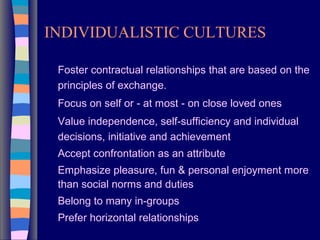
INDIVIDUALISTIC CULTURES
Foster contractual relationships that are based on the
principles of exchange.
Focus on self or - at most - on close loved ones
Value independence, self-sufficiency and individual
decisions, initiative and achievement
Accept confrontation as an attribute
Emphasize pleasure, fun & personal enjoyment more
than social norms and duties
Belong to many in-groups
Prefer horizontal relationships
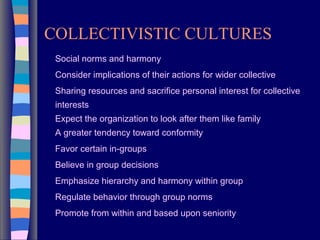
COLLECTIVISTIC CULTURES
Social norms and harmony
Consider implications of their actions for wider collective
Sharing resources and sacrifice personal interest for collective
interests
Expect the organization to look after them like family
A greater tendency toward conformity
Favor certain in-groups
Believe in group decisions
Emphasize hierarchy and harmony within group
Regulate behavior through group norms
Promote from within and based upon seniority
MASCULINITY AND FEMININITY
(Career Success and Quality of
Life)
The degree to which a society emphasizes work goals (earnings,
achievements) and assertiveness as opposed to personal goals (friendly
atmosphere, getting along with the boss), cooperation, and nurturance.
Masculinity (MAS) focuses on the degree the society reinforces, or does
not reinforce, the traditional masculine work role model of male
achievement, control, and power.
A High Masculinity ranking indicates the country experiences a high degree of
gender differentiation. In these cultures, males dominate a significant portion of
the society and power structure, with females being controlled by male
domination.
A Low Masculinity ranking indicates the country has a low level of differentiation
and discrimination between genders. In these cultures, females are treated
equally to males in all aspects of the society.
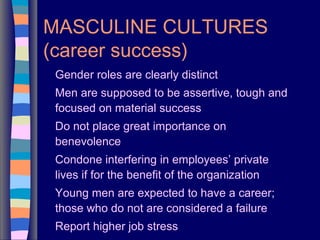
MASCULINE CULTURES
(career success)
Gender roles are clearly distinct
Men are supposed to be assertive, tough and
focused on material success
Do not place great importance on
benevolence
Condone interfering in employees’ private
lives if for the benefit of the organization
Young men are expected to have a career;
those who do not are considered a failure
Report higher job stress
FEMININE CULTURES
(Quality of life)
Social gender roles overlap
Emphasizes personal goals and nurturance
Both men and women are supposed to be
modest, tender and concerned with the quality of
life
Have less occupational segregation by gender
Women and men occupy high-level jobs
Emphasize non-materialistic aspects of success
UNCERTAINTY AVOIDANCE
The degree to which members of a society are able to cope
with the uncertainty of the future without experiencing undue
stress.
Uncertainty Avoidance Index (UAI) focuses on the level of
tolerance for uncertainty and ambiguity within the society - i.e.
unstructured situations.
A High Uncertainty Avoidance ranking indicates the country has a
low tolerance for uncertainty and ambiguity. This creates a rule-
oriented society that institutes laws, rules, regulations, and
controls in order to reduce the amount of uncertainty.
A Low Uncertainty Avoidance ranking indicates the country has
less concern about ambiguity and uncertainty and has more
tolerance for a variety of opinions. This is reflected in a society
that is less rule-oriented, more readily accepts change, and takes
more and greater risks.
WEAK UNCERTAINTY
AVOIDANCE CULTURES
Take risks,tolerate ambiguity and
uncertainty
Tolerate differing behaviors and opinions
Demonstrate flexibility and willingness to
change
Have organizations with a relatively low
degree of structure and few rules
Promotions based on merit
Use participatory management
STRONG UNCERTAINTY
AVOIDANCE CULTURES
Do not like ambiguity and uncertainty
Avoid risk,have organizations that have
clearly delineated structures
Promote on the basis of seniority or age
Have a strong need for consensus
Need for predictability
Respect for authority
POWER DISTANCE
The degree to which power differentials within society
and organizations are expected and accepted.
Power Distance Index (PDI) focuses on the degree of
equality, or inequality, between people in the country's
society.
A High Power Distance ranking indicates that inequalities of
power and wealth have been allowed to grow within the society.
These societies are more likely to follow a caste system that
does not allow significant upward mobility of its citizens.
A Low Power Distance ranking indicates the society de-
emphasizes the differences between citizen's power and
wealth. In these societies equality and opportunity for everyone
is stressed.
LARGE POWER
DISTANCE SOCIETIES
Use centralized authority and many
hierarchical levels
Accept autocratic leadership
Prefer a paternalistic management style
Closely supervise employees
Have large numbers of supervisory staff
Accept that power has its privileges
Expect inequality and power differences
SMALL POWER DISTANCE
SOCIETIES
Decentralized authority and flat
organizational structures
Consultative or participative
management style
Small proportion of supervisory staff
Tend to question authority
Rights conscious
Tend toward egalitarianism
Confucian Dynamism (Bond)
 Long-Term Orientation (LTO) focuses on the
degree the society embraces, or does not embrace,
long-term devotion to traditional, forward thinking
values.
– High Long-Term Orientation ranking indicates the country
prescribes to the values of long-term commitments and
respect for tradition. This is thought to support a strong work
ethic where long-term rewards are expected as a result of
today's hard work. However, business may take longer to
develop in this society, particularly for an "outsider".
– A Low Long-Term Orientation ranking indicates the country
does not reinforce the concept of long-term, traditional
orientation. In this culture, change can occur more rapidly as
long-term traditions and commitments do not become
impediments to change.

Лекция. Параметры Хофштеде

  • 1.
    Hofstede’s Dimensions and OrganizationalImplications INDIVIDUALISM - COLLECTIVISM Individualism is a concern for self as opposed to concern for the priorities and rules of the group to which the person belongs (collectivism). Individualism (IDV) focuses on the degree the society reinforces individual or collective achievement and interpersonal relationships. A High Individualism ranking indicates that individuality and individual rights are paramount within the society. Individuals in these societies may tend to form a larger number of looser relationships. A Low Individualism ranking typifies societies of a more collectivist nature with close ties between individuals. These cultures reinforce extended families and collectives where everyone takes responsibility for fellow members of their group.
  • 2.
    INDIVIDUALISTIC CULTURES Foster contractualrelationships that are based on the principles of exchange. Focus on self or - at most - on close loved ones Value independence, self-sufficiency and individual decisions, initiative and achievement Accept confrontation as an attribute Emphasize pleasure, fun & personal enjoyment more than social norms and duties Belong to many in-groups Prefer horizontal relationships
  • 3.
    COLLECTIVISTIC CULTURES Social normsand harmony Consider implications of their actions for wider collective Sharing resources and sacrifice personal interest for collective interests Expect the organization to look after them like family A greater tendency toward conformity Favor certain in-groups Believe in group decisions Emphasize hierarchy and harmony within group Regulate behavior through group norms Promote from within and based upon seniority
  • 4.
    MASCULINITY AND FEMININITY (CareerSuccess and Quality of Life) The degree to which a society emphasizes work goals (earnings, achievements) and assertiveness as opposed to personal goals (friendly atmosphere, getting along with the boss), cooperation, and nurturance. Masculinity (MAS) focuses on the degree the society reinforces, or does not reinforce, the traditional masculine work role model of male achievement, control, and power. A High Masculinity ranking indicates the country experiences a high degree of gender differentiation. In these cultures, males dominate a significant portion of the society and power structure, with females being controlled by male domination. A Low Masculinity ranking indicates the country has a low level of differentiation and discrimination between genders. In these cultures, females are treated equally to males in all aspects of the society.
  • 5.
    MASCULINE CULTURES (career success) Genderroles are clearly distinct Men are supposed to be assertive, tough and focused on material success Do not place great importance on benevolence Condone interfering in employees’ private lives if for the benefit of the organization Young men are expected to have a career; those who do not are considered a failure Report higher job stress
  • 6.
    FEMININE CULTURES (Quality oflife) Social gender roles overlap Emphasizes personal goals and nurturance Both men and women are supposed to be modest, tender and concerned with the quality of life Have less occupational segregation by gender Women and men occupy high-level jobs Emphasize non-materialistic aspects of success
  • 7.
    UNCERTAINTY AVOIDANCE The degreeto which members of a society are able to cope with the uncertainty of the future without experiencing undue stress. Uncertainty Avoidance Index (UAI) focuses on the level of tolerance for uncertainty and ambiguity within the society - i.e. unstructured situations. A High Uncertainty Avoidance ranking indicates the country has a low tolerance for uncertainty and ambiguity. This creates a rule- oriented society that institutes laws, rules, regulations, and controls in order to reduce the amount of uncertainty. A Low Uncertainty Avoidance ranking indicates the country has less concern about ambiguity and uncertainty and has more tolerance for a variety of opinions. This is reflected in a society that is less rule-oriented, more readily accepts change, and takes more and greater risks.
  • 8.
    WEAK UNCERTAINTY AVOIDANCE CULTURES Takerisks,tolerate ambiguity and uncertainty Tolerate differing behaviors and opinions Demonstrate flexibility and willingness to change Have organizations with a relatively low degree of structure and few rules Promotions based on merit Use participatory management
  • 9.
    STRONG UNCERTAINTY AVOIDANCE CULTURES Donot like ambiguity and uncertainty Avoid risk,have organizations that have clearly delineated structures Promote on the basis of seniority or age Have a strong need for consensus Need for predictability Respect for authority
  • 10.
    POWER DISTANCE The degreeto which power differentials within society and organizations are expected and accepted. Power Distance Index (PDI) focuses on the degree of equality, or inequality, between people in the country's society. A High Power Distance ranking indicates that inequalities of power and wealth have been allowed to grow within the society. These societies are more likely to follow a caste system that does not allow significant upward mobility of its citizens. A Low Power Distance ranking indicates the society de- emphasizes the differences between citizen's power and wealth. In these societies equality and opportunity for everyone is stressed.
  • 11.
    LARGE POWER DISTANCE SOCIETIES Usecentralized authority and many hierarchical levels Accept autocratic leadership Prefer a paternalistic management style Closely supervise employees Have large numbers of supervisory staff Accept that power has its privileges Expect inequality and power differences
  • 12.
    SMALL POWER DISTANCE SOCIETIES Decentralizedauthority and flat organizational structures Consultative or participative management style Small proportion of supervisory staff Tend to question authority Rights conscious Tend toward egalitarianism
  • 13.
    Confucian Dynamism (Bond) Long-Term Orientation (LTO) focuses on the degree the society embraces, or does not embrace, long-term devotion to traditional, forward thinking values. – High Long-Term Orientation ranking indicates the country prescribes to the values of long-term commitments and respect for tradition. This is thought to support a strong work ethic where long-term rewards are expected as a result of today's hard work. However, business may take longer to develop in this society, particularly for an "outsider". – A Low Long-Term Orientation ranking indicates the country does not reinforce the concept of long-term, traditional orientation. In this culture, change can occur more rapidly as long-term traditions and commitments do not become impediments to change.

Editor's Notes

  • #3 Foster contractual relationships that are based on the principles of exchange. They calculate profit and loss before engaging in a behavior. Focus on self or at most on close loved ones, are concerned with the relationship between their behaviors and their own needs, interests & goals. Value independence, self-sufficiency and individual decisions Accept confrontation as an attribute Emphasize pleasure, fun & personal enjoyment more than social norms and duties belong to many in-groups that exert little influence on their lives prefer horizontal relationships (e.g. colleague to colleague) over vertical relationships (e.g.boss-subordinate)
  • #4 Behave according to social norms that are designed to maintain social harmony among members of an in-group Consider implications of their actions for wider collective Share resources and are prepared to sacrifice personal interest for collective interests Expect the organization to look after them like family Have a greater tendency toward conformity than individualists Favor certain in-groups (e.g. family, friends). The Chinese culture, for example, believes that one's elf-esteem and future are tied to one's in-groups such as parents, siblings, friends. Believe in group decisions Emphasize hierarchy and harmony within group Regulate behavior through group norms Promote from within and based upon seniority
  • #5 The degree to which a society emphasizes work goals (earnings, achievements) and assertiveness as opposed to personal goals (friendly atmosphere, getting along with the boss), cooperation, and nurturance.
  • #8 The degree to which members of a society are able to cope with the uncertainty of the future without experiencing undue stress. This value is more relevant for Western cultures than it is for Eastern cultures.
  • #10 avoid risk,have organizations that have clearly delineated structures, many written rules, standardized procedures have a strong need for consensus, hence lack of tolerance for deviants need for predictability hence, planning is important