The Case for using
MongoDB in Social Game


            Masakazu Matsushita
                Cyberagent, Inc.
About Me
• Masakazu Matsushita
• @matsukaz
• Cyberagent, Inc. - SocialApps Division
  - Ameba Pico (2011/01∼)
  - Animal Land (2011/03∼)
• DevLOVE Staff
Agenda
• About Animal Land
• System Overview
• Why MongoDB ?
• Considered Points
• Troubles
• Current Problems
About
Animal Land
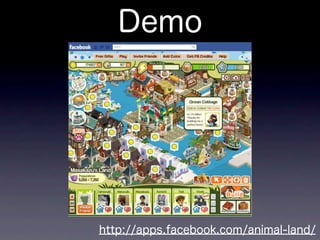
Demo


http://apps.facebook.com/animal-land/
Development Period
• Started on 2011/03
• First meeting was held on 3.11
• Released on 2011/12/09
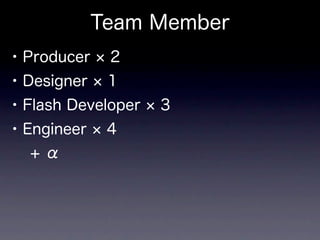
Team Member
• Producer 2
• Designer 1
• Flash Developer   3
• Engineer 4
  +α
System
Overview
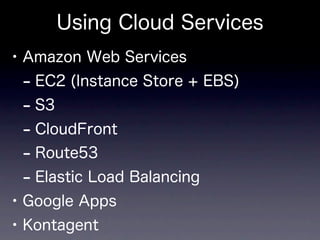
Using Cloud Services
• Amazon Web Services
  - EC2 (Instance Store + EBS)
  - S3
  - CloudFront
  - Route53
  - Elastic Load Balancing
• Google Apps
• Kontagent
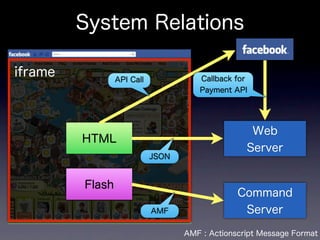
System Relations

iframe           API Call             Callback for
                                      Payment API


                                                   Web
         HTML
                                                  Server
                            JSON


         Flash
                                                Command
                            AMF                  Server

                                   AMF : Actionscript Message Format
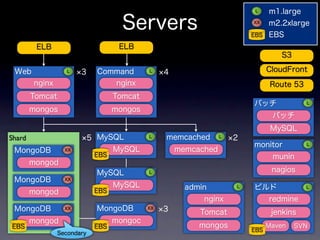
L    m1.large

                                      Servers                             XX

                                                                          EBS
                                                                                m2.2xlarge
                                                                                EBS
         ELB                         ELB
                                                                                    S3

 Web                L   3     Command        L    4                             CloudFront
        nginx                       nginx                                        Route 53
        Tomcat                      Tomcat
                                                                          バッチ               L
        mongos                      mongos
                                                                                 バッチ
                                                                                 MySQL
Shard                        5 MySQL         L    memcached       L   2
                                                                          monitor           L
 MongoDB           XX               MySQL             memcached
                              EBS                                                munin
        mongod
                              MySQL          L                                   nagios
 MongoDB           XX
                                    MySQL               admin         L   ビルド               L
        mongod                EBS
                                                            nginx               redmine
 MongoDB           XX         MongoDB        XX   3        Tomcat                jenkins
        mongod                      mongoc
EBS                           EBS                          mongos               Maven    SVN
                                                                          EBS
                 Secondary
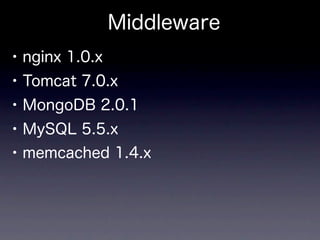
Middleware
• nginx 1.0.x
• Tomcat 7.0.x
• MongoDB 2.0.1
• MySQL 5.5.x
• memcached 1.4.x
Framework / Libraries
• Spring Framework、Spring MVC
• BlazeDS、Spring Flex
• Spring Data - MongoDB 1.0.0 M4
• mongo-java-driver 2.6.5
• Ehcache
• spymemcached
• RestFB
• MyBatis
Why MongoDB ?
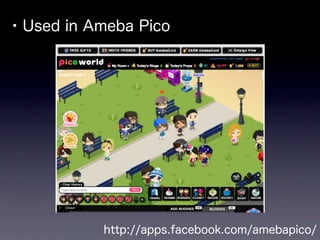
• Used in Ameba Pico


           http://apps.facebook.com/amebapico/
• I like MongoDB features !!
  - ReplicaSet
  - Auto-Sharding
  - Can handle complex data structures
  - Index, Advanced Queries
  - Developed actively
  - Quite easy to understand
• Fits in Animal Land requirements
  - Complex data structures (City s grid
   data, user/structure parameters, ...)
 - Most processes run sequencially and
   doesn t update same data at a time
 - Maintenance-less
   • Change data structures
     dynamically
   • Durability, Scalability
• Resolve MongoDB s weak points by
 other way
 - Some data are stored in other DB
   • Payments history needs reliability,
    so they are stored in MySQL
   • Temporary data are stored in
    memcached
 - Don t think of using transactions
Considered
  Points
Developing Application
• Define data without using transaction
  - User data are defined in 1 document
      and updated only once in block
                                                          User Data
{ facebookId : xxx,
                                                           Image
   status : { lv : 10, coin : 9999, ... },
   layerInfo : 1¦1¦0¦1¦2¦1¦1¦3¦1¦1¦4¦0... ,
   structure : {
         1¦1 : { id : xxxx, depth : 3, width : 3, aspect : 1, ... }, ...
  },
   inventory : [ { id : xxx, size : xxx, ... }, ... ],
   neighbor : [ { id : xxx, newFlg : false, ... }, ... ],
   animal : [ { id : xxx, color : 0, pos : 20¦20 , ... } ],
  ...
}
Developing Application
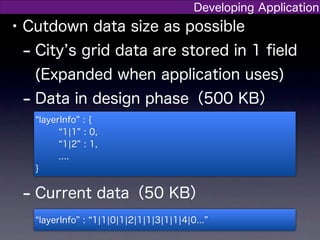
• Cutdown data size as possible
  - City s grid data are stored in 1 field
   (Expanded when application uses)
 - Data in design phase(500 KB)
       layerInfo : {
             1¦1 : 0,
             1¦2 : 1,
            ....
   }


 - Current data(50 KB)
       layerInfo : 1¦1¦0¦1¦2¦1¦1¦3¦1¦1¦4¦0...
Developing Application
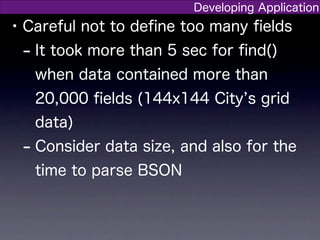
• Careful not to define too many fields
  - It took more than 5 sec for find()
   when data contained more than
   20,000 fields (144x144 City s grid
   data)
 - Consider data size, and also for the
   time to parse BSON
Developing Application
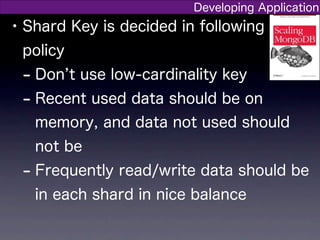
• Shard Key is decided in following
 policy
 - Don t use low-cardinality key
 - Recent used data should be on
   memory, and data not used should
   not be
 - Frequently read/write data should be
   in each shard in nice balance
Developing Application
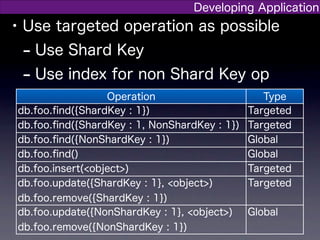
• Use targeted operation as possible
  - Use Shard Key
  - Use index for non Shard Key op
                   Operation                      Type
 db.foo.find({ShardKey : 1})                    Targeted
 db.foo.find({ShardKey : 1, NonShardKey : 1})   Targeted
 db.foo.find({NonShardKey : 1})                 Global
 db.foo.find()                                  Global
 db.foo.insert(<object>)                       Targeted
 db.foo.update({ShardKey : 1}, <object>)       Targeted
 db.foo.remove({ShardKey : 1})
 db.foo.update({NonShardKey : 1}, <object>)    Global
 db.foo.remove({NonShardKey : 1})
Developing Application
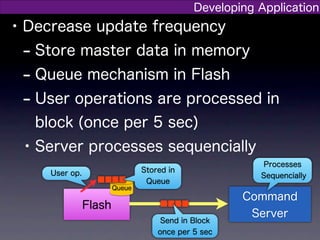
• Decrease update frequency
  - Store master data in memory
  - Queue mechanism in Flash
  - User operations are processed in
   block (once per 5 sec)
 • Server processes sequencially
                                                        Processes
     User op.                   Stored in
                                                        Sequencially
                                 Queue
                        Queue
                                                     Command
                Flash
                                                      Server
                                     Send in Block
                                    once per 5 sec
Developing Application
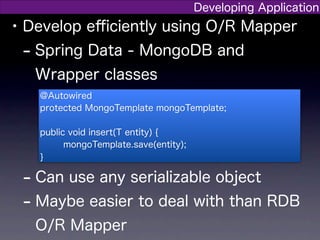
• Develop efficiently using O/R Mapper
  - Spring Data - MongoDB and
   Wrapper classes
   @Autowired
   protected MongoTemplate mongoTemplate;

   public void insert(T entity) {
         mongoTemplate.save(entity);
   }

 - Can use any serializable object
 - Maybe easier to deal with than RDB
   O/R Mapper
Developing Application
• Implements without expecting rollback
  - Give up for some inconsistent data
  - Careful not to inflict disadvantages
   to user
Constructing Infrastructure
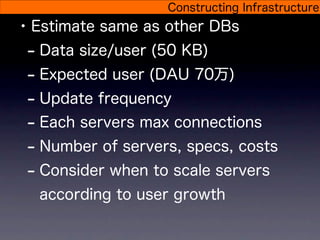
• Estimate same as other DBs
 - Data size/user (50 KB)
 - Expected user (DAU 70万)
 - Update frequency
 - Each servers max connections
 - Number of servers, specs, costs
 - Consider when to scale servers
  according to user growth
Constructing Infrastructure
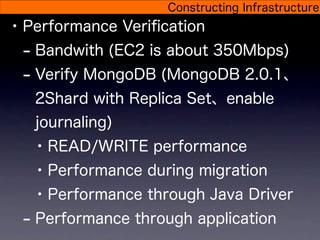
• Performance Verification
  - Bandwith (EC2 is about 350Mbps)
  - Verify MongoDB (MongoDB 2.0.1、
   2Shard with Replica Set、enable
   journaling)
   • READ/WRITE performance
   • Performance during migration
   • Performance through Java Driver
 - Performance through application
Constructing Infrastructure
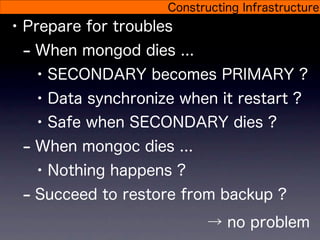
• Prepare for troubles
  - When mongod dies ...
    • SECONDARY becomes PRIMARY ?
    • Data synchronize when it restart ?
    • Safe when SECONDARY dies ?
  - When mongoc dies ...
    • Nothing happens ?
  - Succeed to restore from backup ?
                            → no problem
Constructing Infrastructure
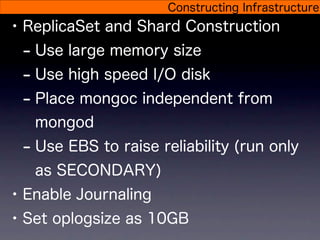
• ReplicaSet and Shard Construction
  - Use large memory size
  - Use high speed I/O disk
  - Place mongoc independent from
   mongod
 - Use EBS to raise reliability (run only
   as SECONDARY)
• Enable Journaling
• Set oplogsize as 10GB
Constructing Infrastructure
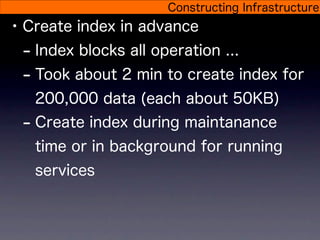
• Create index in advance
  - Index blocks all operation ...
  - Took about 2 min to create index for
   200,000 data (each about 50KB)
 - Create index during maintanance
   time or in background for running
   services
Constructing Infrastructure
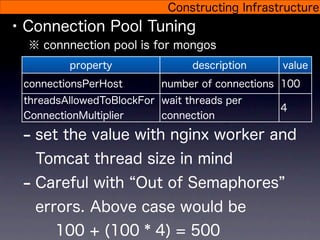
• Connection Pool Tuning
  ※ connnection pool is for mongos
         property               description     value
 connectionsPerHost       number of connections 100
 threadsAllowedToBlockFor wait threads per
                                                4
 ConnectionMultiplier     connection

 - set the value with nginx worker and
   Tomcat thread size in mind
 - Careful with Out of Semaphores
   errors. Above case would be
      100 + (100 * 4) = 500
In Operation
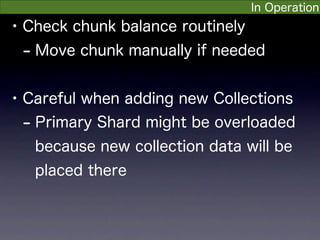
• Check chunk balance routinely
  - Move chunk manually if needed

• Careful when adding new Collections
  - Primary Shard might be overloaded
   because new collection data will be
   placed there
Troubles
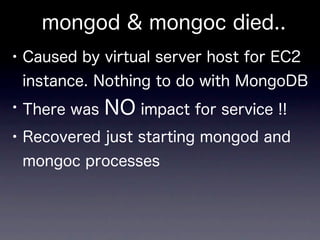
mongod & mongoc died..
• Caused by virtual server host for EC2
 instance. Nothing to do with MongoDB
• There was NO impact for service !!
• Recovered just starting mongod and
 mongoc processes
Current
Problems
Online Backup
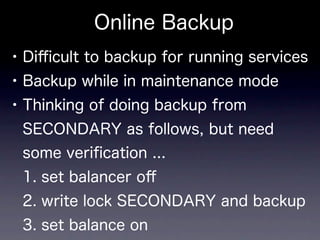
• Difficult to backup for running services
• Backup while in maintenance mode
• Thinking of doing backup from
 SECONDARY as follows, but need
 some verification ...
 1. set balancer off
 2. write lock SECONDARY and backup
 3. set balance on
Upgrade
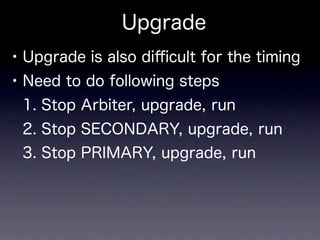
• Upgrade is also difficult for the timing
• Need to do following steps
 1. Stop Arbiter, upgrade, run
 2. Stop SECONDARY, upgrade, run
 3. Stop PRIMARY, upgrade, run
Adding Shards
• It s possible to add shards later on,
 but have to consider it s performance
 for balancing
 - Pico is adding shards while in
   maintenance mode for safety
Best Chunksize
• Migration frequently occurs, because
 user data was too large and chunksize
 was small (default 64MB)
• Need to adjust chunksize according to
 it s data size


Maybe nice if you can set the chunksize
for each collections ...
Analyzing Data
• Hard to analyze user data, because we
 handle the data in 1 document
• Creating index if necessary
  - Tested MapReduce, but some
   performance problems occured. Not
   using it right now
Thank you !
Please enjoy Animal Land !!


        http://apps.facebook.com/animal-land/

The Case for using MongoDB in Social Game - Animal Land

  • 1.
    The Case forusing MongoDB in Social Game Masakazu Matsushita Cyberagent, Inc.
  • 2.
    About Me • MasakazuMatsushita • @matsukaz • Cyberagent, Inc. - SocialApps Division - Ameba Pico (2011/01∼) - Animal Land (2011/03∼) • DevLOVE Staff
  • 3.
    Agenda • About AnimalLand • System Overview • Why MongoDB ? • Considered Points • Troubles • Current Problems
  • 4.
  • 5.
  • 6.
    Development Period • Startedon 2011/03 • First meeting was held on 3.11 • Released on 2011/12/09
  • 7.
    Team Member • Producer2 • Designer 1 • Flash Developer 3 • Engineer 4 +α
  • 8.
  • 9.
    Using Cloud Services •Amazon Web Services - EC2 (Instance Store + EBS) - S3 - CloudFront - Route53 - Elastic Load Balancing • Google Apps • Kontagent
  • 10.
    System Relations iframe API Call Callback for Payment API Web HTML Server JSON Flash Command AMF Server AMF : Actionscript Message Format
  • 11.
    L m1.large Servers XX EBS m2.2xlarge EBS ELB ELB S3 Web L 3 Command L 4 CloudFront nginx nginx Route 53 Tomcat Tomcat バッチ L mongos mongos バッチ MySQL Shard 5 MySQL L memcached L 2 monitor L MongoDB XX MySQL memcached EBS munin mongod MySQL L nagios MongoDB XX MySQL admin L ビルド L mongod EBS nginx redmine MongoDB XX MongoDB XX 3 Tomcat jenkins mongod mongoc EBS EBS mongos Maven SVN EBS Secondary
  • 12.
    Middleware • nginx 1.0.x •Tomcat 7.0.x • MongoDB 2.0.1 • MySQL 5.5.x • memcached 1.4.x
  • 13.
    Framework / Libraries •Spring Framework、Spring MVC • BlazeDS、Spring Flex • Spring Data - MongoDB 1.0.0 M4 • mongo-java-driver 2.6.5 • Ehcache • spymemcached • RestFB • MyBatis
  • 14.
  • 15.
    • Used inAmeba Pico http://apps.facebook.com/amebapico/
  • 16.
    • I likeMongoDB features !! - ReplicaSet - Auto-Sharding - Can handle complex data structures - Index, Advanced Queries - Developed actively - Quite easy to understand
  • 17.
    • Fits inAnimal Land requirements - Complex data structures (City s grid data, user/structure parameters, ...) - Most processes run sequencially and doesn t update same data at a time - Maintenance-less • Change data structures dynamically • Durability, Scalability
  • 18.
    • Resolve MongoDBs weak points by other way - Some data are stored in other DB • Payments history needs reliability, so they are stored in MySQL • Temporary data are stored in memcached - Don t think of using transactions
  • 19.
  • 20.
    Developing Application • Definedata without using transaction - User data are defined in 1 document and updated only once in block User Data { facebookId : xxx, Image status : { lv : 10, coin : 9999, ... }, layerInfo : 1¦1¦0¦1¦2¦1¦1¦3¦1¦1¦4¦0... , structure : { 1¦1 : { id : xxxx, depth : 3, width : 3, aspect : 1, ... }, ... }, inventory : [ { id : xxx, size : xxx, ... }, ... ], neighbor : [ { id : xxx, newFlg : false, ... }, ... ], animal : [ { id : xxx, color : 0, pos : 20¦20 , ... } ], ... }
  • 21.
    Developing Application • Cutdowndata size as possible - City s grid data are stored in 1 field (Expanded when application uses) - Data in design phase(500 KB) layerInfo : { 1¦1 : 0, 1¦2 : 1, .... } - Current data(50 KB) layerInfo : 1¦1¦0¦1¦2¦1¦1¦3¦1¦1¦4¦0...
  • 22.
    Developing Application • Carefulnot to define too many fields - It took more than 5 sec for find() when data contained more than 20,000 fields (144x144 City s grid data) - Consider data size, and also for the time to parse BSON
  • 23.
    Developing Application • ShardKey is decided in following policy - Don t use low-cardinality key - Recent used data should be on memory, and data not used should not be - Frequently read/write data should be in each shard in nice balance
  • 24.
    Developing Application • Usetargeted operation as possible - Use Shard Key - Use index for non Shard Key op Operation Type db.foo.find({ShardKey : 1}) Targeted db.foo.find({ShardKey : 1, NonShardKey : 1}) Targeted db.foo.find({NonShardKey : 1}) Global db.foo.find() Global db.foo.insert(<object>) Targeted db.foo.update({ShardKey : 1}, <object>) Targeted db.foo.remove({ShardKey : 1}) db.foo.update({NonShardKey : 1}, <object>) Global db.foo.remove({NonShardKey : 1})
  • 25.
    Developing Application • Decreaseupdate frequency - Store master data in memory - Queue mechanism in Flash - User operations are processed in block (once per 5 sec) • Server processes sequencially Processes User op. Stored in Sequencially Queue Queue Command Flash Server Send in Block once per 5 sec
  • 26.
    Developing Application • Developefficiently using O/R Mapper - Spring Data - MongoDB and Wrapper classes @Autowired protected MongoTemplate mongoTemplate; public void insert(T entity) { mongoTemplate.save(entity); } - Can use any serializable object - Maybe easier to deal with than RDB O/R Mapper
  • 27.
    Developing Application • Implementswithout expecting rollback - Give up for some inconsistent data - Careful not to inflict disadvantages to user
  • 28.
    Constructing Infrastructure • Estimatesame as other DBs - Data size/user (50 KB) - Expected user (DAU 70万) - Update frequency - Each servers max connections - Number of servers, specs, costs - Consider when to scale servers according to user growth
  • 29.
    Constructing Infrastructure • PerformanceVerification - Bandwith (EC2 is about 350Mbps) - Verify MongoDB (MongoDB 2.0.1、 2Shard with Replica Set、enable journaling) • READ/WRITE performance • Performance during migration • Performance through Java Driver - Performance through application
  • 30.
    Constructing Infrastructure • Preparefor troubles - When mongod dies ... • SECONDARY becomes PRIMARY ? • Data synchronize when it restart ? • Safe when SECONDARY dies ? - When mongoc dies ... • Nothing happens ? - Succeed to restore from backup ? → no problem
  • 31.
    Constructing Infrastructure • ReplicaSetand Shard Construction - Use large memory size - Use high speed I/O disk - Place mongoc independent from mongod - Use EBS to raise reliability (run only as SECONDARY) • Enable Journaling • Set oplogsize as 10GB
  • 32.
    Constructing Infrastructure • Createindex in advance - Index blocks all operation ... - Took about 2 min to create index for 200,000 data (each about 50KB) - Create index during maintanance time or in background for running services
  • 33.
    Constructing Infrastructure • ConnectionPool Tuning ※ connnection pool is for mongos property description value connectionsPerHost number of connections 100 threadsAllowedToBlockFor wait threads per 4 ConnectionMultiplier connection - set the value with nginx worker and Tomcat thread size in mind - Careful with Out of Semaphores errors. Above case would be 100 + (100 * 4) = 500
  • 34.
    In Operation • Checkchunk balance routinely - Move chunk manually if needed • Careful when adding new Collections - Primary Shard might be overloaded because new collection data will be placed there
  • 35.
  • 36.
    mongod & mongocdied.. • Caused by virtual server host for EC2 instance. Nothing to do with MongoDB • There was NO impact for service !! • Recovered just starting mongod and mongoc processes
  • 37.
  • 38.
    Online Backup • Difficultto backup for running services • Backup while in maintenance mode • Thinking of doing backup from SECONDARY as follows, but need some verification ... 1. set balancer off 2. write lock SECONDARY and backup 3. set balance on
  • 39.
    Upgrade • Upgrade isalso difficult for the timing • Need to do following steps 1. Stop Arbiter, upgrade, run 2. Stop SECONDARY, upgrade, run 3. Stop PRIMARY, upgrade, run
  • 40.
    Adding Shards • Its possible to add shards later on, but have to consider it s performance for balancing - Pico is adding shards while in maintenance mode for safety
  • 41.
    Best Chunksize • Migrationfrequently occurs, because user data was too large and chunksize was small (default 64MB) • Need to adjust chunksize according to it s data size Maybe nice if you can set the chunksize for each collections ...
  • 42.
    Analyzing Data • Hardto analyze user data, because we handle the data in 1 document • Creating index if necessary - Tested MapReduce, but some performance problems occured. Not using it right now
  • 43.
    Thank you ! Pleaseenjoy Animal Land !! http://apps.facebook.com/animal-land/