Introduction to
Hofstede's Cultural
Dimensions Theory
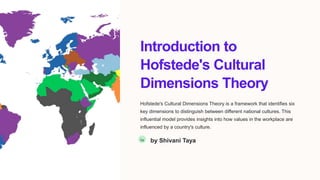
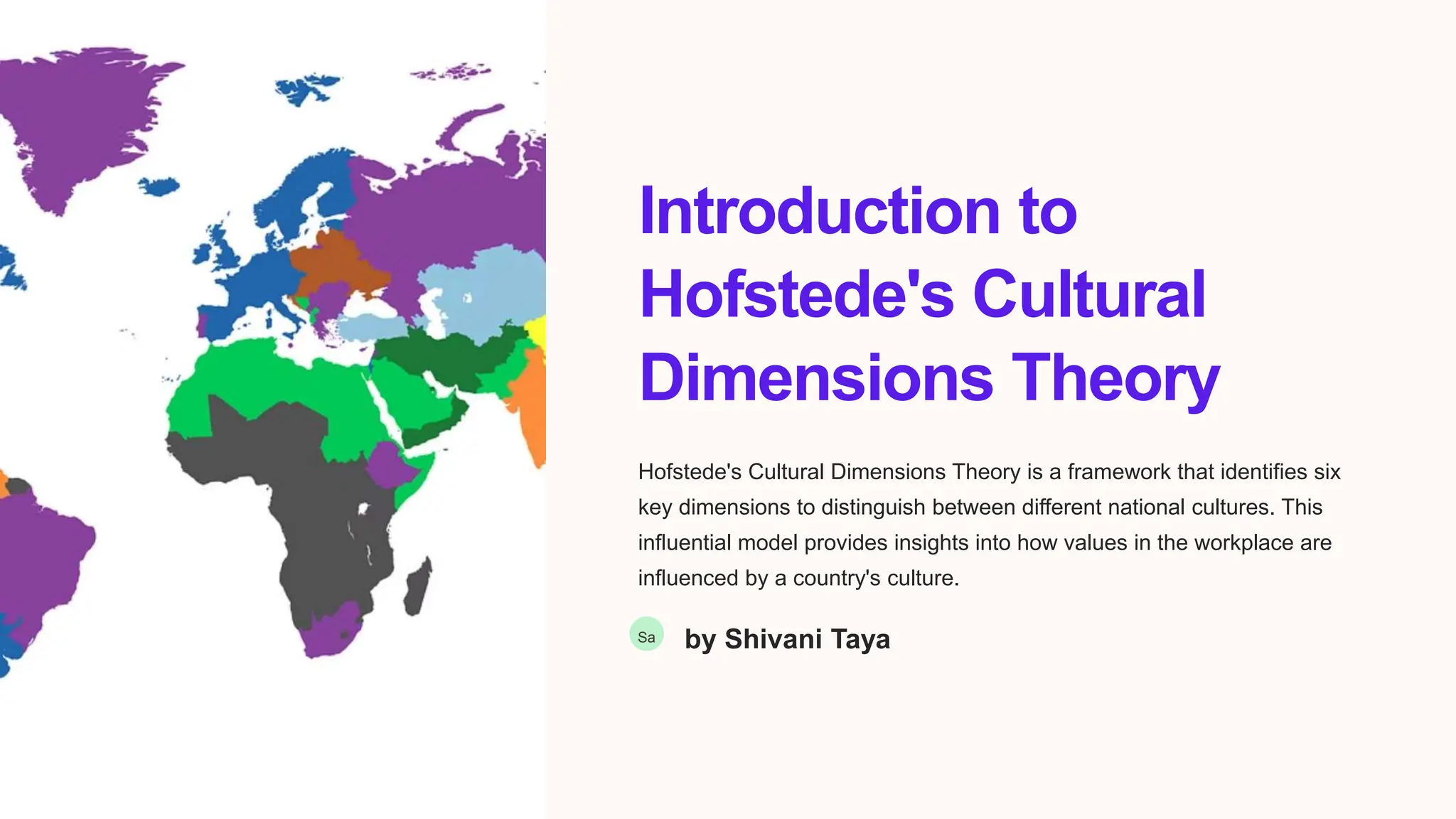
Hofstede's Cultural Dimensions Theory is a framework that identifies six
key dimensions to distinguish between different national cultures. This
influential model provides insights into how values in the workplace are
influenced by a country's culture.
Sa by Shivani Taya
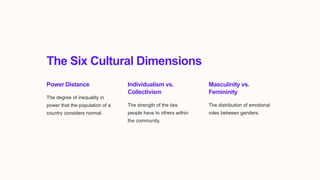
The Six Cultural Dimensions
Power Distance
The degree of inequality in
power that the population of a
country considers normal.
Individualism vs.
Collectivism
The strength of the ties
people have to others within
the community.
Masculinity vs.
Femininity
The distribution of emotional
roles between genders.
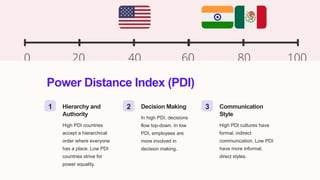
Power Distance Index
The power distance index considers the extent to which inequality and power are tolerated.
A high-power distance index indicates that a culture accepts inequity and power differences, encourages bureaucracy, and shows
high respect for rank and authority.
A low power distance index indicates that a culture encourages flat organizational structures that feature decentralized decision-
making responsibility, a participative management style, and emphasis on power distribution.
Power Distance Index (PDI)
1 Hierarchy and
Authority
High PDI countries
accept a hierarchical
order where everyone
has a place. Low PDI
countries strive for
power equality.
2 Decision Making
In high PDI, decisions
flow top-down. In low
PDI, employees are
more involved in
decision making.
3 Communication
Style
High PDI cultures have
formal, indirect
communication. Low PDI
have more informal,
direct styles.
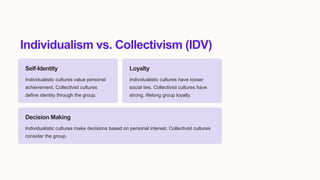
Individualism vs. Collectivism (IDV)
Self-Identity
Individualistic cultures value personal
achievement. Collectivist cultures
define identity through the group.
Loyalty
Individualistic cultures have looser
social ties. Collectivist cultures have
strong, lifelong group loyalty.
Decision Making
Individualistic cultures make decisions based on personal interest. Collectivist cultures
consider the group.
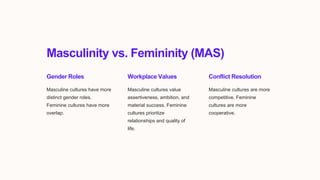
Masculinity vs. Femininity (MAS)
Gender Roles
Masculine cultures have more
distinct gender roles.
Feminine cultures have more
overlap.
Workplace Values
Masculine cultures value
assertiveness, ambition, and
material success. Feminine
cultures prioritize
relationships and quality of
life.
Conflict Resolution
Masculine cultures are more
competitive. Feminine
cultures are more
cooperative.
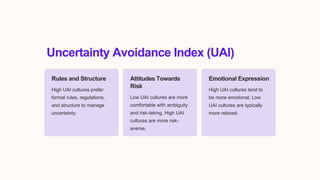
Uncertainty Avoidance Index (UAI)
Rules and Structure
High UAI cultures prefer
formal rules, regulations,
and structure to manage
uncertainty.
Attitudes Towards
Risk
Low UAI cultures are more
comfortable with ambiguity
and risk-taking. High UAI
cultures are more risk-
averse.
Emotional Expression
High UAI cultures tend to
be more emotional. Low
UAI cultures are typically
more relaxed.
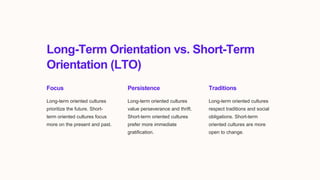
Long-Term Orientation vs. Short-Term
Orientation (LTO)
Focus
Long-term oriented cultures
prioritize the future. Short-
term oriented cultures focus
more on the present and past.
Persistence
Long-term oriented cultures
value perseverance and thrift.
Short-term oriented cultures
prefer more immediate
gratification.
Traditions
Long-term oriented cultures
respect traditions and social
obligations. Short-term
oriented cultures are more
open to change.
Indulgence vs. Restraint (IVR)
Happiness
Indulgent cultures allow
relatively free gratification of
basic and natural human
desires related to enjoying life
and having fun.
Self-Control
Restrained cultures have a
perception that such
gratification needs to be curbed
and regulated by strict norms.
Emotions
Indulgent cultures allow
relatively free gratification of
basic and natural human
desires related to enjoying life.

Introduction-to-Hofstedes-Cultural-Dimensions-Theory.pptx

  • 1.
    Introduction to Hofstede's Cultural DimensionsTheory Hofstede's Cultural Dimensions Theory is a framework that identifies six key dimensions to distinguish between different national cultures. This influential model provides insights into how values in the workplace are influenced by a country's culture. Sa by Shivani Taya
  • 2.
    The Six CulturalDimensions Power Distance The degree of inequality in power that the population of a country considers normal. Individualism vs. Collectivism The strength of the ties people have to others within the community. Masculinity vs. Femininity The distribution of emotional roles between genders.
  • 3.
    Power Distance Index Thepower distance index considers the extent to which inequality and power are tolerated. A high-power distance index indicates that a culture accepts inequity and power differences, encourages bureaucracy, and shows high respect for rank and authority. A low power distance index indicates that a culture encourages flat organizational structures that feature decentralized decision- making responsibility, a participative management style, and emphasis on power distribution.
  • 4.
    Power Distance Index(PDI) 1 Hierarchy and Authority High PDI countries accept a hierarchical order where everyone has a place. Low PDI countries strive for power equality. 2 Decision Making In high PDI, decisions flow top-down. In low PDI, employees are more involved in decision making. 3 Communication Style High PDI cultures have formal, indirect communication. Low PDI have more informal, direct styles.
  • 5.
    Individualism vs. Collectivism(IDV) Self-Identity Individualistic cultures value personal achievement. Collectivist cultures define identity through the group. Loyalty Individualistic cultures have looser social ties. Collectivist cultures have strong, lifelong group loyalty. Decision Making Individualistic cultures make decisions based on personal interest. Collectivist cultures consider the group.
  • 6.
    Masculinity vs. Femininity(MAS) Gender Roles Masculine cultures have more distinct gender roles. Feminine cultures have more overlap. Workplace Values Masculine cultures value assertiveness, ambition, and material success. Feminine cultures prioritize relationships and quality of life. Conflict Resolution Masculine cultures are more competitive. Feminine cultures are more cooperative.
  • 7.
    Uncertainty Avoidance Index(UAI) Rules and Structure High UAI cultures prefer formal rules, regulations, and structure to manage uncertainty. Attitudes Towards Risk Low UAI cultures are more comfortable with ambiguity and risk-taking. High UAI cultures are more risk- averse. Emotional Expression High UAI cultures tend to be more emotional. Low UAI cultures are typically more relaxed.
  • 8.
    Long-Term Orientation vs.Short-Term Orientation (LTO) Focus Long-term oriented cultures prioritize the future. Short- term oriented cultures focus more on the present and past. Persistence Long-term oriented cultures value perseverance and thrift. Short-term oriented cultures prefer more immediate gratification. Traditions Long-term oriented cultures respect traditions and social obligations. Short-term oriented cultures are more open to change.
  • 9.
    Indulgence vs. Restraint(IVR) Happiness Indulgent cultures allow relatively free gratification of basic and natural human desires related to enjoying life and having fun. Self-Control Restrained cultures have a perception that such gratification needs to be curbed and regulated by strict norms. Emotions Indulgent cultures allow relatively free gratification of basic and natural human desires related to enjoying life.