 Individualism – Personal needs &
goals are prioritized. Stress is
independent rather than
interdependent.
 Collectivism – Needs and goals of
the group or organization. Has the
great emphasis on the views and
needs of the group. Majorly follows
social norms and duty defined by
the group.
 The extent to which the members of a culture feel threatened by
ambiguous or unknown situations
 High uncertainty avoidance culture attempt to increase the assurance
 Low uncertainty avoidance culture easily accepts the uncertainty
inherent in life
Examples
High Uncertainty
 Traditional gender roles at workplace
 Countries: Japan, Germany, Latin America, etc.
Low uncertainty
 People will be more open to innovation and change
 There is an increased willingness and readiness to take risks
 Countries: US, UK, Denmark, etc.
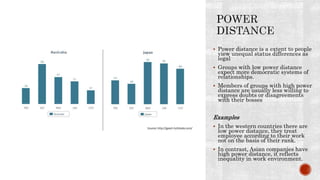
 Power distance is a extent to people
view unequal status differences as
legal
 Groups with low power distance
expect more democratic systems of
relationships.
 Members of groups with high power
distance are usually less willing to
express doubts or disagreements
with their bosses
Examples
 In the western countries there are
low power distance, they treat
employee according to their work
not on the basis of their rank.
 In contrast, Asian companies have
high power distance, it reflects
inequality in work environment.
 Masculinity stands for a society in which
shows gender role are clearly distinct: Men
are supposed to be assertive, tough, and
focus on material success; Women are
modest, tender and concerned with quality of
life
 Femininity stands for the society in which
social gender roles overlap: Both Men and
women are supposed to be modest, tender,
concerned with the quality of life
LONG TERM/ SHORT TERM
ORIENTATION
 Long-term orientation describes the inclination of a society toward searching for
virtue.
 A culture that scores high in long-term orientation will often put emphasis on
traditions and customs, and will view change as a negative.
 Short-term orientation pertains to those societies that are strongly inclined
toward the establishment of the absolute truth.
 Short-term cultures are much more accepting on change, seeing it as inevitable.
 Long-term orientated cultures will also plan for the future.
 Short-term orientated cultures are likely to focus on short-term gains in life.
Indulgence stands for
desires related to
enjoying life
Sense of freedom
Restraint regulated by
strict social norms

Hofstede's Value Dimensions

  • 2.
     Individualism –Personal needs & goals are prioritized. Stress is independent rather than interdependent.  Collectivism – Needs and goals of the group or organization. Has the great emphasis on the views and needs of the group. Majorly follows social norms and duty defined by the group.
  • 3.
     The extentto which the members of a culture feel threatened by ambiguous or unknown situations  High uncertainty avoidance culture attempt to increase the assurance  Low uncertainty avoidance culture easily accepts the uncertainty inherent in life Examples High Uncertainty  Traditional gender roles at workplace  Countries: Japan, Germany, Latin America, etc. Low uncertainty  People will be more open to innovation and change  There is an increased willingness and readiness to take risks  Countries: US, UK, Denmark, etc.
  • 4.
     Power distanceis a extent to people view unequal status differences as legal  Groups with low power distance expect more democratic systems of relationships.  Members of groups with high power distance are usually less willing to express doubts or disagreements with their bosses Examples  In the western countries there are low power distance, they treat employee according to their work not on the basis of their rank.  In contrast, Asian companies have high power distance, it reflects inequality in work environment.
  • 5.
     Masculinity standsfor a society in which shows gender role are clearly distinct: Men are supposed to be assertive, tough, and focus on material success; Women are modest, tender and concerned with quality of life  Femininity stands for the society in which social gender roles overlap: Both Men and women are supposed to be modest, tender, concerned with the quality of life
  • 7.
    LONG TERM/ SHORTTERM ORIENTATION  Long-term orientation describes the inclination of a society toward searching for virtue.  A culture that scores high in long-term orientation will often put emphasis on traditions and customs, and will view change as a negative.  Short-term orientation pertains to those societies that are strongly inclined toward the establishment of the absolute truth.  Short-term cultures are much more accepting on change, seeing it as inevitable.  Long-term orientated cultures will also plan for the future.  Short-term orientated cultures are likely to focus on short-term gains in life.
  • 8.
    Indulgence stands for desiresrelated to enjoying life Sense of freedom Restraint regulated by strict social norms