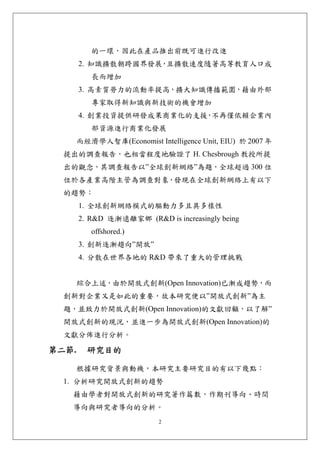
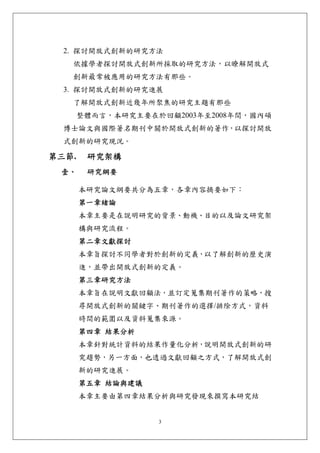
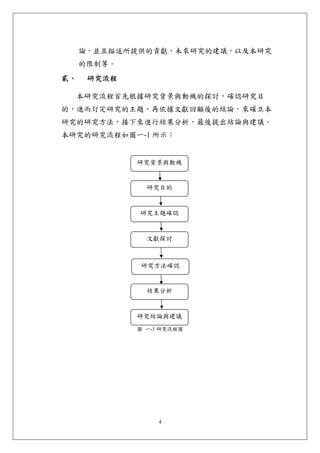
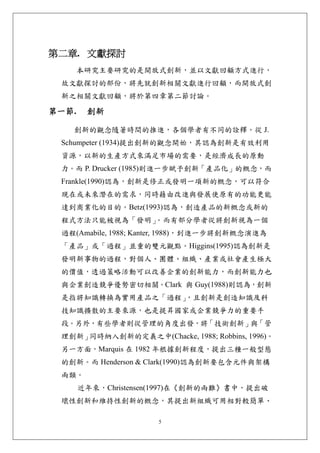
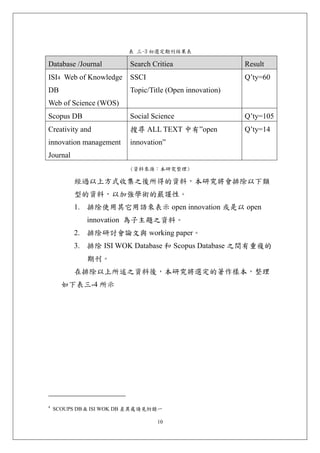
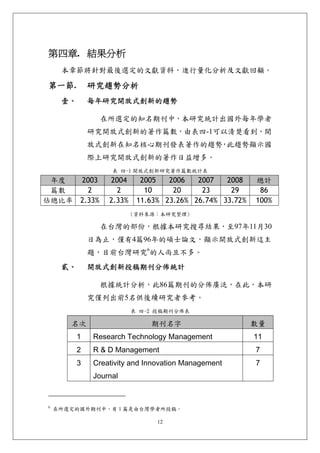
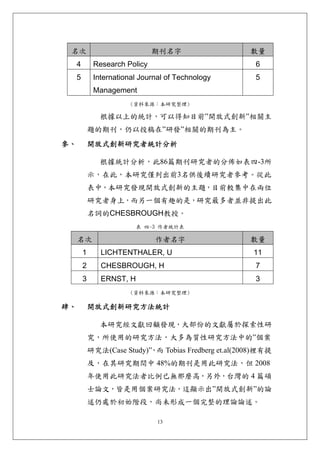
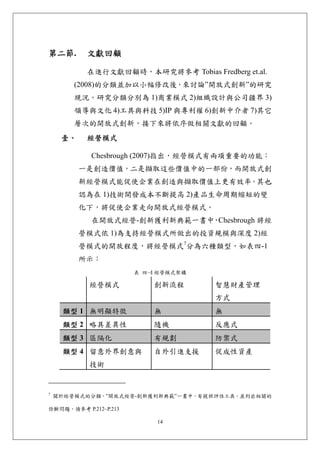
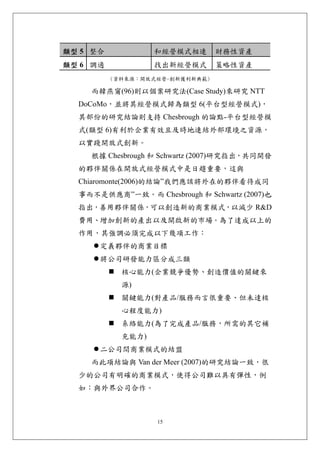
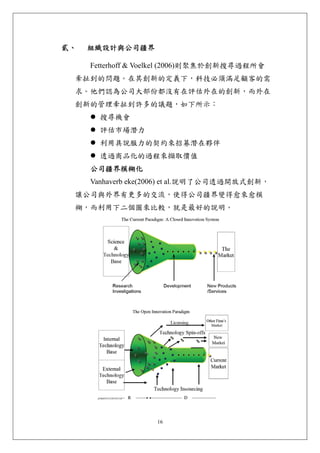
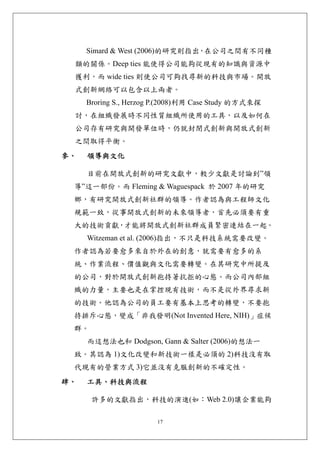
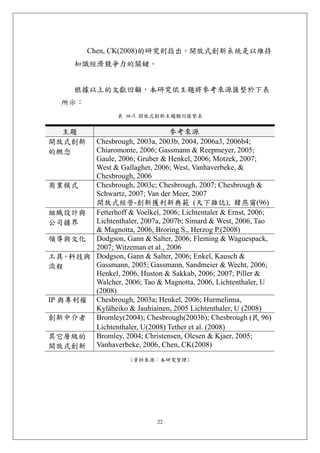
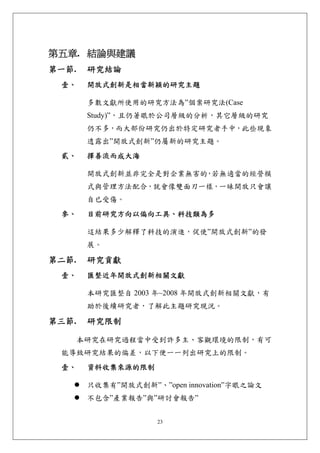
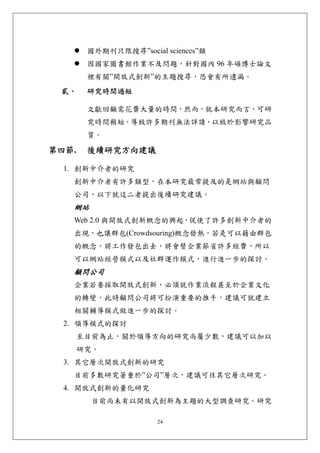
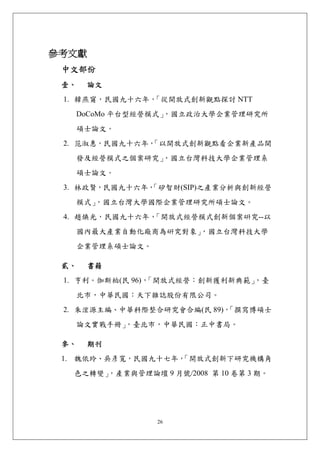
表 三-3 初選定期刊結果表
Database/Journal Search Critiea Result
ISI4 Web of Knowledge SSCI Q’ty=60
DB Topic/Title (Open innovation)
Web of Science (WOS)
Scopus DB Social Science Q’ty=105
Creativity and 搜尋 ALL TEXT 中有”open Q’ty=14
innovation management innovation”
Journal
(資料來源:本研究整理)
經過以上方式收集之後所得的資料,本研究將會排除以下類
型的資料,以加強學術的嚴謹性。
1. 排除使用其它用語來表示 open innovation 或是以 open
innovation 為子主題之資料。
2. 排除研討會論文與 working paper。
3. 排除 ISI WOK Database 和 Scopus Database 之間有重複的
期刊。
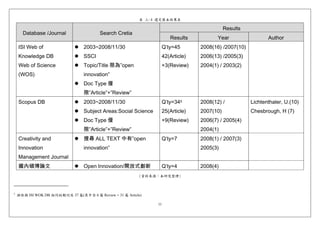
在排除以上所述之資料後,本研究將選定的著作樣本,整理
如下表三-4 所示
4
SCOUPS DB & ISI WOK DB 差異處請見附錄一
10
14.
表 三-4 選定樣本結果表
Results
Database /Journal Search Cretia
Results Year Author
ISI Web of 2003~2008/11/30 Q’ty=45 2008(16) /2007(10)
Knowledge DB SSCI 42(Article) 2006(13) /2005(3)
Web of Science Topic/Title 限為”open +3(Review) 2004(1) / 2003(2)
(WOS) innovation”
Doc Type 僅
限”Article”+”Review”
Scopus DB 2003~2008/11/30 Q’ty=345 2008(12) / Lichtenthaler, U.(10)
Subject Areas:Social Science 25(Article) 2007(10) Chesbrough, H (7)
Doc Type 僅 +9(Review) 2006(7) / 2005(4)
限”Article”+”Review” 2004(1)
Creativity and 搜尋 ALL TEXT 中有”open Q’ty=7 2008(1) / 2007(3)
Innovation innovation” 2005(3)
Management Journal
國內碩博論文 Open Innovation/開放式創新 Q’ty=4 2008(4)
(資料來源:本研究整理)
5
排除與 ISI WOK DB 相同的期刊共 37 篇(其中含 6 篇 Review + 31 篇 Article)
11
市場的層級
伍、 IP 與專利權
所有使用開放式創新的企業都必須處理保護智財權的需
求(Henkel,2006)。企業如何管理 IP,則依據其是採用封閉式
創新還是開放式新創新(Chesbrough,2003a),而其研究中,作者
也進一步討論到,IBM、INTEL 是如何使用不同的策略以 IP
和商業模式,並透過這些模式來善用企業內、外部的 IP。
根據 von Hippel and von Krogh (2006)的研究指出,免費揭
露對創意者而言,通常是增加創意利潤最實際的方式。尤其
是對軟體而言。創意者為何要免費揭露資訊而不是保有它或
授權出去,最主要的原因是 1)當他人知道與你秘密非常相近
的資訊,2)當透過專利取得利潤的機率低時,3)當免費揭露有
正面的刺激時。
而 Henkel (2006)則透過質化與量化的研究,得知許多公
司已經意識到這種狀況,而使用不同的方式來保護他們的程
式碼。他們釋出多少自身開發的程式碼,憑藉的是在開發工
作中,需要獲取外部支持的重要性而定。作者更認為公司選
擇性的揭露,能將競爭損失降至最低,這與利潤最大化的行
為一致(Henkel, 2006)。
Hurmelinna, Kyläheiko and Jauhiainen (2005)則認為是否
要保護還是要向外獲取新的知識是雙面的。他們使
用”appropriability regime8”來討論知識資產的開發和維持競
爭優勢。保護制度(Regime)的優缺點,會根據公司所面對的
狀況,而轉變成優勢或劣勢。
Lichtenthaler, U (2008)從152家企業的實證研究中探討,不
同的新產品開發階段影響企業專利授權的績效成果。
8
The appropriability regime means those factors that influence. a firm’s ability to capture profits
20
英文部份
壹、 期刊
1. Amabile, T.M.(1998),”A model of creativity and innovation in
organization.” In B. M. Straw & L.L. Chumming (Eds.),
Research in Organiztion Behavior (Vol. 10,
pp.123-167).Greenwich ,CT:JAI Press.
2. Betz, F.,Strategic Technology Management. New York:McGraw
Hill. (1993)
3. Broring S., Herzog P. 2008 European Journal of Innovation
Management, 11(3) :330-348
4. Bromley, D. A. 2004. Technology policy. Technology in Society,
26(2-3): 455-468.
5. Brown, J. S. & Hagel III, J. 2006. Creation nets: Getting the most
from open innovation. McKinsey Quarterly(2): 40-51.
6. Chacke, G.K. (1988); Technology Management Application to
Corporate Markets and Military Missions-New York: Praeger.
7. Christensen, C.M.(1997), The Innovator’s Dilemma:When New
Technologies Cause Great Firms to Fail. Boston: Harvard
Business School Press.
8. Chesbrough, H. 2003a. The logic of open innovation: Managing
intellectual property. California Management Review, 45(3): 33.
9. Chesbrough, H. W. 2003b. The era of open innovation. Mit Sloan
Management Review, 44(3):35-41.
10. Chesbrough, H. W. 2003c. Open innovation : the new imperative
for creating and profiting from technology. Boston, MA: Harvard
Business School Press.
11. Chesbrough, H. 2004. Managing open innovation.
Research-Technology Management, 47(1):23-26.
27
31.
12. Chesbrough, H.& Crowther, A. K. 2006. Beyond high tech:
early adopters of open innovation in other industries. R & D
Management, 36(3): 229-236.
13. Chesbrough, H. W., Vanhaverbeke, W., & West, J. (Eds.). 2006.
Open innovation: Researching a new paradigm. Oxford: Oxford
University Press.
14. Chesbrough, H. W. 2007. Why companies should have open
business models. Mit Sloan Management Review, 48(2): 22-+.
15. Chesbrough, H. & Schwartz, K. 2007. Innovating business
models with co-development partnerships. Research-Technology
Management, 50(1): 55-59.
16. Chiaromonte, F. 2006. Open innovation through alliances and
partnership: theory and practice. International Journal of
Technology Management, 33(2-3): 111-114.
17. Christensen, J. F., Olesen, M. H., & Kjaer, J. S. 2005. The
industrial dynamics of Open Innovation - Evidence from the
transformation of consumer electronics. Research Policy, 34(10):
1533-1549.
18. Chen, CK(2008) MANAGEMENT DECISION, 46 (3-4):
501-514.
19. Clark, J, & Guy.K. (1998),”Innovation abd Competitiveness: A
Review,” Technology Analysis & Strategic Management,
10(3),pp.363-395.
20. Dahlander, L. & Wallin, M. W. 2006. A man on the inside:
Unlocking communities as complementary assets. Research
Policy, 35(8 SPEC. ISS.): 1243-1259.
21. Dittrich, K. & Duysters, G. 2007. Networking as a Means to
Strategy Change: The Case of Open Innovation in Mobile
28
32.
Telephony, Journal ofProduct Innovation Management, 24(5):
510-521.
22. Dodgson, M., Gann, D., & Salter, A. 2006. The role of
technology in the shift towards open innovation: the case of
Procter & Gamble. R & D Management, 36(3): 333-346.57
23. Enkel, E., Kausch, C., & Gassmann, O. 2005. Managing the risk
of customer integration. European Management Journal, 23(2):
203-213.
24. Fetterhoff, T. J. & Voelkel, D. 2006. Managing open innovation
in biotechnology. Research-Technology Management, 49(3):
14-18.
25. Fleming, L. & Waguespack, D. M. 2007. Brokerage, boundary
spanning, and leadership in open innovation communities.
Organization Science, 18(2): 165-180.
26. Gassmann, O. & Reepmeyer, G. 2005. Organizing
Pharmaceutical Innovation: From Sciencebased Knowledge
Creators to Drug-oriented Knowledge Brokers. Creativity and
Innovation Management, 14(3): 233-245.
27. Gassmann, O., Sandmeier, P., & Wecht, C. H. 2006. Extreme
customer innovation in the frontend:learning from a new
software paradigm. International Journal of Technology
Management,33(1): 46-66.
28. Gaule, A. 2006. Open Innovation in Action: How to be strategic
in the search for new sources of value. London: Blackwell.
29. Gruber, M. & Henkel, J. 2006. New ventures based on open
innovation - an empirical analysis of start-up firms in embedded
Linux. International Journal of Technology Management,
33(4):356-372.
29
33.
30. Henderson R.M. & Clark, K.B .(1990) ,”Architectural
Innovation: The Reconfiguration of Existing Product
Technologies and the Failure of Established Firms,”
Administrative Science Qusrterly, 35, pp.286-316.
31. Henkel, J. 2006. Selective revealing in open innovation processes:
The case of embedded Linux. Research Policy, 35(7): 953-969.
32. Higgins, J.M. (1995), “Innovation The Core
Competence,”Planning Review, 23(6),pp.32-35.
33. Hurmelinna, P., Kylaheiko, K., & Jauhiainen, T. 2007. The Janus
face of the appropriability regime in the protection of innovations:
Theoretical re-appraisal and empirical analysis. Technovation,
27(3): 133-144.
34. Huston, L. & Sakkab, N. 2006. Connect and develop inside
Procter & Gamble's new model for innovation. Harvard Business
Review, 84(3): 58-67.
35. Huston, L. & Sakkab, N. 2007. Implementing open innovation.
Research-Technology Management, 50(2): 21-25.
36. Lichtenthaler, U. & Ernst, H. 2006. Attitudes to externally
organising knowledge management tasks: a review,
reconsideration and extension of the NIH syndrome. R & D
Management, 36(4): 367-386.
37. Lichtenthaler, U. 2007a. The drivers of technology licensing: An
industry comparison. California Management Review, 49(4):
67-+.
38. Lichtenthaler, U. 2007b. Hierarchical strategies and strategic fit
in the keep-or-sell decision. Management Decision, 45(3):
340-359.
39. Lichtenthaler, U 2008 MANAGEMENT DECISION, 46 (1-2):
30
34.
77-91 2008
40. Lichtenthaler,U 2008 ORGANIZATION STUDIES, 29 (7):
1003-1035 JUL
41. Lichtenthaler, U (2008) JOURNAL OF BUSINESS
VENTURING, 23 (4): 445-464 JUL 2008
42. Marquis,D.G. (1982), The Anatomy of Successful Innova tion.
Cambridge:Winthrop.
43. Motzek, R. 2007. Motivation in Open Innovation: An
Exploratory Study on User Innovators. Saarbrücken: VDM
Verlag Dr. Müller.
44. P. Drucker (1985),Innovation and Entrepreneurship. New
York:Harper & Row.
45. Piller, F. T. & Walcher, D. 2006. Toolkits for idea competitions: a
novel method to integrate users in new product development. R
& D Management, 36(3): 307-318.
46. Robbins,S.P. (1996), Oraganiztion Behav ior:Concept,
Controversies and Applications. Englewood Cliffs,
NJ:Prentice-Hall.
47. Schumpeter,J.A. 1934, The Theory of Economic Development.
Camb ridge:Harva rd University Press.
48. Tao, J. & Magnotta, V. 2006. How air products and
chemicals ”identifies and accelerates”. Research Technology
Management, 49(5): 12-18.
49. Tether, BS (Tether, Bruce S.); Tajar, A (Tajar, Abdelouahid).
(2008) RESEARCH POLICY, 37 (6-7): 1079-1095 JUL 2008
50. van der Meer, H. 2007. Open Innovation – The Dutch Treat:
Challenges in Thinking in Business Models. Creativity and
Innovation Management, 16(2): 192-202.
31
35.
51. West, J.& Gallagher, S. 2006. Challenges of open innovation:
the paradox of firm investment in open-source software. R & D
Management, 36(3): 319-331.
52. Witzeman, S., Slowinski, G., Dirkx, R., Gollob, L., Tao, J., Ward,
S., & Miraglia, S. 2006. Harnessing external technology for
innovation. Research-Technology Management, 49(3): 19-27.
53. von Hippel, E. & von Krogh, G. 2006. Free revealing and the
private-collective model for innovation incentives. R & D
Management, 36(3): 295-306.
貳、 書籍
1. Dane, F.C., 1990, Research Method, California: Brooks/Cole.
2. Henry Chesbrough (Editor), Wim Vanhaverbeke (Editor), Joel
West (Editor)., 2006 Open Innovation: Researching a New
Paradigm
參、 報告
1. Tobias Fredberg, Maria Elmquist & Susanne Ollila, (2008)”
Managing Open Innovation - Present Findings and Future
Directions,” Vinnova Report ,VR 2008:02, Chalmers University
of Technology.
2. Economist Intelligence Unit (2007), Sharing the Idea: The
Emergence of Global Innovation Networks. London: EIU.
肆、 網路
1. Randy Burge. Internet allows us to resource the crowd, 2007.4,
http://www.abqtrib.com/news/2007/apr/09/randy-burge-internet-
allows-us-resource-crowd/
32
36.
附錄
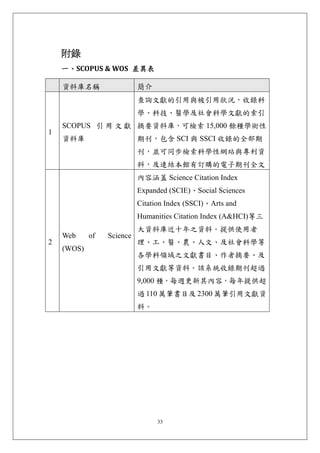
一、SCOPUS & WOS 差異表
資料庫名稱 簡介
查詢文獻的引用與被引用狀況,收錄科
學、科技、醫學及社會科學文獻的索引
SCOPUS 引 用 文 獻 摘要資料庫,可檢索 15,000 餘種學術性
1
資料庫 期刊,包含 SCI 與 SSCI 收錄的全部期
刊,並可同步檢索科學性網站與專利資
料,及連結本館有訂購的電子期刊全文
內容涵蓋 Science Citation Index
Expanded (SCIE)、Social Sciences
Citation Index (SSCI)、Arts and
Humanities Citation Index (A&HCI)等三
大資料庫近十年之資料。提供使用者
Web of Science
2 理、工、醫、農、人文、及社會科學等
(WOS)
各學科領域之文獻書目、作者摘要、及
引用文獻等資料。該系統收錄期刊超過
9,000 種,每週更新其內容,每年提供超
過 110 萬筆書目及 2300 萬筆引用文獻資
料。
33