INTRODUCTION
• Atma isthe one of Amurta Karana Dravya. Atma is prime component of living body.
• The knowledge of Atma is considered as the sole motive of the Darshana. All the
philosophes have tried to understand the pure nature of Atma and thereby attempt to gain the
liberation, which is the ultimate aim of the human life.
• Atma is omnipresent means it is spread in whole universe. Not a single spot is existed in this
universe where Atma doesn’t exist. So, automatically it gets adhered with all objects and
involves in all the types of activities.
• Being a Karana Dravya; it involves in the process of manifestation of all the Karya
Dravyas.
3.
Nirukti
• The word‘Atma’ is derived from the root verb, ‘अत ्सातत्यगमने’ means which has continuous
motion is called Atma.
• अततत सकलं व्याप्नोतत इतत आत्मा |
The word Atma is derived from the “अत ्
” dhatu and ‘अप ्
’ dhatu.
‘अत ्
’-Which means spread all over.
‘अप ्
’ – which means continuous moving.
Synonyms: क्षेत्रज्ञ पुरुष शारीरर निर्ुुण अक्षर देनि
वेदनिता साक्षी ज्ञ वशी नवश्वकर्ाु पुदर्ल
द्रष्टा वक्ता सवुज्ञ कताु नवश्वरूपा जीव
श्रोता चेतिा निनवुकार ईश्वर अव्यक्त etc.
4.
LAKSHANA
• ज्ञानाऽतिकरणमात्मा |(तककसंग्रह)
The substratum of knowledge is the Atma.
• समवायेन ज्ञानातिकरणं आत्मनो लक्षणम ्|
Atma is considered as the source of eternal knowledge. It has Samavaya relation with eternal
knowledge.
'चेतनावान ्यतश्चात्मा ततः कताक तनरुच्यते |' (च.शा. 1/76)
Atma is said as Chetana and Karta. In the entire universe the Atma only the Chaitanya
bhava (Active lively principle) and rest of all Achetana or Jada (Liveless priciples).
• अव्यक्तमात्मा क्षेत्रज्ञः शाश्वतो तवभुरव्ययः|
Atma is the Vibhu and Shashvata Dravya.
5.
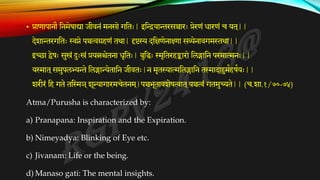
• प्राणापानौ तनमेषाद्याजीवनं मनसो गततः| इतियान्तरसञ्चारः प्रेरणं िारणं च यत ्
||
देशान्तरगततः स्वप्ने पञ्चत्वग्रहणं तथा| दृष्टस्य दतक्षणेनाक्ष्णा सव्येनावगम्तथथा||
इच्छा द्वेषः सुखं दःखं प्रयत्नश्चेतना िृततः| बुतधः स्मृततरहङ्कारो तलङ्गातन परमात्मनः||
यस्मात ्समुपलभ्यन्ते तलङ्गान्येतातन जीवतः|न मृतस्यात्मतलङ्गातन तस्मादा्ममकहषकयः||
शरीरं तह गते ततस्मञ ्शून्यागारमचेतनम ्
|पञ्चभूतावशेषत्वात ्पञ्चत्वं गतमुच्यते|| (च.शा.१/७०-७४)
Atma/Purusha is characterized by:
a) Pranapana: Inspiration and the Expiration.
b) Nimeyadya: Blinking of Eye etc.
c) Jivanam: Life or the being.
d) Manaso gati: The mental insights.
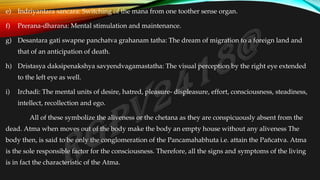
6.
e) Indriyantara sancara:Switching of the mana from one toother sense organ.
f) Prerana-dharana: Mental stimulation and maintenance.
g) Desantara gati swapne panchatva grahanam tatha: The dream of migration to a foreign land and
that of an anticipation of death.
h) Dristasya daksipenakshya savуendvagamastatha: The visual perception by the right eye extended
to the left eye as well.
i) Irchadi: The mental units of desire, hatred, pleasure- displeasure, effort, consciousness, steadiness,
intellect, recollection and ego.
All of these symbolize the aliveness or the chetana as they are conspicuously absent from the
dead. Atma when moves out of the body make the body an empty house without any aliveness The
body then, is said to be only the conglomeration of the Pancamahabhuta i.e. attain the Pañcatva. Atma
is the sole responsible factor for the consciousness. Therefore, all the signs and symptoms of the living
is in fact the characteristic of the Atma.
7.
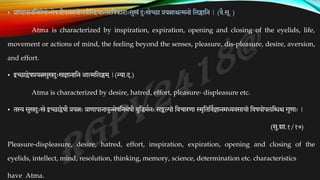
• प्राणापानतनमेषोन्मेषजीवनमनोगतीतियान्तरतवकाराःसुखं दःखेच्छाप्रयत्नाश्चत्मनो तलङ्गातन | (वै.सू. )
Atma is characterized by inspiration, expiration, opening and closing of the eyelids, life,
movement or actions of mind, the feeling beyond the senses, pleasure, dis-pleasure, desire, aversion,
and effort.
• इच्छाद्वेषप्रयत्नसुखदःखज्ञानातन आत्मतलङ्गम ्|(न्या.द.)
Atma is characterized by desire, hatred, effort, pleasure- displeasure etc.
• तस्य सुखदःखे इच्छाद्वेषौ प्रयत्नः प्राणापानावुन्मेषतनमेषौ बुतधमकनः सङ्कल्पो तवचारणा स्मृतततवकज्ञानमध्यवसायो तवषयोपलतिश्च गुणाः |
(सु.शा.१/१७)
Pleasure-displeasure, desire, hatred, effort, inspiration, expiration, opening and closing of the
eyelids, intellect, mind, resolution, thinking, memory, science, determination etc. characteristics
have Atma.
8.
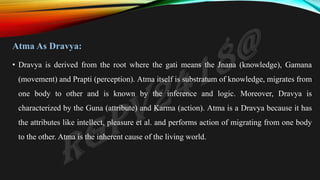
Atma As Dravya:
•Dravya is derived from the root where the gati means the Jnana (knowledge), Gamana
(movement) and Prapti (perception). Atma itself is substratum of knowledge, migrates from
one body to other and is known by the inference and logic. Moreover, Dravya is
characterized by the Guna (attribute) and Karma (action). Atma is a Dravya because it has
the attributes like intellect, pleasure et al. and performs action of migrating from one body
to the other. Atma is the inherent cause of the living world.
9.
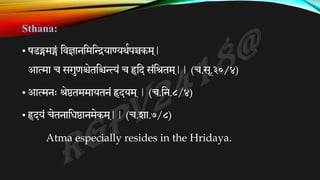
Sthana:
• षडङ्गमङ्गं तवज्ञानतमतियाण्यथकपञ्चकम्
|
आत्मा च सगुणश्चेततश्चन्त्यं च हृतद संतितम ्
|| (च.सू.३०/४)
• आत्मनः िेष्ठतममायतनं हृदयम ्| (च.तन.८/४)
• हृदयं चेतनातिष्ठानमेकम ्
|| (च.शा.७/८)
Atma especially resides in the Hridaya.
10.
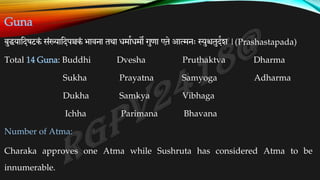
Guna
बुधयातदषटकं संख्यातदपञ्चकं भावनातथा िमाकिमो गुणा एते आत्मनः स्युश्चतुदकश |(Prashastapada)
Total 14 Guna: Buddhi Dvesha Pruthaktva Dharma
Sukha Prayatna Samyoga Adharma
Dukha Samkya Vibhaga
Ichha Parimana Bhavana
Number of Atma:
Charaka approves one Atma while Sushruta has considered Atma to be
innumerable.
11.
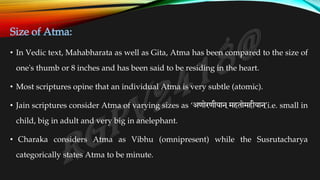
Size of Atma:
•In Vedic text, Mahabharata as well as Gita, Atma has been compared to the size of
one's thumb or 8 inches and has been said to be residing in the heart.
• Most scriptures opine that an individual Atma is very subtle (atomic).
• Jain scriptures consider Atma of varying sizes as ‘अणोरणीयान ्महतोमहीयान ्
’i.e. small in
child, big in adult and very big in anelephant.
• Charaka considers Atma as Vibhu (omnipresent) while the Susrutacharya
categorically states Atma to be minute.
12.
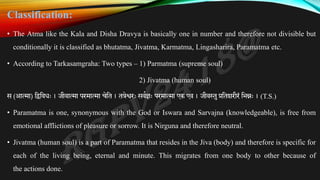
Classification:
• The Atmalike the Kala and Disha Dravya is basically one in number and therefore not divisible but
conditionally it is classified as bhutatma, Jivatma, Karmatma, Lingasharira, Paramatma etc.
• According to Tarkasamgraha: Two types – 1) Parmatma (supreme soul)
2) Jivatma (human soul)
स (आत्मा) तद्वतविः । जीवात्मा परमात्मा चेतत । तत्रेश्वरः सवकज्ञः परमात्मा एक एव । जीव्तथुप्रततशरीरं तभन्नः । (T.S.)
• Paramatma is one, synonymous with the God or Iswara and Sarvajna (knowledgeable), is free from
emotional afflictions of pleasure or sorrow. It is Nirguna and therefore neutral.
• Jivatma (human soul) is a part of Paramatma that resides in the Jiva (body) and therefore is specific for
each of the living being, eternal and minute. This migrates from one body to other because of
the actions done.
13.
Ayurveda describes Atmain three ways:
1) Paramatma 2) Jivatma 3) Linga or Sukshma Sharir
1) Parmatma:
तनतवककारः परस्त्वात्मा सत्त्वभूतगुणेतियैः|
चैतन्ये कारणं तनत्यो द्रष्टा पश्यतत तह तियाः|| (च.सू.१/५६)
Paramatma is Nirvikara (devoid of ailments), is the cause of Chaitanya (consciousness)
in association with the mana and bhutaguna, and is the sole observer of all the activities. The
fact that only the Paramatma is eligible to know (Jnah) makes it the observer or witness
(Sakshi).
14.
अव्यक्तमात्माः क्षेत्रज्ञः शाश्वतोतवभुरव्ययः । (च.शा. 1/61)
• Paramatma is Anadi (beginning less) and Nitya (eternal or everlasting). It is omnipresent as it pervades the
whole of the universe that makes it great. It is Avyakta (unmanifest), Shashwat (perpetual), Vibhu (all pervading)
and Avyaya (without any loss or degradation). Thus, it is the supreme soul or the absolute or the pure soul.
ज्ञः साक्षीत्युच्चते नाज्ञः साक्षीत्वात्माः यतः स्मृतः । सवे भावा तह सवेषां भूतानामात्मसातक्षका ॥ (च.शा. 1/83)
• Acharya Charaka mentions that the Paramatma is the witness of all the activities of the universe, as he is an
observer of all the activities. The Paramatma observes all the attributes, actions etc. of Bhutas. Hence; all the
activities of Pancha Mahabhutas are witnessed by the Paramatma.
• Paramatma actually represents the Iswara or the Brahma. It is the cause of all but is itself without a cause. This
Atma however is not the concern of Ayurveda as it is without any afflictions and therefore does not expect the
principles of Ayurveda.
15.
2) Jivatma
• Wheneverthe omnipresent Paramatma gets united with elemental body along with Indriyas and
mana; it causes for the consciousness of body. Now, this form of Paramatma which is limited to
physical body is called as Jivatma.
• There are innumerable jivatmas are there in this universe due to variance of Sharira, Indriya and
Sattva in each person. It is also termed as Kshetrajna by Sushruta and is Asarvagata but Nitya.
• Jivatma is the Karta for all the activities and Bhokta of the results of all deeds through the medium
of Sharira in all the living bodies. Jivatma is the seat for Sukha, Dukha etc. with invariable relation.
He has limited powers and Alpajna.
• The Sharir or the body is in continuous state of decay or wear & tear and undergoes repair leading
to growth manifesting its aliveness. This aliveness is attributed to Jivatma.
• Panchamahabhuta with Jivatma become the substratum of health and disease and therefore expects
the intervention of Ayurveda. Thus, it is of great practical utility.
16.
3) Ativahika Purusha/ Sukhshma Sharira / Linga Sharira
The cause of the transmigration of the soul from one body to other is in the form of the Sukṣma Sarira or the
Limga Sarira or the Ativāhika Sarira. In the Bhagwat Gita also, Lord Krishna propounds that the soul migrates
from one body to other just like the changing the clothes from the old/torn to the new ones.
Acharya Charaka explains the transmigration in the following manner:
भूतैश्चतुतभकः सतहतः सुसूक्ष्मैमकनोजवो देहमुपैतत देहात ्
| कमाकत्मकत्वान्न तुतस्य दृश्यं तदव्यं तवना दशकनमत्तथ रूपम ्
||(Cha.Sha.2/31)
Because of the past actions (karma) the soul migrates from one body to the other in association with the
manas and the four subtle bhuta. This Sukshma Sharira cannot be visualized by the senses but only
through the divine senses. This is omnipresent and capable of entering any of the body of any shape
and is the able to perform any action.
17.
• In theSamkhya darsana, Acarya Kapila expounds that the Sukshma Sharira is actually a
conglomeration of the seventeen elements.
सप्तदशैकतलङ्ग | (Samkhya Darshana 3/9)
• These seventeen elements include the buddhi (intellect), ekadasaindriya (5 sense organs, 5
conative organs and one mind) and the Panca tanmatra (five subtle elements).
• Samkhya Karika however includes ahamkara in addition to the seventeen to make it
eighteen elemental Sukshma Sharira.
18.
Gyanarjana Praktiya
Acarya Charakadescribes that Jivatma is the knower of all the objects of the universe. Even
though Jivatma is the knower and the seat of cognition; it is limited to one person only. It
can't be able to know the things happening in other's body.
आत्मा ज्ञः करणैयोगाज ्ज्ञानं त्वस्य प्रवतकते|करणानामवैमल्यादयोगाद्वा न वतकते||
पश्यतोऽतप यथाऽऽदशे सतिष्टे नात्तथ दशकनम ्
|तत्त्वं जले वा कलुषे चेतस्युपहते तथा||(च.शा.१/५४-५५)
• Atma can perceive the knowledge of the objects whenever it associates with the karanas
viz. mana, buddhi, indriya. If mana doesn't associate with the indriya or whenever indriyas
become defective then Atma doesn't get perception. E.g. a person cannot see his image (i)
in a mirror covered with dust (ii) in the polluted water (iii) in unhealthy state of mind.
19.
• If weaccept that Atma always perceives the knowledge of all the objects then queries arise that
(1) Why the perception doesn't occur during sleep?
(2) Does Atma also sleep whenever a person sleeps?
करणानां तु वैकल्ये तमसाऽतभप्रवतिकते।
अस्वपन्नतप भूतात्माः प्रसुप्त इव चोच्यते ॥(सु.सू. 4/37)
• Acarya Shushruta answers that Atma does not perceive the knowledge on different situations like
unhealthy state of mana or absence of mana during the process of cognition or Indriyas get
defected or due to predominance of Tamo Guna. During a sleep; Kapha and Tamasa dosas remain
in predominant state and so, Atma does not get perception. Hence; even though Atma is not
sleeping but it is called as sleeping due to have an absence of cognition through Indriyas in that
state.
20.
SIGNIFICANCE:
• Atma isthe one component of Tridanda and Ayu.
➢ सत्त्वमात्मा शरीरं च त्रयमेततिदण्डवत ्
|
लोकत्तथष्ठतत संयोगात्तत्र सवं प्रतततष्ठतम ्
|| (च.सू.१/४६)
➢ शरीरेतियसत्त्वात्मसंयोगो िातर जीतवतम ्
|
तनत्यगश्चानुबन्धश्च पयाकयैरायुरुच्यते|| (च.सू.१/४२)
• Person who has Prasana Atma is considered as Swastha.
➢ समदोषः समातिश्च समिातुमलतियः |
प्रसन्नात्मेतियमनाः स्वस्थ इत्यतभिीयते || (सु.सू.१५/४१)
21.
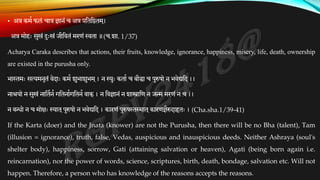
• अत्र कमकफलं चात्र ज्ञानं च अत्र प्रतततष्ठतम ्
।
अत्र मोहः सुखं दःखं जीतवतं मरणं स्वता ॥(च.शा. 1/37)
Acharya Caraka describes that actions, their fruits, knowledge, ignorance, happiness, misery, life, death, ownership
are existed in the purusha only.
भा्तथमः सत्यमनृतं वेदाः कमक शुभाशुभम ्। न स्युः कताक च बौधा च पुरुषो न भवेद्यतद ।।
नाियो न सुखं नाततकनकगततनाकगततनकवाक्। न तवज्ञानं न शास्त्रातण न जन्म मरणं न च ।।
न बन्धो न च मोक्षः स्यात ्पुरुषो न भवेद्यतद । कारणं पुरुष्तथस्मात ्कारणज्ञैरुदाहृतः । (Cha.sha.1/39-41)
If the Karta (doer) and the Jnata (knower) are not the Purusha, then there will be no Bha (talent), Tam
(illusion = ignorance), truth, false, Vedas, auspicious and inauspicious deeds. Neither Ashraya (soul's
shelter body), happiness, sorrow, Gati (attaining salvation or heaven), Agati (being born again i.e.
reincarnation), nor the power of words, science, scriptures, birth, death, bondage, salvation etc. Will not
happen. Therefore, a person who has knowledge of the reasons accepts the reasons.



![AYURVEDA[1].pptx details with the proper](https://cdn.slidesharecdn.com/ss_thumbnails/ayurveda1-250429043832-7776c96e-thumbnail.jpg?width=640&height=640&fit=bounds)


