
Supporting Students'
Motivation in School: A Focus
on Classroom Support
Acknowledgements
Linnenbrink-Garcia Lab
• Adar Ben-Eliyahu
• Kate Flanagan
• Paul O’Keefe
• Erika Patall
Other Collaborators
• Kenn Barron, James Madison Univ.
• AnneMarie Conley, UC, Irvine
• Amanda Durik, Northern Illinois
• Judith Harackiewicz, Univ. of Wisconsin
• Stuart Karabenick, Univ. of Michigan
• Kristin Koskey, Univ. of Toledo
• Christine Manzey, Univ. of Toledo
• Emily Messersmith, UNC-CH
• Kevin Pugh, Univ. of Northern Colorado
• Victoria Stewart, Univ. of Toledo
• John Tauer, Univ. of St. Thomas
Study 2 was funded by the National Science Foundation
Study 3 was funded by Duke TIP
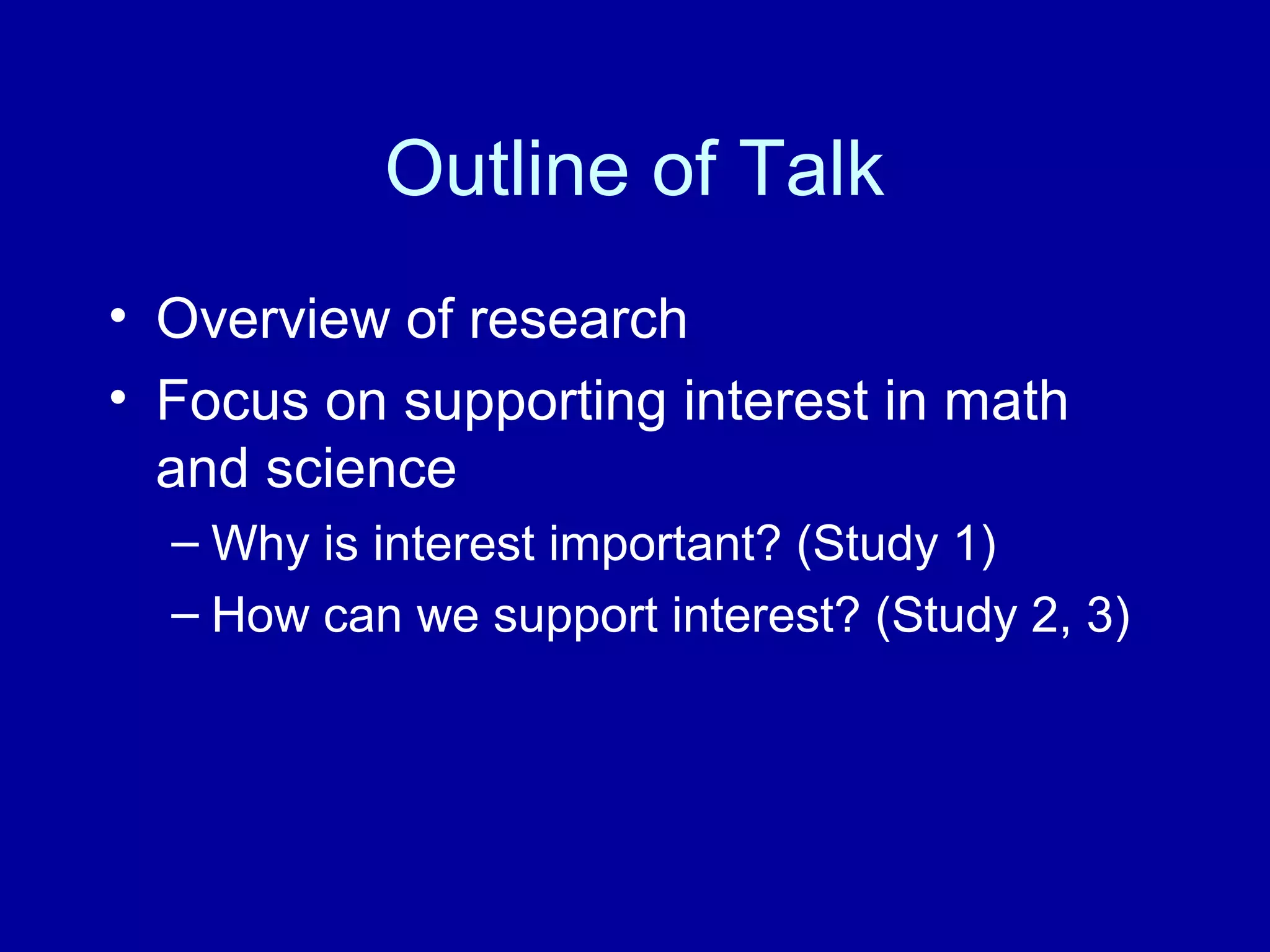
Outline of Talk
• Overview of research
• Focus on supporting interest in math
and science
– Why is interest important? (Study 1)
– How can we support interest? (Study 2, 3)
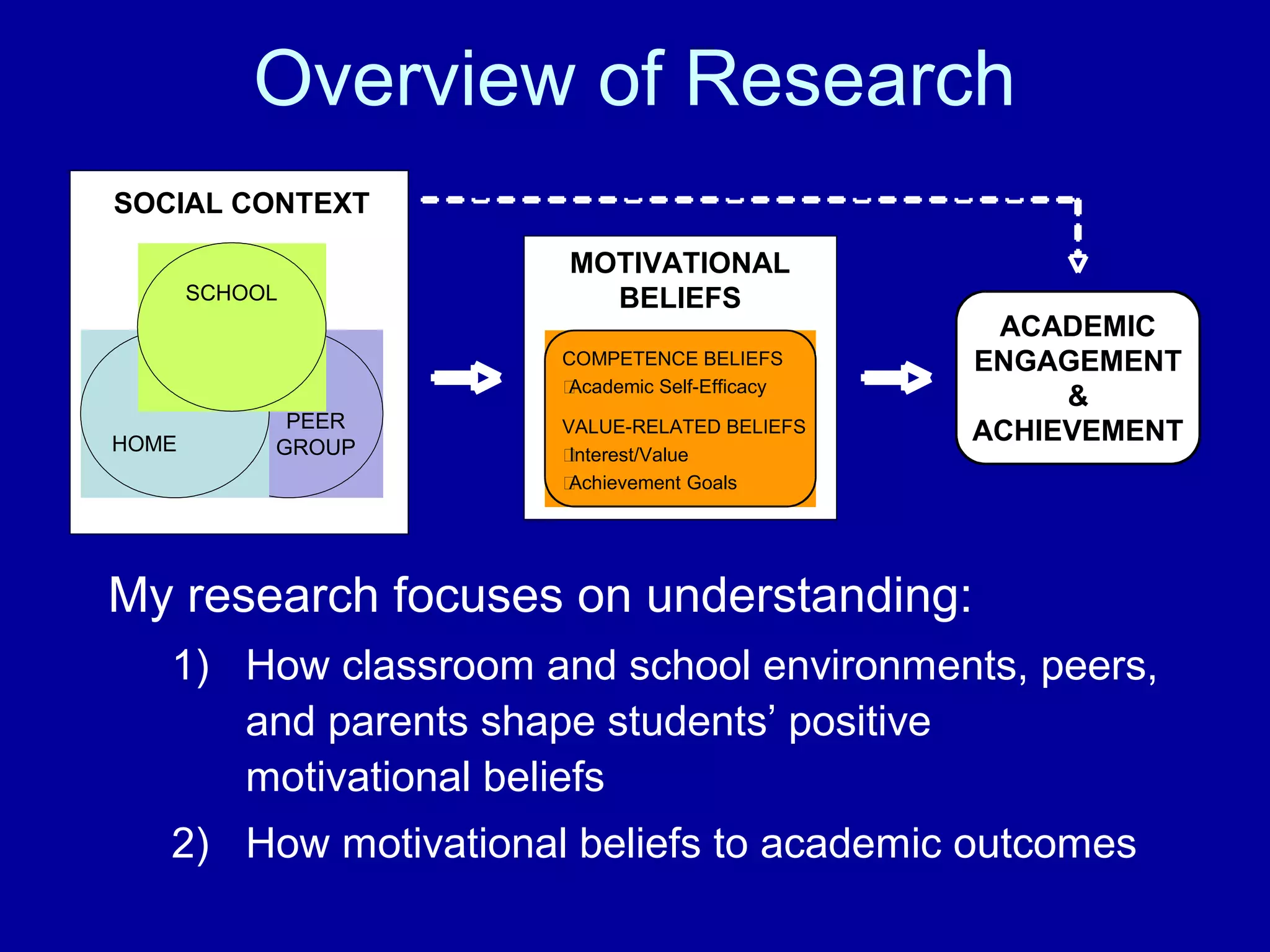
Overview of Research
My research focuses on understanding:
1) How classroom and school environments, peers,
and parents shape students’ positive
motivational beliefs
2) How motivational beliefs to academic outcomes
ACADEMIC
ENGAGEMENT
&
ACHIEVEMENT
MOTIVATIONAL
BELIEFS
COMPETENCE BELIEFS
Academic Self-Efficacy
VALUE-RELATED BELIEFS
Interest/Value
Achievement Goals
SOCIAL CONTEXT
SCHOOL
PEER
GROUPHOME
Motivational Beliefs
• Two primary types of motivational beliefs:
1) Can I do this?
2) Why do I want to do this?
– Reasons for engagement (goal orientations)
– Interest/value in a domain
• Shaped by the environment and what the
individual brings to the environment
FOCUS ON INTEREST
(Why do I want to do this?)
Individual Interest
• Relatively stable, enduring
characteristic of the individual
• Includes both feeling (finding a domain
enjoyable) and value (finding a domain
personally meaningful, useful)
Why is Interest Important?
Study 1: Focus on Science Learning
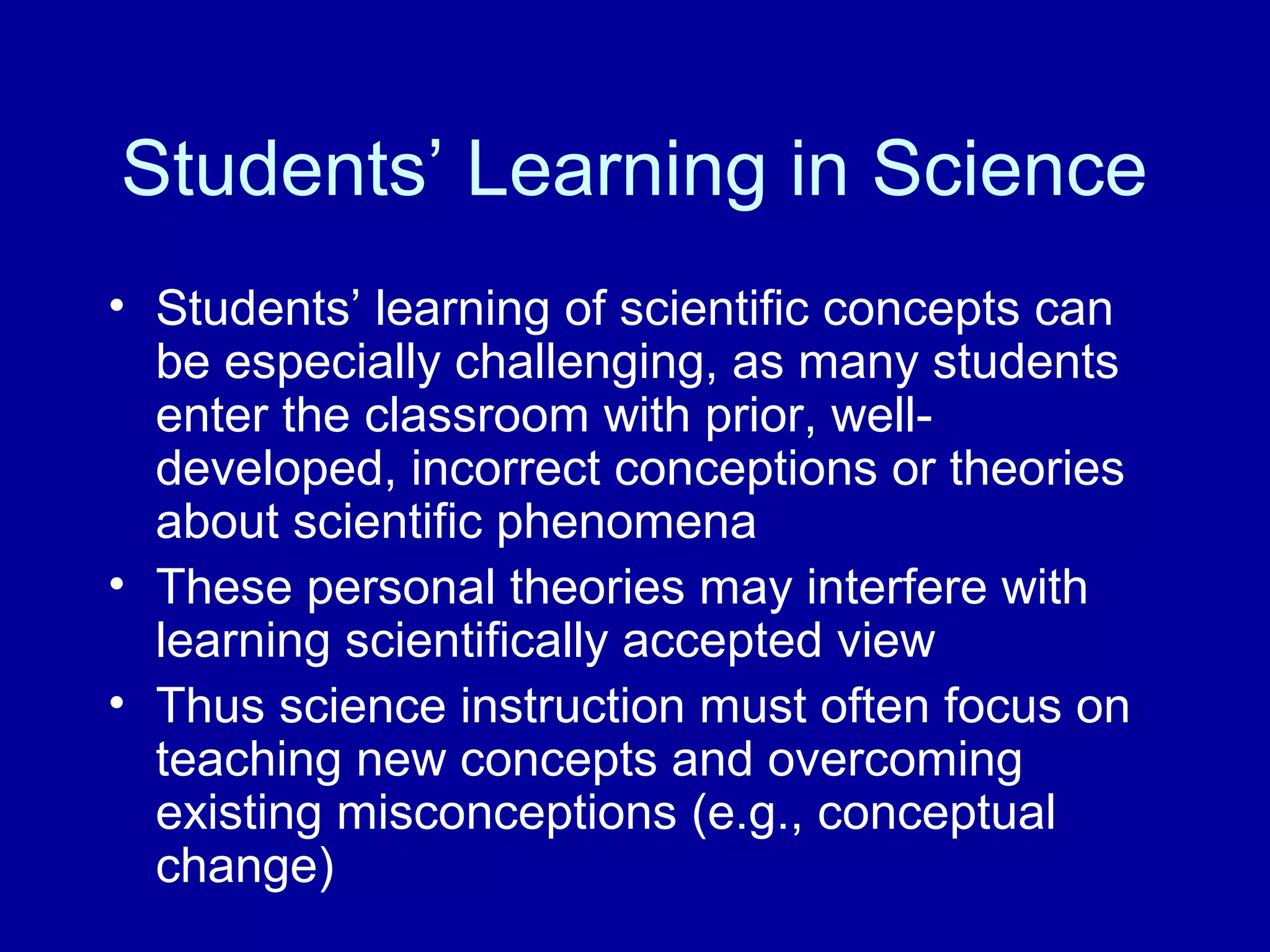
Students’ Learning in Science
• Students’ learning of scientific concepts can
be especially challenging, as many students
enter the classroom with prior, well-
developed, incorrect conceptions or theories
about scientific phenomena
• These personal theories may interfere with
learning scientifically accepted view
• Thus science instruction must often focus on
teaching new concepts and overcoming
existing misconceptions (e.g., conceptual
change)
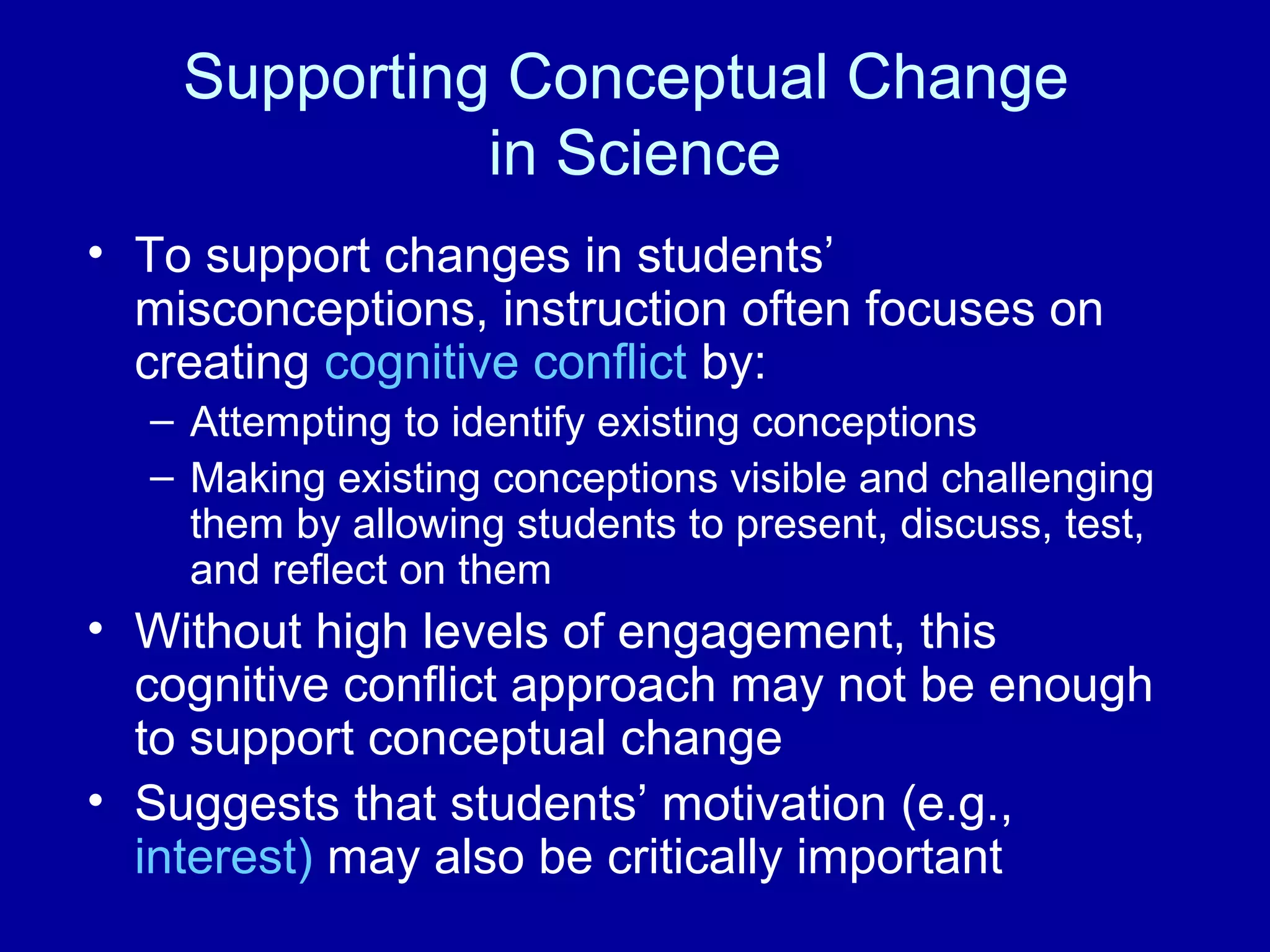
Supporting Conceptual Change
in Science
• To support changes in students’
misconceptions, instruction often focuses on
creating cognitive conflict by:
– Attempting to identify existing conceptions
– Making existing conceptions visible and challenging
them by allowing students to present, discuss, test,
and reflect on them
• Without high levels of engagement, this
cognitive conflict approach may not be enough
to support conceptual change
• Suggests that students’ motivation (e.g.,
interest) may also be critically important
Does the effectiveness of
cognitive conflict on students’
understanding of natural
selection vary as a function of
individual interest in biology?
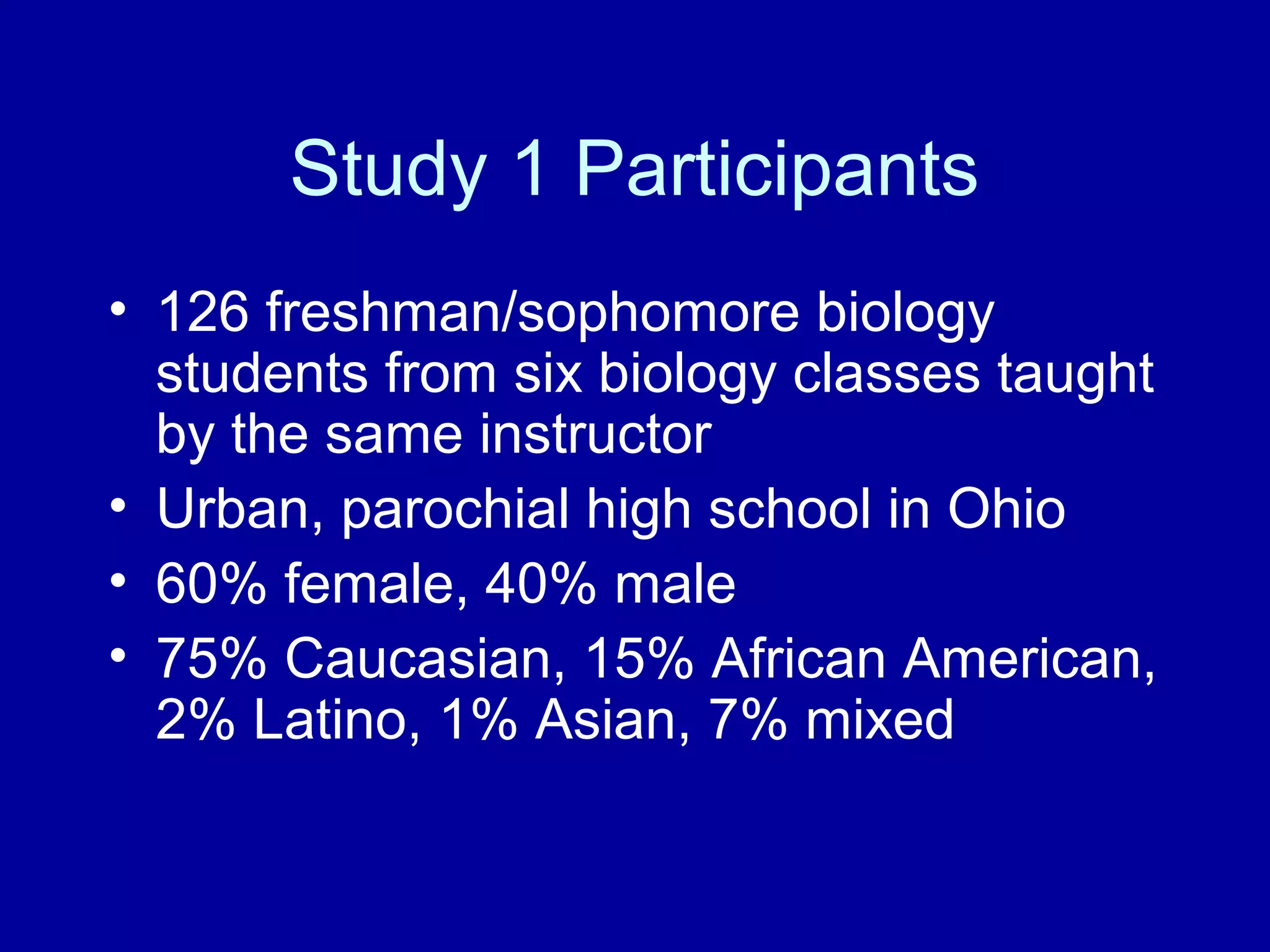
Study 1 Participants
• 126 freshman/sophomore biology
students from six biology classes taught
by the same instructor
• Urban, parochial high school in Ohio
• 60% female, 40% male
• 75% Caucasian, 15% African American,
2% Latino, 1% Asian, 7% mixed
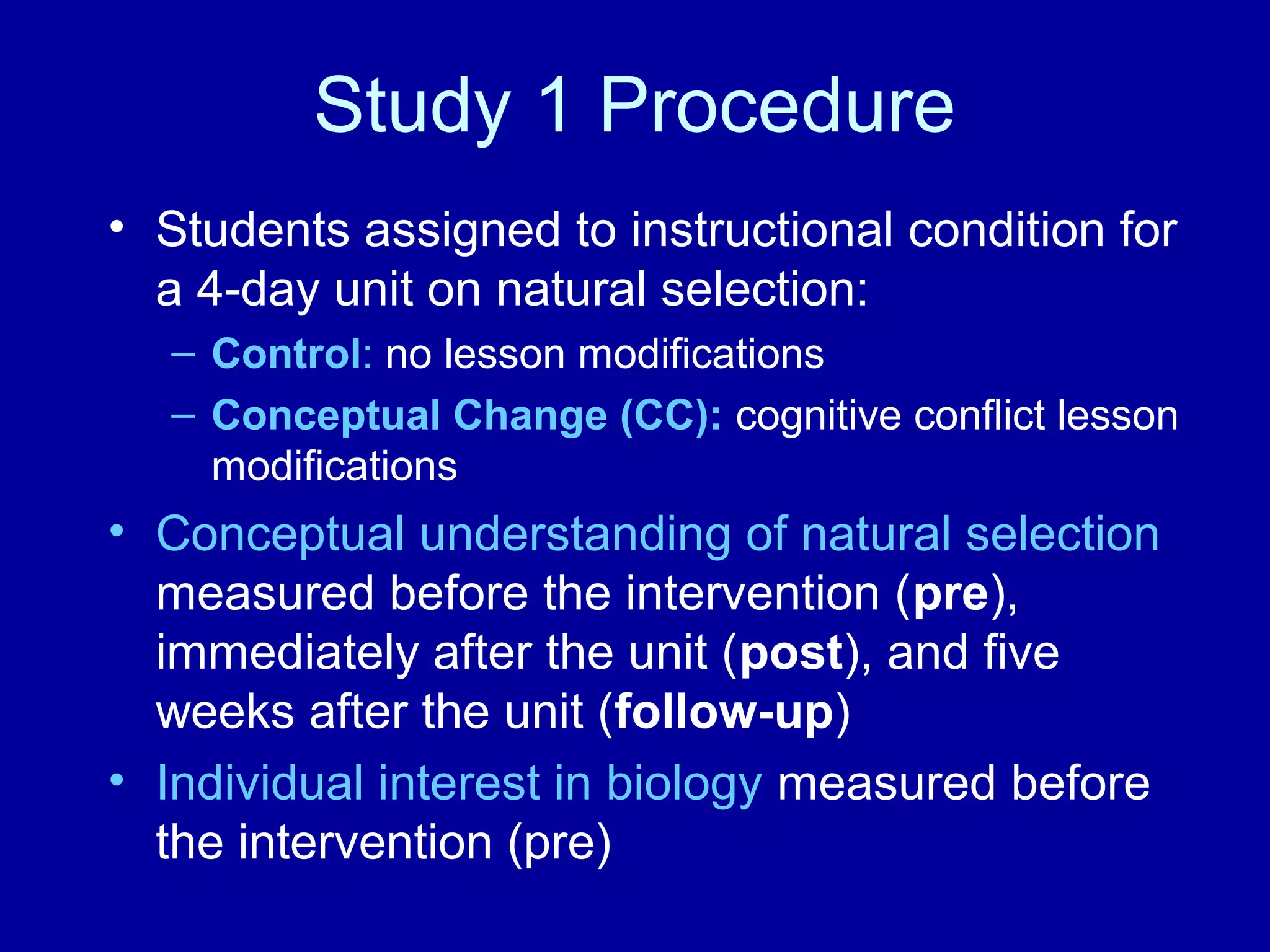
Study 1 Procedure
• Students assigned to instructional condition for
a 4-day unit on natural selection:
– Control: no lesson modifications
– Conceptual Change (CC): cognitive conflict lesson
modifications
• Conceptual understanding of natural selection
measured before the intervention (pre),
immediately after the unit (post), and five
weeks after the unit (follow-up)
• Individual interest in biology measured before
the intervention (pre)
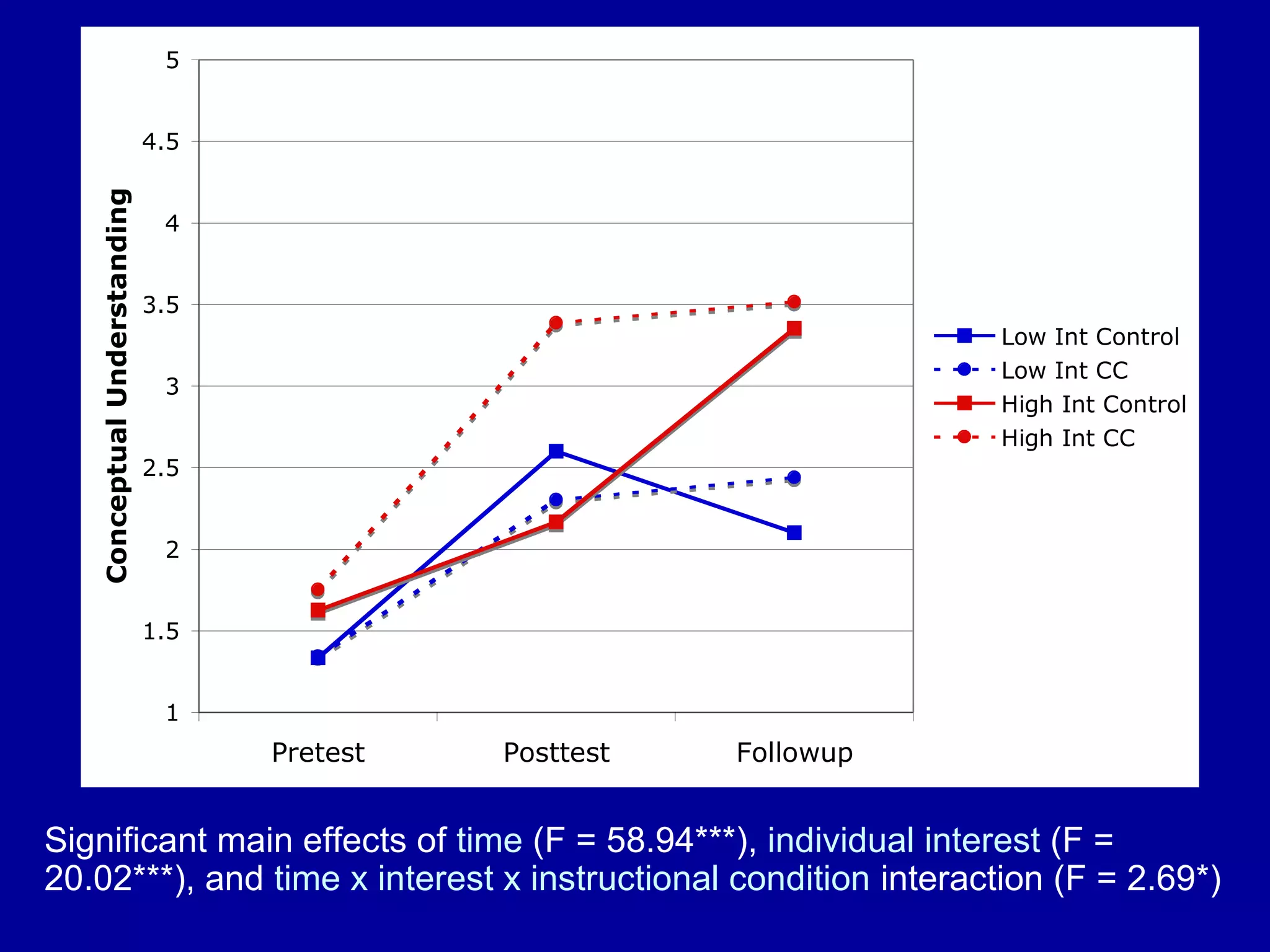
Significant main effects of time (F = 58.94***), individual interest (F =
20.02***), and time x interest x instructional condition interaction (F = 2.69*)
1
1.5
2
2.5
3
3.5
4
4.5
5
Pretest Posttest Followup
ConceptualUnderstanding
Low Int Control
Low Int CC
High Int Control
High Int CC
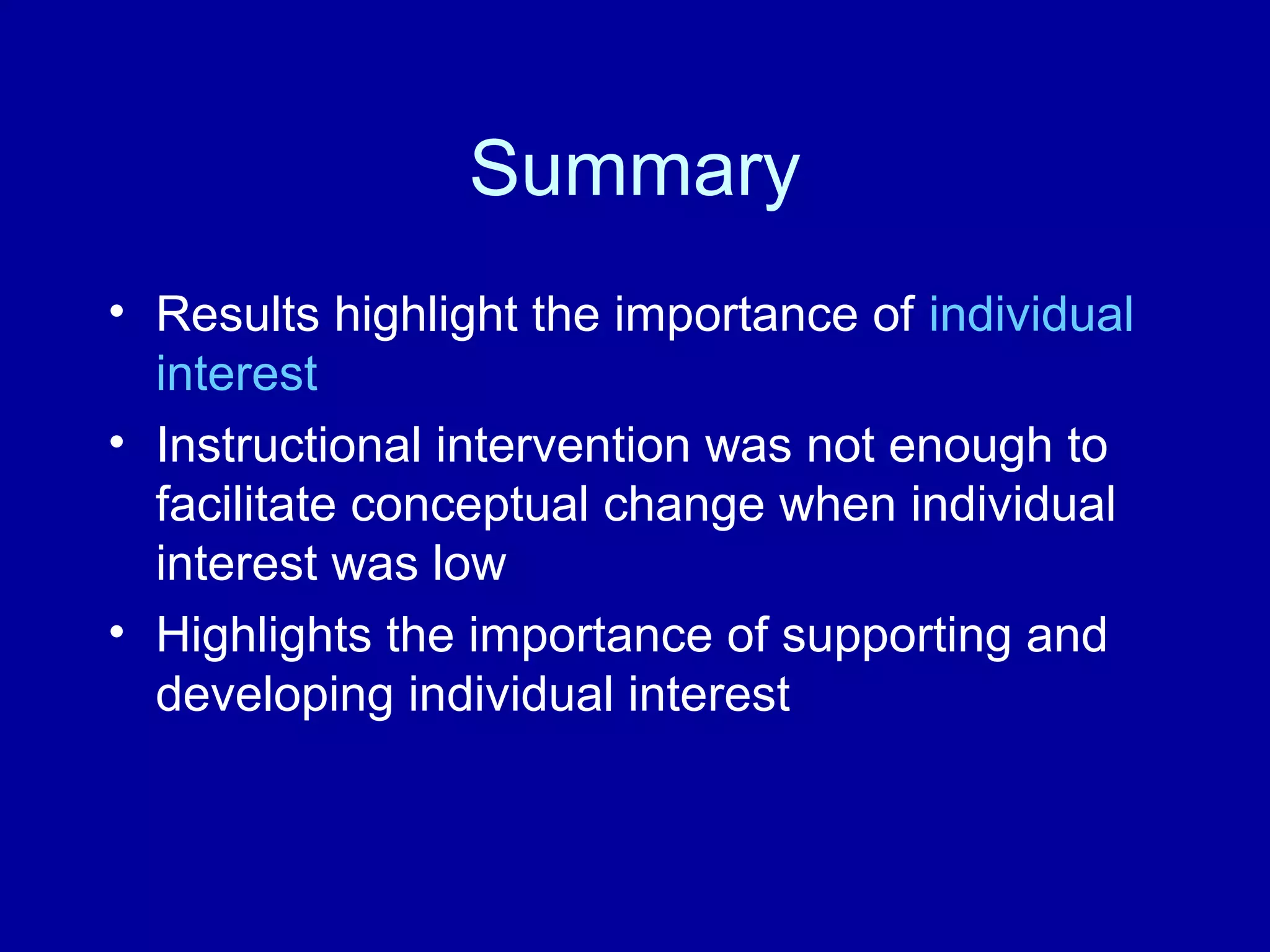
Summary
• Results highlight the importance of individual
interest
• Instructional intervention was not enough to
facilitate conceptual change when individual
interest was low
• Highlights the importance of supporting and
developing individual interest
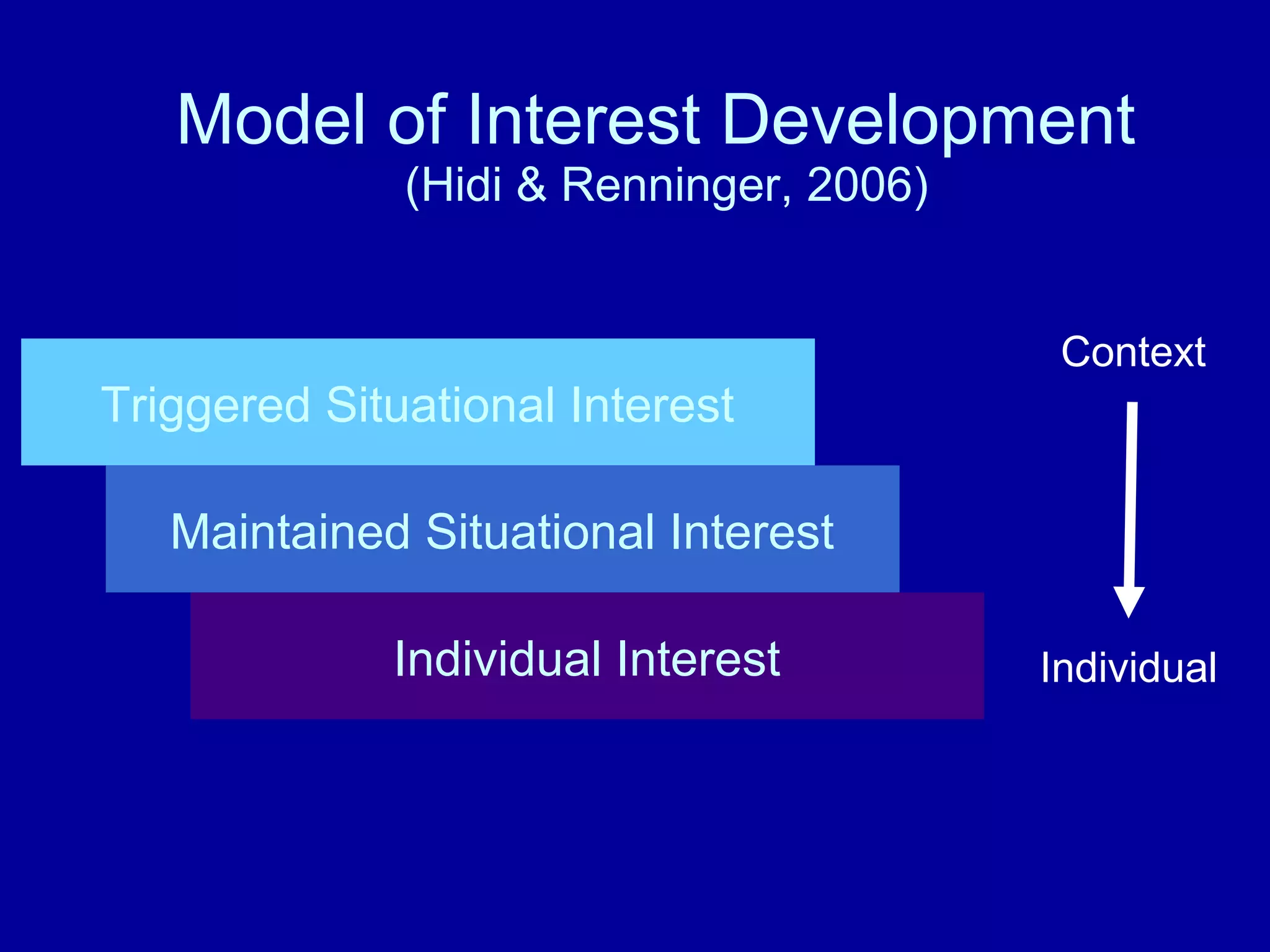
Model of Interest Development
(Hidi & Renninger, 2006)
Triggered Situational Interest
Maintained Situational Interest
Individual Interest
Context
Individual
Situational Interest
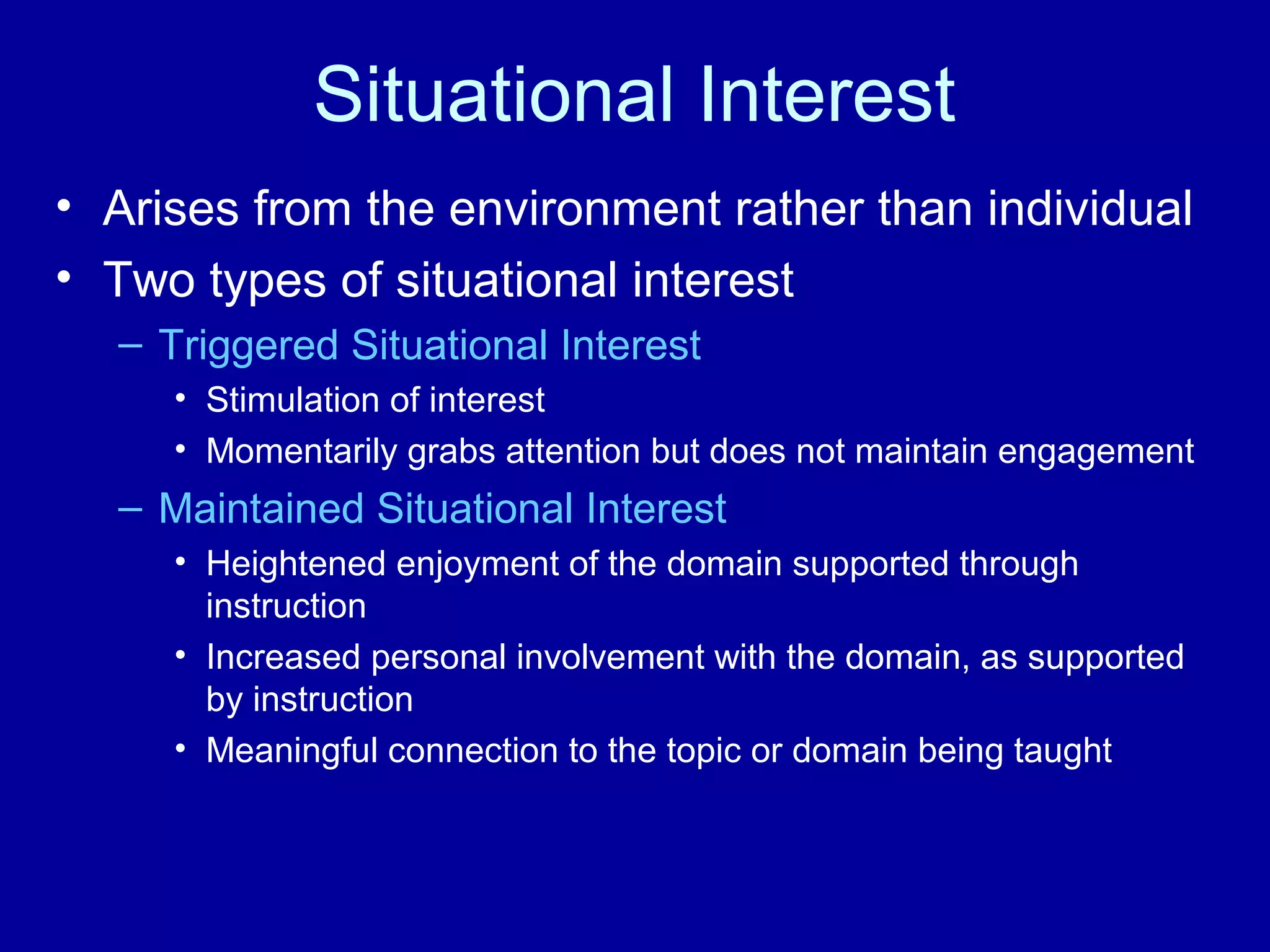
• Arises from the environment rather than individual
• Two types of situational interest
– Triggered Situational Interest
• Stimulation of interest
• Momentarily grabs attention but does not maintain engagement
– Maintained Situational Interest
• Heightened enjoyment of the domain supported through
instruction
• Increased personal involvement with the domain, as supported
by instruction
• Meaningful connection to the topic or domain being taught
Supporting Interest
Development
Study 2: Focus on Situational
Interest
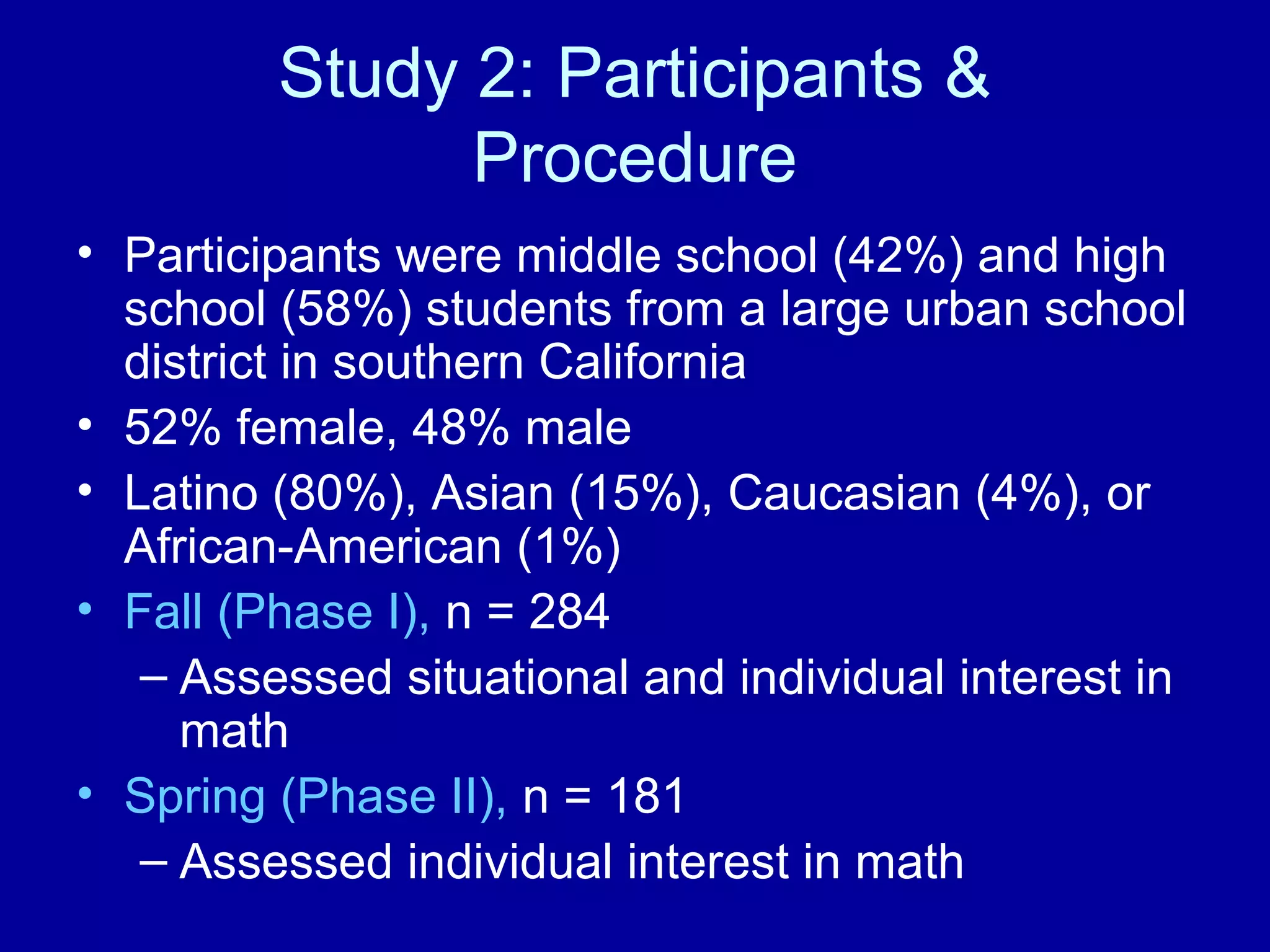
Study 2: Participants &
Procedure
• Participants were middle school (42%) and high
school (58%) students from a large urban school
district in southern California
• 52% female, 48% male
• Latino (80%), Asian (15%), Caucasian (4%), or
African-American (1%)
• Fall (Phase I), n = 284
– Assessed situational and individual interest in
math
• Spring (Phase II), n = 181
– Assessed individual interest in math
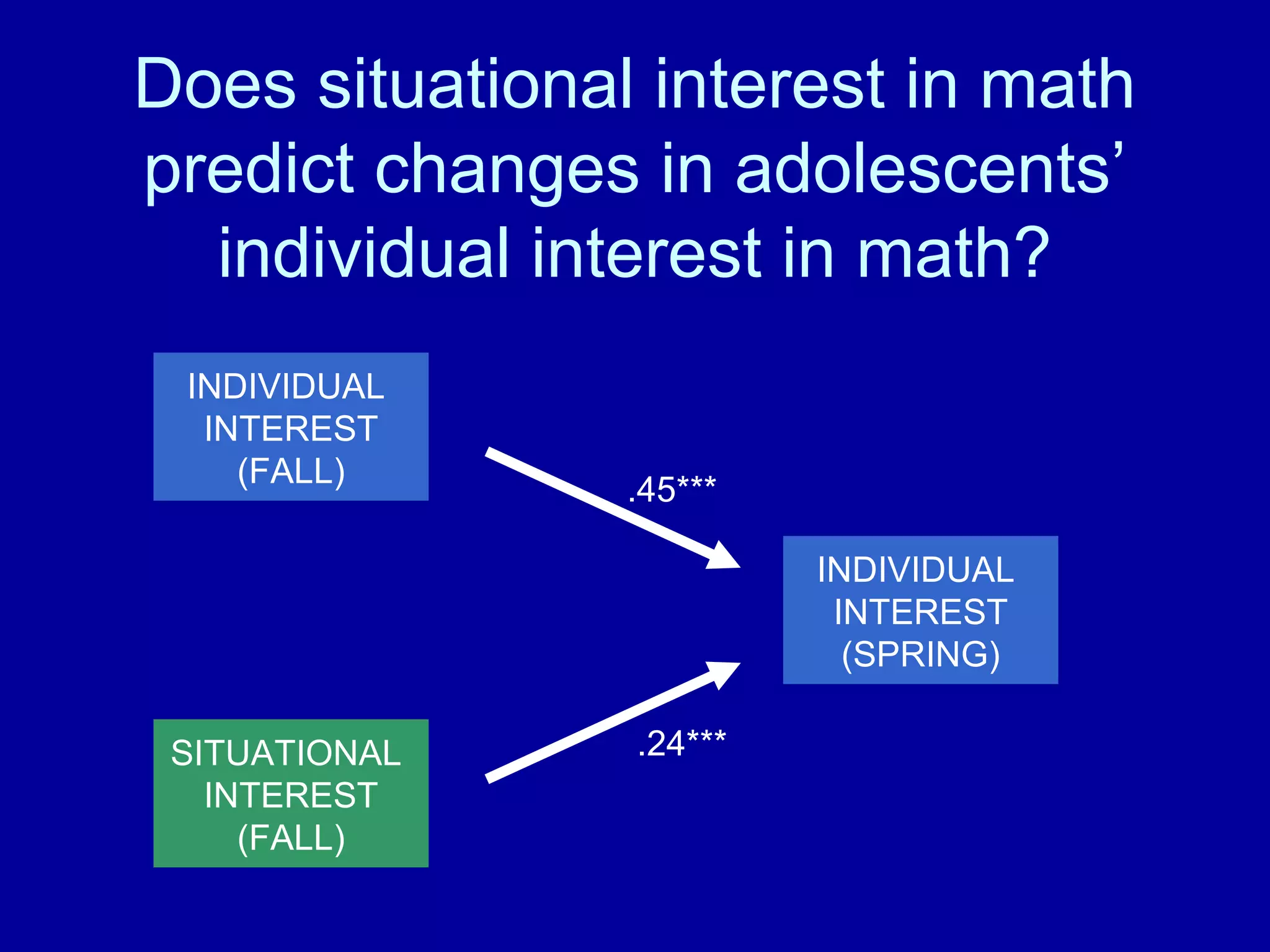
INDIVIDUAL
INTEREST
(FALL)
SITUATIONAL
INTEREST
(FALL)
INDIVIDUAL
INTEREST
(SPRING)
.45***
.24***
Does situational interest in math
predict changes in adolescents’
individual interest in math?
What Instructional Practices
Support Situational Interest and
Does this Lead to Changes in
Individual Interest?
Study 3
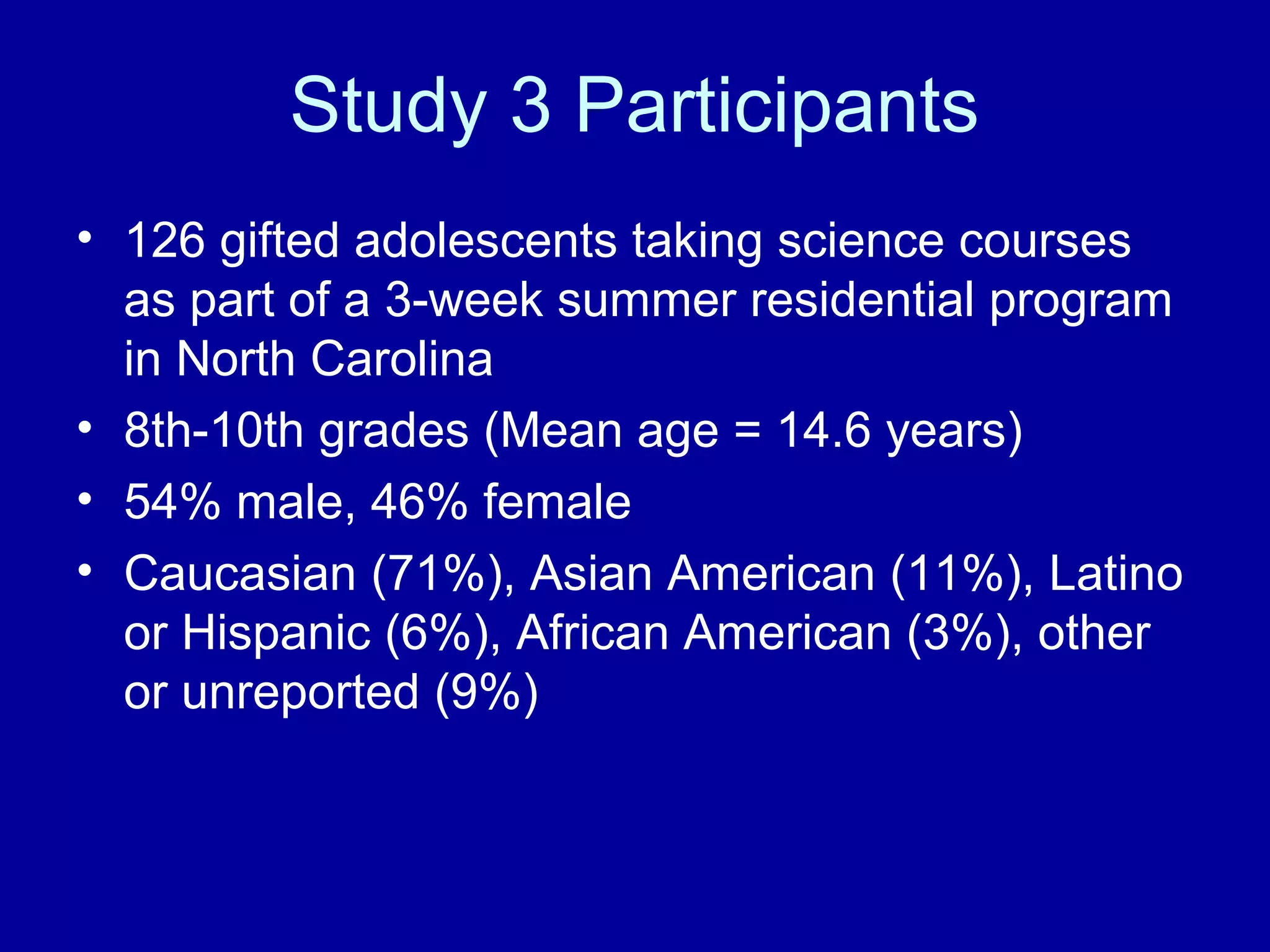
Study 3 Participants
• 126 gifted adolescents taking science courses
as part of a 3-week summer residential program
in North Carolina
• 8th-10th grades (Mean age = 14.6 years)
• 54% male, 46% female
• Caucasian (71%), Asian American (11%), Latino
or Hispanic (6%), African American (3%), other
or unreported (9%)
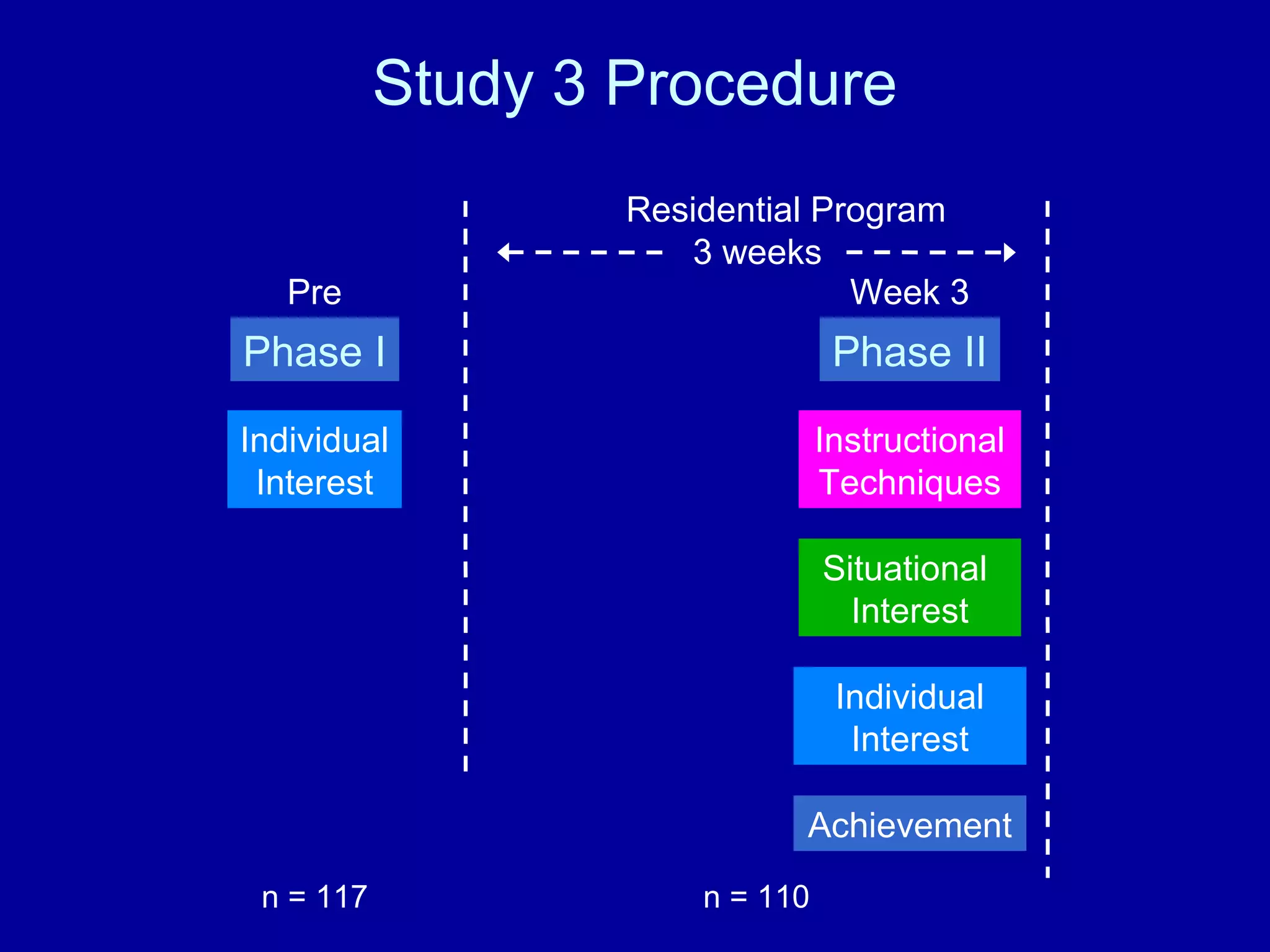
Study 3 Procedure
Phase I Phase II
Individual
Interest
Pre Week 3
Individual
Interest
Situational
Interest
Residential Program
3 weeks
n = 117 n = 110
Instructional
Techniques
Achievement
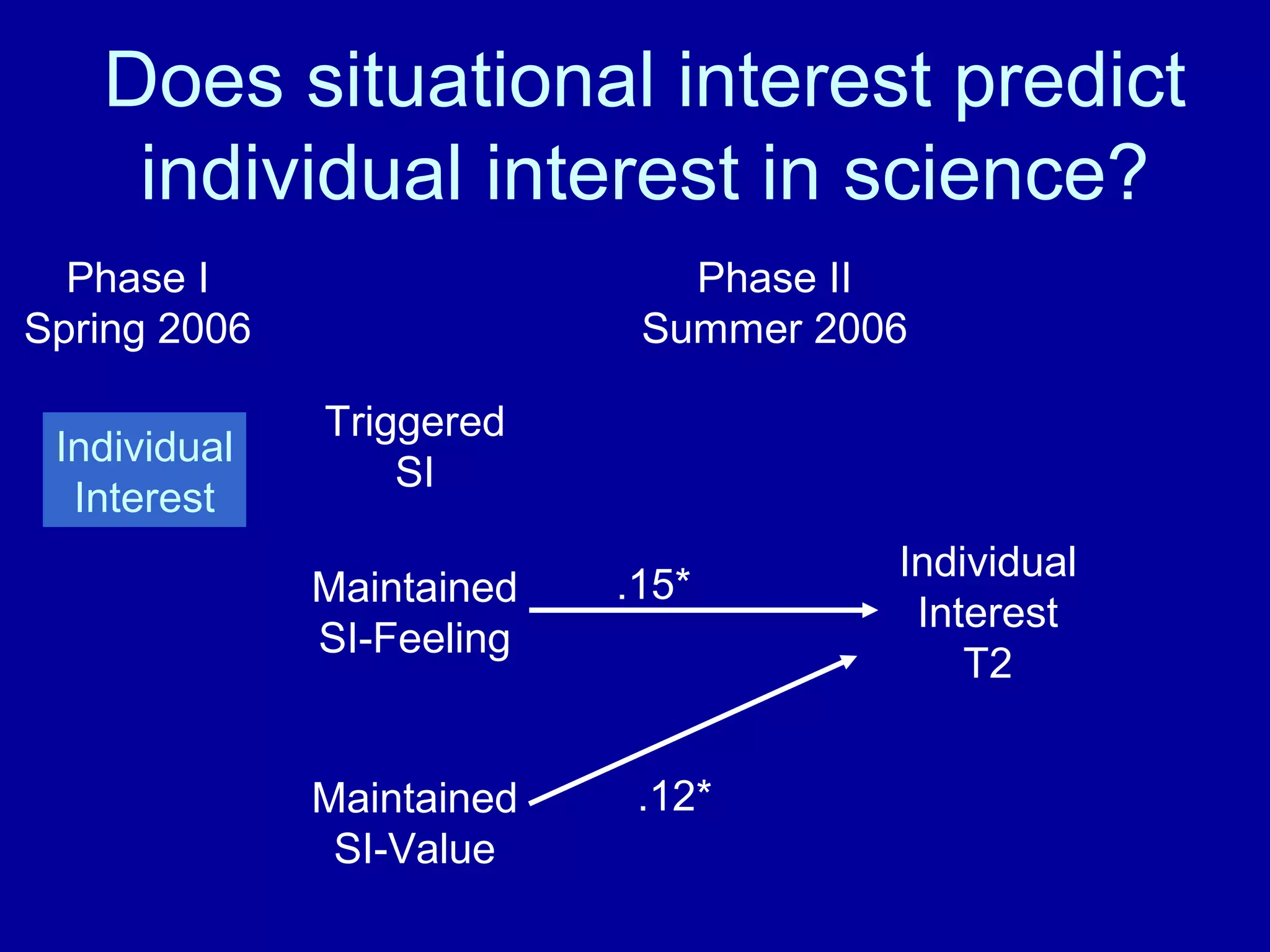
Does situational interest predict
individual interest in science?
Triggered
SI
Maintained
SI-Value
Maintained
SI-Feeling
Individual
Interest
T2
.15*
Individual
Interest
Phase I
Spring 2006
Phase II
Summer 2006
.12*
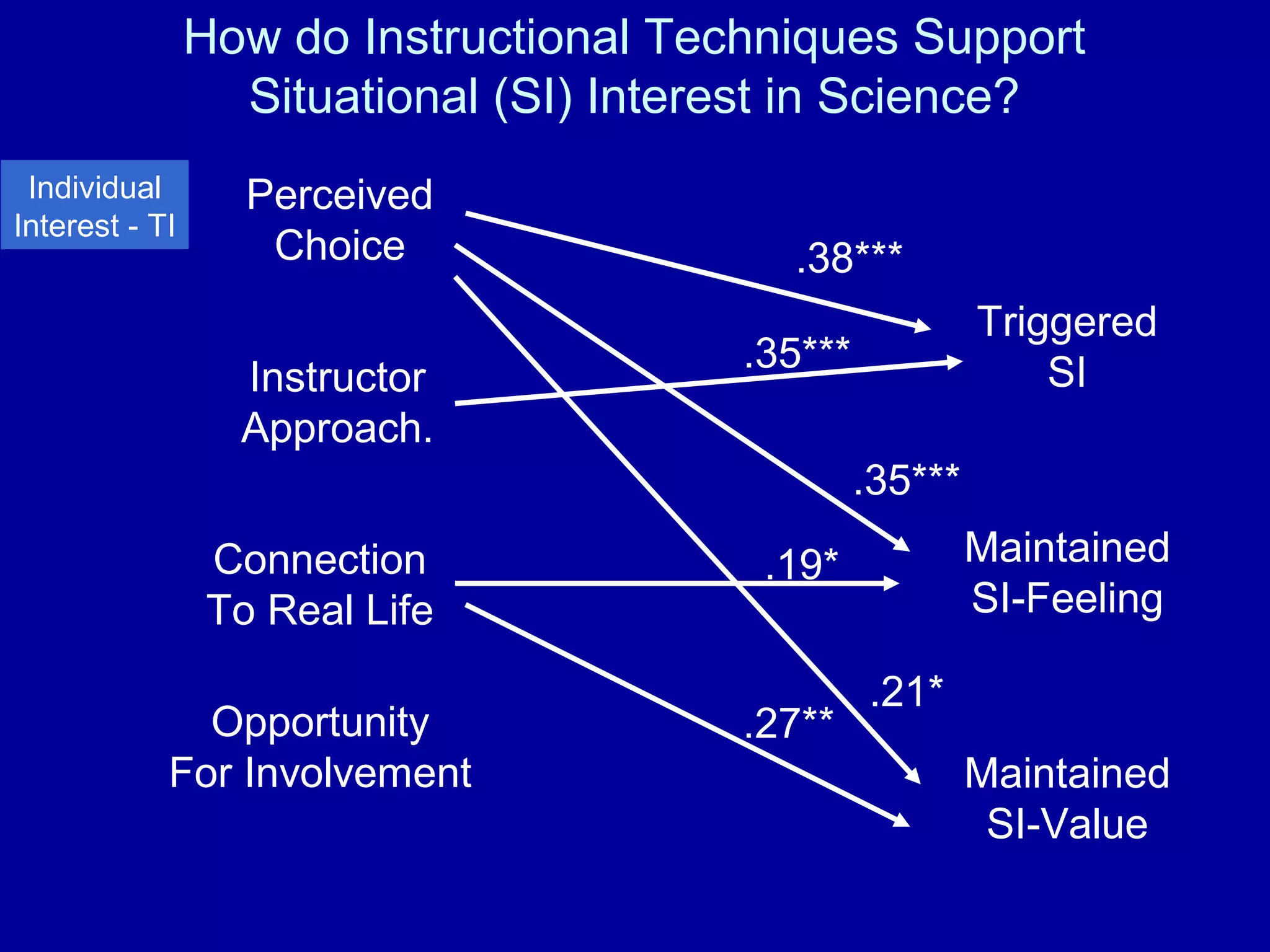
How do Instructional Techniques Support
Situational (SI) Interest in Science?
Perceived
Choice
Connection
To Real Life
Instructor
Approach.
.38***
.35***
Triggered
SI
Maintained
SI-Value
Maintained
SI-Feeling
Individual
Interest - TI
.19*
.35***
.21*
.27**Opportunity
For Involvement
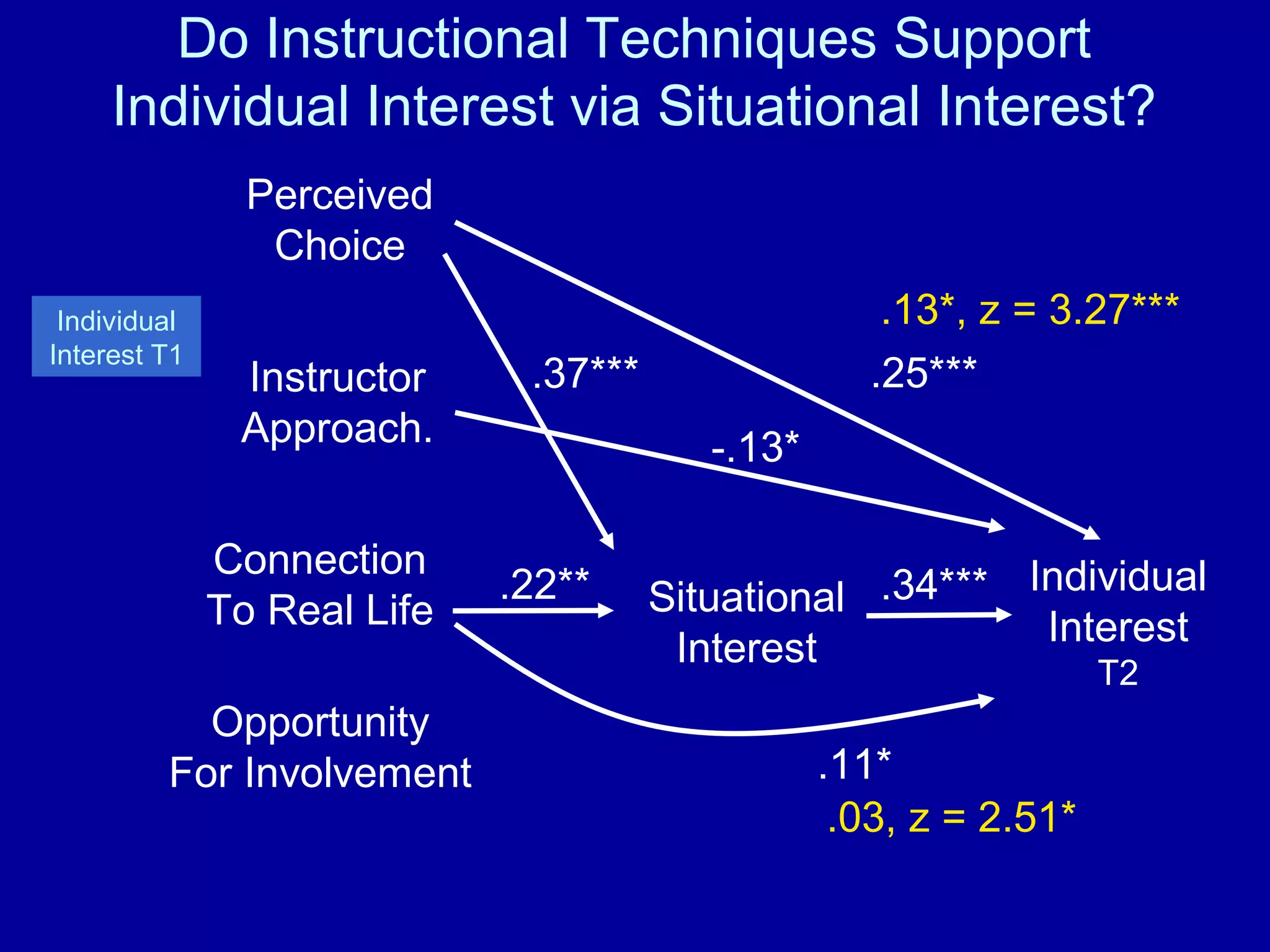
Individual
Interest T1
Individual
Interest
T2
.22**
.25***
.11*
Situational
Interest
.34***
Perceived
Choice
Connection
To Real Life
Instructor
Approach.
Opportunity
For Involvement
.37***
.13*, z = 3.27***
.03, z = 2.51*
-.13*
Do Instructional Techniques Support
Individual Interest via Situational Interest?
Conclusion
• Individual interest is important for enhancing
students’ learning and engagement in school
• Effectiveness of instructional interventions to
facilitate learning may vary as a function of students’
interest (and subsequent engagement in the
intervention)
• Teachers can support situational interest by
providing students with choices and helping to make
connections of course material to real life, which is
in turn associated with changes in domain-level
individual interest
• Suggests that teachers play an important role in
shaping students’ interest in school, which can in
turn facilitate engagement and learning
Thank you…

Srp student motivation_2009

  • 1.
    Supporting Students' Motivation inSchool: A Focus on Classroom Support
  • 2.
    Acknowledgements Linnenbrink-Garcia Lab • AdarBen-Eliyahu • Kate Flanagan • Paul O’Keefe • Erika Patall Other Collaborators • Kenn Barron, James Madison Univ. • AnneMarie Conley, UC, Irvine • Amanda Durik, Northern Illinois • Judith Harackiewicz, Univ. of Wisconsin • Stuart Karabenick, Univ. of Michigan • Kristin Koskey, Univ. of Toledo • Christine Manzey, Univ. of Toledo • Emily Messersmith, UNC-CH • Kevin Pugh, Univ. of Northern Colorado • Victoria Stewart, Univ. of Toledo • John Tauer, Univ. of St. Thomas Study 2 was funded by the National Science Foundation Study 3 was funded by Duke TIP
  • 3.
    Outline of Talk •Overview of research • Focus on supporting interest in math and science – Why is interest important? (Study 1) – How can we support interest? (Study 2, 3)
  • 4.
    Overview of Research Myresearch focuses on understanding: 1) How classroom and school environments, peers, and parents shape students’ positive motivational beliefs 2) How motivational beliefs to academic outcomes ACADEMIC ENGAGEMENT & ACHIEVEMENT MOTIVATIONAL BELIEFS COMPETENCE BELIEFS Academic Self-Efficacy VALUE-RELATED BELIEFS Interest/Value Achievement Goals SOCIAL CONTEXT SCHOOL PEER GROUPHOME
  • 5.
    Motivational Beliefs • Twoprimary types of motivational beliefs: 1) Can I do this? 2) Why do I want to do this? – Reasons for engagement (goal orientations) – Interest/value in a domain • Shaped by the environment and what the individual brings to the environment
  • 6.
    FOCUS ON INTEREST (Whydo I want to do this?)
  • 7.
    Individual Interest • Relativelystable, enduring characteristic of the individual • Includes both feeling (finding a domain enjoyable) and value (finding a domain personally meaningful, useful)
  • 8.
    Why is InterestImportant? Study 1: Focus on Science Learning
  • 9.
    Students’ Learning inScience • Students’ learning of scientific concepts can be especially challenging, as many students enter the classroom with prior, well- developed, incorrect conceptions or theories about scientific phenomena • These personal theories may interfere with learning scientifically accepted view • Thus science instruction must often focus on teaching new concepts and overcoming existing misconceptions (e.g., conceptual change)
  • 10.
    Supporting Conceptual Change inScience • To support changes in students’ misconceptions, instruction often focuses on creating cognitive conflict by: – Attempting to identify existing conceptions – Making existing conceptions visible and challenging them by allowing students to present, discuss, test, and reflect on them • Without high levels of engagement, this cognitive conflict approach may not be enough to support conceptual change • Suggests that students’ motivation (e.g., interest) may also be critically important
  • 11.
    Does the effectivenessof cognitive conflict on students’ understanding of natural selection vary as a function of individual interest in biology?
  • 12.
    Study 1 Participants •126 freshman/sophomore biology students from six biology classes taught by the same instructor • Urban, parochial high school in Ohio • 60% female, 40% male • 75% Caucasian, 15% African American, 2% Latino, 1% Asian, 7% mixed
  • 13.
    Study 1 Procedure •Students assigned to instructional condition for a 4-day unit on natural selection: – Control: no lesson modifications – Conceptual Change (CC): cognitive conflict lesson modifications • Conceptual understanding of natural selection measured before the intervention (pre), immediately after the unit (post), and five weeks after the unit (follow-up) • Individual interest in biology measured before the intervention (pre)
  • 14.
    Significant main effectsof time (F = 58.94***), individual interest (F = 20.02***), and time x interest x instructional condition interaction (F = 2.69*) 1 1.5 2 2.5 3 3.5 4 4.5 5 Pretest Posttest Followup ConceptualUnderstanding Low Int Control Low Int CC High Int Control High Int CC
  • 15.
    Summary • Results highlightthe importance of individual interest • Instructional intervention was not enough to facilitate conceptual change when individual interest was low • Highlights the importance of supporting and developing individual interest
  • 16.
    Model of InterestDevelopment (Hidi & Renninger, 2006) Triggered Situational Interest Maintained Situational Interest Individual Interest Context Individual
  • 17.
    Situational Interest • Arisesfrom the environment rather than individual • Two types of situational interest – Triggered Situational Interest • Stimulation of interest • Momentarily grabs attention but does not maintain engagement – Maintained Situational Interest • Heightened enjoyment of the domain supported through instruction • Increased personal involvement with the domain, as supported by instruction • Meaningful connection to the topic or domain being taught
  • 18.
    Supporting Interest Development Study 2:Focus on Situational Interest
  • 19.
    Study 2: Participants& Procedure • Participants were middle school (42%) and high school (58%) students from a large urban school district in southern California • 52% female, 48% male • Latino (80%), Asian (15%), Caucasian (4%), or African-American (1%) • Fall (Phase I), n = 284 – Assessed situational and individual interest in math • Spring (Phase II), n = 181 – Assessed individual interest in math
  • 20.
  • 21.
    What Instructional Practices SupportSituational Interest and Does this Lead to Changes in Individual Interest? Study 3
  • 22.
    Study 3 Participants •126 gifted adolescents taking science courses as part of a 3-week summer residential program in North Carolina • 8th-10th grades (Mean age = 14.6 years) • 54% male, 46% female • Caucasian (71%), Asian American (11%), Latino or Hispanic (6%), African American (3%), other or unreported (9%)
  • 23.
    Study 3 Procedure PhaseI Phase II Individual Interest Pre Week 3 Individual Interest Situational Interest Residential Program 3 weeks n = 117 n = 110 Instructional Techniques Achievement
  • 24.
    Does situational interestpredict individual interest in science? Triggered SI Maintained SI-Value Maintained SI-Feeling Individual Interest T2 .15* Individual Interest Phase I Spring 2006 Phase II Summer 2006 .12*
  • 25.
    How do InstructionalTechniques Support Situational (SI) Interest in Science? Perceived Choice Connection To Real Life Instructor Approach. .38*** .35*** Triggered SI Maintained SI-Value Maintained SI-Feeling Individual Interest - TI .19* .35*** .21* .27**Opportunity For Involvement
  • 26.
    Individual Interest T1 Individual Interest T2 .22** .25*** .11* Situational Interest .34*** Perceived Choice Connection To RealLife Instructor Approach. Opportunity For Involvement .37*** .13*, z = 3.27*** .03, z = 2.51* -.13* Do Instructional Techniques Support Individual Interest via Situational Interest?
  • 27.
    Conclusion • Individual interestis important for enhancing students’ learning and engagement in school • Effectiveness of instructional interventions to facilitate learning may vary as a function of students’ interest (and subsequent engagement in the intervention) • Teachers can support situational interest by providing students with choices and helping to make connections of course material to real life, which is in turn associated with changes in domain-level individual interest • Suggests that teachers play an important role in shaping students’ interest in school, which can in turn facilitate engagement and learning
  • 28.

Editor's Notes

  • #2 Linnenbrink-Garcia
  • #3 Linnenbrink-Garcia
  • #4 Linnenbrink-Garcia
  • #5 Linnenbrink-Garcia
  • #6 Linnenbrink-Garcia
  • #7 Linnenbrink-Garcia
  • #8 Linnenbrink-Garcia
  • #9 Linnenbrink-Garcia
  • #10 Linnenbrink-Garcia
  • #11 Linnenbrink-Garcia
  • #12 Linnenbrink-Garcia
  • #13 Linnenbrink-Garcia
  • #14 Linnenbrink-Garcia
  • #15 Linnenbrink-Garcia
  • #16 Linnenbrink-Garcia
  • #17 Linnenbrink-Garcia
  • #18 Linnenbrink-Garcia
  • #19 Linnenbrink-Garcia
  • #20 Linnenbrink-Garcia
  • #21 Linnenbrink-Garcia
  • #22 Linnenbrink-Garcia
  • #23 Linnenbrink-Garcia
  • #24 Linnenbrink-Garcia
  • #25 Linnenbrink-Garcia
  • #26 Linnenbrink-Garcia
  • #27 Linnenbrink-Garcia
  • #28 Linnenbrink-Garcia
  • #29 Linnenbrink-Garcia