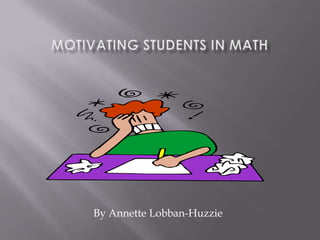
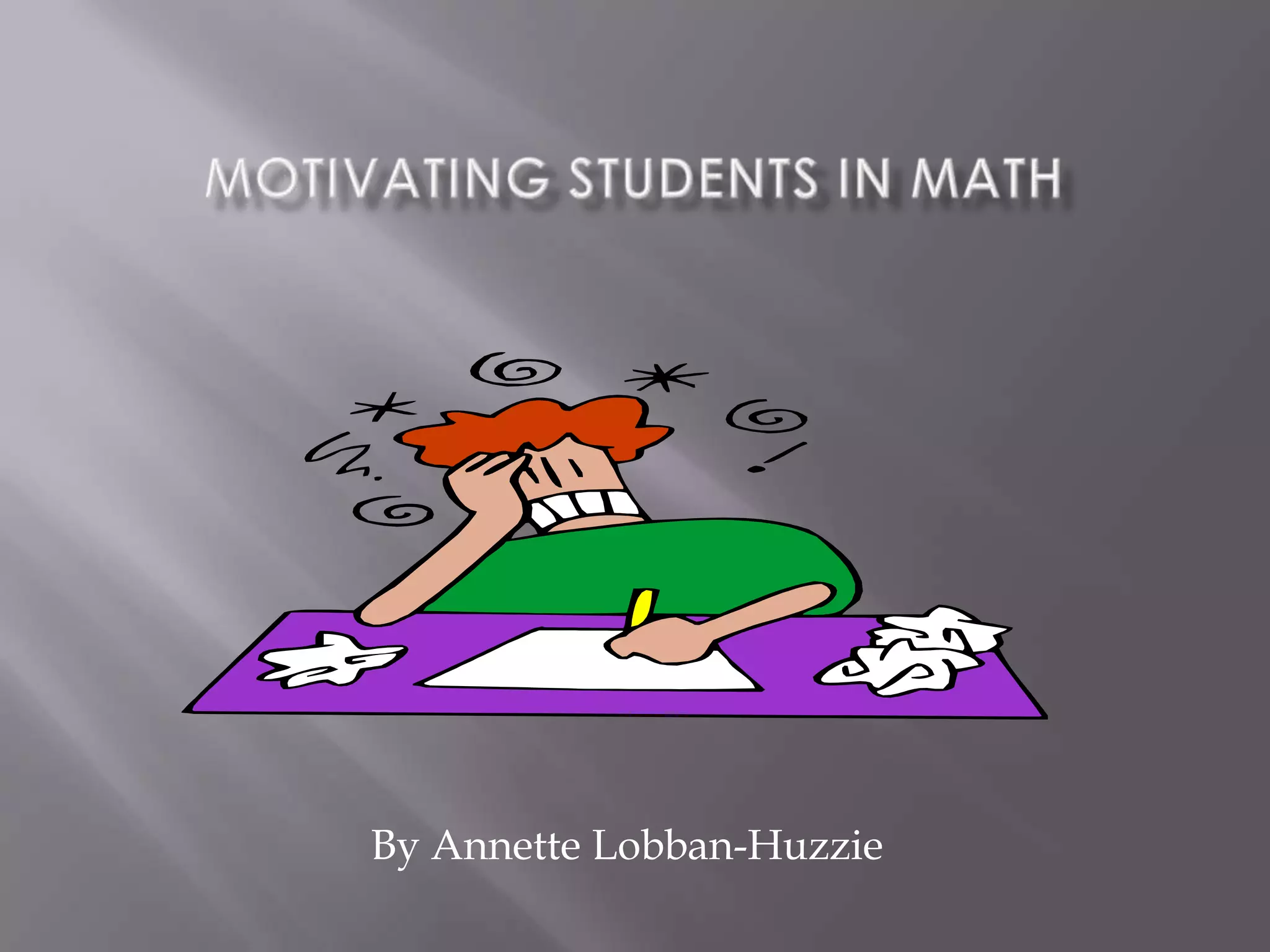
By Annette Lobban-Huzzie
Strategies to build student’s intrinsic
             motivation
   East Side Elementary Title 1 institution

    60% failed the state’s standardized test
    and 70% fail the county’s benchmark test
    (Georgia Online Assessment). At
    International level fourth graders
    performing below students in (Brown, A. &
    Brown, L. 2007)

    Students exceeding standards in all
    subjects except math ( GA. Department of
    Education, 2012).
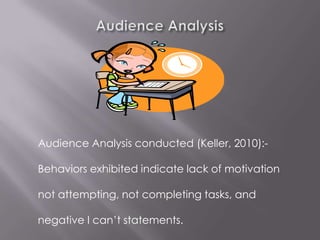
Audience Analysis conducted (Keller, 2010):-

Behaviors exhibited indicate lack of motivation

not attempting, not completing tasks, and

negative I can’t statements.
   Students failing state and county’s benchmark
    tests

   Developing learned helplessness (Schunk, Pintrich,
    & Meece, 2008)
   Intrinsic Motivation Theory
    Self-Determination Theory
    Self-Worth Theory
Design utilizes Keller (2010) ARCS
model:-
    Attention
    Relevance
    Confidence
    Satisfaction
The Creative Solutions Math program will promote

and measure learning through the objectives.

Students will:-

    Apply lessons to real life situations (Relevance)

    Demonstrate continued attention during lesson
     (Attention). Utilize technology, games, small and
     whole group activities.

    Complete activities in module (Confidence)

    Corporate with others (Attitude)
Share

Strategies   Implement technology and games into
             daily math lessons

             Consistently reflect, review and modify
             learning outcomes

             Conduct presentation to share strategies
             with interest groups (administrators &
             teachers)
It is hoped that by providing activities that allow
students to enjoy lessons while determining
relevance, their attention and interest will be aroused
and sustained throughout the lessons. In addition to
this, I hope my creative solution will help to lessen the
gap in math achievement and help students to
develop a positive attitude towards math.
Brown, A., & Brown, L. (2007). What are science and math
test scores really telling U.S.? The Bent of Tau Beta Pi.
Retrieved from
www.tbp.org/pages/publications/Bent/Features/W07Brow
n.pdf

Georgia Department of Education (2012). 2012 CRCT results:
More students exceeding standards (updated 7.12.12).
Georgia Department of Education. Retrieved from
http://www.doe.k12.ga.us/External-Affairs-and -
Policy/communications/Pages/PressrReleaseDetails.aspx?P
ressView=default&pid=46

Keller, J.M. (2010). Motivational design for learning and
performance: The ARCS model approach. New York, NY:
Springer
Mueller, M., Yankelewitz, D., & Maher, C. (2011). Sense
making as motivation in doing mathematics: Results from
two studies. The Mathematics Educator, 20(2), 33-43.

Schunk, D., Pintrich, P., & Meece, J. (2008). Motivation in
education: Theory, research, and application (3rd ed.). Upper
Saddle River, New Jersey: Pearson.

Seifert, T. (2004). Understanding student motivation.
Educational Research, 46(2). 137-149.
SMART Technologies. (2006). Interactive whiteboards and
learning: Improving student learning outcomes and
streamlining lesson plans. SMART Technologies Inc.
Retrieved from
downloads01.smarttech.com/…/research/…/int_whiteboar
d_research_...

Educ 8404 module 6 multi media presentation for voice thread

  • 1.
  • 2.
    Strategies to buildstudent’s intrinsic motivation
  • 3.
    East Side Elementary Title 1 institution  60% failed the state’s standardized test and 70% fail the county’s benchmark test (Georgia Online Assessment). At International level fourth graders performing below students in (Brown, A. & Brown, L. 2007)  Students exceeding standards in all subjects except math ( GA. Department of Education, 2012).
  • 4.
    Audience Analysis conducted(Keller, 2010):- Behaviors exhibited indicate lack of motivation not attempting, not completing tasks, and negative I can’t statements.
  • 5.
    Students failing state and county’s benchmark tests  Developing learned helplessness (Schunk, Pintrich, & Meece, 2008)
  • 6.
    Intrinsic Motivation Theory  Self-Determination Theory  Self-Worth Theory
  • 7.
    Design utilizes Keller(2010) ARCS model:- Attention Relevance Confidence Satisfaction
  • 8.
    The Creative SolutionsMath program will promote and measure learning through the objectives. Students will:-  Apply lessons to real life situations (Relevance)  Demonstrate continued attention during lesson (Attention). Utilize technology, games, small and whole group activities.  Complete activities in module (Confidence)  Corporate with others (Attitude)
  • 9.
    Share Strategies Implement technology and games into daily math lessons Consistently reflect, review and modify learning outcomes Conduct presentation to share strategies with interest groups (administrators & teachers)
  • 10.
    It is hopedthat by providing activities that allow students to enjoy lessons while determining relevance, their attention and interest will be aroused and sustained throughout the lessons. In addition to this, I hope my creative solution will help to lessen the gap in math achievement and help students to develop a positive attitude towards math.
  • 11.
    Brown, A., &Brown, L. (2007). What are science and math test scores really telling U.S.? The Bent of Tau Beta Pi. Retrieved from www.tbp.org/pages/publications/Bent/Features/W07Brow n.pdf Georgia Department of Education (2012). 2012 CRCT results: More students exceeding standards (updated 7.12.12). Georgia Department of Education. Retrieved from http://www.doe.k12.ga.us/External-Affairs-and - Policy/communications/Pages/PressrReleaseDetails.aspx?P ressView=default&pid=46 Keller, J.M. (2010). Motivational design for learning and performance: The ARCS model approach. New York, NY: Springer
  • 12.
    Mueller, M., Yankelewitz,D., & Maher, C. (2011). Sense making as motivation in doing mathematics: Results from two studies. The Mathematics Educator, 20(2), 33-43. Schunk, D., Pintrich, P., & Meece, J. (2008). Motivation in education: Theory, research, and application (3rd ed.). Upper Saddle River, New Jersey: Pearson. Seifert, T. (2004). Understanding student motivation. Educational Research, 46(2). 137-149.
  • 13.
    SMART Technologies. (2006).Interactive whiteboards and learning: Improving student learning outcomes and streamlining lesson plans. SMART Technologies Inc. Retrieved from downloads01.smarttech.com/…/research/…/int_whiteboar d_research_...