THE GREAT INDIAN REVOLT OF 
1857 
SUBMITTED BY 
SREELAL C P
THE GREAT INDIAN REVOLT 
INTRODUCTION 
THE REVOLT OF 1857 WAS A LARGE SCALE REBELLION 
AGAINST BRITISH RULE THAT SWEPT ACROSS NORTHERN AND 
CENTRAL INDIA IN A SERIES OF VIOLENT UPRISINGS.IF IT 
HAD SUCCEEDED IT WOULD HAVE MARKED THE END OF 
COLONIAL RULE IN INDIA.BUT AFTER BATTLING THE REBELS 
FOR ALMOST TWO YEARS,THE BRITISH MANAGED TO CRUSH 
THE REVOLT.THEY WENT ON TO RULE INDIA FOR ANOTHER 
90 YEARS.BUT THE REVOLT OF 1857 HAD SUCH FAR 
REACHING CONSEQUENCES THAT SOME HISTORIANS REFER TO 
IT AS THE FIRST WAR OF INDIAN INDEPENDENCE.
Importance of Revolt 
In modern Indian history the revolt of 1857 
is to much impotent because it is the first 
revolution which started in on national 
level. Different community of India 
participated in this revolt .
Different Opinion Regarding Revolt 
1.Desiarley- 
“It was the national Revolt” 
2.John Selay- 
The revolt of 1857 was sipoy mutiny 
3. T. R. Homes- 
Struggle between civilized and civilized person “ 
4.Vinayak Damodar Sawerkar- 
“The revolt of 1857 was first national in 
dependence”
THE GREAT INDIAN REVOLT 
CAUSES FOR THE REVOLT OF 1857 
 ECONOMIC CAUSES 
1. The zamindari system was introduced by the british and the 
pleasants were exploited by them.They were often tortured or 
jailed when the peasants failed to pay the taxes. 
2. The landlords also were insecured and lands were confiscated 
when the taxes did not match the assigned goals. 
3. The interest of India were not the first priority of the 
government.The british came in India for economic profit,which 
was the main priority.No measures were taken to improve the 
conditions of the peasants and the artisians. 
4. The annexation of Indian states was followed by large scale 
unemployment and economic distress as a large number of court 
officials and other lost their means of earning.All poets,artisians 
etc working under these rulers lost their jobs.
THE GREAT INDIAN REVOLT 
 POLITICAL CAUSES 
1. Lord Dalhousie caused widespread resentment among the Indian rulers 
and their subjects by aggressively expanding his state and annexing 
native Indian states. 
2. He annexed the states of satara nagpur and jhansi by applying the 
doctrine of lapse. 
3. Nana Sahib was denied a pension after his father’s death.He was the 
son of Peshwa Baji Rao II. 
4. Bahadur Shah’s successors was denied the right to live at the Red Fort. 
5. He annexed Awadh,accusing the government of maladministration and 
shocking the nawab who was a faithfully and the people of India. 
6. The british did not obey the treaties sometimes and they were broken 
according to the need of the british and the nawabs at that time could 
not trust any treaty at all.
THE GREAT INDIAN REVOLT 
 SOCIAL CAUSES 
1. Social reforms by the britishers were hated by the Indians who 
took it as a mark of british interference in the political affairs of 
India. 
2. The efforts of missionaries to convert people to cristianity also 
angered the Indians. 
3. The introduction of western education undetermined the position of 
the traditional teachers and teaching methods in India. 
4. The british judicial system introduced the principal of equality 
which determined the presence of caste system in India. 
5. The british looked down upon Indians and followed a policy of 
racial discrimination and separated themselves as SUPERIORS from 
the Indian society.Lord Wellesley described Indians as 
vulgar,ignorant,rude,familiar and stupid.
THE GREAT INDIAN REVOLT 
 MILITARY CAUSES 
1. The sepoys had helped the british to establish their empire in India 
but were not awarded or promoted at all.On the contrary,they were 
treated with contempt. 
2. There was a discrimination between the Indian and the british 
soldiers. 
3. An Indian soldier got much less salary as compared to a Western 
soldier. 
4. The senior british officers did not pay any respect to the Indian 
soldiers at all. 
5. The Indian soldiers were much more in number as compared to 
the british soldiers.In 1856 the number of Indian troops was up to 
5 times as compared to the british troops.This also encouraged the 
sepoys to rise against the british.
THE GREAT INDIAN REVOLT 
SPREAD OF REVOLT 
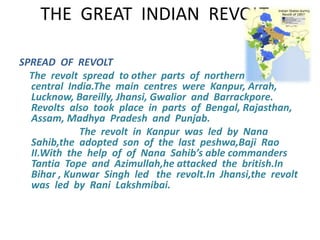
The revolt spread to other parts of northern and 
central India.The main centres were Kanpur, Arrah, 
Lucknow, Bareilly, Jhansi, Gwalior and Barrackpore. 
Revolts also took place in parts of Bengal, Rajasthan, 
Assam, Madhya Pradesh and Punjab. 
The revolt in Kanpur was led by Nana 
Sahib,the adopted son of the last peshwa,Baji Rao 
II.With the help of of Nana Sahib’s able commanders 
Tantia Tope and Azimullah,he attacked the british.In 
Bihar , Kunwar Singh led the revolt.In Jhansi,the revolt 
was led by Rani Lakshmibai.
IMPORTANT CENTER OF REVOLT 
1.MERRUT 8.ALLAHABAD 
2.DELHI 9. GOWALIAR 
3.LUCKNOW 10.JHASHI 
4.KANPUR 
5.BARELY 
6. FAIZABAD 
7.DANAPUR
IMPORTANT LEADER 
1.MANGAL PANDAY 10.NANA SAHAB 
2.BHADUR SHHA JAFAR 
3.KHAN BAHADUR 
4.BABU KUWAR SINGH 
5. LAXMI BAI 
6.TATYA TOPE 
8.LIYAKAT ALI 
9.BEGAM HAJARAT MAHAL
THE GREAT INDIAN REVOLT 
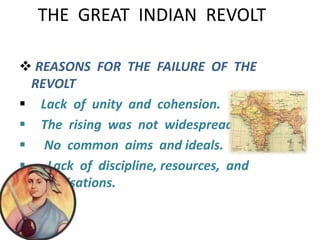
 REASONS FOR THE FAILURE OF THE 
REVOLT 
 Lack of unity and cohension. 
 The rising was not widespread. 
 No common aims and ideals. 
 Lack of discipline, resources, and 
organisations.
THE GREAT INDIAN REVOLT 
 RESULTS OF THE REVOLT 
a) The English East India Company’s rule came to 
an end. 
b) The administration of India was taken over by 
the british crown. 
c) The board of directors and the board of control 
were abolished. 
d) The Indian army was thoroughly reorganised. 
e) The policy of ruthless conquests in India was 
given up.
THE GREAT INDIAN REVOLT 
SREELAL C P

Sreelal

  • 1.
    THE GREAT INDIANREVOLT OF 1857 SUBMITTED BY SREELAL C P
  • 2.
    THE GREAT INDIANREVOLT INTRODUCTION THE REVOLT OF 1857 WAS A LARGE SCALE REBELLION AGAINST BRITISH RULE THAT SWEPT ACROSS NORTHERN AND CENTRAL INDIA IN A SERIES OF VIOLENT UPRISINGS.IF IT HAD SUCCEEDED IT WOULD HAVE MARKED THE END OF COLONIAL RULE IN INDIA.BUT AFTER BATTLING THE REBELS FOR ALMOST TWO YEARS,THE BRITISH MANAGED TO CRUSH THE REVOLT.THEY WENT ON TO RULE INDIA FOR ANOTHER 90 YEARS.BUT THE REVOLT OF 1857 HAD SUCH FAR REACHING CONSEQUENCES THAT SOME HISTORIANS REFER TO IT AS THE FIRST WAR OF INDIAN INDEPENDENCE.
  • 3.
    Importance of Revolt In modern Indian history the revolt of 1857 is to much impotent because it is the first revolution which started in on national level. Different community of India participated in this revolt .
  • 4.
    Different Opinion RegardingRevolt 1.Desiarley- “It was the national Revolt” 2.John Selay- The revolt of 1857 was sipoy mutiny 3. T. R. Homes- Struggle between civilized and civilized person “ 4.Vinayak Damodar Sawerkar- “The revolt of 1857 was first national in dependence”
  • 5.
    THE GREAT INDIANREVOLT CAUSES FOR THE REVOLT OF 1857  ECONOMIC CAUSES 1. The zamindari system was introduced by the british and the pleasants were exploited by them.They were often tortured or jailed when the peasants failed to pay the taxes. 2. The landlords also were insecured and lands were confiscated when the taxes did not match the assigned goals. 3. The interest of India were not the first priority of the government.The british came in India for economic profit,which was the main priority.No measures were taken to improve the conditions of the peasants and the artisians. 4. The annexation of Indian states was followed by large scale unemployment and economic distress as a large number of court officials and other lost their means of earning.All poets,artisians etc working under these rulers lost their jobs.
  • 6.
    THE GREAT INDIANREVOLT  POLITICAL CAUSES 1. Lord Dalhousie caused widespread resentment among the Indian rulers and their subjects by aggressively expanding his state and annexing native Indian states. 2. He annexed the states of satara nagpur and jhansi by applying the doctrine of lapse. 3. Nana Sahib was denied a pension after his father’s death.He was the son of Peshwa Baji Rao II. 4. Bahadur Shah’s successors was denied the right to live at the Red Fort. 5. He annexed Awadh,accusing the government of maladministration and shocking the nawab who was a faithfully and the people of India. 6. The british did not obey the treaties sometimes and they were broken according to the need of the british and the nawabs at that time could not trust any treaty at all.
  • 7.
    THE GREAT INDIANREVOLT  SOCIAL CAUSES 1. Social reforms by the britishers were hated by the Indians who took it as a mark of british interference in the political affairs of India. 2. The efforts of missionaries to convert people to cristianity also angered the Indians. 3. The introduction of western education undetermined the position of the traditional teachers and teaching methods in India. 4. The british judicial system introduced the principal of equality which determined the presence of caste system in India. 5. The british looked down upon Indians and followed a policy of racial discrimination and separated themselves as SUPERIORS from the Indian society.Lord Wellesley described Indians as vulgar,ignorant,rude,familiar and stupid.
  • 8.
    THE GREAT INDIANREVOLT  MILITARY CAUSES 1. The sepoys had helped the british to establish their empire in India but were not awarded or promoted at all.On the contrary,they were treated with contempt. 2. There was a discrimination between the Indian and the british soldiers. 3. An Indian soldier got much less salary as compared to a Western soldier. 4. The senior british officers did not pay any respect to the Indian soldiers at all. 5. The Indian soldiers were much more in number as compared to the british soldiers.In 1856 the number of Indian troops was up to 5 times as compared to the british troops.This also encouraged the sepoys to rise against the british.
  • 9.
    THE GREAT INDIANREVOLT SPREAD OF REVOLT The revolt spread to other parts of northern and central India.The main centres were Kanpur, Arrah, Lucknow, Bareilly, Jhansi, Gwalior and Barrackpore. Revolts also took place in parts of Bengal, Rajasthan, Assam, Madhya Pradesh and Punjab. The revolt in Kanpur was led by Nana Sahib,the adopted son of the last peshwa,Baji Rao II.With the help of of Nana Sahib’s able commanders Tantia Tope and Azimullah,he attacked the british.In Bihar , Kunwar Singh led the revolt.In Jhansi,the revolt was led by Rani Lakshmibai.
  • 10.
    IMPORTANT CENTER OFREVOLT 1.MERRUT 8.ALLAHABAD 2.DELHI 9. GOWALIAR 3.LUCKNOW 10.JHASHI 4.KANPUR 5.BARELY 6. FAIZABAD 7.DANAPUR
  • 11.
    IMPORTANT LEADER 1.MANGALPANDAY 10.NANA SAHAB 2.BHADUR SHHA JAFAR 3.KHAN BAHADUR 4.BABU KUWAR SINGH 5. LAXMI BAI 6.TATYA TOPE 8.LIYAKAT ALI 9.BEGAM HAJARAT MAHAL
  • 12.
    THE GREAT INDIANREVOLT  REASONS FOR THE FAILURE OF THE REVOLT  Lack of unity and cohension.  The rising was not widespread.  No common aims and ideals.  Lack of discipline, resources, and organisations.
  • 13.
    THE GREAT INDIANREVOLT  RESULTS OF THE REVOLT a) The English East India Company’s rule came to an end. b) The administration of India was taken over by the british crown. c) The board of directors and the board of control were abolished. d) The Indian army was thoroughly reorganised. e) The policy of ruthless conquests in India was given up.
  • 14.
    THE GREAT INDIANREVOLT SREELAL C P