0
SQL Server for
Developers
Developers view point
Irshad Peeran
Lead Engineer
21 August 2015
1
Overview and Agenda
 SQL Server Overview
 Managing Databases
 Database Maintenance
and Data Protection
 Securing SQL Server
 Managing Database Objects
2
SQL Server Platform
Overview
Understanding SQL Server’s
features, services, and
administrative tools
3 IMS Health Confidential
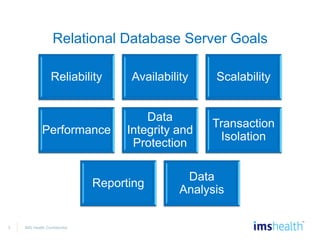
Relational Database Server Goals
Reliability Availability Scalability
Performance
Data
Integrity and
Protection
Transaction
Isolation
Reporting
Data
Analysis
4 IMS Health Confidential
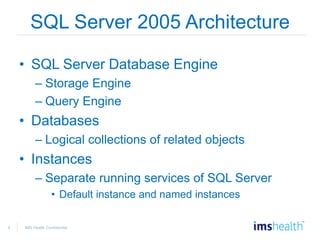
SQL Server 2005 Architecture
• SQL Server Database Engine
– Storage Engine
– Query Engine
• Databases
– Logical collections of related objects
• Instances
– Separate running services of SQL Server
• Default instance and named instances
5 IMS Health Confidential
SQL Server Services
• Instance-Specific
(one service per instance):
– SQL Server
– SQL Server Agent
– Analysis Services
– Reporting Services
– Full-Text Search
• Instance-unaware
– Notification Services
– Integration Services
– SQL Server Browser
– SQL Server Active
Directory Helper
– SQL Writer
6 IMS Health Confidential
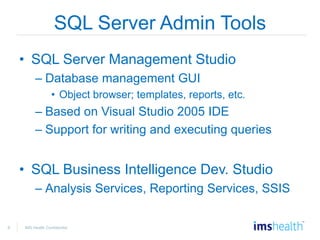
SQL Server Admin Tools
• SQL Server Management Studio
– Database management GUI
• Object browser; templates, reports, etc.
– Based on Visual Studio 2005 IDE
– Support for writing and executing queries
• SQL Business Intelligence Dev. Studio
– Analysis Services, Reporting Services, SSIS
7 IMS Health Confidential
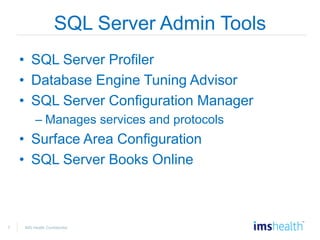
SQL Server Admin Tools
• SQL Server Profiler
• Database Engine Tuning Advisor
• SQL Server Configuration Manager
– Manages services and protocols
• Surface Area Configuration
• SQL Server Books Online
8 IMS Health Confidential
Configuring SQL Server
• Default options are set during installation
• SQL Server Management Studio
• Server Properties:
– Memory
– Processors
– Security (Windows, SQL Server); Auditing
– Database settings (default file locations)
9
Managing Databases
An overview of working with
physical and logical database files
10 IMS Health Confidential
Designing Data Storage
• Goals:
– Maximize performance by reducing contention
– Simplify administration
• Best practices:
– Monitor and analyze real-world workloads
– Separate data files and transaction log files
11 IMS Health Confidential
SQL Server Physical Data Files
• Database storage
– Primarily table data and index data
• Database Files:
– Primary data file (*.mdf)
– Secondary data files (*.ndf)
– Transaction log file(s) (*.ldf)
• Filegroups:
– Logical collections of files
– Objects can be created on filegroups
12 IMS Health Confidential
Monitoring Disk Usage
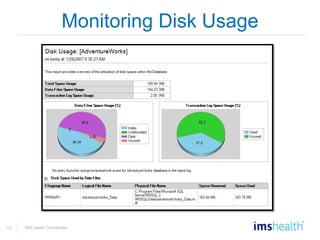
• SQL Server Management Studio Reports
– Server: Server Dashboard
– Database: Disk Usage (several reports)
• Transact-SQL
– Stored Procedures:
•sp_Help, sp_HelpDB, sp_SpaceUsed
– System Tables / Views
•Sys.Database_Files
13 IMS Health Confidential
Monitoring Disk Usage
14 IMS Health Confidential
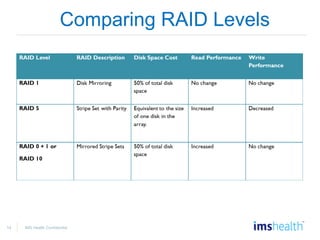
Comparing RAID Levels
15
Database Maintenance &
Data Protection
Methods for maintaining, backing
up, and restoring databases
16 IMS Health Confidential
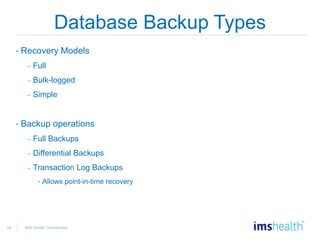
Database Backup Types
• Recovery Models
– Full
– Bulk-logged
– Simple
• Backup operations
– Full Backups
– Differential Backups
– Transaction Log Backups
• Allows point-in-time recovery
17 IMS Health Confidential
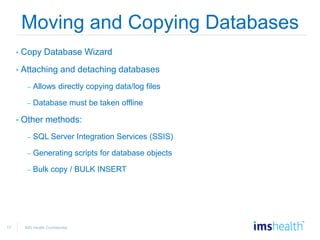
Moving and Copying Databases
• Copy Database Wizard
• Attaching and detaching databases
– Allows directly copying data/log files
– Database must be taken offline
• Other methods:
– SQL Server Integration Services (SSIS)
– Generating scripts for database objects
– Bulk copy / BULK INSERT
18 IMS Health Confidential
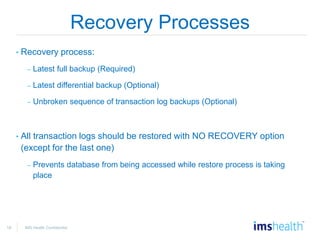
Recovery Processes
• Recovery process:
– Latest full backup (Required)
– Latest differential backup (Optional)
– Unbroken sequence of transaction log backups (Optional)
• All transaction logs should be restored with NO RECOVERY option
(except for the last one)
– Prevents database from being accessed while restore process is taking
place
19 IMS Health Confidential
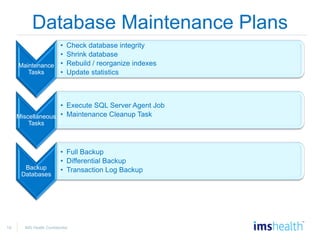
Database Maintenance Plans
Maintenance
Tasks
• Check database integrity
• Shrink database
• Rebuild / reorganize indexes
• Update statistics
Miscellaneous
Tasks
• Execute SQL Server Agent Job
• Maintenance Cleanup Task
Backup
Databases
• Full Backup
• Differential Backup
• Transaction Log Backup
20 IMS Health Confidential
Reliability & Availability Options
• Database Mirroring
• Log-shipping
• SQL Server Fail-Over Clusters
• Distributed Federated Servers
• Replication
• Load-Balancing (at network or OS level)
21
Securing SQL Server
Understanding SQL Server 2005’s
security architecture and objects
22 IMS Health Confidential
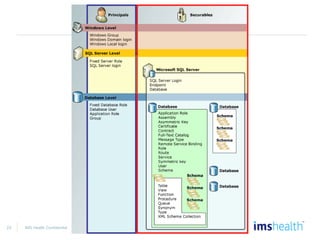
SQL Server Security Overview
•Layered Security Model:
–Windows Level
–SQL Server Level
–Database
• Schemas (for database objects)
•Terminology:
–Principals
–Securables
–Permissions
• Scopes and Inheritance
23 IMS Health Confidential
24 IMS Health Confidential
Configuring Permissions
• Scopes of Securables
– Server
– Database
– Schema
– Objects
• Permission Settings:
– GRANT
– REVOKE
– DENY
• Options
– WITH GRANT OPTION
– AS (Sets permissions using another user or role)
25 IMS Health Confidential
SQL Server Service Accounts
•Local Service Account
–Permissions of “Users” group (limited)
–No network authentication
•Network Service Account
–Permissions of Users group
–Network authentication with Computer account
•Domain User Accounts
–Adds network access for cross-server functionality
26 IMS Health Confidential
Creating Logins
•Transact-SQL
–CREATE LOGIN statement
• Replaces sp_AddLogin and sp_GrantLogin
–SQL Server Logins
–Windows Logins
•SQL Server Management Studio
–Setting server authentication options
–Login Auditing
–Managing Logins
27 IMS Health Confidential
Database Users and Roles
•Database Users
–Logins map to database users
•Database Roles
–Users can belong to multiple roles
–Guest (does not require a user account)
–dbo (Server sysadmin users)
•Application Roles
–Used to support application code
28 IMS Health Confidential
Creating Database Users and Roles
•CREATE USER
–Replaces sp_AddUser and sp_GrantDBAccess
–Can specify a default schema
–Managed with ALTER USER and DROP USER
•CREATE ROLE
–Default owner is creator of the role
•SQL Server Management Studio
–Working with Users and Roles
29 IMS Health Confidential
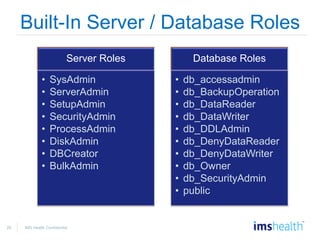
Built-In Server / Database Roles
Server Roles
• SysAdmin
• ServerAdmin
• SetupAdmin
• SecurityAdmin
• ProcessAdmin
• DiskAdmin
• DBCreator
• BulkAdmin
Database Roles
• db_accessadmin
• db_BackupOperation
• db_DataReader
• db_DataWriter
• db_DDLAdmin
• db_DenyDataReader
• db_DenyDataWriter
• db_Owner
• db_SecurityAdmin
• public
30
Managing Database Objects
Understanding database design,
tables, and indexes
31 IMS Health Confidential
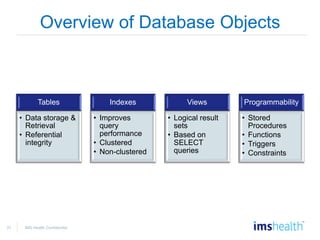
Overview of Database Objects
Tables
• Data storage &
Retrieval
• Referential
integrity
Indexes
• Improves
query
performance
• Clustered
• Non-clustered
Views
• Logical result
sets
• Based on
SELECT
queries
Programmability
• Stored
Procedures
• Functions
• Triggers
• Constraints
32 IMS Health Confidential
Designing a database
• Normalization
– Reduces redundancy and improves data modification performance
– Denormalization is often done to enhance reporting performance (at the
expense of disk space and redundancy)
• Referential Integrity
– Maintains the logical relationships between database objects
33
Questions and Answers???

SQL Server Overview

  • 1.
    0 SQL Server for Developers Developersview point Irshad Peeran Lead Engineer 21 August 2015
  • 2.
    1 Overview and Agenda SQL Server Overview  Managing Databases  Database Maintenance and Data Protection  Securing SQL Server  Managing Database Objects
  • 3.
    2 SQL Server Platform Overview UnderstandingSQL Server’s features, services, and administrative tools
  • 4.
    3 IMS HealthConfidential Relational Database Server Goals Reliability Availability Scalability Performance Data Integrity and Protection Transaction Isolation Reporting Data Analysis
  • 5.
    4 IMS HealthConfidential SQL Server 2005 Architecture • SQL Server Database Engine – Storage Engine – Query Engine • Databases – Logical collections of related objects • Instances – Separate running services of SQL Server • Default instance and named instances
  • 6.
    5 IMS HealthConfidential SQL Server Services • Instance-Specific (one service per instance): – SQL Server – SQL Server Agent – Analysis Services – Reporting Services – Full-Text Search • Instance-unaware – Notification Services – Integration Services – SQL Server Browser – SQL Server Active Directory Helper – SQL Writer
  • 7.
    6 IMS HealthConfidential SQL Server Admin Tools • SQL Server Management Studio – Database management GUI • Object browser; templates, reports, etc. – Based on Visual Studio 2005 IDE – Support for writing and executing queries • SQL Business Intelligence Dev. Studio – Analysis Services, Reporting Services, SSIS
  • 8.
    7 IMS HealthConfidential SQL Server Admin Tools • SQL Server Profiler • Database Engine Tuning Advisor • SQL Server Configuration Manager – Manages services and protocols • Surface Area Configuration • SQL Server Books Online
  • 9.
    8 IMS HealthConfidential Configuring SQL Server • Default options are set during installation • SQL Server Management Studio • Server Properties: – Memory – Processors – Security (Windows, SQL Server); Auditing – Database settings (default file locations)
  • 10.
    9 Managing Databases An overviewof working with physical and logical database files
  • 11.
    10 IMS HealthConfidential Designing Data Storage • Goals: – Maximize performance by reducing contention – Simplify administration • Best practices: – Monitor and analyze real-world workloads – Separate data files and transaction log files
  • 12.
    11 IMS HealthConfidential SQL Server Physical Data Files • Database storage – Primarily table data and index data • Database Files: – Primary data file (*.mdf) – Secondary data files (*.ndf) – Transaction log file(s) (*.ldf) • Filegroups: – Logical collections of files – Objects can be created on filegroups
  • 13.
    12 IMS HealthConfidential Monitoring Disk Usage • SQL Server Management Studio Reports – Server: Server Dashboard – Database: Disk Usage (several reports) • Transact-SQL – Stored Procedures: •sp_Help, sp_HelpDB, sp_SpaceUsed – System Tables / Views •Sys.Database_Files
  • 14.
    13 IMS HealthConfidential Monitoring Disk Usage
  • 15.
    14 IMS HealthConfidential Comparing RAID Levels
  • 16.
    15 Database Maintenance & DataProtection Methods for maintaining, backing up, and restoring databases
  • 17.
    16 IMS HealthConfidential Database Backup Types • Recovery Models – Full – Bulk-logged – Simple • Backup operations – Full Backups – Differential Backups – Transaction Log Backups • Allows point-in-time recovery
  • 18.
    17 IMS HealthConfidential Moving and Copying Databases • Copy Database Wizard • Attaching and detaching databases – Allows directly copying data/log files – Database must be taken offline • Other methods: – SQL Server Integration Services (SSIS) – Generating scripts for database objects – Bulk copy / BULK INSERT
  • 19.
    18 IMS HealthConfidential Recovery Processes • Recovery process: – Latest full backup (Required) – Latest differential backup (Optional) – Unbroken sequence of transaction log backups (Optional) • All transaction logs should be restored with NO RECOVERY option (except for the last one) – Prevents database from being accessed while restore process is taking place
  • 20.
    19 IMS HealthConfidential Database Maintenance Plans Maintenance Tasks • Check database integrity • Shrink database • Rebuild / reorganize indexes • Update statistics Miscellaneous Tasks • Execute SQL Server Agent Job • Maintenance Cleanup Task Backup Databases • Full Backup • Differential Backup • Transaction Log Backup
  • 21.
    20 IMS HealthConfidential Reliability & Availability Options • Database Mirroring • Log-shipping • SQL Server Fail-Over Clusters • Distributed Federated Servers • Replication • Load-Balancing (at network or OS level)
  • 22.
    21 Securing SQL Server UnderstandingSQL Server 2005’s security architecture and objects
  • 23.
    22 IMS HealthConfidential SQL Server Security Overview •Layered Security Model: –Windows Level –SQL Server Level –Database • Schemas (for database objects) •Terminology: –Principals –Securables –Permissions • Scopes and Inheritance
  • 24.
    23 IMS HealthConfidential
  • 25.
    24 IMS HealthConfidential Configuring Permissions • Scopes of Securables – Server – Database – Schema – Objects • Permission Settings: – GRANT – REVOKE – DENY • Options – WITH GRANT OPTION – AS (Sets permissions using another user or role)
  • 26.
    25 IMS HealthConfidential SQL Server Service Accounts •Local Service Account –Permissions of “Users” group (limited) –No network authentication •Network Service Account –Permissions of Users group –Network authentication with Computer account •Domain User Accounts –Adds network access for cross-server functionality
  • 27.
    26 IMS HealthConfidential Creating Logins •Transact-SQL –CREATE LOGIN statement • Replaces sp_AddLogin and sp_GrantLogin –SQL Server Logins –Windows Logins •SQL Server Management Studio –Setting server authentication options –Login Auditing –Managing Logins
  • 28.
    27 IMS HealthConfidential Database Users and Roles •Database Users –Logins map to database users •Database Roles –Users can belong to multiple roles –Guest (does not require a user account) –dbo (Server sysadmin users) •Application Roles –Used to support application code
  • 29.
    28 IMS HealthConfidential Creating Database Users and Roles •CREATE USER –Replaces sp_AddUser and sp_GrantDBAccess –Can specify a default schema –Managed with ALTER USER and DROP USER •CREATE ROLE –Default owner is creator of the role •SQL Server Management Studio –Working with Users and Roles
  • 30.
    29 IMS HealthConfidential Built-In Server / Database Roles Server Roles • SysAdmin • ServerAdmin • SetupAdmin • SecurityAdmin • ProcessAdmin • DiskAdmin • DBCreator • BulkAdmin Database Roles • db_accessadmin • db_BackupOperation • db_DataReader • db_DataWriter • db_DDLAdmin • db_DenyDataReader • db_DenyDataWriter • db_Owner • db_SecurityAdmin • public
  • 31.
    30 Managing Database Objects Understandingdatabase design, tables, and indexes
  • 32.
    31 IMS HealthConfidential Overview of Database Objects Tables • Data storage & Retrieval • Referential integrity Indexes • Improves query performance • Clustered • Non-clustered Views • Logical result sets • Based on SELECT queries Programmability • Stored Procedures • Functions • Triggers • Constraints
  • 33.
    32 IMS HealthConfidential Designing a database • Normalization – Reduces redundancy and improves data modification performance – Denormalization is often done to enhance reporting performance (at the expense of disk space and redundancy) • Referential Integrity – Maintains the logical relationships between database objects
  • 34.