SQL:
Query optimization
in practice
@jsuchal (@rubyslava #21)
Query optimization


  "The fastest query is
   the one you never
         make"
Query planner
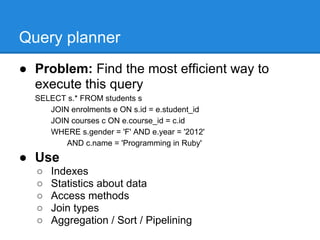
● Problem: Find the most efficient way to
  execute this query
  SELECT s.* FROM students s
     JOIN enrolments e ON s.id = e.student_id
     JOIN courses c ON e.course_id = c.id
     WHERE s.gender = 'F' AND e.year = '2012'
         AND c.name = 'Programming in Ruby'

● Use
  ○   Indexes
  ○   Statistics about data
  ○   Access methods
  ○   Join types
  ○   Aggregation / Sort / Pipelining
B+ tree index


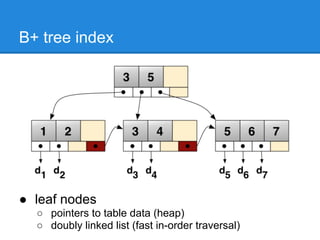
● leaf nodes
  ○ pointers to table data (heap)
  ○ doubly linked list (fast in-order traversal)
Access methods
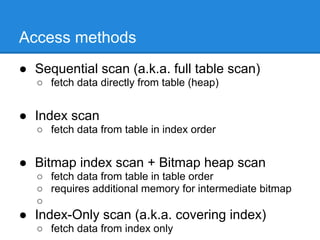
● Sequential scan (a.k.a. full table scan)
   ○ fetch data directly from table (heap)


● Index scan
   ○ fetch data from table in index order


● Bitmap index scan + Bitmap heap scan
   ○ fetch data from table in table order
   ○ requires additional memory for intermediate bitmap
   ○
● Index-Only scan (a.k.a. covering index)
   ○ fetch data from index only
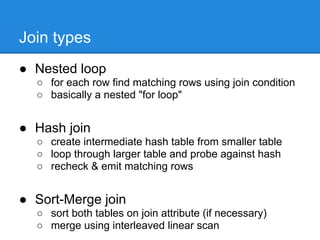
Join types
● Nested loop
  ○ for each row find matching rows using join condition
  ○ basically a nested "for loop"


● Hash join
  ○ create intermediate hash table from smaller table
  ○ loop through larger table and probe against hash
  ○ recheck & emit matching rows


● Sort-Merge join
  ○ sort both tables on join attribute (if necessary)
  ○ merge using interleaved linear scan
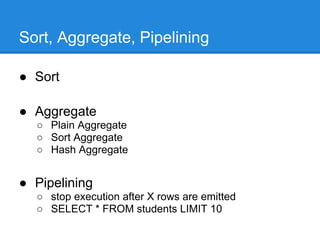
Sort, Aggregate, Pipelining

● Sort

● Aggregate
  ○ Plain Aggregate
  ○ Sort Aggregate
  ○ Hash Aggregate


● Pipelining
  ○ stop execution after X rows are emitted
  ○ SELECT * FROM students LIMIT 10
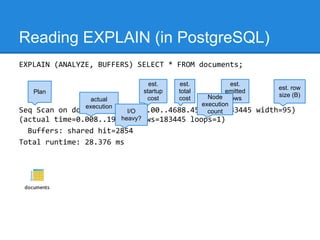
Reading EXPLAIN (in PostgreSQL)
EXPLAIN (ANALYZE, BUFFERS) SELECT * FROM documents;

                              est.     est.             est.
                                                                     est. row
   Plan                     startup   total           emitted
                                                Node rows            size (B)
                actual       cost     cost
               execution                      execution
Seq Scan on documents (cost=0.00..4688.45
                         I/O                  rows=183445
                                                count           width=95)
                       heavy?
(actual time=0.008..19.241 rows=183445 loops=1)
  Buffers: shared hit=2854
Total runtime: 28.376 ms
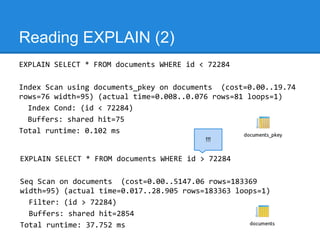
Reading EXPLAIN (2)
EXPLAIN SELECT * FROM documents WHERE id < 72284

Index Scan using documents_pkey on documents (cost=0.00..19.74
rows=76 width=95) (actual time=0.008..0.076 rows=81 loops=1)
  Index Cond: (id < 72284)
  Buffers: shared hit=75
Total runtime: 0.102 ms
                                          !!!


EXPLAIN SELECT * FROM documents WHERE id > 72284

Seq Scan on documents (cost=0.00..5147.06 rows=183369
width=95) (actual time=0.017..28.905 rows=183363 loops=1)
  Filter: (id > 72284)
  Buffers: shared hit=2854
Total runtime: 37.752 ms
Reading EXPLAIN (3)
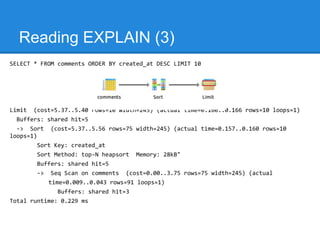
SELECT * FROM comments ORDER BY created_at DESC LIMIT 10


Limit (cost=5.37..5.40 rows=10 width=245) (actual time=0.160..0.166 rows=10 loops=1)
  Buffers: shared hit=5
  -> Sort (cost=5.37..5.56 rows=75 width=245) (actual time=0.157..0.160 rows=10
loops=1)
         Sort Key: created_at
         Sort Method: top-N heapsort Memory: 28kB"
         Buffers: shared hit=5
         -> Seq Scan on comments (cost=0.00..3.75 rows=75 width=245) (actual
            time=0.009..0.043 rows=91 loops=1)
               Buffers: shared hit=3
Total runtime: 0.229 ms
Reading EXPLAIN (4)
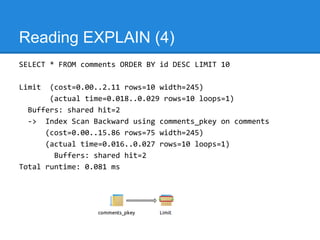
SELECT * FROM comments ORDER BY id DESC LIMIT 10

Limit  (cost=0.00..2.11 rows=10 width=245)
       (actual time=0.018..0.029 rows=10 loops=1)
  Buffers: shared hit=2
  -> Index Scan Backward using comments_pkey on comments
      (cost=0.00..15.86 rows=75 width=245)
      (actual time=0.016..0.027 rows=10 loops=1)
        Buffers: shared hit=2
Total runtime: 0.081 ms
Reading EXPLAIN (5)
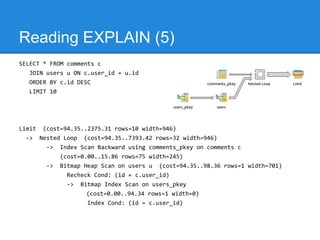
SELECT * FROM comments c
   JOIN users u ON c.user_id = u.id
   ORDER BY c.id DESC
   LIMIT 10


Limit (cost=94.35..2375.31 rows=10 width=946)
  -> Nested Loop (cost=94.35..7393.42 rows=32 width=946)
       -> Index Scan Backward using comments_pkey on comments c
           (cost=0.00..15.86 rows=75 width=245)
       -> Bitmap Heap Scan on users u (cost=94.35..98.36 rows=1 width=701)
             Recheck Cond: (id = c.user_id)
             -> Bitmap Index Scan on users_pkey
                   (cost=0.00..94.34 rows=1 width=0)
                   Index Cond: (id = c.user_id)
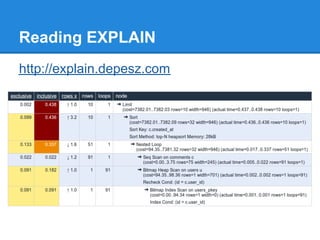
Reading EXPLAIN
http://explain.depesz.com
Tricks
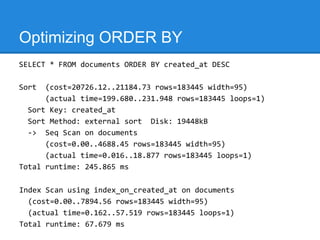
Optimizing ORDER BY
SELECT * FROM documents ORDER BY created_at DESC

Sort  (cost=20726.12..21184.73 rows=183445 width=95)
      (actual time=199.680..231.948 rows=183445 loops=1)
  Sort Key: created_at
  Sort Method: external sort Disk: 19448kB
  -> Seq Scan on documents
      (cost=0.00..4688.45 rows=183445 width=95)
      (actual time=0.016..18.877 rows=183445 loops=1)
Total runtime: 245.865 ms

Index Scan using index_on_created_at on documents
  (cost=0.00..7894.56 rows=183445 width=95)
  (actual time=0.162..57.519 rows=183445 loops=1)
Total runtime: 67.679 ms
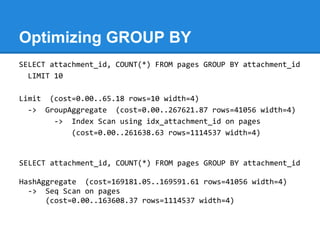
Optimizing GROUP BY
SELECT attachment_id, COUNT(*) FROM pages GROUP BY attachment_id
  LIMIT 10

Limit (cost=0.00..65.18 rows=10 width=4)
  -> GroupAggregate (cost=0.00..267621.87 rows=41056 width=4)
       -> Index Scan using idx_attachment_id on pages
           (cost=0.00..261638.63 rows=1114537 width=4)


SELECT attachment_id, COUNT(*) FROM pages GROUP BY attachment_id

HashAggregate (cost=169181.05..169591.61 rows=41056 width=4)
  -> Seq Scan on pages
      (cost=0.00..163608.37 rows=1114537 width=4)
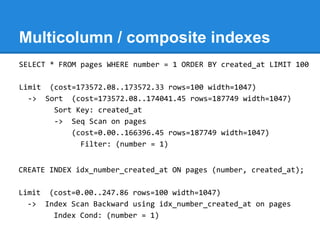
Multicolumn / composite indexes
SELECT * FROM pages WHERE number = 1 ORDER BY created_at LIMIT 100

Limit (cost=173572.08..173572.33 rows=100 width=1047)
  -> Sort (cost=173572.08..174041.45 rows=187749 width=1047)
       Sort Key: created_at
       -> Seq Scan on pages
           (cost=0.00..166396.45 rows=187749 width=1047)
             Filter: (number = 1)


CREATE INDEX idx_number_created_at ON pages (number, created_at);

Limit (cost=0.00..247.86 rows=100 width=1047)
  -> Index Scan Backward using idx_number_created_at on pages
       Index Cond: (number = 1)
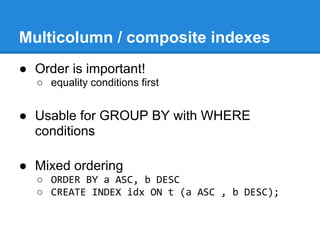
Multicolumn / composite indexes
● Order is important!
  ○ equality conditions first


● Usable for GROUP BY with WHERE
  conditions

● Mixed ordering
  ○ ORDER BY a ASC, b DESC
  ○ CREATE INDEX idx ON t (a ASC , b DESC);
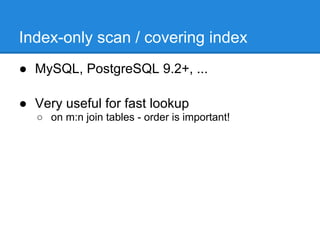
Index-only scan / covering index
● MySQL, PostgreSQL 9.2+, ...

● Very useful for fast lookup
   ○ on m:n join tables - order is important!
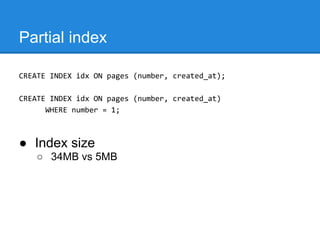
Partial index

CREATE INDEX idx ON pages (number, created_at);

CREATE INDEX idx ON pages (number, created_at)
      WHERE number = 1;


● Index size
   ○ 34MB vs 5MB
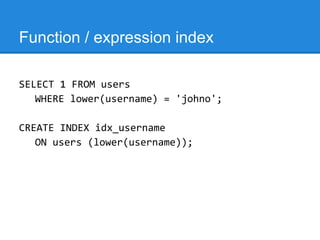
Function / expression index

SELECT 1 FROM users
   WHERE lower(username) = 'johno';

CREATE INDEX idx_username
   ON users (lower(username));
"Hacks"
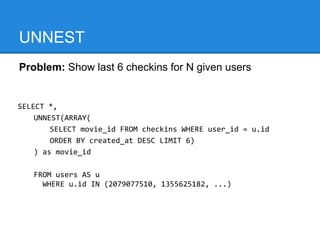
UNNEST
Problem: Show last 6 checkins for N given users


SELECT *,
    UNNEST(ARRAY(
        SELECT movie_id FROM checkins WHERE user_id = u.id
        ORDER BY created_at DESC LIMIT 6)
    ) as movie_id

   FROM users AS u
     WHERE u.id IN (2079077510, 1355625182, ...)
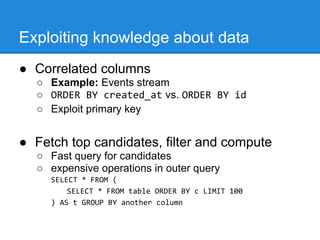
Exploiting knowledge about data
● Correlated columns
  ○ Example: Events stream
  ○ ORDER BY created_at vs. ORDER BY id
  ○ Exploit primary key


● Fetch top candidates, filter and compute
  ○ Fast query for candidates
  ○ expensive operations in outer query
     SELECT * FROM (
         SELECT * FROM table ORDER BY c LIMIT 100
     ) AS t GROUP BY another column
Now what?
● Denormalization = redundancy
  ○ counters
  ○ duplicate columns
  ○ materialized views
● Specialized structures
  ○ nested set
● Specialized indexes
  ○ GIN, GiST, SP-GiST, Spatial
● Specialized engines
  ○ column stores, full text, graphs
Common caveats
● most selective first myth

● unique vs non-unique indexes
   ○ additional information planner can use


● Unnecessary subqueries
   ○ Good query planner might restructure it to join


● LEFT JOIN vs. JOIN
   ○ LEFT JOIN constraints joining order possibilities
   ○ not semantically equivalent!
Resources


● http://use-the-index-luke.com/

● http://www.postgresql.org/docs/9.
  2/static/indexes.html

● http://www.postgresql.org/docs/9.
  2/static/using-explain.html

SQL: Query optimization in practice

  • 1.
  • 2.
    Query optimization "The fastest query is the one you never make"
  • 3.
    Query planner ● Problem:Find the most efficient way to execute this query SELECT s.* FROM students s JOIN enrolments e ON s.id = e.student_id JOIN courses c ON e.course_id = c.id WHERE s.gender = 'F' AND e.year = '2012' AND c.name = 'Programming in Ruby' ● Use ○ Indexes ○ Statistics about data ○ Access methods ○ Join types ○ Aggregation / Sort / Pipelining
  • 4.
    B+ tree index ●leaf nodes ○ pointers to table data (heap) ○ doubly linked list (fast in-order traversal)
  • 5.
    Access methods ● Sequentialscan (a.k.a. full table scan) ○ fetch data directly from table (heap) ● Index scan ○ fetch data from table in index order ● Bitmap index scan + Bitmap heap scan ○ fetch data from table in table order ○ requires additional memory for intermediate bitmap ○ ● Index-Only scan (a.k.a. covering index) ○ fetch data from index only
  • 6.
    Join types ● Nestedloop ○ for each row find matching rows using join condition ○ basically a nested "for loop" ● Hash join ○ create intermediate hash table from smaller table ○ loop through larger table and probe against hash ○ recheck & emit matching rows ● Sort-Merge join ○ sort both tables on join attribute (if necessary) ○ merge using interleaved linear scan
  • 7.
    Sort, Aggregate, Pipelining ●Sort ● Aggregate ○ Plain Aggregate ○ Sort Aggregate ○ Hash Aggregate ● Pipelining ○ stop execution after X rows are emitted ○ SELECT * FROM students LIMIT 10
  • 8.
    Reading EXPLAIN (inPostgreSQL) EXPLAIN (ANALYZE, BUFFERS) SELECT * FROM documents; est. est. est. est. row Plan startup total emitted Node rows size (B) actual cost cost execution execution Seq Scan on documents (cost=0.00..4688.45 I/O rows=183445 count width=95) heavy? (actual time=0.008..19.241 rows=183445 loops=1) Buffers: shared hit=2854 Total runtime: 28.376 ms
  • 9.
    Reading EXPLAIN (2) EXPLAINSELECT * FROM documents WHERE id < 72284 Index Scan using documents_pkey on documents (cost=0.00..19.74 rows=76 width=95) (actual time=0.008..0.076 rows=81 loops=1) Index Cond: (id < 72284) Buffers: shared hit=75 Total runtime: 0.102 ms !!! EXPLAIN SELECT * FROM documents WHERE id > 72284 Seq Scan on documents (cost=0.00..5147.06 rows=183369 width=95) (actual time=0.017..28.905 rows=183363 loops=1) Filter: (id > 72284) Buffers: shared hit=2854 Total runtime: 37.752 ms
  • 10.
    Reading EXPLAIN (3) SELECT* FROM comments ORDER BY created_at DESC LIMIT 10 Limit (cost=5.37..5.40 rows=10 width=245) (actual time=0.160..0.166 rows=10 loops=1) Buffers: shared hit=5 -> Sort (cost=5.37..5.56 rows=75 width=245) (actual time=0.157..0.160 rows=10 loops=1) Sort Key: created_at Sort Method: top-N heapsort Memory: 28kB" Buffers: shared hit=5 -> Seq Scan on comments (cost=0.00..3.75 rows=75 width=245) (actual time=0.009..0.043 rows=91 loops=1) Buffers: shared hit=3 Total runtime: 0.229 ms
  • 11.
    Reading EXPLAIN (4) SELECT* FROM comments ORDER BY id DESC LIMIT 10 Limit (cost=0.00..2.11 rows=10 width=245) (actual time=0.018..0.029 rows=10 loops=1) Buffers: shared hit=2 -> Index Scan Backward using comments_pkey on comments (cost=0.00..15.86 rows=75 width=245) (actual time=0.016..0.027 rows=10 loops=1) Buffers: shared hit=2 Total runtime: 0.081 ms
  • 12.
    Reading EXPLAIN (5) SELECT* FROM comments c JOIN users u ON c.user_id = u.id ORDER BY c.id DESC LIMIT 10 Limit (cost=94.35..2375.31 rows=10 width=946) -> Nested Loop (cost=94.35..7393.42 rows=32 width=946) -> Index Scan Backward using comments_pkey on comments c (cost=0.00..15.86 rows=75 width=245) -> Bitmap Heap Scan on users u (cost=94.35..98.36 rows=1 width=701) Recheck Cond: (id = c.user_id) -> Bitmap Index Scan on users_pkey (cost=0.00..94.34 rows=1 width=0) Index Cond: (id = c.user_id)
  • 13.
  • 14.
  • 15.
    Optimizing ORDER BY SELECT* FROM documents ORDER BY created_at DESC Sort (cost=20726.12..21184.73 rows=183445 width=95) (actual time=199.680..231.948 rows=183445 loops=1) Sort Key: created_at Sort Method: external sort Disk: 19448kB -> Seq Scan on documents (cost=0.00..4688.45 rows=183445 width=95) (actual time=0.016..18.877 rows=183445 loops=1) Total runtime: 245.865 ms Index Scan using index_on_created_at on documents (cost=0.00..7894.56 rows=183445 width=95) (actual time=0.162..57.519 rows=183445 loops=1) Total runtime: 67.679 ms
  • 16.
    Optimizing GROUP BY SELECTattachment_id, COUNT(*) FROM pages GROUP BY attachment_id LIMIT 10 Limit (cost=0.00..65.18 rows=10 width=4) -> GroupAggregate (cost=0.00..267621.87 rows=41056 width=4) -> Index Scan using idx_attachment_id on pages (cost=0.00..261638.63 rows=1114537 width=4) SELECT attachment_id, COUNT(*) FROM pages GROUP BY attachment_id HashAggregate (cost=169181.05..169591.61 rows=41056 width=4) -> Seq Scan on pages (cost=0.00..163608.37 rows=1114537 width=4)
  • 17.
    Multicolumn / compositeindexes SELECT * FROM pages WHERE number = 1 ORDER BY created_at LIMIT 100 Limit (cost=173572.08..173572.33 rows=100 width=1047) -> Sort (cost=173572.08..174041.45 rows=187749 width=1047) Sort Key: created_at -> Seq Scan on pages (cost=0.00..166396.45 rows=187749 width=1047) Filter: (number = 1) CREATE INDEX idx_number_created_at ON pages (number, created_at); Limit (cost=0.00..247.86 rows=100 width=1047) -> Index Scan Backward using idx_number_created_at on pages Index Cond: (number = 1)
  • 18.
    Multicolumn / compositeindexes ● Order is important! ○ equality conditions first ● Usable for GROUP BY with WHERE conditions ● Mixed ordering ○ ORDER BY a ASC, b DESC ○ CREATE INDEX idx ON t (a ASC , b DESC);
  • 19.
    Index-only scan /covering index ● MySQL, PostgreSQL 9.2+, ... ● Very useful for fast lookup ○ on m:n join tables - order is important!
  • 20.
    Partial index CREATE INDEXidx ON pages (number, created_at); CREATE INDEX idx ON pages (number, created_at) WHERE number = 1; ● Index size ○ 34MB vs 5MB
  • 21.
    Function / expressionindex SELECT 1 FROM users WHERE lower(username) = 'johno'; CREATE INDEX idx_username ON users (lower(username));
  • 22.
  • 23.
    UNNEST Problem: Show last6 checkins for N given users SELECT *, UNNEST(ARRAY( SELECT movie_id FROM checkins WHERE user_id = u.id ORDER BY created_at DESC LIMIT 6) ) as movie_id FROM users AS u WHERE u.id IN (2079077510, 1355625182, ...)
  • 24.
    Exploiting knowledge aboutdata ● Correlated columns ○ Example: Events stream ○ ORDER BY created_at vs. ORDER BY id ○ Exploit primary key ● Fetch top candidates, filter and compute ○ Fast query for candidates ○ expensive operations in outer query SELECT * FROM ( SELECT * FROM table ORDER BY c LIMIT 100 ) AS t GROUP BY another column
  • 25.
    Now what? ● Denormalization= redundancy ○ counters ○ duplicate columns ○ materialized views ● Specialized structures ○ nested set ● Specialized indexes ○ GIN, GiST, SP-GiST, Spatial ● Specialized engines ○ column stores, full text, graphs
  • 26.
    Common caveats ● mostselective first myth ● unique vs non-unique indexes ○ additional information planner can use ● Unnecessary subqueries ○ Good query planner might restructure it to join ● LEFT JOIN vs. JOIN ○ LEFT JOIN constraints joining order possibilities ○ not semantically equivalent!
  • 27.
    Resources ● http://use-the-index-luke.com/ ● http://www.postgresql.org/docs/9. 2/static/indexes.html ● http://www.postgresql.org/docs/9. 2/static/using-explain.html