Ven Señor, sobre nuestros pensamientos, palabras y obras, a fin
de que nuestro dia se agradable ante tus ojos.
Querido Dios abre sus ojos para que se salven y dejen la
ignorancia y las ensenñanzas que han recibido.
Beshir Estefanos Kamel
El verdadero tesoro
La lámpara del cuerpo es el ojo; por eso, si tu ojo está sano, todo
tu cuerpo estará lleno de luz.
Pero si tu ojo está malo, todo tu cuerpo estará lleno de oscuridad.
Así que, si la luz que hay en ti es oscuridad, ¡cuán grande será la
oscuridad!
Mateo 6:22
Profesor de POO y Bases de Datos.
Carlos.Flores.Roman@gmail.com
Carlos.Flores@dae.una.edu.ni
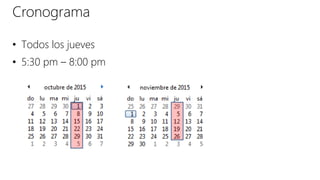
Cronograma
• Todos los jueves
• 5:30 pm – 8:00 pm
Expectativas
• Audiencia
– Con conocimientos básico e intermedio en MS SQL Server
– Personas que estan considerando tomar el examen 70-461;
• Material Adicional
– Microsoft Official Course 20461
• Querying Microsoft SQL Server
• Charla preparatoria para la certificación de Microsoft: Examen 461
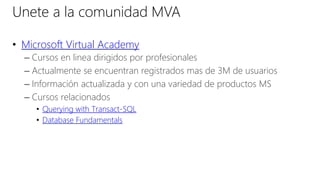
• Microsoft Virtual Academy
– Cursos en linea dirigidos por profesionales
– Actualmente se encuentran registrados mas de 3M de usuarios
– Información actualizada y con una variedad de productos MS
– Cursos relacionados
• Querying with Transact-SQL
• Database Fundamentals
Unete a la comunidad MVA
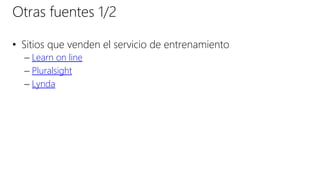
Otras fuentes 1/2
• Sitios que venden el servicio de entrenamiento
– Learn on line
– Pluralsight
– Lynda
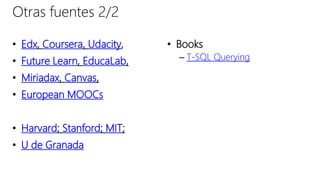
• Edx, Coursera, Udacity,
• Future Learn, EducaLab,
• Miriadax, Canvas,
• European MOOCs
• Harvard; Stanford; MIT;
• U de Granada
• Books
– T-SQL Querying
Otras fuentes 2/2
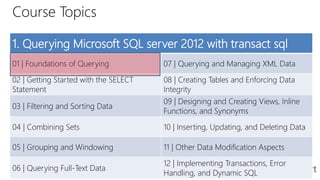
Course Topics
1. Querying Microsoft SQL server 2012 with transact sql
01 | Foundations of Querying 07 | Querying and Managing XML Data
02 | Getting Started with the SELECT
Statement
08 | Creating Tables and Enforcing Data
Integrity
03 | Filtering and Sorting Data
09 | Designing and Creating Views, Inline
Functions, and Synonyms
04 | Combining Sets 10 | Inserting, Updating, and Deleting Data
05 | Grouping and Windowing 11 | Other Data Modification Aspects
06 | Querying Full-Text Data
12 | Implementing Transactions, Error
Handling, and Dynamic SQL
01 | Foundations of Querying
Carlos.Flores.Roman@gmail.com | Instructor
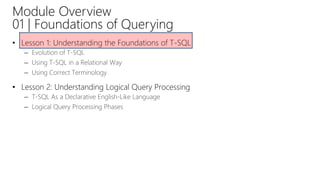
Module Overview
01 | Foundations of Querying
• Lesson 1: Understanding the Foundations of T-SQL
– Evolution of T-SQL
– Using T-SQL in a Relational Way
– Using Correct Terminology
• Lesson 2: Understanding Logical Query Processing
– T-SQL As a Declarative English-Like Language
– Logical Query Processing Phases
02 | Getting Started with the SELECT
Statement
Carlos.Flores.Roman@gmail.com | Instructor
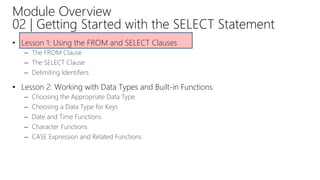
Module Overview
02 | Getting Started with the SELECT Statement
• Lesson 1: Using the FROM and SELECT Clauses
– The FROM Clause
– The SELECT Clause
– Delimiting Identifiers
• Lesson 2: Working with Data Types and Built-in Functions
– Choosing the Appropriate Data Type
– Choosing a Data Type for Keys
– Date and Time Functions
– Character Functions
– CASE Expression and Related Functions
03 | Filtering and Sorting Data
Carlos.Flores.Roman@gmail.com | Instructor
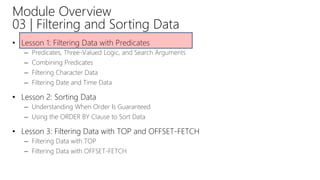
Module Overview
03 | Filtering and Sorting Data
• Lesson 1: Filtering Data with Predicates
– Predicates, Three-Valued Logic, and Search Arguments
– Combining Predicates
– Filtering Character Data
– Filtering Date and Time Data
• Lesson 2: Sorting Data
– Understanding When Order Is Guaranteed
– Using the ORDER BY Clause to Sort Data
• Lesson 3: Filtering Data with TOP and OFFSET-FETCH
– Filtering Data with TOP
– Filtering Data with OFFSET-FETCH
04 | Combining Sets
Carlos.Flores.Roman@gmail.com | Instructor
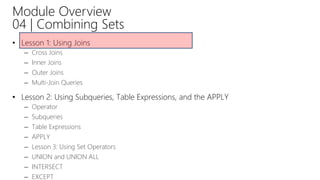
Module Overview
04 | Combining Sets
• Lesson 1: Using Joins
– Cross Joins
– Inner Joins
– Outer Joins
– Multi-Join Queries
• Lesson 2: Using Subqueries, Table Expressions, and the APPLY
– Operator
– Subqueries
– Table Expressions
– APPLY
– Lesson 3: Using Set Operators
– UNION and UNION ALL
– INTERSECT
– EXCEPT
05 | Grouping and Windowing
Carlos.Flores.Roman@gmail.com | Instructor
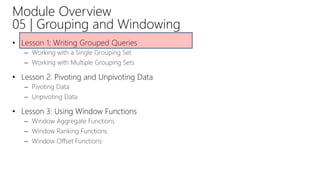
Module Overview
05 | Grouping and Windowing
• Lesson 1: Writing Grouped Queries
– Working with a Single Grouping Set
– Working with Multiple Grouping Sets
• Lesson 2: Pivoting and Unpivoting Data
– Pivoting Data
– Unpivoting Data
• Lesson 3: Using Window Functions
– Window Aggregate Functions
– Window Ranking Functions
– Window Offset Functions
06 | Querying Full-Text Data
Carlos.Flores.Roman@gmail.com | Instructor
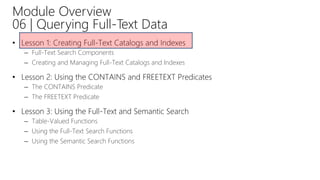
Module Overview
06 | Querying Full-Text Data
• Lesson 1: Creating Full-Text Catalogs and Indexes
– Full-Text Search Components
– Creating and Managing Full-Text Catalogs and Indexes
• Lesson 2: Using the CONTAINS and FREETEXT Predicates
– The CONTAINS Predicate
– The FREETEXT Predicate
• Lesson 3: Using the Full-Text and Semantic Search
– Table-Valued Functions
– Using the Full-Text Search Functions
– Using the Semantic Search Functions
07 | Querying and Managing XML Data
Carlos.Flores.Roman@gmail.com | Instructor
Module Overview
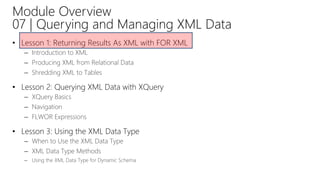
07 | Querying and Managing XML Data
• Lesson 1: Returning Results As XML with FOR XML
– Introduction to XML
– Producing XML from Relational Data
– Shredding XML to Tables
• Lesson 2: Querying XML Data with XQuery
– XQuery Basics
– Navigation
– FLWOR Expressions
• Lesson 3: Using the XML Data Type
– When to Use the XML Data Type
– XML Data Type Methods
– Using the XML Data Type for Dynamic Schema
08 | Creating Tables and Enforcing Data
Integrity
Carlos.Flores.Roman@gmail.com | Instructor
Module Overview
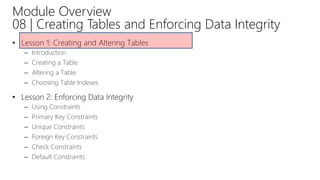
08 | Creating Tables and Enforcing Data Integrity
• Lesson 1: Creating and Altering Tables
– Introduction
– Creating a Table
– Altering a Table
– Choosing Table Indexes
• Lesson 2: Enforcing Data Integrity
– Using Constraints
– Primary Key Constraints
– Unique Constraints
– Foreign Key Constraints
– Check Constraints
– Default Constraints
09 | Designing and Creating Views, Inline
Functions, and Synonyms
Carlos.Flores.Roman@gmail.com | Instructor
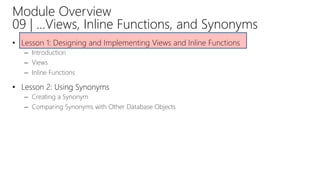
Module Overview
09 | …Views, Inline Functions, and Synonyms
• Lesson 1: Designing and Implementing Views and Inline Functions
– Introduction
– Views
– Inline Functions
• Lesson 2: Using Synonyms
– Creating a Synonym
– Comparing Synonyms with Other Database Objects
10 | Inserting, Updating, and Deleting
Data
Carlos.Flores.Roman@gmail.com | Instructor
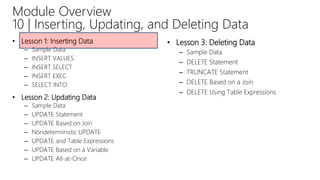
• Lesson 1: Inserting Data
– Sample Data
– INSERT VALUES
– INSERT SELECT
– INSERT EXEC
– SELECT INTO
• Lesson 2: Updating Data
– Sample Data
– UPDATE Statement
– UPDATE Based on Join
– Nondeterministic UPDATE
– UPDATE and Table Expressions
– UPDATE Based on a Variable
– UPDATE All-at-Once
• Lesson 3: Deleting Data
– Sample Data
– DELETE Statement
– TRUNCATE Statement
– DELETE Based on a Join
– DELETE Using Table Expressions
Module Overview
10 | Inserting, Updating, and Deleting Data
11 | Other Data Modification Aspects
Carlos.Flores.Roman@gmail.com | Instructor
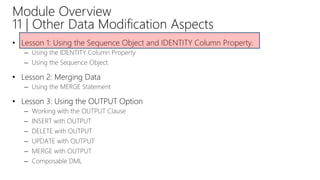
Module Overview
11 | Other Data Modification Aspects
• Lesson 1: Using the Sequence Object and IDENTITY Column Property.
– Using the IDENTITY Column Property
– Using the Sequence Object
• Lesson 2: Merging Data
– Using the MERGE Statement
• Lesson 3: Using the OUTPUT Option
– Working with the OUTPUT Clause
– INSERT with OUTPUT
– DELETE with OUTPUT
– UPDATE with OUTPUT
– MERGE with OUTPUT
– Composable DML
12 | Implementing Transactions, Error
Handling, and Dynamic SQL
Carlos.Flores.Roman@gmail.com | Instructor
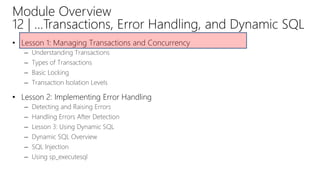
Module Overview
12 | …Transactions, Error Handling, and Dynamic SQL
• Lesson 1: Managing Transactions and Concurrency
– Understanding Transactions
– Types of Transactions
– Basic Locking
– Transaction Isolation Levels
• Lesson 2: Implementing Error Handling
– Detecting and Raising Errors
– Handling Errors After Detection
– Lesson 3: Using Dynamic SQL
– Dynamic SQL Overview
– SQL Injection
– Using sp_executesql
13 | Designing and Implementing T-SQL
Routines
Carlos.Flores.Roman@gmail.com | Instructor
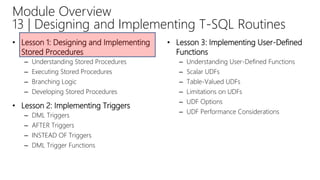
• Lesson 1: Designing and Implementing
Stored Procedures
– Understanding Stored Procedures
– Executing Stored Procedures
– Branching Logic
– Developing Stored Procedures
• Lesson 2: Implementing Triggers
– DML Triggers
– AFTER Triggers
– INSTEAD OF Triggers
– DML Trigger Functions
• Lesson 3: Implementing User-Defined
Functions
– Understanding User-Defined Functions
– Scalar UDFs
– Table-Valued UDFs
– Limitations on UDFs
– UDF Options
– UDF Performance Considerations
Module Overview
13 | Designing and Implementing T-SQL Routines
14 | Using Tools to Analyze Query
Performance
Carlos.Flores.Roman@gmail.com | Instructor
17 | Implementing Indexes and Statistics
Carlos.Flores.Roman@gmail.com | Instructor
16 | Understanding Cursors, Sets, and
Temporary Tables
Carlos.Flores.Roman@gmail.com | Instructor
Module Overview
16 | … Cursors, Sets, and Temporary Tables
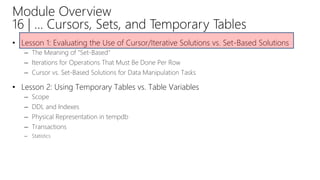
• Lesson 1: Evaluating the Use of Cursor/Iterative Solutions vs. Set-Based Solutions
– The Meaning of "Set-Based"
– Iterations for Operations That Must Be Done Per Row
– Cursor vs. Set-Based Solutions for Data Manipulation Tasks
• Lesson 2: Using Temporary Tables vs. Table Variables
– Scope
– DDL and Indexes
– Physical Representation in tempdb
– Transactions
– Statistics
©2013 Microsoft Corporation. All rights reserved. Microsoft, Windows, Office, Azure, System Center, Dynamics and other product names are or may be registered trademarks and/or trademarks in the
U.S. and/or other countries. The information herein is for informational purposes only and represents the current view of Microsoft Corporation as of the date of this presentation. Because Microsoft
must respond to changing market conditions, it should not be interpreted to be a commitment on the part of Microsoft, and Microsoft cannot guarantee the accuracy of any information provided after
the date of this presentation. MICROSOFT MAKES NO WARRANTIES, EXPRESS, IMPLIED OR STATUTORY, AS TO THE INFORMATION IN THIS PRESENTATION.
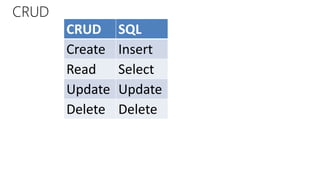
CRUD
CRUD SQL
Create Insert
Read Select
Update Update
Delete Delete

Consultas en MS SQL Server 2012

  • 3.
    Ven Señor, sobrenuestros pensamientos, palabras y obras, a fin de que nuestro dia se agradable ante tus ojos. Querido Dios abre sus ojos para que se salven y dejen la ignorancia y las ensenñanzas que han recibido. Beshir Estefanos Kamel
  • 4.
    El verdadero tesoro Lalámpara del cuerpo es el ojo; por eso, si tu ojo está sano, todo tu cuerpo estará lleno de luz. Pero si tu ojo está malo, todo tu cuerpo estará lleno de oscuridad. Así que, si la luz que hay en ti es oscuridad, ¡cuán grande será la oscuridad! Mateo 6:22
  • 5.
    Profesor de POOy Bases de Datos. Carlos.Flores.Roman@gmail.com Carlos.Flores@dae.una.edu.ni
  • 6.
    Cronograma • Todos losjueves • 5:30 pm – 8:00 pm
  • 7.
    Expectativas • Audiencia – Conconocimientos básico e intermedio en MS SQL Server – Personas que estan considerando tomar el examen 70-461; • Material Adicional – Microsoft Official Course 20461 • Querying Microsoft SQL Server • Charla preparatoria para la certificación de Microsoft: Examen 461
  • 8.
    • Microsoft VirtualAcademy – Cursos en linea dirigidos por profesionales – Actualmente se encuentran registrados mas de 3M de usuarios – Información actualizada y con una variedad de productos MS – Cursos relacionados • Querying with Transact-SQL • Database Fundamentals Unete a la comunidad MVA
  • 9.
    Otras fuentes 1/2 •Sitios que venden el servicio de entrenamiento – Learn on line – Pluralsight – Lynda
  • 10.
    • Edx, Coursera,Udacity, • Future Learn, EducaLab, • Miriadax, Canvas, • European MOOCs • Harvard; Stanford; MIT; • U de Granada • Books – T-SQL Querying Otras fuentes 2/2
  • 11.
    Course Topics 1. QueryingMicrosoft SQL server 2012 with transact sql 01 | Foundations of Querying 07 | Querying and Managing XML Data 02 | Getting Started with the SELECT Statement 08 | Creating Tables and Enforcing Data Integrity 03 | Filtering and Sorting Data 09 | Designing and Creating Views, Inline Functions, and Synonyms 04 | Combining Sets 10 | Inserting, Updating, and Deleting Data 05 | Grouping and Windowing 11 | Other Data Modification Aspects 06 | Querying Full-Text Data 12 | Implementing Transactions, Error Handling, and Dynamic SQL
  • 12.
    01 | Foundationsof Querying Carlos.Flores.Roman@gmail.com | Instructor
  • 13.
    Module Overview 01 |Foundations of Querying • Lesson 1: Understanding the Foundations of T-SQL – Evolution of T-SQL – Using T-SQL in a Relational Way – Using Correct Terminology • Lesson 2: Understanding Logical Query Processing – T-SQL As a Declarative English-Like Language – Logical Query Processing Phases
  • 14.
    02 | GettingStarted with the SELECT Statement Carlos.Flores.Roman@gmail.com | Instructor
  • 15.
    Module Overview 02 |Getting Started with the SELECT Statement • Lesson 1: Using the FROM and SELECT Clauses – The FROM Clause – The SELECT Clause – Delimiting Identifiers • Lesson 2: Working with Data Types and Built-in Functions – Choosing the Appropriate Data Type – Choosing a Data Type for Keys – Date and Time Functions – Character Functions – CASE Expression and Related Functions
  • 16.
    03 | Filteringand Sorting Data Carlos.Flores.Roman@gmail.com | Instructor
  • 17.
    Module Overview 03 |Filtering and Sorting Data • Lesson 1: Filtering Data with Predicates – Predicates, Three-Valued Logic, and Search Arguments – Combining Predicates – Filtering Character Data – Filtering Date and Time Data • Lesson 2: Sorting Data – Understanding When Order Is Guaranteed – Using the ORDER BY Clause to Sort Data • Lesson 3: Filtering Data with TOP and OFFSET-FETCH – Filtering Data with TOP – Filtering Data with OFFSET-FETCH
  • 18.
    04 | CombiningSets Carlos.Flores.Roman@gmail.com | Instructor
  • 19.
    Module Overview 04 |Combining Sets • Lesson 1: Using Joins – Cross Joins – Inner Joins – Outer Joins – Multi-Join Queries • Lesson 2: Using Subqueries, Table Expressions, and the APPLY – Operator – Subqueries – Table Expressions – APPLY – Lesson 3: Using Set Operators – UNION and UNION ALL – INTERSECT – EXCEPT
  • 20.
    05 | Groupingand Windowing Carlos.Flores.Roman@gmail.com | Instructor
  • 21.
    Module Overview 05 |Grouping and Windowing • Lesson 1: Writing Grouped Queries – Working with a Single Grouping Set – Working with Multiple Grouping Sets • Lesson 2: Pivoting and Unpivoting Data – Pivoting Data – Unpivoting Data • Lesson 3: Using Window Functions – Window Aggregate Functions – Window Ranking Functions – Window Offset Functions
  • 22.
    06 | QueryingFull-Text Data Carlos.Flores.Roman@gmail.com | Instructor
  • 23.
    Module Overview 06 |Querying Full-Text Data • Lesson 1: Creating Full-Text Catalogs and Indexes – Full-Text Search Components – Creating and Managing Full-Text Catalogs and Indexes • Lesson 2: Using the CONTAINS and FREETEXT Predicates – The CONTAINS Predicate – The FREETEXT Predicate • Lesson 3: Using the Full-Text and Semantic Search – Table-Valued Functions – Using the Full-Text Search Functions – Using the Semantic Search Functions
  • 24.
    07 | Queryingand Managing XML Data Carlos.Flores.Roman@gmail.com | Instructor
  • 25.
    Module Overview 07 |Querying and Managing XML Data • Lesson 1: Returning Results As XML with FOR XML – Introduction to XML – Producing XML from Relational Data – Shredding XML to Tables • Lesson 2: Querying XML Data with XQuery – XQuery Basics – Navigation – FLWOR Expressions • Lesson 3: Using the XML Data Type – When to Use the XML Data Type – XML Data Type Methods – Using the XML Data Type for Dynamic Schema
  • 26.
    08 | CreatingTables and Enforcing Data Integrity Carlos.Flores.Roman@gmail.com | Instructor
  • 27.
    Module Overview 08 |Creating Tables and Enforcing Data Integrity • Lesson 1: Creating and Altering Tables – Introduction – Creating a Table – Altering a Table – Choosing Table Indexes • Lesson 2: Enforcing Data Integrity – Using Constraints – Primary Key Constraints – Unique Constraints – Foreign Key Constraints – Check Constraints – Default Constraints
  • 28.
    09 | Designingand Creating Views, Inline Functions, and Synonyms Carlos.Flores.Roman@gmail.com | Instructor
  • 29.
    Module Overview 09 |…Views, Inline Functions, and Synonyms • Lesson 1: Designing and Implementing Views and Inline Functions – Introduction – Views – Inline Functions • Lesson 2: Using Synonyms – Creating a Synonym – Comparing Synonyms with Other Database Objects
  • 30.
    10 | Inserting,Updating, and Deleting Data Carlos.Flores.Roman@gmail.com | Instructor
  • 31.
    • Lesson 1:Inserting Data – Sample Data – INSERT VALUES – INSERT SELECT – INSERT EXEC – SELECT INTO • Lesson 2: Updating Data – Sample Data – UPDATE Statement – UPDATE Based on Join – Nondeterministic UPDATE – UPDATE and Table Expressions – UPDATE Based on a Variable – UPDATE All-at-Once • Lesson 3: Deleting Data – Sample Data – DELETE Statement – TRUNCATE Statement – DELETE Based on a Join – DELETE Using Table Expressions Module Overview 10 | Inserting, Updating, and Deleting Data
  • 32.
    11 | OtherData Modification Aspects Carlos.Flores.Roman@gmail.com | Instructor
  • 33.
    Module Overview 11 |Other Data Modification Aspects • Lesson 1: Using the Sequence Object and IDENTITY Column Property. – Using the IDENTITY Column Property – Using the Sequence Object • Lesson 2: Merging Data – Using the MERGE Statement • Lesson 3: Using the OUTPUT Option – Working with the OUTPUT Clause – INSERT with OUTPUT – DELETE with OUTPUT – UPDATE with OUTPUT – MERGE with OUTPUT – Composable DML
  • 34.
    12 | ImplementingTransactions, Error Handling, and Dynamic SQL Carlos.Flores.Roman@gmail.com | Instructor
  • 35.
    Module Overview 12 |…Transactions, Error Handling, and Dynamic SQL • Lesson 1: Managing Transactions and Concurrency – Understanding Transactions – Types of Transactions – Basic Locking – Transaction Isolation Levels • Lesson 2: Implementing Error Handling – Detecting and Raising Errors – Handling Errors After Detection – Lesson 3: Using Dynamic SQL – Dynamic SQL Overview – SQL Injection – Using sp_executesql
  • 36.
    13 | Designingand Implementing T-SQL Routines Carlos.Flores.Roman@gmail.com | Instructor
  • 37.
    • Lesson 1:Designing and Implementing Stored Procedures – Understanding Stored Procedures – Executing Stored Procedures – Branching Logic – Developing Stored Procedures • Lesson 2: Implementing Triggers – DML Triggers – AFTER Triggers – INSTEAD OF Triggers – DML Trigger Functions • Lesson 3: Implementing User-Defined Functions – Understanding User-Defined Functions – Scalar UDFs – Table-Valued UDFs – Limitations on UDFs – UDF Options – UDF Performance Considerations Module Overview 13 | Designing and Implementing T-SQL Routines
  • 38.
    14 | UsingTools to Analyze Query Performance Carlos.Flores.Roman@gmail.com | Instructor
  • 39.
    17 | ImplementingIndexes and Statistics Carlos.Flores.Roman@gmail.com | Instructor
  • 40.
    16 | UnderstandingCursors, Sets, and Temporary Tables Carlos.Flores.Roman@gmail.com | Instructor
  • 41.
    Module Overview 16 |… Cursors, Sets, and Temporary Tables • Lesson 1: Evaluating the Use of Cursor/Iterative Solutions vs. Set-Based Solutions – The Meaning of "Set-Based" – Iterations for Operations That Must Be Done Per Row – Cursor vs. Set-Based Solutions for Data Manipulation Tasks • Lesson 2: Using Temporary Tables vs. Table Variables – Scope – DDL and Indexes – Physical Representation in tempdb – Transactions – Statistics
  • 42.
    ©2013 Microsoft Corporation.All rights reserved. Microsoft, Windows, Office, Azure, System Center, Dynamics and other product names are or may be registered trademarks and/or trademarks in the U.S. and/or other countries. The information herein is for informational purposes only and represents the current view of Microsoft Corporation as of the date of this presentation. Because Microsoft must respond to changing market conditions, it should not be interpreted to be a commitment on the part of Microsoft, and Microsoft cannot guarantee the accuracy of any information provided after the date of this presentation. MICROSOFT MAKES NO WARRANTIES, EXPRESS, IMPLIED OR STATUTORY, AS TO THE INFORMATION IN THIS PRESENTATION.
  • 43.
    CRUD CRUD SQL Create Insert ReadSelect Update Update Delete Delete

Editor's Notes

  • #2 1
  • #8 https://www.microsoft.com/learning/es-mx/exam-70-461.aspx https://www.microsoft.com/learning/en-us/exam-70-461.aspx Course 20461C: Querying Microsoft SQL Server https://www.microsoft.com/learning/en-us/course.aspx?id=20461c
  • #12 01 | Foundations of Querying 02 | Getting Started with the SELECT Statement 03 | Filtering and Sorting Data 04 | Combining Sets 05 | Grouping and Windowing 06 | Querying Full-Text Data 07 | Querying and Managing XML Data 08 | Creating Tables and Enforcing Data Integrity 09 | Designing and Creating Views, Inline Functions, and Synonyms 10 | Inserting, Updating, and Deleting Data 11 | Other Data Modification Aspects 12 | Implementing Transactions, Error Handling, and Dynamic SQL 13 | Designing and Implementing T-SQL Routines 14 | Using Tools to Analyze Query Performance 15 | Implementing Indexes and Statistics 16 | Understanding Cursors, Sets, and Temporary Tables 17 | Understanding Further Optimization Aspects Chapter 1 Foundations of Querying Lesson 1: Understanding the Foundations of T-SQL Evolution of T-SQL Using T-SQL in a Relational Way Using Correct Terminology Lesson 2: Understanding Logical Query Processing T-SQL As a Declarative English-Like Language Logical Query Processing Phases   Chapter 2 Getting Started with the SELECT Statement Lesson 1: Using the FROM and SELECT Clauses The FROM Clause The SELECT Clause Delimiting Identifiers Lesson 2: Working with Data Types and Built-in Functions Choosing the Appropriate Data Type Choosing a Data Type for Keys Date and Time Functions Character Functions CASE Expression and Related Functions   Chapter 3 Filtering and Sorting Data Lesson 1: Filtering Data with Predicates Predicates, Three-Valued Logic, and Search Arguments Combining Predicates Filtering Character Data Filtering Date and Time Data Lesson 2: Sorting Data Understanding When Order Is Guaranteed Using the ORDER BY Clause to Sort Data Lesson 3: Filtering Data with TOP and OFFSET-FETCH Filtering Data with TOP Filtering Data with OFFSET-FETCH   Chapter 4 Combining Sets Lesson 1: Using Joins Cross Joins Inner Joins Outer Joins Multi-Join Queries Lesson 2: Using Subqueries, Table Expressions, and the APPLY Operator Subqueries Table Expressions APPLY Lesson 3: Using Set Operator UNION and UNION ALL INTERSECT EXCEPT   Chapter 5 Grouping and Windowing Lesson 1: Writing Grouped Queries Working with a Single Grouping Set Working with Multiple Grouping Sets Lesson 2: Pivoting and Unpivoting Data Pivoting Data Unpivoting Data Lesson 3: Using Window Functions Window Aggregate Functions Window Ranking Functions Window Offset Functions   Chapter 6 Querying Full-Text Data Lesson 1: Creating Full-Text Catalogs and Indexes Full-Text Search Components Creating and Managing Full-Text Catalogs and Indexes Lesson 2: Using the CONTAINS and FREETEXT Predicate The CONTAINS Predicate The FREETEXT Predicate Lesson 3: Using the Full-Text and Semantic Search Table-Valued Function Using the Full-Text Search Functions Using the Semantic Search Functions   Chapter 7 Querying and Managing XML Data Lesson 1: Returning Results As XML with FOR XML Introduction to XML Producing XML from Relational Data Shredding XML to Tables Lesson 2: Querying XML Data with XQuery XQuery Basics Navigation FLWOR Expressions Lesson 3: Using the XML Data Type When to Use the XML Data Type XML Data Type Methods Using the XML Data Type for Dynamic Schema   Chapter 8 Creating Tables and Enforcing Data Integrity Lesson 1: Creating and Altering Tables Introduction Creating a Table Altering a Table Choosing Table Indexes Lesson 2: Enforcing Data Integrity Using Constraints Primary Key Constraints Unique Constraints Foreign Key Constraints Check Constraints Default Constraints   Chapter 9 Designing and Creating Views, Inline Functions, and Synonyms Lesson 1: Designing and Implementing Views and Inline Functions Introduction Views Inline Functions Lesson 2: Using Synonyms Creating a Synonym Comparing Synonyms with Other Database Objects   Chapter 10 Inserting, Updating, and Deleting Data Lesson 1: Inserting Data Sample Data INSERT VALUES INSERT SELECT INSERT EXEC SELECT INTO Lesson 2: Updating Data Sample Data UPDATE Statement UPDATE Based on Join Nondeterministic UPDATE UPDATE and Table Expressions UPDATE Based on a Variable UPDATE All-at-Once Lesson 3: Deleting Data Sample Data DELETE Statement TRUNCATE Statement DELETE Based on a Join DELETE Using Table Expressions   Chapter 11 Other Data Modification Aspects Lesson 1: Using the Sequence Object and IDENTITY Column Property. Using the IDENTITY Column Property Using the Sequence Object Lesson 2: Merging Data Using the MERGE Statement Lesson 3: Using the OUTPUT Option Working with the OUTPUT Clause INSERT with OUTPUT DELETE with OUTPUT UPDATE with OUTPUT MERGE with OUTPUT Composable DML   Chapter 12 Implementing Transactions, Error Handling, and Dynamic SQL Lesson 1: Managing Transactions and Concurrency Understanding Transactions Types of Transactions Basic Locking Transaction Isolation Levels Lesson 2: Implementing Error Handling Detecting and Raising Errors Handling Errors After Detection Lesson 3: Using Dynamic SQL Dynamic SQL Overview SQL Injection Using sp_executesql   Chapter 13 Designing and Implementing T-SQL Routines Lesson 1: Designing and Implementing Stored Procedures Understanding Stored Procedures Executing Stored Procedures Branching Logic Developing Stored Procedures Lesson 2: Implementing Triggers DML Triggers AFTER Triggers INSTEAD OF Triggers DML Trigger Functions Lesson 3: Implementing User-Defined Functions Understanding User-Defined Functions Scalar UDFs Table-Valued UDFs Limitations on UDFs UDF Options UDF Performance Considerations   Chapter 14 Using Tools to Analyze Query Performance Lesson 1: Getting Started with Query Optimization Query Optimization Problems and the Query Optimizer SQL Server Extended Events, SQL Trace, and SQL Server Profiler   Lesson 2: Using SET Session Options and Analyzing Query Plans SET Session Options Execution Plans Lesson 3: Using Dynamic Management Objects Introduction to Dynamic Management Objects The Most Important DMOs for Query Tuning   Chapter 15 Implementing Indexes and Statistics Lesson 1: Implementing Indexes Heaps and Balanced Trees Implementing Nonclustered Indexes Implementing Indexed Views Lesson 2: Using Search Arguments Supporting Queries with Indexes Search Arguments Lesson 3: Understanding Statistics Auto-Created Statistics Manually Maintaining Statistics   Chapter 16 Understanding Cursors, Sets, and Temporary Tables Lesson 1: Evaluating the Use of Cursor/Iterative Solutions vs. Set-Based Solutions The Meaning of “Set-Based” Iterations for Operations That Must Be Done Per Row Cursor vs. Set-Based Solutions for Data Manipulation Tasks Lesson 2: Using Temporary Tables vs. Table Variables Scope DDL and Indexes Physical Representation in tempdb Transactions Statistics   Chapter 17 Understanding Further Optimization Aspects Lesson 1: Understanding Plan Iterator Access Methods Join Algorithms Other Plan Iterators Lesson 2: Using Parameterized Queries and Batch Operations Parameterized Queries Batch Processing Lesson 3: Using Optimizer Hints and Plan Guides Optimizer Hints Plan Guides
  • #13 12
  • #15 14
  • #17 16
  • #19 18
  • #21 20
  • #23 22
  • #25 24
  • #27 26
  • #29 28
  • #31 30
  • #33 32
  • #35 34
  • #37 36
  • #39 38
  • #40 39
  • #41 40