P!"#r$% P$rf&r'()*$
f&r H+'()%
@*r(,#-$r%",$)%
S.('$/$%% p/+#%
http://www.postgresweekly.com
http://www.craigkerstiens.com
http://www.postgresguide.com
http://www.postgresapp.com
http://postgres.heroku.com
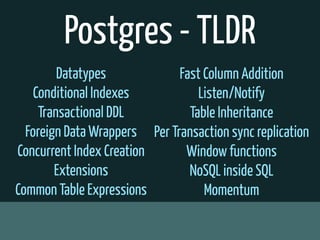
Postgres - TLDR
Postgres - TLDR
Datatypes
Conditional Indexes
Transactional DDL
Foreign Data Wrappers
Concurrent Index Creation
Extensions
Common Table Expressions
Fast Column Addition
Listen/Notify
Table Inheritance
Per Transaction sync replication
Window functions
NoSQL inside SQL
Momentum
OLTP vs OLAP
OLTP
W$b(pp%
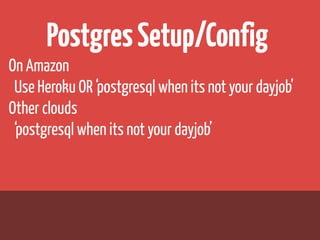
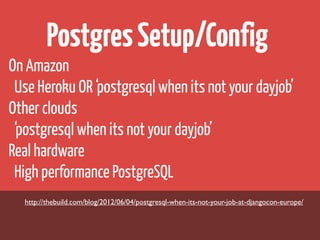
PostgresSetup/Config
On Amazon
PostgresSetup/Config
On Amazon
Use Heroku OR ‘postgresql when its not your dayjob’
PostgresSetup/Config
On Amazon
Use Heroku OR ‘postgresql when its not your dayjob’
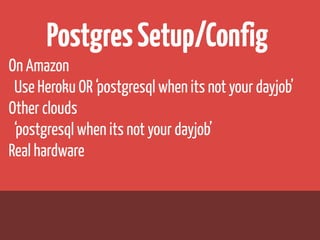
Other clouds
PostgresSetup/Config
On Amazon
Use Heroku OR ‘postgresql when its not your dayjob’
Other clouds
‘postgresql when its not your dayjob’
PostgresSetup/Config
On Amazon
Use Heroku OR ‘postgresql when its not your dayjob’
Other clouds
‘postgresql when its not your dayjob’
Real hardware
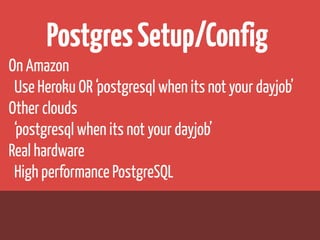
PostgresSetup/Config
On Amazon
Use Heroku OR ‘postgresql when its not your dayjob’
Other clouds
‘postgresql when its not your dayjob’
Real hardware
High performance PostgreSQL
PostgresSetup/Config
On Amazon
Use Heroku OR ‘postgresql when its not your dayjob’
Other clouds
‘postgresql when its not your dayjob’
Real hardware
High performance PostgreSQL
http://thebuild.com/blog/2012/06/04/postgresql-when-its-not-your-job-at-djangocon-europe/
C(*.$
80/20 r+/$
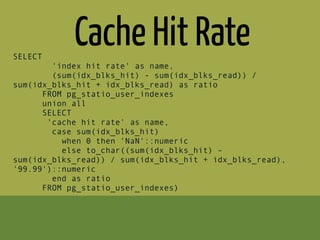
Cache Hit RateSELECT
'index hit rate' as name,
(sum(idx_blks_hit) - sum(idx_blks_read)) /
sum(idx_blks_hit + idx_blks_read) as ratio
FROM pg_statio_user_indexes
union all
SELECT
'cache hit rate' as name,
case sum(idx_blks_hit)
when 0 then 'NaN'::numeric
else to_char((sum(idx_blks_hit) -
sum(idx_blks_read)) / sum(idx_blks_hit + idx_blks_read),
'99.99')::numeric
end as ratio
FROM pg_statio_user_indexes)
Cache Hit Rate
name | ratio
----------------+------------------------
cache hit rate | 0.99
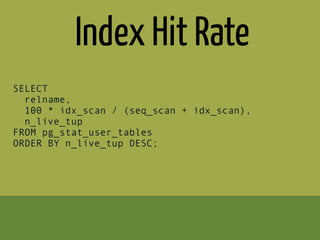
Index Hit Rate
SELECT
relname,
100 * idx_scan / (seq_scan + idx_scan),
n_live_tup
FROM pg_stat_user_tables
ORDER BY n_live_tup DESC;
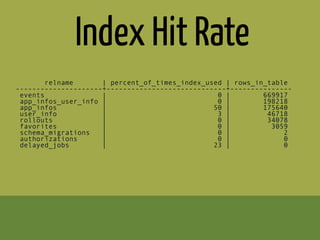
Index Hit Rate
relname | percent_of_times_index_used | rows_in_table
---------------------+-----------------------------+---------------
events | 0 | 669917
app_infos_user_info | 0 | 198218
app_infos | 50 | 175640
user_info | 3 | 46718
rollouts | 0 | 34078
favorites | 0 | 3059
schema_migrations | 0 | 2
authorizations | 0 | 0
delayed_jobs | 23 | 0
S.&r"*+"%
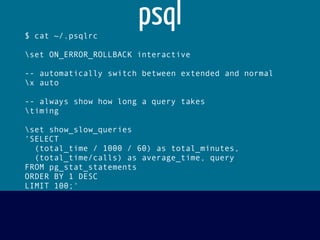
$ cat ~/.psqlrc
set ON_ERROR_ROLLBACK interactive
-- automatically switch between extended and normal
x auto
-- always show how long a query takes
timing
set show_slow_queries
'SELECT
(total_time / 1000 / 60) as total_minutes,
(total_time/calls) as average_time, query
FROM pg_stat_statements
ORDER BY 1 DESC
LIMIT 100;'
psql
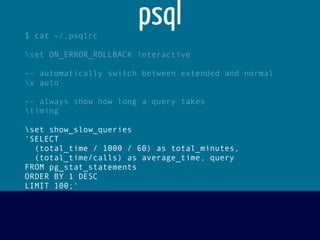
$ cat ~/.psqlrc
set ON_ERROR_ROLLBACK interactive
-- automatically switch between extended and normal
x auto
-- always show how long a query takes
timing
set show_slow_queries
'SELECT
(total_time / 1000 / 60) as total_minutes,
(total_time/calls) as average_time, query
FROM pg_stat_statements
ORDER BY 1 DESC
LIMIT 100;'
psql
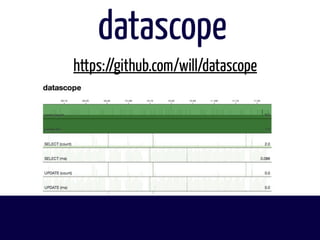
datascope
https://github.com/will/datascope
U)0$r%"()0,)#
Sp$*,1* Q+$r2
P$rf&r'()*$
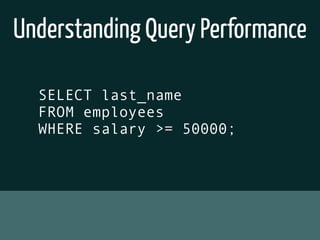
Understanding Query Performance
SELECT last_name
FROM employees
WHERE salary >= 50000;
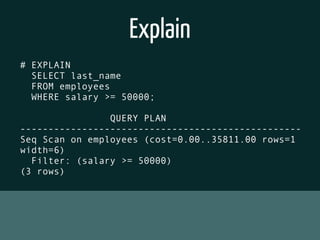
Explain
# EXPLAIN
SELECT last_name
FROM employees
WHERE salary >= 50000;
QUERY PLAN
--------------------------------------------------
Seq Scan on employees (cost=0.00..35811.00 rows=1
width=6)
Filter: (salary >= 50000)
(3 rows)
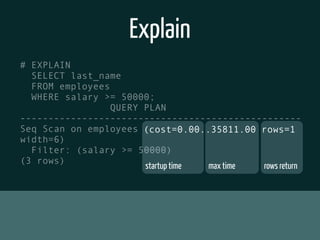
Explain
# EXPLAIN
SELECT last_name
FROM employees
WHERE salary >= 50000;
QUERY PLAN
--------------------------------------------------
Seq Scan on employees
width=6)
Filter: (salary >= 50000)
(3 rows)
startup time max time rows return
(cost=0.00..35811.00 rows=1
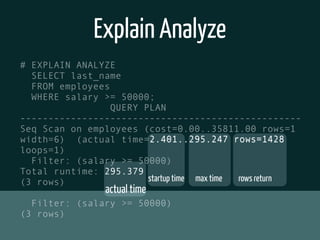
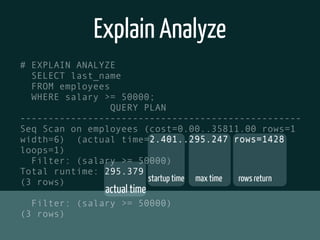
Explain Analyze
# EXPLAIN ANALYZE
SELECT last_name
FROM employees
WHERE salary >= 50000;
QUERY PLAN
--------------------------------------------------
Seq Scan on employees (cost=0.00..35811.00 rows=1
width=6) (actual time=2.401..295.247 rows=1428
loops=1)
Filter: (salary >= 50000)
Total runtime: 295.379
(3 rows)
Filter: (salary >= 50000)
(3 rows)
startup time max time rows return
actual time
2.401..295.247 rows=1428
295.379
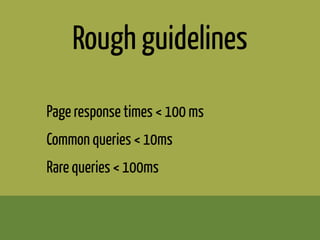
Rough guidelines
Page response times < 100 ms
Common queries < 10ms

Rare queries < 100ms
Explain Analyze
# EXPLAIN ANALYZE
SELECT last_name
FROM employees
WHERE salary >= 50000;
QUERY PLAN
--------------------------------------------------
Seq Scan on employees (cost=0.00..35811.00 rows=1
width=6) (actual time=2.401..295.247 rows=1428
loops=1)
Filter: (salary >= 50000)
Total runtime: 295.379
(3 rows)
Filter: (salary >= 50000)
(3 rows)
startup time max time rows return
actual time
2.401..295.247 rows=1428
295.379
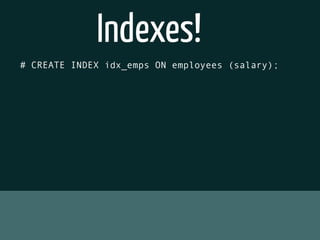
# CREATE INDEX idx_emps ON employees (salary);
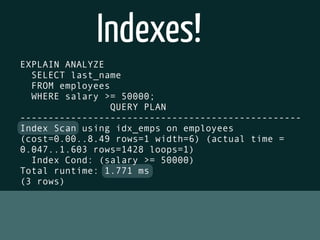
Indexes!
Indexes!
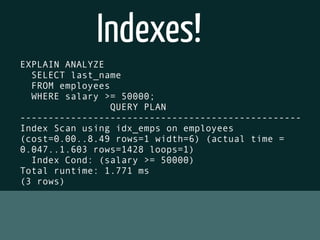
EXPLAIN ANALYZE
SELECT last_name
FROM employees
WHERE salary >= 50000;
QUERY PLAN
--------------------------------------------------
Index Scan using idx_emps on employees
(cost=0.00..8.49 rows=1 width=6) (actual time =
0.047..1.603 rows=1428 loops=1)
Index Cond: (salary >= 50000)
Total runtime: 1.771 ms
(3 rows)
Indexes!
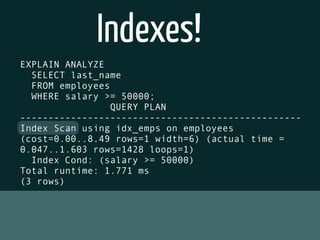
EXPLAIN ANALYZE
SELECT last_name
FROM employees
WHERE salary >= 50000;
QUERY PLAN
--------------------------------------------------
Index Scan using idx_emps on employees
(cost=0.00..8.49 rows=1 width=6) (actual time =
0.047..1.603 rows=1428 loops=1)
Index Cond: (salary >= 50000)
Total runtime: 1.771 ms
(3 rows)
Indexes!
EXPLAIN ANALYZE
SELECT last_name
FROM employees
WHERE salary >= 50000;
QUERY PLAN
--------------------------------------------------
Index Scan using idx_emps on employees
(cost=0.00..8.49 rows=1 width=6) (actual time =
0.047..1.603 rows=1428 loops=1)
Index Cond: (salary >= 50000)
Total runtime: 1.771 ms
(3 rows)
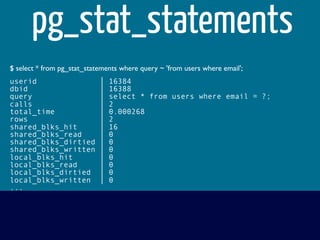
pg_stat_statements
pg_stat_statements
$ select * from pg_stat_statements where query ~ 'from users where email';
userid │ 16384
dbid │ 16388
query │ select * from users where email = ?;
calls │ 2
total_time │ 0.000268
rows │ 2
shared_blks_hit │ 16
shared_blks_read │ 0
shared_blks_dirtied │ 0
shared_blks_written │ 0
local_blks_hit │ 0
local_blks_read │ 0
local_blks_dirtied │ 0
local_blks_written │ 0
...
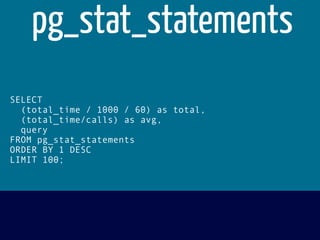
pg_stat_statements
SELECT
(total_time / 1000 / 60) as total,
(total_time/calls) as avg,
query
FROM pg_stat_statements
ORDER BY 1 DESC
LIMIT 100;
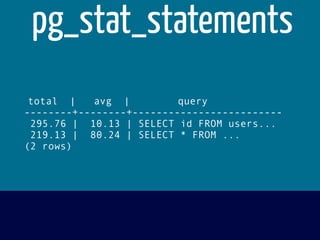
pg_stat_statements
pg_stat_statements
total | avg | query
--------+--------+-------------------------
295.76 | 10.13 | SELECT id FROM users...
219.13 | 80.24 | SELECT * FROM ...
(2 rows)
pg_stat_statements
I)03$%
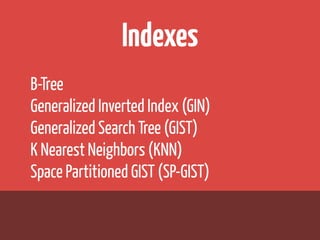
Indexes
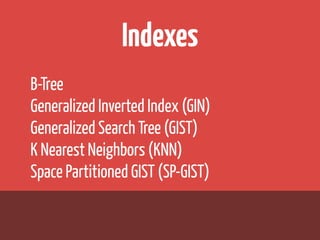
B-Tree
Generalized Inverted Index (GIN)
Generalized Search Tree (GIST)
K Nearest Neighbors (KNN)
Space Partitioned GIST (SP-GIST)
Indexes
Which do I use?
BTree
This is what you usually want
Generalized Inverted Index (GIN)
Use with multiple values in 1 column
Array/hStore
Generalized Search Tree (GIST)
Full text search
Shapes
Indexes
B-Tree
Generalized Inverted Index (GIN)
Generalized Search Tree (GIST)
K Nearest Neighbors (KNN)
Space Partitioned GIST (SP-GIST)
M&r$ ,)03$%
Indexes
Conditional
Functional
Concurrent creation
Conditional
> SELECT *
FROM places;
name | population
-----------------------------------
ACMAR | 6055
ARAB | 13650
Conditional
> SELECT *
FROM places
WHERE population > 10000;
name | population
-----------------------------------
ARAB | 13650
Conditional
> SELECT *
FROM places
WHERE population > 10000;
name | population
-----------------------------------
ARAB | 13650
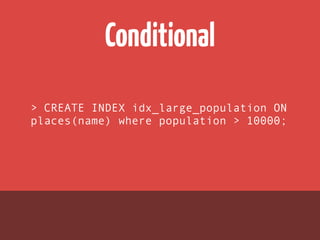
Conditional
> CREATE INDEX idx_large_population ON
places(name) where population > 10000;
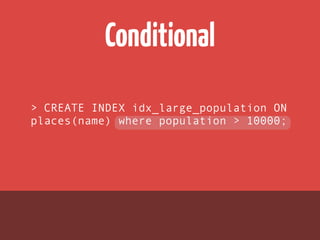
Conditional
> CREATE INDEX idx_large_population ON
places(name) where population > 10000;
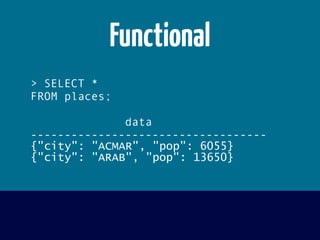
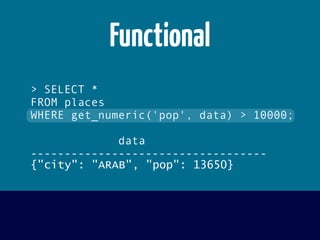
Functional
> SELECT *
FROM places;
data
-----------------------------------
{"city": "ACMAR", "pop": 6055}
{"city": "ARAB", "pop": 13650}
> SELECT *
FROM places
WHERE get_numeric('pop', data) > 10000;
data
-----------------------------------
{"city": "ARAB", "pop": 13650}
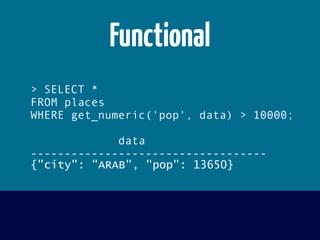
Functional
> SELECT *
FROM places
WHERE get_numeric('pop', data) > 10000;
data
-----------------------------------
{"city": "ARAB", "pop": 13650}
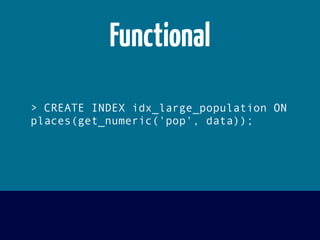
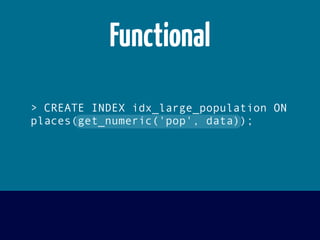
Functional
> CREATE INDEX idx_large_population ON
places(get_numeric('pop', data));
Functional
> CREATE INDEX idx_large_population ON
places(get_numeric('pop', data));
Functional
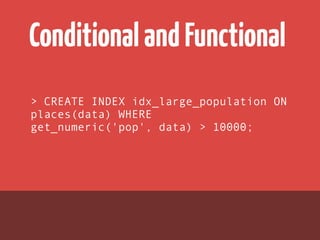
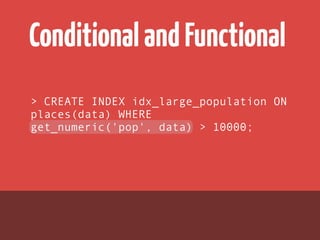
ConditionalandFunctional
> CREATE INDEX idx_large_population ON
places(data) WHERE
get_numeric('pop', data) > 10000;
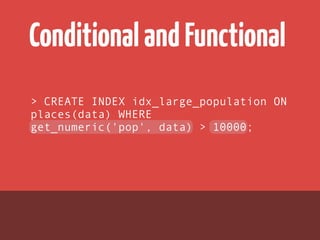
ConditionalandFunctional
> CREATE INDEX idx_large_population ON
places(data) WHERE
get_numeric('pop', data) > 10000;
ConditionalandFunctional
> CREATE INDEX idx_large_population ON
places(data) WHERE
get_numeric('pop', data) > 10000;
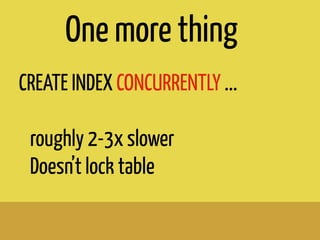
CREATE INDEX CONCURRENTLY ...
roughly 2-3x slower
Doesn’t lock table
One more thing
D4()#&
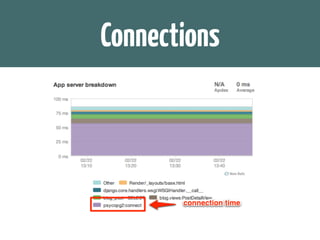
Connections
Connections
django-postgrespool
djorm-ext-pool
django-db-pool
django-postgrespool
import dj_database_url
import django_postgrespool
DATABASE = { 'default': dj_database_url.config() }
DATABASES['default']['ENGINE'] = 'django_postgrespool'
SOUTH_DATABASE_ADAPTERS = {
'default': 'south.db.postgresql_psycopg2'
}
django-postgrespool
import dj_database_url
import django_postgrespool
DATABASE = { 'default': dj_database_url.config() }
DATABASES['default']['ENGINE'] = 'django_postgrespool'
SOUTH_DATABASE_ADAPTERS = {
'default': 'south.db.postgresql_psycopg2'
}
pgbouncer
pgpool
Other options
A00,)# C(*.$
Replicationoptions
Replicationoptions
slony
bucardo
pgpool
Replicationoptions
slony
bucardo
pgpool
wal-e
barman
Replicationoptions
slony
bucardo
pgpool
wal-e
barman
Update settings
effective_cache_size
shared_buffers
work_mem
maintenance_work_mem
Update settings
B(*-+p%
Logical
pg_dump
can be human readable, is portable
Physical
The bytes on disk
Base backup
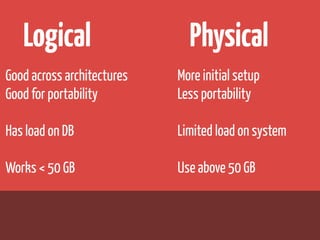
Logical
Good across architectures
Good for portability
Has load on DB
Works < 50 GB
Physical
More initial setup
Less portability
Limited load on system
Use above 50 GB
R$*(p
OLAP
Whole other talk
Disk IO is important
Order on disk is helpful (pg-reorg)
MPP solutions on top of Postgres
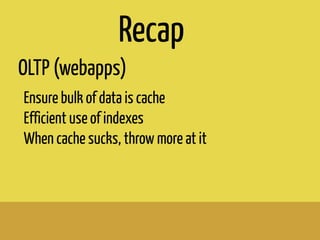
Recap
OLTP (webapps)
Ensure bulk of data is cache
Efficient use of indexes
When cache sucks, throw more at it
Recap
Q+$%",&)%

Postgres performance for humans