The SQ4R MethodReading furnishes the mind only with materials of knowledge; it is thinking that makes what we read ours.” -- John Locke (English philosopher)
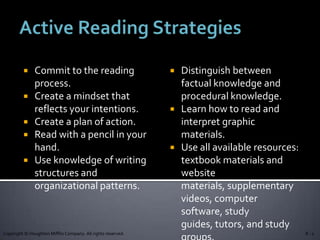
Copyright © Houghton Mifflin Company. All rights reserved.8 - 2Active Reading StrategiesCommit to the reading process.Create a mindset that reflects your intentions.Create a plan of action.Read with a pencil in your hand.Use knowledge of writing structures and organizational patterns.Distinguish between factual knowledge and procedural knowledge.Learn how to read and interpret graphic materials.Use all available resources: textbook materials and website materials, supplementary videos, computer software, study guides, tutors, and study groups.
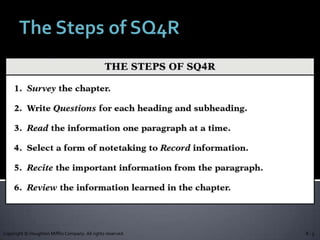
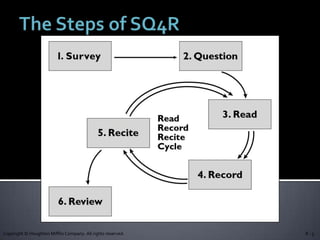
The Steps of SQ4RCopyright © Houghton Mifflin Company. All rights reserved.8 - 3
Contemporary Information Processing ModelLONG-TERMMEMORYWORKINGMEMORYschemaschemaCentral ExecutiveSensory Inputfrom thePhysicalWorld5 sensesSENSORYMEMORY SHORT-TERMMEMORYschemaschemaOutput
The Steps of SQ4RCopyright © Houghton Mifflin Company. All rights reserved.8 - 5
SurveySurvey the chapter contentsSurveying is the process of previewing   or skimming to get an overview.Surveying:    -enhances motivation and interest    -gets the reading process going    -creates a positive mindset to learn    -helps you set goals and plan time
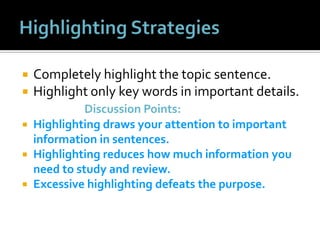
Highlighting StrategiesCompletely highlight the topic sentence.Highlight only key words in important details.Discussion Points:Highlighting draws your attention to important information in sentences.Highlighting reduces how much information you need to study and review.Excessive highlighting defeats the purpose.
QuestionAsk questions before, during, and after reading the material.Create questions from headings and subheadings of a textbook.What do you wonder about after your survey?Review the end of chapter questions.
Use Bloom’s Taxonomy Questions to Predict, Write, and Answer QuestionsCopyright © Houghton Mifflin Company. All rights reserved.8 - 9
ReadAdjust your rate of readingSlow down when you find challenging passagesSpeed up on the easier passages.
RecordRecord the answers to your questions in complete sentences.
ReciteRecite the important pointsSay the answers that you wrote in complete sentences OUT LOUD!!!
ReviewConduct immediate and ongoing reviewImmediateLook Away TechniqueOngoingCreate a 7-day learning cycleCreate Visual Maps, outlines, summaries, and flash cards.

Sq4 R Method Example

  • 1.
    The SQ4R MethodReadingfurnishes the mind only with materials of knowledge; it is thinking that makes what we read ours.” -- John Locke (English philosopher)
  • 2.
    Copyright © HoughtonMifflin Company. All rights reserved.8 - 2Active Reading StrategiesCommit to the reading process.Create a mindset that reflects your intentions.Create a plan of action.Read with a pencil in your hand.Use knowledge of writing structures and organizational patterns.Distinguish between factual knowledge and procedural knowledge.Learn how to read and interpret graphic materials.Use all available resources: textbook materials and website materials, supplementary videos, computer software, study guides, tutors, and study groups.
  • 3.
    The Steps ofSQ4RCopyright © Houghton Mifflin Company. All rights reserved.8 - 3
  • 4.
    Contemporary Information ProcessingModelLONG-TERMMEMORYWORKINGMEMORYschemaschemaCentral ExecutiveSensory Inputfrom thePhysicalWorld5 sensesSENSORYMEMORY SHORT-TERMMEMORYschemaschemaOutput
  • 5.
    The Steps ofSQ4RCopyright © Houghton Mifflin Company. All rights reserved.8 - 5
  • 6.
    SurveySurvey the chaptercontentsSurveying is the process of previewing or skimming to get an overview.Surveying: -enhances motivation and interest -gets the reading process going -creates a positive mindset to learn -helps you set goals and plan time
  • 7.
    Highlighting StrategiesCompletely highlightthe topic sentence.Highlight only key words in important details.Discussion Points:Highlighting draws your attention to important information in sentences.Highlighting reduces how much information you need to study and review.Excessive highlighting defeats the purpose.
  • 8.
    QuestionAsk questions before,during, and after reading the material.Create questions from headings and subheadings of a textbook.What do you wonder about after your survey?Review the end of chapter questions.
  • 9.
    Use Bloom’s TaxonomyQuestions to Predict, Write, and Answer QuestionsCopyright © Houghton Mifflin Company. All rights reserved.8 - 9
  • 10.
    ReadAdjust your rateof readingSlow down when you find challenging passagesSpeed up on the easier passages.
  • 11.
    RecordRecord the answersto your questions in complete sentences.
  • 12.
    ReciteRecite the importantpointsSay the answers that you wrote in complete sentences OUT LOUD!!!
  • 13.
    ReviewConduct immediate andongoing reviewImmediateLook Away TechniqueOngoingCreate a 7-day learning cycleCreate Visual Maps, outlines, summaries, and flash cards.