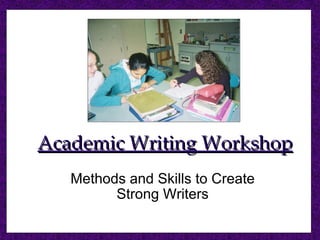
Academic Writing Workshop Methods and Skills to Create Strong Writers
Why Teach Writing? Students need strong writing skills in every subject they study Technology is eroding formal writing skills faster every day Without a strong background in writing students will be unable to succeed in higher level academics
Problems in Teaching Writing Students have a variety of skills from different backgrounds Different subjects require different writing skills Many subject teachers are not trained to teach writing along with their content Students resist long writing assignments.
Designing Writing Assignments
Types of Essays To explain To persuade To compare or contrast To reflect To give opinion To summarize To tell a story (creative writing) To prove (thesis)
Defining Objectives What is the purpose of the assignment? Example: to practice, to evaluate, to share What content will be evaluated? Example: vocabulary, information from a reading What skills will be evaluated?  Example: sentence structure, using quotes from a reading
Creating a Rubric (Scoresheet) Identify a few objectives for the assignment that will be evaluated. Clearly define what students must achieve.   Examples:  Length -Persuasiveness   -Organization Grammar -Capitalization   -Editing Spelling -Quality of info.   -Punctuation Vocabulary -Amount of info.   -Voice/Tone Facts -Argument   -Accuracy Focus on only a few for each assignment!
The 5-Step Writing Process created by teachers in  Arlington, MA, USA
5- Step Writing Process Think Gather Information Organize Write  Edit
Step 1: Think Plan what to write. Students Ask: “ Do I know all of the information that I need?” “ Where can I find information I do not know?”
Brainstorm Good vs. Evil Violence supernatural religion Eventuality of death
Step Two: Gather Information Take notes  Make lists Make sure you have enough information to answer the question or complete the task!
Step Three: Organize Organize data by topic. Example: If students are writing about a story, one paragraph would have information about characters, another paragraph would be about plot, etc Arrange in the order you will write Create an outline of the data Start with an introduction End with a conclusion
Five-Paragraph Essay Format Paragraph One: Introduction Paragraph Two: Supporting Detail #1 Paragraph Three: Supporting Detail #2 Paragraph Four: Supporting Detail #3 Paragraph Five: Conclusion
Sample Outlines
Step Four: WRITE! Following your outline, write the essay. Do not worry about making errors now, just get the words on the paper Be sure to address all areas required for the assignment.
Introduction Paragraph Begin with a general statement to catch the reader’s attention Briefly summarize the  main points of the essay End with a main idea statement (thesis)
Conclusion Paragraph Restate the main idea Briefly summarize the  most importance evidence Tell the importance of this essay, or how it connects to the world
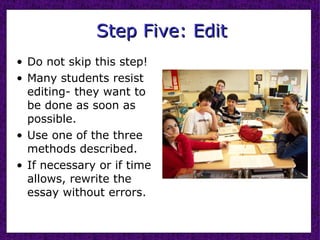
Step Five: Edit Do not skip this step!  Many students resist editing- they want to be done as soon as possible. Use one of the three methods described. If necessary or if time allows, rewrite the essay without errors.
Three Types of Editing SELF EDITING:  Re-read the entire essay, correcting any mistakes  TEACHER EDITING:  Teacher will collect work, edit, and return for corrections.  PEER EDITING:  Students exchange essays and edit their classmate’s work.
WHY THIS WORKS Students can use the method for ANY writing assignment It takes an overwhelming assignment and separates it into smaller, easier to manage steps It becomes habit if used frequently

Academic Writing Workshop

  • 1.
    Academic Writing WorkshopMethods and Skills to Create Strong Writers
  • 2.
    Why Teach Writing?Students need strong writing skills in every subject they study Technology is eroding formal writing skills faster every day Without a strong background in writing students will be unable to succeed in higher level academics
  • 3.
    Problems in TeachingWriting Students have a variety of skills from different backgrounds Different subjects require different writing skills Many subject teachers are not trained to teach writing along with their content Students resist long writing assignments.
  • 4.
  • 5.
    Types of EssaysTo explain To persuade To compare or contrast To reflect To give opinion To summarize To tell a story (creative writing) To prove (thesis)
  • 6.
    Defining Objectives Whatis the purpose of the assignment? Example: to practice, to evaluate, to share What content will be evaluated? Example: vocabulary, information from a reading What skills will be evaluated? Example: sentence structure, using quotes from a reading
  • 7.
    Creating a Rubric(Scoresheet) Identify a few objectives for the assignment that will be evaluated. Clearly define what students must achieve. Examples: Length -Persuasiveness -Organization Grammar -Capitalization -Editing Spelling -Quality of info. -Punctuation Vocabulary -Amount of info. -Voice/Tone Facts -Argument -Accuracy Focus on only a few for each assignment!
  • 8.
    The 5-Step WritingProcess created by teachers in Arlington, MA, USA
  • 9.
    5- Step WritingProcess Think Gather Information Organize Write Edit
  • 10.
    Step 1: ThinkPlan what to write. Students Ask: “ Do I know all of the information that I need?” “ Where can I find information I do not know?”
  • 11.
    Brainstorm Good vs.Evil Violence supernatural religion Eventuality of death
  • 12.
    Step Two: GatherInformation Take notes Make lists Make sure you have enough information to answer the question or complete the task!
  • 13.
    Step Three: OrganizeOrganize data by topic. Example: If students are writing about a story, one paragraph would have information about characters, another paragraph would be about plot, etc Arrange in the order you will write Create an outline of the data Start with an introduction End with a conclusion
  • 14.
    Five-Paragraph Essay FormatParagraph One: Introduction Paragraph Two: Supporting Detail #1 Paragraph Three: Supporting Detail #2 Paragraph Four: Supporting Detail #3 Paragraph Five: Conclusion
  • 15.
  • 16.
    Step Four: WRITE!Following your outline, write the essay. Do not worry about making errors now, just get the words on the paper Be sure to address all areas required for the assignment.
  • 17.
    Introduction Paragraph Beginwith a general statement to catch the reader’s attention Briefly summarize the main points of the essay End with a main idea statement (thesis)
  • 18.
    Conclusion Paragraph Restatethe main idea Briefly summarize the most importance evidence Tell the importance of this essay, or how it connects to the world
  • 19.
    Step Five: EditDo not skip this step! Many students resist editing- they want to be done as soon as possible. Use one of the three methods described. If necessary or if time allows, rewrite the essay without errors.
  • 20.
    Three Types ofEditing SELF EDITING: Re-read the entire essay, correcting any mistakes TEACHER EDITING: Teacher will collect work, edit, and return for corrections. PEER EDITING: Students exchange essays and edit their classmate’s work.
  • 21.
    WHY THIS WORKSStudents can use the method for ANY writing assignment It takes an overwhelming assignment and separates it into smaller, easier to manage steps It becomes habit if used frequently