SPREAD SPECTRUM
MODULATION
Prepared By
Ms. Lipsa Dash
Senior Assistant Professor
New Horizon College of Engineering, Bangalore
SPREAD SPECTRUM MODULATION
Primary Advantage:
Ability to reject interference whether it be
unintentional interference of another user
simultaneously attempting to transmit through the
channel, or the intentional interference of a hostile
transmitter attempting to jam the transmission.
Definition:
1. Spread spectrum is a means of transmission in which
the data of interest occupies a bandwidth in excess of
the minimum bandwidth necessary to send the data.
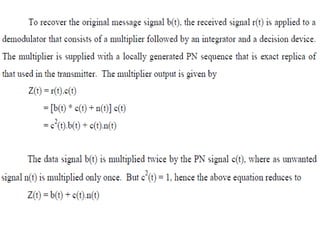
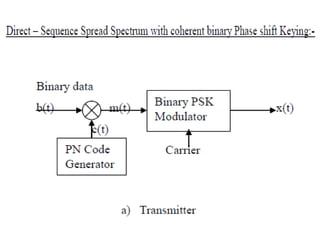
2. The spectrum spreading is accomplished before
transmission through the use of a code that is
independent of the data sequence. The same code is
used in the receive(operating in synchronism with
the transmitter) to despread the received signal so
that the original data may be recovered.
Uses:
1. Used to provide multipath rejection in a ground-
based mobile radio environment
2. Used in multiple-access communication
PSEUDO-NOISE SEQUENCES
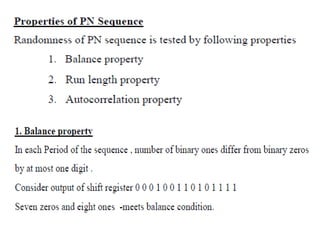
• A pseudo-noise (PN) sequence is defined as a coded
sequence of 1s and 0s with certain autocorrelation
properties.
• The class of sequences used in spread spectrum
communications is usually periodic in that a
sequence of 1s and 0s repeats itself exactly with a
known period.
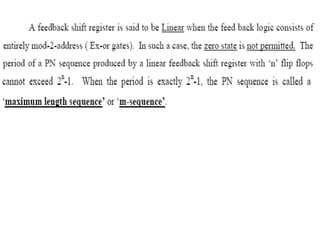
• The maximum length sequence, a type of cyclic code
represents a commonly used periodic PN sequence.
• Such sequences have long periods and require
simple instrumentation in the form of a LFSR (Linear
Feedback Shift Register).
Spread Spectrum Modulation

Spread Spectrum Modulation

  • 1.
    SPREAD SPECTRUM MODULATION Prepared By Ms.Lipsa Dash Senior Assistant Professor New Horizon College of Engineering, Bangalore
  • 2.
    SPREAD SPECTRUM MODULATION PrimaryAdvantage: Ability to reject interference whether it be unintentional interference of another user simultaneously attempting to transmit through the channel, or the intentional interference of a hostile transmitter attempting to jam the transmission. Definition: 1. Spread spectrum is a means of transmission in which the data of interest occupies a bandwidth in excess of the minimum bandwidth necessary to send the data.
  • 3.
    2. The spectrumspreading is accomplished before transmission through the use of a code that is independent of the data sequence. The same code is used in the receive(operating in synchronism with the transmitter) to despread the received signal so that the original data may be recovered. Uses: 1. Used to provide multipath rejection in a ground- based mobile radio environment 2. Used in multiple-access communication
  • 4.
    PSEUDO-NOISE SEQUENCES • Apseudo-noise (PN) sequence is defined as a coded sequence of 1s and 0s with certain autocorrelation properties. • The class of sequences used in spread spectrum communications is usually periodic in that a sequence of 1s and 0s repeats itself exactly with a known period. • The maximum length sequence, a type of cyclic code represents a commonly used periodic PN sequence.
  • 5.
    • Such sequenceshave long periods and require simple instrumentation in the form of a LFSR (Linear Feedback Shift Register).