Concept of SS
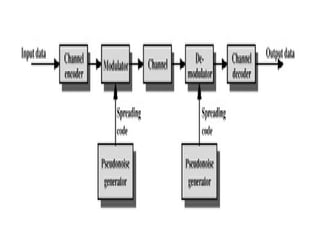
•Input is fed into a channel encoder that produces an
analog signal with a relatively narrow bandwidth
around some center frequency. This signal is further
modulated using a sequence of digits known as a
spreading code or spreading sequence.
• The spreading code is a series of numbers that look
random, but are in fact a pattern. In general, but not
always, the spreading code is generated by a
pseudonoise, or pseudorandom number, generator
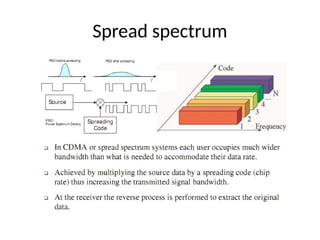
• This modulationhas the effect of increasing
considerably the bandwidth (spread the
spectrum) of the signal to be transmitted.
• On the receiving end, the same digit sequence
which was used as the spreading code is used
to demodulate the spread spectrum signal.
Lastly, the signal is fed into a channel decoder
to recover the data.
6.
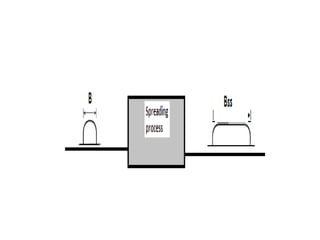
• Bandwidth ofthe modulated signal is wider
than the bandwidth of the signal before it is
modulated by spread spectrum. Figure next
slide shows the bandwidth of the signal before
and after the spreading process. If the
bandwidth before spreading is B, then the
spreading process expands it to Bss where Bss is
so much wider than B. That is Bss >> B. The
expanded bandwidth allows the source to
enfold its message in a protective envelope for
a more secure transmission
8.
Class work
• Explainkey features of SS
• Advantages of SS
• Explain FHSS and DSSS