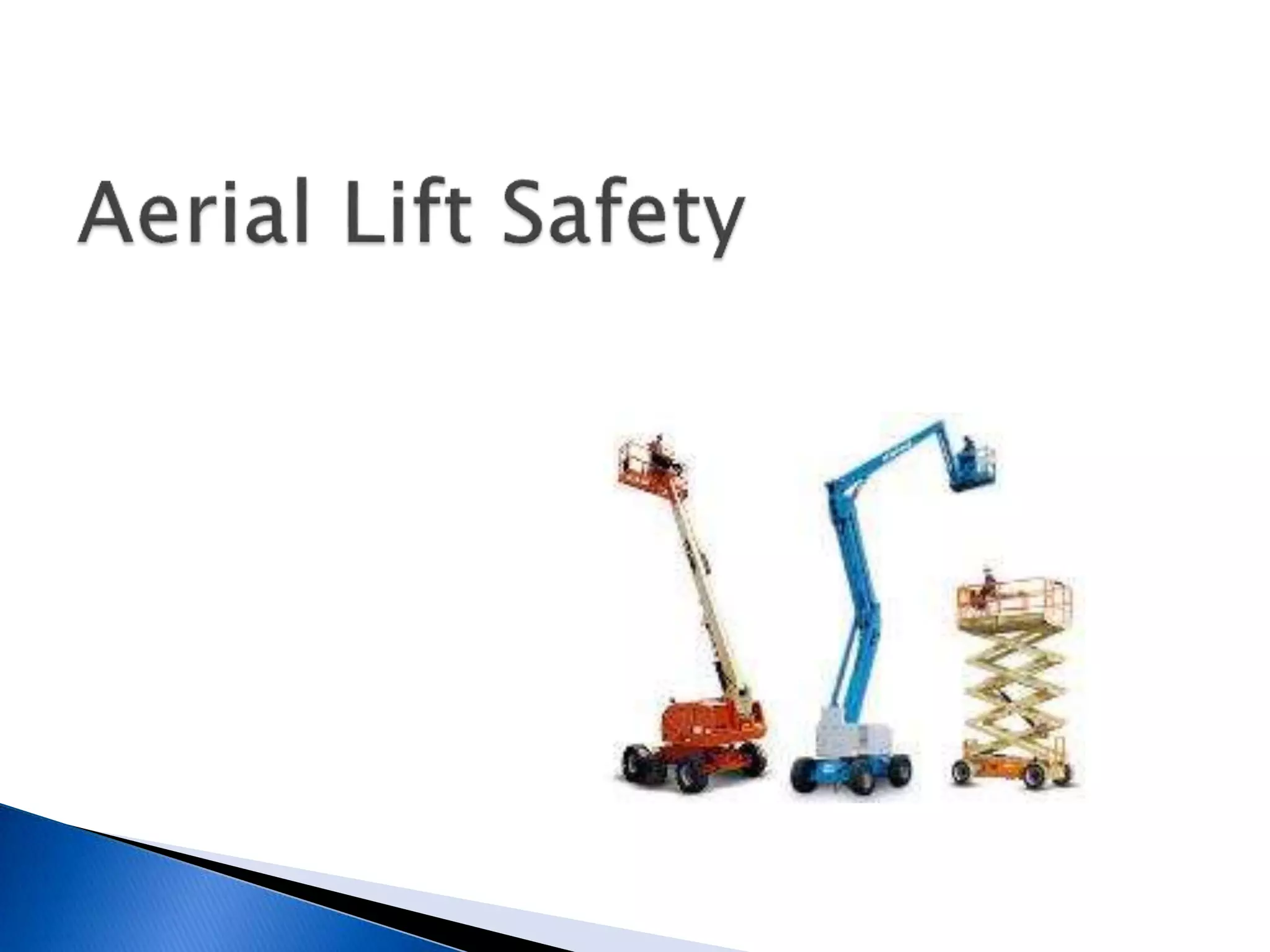
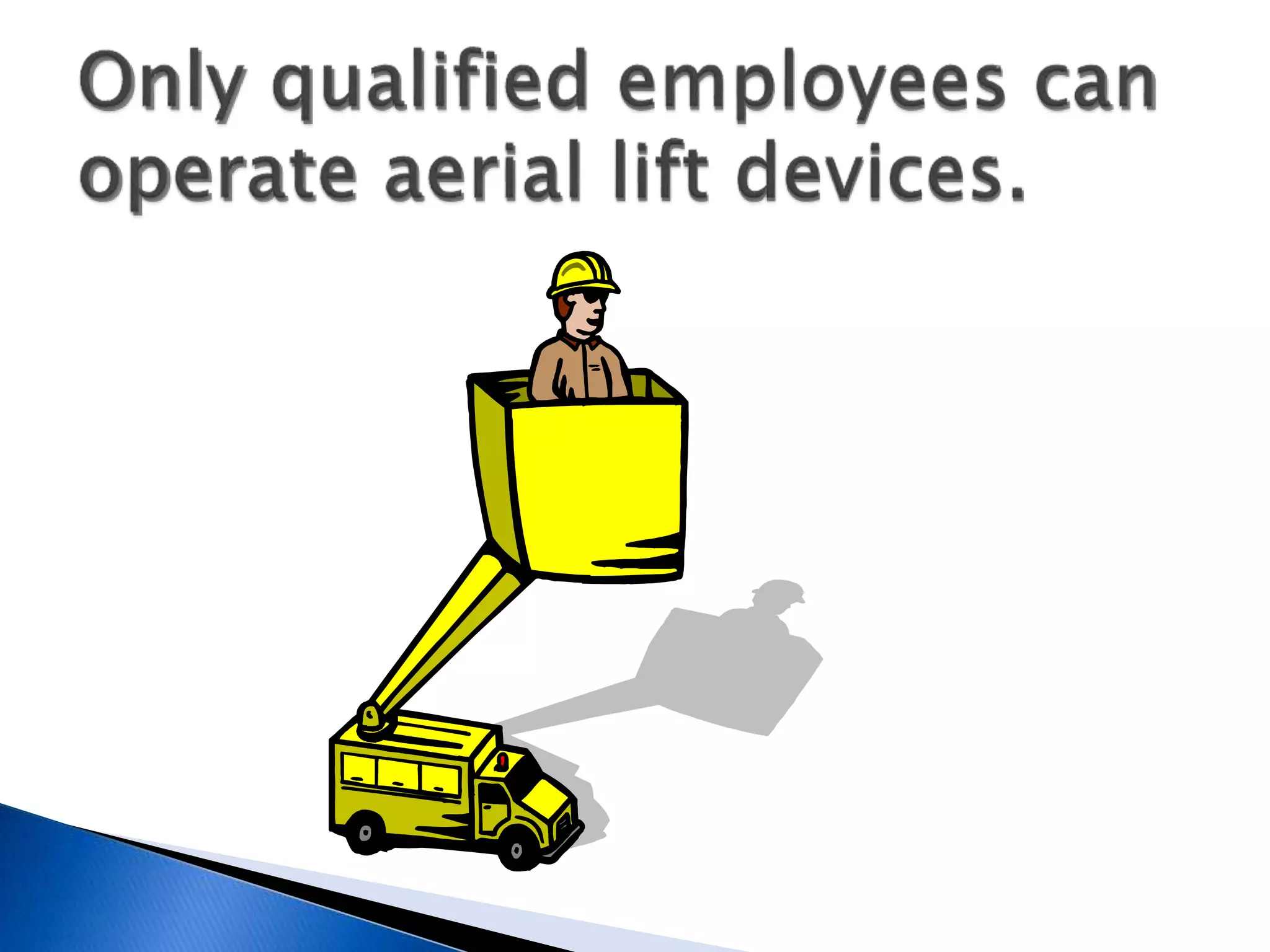
 An aerial lift, for the purpose of this training, is
any work platform that has an articulating boom
with a bucket.
• Only qualified employees can operate aerial lifts. Only your
employer can certify that you are qualified operator.
• This training program is based on OSHA and ANSI Z133
safety standards for arboricultural operations.
• This manual presents general safety awareness, industry
safety standards, and some operational guidelines for aerial
lifts.
• It is your responsibility to know and comply with company
policies. If unsure, ask your supervisor. This training is not
intended to replace or supersede company policies and
procedures.
Any one of the following types of vehicle-mounted
apparatus used to elevate personnel to jobsites above
ground:
 Extensible boom platform
 Aerial ladder
 Articulating boom platform
 Vertical tower
 A combination of any of the above
 Objectives:
 Name the most common types of accidents involving
aerial lift devices.
 Interpret the meaning of common warning signs and
labels.
 Identify appropriate personal protective equipment.
OSHA DEFINITION of a "Qualified person" - a
person who possesses a recognized degree,
certificate, professional standing, or skill and
who, by knowledge, training, and experience,
has demonstrated the ability to deal with
problems relating to the subject matter, the
work, or the project.
 Struck-by’s - 42%
 Falls - 31%
 Electrocution - 16% (harmful
environment)
 Transportation - 11%
 Assaults 1%
 Working without fall protection/fall
restraint of any kind
 Misuse of the lift
 Tree parts falling on the
booms/basket
 Failure to inspect/maintain the lift
 Falls from headache rack
 Bucket Operator Warnings
◦ The bucket does not keep you free from risk of
electrocution
◦ Insulation provides only a measure of safety
◦ You can be electrocuted through other paths to
ground:
 If you contact the conductor and the tree
at the same time
 If you contact two conductors at the
same time
The triangle shape is the symbol for:
Caution, Warning, and/or Danger
– the Exclamation Point Means “Pay Attention!”
The manufacturer puts
important
messages on the
equipment. It is our job
to read, know, and
understand them!!
Indicates a hazardous situation.
Know what each word means!
The triangle with the exclamation point and a
picture is used to show you what you are
supposed to use caution for.
The symbol will always remain the same for
caution, but the picture may change.
CAUTION
Means you need to be
careful. Follow the
directions on the sign or
you could get hurt.
WARNING more
Serious than
CAUTION! Follow
directions or injury,
and possibly death,
could occur.
DANGER – the most
Serious safety message!
Serious injury or death
likely to occur if you do
not follow directions!
Personal Protective Equipment (PPE)
1. Fall Protection – full body harness or body belt
with appropriate lanyard connected to
designated anchor point. (OSHA)
2. Helmet – Type 1 Class E and must meet
ANSI-American National Standards Institute
Z89.1 standard
3. Eye Protection – goggles or safety
glasses, including prescription safety
glasses, must meet ANSI Z87.
PPE (cont)
4. Hearing protection – earmuffs or plugs in high noise areas
5. Leg Protection – may be worn, but is not always required
6. Face Shield – If worn, does not substitute for safety glasses.
7. Sturdy, non-slip boots
8. Close fitting clothing and no jewelry. Nothing to get caught in
equipment.
 Objectives:
 Indicate parts to be inspected before and after
operation.
 Demonstrate start-up procedures.
 Understand daily, weekly, monthly and annual
inspection requirements.
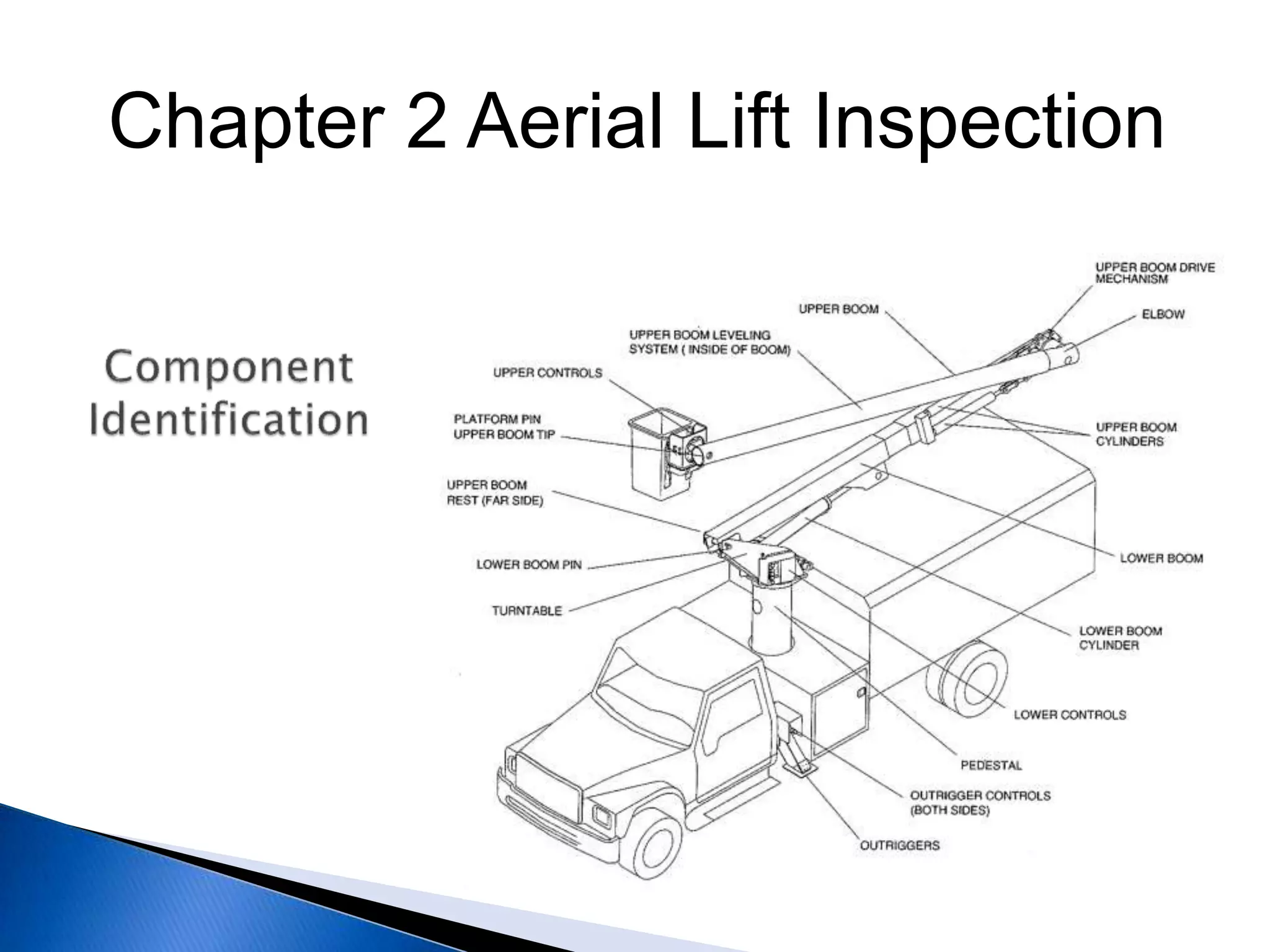
Chapter 2 Aerial Lift Inspection
7-step process to ensure safe operation of
a bucket truck
Conduct visual
inspection of the unit
Inspection: Step 1
Check oil level in hydraulic
reservoir
• Outriggers are up
• Vehicle parked on level surface
• The need to add oil on a
regular basis may indicate a
leak
Check
visual
and
audible
safety
devices
Inspect the
fiberglass
lower and
upper boom
insulator for
dirt and
damage
caused by
rubbing wires,
tree sap etc.
Test the outrigger
interlock system (if
equipped)
 Put truck on
level surface
and attempt to
raise and lower
booms without
putting
outriggers down
 While setting the outriggers make sure
they are working properly
◦ No leaks
◦ No signs of wear due to rubbing against
outrigger weldment
CAUTION: when testing the operation of
the interlock system the platform and
booms should be in such a position that
no damage
can result from unexpected movement
 With no one in the platform, operate the
functions from the lower controls
o If functions are operating normally, move to upper
controls
o Test the interlock system for the upper controls
o First, try to operate booms with upper controls with
the hydraulic stop pushed in
o Next, for trucks with interlock trigger, try to operate
booms without squeezing trigger
o If boom movement occur, interlock system has failed – do
not operate until problem is corrected
** While the unit is operating, look for leakage from hydraulic lines and components
Test station selector at the lower control
station
◦ When the station selector is set to the override
position, the upper controls should not work
◦ The lower controls must always override the
upper control
If the unit is equipped with a secondary
stowage system, remote throttle system,
stop/start system, or battery powered electrical
drive, check these systems for proper operation
 Service brakes,
including trailer
brake connections
 Parking brake
 Steering
mechanism
 Lighting devices
and reflectors
 Tires
 Horn
 Windshield wipers
 Rear vision mirrors
 Coupling devices
 Wheels and rims
 Emergency
equipment
 Shop Start-Up Procedures
◦ Check oil and coolant levels before starting the engine.
◦ Start engine as soon as possible for full warm-up.
◦ Perform visual inspection.
◦ Perform operational inspection of controls and outriggers.
◦ Inform supervisor if you find any broken items.
◦ Check truck storage boxes for all safety devices (i.e.: flags, vests, signs,
cones, chocks, pads) and any other equipment needed.
◦ Be sure there are no loose tools on top of the lift or in the buck- et.
◦ Be sure all equipment doors are shut and locked.
◦ Before leaving your shop, be sure you have your DOT med. exam card (if
applicable), driver’s license, work orders, directions to location(s),
emergency numbers, and all co-workers you need to transport before
leaving.
◦ Wear your seat belt.
◦ Be sure all passengers are wearing their seat belt.
Fueling the Vehicle
• Use correct fuel for equipment
• Never smoke or have an open
flame
• Touch the nozzle to machine
before removing the fuel cap to
prevent static spark
• Keep nozzle or funnel in contact
with fuel tank.
• Wipe up all spills immediately,
before starting Engine.
 Daily, Weekly, Monthly, and Annual Lift Inspections
 Consult manufacturer’s instructions for what is to be included in
“daily,” “weekly,” monthly and annual inspections. Your DVIR form
covers standard items inspected on a daily basis to meet USDOT
Federal Motor Carrier Safety Regulations (FMCSR) for the vehicle on
which the aerial lift is mounted. Lift manufacturers have additional
inspection items for the lift itself, based on the specific model you
are operating.
 In general, “daily” inspections are conducted by aerial lifts
specialists (qualified operators). Depending on your company,
“weekly” inspections may be conducted by an aerial lift specialist or
a qualified maintenance technician. Aerial Lift Specialists, at a
minimum, should be aware of the items that are checked on a
“weekly” basis.
• Monthly and annual inspections are conducted by qualified
maintenance technicians. “Daily” inspections are actually
based on 8 hours of operation and “weekly” inspections are
based on 40 hours of operation.
While driving, parking at job, and returning…
◦ Know the height clearance of your vehicle!
◦ Drive defensively – not offensively!
◦ No tailgating – maintain the right following
distance!
◦ Park your vehicle properly
◦ Conduct post trip inspection
◦ Unload equipment properly and Check equipment
storage – locking them always.
◦ Turn in completed DVIR when back to
office.
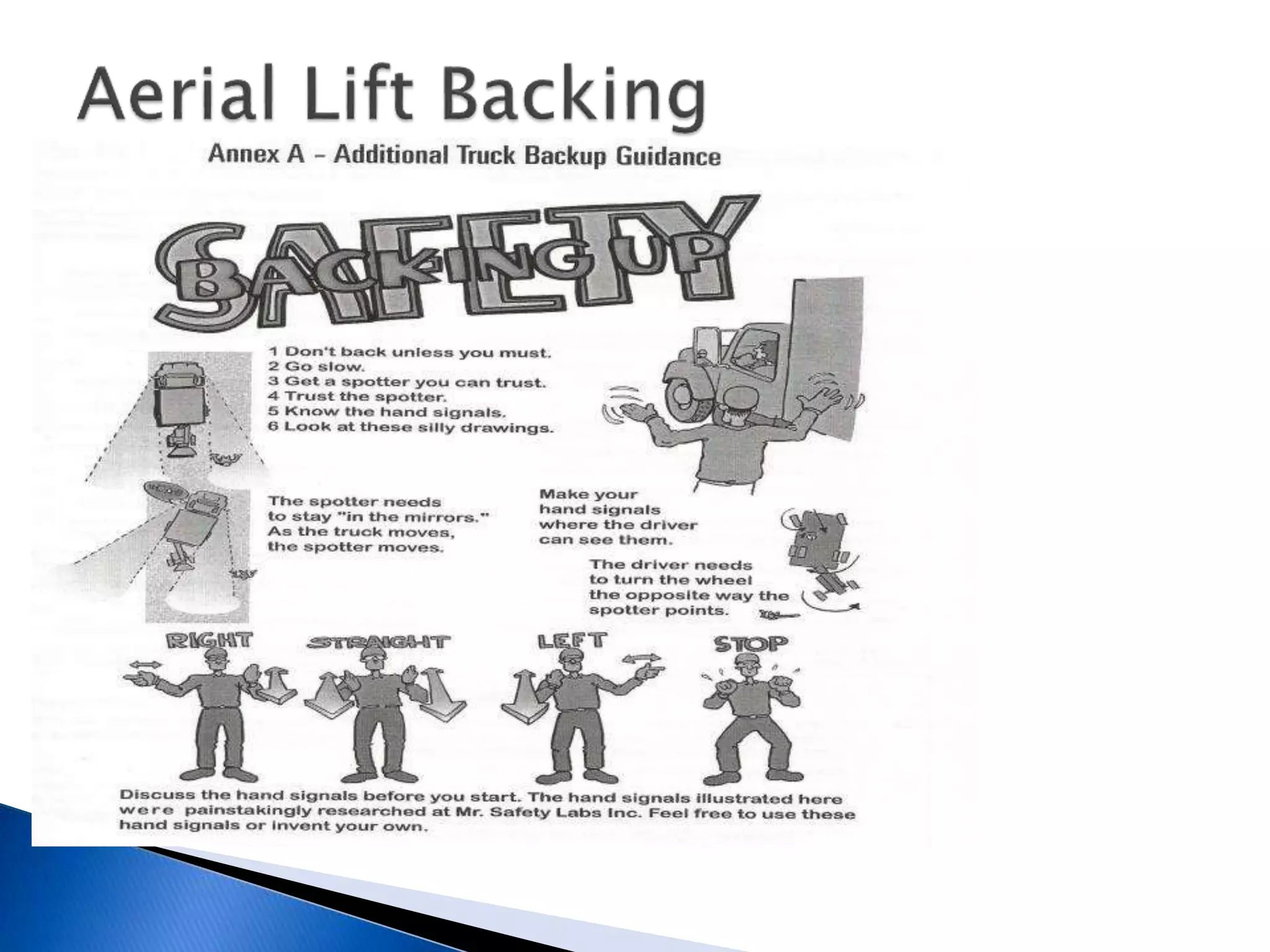
Use a spotter
when backing
vehicles
 Objectives:
◦ The employee will:
 Learn safety standards for working with an aerial lift
 Learn work-site traffic control procedures
 Learn aerial lift positioning and set-up procedures
 Identify good work-site set-up position
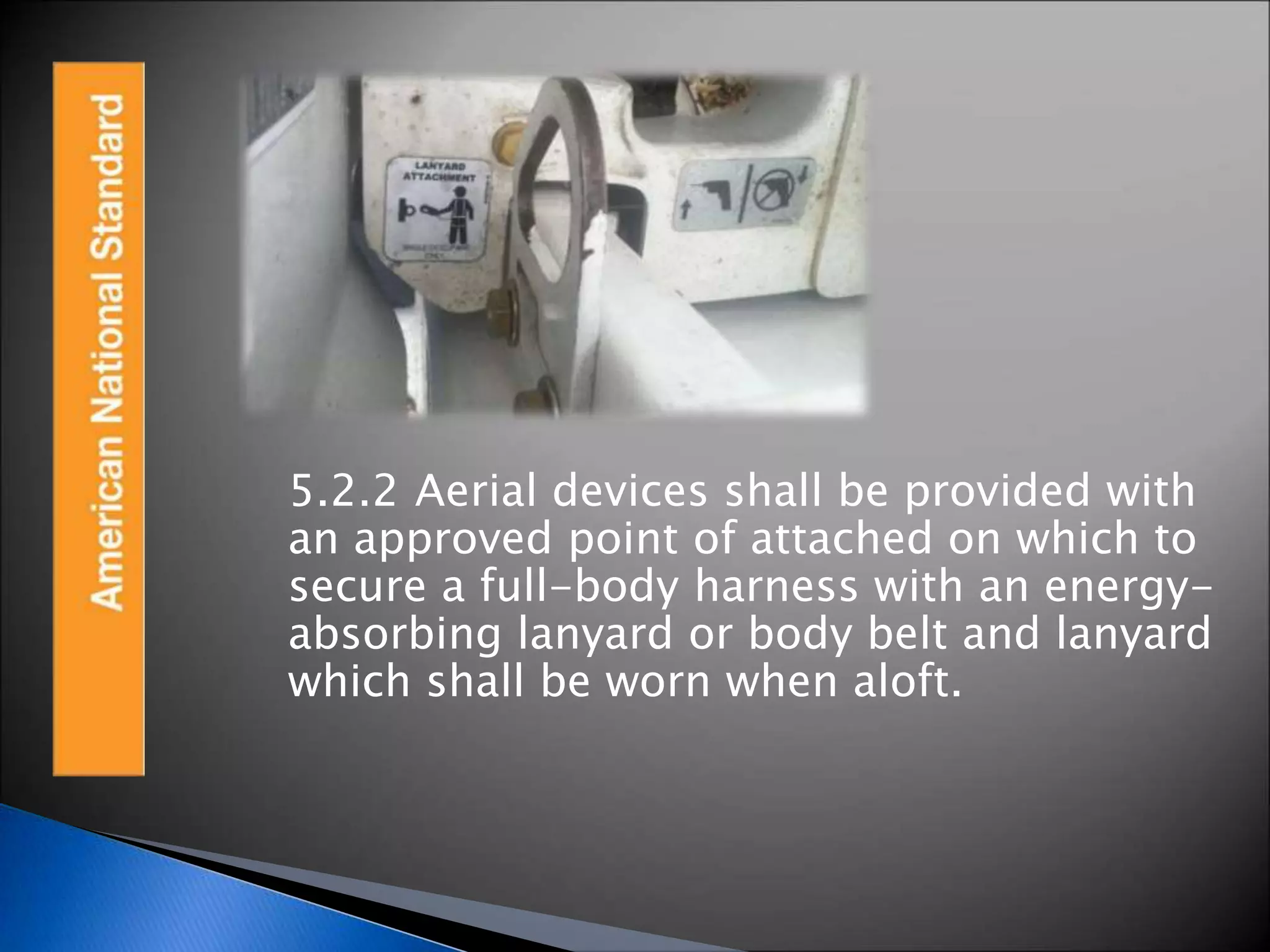
5.2.2 Aerial devices shall be provided with
an approved point of attached on which to
secure a full-body harness with an energy-
absorbing lanyard or body belt and lanyard
which shall be worn when aloft.
5.2.4 Aerial devices or aerial ladders shall
not be used as cranes or hoists to lift or
lower material or tree parts, unless they
were specifically designed by the
manufacturer to do so
5.2.5 Wheel chocks shall be set before
using an aerial device unless the device has
no wheels on the ground or is designed for
use without chocks
5.2.3 Booms, buckets, or any other
part of the aerial device shall not be
allowed to make contact or violate
minimum approach distances with
energized electrical conductors, poles or
similar conductive objects.
5.2.6 Units equipped with
outriggers or a stabilizing
system shall be operated in a
manner consistent with
manufacturer’s requirements
5.2.7 The operator shall
ensure adequate clearance
exists and give warning prior to
lowering outriggers. Pads shall
be placed under outrigger feet
when they are needed to ensure
stable footing.
5.2.8 When operating aerial devices, the operator shall
look in the direction the bucket is traveling and be aware
of the location of the booms in relation to all other objects
and hazards
5.2.9 Clearances from passing vehicles shall be
maintained, or traffic control shall be provided when
booms or buckets are operated over roads
5.2.10 One-person buckets shall not have more than one
person in them during operations
5.2.11 Hydraulic/pneumatic tools shall be disconnected
when they are being serviced or adjusted, except where
manufacture’s procedure require otherwise.
5.2.12 To avoid flying particles or shipping
hydraulic/pneumatic hoses, pressure shall be
released before connections are broken, except
where quick-acting connectors are used. Hydraulic
pneumatic hoses shall never be kinked in order to cut
off pressure
5.2.13 No part of the body shall be used to locate or
stop hydraulic leaks
5.2.14 Hoses affecting dielectric characteristics of
equipment shall meet manufacturer’s requirement
5.2.15 The flash point of hydraulic fluid shall meet
the minimum set by the manufacturer
5.2.16 Combine loads shall not exceed rated lift capacities. Load
ratings shall be conspicuously and permanently posted on aerial
devices in accordance with ANSI A92.2.
5.2.17 Electric cables/cords used with electrics saws or lights, or
other conductive material shall not be run from the vehicle to the
bucket when arborists are working in proximity to energized
electrical conductors.
5.2.18 aerial devices shall not be moved with an arborist in the
platform (for example, a bucket) except when equipment is
specifically designed for such a operation.
5.2.19 Holes shall not be drilled in buckets or liners.
5.2.21 Arborists and other workers shall be instructed that
insulated aerial buckets do not protect them from other electric
paths to the ground, such as paths through trees, guy wires, or
from one phase were to the second phase wire, any one of
which can be fatal.
5.2.22 All underground hazards shall be located proper to
operating aerial lift devices off-road. These hazards could
include natural gas tanks, underground oil tanks and septic
systems.
 Aerial Lifts
◦ Need to be tested annually for dielectric insulating
ability
◦ Inspected and operationally checked prior to use
◦ Maintenance done as recommended by
manufacturer
 Aerial Lifts . . .
◦ Insulating parts should be cleaned with non-filming
agents
◦ Never drill holes in the bottom of the bucket, if
water can drain out, electricity can get in!
 Job Briefing
◦ You are required to make sure that all workers
understand the hazards associated with their work
as well as their individual responsibilities
◦ This is required by OSHA and ANSI Z133
 Job Briefing should include:
◦ Job steps
◦ Potential hazards
◦ Specific work assignments
◦ Action steps needed to avert the hazards
◦ What PPE is required
 Any new hazard or change in job
site needs to be addressed
 http://www.youtube.com/watch?v=IgDn8f2
7xvQ
 Aerial Lift Accident
Work-Site Set Up Procedures
1. Ensure the vehicle is positioned on level ground.
2. Set the parking brake.
3. Chock the wheels.
4. Engage the power supply.
5. Set the outriggers. When working on soft ground, place
outrigger pads beneath outriggers to prevent sinking (according
to the operator’s manual instructions).
6. Ensure the vehicle is stable before entering the
bucket/platform and raising or lowering the boom.
7. Check the operator’s manual for additional procedures.
◦ Always know where the conductors are
◦ Face the direction of bucket travel
◦ Do not work with your back to the conductors
◦ NEVER move the bucket between to conductors
◦ Inspect and maintain the bucket
 Work planning when there is an electrical
hazard:
◦ Inspect trees to determine proximity to all wires
◦ Consider all wires to be energized with potentially
fatal voltages, this includes;
 Electric
 Fire alarm
 Communication
 Street light
 The bucket, boom, tools, and the
operator shall never contact the
conductors or violate the Minimum
Approach Distances (more on this later)
 The truck and any attached equipment
shall be considered energized if contact
is made
 If a worker on the ground contacts an
energized vehicle, electrocution may
occur
61
Current passing through the
body can cause electrocution
or severe burns.
How much is too much?
1 mA can be felt
3-10 mA, muscle contraction and pain
10-40 mA is ‘let go’ threshold
30-75 mA, respiratory paralysis*
100-200 mA, heart clamps tight*
1500 mA, tissue and organs burn*
*Often fatal
Note: Normal skin resistance is around 1000 ohms.
Electrical Current and the Human Body
• Minimum approach
distance listed in the ANSI
Z133 table
• Based on maximum
nominal operating voltage
in the energized
conductors.
• Line clearance arborist or
line clearance arborists
trainees
Lower
insulator/isolator
Upper
insulator/isolator
Dielectric
protection is only
within arrows (Left
side only shown
here)
Lower
insulator/isolator
Any electrical
contacts below the
lower isolator will
energize the truck,
ground around the
truck and any
towed equipment.
• Never modify any part of the lift without permission from the
manufacturer
• A must – a grounder worker must be present, trained and qualified to
make an Aerial rescue from the lower controls.
• Never allow unauthorized users or pedestrians around lift or job site.
• Stop working if a pedestrian approaches or enters the work zone.
• Stop working if there is a malfunction – call your supervisor.
• Stop working if you realize that you cannot complete the job safely or
efficiently With the Aerial lift – call your supervisor.
• Once a bucket operator is aloft, the lower controls
should only be operated by a Ground person
in case of an emergency and with permission
by the operator aloft.
When raising or lowering the
boom, avoid:
• Jerking the controls.
• Obstacles, tree limbs,
power lines, etc.
• Don’t get crushed
between bucket and object.
• Secure tools before moving
bucket.
• Refer to owner’s manual for
crush points on your
equipment.
• Conduct a work-site and hazard
assessment.
• Conduct a job briefing – all employees
must understand the assessment and
work plan.
• Discuss voice command and response
system to be used – agree upon it – all
of you.
• Use this communications system while
working.
• Ensure that all workers on ground stay
out from under the boom and bucket.
 Slowly lower the boom
to rest on is supports
 Secure the boom
according to the
operator’s manual.
 Raise the outriggers.
 Shut off the power
supply.
 Depress the parking
brake.
 Remove the key.
 Stow the outrigger pads (if
applicable).
 Remove and stow the wheel
chocks before leaving the work
site.
 Return all equipment and traffic
control devices to tools boxes.
 Objectives:
◦ The employee will:
 Identify steps to secure yourself in the bucket of the
lift.
 Recognize safe operating procedures to avoid falling
from an aerial lift.
 Identify safe work procedures to avoid being cut by a
chain saw operated from a bucket.
 Indicate how to avoid being struck by
objects while operating the bucket.
Common Types of Accidents for Aerial Lift Operators
1. Falls from Bucket – failure to secure yourself in bucket with a full body harness.
Falls over 35 feet usually result in death. Many times an operator is knocked out
of a bucket from being struck by another vehicle or a section of wood hitting the
boom.
2. Chain Saw Cuts – failure to use two hands while operating a Chain Saw.
3. Struck-Bys – you and co-worker injured by branches. Create a work plan before
going aloft. Use voice command or hand signals.
4. Contact Energized Conductors – Always maintain minimum approach
distances.
5. Equipment Failure – inspect and maintain your boom. Most common failure is
breakage of cables.
6. Lift Overturns – not as common, but it does happen. Don’t forget to use the
outriggers.
Aerial Lifts
•Personal fall
arrest system,
or…
•Fall restraint
system
1910.269(g)(2)(vi)(C)
• Fall restraint - system that prevents the user from
falling any distance, or from reaching “unprotected
edge” of a horizontal surface
• Work positioning - system rigged to allow an
employee (lineman) to be supported on an elevated
vertical surface (pole, tower) and work with both hands
free while leaning
• Fall arrest - system used to arrest a fall from a working
level, limits free fall to 6 feet, rigged so that worker
cannot contact lower level
* Fall protection requirements vary depending on
which OSHA regulations apply. More in Chapter 5…
Do gear inspection prior to entering the bucket. Make
sure you are properly positioned and attached with a
properly fitted and worn harness and appropriate lanyard.
 Work planning when there is an electrical
hazard:
◦ Inspect trees to determine proximity to all wires
◦ Consider all wires to be energized with potentially
fatal voltages, this includes;
 Electric
 Fire alarm
 Communication
 Street light
 Coating on wires is weather proofing, not
insulation
◦ Designed to protect the wire, not you
 Never touch any electrical conductor,
apparatus or any conductive object in contact
with an electrical conductor
 This manual does not address aerial rescue training. Aerial rescue
requires complex training that includes decision-making and
knowledge of various techniques.
 Possible aerial rescue scenarios involving Aerial Lifts
◦ Aerial Lift Specialists who are qualified to climb may need to use
an aerial lift to access a tree when trying to reach a victim in the
tree.
◦ Aerial Lift Specialists may need to use an aerial lift to rescue a
rescue victim in a tree.
◦ Aerial Lift Specialists may need to rescue a victim in a bucket
rescue another lift operator using the lower controls.
Environmental Hazards
Heat exhaustion
Heat stroke
Cold exposure
Stinging and biting insects
Animals and mammals
Lightning
Make sure your First Aid
and CPR are up to date.
Aerial Lift Safety

Aerial Lift Safety

  • 2.
     An aeriallift, for the purpose of this training, is any work platform that has an articulating boom with a bucket. • Only qualified employees can operate aerial lifts. Only your employer can certify that you are qualified operator. • This training program is based on OSHA and ANSI Z133 safety standards for arboricultural operations. • This manual presents general safety awareness, industry safety standards, and some operational guidelines for aerial lifts. • It is your responsibility to know and comply with company policies. If unsure, ask your supervisor. This training is not intended to replace or supersede company policies and procedures.
  • 3.
    Any one ofthe following types of vehicle-mounted apparatus used to elevate personnel to jobsites above ground:  Extensible boom platform  Aerial ladder  Articulating boom platform  Vertical tower  A combination of any of the above
  • 4.
     Objectives:  Namethe most common types of accidents involving aerial lift devices.  Interpret the meaning of common warning signs and labels.  Identify appropriate personal protective equipment.
  • 6.
    OSHA DEFINITION ofa "Qualified person" - a person who possesses a recognized degree, certificate, professional standing, or skill and who, by knowledge, training, and experience, has demonstrated the ability to deal with problems relating to the subject matter, the work, or the project.
  • 7.
     Struck-by’s -42%  Falls - 31%  Electrocution - 16% (harmful environment)  Transportation - 11%  Assaults 1%
  • 8.
     Working withoutfall protection/fall restraint of any kind  Misuse of the lift  Tree parts falling on the booms/basket  Failure to inspect/maintain the lift  Falls from headache rack
  • 9.
     Bucket OperatorWarnings ◦ The bucket does not keep you free from risk of electrocution ◦ Insulation provides only a measure of safety ◦ You can be electrocuted through other paths to ground:  If you contact the conductor and the tree at the same time  If you contact two conductors at the same time
  • 10.
    The triangle shapeis the symbol for: Caution, Warning, and/or Danger – the Exclamation Point Means “Pay Attention!” The manufacturer puts important messages on the equipment. It is our job to read, know, and understand them!!
  • 11.
    Indicates a hazardoussituation. Know what each word means!
  • 12.
    The triangle withthe exclamation point and a picture is used to show you what you are supposed to use caution for. The symbol will always remain the same for caution, but the picture may change. CAUTION Means you need to be careful. Follow the directions on the sign or you could get hurt.
  • 13.
    WARNING more Serious than CAUTION!Follow directions or injury, and possibly death, could occur.
  • 14.
    DANGER – themost Serious safety message! Serious injury or death likely to occur if you do not follow directions!
  • 16.
    Personal Protective Equipment(PPE) 1. Fall Protection – full body harness or body belt with appropriate lanyard connected to designated anchor point. (OSHA) 2. Helmet – Type 1 Class E and must meet ANSI-American National Standards Institute Z89.1 standard 3. Eye Protection – goggles or safety glasses, including prescription safety glasses, must meet ANSI Z87.
  • 17.
    PPE (cont) 4. Hearingprotection – earmuffs or plugs in high noise areas 5. Leg Protection – may be worn, but is not always required 6. Face Shield – If worn, does not substitute for safety glasses. 7. Sturdy, non-slip boots 8. Close fitting clothing and no jewelry. Nothing to get caught in equipment.
  • 18.
     Objectives:  Indicateparts to be inspected before and after operation.  Demonstrate start-up procedures.  Understand daily, weekly, monthly and annual inspection requirements.
  • 19.
    Chapter 2 AerialLift Inspection
  • 20.
    7-step process toensure safe operation of a bucket truck
  • 21.
    Conduct visual inspection ofthe unit Inspection: Step 1 Check oil level in hydraulic reservoir • Outriggers are up • Vehicle parked on level surface • The need to add oil on a regular basis may indicate a leak
  • 22.
  • 23.
    Inspect the fiberglass lower and upperboom insulator for dirt and damage caused by rubbing wires, tree sap etc.
  • 24.
    Test the outrigger interlocksystem (if equipped)  Put truck on level surface and attempt to raise and lower booms without putting outriggers down
  • 25.
     While settingthe outriggers make sure they are working properly ◦ No leaks ◦ No signs of wear due to rubbing against outrigger weldment CAUTION: when testing the operation of the interlock system the platform and booms should be in such a position that no damage can result from unexpected movement
  • 26.
     With noone in the platform, operate the functions from the lower controls o If functions are operating normally, move to upper controls o Test the interlock system for the upper controls o First, try to operate booms with upper controls with the hydraulic stop pushed in o Next, for trucks with interlock trigger, try to operate booms without squeezing trigger o If boom movement occur, interlock system has failed – do not operate until problem is corrected ** While the unit is operating, look for leakage from hydraulic lines and components
  • 27.
    Test station selectorat the lower control station ◦ When the station selector is set to the override position, the upper controls should not work ◦ The lower controls must always override the upper control
  • 28.
    If the unitis equipped with a secondary stowage system, remote throttle system, stop/start system, or battery powered electrical drive, check these systems for proper operation
  • 30.
     Service brakes, includingtrailer brake connections  Parking brake  Steering mechanism  Lighting devices and reflectors  Tires  Horn  Windshield wipers  Rear vision mirrors  Coupling devices  Wheels and rims  Emergency equipment
  • 31.
     Shop Start-UpProcedures ◦ Check oil and coolant levels before starting the engine. ◦ Start engine as soon as possible for full warm-up. ◦ Perform visual inspection. ◦ Perform operational inspection of controls and outriggers. ◦ Inform supervisor if you find any broken items. ◦ Check truck storage boxes for all safety devices (i.e.: flags, vests, signs, cones, chocks, pads) and any other equipment needed. ◦ Be sure there are no loose tools on top of the lift or in the buck- et. ◦ Be sure all equipment doors are shut and locked. ◦ Before leaving your shop, be sure you have your DOT med. exam card (if applicable), driver’s license, work orders, directions to location(s), emergency numbers, and all co-workers you need to transport before leaving. ◦ Wear your seat belt. ◦ Be sure all passengers are wearing their seat belt.
  • 32.
    Fueling the Vehicle •Use correct fuel for equipment • Never smoke or have an open flame • Touch the nozzle to machine before removing the fuel cap to prevent static spark • Keep nozzle or funnel in contact with fuel tank. • Wipe up all spills immediately, before starting Engine.
  • 33.
     Daily, Weekly,Monthly, and Annual Lift Inspections  Consult manufacturer’s instructions for what is to be included in “daily,” “weekly,” monthly and annual inspections. Your DVIR form covers standard items inspected on a daily basis to meet USDOT Federal Motor Carrier Safety Regulations (FMCSR) for the vehicle on which the aerial lift is mounted. Lift manufacturers have additional inspection items for the lift itself, based on the specific model you are operating.  In general, “daily” inspections are conducted by aerial lifts specialists (qualified operators). Depending on your company, “weekly” inspections may be conducted by an aerial lift specialist or a qualified maintenance technician. Aerial Lift Specialists, at a minimum, should be aware of the items that are checked on a “weekly” basis. • Monthly and annual inspections are conducted by qualified maintenance technicians. “Daily” inspections are actually based on 8 hours of operation and “weekly” inspections are based on 40 hours of operation.
  • 35.
    While driving, parkingat job, and returning… ◦ Know the height clearance of your vehicle! ◦ Drive defensively – not offensively! ◦ No tailgating – maintain the right following distance! ◦ Park your vehicle properly ◦ Conduct post trip inspection ◦ Unload equipment properly and Check equipment storage – locking them always. ◦ Turn in completed DVIR when back to office.
  • 37.
    Use a spotter whenbacking vehicles
  • 39.
     Objectives: ◦ Theemployee will:  Learn safety standards for working with an aerial lift  Learn work-site traffic control procedures  Learn aerial lift positioning and set-up procedures  Identify good work-site set-up position
  • 40.
    5.2.2 Aerial devicesshall be provided with an approved point of attached on which to secure a full-body harness with an energy- absorbing lanyard or body belt and lanyard which shall be worn when aloft.
  • 41.
    5.2.4 Aerial devicesor aerial ladders shall not be used as cranes or hoists to lift or lower material or tree parts, unless they were specifically designed by the manufacturer to do so 5.2.5 Wheel chocks shall be set before using an aerial device unless the device has no wheels on the ground or is designed for use without chocks
  • 42.
    5.2.3 Booms, buckets,or any other part of the aerial device shall not be allowed to make contact or violate minimum approach distances with energized electrical conductors, poles or similar conductive objects.
  • 43.
    5.2.6 Units equippedwith outriggers or a stabilizing system shall be operated in a manner consistent with manufacturer’s requirements 5.2.7 The operator shall ensure adequate clearance exists and give warning prior to lowering outriggers. Pads shall be placed under outrigger feet when they are needed to ensure stable footing.
  • 44.
    5.2.8 When operatingaerial devices, the operator shall look in the direction the bucket is traveling and be aware of the location of the booms in relation to all other objects and hazards 5.2.9 Clearances from passing vehicles shall be maintained, or traffic control shall be provided when booms or buckets are operated over roads 5.2.10 One-person buckets shall not have more than one person in them during operations
  • 45.
    5.2.11 Hydraulic/pneumatic toolsshall be disconnected when they are being serviced or adjusted, except where manufacture’s procedure require otherwise. 5.2.12 To avoid flying particles or shipping hydraulic/pneumatic hoses, pressure shall be released before connections are broken, except where quick-acting connectors are used. Hydraulic pneumatic hoses shall never be kinked in order to cut off pressure 5.2.13 No part of the body shall be used to locate or stop hydraulic leaks 5.2.14 Hoses affecting dielectric characteristics of equipment shall meet manufacturer’s requirement 5.2.15 The flash point of hydraulic fluid shall meet the minimum set by the manufacturer
  • 46.
    5.2.16 Combine loadsshall not exceed rated lift capacities. Load ratings shall be conspicuously and permanently posted on aerial devices in accordance with ANSI A92.2. 5.2.17 Electric cables/cords used with electrics saws or lights, or other conductive material shall not be run from the vehicle to the bucket when arborists are working in proximity to energized electrical conductors. 5.2.18 aerial devices shall not be moved with an arborist in the platform (for example, a bucket) except when equipment is specifically designed for such a operation. 5.2.19 Holes shall not be drilled in buckets or liners.
  • 47.
    5.2.21 Arborists andother workers shall be instructed that insulated aerial buckets do not protect them from other electric paths to the ground, such as paths through trees, guy wires, or from one phase were to the second phase wire, any one of which can be fatal. 5.2.22 All underground hazards shall be located proper to operating aerial lift devices off-road. These hazards could include natural gas tanks, underground oil tanks and septic systems.
  • 48.
     Aerial Lifts ◦Need to be tested annually for dielectric insulating ability ◦ Inspected and operationally checked prior to use ◦ Maintenance done as recommended by manufacturer
  • 49.
     Aerial Lifts. . . ◦ Insulating parts should be cleaned with non-filming agents ◦ Never drill holes in the bottom of the bucket, if water can drain out, electricity can get in!
  • 50.
     Job Briefing ◦You are required to make sure that all workers understand the hazards associated with their work as well as their individual responsibilities ◦ This is required by OSHA and ANSI Z133
  • 51.
     Job Briefingshould include: ◦ Job steps ◦ Potential hazards ◦ Specific work assignments ◦ Action steps needed to avert the hazards ◦ What PPE is required  Any new hazard or change in job site needs to be addressed
  • 54.
  • 55.
    Work-Site Set UpProcedures 1. Ensure the vehicle is positioned on level ground. 2. Set the parking brake. 3. Chock the wheels. 4. Engage the power supply. 5. Set the outriggers. When working on soft ground, place outrigger pads beneath outriggers to prevent sinking (according to the operator’s manual instructions). 6. Ensure the vehicle is stable before entering the bucket/platform and raising or lowering the boom. 7. Check the operator’s manual for additional procedures.
  • 56.
    ◦ Always knowwhere the conductors are ◦ Face the direction of bucket travel ◦ Do not work with your back to the conductors ◦ NEVER move the bucket between to conductors ◦ Inspect and maintain the bucket
  • 59.
     Work planningwhen there is an electrical hazard: ◦ Inspect trees to determine proximity to all wires ◦ Consider all wires to be energized with potentially fatal voltages, this includes;  Electric  Fire alarm  Communication  Street light
  • 60.
     The bucket,boom, tools, and the operator shall never contact the conductors or violate the Minimum Approach Distances (more on this later)  The truck and any attached equipment shall be considered energized if contact is made  If a worker on the ground contacts an energized vehicle, electrocution may occur
  • 61.
  • 65.
    Current passing throughthe body can cause electrocution or severe burns.
  • 66.
    How much istoo much? 1 mA can be felt 3-10 mA, muscle contraction and pain 10-40 mA is ‘let go’ threshold 30-75 mA, respiratory paralysis* 100-200 mA, heart clamps tight* 1500 mA, tissue and organs burn* *Often fatal Note: Normal skin resistance is around 1000 ohms. Electrical Current and the Human Body
  • 68.
    • Minimum approach distancelisted in the ANSI Z133 table • Based on maximum nominal operating voltage in the energized conductors. • Line clearance arborist or line clearance arborists trainees
  • 69.
  • 70.
    Dielectric protection is only withinarrows (Left side only shown here)
  • 71.
    Lower insulator/isolator Any electrical contacts belowthe lower isolator will energize the truck, ground around the truck and any towed equipment.
  • 74.
    • Never modifyany part of the lift without permission from the manufacturer • A must – a grounder worker must be present, trained and qualified to make an Aerial rescue from the lower controls. • Never allow unauthorized users or pedestrians around lift or job site. • Stop working if a pedestrian approaches or enters the work zone. • Stop working if there is a malfunction – call your supervisor. • Stop working if you realize that you cannot complete the job safely or efficiently With the Aerial lift – call your supervisor. • Once a bucket operator is aloft, the lower controls should only be operated by a Ground person in case of an emergency and with permission by the operator aloft.
  • 75.
    When raising orlowering the boom, avoid: • Jerking the controls. • Obstacles, tree limbs, power lines, etc. • Don’t get crushed between bucket and object. • Secure tools before moving bucket. • Refer to owner’s manual for crush points on your equipment.
  • 76.
    • Conduct awork-site and hazard assessment. • Conduct a job briefing – all employees must understand the assessment and work plan. • Discuss voice command and response system to be used – agree upon it – all of you. • Use this communications system while working. • Ensure that all workers on ground stay out from under the boom and bucket.
  • 77.
     Slowly lowerthe boom to rest on is supports  Secure the boom according to the operator’s manual.  Raise the outriggers.  Shut off the power supply.  Depress the parking brake.  Remove the key.
  • 78.
     Stow theoutrigger pads (if applicable).  Remove and stow the wheel chocks before leaving the work site.  Return all equipment and traffic control devices to tools boxes.
  • 79.
     Objectives: ◦ Theemployee will:  Identify steps to secure yourself in the bucket of the lift.  Recognize safe operating procedures to avoid falling from an aerial lift.  Identify safe work procedures to avoid being cut by a chain saw operated from a bucket.  Indicate how to avoid being struck by objects while operating the bucket.
  • 80.
    Common Types ofAccidents for Aerial Lift Operators 1. Falls from Bucket – failure to secure yourself in bucket with a full body harness. Falls over 35 feet usually result in death. Many times an operator is knocked out of a bucket from being struck by another vehicle or a section of wood hitting the boom. 2. Chain Saw Cuts – failure to use two hands while operating a Chain Saw. 3. Struck-Bys – you and co-worker injured by branches. Create a work plan before going aloft. Use voice command or hand signals. 4. Contact Energized Conductors – Always maintain minimum approach distances. 5. Equipment Failure – inspect and maintain your boom. Most common failure is breakage of cables. 6. Lift Overturns – not as common, but it does happen. Don’t forget to use the outriggers.
  • 82.
    Aerial Lifts •Personal fall arrestsystem, or… •Fall restraint system 1910.269(g)(2)(vi)(C)
  • 83.
    • Fall restraint- system that prevents the user from falling any distance, or from reaching “unprotected edge” of a horizontal surface • Work positioning - system rigged to allow an employee (lineman) to be supported on an elevated vertical surface (pole, tower) and work with both hands free while leaning • Fall arrest - system used to arrest a fall from a working level, limits free fall to 6 feet, rigged so that worker cannot contact lower level * Fall protection requirements vary depending on which OSHA regulations apply. More in Chapter 5…
  • 84.
    Do gear inspectionprior to entering the bucket. Make sure you are properly positioned and attached with a properly fitted and worn harness and appropriate lanyard.
  • 89.
     Work planningwhen there is an electrical hazard: ◦ Inspect trees to determine proximity to all wires ◦ Consider all wires to be energized with potentially fatal voltages, this includes;  Electric  Fire alarm  Communication  Street light
  • 90.
     Coating onwires is weather proofing, not insulation ◦ Designed to protect the wire, not you  Never touch any electrical conductor, apparatus or any conductive object in contact with an electrical conductor
  • 91.
     This manualdoes not address aerial rescue training. Aerial rescue requires complex training that includes decision-making and knowledge of various techniques.  Possible aerial rescue scenarios involving Aerial Lifts ◦ Aerial Lift Specialists who are qualified to climb may need to use an aerial lift to access a tree when trying to reach a victim in the tree. ◦ Aerial Lift Specialists may need to use an aerial lift to rescue a rescue victim in a tree. ◦ Aerial Lift Specialists may need to rescue a victim in a bucket rescue another lift operator using the lower controls.
  • 92.
    Environmental Hazards Heat exhaustion Heatstroke Cold exposure Stinging and biting insects Animals and mammals Lightning Make sure your First Aid and CPR are up to date.

Editor's Notes

  • #8  Transportation  Most transportation incidents occur driving to and from job sites on highways or streets.  Those that occur at the job site are either due to the worker being struck by passing traffic or hit by their own truck – frequently when it is backing up.  Transportation is the third leading category for non-fatal injuries, behind chainsaws and struck by a limb. Assault  Every year at least one tree worker is killed, often by an angry neighbor.  If someone says, “I’m going to kill you,” believe him or her!  However we had a murder (robberies) and one fight between two tree workers that resulted in a death. Contact with an object or equipment  The majority of incidents in this category involve a branch or the entire tree striking the worker.  Ground workers are the frequent target.  While many of the “struck-by” occur during felling the tree, either the tree falling in the wrong direction or a branch breaking free during the fall, a number of contact incidents are due to rigging failures and workers standing beneath the load. A command and rely system and using established drop zones would significantly reduce incidents in the category.  Contact is the leading categories for non-fatal injuries such as fractures, concussions, punctures etc. Other contact/caught in fatalities  Other contact issues involve chippers and chain saws.  Both are responsible for a significant proportion of the fatal injuries that occur in tree work.  Chainsaw fatalities are increasing, primarily to climbers or lift operators.  Chipper incidents, both fatal and nonfatal, are either from standing on the in-feed to kick brush in or scooping brush in with your hands and caught. Chipper incidents result in many of the amputations for our industry. Falls  Not too surprisingly, most falls occur to climbers and these numbers are increasing.  Falls greater than 40 feet tend to be fatalities rather than injuries. The average height of a fatal fall last year was 46 feet, non-fatal was 32 feet.  Many time climbers fall with the tree (or part of it), rather than from it. The tree failed at the base while the worker was in it or the branch that served as the anchor broke.  Most times when an aerial lift operator falls it is due to equipment failure (and they fall with the boom) or a limb strikes the boom and they fall out of the bucket since they are not using fall protection. Exposure to hazardous environment  Still the single most common cause of fatalities among tree workers is electrical contact.  Climbers are the group most likely to experience electrical shock, but ground workers are a close second. The group most likely to suffer electrical shock is a residential tree worker  Generally it is through indirect contact – a branch or saw – but a surprisingly high percent is direct contact.  Most electrical contacts are fatal; there relatively few non-fatal injuries proportion to the fatalities in this category.  However, if you do survive the electrical contact, immediate medical treatment is required to deal with burns and fractures. Emergency response  Nonfatal injuries can become fatalities if co-workers do not respond in time or appropriately.  If you are not trained in first-aid, your biggest value to the victim is calling for help on the cell phone.  Don’t become the second victim – never enter the site unless it is safe to do so.  Continuous training and practicing different types of accidents (both ground and aerial) are the keys to emergency response.
  • #84 Fall protection equipment rigged to arrest falls is considered as one or more components of a fall arrest system and must meet the applicable requirements for the design and use of those systems. Fall protection equipment rigged for work positioning is considered as work positioning equipment and must meet the applicable requirements for the design and use of that equipment.