CE ELEC 413 – CONSTRUCTION SAFETY
ENGINEERING
Heavy Equipment
Safety
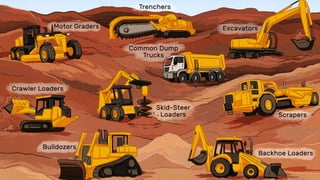
Many types of mobile construction heavy equipment are being used in a
construction site doing a wide variety of work. Most of these machines
operate within close proximity to persons on foot. With this, many people
are exposed to hazards associated with this equipment.
In short, you have a congested construction site with personnel on foot, and
mobile machines working in the same area at the same time
Total Equipment Safety Management
1. Management Commitment
2. Employee Involvement
3. Pre-Construction Job Hazard Analysis
4. Hazard Prevention and Controls
5. Equipment Maintenance
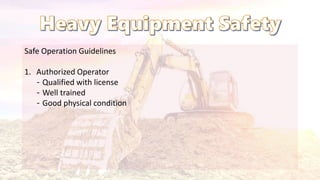
Safe Operation Guidelines
1. Authorized Operator
‐ Qualified with license
‐ Well trained
‐ Good physical condition
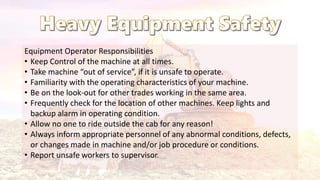
Equipment Operator Responsibilities
• Keep Control of the machine at all times.
• Take machine “out of service”, if it is unsafe to operate.
• Familiarity with the operating characteristics of your machine.
• Be on the look-out for other trades working in the same area.
• Frequently check for the location of other machines. Keep lights and
backup alarm in operating condition.
• Allow no one to ride outside the cab for any reason!
• Always inform appropriate personnel of any abnormal conditions, defects,
or changes made in machine and/or job procedure or conditions.
• Report unsafe workers to supervisor.
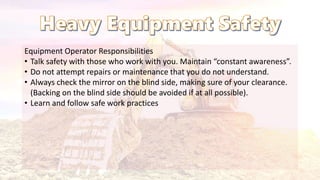
Equipment Operator Responsibilities
• Talk safety with those who work with you. Maintain “constant awareness”.
• Do not attempt repairs or maintenance that you do not understand.
• Always check the mirror on the blind side, making sure of your clearance.
(Backing on the blind side should be avoided if at all possible).
• Learn and follow safe work practices
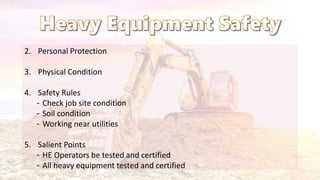
2. Personal Protection
3. Physical Condition
4. Safety Rules
‐ Check job site condition
‐ Soil condition
‐ Working near utilities
5. Salient Points
‐ HE Operators be tested and certified
‐ All heavy equipment tested and certified
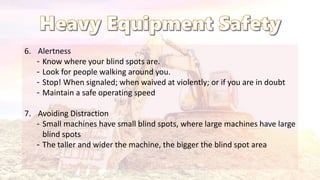
6. Alertness
‐ Know where your blind spots are.
‐ Look for people walking around you.
‐ Stop! When signaled; when waived at violently; or if you are in doubt
‐ Maintain a safe operating speed
7. Avoiding Distraction
‐ Small machines have small blind spots, where large machines have large
blind spots
‐ The taller and wider the machine, the bigger the blind spot area
8. Appropriate Use
‐ Specific equipment operation
‐ Equipment capacity
‐ Equipment capability
‐ Equipment restriction
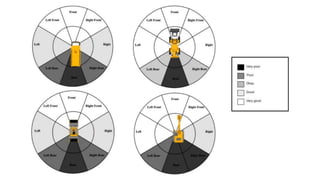
Blind Spots
• Small heavy mobile equipment has small blind spots and heavy mobile
equipment have large blind spots, both can cause serious injury or death
• The taller and wider the machine, the bigger the blind spot area
• Operators, spotters and workers on foot need to be aware where the
blind spots are.
Concerned Personnel in Heavy Equipment Safety
1. Equipment Operator
2. Workers on foot
3. Spotters – assist the equipment operator on the recognized hazards
4. Management people and supervisors
5. Other construction site personnel
Spotter Responsibilities
1. Wearing of high visibility vests and other appropriate PPE’s.
2. Spotters should use clearly understood hand signals or traffic
control devices, (i.e. signs, etc.)
3. Spotters should know operator visibility limitations, always remain
visible to the operator and be sure eye contact is made before any
signals are given.
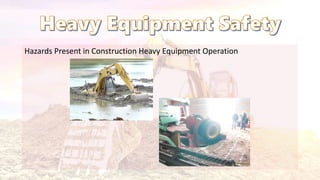
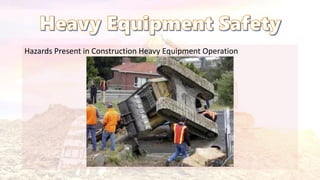
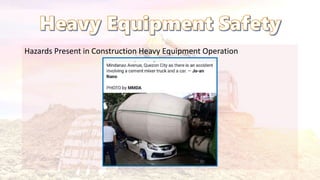
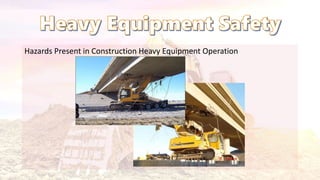
Hazards Present in Construction Heavy Equipment Operation
1. Moving parts of the equipment
2. Uneven terrain
3. Energized electrical lines
4. Fall
5. Dust
6. Overloaded equipment
7. Noise
8. Vibration
9. Unsecured loads
10. Improvised attachments
11. Blind spot
Hazards Present in Construction Heavy Equipment Operation
D.O.13 – ON HEAVY EQUIPMENT
Section 10.1-a
“All heavy equipment operators assigned at the project site must be tested
and certified in accordance with a standard trade test prescribed by TESDA in
coordination with its
accredited organization/s”
Section 10.2.4-a
“Only duly certified operators shall be allowed to operate their designated
heavy equipment
5 Basic Guidelines on Heavy Equipment Operation
When using heavy equipment, there are 5 basic guidelines that the operators
must always follow to ensure safety:
1. Know how to properly operate the equipment you are using
2. Do not use heavy machinery when you are drowsy, intoxicated, or taking
prescription medication that may affect your performance
3. Use only equipment that is appropriate for the work to be done
4. Inspect your equipment to ensure that it is in good working condition
before beginning a job. In addition, ensure that regular inspections and
maintenance are conducted as appropriate
5. Do not stress or overload your equipment.
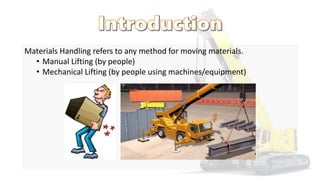
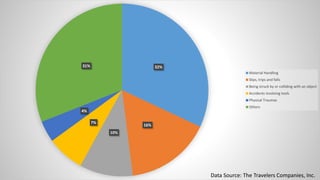
Materials Handling refers to any method for moving materials.
• Manual Lifting (by people)
• Mechanical Lifting (by people using machines/equipment)
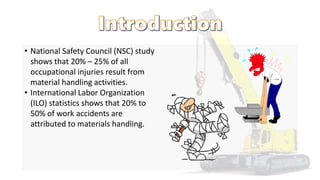
• National Safety Council (NSC) study
shows that 20% – 25% of all
occupational injuries result from
material handling activities.
• International Labor Organization
(ILO) statistics shows that 20% to
50% of work accidents are
attributed to materials handling.
32%
16%
10%
7%
4%
31%
Material Handling
Slips, trips and falls
Being struck by or colliding with an object
Accidents involving tools
Physical Traumas
Others
Data Source: The Travelers Companies, Inc.
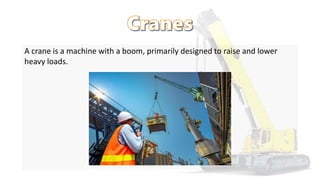
A crane is a machine with a boom, primarily designed to raise and lower
heavy loads.
Cranes
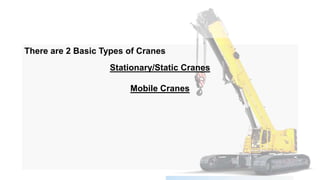
There are 2 Basic Types of Cranes
Stationary/Static Cranes
Mobile Cranes
There are 2 Basic Types of Cranes
Stationary/Static Cranes
• semi-permanent structure
• lifts and moves loads along a fixed
path.
Mobile Cranes
• mounted on threads or wheels
• it can easily move from one job
site to another
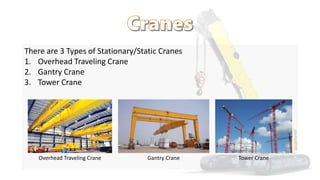
There are 3 Types of Stationary/Static Cranes
1. Overhead Traveling Crane
2. Gantry Crane
3. Tower Crane
Overhead Traveling Crane Gantry Crane Tower Crane
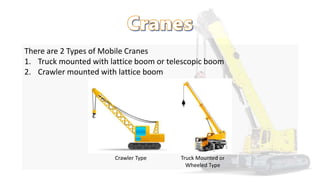
There are 2 Types of Mobile Cranes
1. Truck mounted with lattice boom or telescopic boom
2. Crawler mounted with lattice boom
Crawler Type Truck Mounted or
Wheeled Type
Hazards during operating of cranes:
• Collision of the crane jib or its load, with personnel, equipment or
buildings,
• Contact with live aerial conductors (overhead power lines),
• Overturning of the crane during lift,
• Introduction of a source of ignition to a hazardous area,
• Damage to underground services.
Proximity hazards include, but are not limited to, the following:
• Overhead power lines
• Nearby structures or other cranes
• Excavations
• Fixed hazards
• Personnel movement within the crane working area
• Mobile equipment movement within the crane working area
• Public access areas including roadways, railways and rivers.
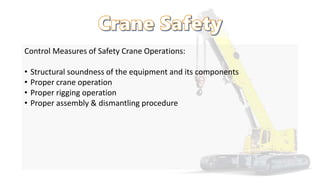
Control Measures of Safety Crane Operations:
• Structural soundness of the equipment and its components
• Proper crane operation
• Proper rigging operation
• Proper assembly & dismantling procedure
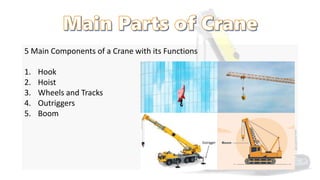
5 Main Components of a Crane with its Functions
1. Hook
2. Hoist
3. Wheels and Tracks
4. Outriggers
5. Boom
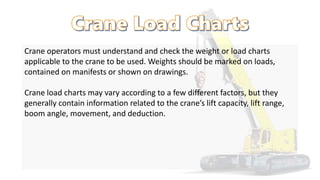
Crane operators must understand and check the weight or load charts
applicable to the crane to be used. Weights should be marked on loads,
contained on manifests or shown on drawings.
Crane load charts may vary according to a few different factors, but they
generally contain information related to the crane’s lift capacity, lift range,
boom angle, movement, and deduction.
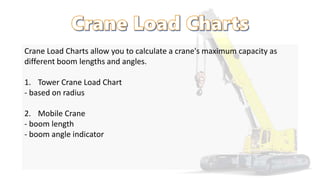
Crane Load Charts allow you to calculate a crane's maximum capacity as
different boom lengths and angles.
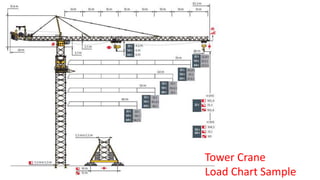
1. Tower Crane Load Chart
- based on radius
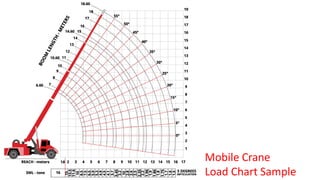
2. Mobile Crane
- boom length
- boom angle indicator
Tower Crane
Load Chart Sample
Mobile Crane
Load Chart Sample
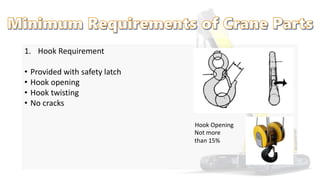
1. Hook Requirement
• Provided with safety latch
• Hook opening
• Hook twisting
• No cracks
Hook Opening
Not more
than 15%
2. Wire Rope Requirement
• Rope Criteria
over 7 strands are severed in one lay
1/3 diameter of individual wire
kinks, birdcage or other damages
• At least 2 wire of rope shall remain in the drum when the hook is placed at
the lowest portion
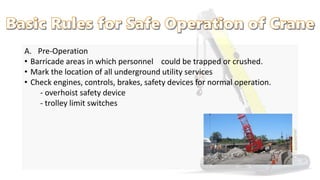
A. Pre-Operation
• Barricade areas in which personnel could be trapped or crushed.
• Mark the location of all underground utility services
• Check engines, controls, brakes, safety devices for normal operation.
- overhoist safety device
- trolley limit switches
B. During Operation
Rule #1 Do not carry or use crane beyond the rated load
Rule #2 Never move load over people.
Rule #3 Never allow personnel to ride on a load.
Rule #4 Center the crane over the load before starting to hoist.
- Keep hoisting ropes vertical
- No side pull
Rule #5 Lift, move & lower loads smoothly.
Rule #6 Crane operators should not use limit switches to stop the hoist
under normal operating conditions.
Rule #7 Do not leave suspended load unattended.
B. During Operation
Rule #8 Keep hook block more than 2m above the floor when not in use.
Rule #9 Use tagline to stabilize and control loads.
Rule # 10 Respond to signals from designated signalman only.
Precautions shall be taken when erecting and dismantling a crane to ensure
that the stability of the crane is maintained. In particular, the following
procedures shall be followed where applicable:
• Only parts and components meeting the manufacturer’s specification shall
be used.
• Jointing pins shall be assembled so that they can be removed by a person
standing on the outside of the assembly.
• All outrigger jacks shall be fitted with foot plates according to
manufacturer’s instructions.
• All outrigger jacks shall be fitted and adjusted in accordance with the
operating instructions.
• The correct amount of counterweight shall be fitted on the crane and at
the appropriate location before the boom or jib is raised.
• When the operating length of boom or jib is reduced, the specified
counterweight shall be removed to ensure that the backward stability of
the crane is not adversely affected.
• Appropriate precautions shall be taken before a long boom is lowered to
the ground level.
• To maintain the best margin of stability when a long boom is raised or
lowered to the ground level, the hook blocks shall be lowered and rested
on the ground before the Boom or jib is lowered.
• Where timbers are used under outrigger footplates, they shall be arranged
so that successive layers are laid at 90o to each other (pig sty fashion) so
that the top layer is in line with the outrigger arm.
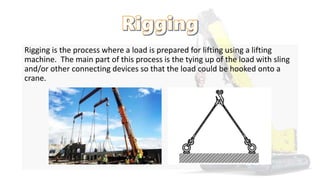
Rigging is the process where a load is prepared for lifting using a lifting
machine. The main part of this process is the tying up of the load with sling
and/or other connecting devices so that the load could be hooked onto a
crane.
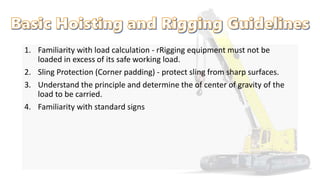
1. Familiarity with load calculation - rRigging equipment must not be
loaded in excess of its safe working load.
2. Sling Protection (Corner padding) - protect sling from sharp surfaces.
3. Understand the principle and determine the of center of gravity of the
load to be carried.
4. Familiarity with standard signs
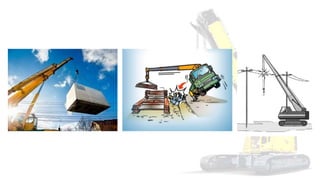
Failure to rigged the load properly would result to:
• The load became damaged on impact
• The load fell on someone and injure or kill him
• The load fall on a structure causing damage to both property and life
• The sudden release of load causing the crane to be destabilized and topple
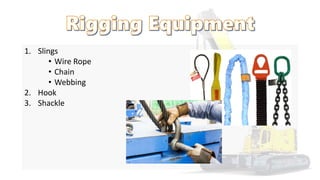
1. Slings
• Wire Rope
• Chain
• Webbing
2. Hook
3. Shackle
Observe the following precautions when operating a mobile crane:
• Do not leave a crane unattended
• Do not operate a crane in high or gusty wind conditions
• Do not use flat web slings to raise, lower or suspend a load.
• Do not use a fiber rope slings if a suitable steel wire rope can be used.
• Faulty slings shall be tagged for destruction
• Discard any wire rope with visible number of broken wires
• Check that there are no loose objects on a load that could fall during lifting.
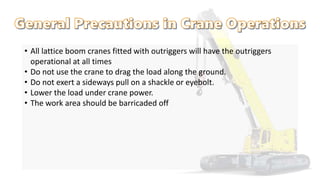
• All lattice boom cranes fitted with outriggers will have the outriggers
operational at all times
• Do not use the crane to drag the load along the ground.
• Do not exert a sideways pull on a shackle or eyebolt.
• Lower the load under crane power.
• The work area should be barricaded off
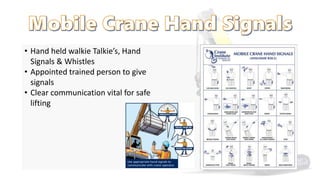
• Hand held walkie Talkie’s, Hand
Signals & Whistles
• Appointed trained person to give
signals
• Clear communication vital for safe
lifting
• An unstable load, lack of communication, lack of training, and inadequate
maintenance or inspection are major contributors to crane accidents.
• Operators or others working in the area can be victims to “struck by" and
"caught in" injuries.
• Contact with power lines causes many accidents.
• A competent person must inspect a crane regularly to insure it is in proper
order.
• Planning and training reduces accidents.
The Occupational Safety and Health Administration states that most
injuries on construction sites involve excavation cave-ins, power tool
accidents, falls, electrical hazards, and exposure to potentially
dangerous materials.
Hand tools are exactly what they sound like – tools that require manual
labor to use.
Power tools have a power source that allows them to operate
automatically and without human intervention.
The following are the sources of hazards that eventually cause
accidents:
1. Human carelessness
2. Not knowing the right tool for the job
3. Ignorance of safety precautions
4. Failure to maintain/keep the tools properly
5. Not instructed for the correct usage
Hazards of using hand and power tools:
1. Electric shock
2. Particles in the eyes
3. Fires
4. Falls
5. Explosions
6. Falling Tools
7. Free shots
8. Ricochet
9. Projectiles fired through the work
Some ergonomic hazards of using hand and power tools:
1. Bursitis Osteo-Arthritis
2. Carpal Tunnel Syndrome
3. Tendonitis
4. Cellulitis
5. Tenosynovitis
6. Epicondylitis
7. Tension Neck/Shoulder
8. Ganglion
9. Trigger Finger
Main Types of Portable Power Tools according to power source:
1. Electric
2. Pneumatic
3. Cartridge/powder actuated
4. Gasoline
5. Hydraulic
1. Electric
2. Pneumatic
‐ powered by compressed air
3. Cartridge/powder actuated
‐ used for fastening fixtures and materials to metal, pre-cast, pre-
stressed concrete, masonry, block, brick, stone and wood surfaces
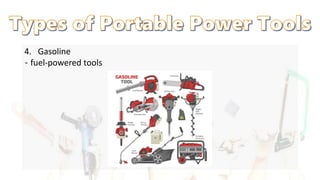
4. Gasoline
‐ fuel-powered tools
5. Hydraulic
‐ high-powered tools that use pressurized fluid to operate hydraulic
machinery
Hand Tools Safety Tips:
1. Keep tools clean
2. Check tools for good working condition
3. Use the right size and type for the job
4. Carry tools in tool box, bag or belt
5. Do not use excessive force on the tool
6. Wear appropriate PPE
Safety engineering module 6 shskwn ejekdndhek

Safety engineering module 6 shskwn ejekdndhek

  • 1.
    CE ELEC 413– CONSTRUCTION SAFETY ENGINEERING
  • 3.
  • 4.
    Many types ofmobile construction heavy equipment are being used in a construction site doing a wide variety of work. Most of these machines operate within close proximity to persons on foot. With this, many people are exposed to hazards associated with this equipment. In short, you have a congested construction site with personnel on foot, and mobile machines working in the same area at the same time
  • 5.
    Total Equipment SafetyManagement 1. Management Commitment 2. Employee Involvement 3. Pre-Construction Job Hazard Analysis 4. Hazard Prevention and Controls 5. Equipment Maintenance
  • 6.
    Safe Operation Guidelines 1.Authorized Operator ‐ Qualified with license ‐ Well trained ‐ Good physical condition
  • 7.
    Equipment Operator Responsibilities •Keep Control of the machine at all times. • Take machine “out of service”, if it is unsafe to operate. • Familiarity with the operating characteristics of your machine. • Be on the look-out for other trades working in the same area. • Frequently check for the location of other machines. Keep lights and backup alarm in operating condition. • Allow no one to ride outside the cab for any reason! • Always inform appropriate personnel of any abnormal conditions, defects, or changes made in machine and/or job procedure or conditions. • Report unsafe workers to supervisor.
  • 8.
    Equipment Operator Responsibilities •Talk safety with those who work with you. Maintain “constant awareness”. • Do not attempt repairs or maintenance that you do not understand. • Always check the mirror on the blind side, making sure of your clearance. (Backing on the blind side should be avoided if at all possible). • Learn and follow safe work practices
  • 9.
    2. Personal Protection 3.Physical Condition 4. Safety Rules ‐ Check job site condition ‐ Soil condition ‐ Working near utilities 5. Salient Points ‐ HE Operators be tested and certified ‐ All heavy equipment tested and certified
  • 10.
    6. Alertness ‐ Knowwhere your blind spots are. ‐ Look for people walking around you. ‐ Stop! When signaled; when waived at violently; or if you are in doubt ‐ Maintain a safe operating speed 7. Avoiding Distraction ‐ Small machines have small blind spots, where large machines have large blind spots ‐ The taller and wider the machine, the bigger the blind spot area
  • 11.
    8. Appropriate Use ‐Specific equipment operation ‐ Equipment capacity ‐ Equipment capability ‐ Equipment restriction
  • 12.
    Blind Spots • Smallheavy mobile equipment has small blind spots and heavy mobile equipment have large blind spots, both can cause serious injury or death • The taller and wider the machine, the bigger the blind spot area • Operators, spotters and workers on foot need to be aware where the blind spots are.
  • 14.
    Concerned Personnel inHeavy Equipment Safety 1. Equipment Operator 2. Workers on foot 3. Spotters – assist the equipment operator on the recognized hazards 4. Management people and supervisors 5. Other construction site personnel
  • 15.
    Spotter Responsibilities 1. Wearingof high visibility vests and other appropriate PPE’s. 2. Spotters should use clearly understood hand signals or traffic control devices, (i.e. signs, etc.) 3. Spotters should know operator visibility limitations, always remain visible to the operator and be sure eye contact is made before any signals are given.
  • 16.
    Hazards Present inConstruction Heavy Equipment Operation 1. Moving parts of the equipment 2. Uneven terrain 3. Energized electrical lines 4. Fall 5. Dust 6. Overloaded equipment 7. Noise 8. Vibration 9. Unsecured loads 10. Improvised attachments 11. Blind spot
  • 17.
    Hazards Present inConstruction Heavy Equipment Operation
  • 18.
    Hazards Present inConstruction Heavy Equipment Operation
  • 19.
    Hazards Present inConstruction Heavy Equipment Operation
  • 20.
    Hazards Present inConstruction Heavy Equipment Operation
  • 21.
    D.O.13 – ONHEAVY EQUIPMENT Section 10.1-a “All heavy equipment operators assigned at the project site must be tested and certified in accordance with a standard trade test prescribed by TESDA in coordination with its accredited organization/s” Section 10.2.4-a “Only duly certified operators shall be allowed to operate their designated heavy equipment
  • 22.
    5 Basic Guidelineson Heavy Equipment Operation When using heavy equipment, there are 5 basic guidelines that the operators must always follow to ensure safety: 1. Know how to properly operate the equipment you are using 2. Do not use heavy machinery when you are drowsy, intoxicated, or taking prescription medication that may affect your performance 3. Use only equipment that is appropriate for the work to be done
  • 23.
    4. Inspect yourequipment to ensure that it is in good working condition before beginning a job. In addition, ensure that regular inspections and maintenance are conducted as appropriate 5. Do not stress or overload your equipment.
  • 25.
    Materials Handling refersto any method for moving materials. • Manual Lifting (by people) • Mechanical Lifting (by people using machines/equipment)
  • 26.
    • National SafetyCouncil (NSC) study shows that 20% – 25% of all occupational injuries result from material handling activities. • International Labor Organization (ILO) statistics shows that 20% to 50% of work accidents are attributed to materials handling.
  • 27.
    32% 16% 10% 7% 4% 31% Material Handling Slips, tripsand falls Being struck by or colliding with an object Accidents involving tools Physical Traumas Others Data Source: The Travelers Companies, Inc.
  • 28.
    A crane isa machine with a boom, primarily designed to raise and lower heavy loads.
  • 29.
    Cranes There are 2Basic Types of Cranes Stationary/Static Cranes Mobile Cranes
  • 30.
    There are 2Basic Types of Cranes Stationary/Static Cranes • semi-permanent structure • lifts and moves loads along a fixed path. Mobile Cranes • mounted on threads or wheels • it can easily move from one job site to another
  • 31.
    There are 3Types of Stationary/Static Cranes 1. Overhead Traveling Crane 2. Gantry Crane 3. Tower Crane Overhead Traveling Crane Gantry Crane Tower Crane
  • 32.
    There are 2Types of Mobile Cranes 1. Truck mounted with lattice boom or telescopic boom 2. Crawler mounted with lattice boom Crawler Type Truck Mounted or Wheeled Type
  • 33.
    Hazards during operatingof cranes: • Collision of the crane jib or its load, with personnel, equipment or buildings, • Contact with live aerial conductors (overhead power lines), • Overturning of the crane during lift, • Introduction of a source of ignition to a hazardous area, • Damage to underground services.
  • 34.
    Proximity hazards include,but are not limited to, the following: • Overhead power lines • Nearby structures or other cranes • Excavations • Fixed hazards • Personnel movement within the crane working area • Mobile equipment movement within the crane working area • Public access areas including roadways, railways and rivers.
  • 36.
    Control Measures ofSafety Crane Operations: • Structural soundness of the equipment and its components • Proper crane operation • Proper rigging operation • Proper assembly & dismantling procedure
  • 37.
    5 Main Componentsof a Crane with its Functions 1. Hook 2. Hoist 3. Wheels and Tracks 4. Outriggers 5. Boom
  • 38.
    Crane operators mustunderstand and check the weight or load charts applicable to the crane to be used. Weights should be marked on loads, contained on manifests or shown on drawings. Crane load charts may vary according to a few different factors, but they generally contain information related to the crane’s lift capacity, lift range, boom angle, movement, and deduction.
  • 39.
    Crane Load Chartsallow you to calculate a crane's maximum capacity as different boom lengths and angles. 1. Tower Crane Load Chart - based on radius 2. Mobile Crane - boom length - boom angle indicator
  • 40.
  • 41.
  • 42.
    1. Hook Requirement •Provided with safety latch • Hook opening • Hook twisting • No cracks Hook Opening Not more than 15%
  • 43.
    2. Wire RopeRequirement • Rope Criteria over 7 strands are severed in one lay 1/3 diameter of individual wire kinks, birdcage or other damages • At least 2 wire of rope shall remain in the drum when the hook is placed at the lowest portion
  • 44.
    A. Pre-Operation • Barricadeareas in which personnel could be trapped or crushed. • Mark the location of all underground utility services • Check engines, controls, brakes, safety devices for normal operation. - overhoist safety device - trolley limit switches
  • 45.
    B. During Operation Rule#1 Do not carry or use crane beyond the rated load Rule #2 Never move load over people. Rule #3 Never allow personnel to ride on a load. Rule #4 Center the crane over the load before starting to hoist. - Keep hoisting ropes vertical - No side pull Rule #5 Lift, move & lower loads smoothly. Rule #6 Crane operators should not use limit switches to stop the hoist under normal operating conditions. Rule #7 Do not leave suspended load unattended.
  • 46.
    B. During Operation Rule#8 Keep hook block more than 2m above the floor when not in use. Rule #9 Use tagline to stabilize and control loads. Rule # 10 Respond to signals from designated signalman only.
  • 47.
    Precautions shall betaken when erecting and dismantling a crane to ensure that the stability of the crane is maintained. In particular, the following procedures shall be followed where applicable: • Only parts and components meeting the manufacturer’s specification shall be used. • Jointing pins shall be assembled so that they can be removed by a person standing on the outside of the assembly. • All outrigger jacks shall be fitted with foot plates according to manufacturer’s instructions. • All outrigger jacks shall be fitted and adjusted in accordance with the operating instructions.
  • 48.
    • The correctamount of counterweight shall be fitted on the crane and at the appropriate location before the boom or jib is raised. • When the operating length of boom or jib is reduced, the specified counterweight shall be removed to ensure that the backward stability of the crane is not adversely affected. • Appropriate precautions shall be taken before a long boom is lowered to the ground level. • To maintain the best margin of stability when a long boom is raised or lowered to the ground level, the hook blocks shall be lowered and rested on the ground before the Boom or jib is lowered.
  • 49.
    • Where timbersare used under outrigger footplates, they shall be arranged so that successive layers are laid at 90o to each other (pig sty fashion) so that the top layer is in line with the outrigger arm.
  • 50.
    Rigging is theprocess where a load is prepared for lifting using a lifting machine. The main part of this process is the tying up of the load with sling and/or other connecting devices so that the load could be hooked onto a crane.
  • 51.
    1. Familiarity withload calculation - rRigging equipment must not be loaded in excess of its safe working load. 2. Sling Protection (Corner padding) - protect sling from sharp surfaces. 3. Understand the principle and determine the of center of gravity of the load to be carried. 4. Familiarity with standard signs
  • 52.
    Failure to riggedthe load properly would result to: • The load became damaged on impact • The load fell on someone and injure or kill him • The load fall on a structure causing damage to both property and life • The sudden release of load causing the crane to be destabilized and topple
  • 53.
    1. Slings • WireRope • Chain • Webbing 2. Hook 3. Shackle
  • 54.
    Observe the followingprecautions when operating a mobile crane: • Do not leave a crane unattended • Do not operate a crane in high or gusty wind conditions • Do not use flat web slings to raise, lower or suspend a load. • Do not use a fiber rope slings if a suitable steel wire rope can be used. • Faulty slings shall be tagged for destruction • Discard any wire rope with visible number of broken wires • Check that there are no loose objects on a load that could fall during lifting.
  • 55.
    • All latticeboom cranes fitted with outriggers will have the outriggers operational at all times • Do not use the crane to drag the load along the ground. • Do not exert a sideways pull on a shackle or eyebolt. • Lower the load under crane power. • The work area should be barricaded off
  • 56.
    • Hand heldwalkie Talkie’s, Hand Signals & Whistles • Appointed trained person to give signals • Clear communication vital for safe lifting
  • 57.
    • An unstableload, lack of communication, lack of training, and inadequate maintenance or inspection are major contributors to crane accidents. • Operators or others working in the area can be victims to “struck by" and "caught in" injuries. • Contact with power lines causes many accidents. • A competent person must inspect a crane regularly to insure it is in proper order. • Planning and training reduces accidents.
  • 59.
    The Occupational Safetyand Health Administration states that most injuries on construction sites involve excavation cave-ins, power tool accidents, falls, electrical hazards, and exposure to potentially dangerous materials.
  • 60.
    Hand tools areexactly what they sound like – tools that require manual labor to use. Power tools have a power source that allows them to operate automatically and without human intervention.
  • 62.
    The following arethe sources of hazards that eventually cause accidents: 1. Human carelessness 2. Not knowing the right tool for the job 3. Ignorance of safety precautions 4. Failure to maintain/keep the tools properly 5. Not instructed for the correct usage
  • 63.
    Hazards of usinghand and power tools: 1. Electric shock 2. Particles in the eyes 3. Fires 4. Falls 5. Explosions 6. Falling Tools 7. Free shots 8. Ricochet 9. Projectiles fired through the work
  • 64.
    Some ergonomic hazardsof using hand and power tools: 1. Bursitis Osteo-Arthritis 2. Carpal Tunnel Syndrome 3. Tendonitis 4. Cellulitis 5. Tenosynovitis 6. Epicondylitis 7. Tension Neck/Shoulder 8. Ganglion 9. Trigger Finger
  • 65.
    Main Types ofPortable Power Tools according to power source: 1. Electric 2. Pneumatic 3. Cartridge/powder actuated 4. Gasoline 5. Hydraulic
  • 66.
  • 67.
    2. Pneumatic ‐ poweredby compressed air
  • 68.
    3. Cartridge/powder actuated ‐used for fastening fixtures and materials to metal, pre-cast, pre- stressed concrete, masonry, block, brick, stone and wood surfaces
  • 69.
  • 70.
    5. Hydraulic ‐ high-poweredtools that use pressurized fluid to operate hydraulic machinery
  • 71.
    Hand Tools SafetyTips: 1. Keep tools clean 2. Check tools for good working condition 3. Use the right size and type for the job 4. Carry tools in tool box, bag or belt 5. Do not use excessive force on the tool 6. Wear appropriate PPE

Editor's Notes

  • #3 BSCE 4E, BSCE 4B
  • #4 BSCE 4E, BSCE 4B
  • #6 Management Commitment  Restrict entry onto site of non-essential personnel.  Establish Controlled Entry Points to site.  Coordinate Operations of Various Trades Working in the Same Areas.  Provide Fundamental Site Rules and Training to all Persons at Risk.  Adequate Lay-Down Areas Established. 2. Employee Involvement  All must receive basic orientation.  Attend operator’s Tool Box Meetings  Must learn, follow, and obey established Safety rules.  Realize that they must see and be seen. 3. Pre-Construction Job Hazard Analysis  Identify Potential Known Hazards.  Job Conditions: Haul Roads, Access Points.  Lay down/Storage Areas. 4. HAZARD PREVENTION and CONTROLS  Perimeter Fencing, Enclosures, signs.  Spotters provided for in-the-blind, backing machines and/or equipment.  Be Alert; Stay Clear; Hear Warnings.  Temporary Barricades around Hazards. 5. Equipment maintenance  Duly certified mechanics and operators shall conduct daily routine inspection  Inspect before operation  Check instrumentation  Check safety devices; horns, lights  Warm up and make trial run  Keep machine clean  Be aware of abnormalities
  • #7 Management Commitment  Restrict entry onto site of non-essential personnel.  Establish Controlled Entry Points to site.  Coordinate Operations of Various Trades Working in the Same Areas.  Provide Fundamental Site Rules and Training to all Persons at Risk.  Adequate Lay-Down Areas Established. 2. Employee Involvement  All must receive basic orientation.  Attend operator’s Tool Box Meetings  Must learn, follow, and obey established Safety rules.  Realize that they must see and be seen. 3. Pre-Construction Job Hazard Analysis  Identify Potential Known Hazards.  Job Conditions: Haul Roads, Access Points.  Lay down/Storage Areas. 4. HAZARD PREVENTION and CONTROLS  Perimeter Fencing, Enclosures, signs.  Spotters provided for in-the-blind, backing machines and/or equipment.  Be Alert; Stay Clear; Hear Warnings.  Temporary Barricades around Hazards. 5. Equipment maintenance  Duly certified mechanics and operators shall conduct daily routine inspection  Inspect before operation  Check instrumentation  Check safety devices; horns, lights  Warm up and make trial run  Keep machine clean  Be aware of abnormalities
  • #8 Management Commitment  Restrict entry onto site of non-essential personnel.  Establish Controlled Entry Points to site.  Coordinate Operations of Various Trades Working in the Same Areas.  Provide Fundamental Site Rules and Training to all Persons at Risk.  Adequate Lay-Down Areas Established. 2. Employee Involvement  All must receive basic orientation.  Attend operator’s Tool Box Meetings  Must learn, follow, and obey established Safety rules.  Realize that they must see and be seen. 3. Pre-Construction Job Hazard Analysis  Identify Potential Known Hazards.  Job Conditions: Haul Roads, Access Points.  Lay down/Storage Areas. 4. HAZARD PREVENTION and CONTROLS  Perimeter Fencing, Enclosures, signs.  Spotters provided for in-the-blind, backing machines and/or equipment.  Be Alert; Stay Clear; Hear Warnings.  Temporary Barricades around Hazards. 5. Equipment maintenance  Duly certified mechanics and operators shall conduct daily routine inspection  Inspect before operation  Check instrumentation  Check safety devices; horns, lights  Warm up and make trial run  Keep machine clean  Be aware of abnormalities
  • #9 Management Commitment  Restrict entry onto site of non-essential personnel.  Establish Controlled Entry Points to site.  Coordinate Operations of Various Trades Working in the Same Areas.  Provide Fundamental Site Rules and Training to all Persons at Risk.  Adequate Lay-Down Areas Established. 2. Employee Involvement  All must receive basic orientation.  Attend operator’s Tool Box Meetings  Must learn, follow, and obey established Safety rules.  Realize that they must see and be seen. 3. Pre-Construction Job Hazard Analysis  Identify Potential Known Hazards.  Job Conditions: Haul Roads, Access Points.  Lay down/Storage Areas. 4. HAZARD PREVENTION and CONTROLS  Perimeter Fencing, Enclosures, signs.  Spotters provided for in-the-blind, backing machines and/or equipment.  Be Alert; Stay Clear; Hear Warnings.  Temporary Barricades around Hazards. 5. Equipment maintenance  Duly certified mechanics and operators shall conduct daily routine inspection  Inspect before operation  Check instrumentation  Check safety devices; horns, lights  Warm up and make trial run  Keep machine clean  Be aware of abnormalities
  • #10 Management Commitment  Restrict entry onto site of non-essential personnel.  Establish Controlled Entry Points to site.  Coordinate Operations of Various Trades Working in the Same Areas.  Provide Fundamental Site Rules and Training to all Persons at Risk.  Adequate Lay-Down Areas Established. 2. Employee Involvement  All must receive basic orientation.  Attend operator’s Tool Box Meetings  Must learn, follow, and obey established Safety rules.  Realize that they must see and be seen. 3. Pre-Construction Job Hazard Analysis  Identify Potential Known Hazards.  Job Conditions: Haul Roads, Access Points.  Lay down/Storage Areas. 4. HAZARD PREVENTION and CONTROLS  Perimeter Fencing, Enclosures, signs.  Spotters provided for in-the-blind, backing machines and/or equipment.  Be Alert; Stay Clear; Hear Warnings.  Temporary Barricades around Hazards. 5. Equipment maintenance  Duly certified mechanics and operators shall conduct daily routine inspection  Inspect before operation  Check instrumentation  Check safety devices; horns, lights  Warm up and make trial run  Keep machine clean  Be aware of abnormalities
  • #11 Management Commitment  Restrict entry onto site of non-essential personnel.  Establish Controlled Entry Points to site.  Coordinate Operations of Various Trades Working in the Same Areas.  Provide Fundamental Site Rules and Training to all Persons at Risk.  Adequate Lay-Down Areas Established. 2. Employee Involvement  All must receive basic orientation.  Attend operator’s Tool Box Meetings  Must learn, follow, and obey established Safety rules.  Realize that they must see and be seen. 3. Pre-Construction Job Hazard Analysis  Identify Potential Known Hazards.  Job Conditions: Haul Roads, Access Points.  Lay down/Storage Areas. 4. HAZARD PREVENTION and CONTROLS  Perimeter Fencing, Enclosures, signs.  Spotters provided for in-the-blind, backing machines and/or equipment.  Be Alert; Stay Clear; Hear Warnings.  Temporary Barricades around Hazards. 5. Equipment maintenance  Duly certified mechanics and operators shall conduct daily routine inspection  Inspect before operation  Check instrumentation  Check safety devices; horns, lights  Warm up and make trial run  Keep machine clean  Be aware of abnormalities
  • #12 Management Commitment  Restrict entry onto site of non-essential personnel.  Establish Controlled Entry Points to site.  Coordinate Operations of Various Trades Working in the Same Areas.  Provide Fundamental Site Rules and Training to all Persons at Risk.  Adequate Lay-Down Areas Established. 2. Employee Involvement  All must receive basic orientation.  Attend operator’s Tool Box Meetings  Must learn, follow, and obey established Safety rules.  Realize that they must see and be seen. 3. Pre-Construction Job Hazard Analysis  Identify Potential Known Hazards.  Job Conditions: Haul Roads, Access Points.  Lay down/Storage Areas. 4. HAZARD PREVENTION and CONTROLS  Perimeter Fencing, Enclosures, signs.  Spotters provided for in-the-blind, backing machines and/or equipment.  Be Alert; Stay Clear; Hear Warnings.  Temporary Barricades around Hazards. 5. Equipment maintenance  Duly certified mechanics and operators shall conduct daily routine inspection  Inspect before operation  Check instrumentation  Check safety devices; horns, lights  Warm up and make trial run  Keep machine clean  Be aware of abnormalities
  • #13 Management Commitment  Restrict entry onto site of non-essential personnel.  Establish Controlled Entry Points to site.  Coordinate Operations of Various Trades Working in the Same Areas.  Provide Fundamental Site Rules and Training to all Persons at Risk.  Adequate Lay-Down Areas Established. 2. Employee Involvement  All must receive basic orientation.  Attend operator’s Tool Box Meetings  Must learn, follow, and obey established Safety rules.  Realize that they must see and be seen. 3. Pre-Construction Job Hazard Analysis  Identify Potential Known Hazards.  Job Conditions: Haul Roads, Access Points.  Lay down/Storage Areas. 4. HAZARD PREVENTION and CONTROLS  Perimeter Fencing, Enclosures, signs.  Spotters provided for in-the-blind, backing machines and/or equipment.  Be Alert; Stay Clear; Hear Warnings.  Temporary Barricades around Hazards. 5. Equipment maintenance  Duly certified mechanics and operators shall conduct daily routine inspection  Inspect before operation  Check instrumentation  Check safety devices; horns, lights  Warm up and make trial run  Keep machine clean  Be aware of abnormalities
  • #14 Management Commitment  Restrict entry onto site of non-essential personnel.  Establish Controlled Entry Points to site.  Coordinate Operations of Various Trades Working in the Same Areas.  Provide Fundamental Site Rules and Training to all Persons at Risk.  Adequate Lay-Down Areas Established. 2. Employee Involvement  All must receive basic orientation.  Attend operator’s Tool Box Meetings  Must learn, follow, and obey established Safety rules.  Realize that they must see and be seen. 3. Pre-Construction Job Hazard Analysis  Identify Potential Known Hazards.  Job Conditions: Haul Roads, Access Points.  Lay down/Storage Areas. 4. HAZARD PREVENTION and CONTROLS  Perimeter Fencing, Enclosures, signs.  Spotters provided for in-the-blind, backing machines and/or equipment.  Be Alert; Stay Clear; Hear Warnings.  Temporary Barricades around Hazards. 5. Equipment maintenance  Duly certified mechanics and operators shall conduct daily routine inspection  Inspect before operation  Check instrumentation  Check safety devices; horns, lights  Warm up and make trial run  Keep machine clean  Be aware of abnormalities
  • #15 Management Commitment  Restrict entry onto site of non-essential personnel.  Establish Controlled Entry Points to site.  Coordinate Operations of Various Trades Working in the Same Areas.  Provide Fundamental Site Rules and Training to all Persons at Risk.  Adequate Lay-Down Areas Established. 2. Employee Involvement  All must receive basic orientation.  Attend operator’s Tool Box Meetings  Must learn, follow, and obey established Safety rules.  Realize that they must see and be seen. 3. Pre-Construction Job Hazard Analysis  Identify Potential Known Hazards.  Job Conditions: Haul Roads, Access Points.  Lay down/Storage Areas. 4. HAZARD PREVENTION and CONTROLS  Perimeter Fencing, Enclosures, signs.  Spotters provided for in-the-blind, backing machines and/or equipment.  Be Alert; Stay Clear; Hear Warnings.  Temporary Barricades around Hazards. 5. Equipment maintenance  Duly certified mechanics and operators shall conduct daily routine inspection  Inspect before operation  Check instrumentation  Check safety devices; horns, lights  Warm up and make trial run  Keep machine clean  Be aware of abnormalities
  • #16 Management Commitment  Restrict entry onto site of non-essential personnel.  Establish Controlled Entry Points to site.  Coordinate Operations of Various Trades Working in the Same Areas.  Provide Fundamental Site Rules and Training to all Persons at Risk.  Adequate Lay-Down Areas Established. 2. Employee Involvement  All must receive basic orientation.  Attend operator’s Tool Box Meetings  Must learn, follow, and obey established Safety rules.  Realize that they must see and be seen. 3. Pre-Construction Job Hazard Analysis  Identify Potential Known Hazards.  Job Conditions: Haul Roads, Access Points.  Lay down/Storage Areas. 4. HAZARD PREVENTION and CONTROLS  Perimeter Fencing, Enclosures, signs.  Spotters provided for in-the-blind, backing machines and/or equipment.  Be Alert; Stay Clear; Hear Warnings.  Temporary Barricades around Hazards. 5. Equipment maintenance  Duly certified mechanics and operators shall conduct daily routine inspection  Inspect before operation  Check instrumentation  Check safety devices; horns, lights  Warm up and make trial run  Keep machine clean  Be aware of abnormalities
  • #17 Management Commitment  Restrict entry onto site of non-essential personnel.  Establish Controlled Entry Points to site.  Coordinate Operations of Various Trades Working in the Same Areas.  Provide Fundamental Site Rules and Training to all Persons at Risk.  Adequate Lay-Down Areas Established. 2. Employee Involvement  All must receive basic orientation.  Attend operator’s Tool Box Meetings  Must learn, follow, and obey established Safety rules.  Realize that they must see and be seen. 3. Pre-Construction Job Hazard Analysis  Identify Potential Known Hazards.  Job Conditions: Haul Roads, Access Points.  Lay down/Storage Areas. 4. HAZARD PREVENTION and CONTROLS  Perimeter Fencing, Enclosures, signs.  Spotters provided for in-the-blind, backing machines and/or equipment.  Be Alert; Stay Clear; Hear Warnings.  Temporary Barricades around Hazards. 5. Equipment maintenance  Duly certified mechanics and operators shall conduct daily routine inspection  Inspect before operation  Check instrumentation  Check safety devices; horns, lights  Warm up and make trial run  Keep machine clean  Be aware of abnormalities
  • #22 Management Commitment  Restrict entry onto site of non-essential personnel.  Establish Controlled Entry Points to site.  Coordinate Operations of Various Trades Working in the Same Areas.  Provide Fundamental Site Rules and Training to all Persons at Risk.  Adequate Lay-Down Areas Established. 2. Employee Involvement  All must receive basic orientation.  Attend operator’s Tool Box Meetings  Must learn, follow, and obey established Safety rules.  Realize that they must see and be seen. 3. Pre-Construction Job Hazard Analysis  Identify Potential Known Hazards.  Job Conditions: Haul Roads, Access Points.  Lay down/Storage Areas. 4. HAZARD PREVENTION and CONTROLS  Perimeter Fencing, Enclosures, signs.  Spotters provided for in-the-blind, backing machines and/or equipment.  Be Alert; Stay Clear; Hear Warnings.  Temporary Barricades around Hazards. 5. Equipment maintenance  Duly certified mechanics and operators shall conduct daily routine inspection  Inspect before operation  Check instrumentation  Check safety devices; horns, lights  Warm up and make trial run  Keep machine clean  Be aware of abnormalities
  • #23 Management Commitment  Restrict entry onto site of non-essential personnel.  Establish Controlled Entry Points to site.  Coordinate Operations of Various Trades Working in the Same Areas.  Provide Fundamental Site Rules and Training to all Persons at Risk.  Adequate Lay-Down Areas Established. 2. Employee Involvement  All must receive basic orientation.  Attend operator’s Tool Box Meetings  Must learn, follow, and obey established Safety rules.  Realize that they must see and be seen. 3. Pre-Construction Job Hazard Analysis  Identify Potential Known Hazards.  Job Conditions: Haul Roads, Access Points.  Lay down/Storage Areas. 4. HAZARD PREVENTION and CONTROLS  Perimeter Fencing, Enclosures, signs.  Spotters provided for in-the-blind, backing machines and/or equipment.  Be Alert; Stay Clear; Hear Warnings.  Temporary Barricades around Hazards. 5. Equipment maintenance  Duly certified mechanics and operators shall conduct daily routine inspection  Inspect before operation  Check instrumentation  Check safety devices; horns, lights  Warm up and make trial run  Keep machine clean  Be aware of abnormalities
  • #24 Management Commitment  Restrict entry onto site of non-essential personnel.  Establish Controlled Entry Points to site.  Coordinate Operations of Various Trades Working in the Same Areas.  Provide Fundamental Site Rules and Training to all Persons at Risk.  Adequate Lay-Down Areas Established. 2. Employee Involvement  All must receive basic orientation.  Attend operator’s Tool Box Meetings  Must learn, follow, and obey established Safety rules.  Realize that they must see and be seen. 3. Pre-Construction Job Hazard Analysis  Identify Potential Known Hazards.  Job Conditions: Haul Roads, Access Points.  Lay down/Storage Areas. 4. HAZARD PREVENTION and CONTROLS  Perimeter Fencing, Enclosures, signs.  Spotters provided for in-the-blind, backing machines and/or equipment.  Be Alert; Stay Clear; Hear Warnings.  Temporary Barricades around Hazards. 5. Equipment maintenance  Duly certified mechanics and operators shall conduct daily routine inspection  Inspect before operation  Check instrumentation  Check safety devices; horns, lights  Warm up and make trial run  Keep machine clean  Be aware of abnormalities
  • #28 Material handling is the most frequent cause of workplace injuries, according to a new report from The Travelers Companies, Inc. 
  • #31 A static crane is a permanent/semi-permanent structure fixed to the ground or building that lifts and moves loads along a fixed path. A mobile crane is mounted on treads or wheels and can be moved from job site to job site.
  • #32 On an overhead crane, a horizontal beam called the bridge travels up and down a runway on a track or rail. A trolley and hoist move side to side along the bridge to lift and lower loads throughout a rectangular bay. A gantry crane is a type of overhead crane with a single or double girder configuration supported by freestanding legs that move on wheels or along a track or rail system.  Tower cranes are the cranes you see along city skylines that are used to build tall structures such as skyscrapers.
  • #38 Hooks should last a long time and be strong enough to sustain large loads. Hooks, on the other hand, rely on the weight of other objects to convey them. The items in this list are essential to the crane's ability to lift stuff with the hook. Crane hooks come in a variety of shapes and sizes, depending on the size, weight capacity, and use. It should come as no surprise that crane hooks come in a wide variety of shapes and sizes. The hoist, also known as the hoist drum, is a crane component that provides lift. It is one of the most important crane components. A cranking mechanism, sometimes known as a drum winding, and a wire that raises and lowers the hook make up the hoist. Objects could not be lifted off the ground without the assistance of a hoist. P&H Crane Parts is one of the leading hoist crane parts suppliers. Cranes may travel about the job site using wheels and tracks, depending on the terrain. From moving around a construction site to speeding down the highway, wheels provide more mobility. They are excellent for rough, uneven terrain, but if the job site is soft and muddy, tracks could be the best alternative. Outriggers are crane components that add added safety to the job site when transporting goods. They work in tandem with counterweights to keep cranes upright even while hauling the heaviest of loads. The crane's outriggers extend from the bottom and support it from the ground. They raise the crane off its wheels, eliminating the risk of the crane altering its position due to minor wheel movements. The crane's boom is one of its most prominent features and depending on the crane's size, it may be seen from several miles away. The lengthy steel arm that spans the length of the machine is clearly identifiable as this. From the operator's cabin to the hook, this section of the crane is completed. The boom distributes the load and gives the appropriate height for each load to be lifted. Kobelco crane parts offer great product value, tremendous quality, and overall superb customer service.
  • #40 Note: All cranes with capacity of 16 tonne and upwards have a load indicator in the cab.
  • #47 BSCE 4E
  • #55 Observe the following precautions when operating a mobile crane: Do not leave a crane unattended even for a short time, unless all loads have been removed, lowered to the ground or the engine shut down and brakes applied. Do not operate a crane in high or gusty wind conditions that may put the load or personnel at risk. Always use the cranes load rating charts for guidance, these have wind and weather factors built into them. Do not use flat web slings to raise, lower or suspend a load. Do not use a fiber rope slings if a suitable steel wire rope can be used. Faulty slings shall be tagged for destruction with an Out of Service Tag and returned to the area reliability planner. Discard any wire rope used on a crane, when the visible number of broken wires in any length of rope diameter exceeds 5% of the total number of wires in the wire rope Check that there are no loose objects on a load that could fall during lifting. Pay special attention to the tops of the containers. All lattice boom cranes fitted with outriggers will have the outriggers operational at all times. No slewing of these cranes is to take place unless outriggers are fully extended and in place. Do not use the crane to drag the load along the ground. Severe overloading may result. Do not exert a sideways pull on a shackle or eyebolt. Lower the load under crane power, except where a chain and block system is attached between the crane hook and the load. The work area, equivalent to that of the extended jib, should be barricaded off to ensure unauthorized personnel do not enter the area.
  • #56 Observe the following precautions when operating a mobile crane: Do not leave a crane unattended even for a short time, unless all loads have been removed, lowered to the ground or the engine shut down and brakes applied. Do not operate a crane in high or gusty wind conditions that may put the load or personnel at risk. Always use the cranes load rating charts for guidance, these have wind and weather factors built into them. Do not use flat web slings to raise, lower or suspend a load. Do not use a fiber rope slings if a suitable steel wire rope can be used. Faulty slings shall be tagged for destruction with an Out of Service Tag and returned to the area reliability planner. Discard any wire rope used on a crane, when the visible number of broken wires in any length of rope diameter exceeds 5% of the total number of wires in the wire rope Check that there are no loose objects on a load that could fall during lifting. Pay special attention to the tops of the containers. All lattice boom cranes fitted with outriggers will have the outriggers operational at all times. No slewing of these cranes is to take place unless outriggers are fully extended and in place. Do not use the crane to drag the load along the ground. Severe overloading may result. Do not exert a sideways pull on a shackle or eyebolt. Lower the load under crane power, except where a chain and block system is attached between the crane hook and the load. The work area, equivalent to that of the extended jib, should be barricaded off to ensure unauthorized personnel do not enter the area.
  • #57 Observe the following precautions when operating a mobile crane: Do not leave a crane unattended even for a short time, unless all loads have been removed, lowered to the ground or the engine shut down and brakes applied. Do not operate a crane in high or gusty wind conditions that may put the load or personnel at risk. Always use the cranes load rating charts for guidance, these have wind and weather factors built into them. Do not use flat web slings to raise, lower or suspend a load. Do not use a fiber rope slings if a suitable steel wire rope can be used. Faulty slings shall be tagged for destruction with an Out of Service Tag and returned to the area reliability planner. Discard any wire rope used on a crane, when the visible number of broken wires in any length of rope diameter exceeds 5% of the total number of wires in the wire rope Check that there are no loose objects on a load that could fall during lifting. Pay special attention to the tops of the containers. All lattice boom cranes fitted with outriggers will have the outriggers operational at all times. No slewing of these cranes is to take place unless outriggers are fully extended and in place. Do not use the crane to drag the load along the ground. Severe overloading may result. Do not exert a sideways pull on a shackle or eyebolt. Lower the load under crane power, except where a chain and block system is attached between the crane hook and the load. The work area, equivalent to that of the extended jib, should be barricaded off to ensure unauthorized personnel do not enter the area.
  • #58 Observe the following precautions when operating a mobile crane: Do not leave a crane unattended even for a short time, unless all loads have been removed, lowered to the ground or the engine shut down and brakes applied. Do not operate a crane in high or gusty wind conditions that may put the load or personnel at risk. Always use the cranes load rating charts for guidance, these have wind and weather factors built into them. Do not use flat web slings to raise, lower or suspend a load. Do not use a fiber rope slings if a suitable steel wire rope can be used. Faulty slings shall be tagged for destruction with an Out of Service Tag and returned to the area reliability planner. Discard any wire rope used on a crane, when the visible number of broken wires in any length of rope diameter exceeds 5% of the total number of wires in the wire rope Check that there are no loose objects on a load that could fall during lifting. Pay special attention to the tops of the containers. All lattice boom cranes fitted with outriggers will have the outriggers operational at all times. No slewing of these cranes is to take place unless outriggers are fully extended and in place. Do not use the crane to drag the load along the ground. Severe overloading may result. Do not exert a sideways pull on a shackle or eyebolt. Lower the load under crane power, except where a chain and block system is attached between the crane hook and the load. The work area, equivalent to that of the extended jib, should be barricaded off to ensure unauthorized personnel do not enter the area.
  • #61 Portable power tools are a general category of tools used in construction and manufacturing industries, designed to be easily moved from place to place. They are contrasted with standard tools, which are permanently mounted in a work space. The term generally refers to smaller hand tools that can be carried on a tool belt or easy transported in a tool box. They will either be electric tools powered through a cord, or cordless tools, powered by lithium ion batteries.
  • #64 Working with power tools you can get an electric shock, lose a finger, lose an eye or go deaf. It’s especially dangerous to use a tool that’s defective, that’s been modified, or that’s not designed for the job. Of course, you can also get injured if you use any tool carelessly.
  • #65 Working with power tools you can get an electric shock, lose a finger, lose an eye or go deaf. It’s especially dangerous to use a tool that’s defective, that’s been modified, or that’s not designed for the job. Of course, you can also get injured if you use any tool carelessly.
  • #66 Portable power tools are a general category of tools used in construction and manufacturing industries, designed to be easily moved from place to place. They are contrasted with standard tools, which are permanently mounted in a work space. The term generally refers to smaller hand tools that can be carried on a tool belt or easy transported in a tool box. They will either be electric tools powered through a cord, or cordless tools, powered by lithium ion batteries.
  • #67 Circular saws, jigsaws, drills, hammer-drills, sanders, grinders, routers and numerous other power tools, save time and effort on the job.
  • #68 Pneumatic tools are powered by compressed air. Common types of these air-powered hand tools that are used in industry include buffers, nailing and stapling guns, grinders, drills, jack hammers, chipping hammers, riveting guns, sanders and wrenches.
  • #69 Common examples include some types of nail guns and concrete fasteners. 
  • #70 Liquid fuel-powered tools are usually operated with gasoline, examples of such tools would be chain saws, lawn mowers, concrete saws, and brush cutters.
  • #71 Hydraulic tools are a generic term that includes low to high-pressure tooling and equipment. Tools include but are not limited to jacks, cylinders, crimpers, spreaders, cutters, splitters, breakers, drivers, torque wrenches, punches, drills, saws, and more. ydraulic machines use liquid fluid power to perform work.