VARDA SHAIKH
18S-MBA-BS19
SPOTIFY CASE STUDY
1. who are the major players in music industry
The following are three big
 Sony Music Entertainment
 Universal Music Publishing Group
 Warner Music Group
And others are:
 Island Records
 BMG Rights Management
 ABC-Paramount Records
 Virgin Records
 Red Hill Records
 Atlantic Records
 Def Jam Recordings
2. How has digital changed the value chain?
Traditional film value chain:
The traditional film value chain comprises a chain of connected companies and individuals, all
working on different elements of the film production and distribution process. The interlinking
horizontal elements of the process typically follow the discrete stages of development
 Financing
 Production
 Sales
 Distribution and
 Consumption.
Each of these elements has a series of vertically linked activities to progress a film project. Value
chain restructuring in the global film industry. Each element in the chain is heavily dependent on
a network of varying interacting individuals and companies. Each must be formally engaged and
managed to deliver specific commitments and activities in order for a film project to proceed. Once
the film is distributed, the revenue generated through cinema ticket sales, DVD purchases, or
online download is subject to various revenue shares or commissions as it passes back through the
chain, which then complicates the revenue flow.
The supply chain evolves into extended supply chain management, however, companies must plan
beyond these simple steps.
Digital film value chain:
VARDA SHAIKH
18S-MBA-BS19
SPOTIFY CASE STUDY
A set of technological developments drives the change in the film value chain. The main
technological forces include:
 Broadband Internet connection,
 Digital file compression,
 streaming media,
 Encryption.
These technologies allow video files to be digitized, stored, and transmitted via digital networks,
which in turn made video-on-demand possible. VOD allows the viewer to choose from a large
database of movies located on a video server, and have full control on playing the movie (e.g. start,
pause, replay, rewind and fast forward).
3. Who has the more power in value chain of the music industry?
In the old days, it was much easier for pop stars to keep up with how much they were getting paid.
Somebody would buy a CD at a Tower Records for $15 and a few dollars would appear months
later on the star’s royalty sheet. Then iTunes took over the record business, and it was even easier
(if not more profitable) – every time somebody bought a 99-cent track, a few pennies went into
the artist’s bank account.
Those were such simple times. Today, music fans play free music videos on YouTube, stream
songs for free on Spotify, MOG or Rdio, customize Internet radio stations on Pandora or Slacker
and consume music a zillion different ways. The fractions of pennies artists make for each of these
services are nearly impossible to track – at least for now.
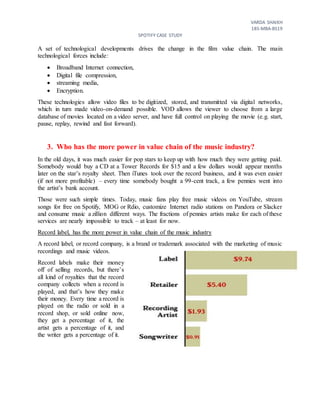
Record label, has the more power in value chain of the music industry
A record label, or record company, is a brand or trademark associated with the marketing of music
recordings and music videos.
Record labels make their money
off of selling records, but there’s
all kind of royalties that the record
company collects when a record is
played, and that’s how they make
their money. Every time a record is
played on the radio or sold in a
record shop, or sold online now,
they get a percentage of it, the
artist gets a percentage of it, and
the writer gets a percentage of it.

SPOTIFY; A CASE STUDY

  • 1.
    VARDA SHAIKH 18S-MBA-BS19 SPOTIFY CASESTUDY 1. who are the major players in music industry The following are three big  Sony Music Entertainment  Universal Music Publishing Group  Warner Music Group And others are:  Island Records  BMG Rights Management  ABC-Paramount Records  Virgin Records  Red Hill Records  Atlantic Records  Def Jam Recordings 2. How has digital changed the value chain? Traditional film value chain: The traditional film value chain comprises a chain of connected companies and individuals, all working on different elements of the film production and distribution process. The interlinking horizontal elements of the process typically follow the discrete stages of development  Financing  Production  Sales  Distribution and  Consumption. Each of these elements has a series of vertically linked activities to progress a film project. Value chain restructuring in the global film industry. Each element in the chain is heavily dependent on a network of varying interacting individuals and companies. Each must be formally engaged and managed to deliver specific commitments and activities in order for a film project to proceed. Once the film is distributed, the revenue generated through cinema ticket sales, DVD purchases, or online download is subject to various revenue shares or commissions as it passes back through the chain, which then complicates the revenue flow. The supply chain evolves into extended supply chain management, however, companies must plan beyond these simple steps. Digital film value chain:
  • 2.
    VARDA SHAIKH 18S-MBA-BS19 SPOTIFY CASESTUDY A set of technological developments drives the change in the film value chain. The main technological forces include:  Broadband Internet connection,  Digital file compression,  streaming media,  Encryption. These technologies allow video files to be digitized, stored, and transmitted via digital networks, which in turn made video-on-demand possible. VOD allows the viewer to choose from a large database of movies located on a video server, and have full control on playing the movie (e.g. start, pause, replay, rewind and fast forward). 3. Who has the more power in value chain of the music industry? In the old days, it was much easier for pop stars to keep up with how much they were getting paid. Somebody would buy a CD at a Tower Records for $15 and a few dollars would appear months later on the star’s royalty sheet. Then iTunes took over the record business, and it was even easier (if not more profitable) – every time somebody bought a 99-cent track, a few pennies went into the artist’s bank account. Those were such simple times. Today, music fans play free music videos on YouTube, stream songs for free on Spotify, MOG or Rdio, customize Internet radio stations on Pandora or Slacker and consume music a zillion different ways. The fractions of pennies artists make for each of these services are nearly impossible to track – at least for now. Record label, has the more power in value chain of the music industry A record label, or record company, is a brand or trademark associated with the marketing of music recordings and music videos. Record labels make their money off of selling records, but there’s all kind of royalties that the record company collects when a record is played, and that’s how they make their money. Every time a record is played on the radio or sold in a record shop, or sold online now, they get a percentage of it, the artist gets a percentage of it, and the writer gets a percentage of it.