Session ID:
Session Classification:
Charles Henderson
Trustwave SpiderLabs
SPO2-W25
Intermediate
APPLICATIONSECURITY:
ONE SIZE DOESN’T FIT ALL
► One size rarely fits all
► Sizing up an application
► Testing choices
► More than just testing
► Conclusions
► Q & A
AGENDA
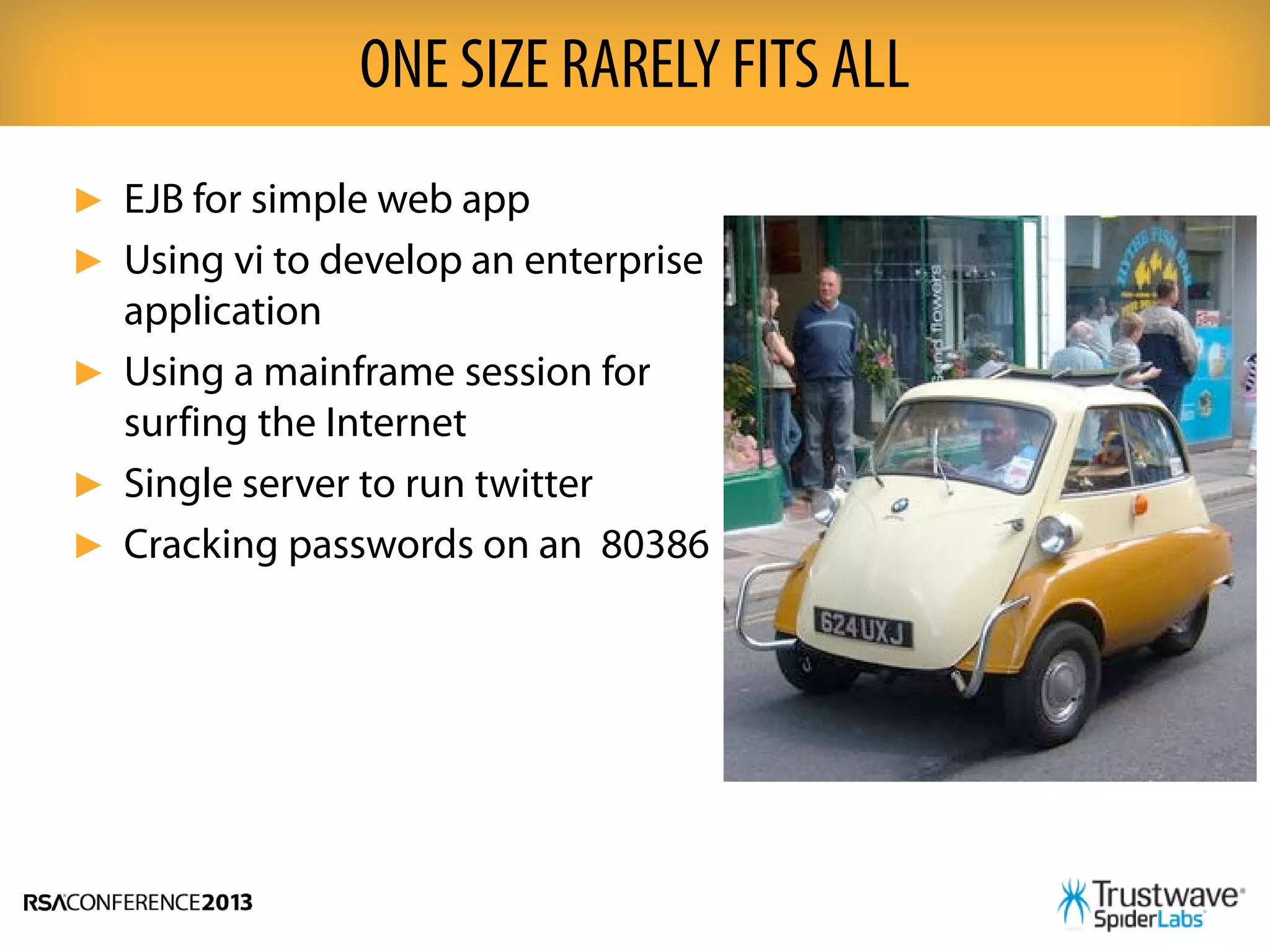
► EJB for simple web app
► Using vi to develop an enterprise
application
► Using a mainframe session for
surfing the Internet
► Single server to run twitter
► Cracking passwords on an 80386
ONE SIZE RARELY FITS ALL
► Point and click web scanners
► No ability to detect complex vulnerabilities
► Low accuracy rate
► Purely automated source code review
► Only support common languages
► Low accuracy rate
► Fixed manual hour projects
► Fails to account for complexity of application
INFLEXIBLE APP-SEC SOLUTIONS
SIZING UP AN APPLICATION
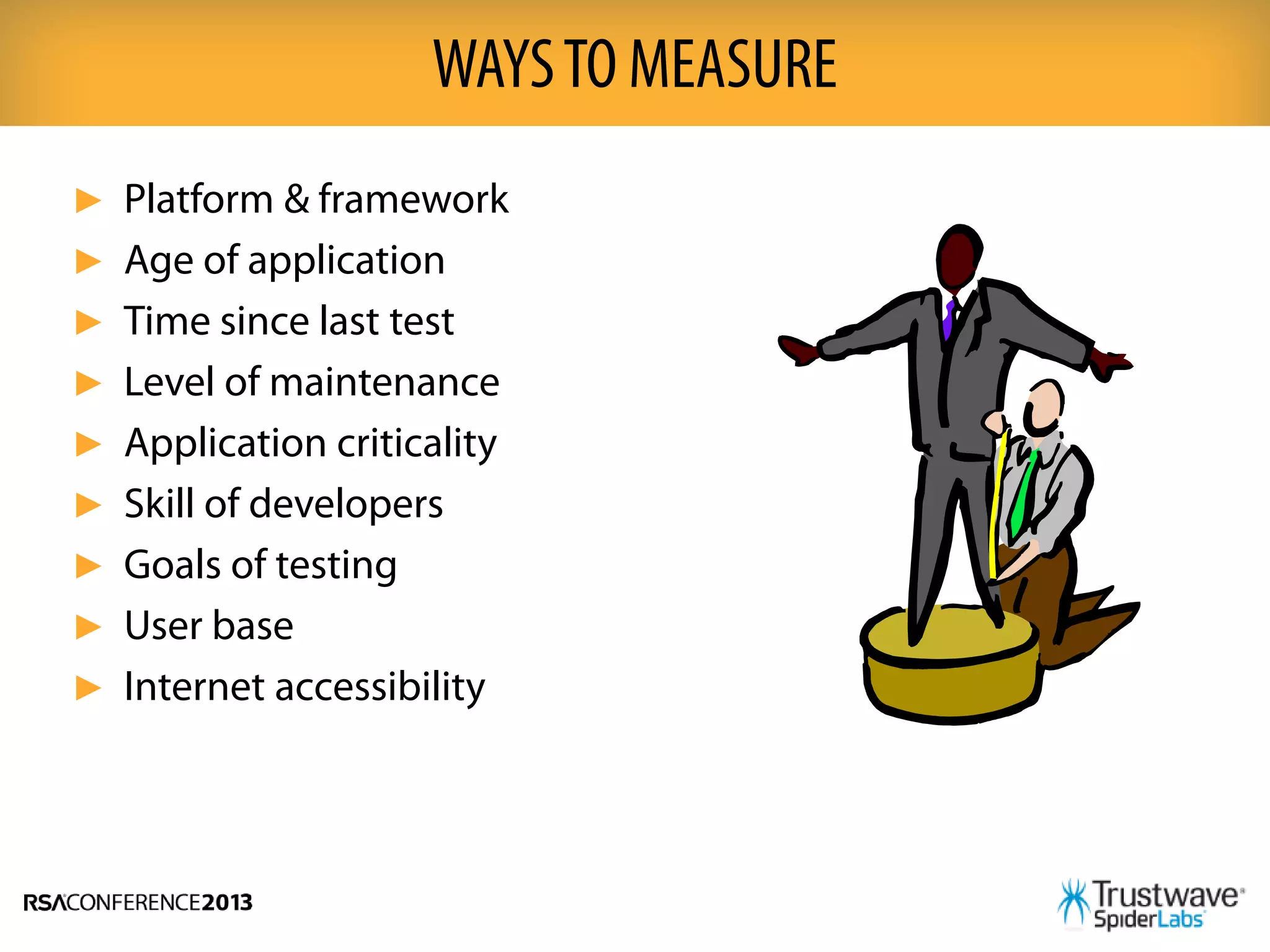
► Platform & framework
► Age of application
► Time since last test
► Level of maintenance
► Application criticality
► Skill of developers
► Goals of testing
► User base
► Internet accessibility
WAYSTO MEASURE
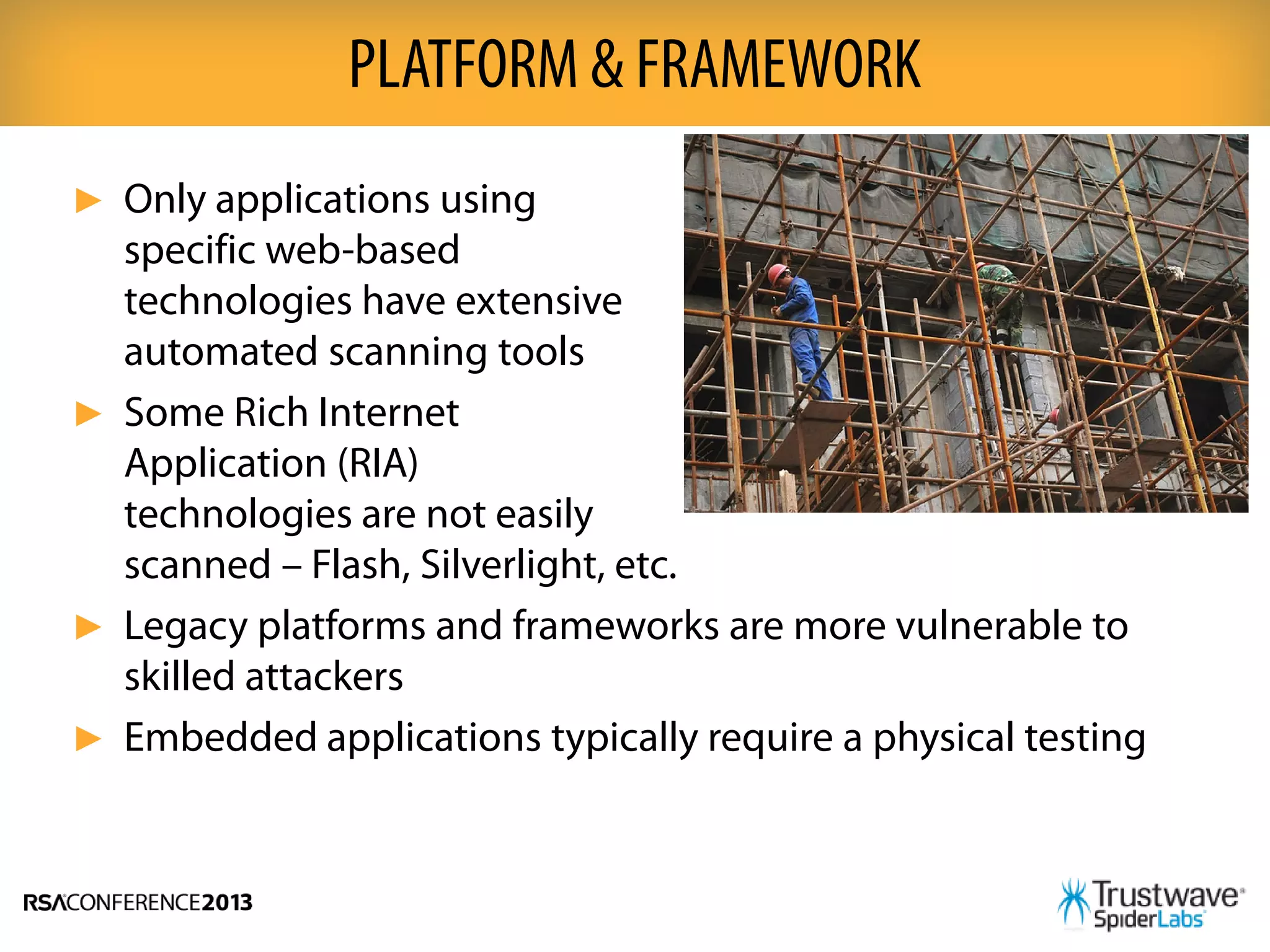
► Only applications using
specific web-based
technologies have extensive
automated scanning tools
► Some Rich Internet
Application (RIA)
technologies are not easily
scanned – Flash, Silverlight, etc.
► Legacy platforms and frameworks are more vulnerable to
skilled attackers
► Embedded applications typically require a physical testing
PLATFORM & FRAMEWORK
► Older code tends to be more vulnerable, especially for web-
based technology
► Older applications will often use vulnerable 3rd-party
libraries and frameworks, or vulnerable versions of currently
secure ones
► Older applications tend to have
architectural mistakes that have since
been recognized and fixed – passing
parameters to command-line tools,
building SQL with concatenated strings,
for instance.
AGE OF APPLICATION
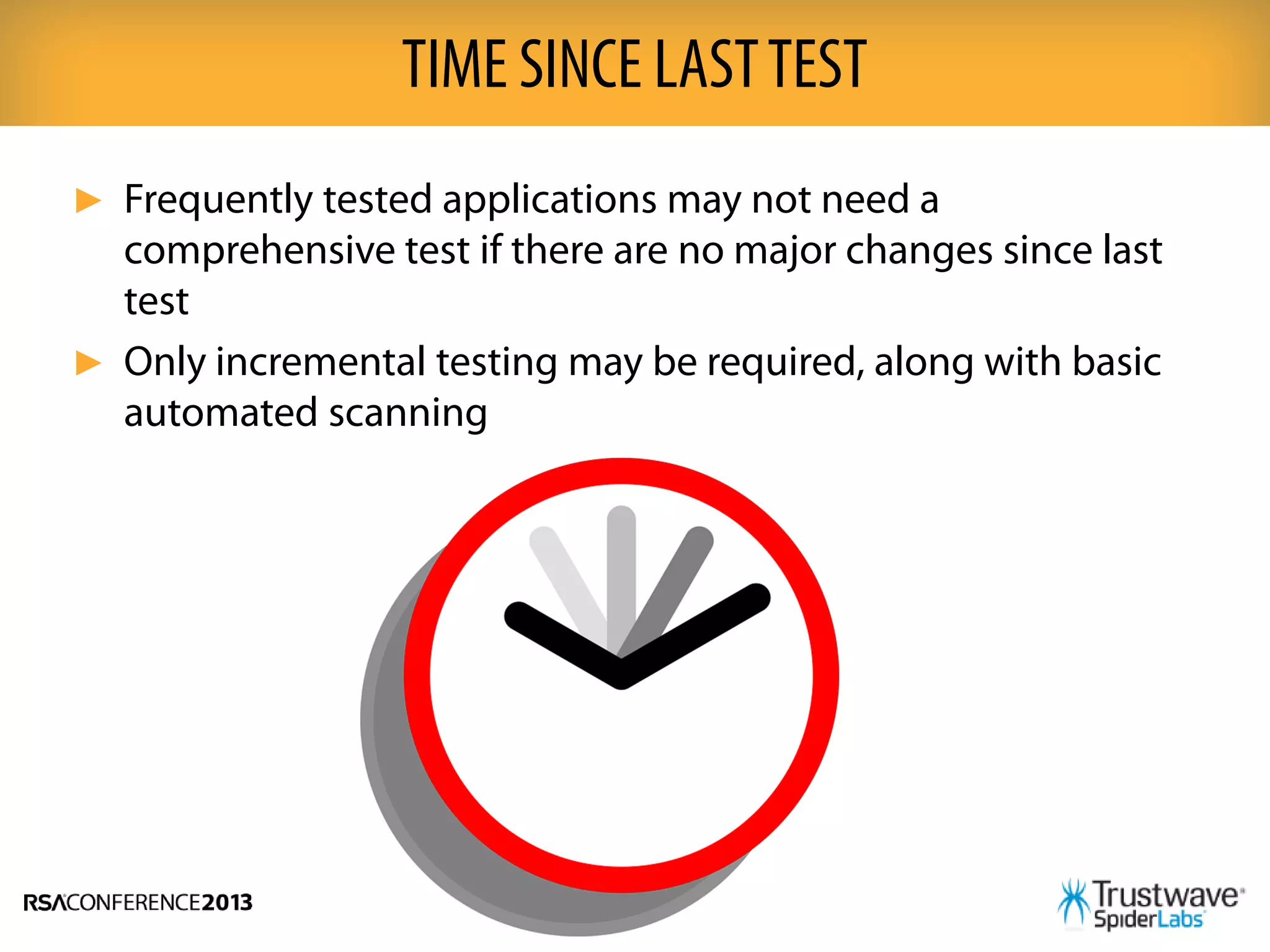
► Frequently tested applications may not need a
comprehensive test if there are no major changes since last
test
► Only incremental testing may be required, along with basic
automated scanning
TIME SINCE LASTTEST
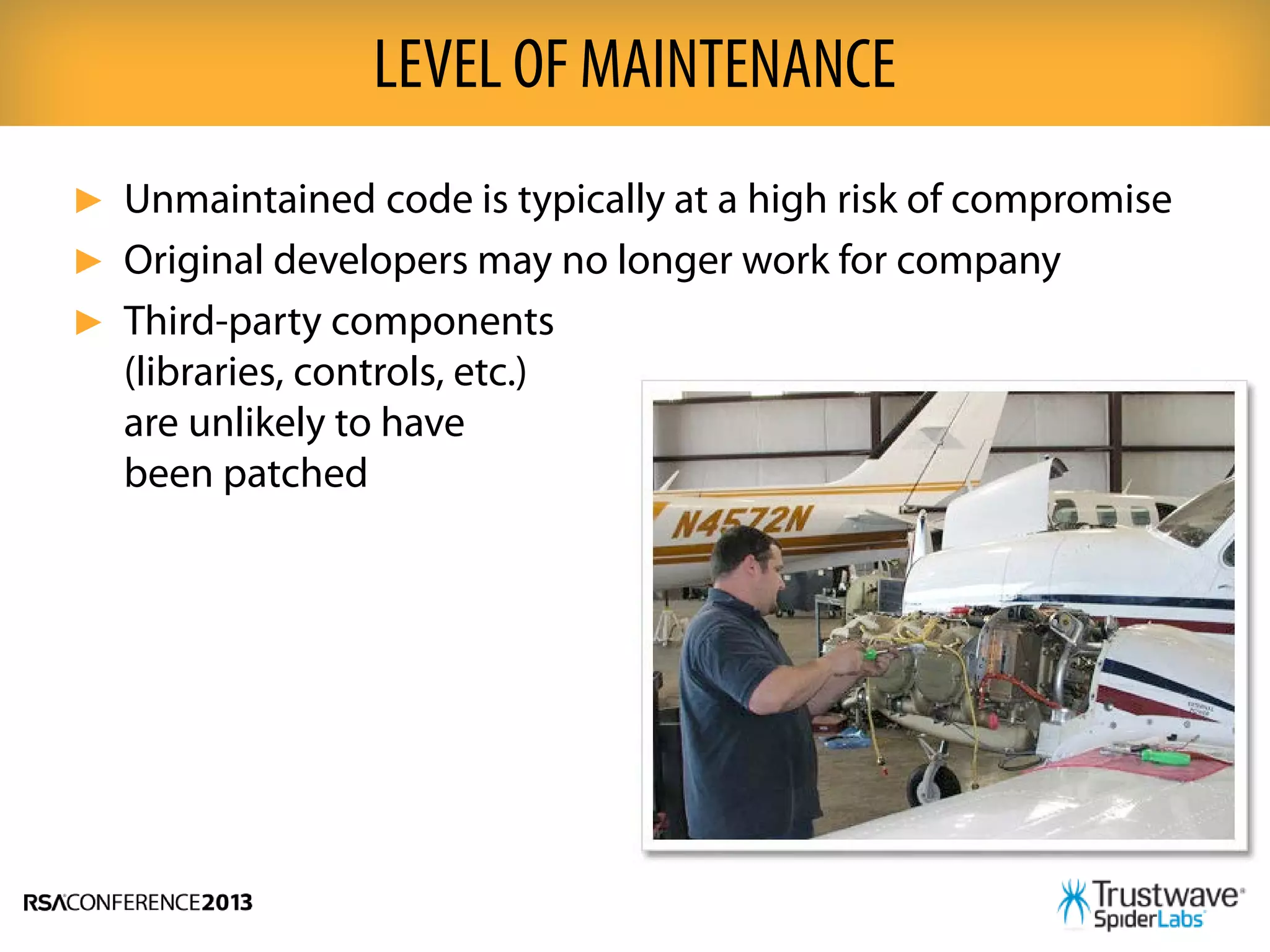
► Unmaintained code is typically at a high risk of compromise
► Original developers may no longer work for company
► Third-party components
(libraries, controls, etc.)
are unlikely to have
been patched
LEVEL OF MAINTENANCE
► Sensitivity of data handled
► Financial
► Medical
► PII
► Business
► Revenue generated by application
► Disruption to business processes if application fails
► Compliance or regulatory mandates
APPLICATION CRITICALITY
► Security staff usually have an idea about the skills of in-
house developers
► Software vendors or open source projects that are popular
may have a reputation about their security skills; niche
products are usually a mystery
► Outsourced developers are usually a mystery unless there is
a high degree of visibility into the provider. Provider training,
turnover rates, and skill are often difficult to assess.
SKILL OF DEVELOPERS
► Applications used by only 10 trusted administrators may not
need comprehensive testing beyond authentication
enforcement
► Self-provisioned users that are offered extensive interfaces
may pose a great threat
► Private applications may have a lower risk profile, especially
if source IP filtering is being used
USER BASE & INTERNET ACCESS
► Compliance mandate
► Internal policies
► Proactive security
► Post-breach security
GOALS OFTESTING
TESTING CHOICES
► Fully automated scanning
► Manual pen testing
► Code review
► “Deep static analysis”
TESTTYPES
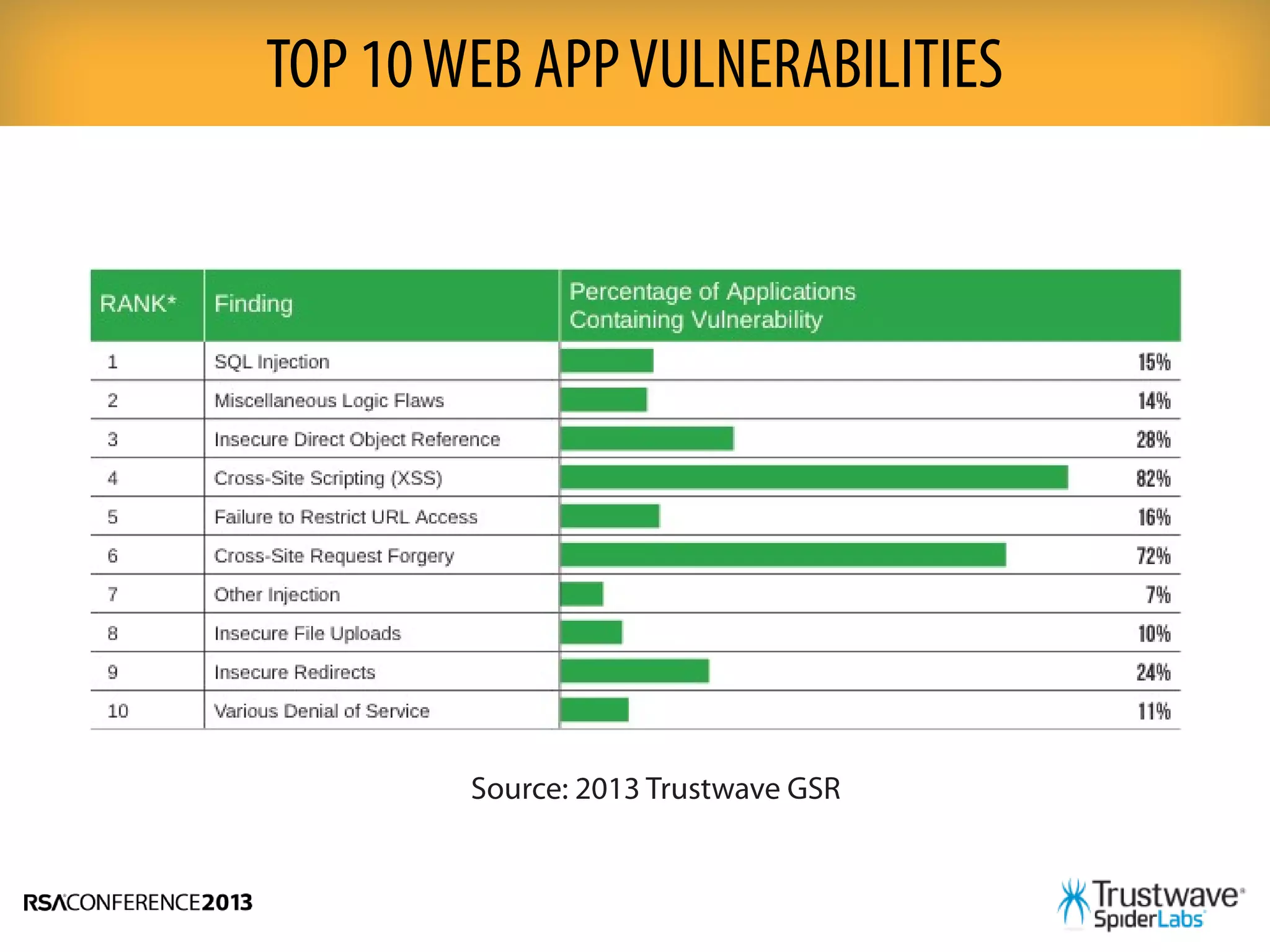
TOP 10WEB APPVULNERABILITIES
Source: 2013 Trustwave GSR
► Appropriate only when accompanied with manual review of
results
► Non-critical applications
► Relatively modern application & frameworks
► Only for web-based applications
► Impossible to discover complex vulnerabilities, including all
logic flaws
► Will miss most authorization and authentication flaws
FULLY AUTOMATED SCANNING
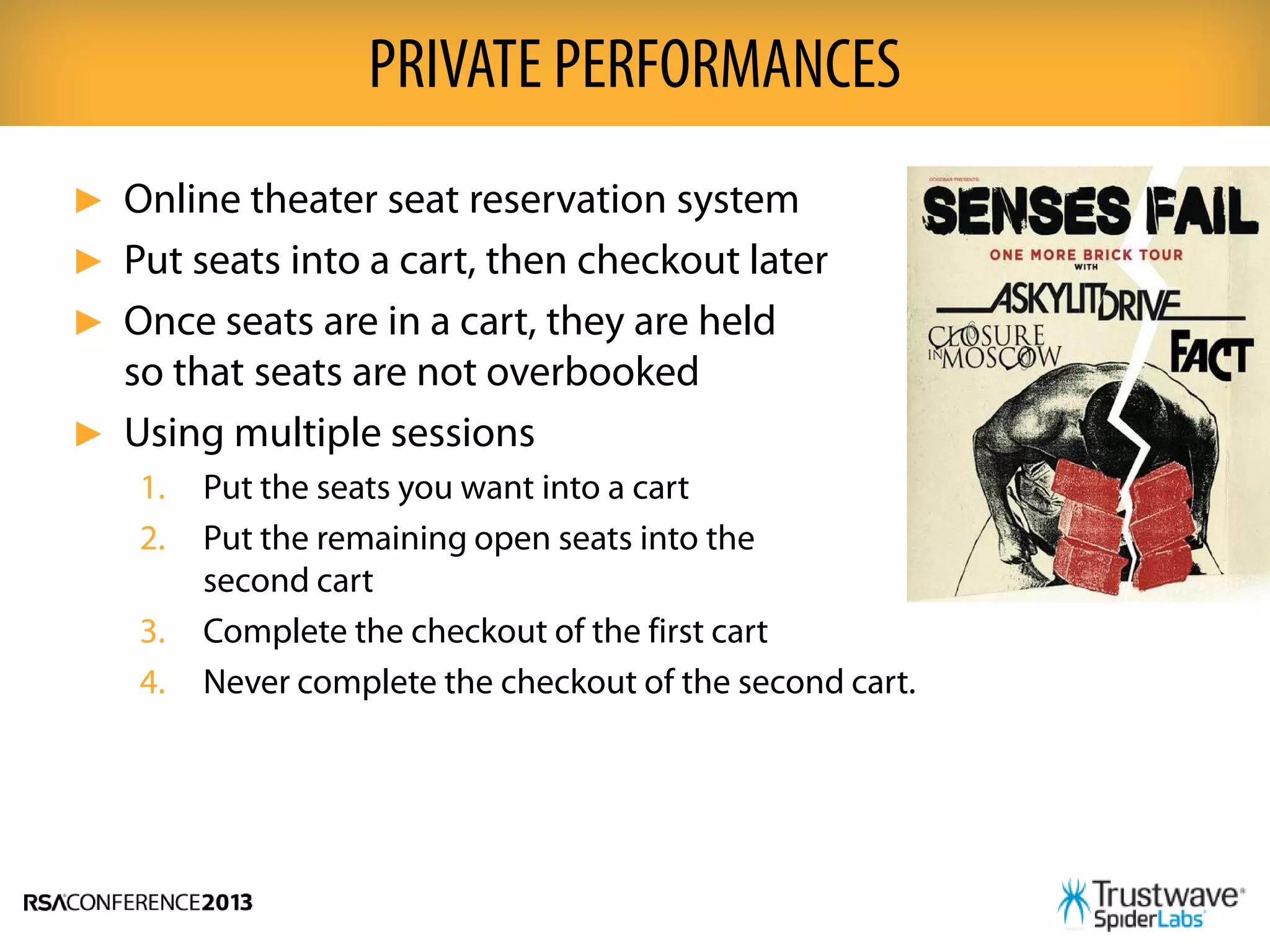
► Online theater seat reservation system
► Put seats into a cart, then checkout later
► Once seats are in a cart, they are held
so that seats are not overbooked
► Using multiple sessions
1. Put the seats you want into a cart
2. Put the remaining open seats into the
second cart
3. Complete the checkout of the first cart
4. Never complete the checkout of the second cart.
PRIVATE PERFORMANCES
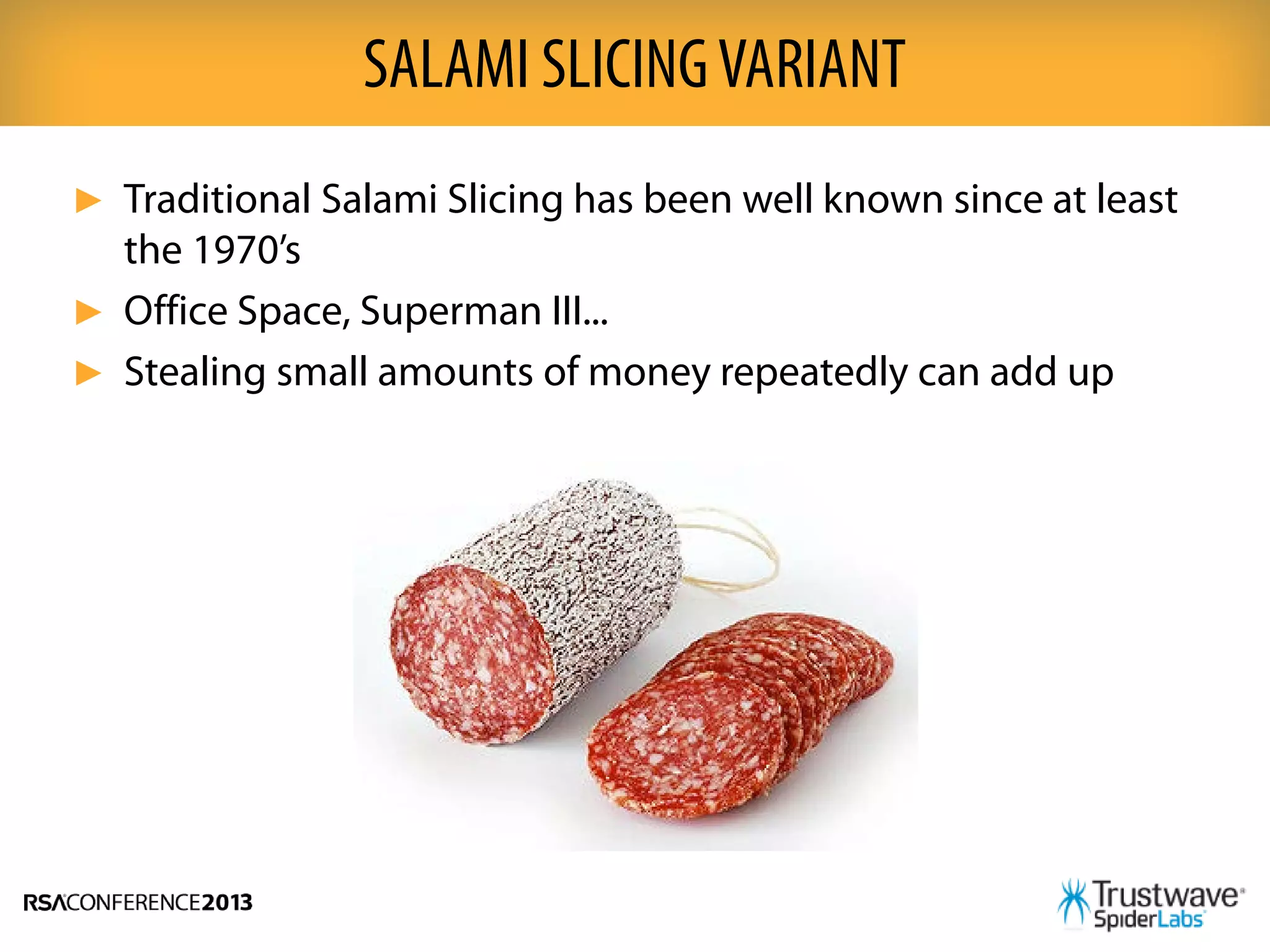
► Traditional Salami Slicing has been well known since at least
the 1970’s
► Office Space, Superman III...
► Stealing small amounts of money repeatedly can add up
SALAMI SLICINGVARIANT
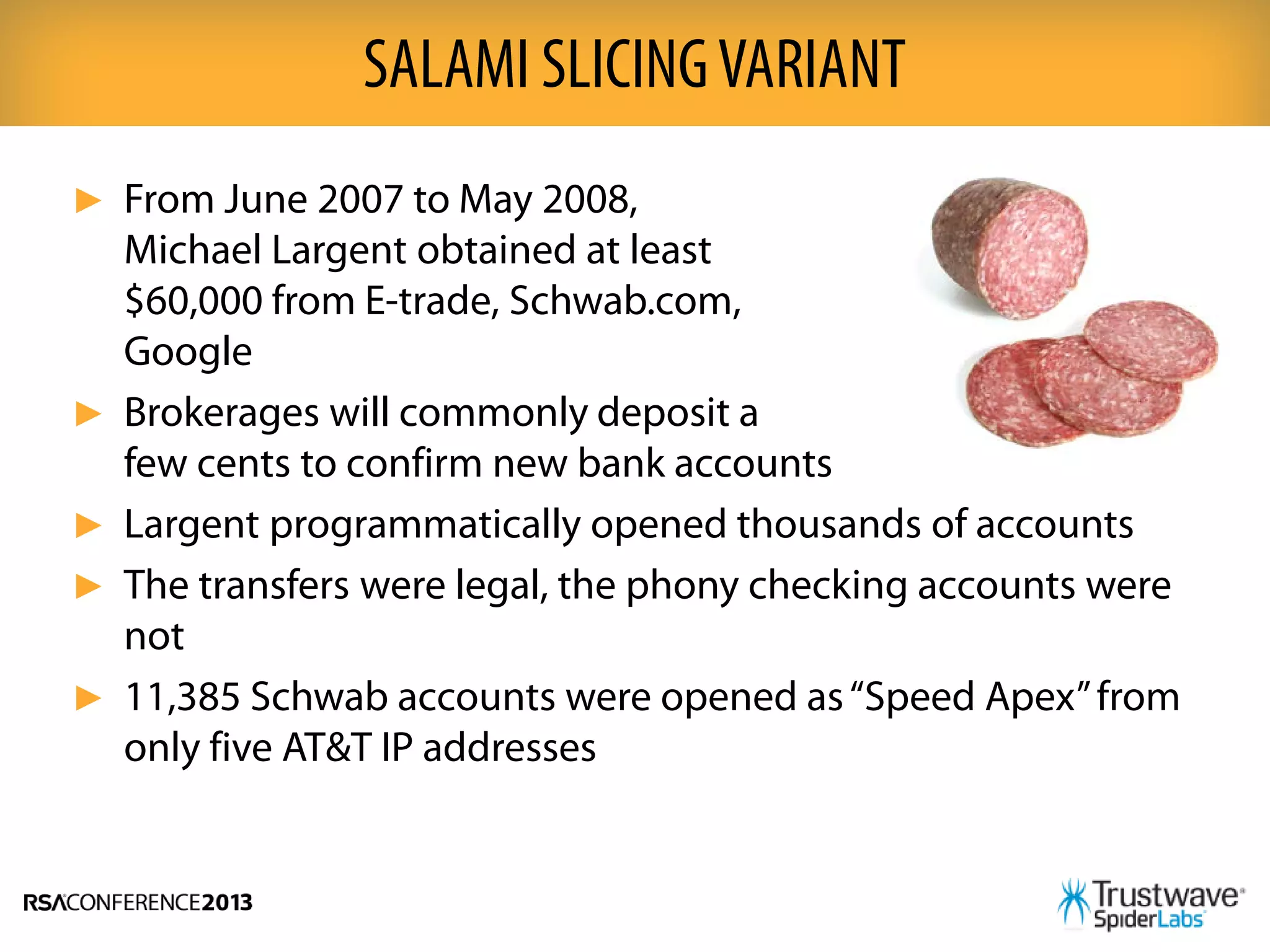
► From June 2007 to May 2008,
Michael Largent obtained at least
$60,000 from E-trade, Schwab.com,
Google
► Brokerages will commonly deposit a
few cents to confirm new bank accounts
► Largent programmatically opened thousands of accounts
► The transfers were legal, the phony checking accounts were
not
► 11,385 Schwab accounts were opened as“Speed Apex”from
only five AT&T IP addresses
SALAMI SLICINGVARIANT
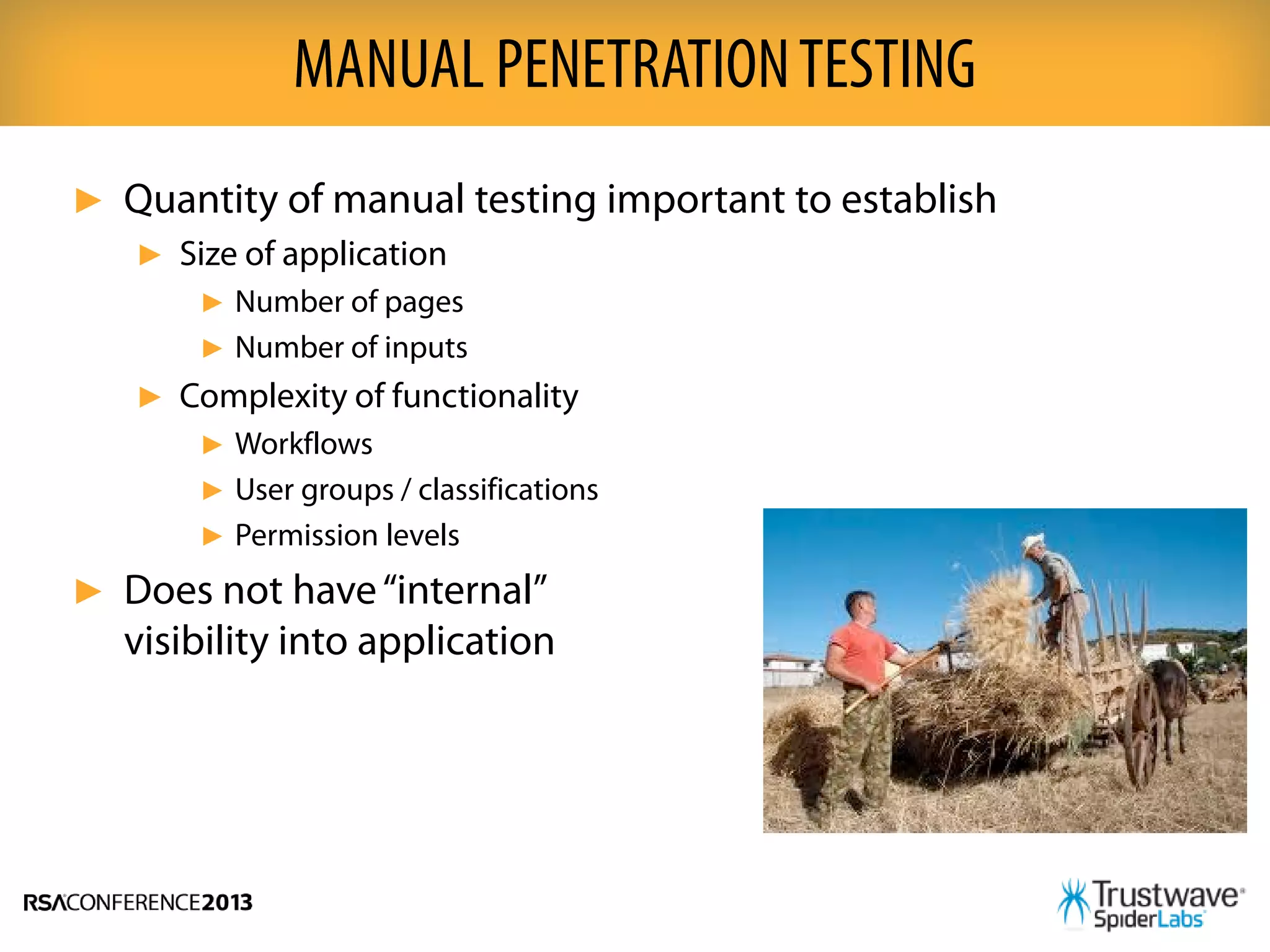
► Quantity of manual testing important to establish
► Size of application
► Number of pages
► Number of inputs
► Complexity of functionality
► Workflows
► User groups / classifications
► Permission levels
► Does not have“internal”
visibility into application
MANUAL PENETRATIONTESTING
► Allows for thorough internal analysis of application
► Requires extensive development and security skills
► Can only be performed when source code available
► Better when combined with manual penetration testing
CODE REVIEW
► Effective when source code is not available
► Allows for internal analysis of application internals
► Best when combined with manual penetration testing
► Enterprise-wide use of a single library or framework could be
a single point of failure
“DEEP STATIC ANALYSIS”
► Apache MyFaces
► Insecure use of client-side view state
► Sun Mojarra
► Insecure use of client-side view state
► Oracle Application Framework
► Profoundly flawed diagnostic mode
► Unnamed game engine
► Systemic buffer overflows
ACTUAL FRAMEWORK FLAWS
MORETHAN JUSTTESTING
► Testing only defines the risk; does nothing to solve it
► Remediation options:
► For web applications, virtual patching is an option
► Risk reduction by restrictive firewall rules, bolt-on IPSec
► Third-party assistance
► Deferment
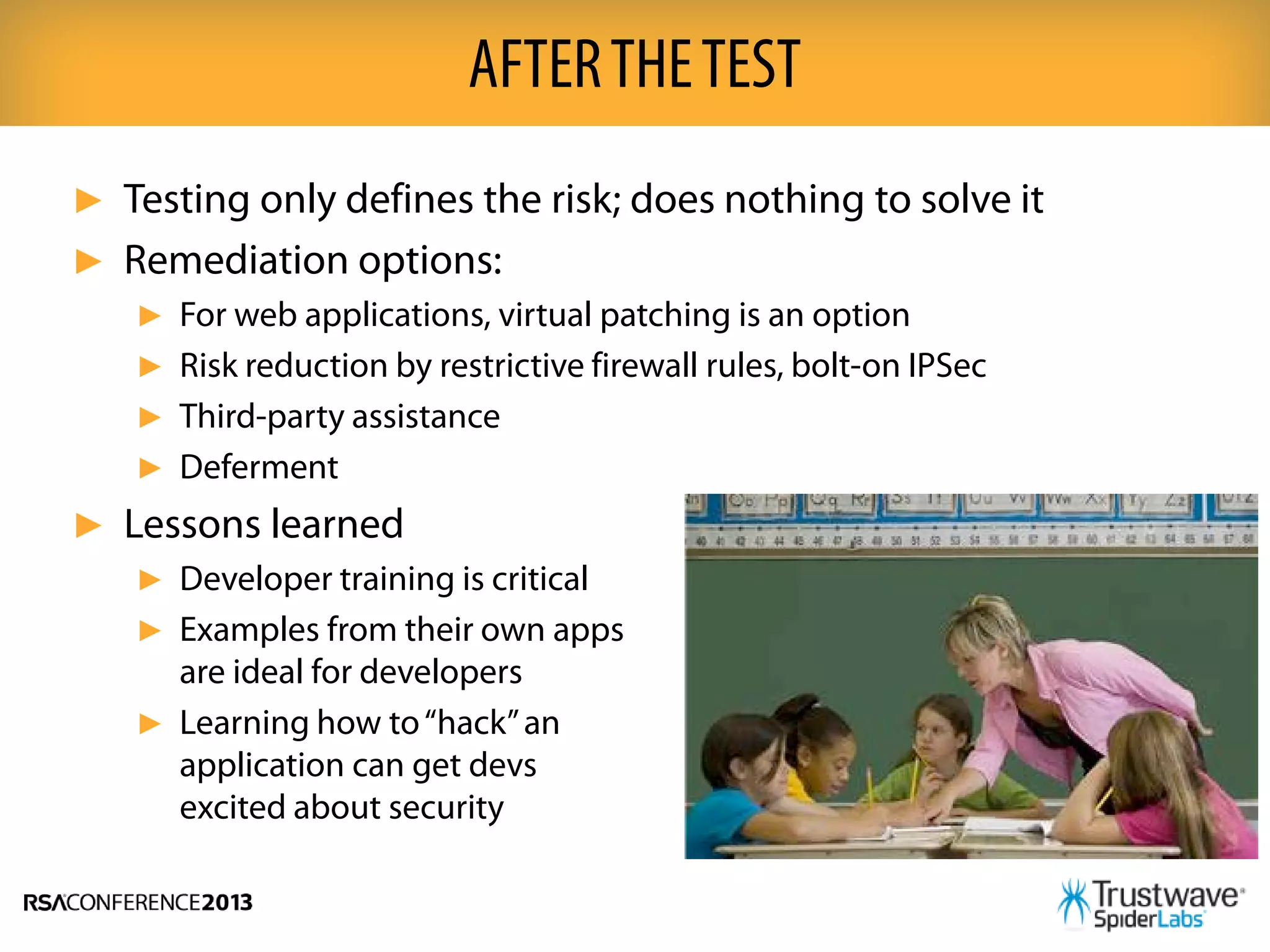
► Lessons learned
► Developer training is critical
► Examples from their own apps
are ideal for developers
► Learning how to“hack”an
application can get devs
excited about security
AFTERTHETEST
► Application security programs are more than single tests
strung together
► Inventory applications
► Prioritization of applications
► Clear SDLC mandates
► Application vendor review
► Commonly used frameworks and libraries must receive
extensive attention, regardless of their source
► May vary testing on application; one year pen test, next year
code review
TACTICSVS. STRATEGY
WRAPPING UP
► Unless you are only securing one application, AppSec
requires a diverse arsenal
► Multiple factors must be considered when determining what
approach is appropriate for a specific target
► Budgets are not unlimited and it is important to make
dollars spent count
► Understanding what you have is the first step to
understanding what you need to protect
CONCLUSIONS
QUESTIONS & ANSWERS

Spo2 w25

  • 1.
    Session ID: Session Classification: CharlesHenderson Trustwave SpiderLabs SPO2-W25 Intermediate APPLICATIONSECURITY: ONE SIZE DOESN’T FIT ALL
  • 2.
    ► One sizerarely fits all ► Sizing up an application ► Testing choices ► More than just testing ► Conclusions ► Q & A AGENDA
  • 3.
    ► EJB forsimple web app ► Using vi to develop an enterprise application ► Using a mainframe session for surfing the Internet ► Single server to run twitter ► Cracking passwords on an 80386 ONE SIZE RARELY FITS ALL
  • 4.
    ► Point andclick web scanners ► No ability to detect complex vulnerabilities ► Low accuracy rate ► Purely automated source code review ► Only support common languages ► Low accuracy rate ► Fixed manual hour projects ► Fails to account for complexity of application INFLEXIBLE APP-SEC SOLUTIONS
  • 5.
    SIZING UP ANAPPLICATION
  • 6.
    ► Platform &framework ► Age of application ► Time since last test ► Level of maintenance ► Application criticality ► Skill of developers ► Goals of testing ► User base ► Internet accessibility WAYSTO MEASURE
  • 7.
    ► Only applicationsusing specific web-based technologies have extensive automated scanning tools ► Some Rich Internet Application (RIA) technologies are not easily scanned – Flash, Silverlight, etc. ► Legacy platforms and frameworks are more vulnerable to skilled attackers ► Embedded applications typically require a physical testing PLATFORM & FRAMEWORK
  • 8.
    ► Older codetends to be more vulnerable, especially for web- based technology ► Older applications will often use vulnerable 3rd-party libraries and frameworks, or vulnerable versions of currently secure ones ► Older applications tend to have architectural mistakes that have since been recognized and fixed – passing parameters to command-line tools, building SQL with concatenated strings, for instance. AGE OF APPLICATION
  • 9.
    ► Frequently testedapplications may not need a comprehensive test if there are no major changes since last test ► Only incremental testing may be required, along with basic automated scanning TIME SINCE LASTTEST
  • 10.
    ► Unmaintained codeis typically at a high risk of compromise ► Original developers may no longer work for company ► Third-party components (libraries, controls, etc.) are unlikely to have been patched LEVEL OF MAINTENANCE
  • 11.
    ► Sensitivity ofdata handled ► Financial ► Medical ► PII ► Business ► Revenue generated by application ► Disruption to business processes if application fails ► Compliance or regulatory mandates APPLICATION CRITICALITY
  • 12.
    ► Security staffusually have an idea about the skills of in- house developers ► Software vendors or open source projects that are popular may have a reputation about their security skills; niche products are usually a mystery ► Outsourced developers are usually a mystery unless there is a high degree of visibility into the provider. Provider training, turnover rates, and skill are often difficult to assess. SKILL OF DEVELOPERS
  • 13.
    ► Applications usedby only 10 trusted administrators may not need comprehensive testing beyond authentication enforcement ► Self-provisioned users that are offered extensive interfaces may pose a great threat ► Private applications may have a lower risk profile, especially if source IP filtering is being used USER BASE & INTERNET ACCESS
  • 14.
    ► Compliance mandate ►Internal policies ► Proactive security ► Post-breach security GOALS OFTESTING
  • 15.
  • 16.
    ► Fully automatedscanning ► Manual pen testing ► Code review ► “Deep static analysis” TESTTYPES
  • 17.
  • 18.
    ► Appropriate onlywhen accompanied with manual review of results ► Non-critical applications ► Relatively modern application & frameworks ► Only for web-based applications ► Impossible to discover complex vulnerabilities, including all logic flaws ► Will miss most authorization and authentication flaws FULLY AUTOMATED SCANNING
  • 19.
    ► Online theaterseat reservation system ► Put seats into a cart, then checkout later ► Once seats are in a cart, they are held so that seats are not overbooked ► Using multiple sessions 1. Put the seats you want into a cart 2. Put the remaining open seats into the second cart 3. Complete the checkout of the first cart 4. Never complete the checkout of the second cart. PRIVATE PERFORMANCES
  • 20.
    ► Traditional SalamiSlicing has been well known since at least the 1970’s ► Office Space, Superman III... ► Stealing small amounts of money repeatedly can add up SALAMI SLICINGVARIANT
  • 21.
    ► From June2007 to May 2008, Michael Largent obtained at least $60,000 from E-trade, Schwab.com, Google ► Brokerages will commonly deposit a few cents to confirm new bank accounts ► Largent programmatically opened thousands of accounts ► The transfers were legal, the phony checking accounts were not ► 11,385 Schwab accounts were opened as“Speed Apex”from only five AT&T IP addresses SALAMI SLICINGVARIANT
  • 22.
    ► Quantity ofmanual testing important to establish ► Size of application ► Number of pages ► Number of inputs ► Complexity of functionality ► Workflows ► User groups / classifications ► Permission levels ► Does not have“internal” visibility into application MANUAL PENETRATIONTESTING
  • 23.
    ► Allows forthorough internal analysis of application ► Requires extensive development and security skills ► Can only be performed when source code available ► Better when combined with manual penetration testing CODE REVIEW
  • 24.
    ► Effective whensource code is not available ► Allows for internal analysis of application internals ► Best when combined with manual penetration testing ► Enterprise-wide use of a single library or framework could be a single point of failure “DEEP STATIC ANALYSIS”
  • 25.
    ► Apache MyFaces ►Insecure use of client-side view state ► Sun Mojarra ► Insecure use of client-side view state ► Oracle Application Framework ► Profoundly flawed diagnostic mode ► Unnamed game engine ► Systemic buffer overflows ACTUAL FRAMEWORK FLAWS
  • 26.
  • 27.
    ► Testing onlydefines the risk; does nothing to solve it ► Remediation options: ► For web applications, virtual patching is an option ► Risk reduction by restrictive firewall rules, bolt-on IPSec ► Third-party assistance ► Deferment ► Lessons learned ► Developer training is critical ► Examples from their own apps are ideal for developers ► Learning how to“hack”an application can get devs excited about security AFTERTHETEST
  • 28.
    ► Application securityprograms are more than single tests strung together ► Inventory applications ► Prioritization of applications ► Clear SDLC mandates ► Application vendor review ► Commonly used frameworks and libraries must receive extensive attention, regardless of their source ► May vary testing on application; one year pen test, next year code review TACTICSVS. STRATEGY
  • 29.
  • 30.
    ► Unless youare only securing one application, AppSec requires a diverse arsenal ► Multiple factors must be considered when determining what approach is appropriate for a specific target ► Budgets are not unlimited and it is important to make dollars spent count ► Understanding what you have is the first step to understanding what you need to protect CONCLUSIONS
  • 31.