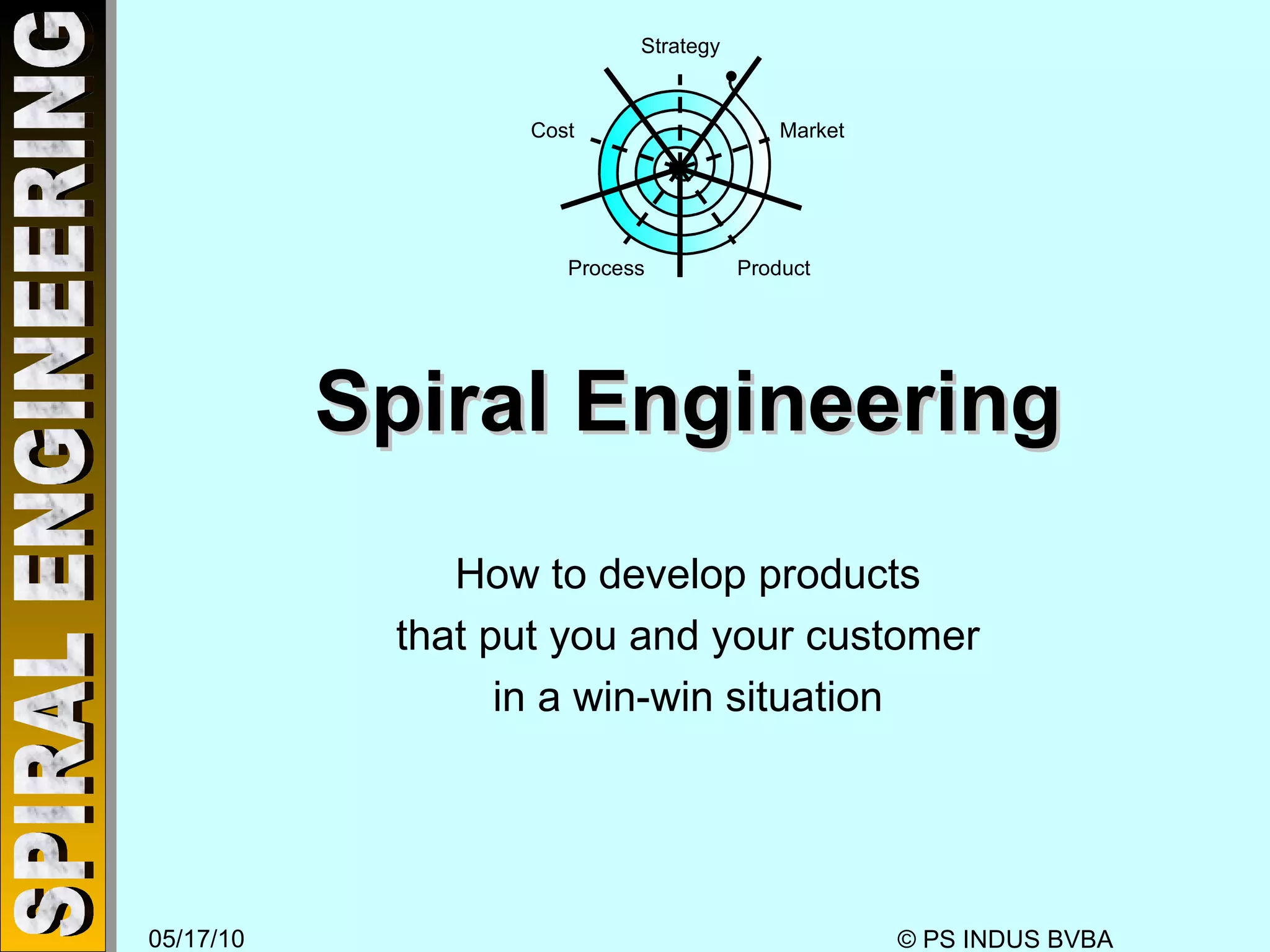
Spiral Engineering How to develop products that put you and your customer in a win-win situation Strategy Market Product Process Cost
Some Reflections on product development What comes up in your mind with the words “product development” Improved technical functionality ? Sexy Product Market combinations ? Nicer looking Designs ? Creative ideas ? Engineering stuff ? But how about ? Develop a product to cost less Addressing flaws identified by customer service Reduce your Time to Market Manage the development process Integrate strategic thinking in the development process.
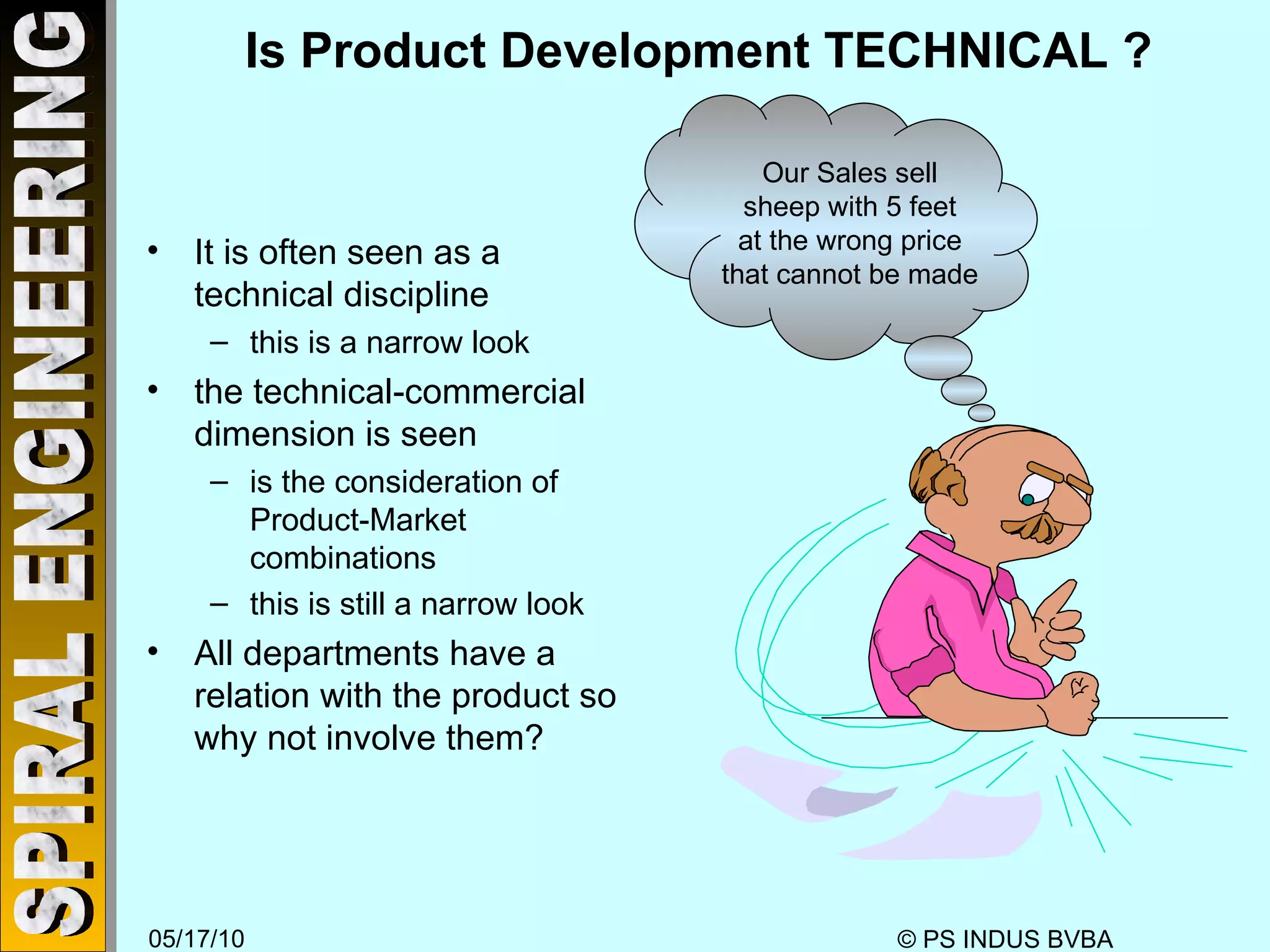
Is Product Development TECHNICAL ? It is often seen as a  technical discipline this is a narrow look the technical-commercial dimension is seen is the consideration of Product-Market combinations this is still a narrow look All departments have a relation with the product so why not involve them? Our Sales sell sheep with 5 feet at the wrong price that cannot be made
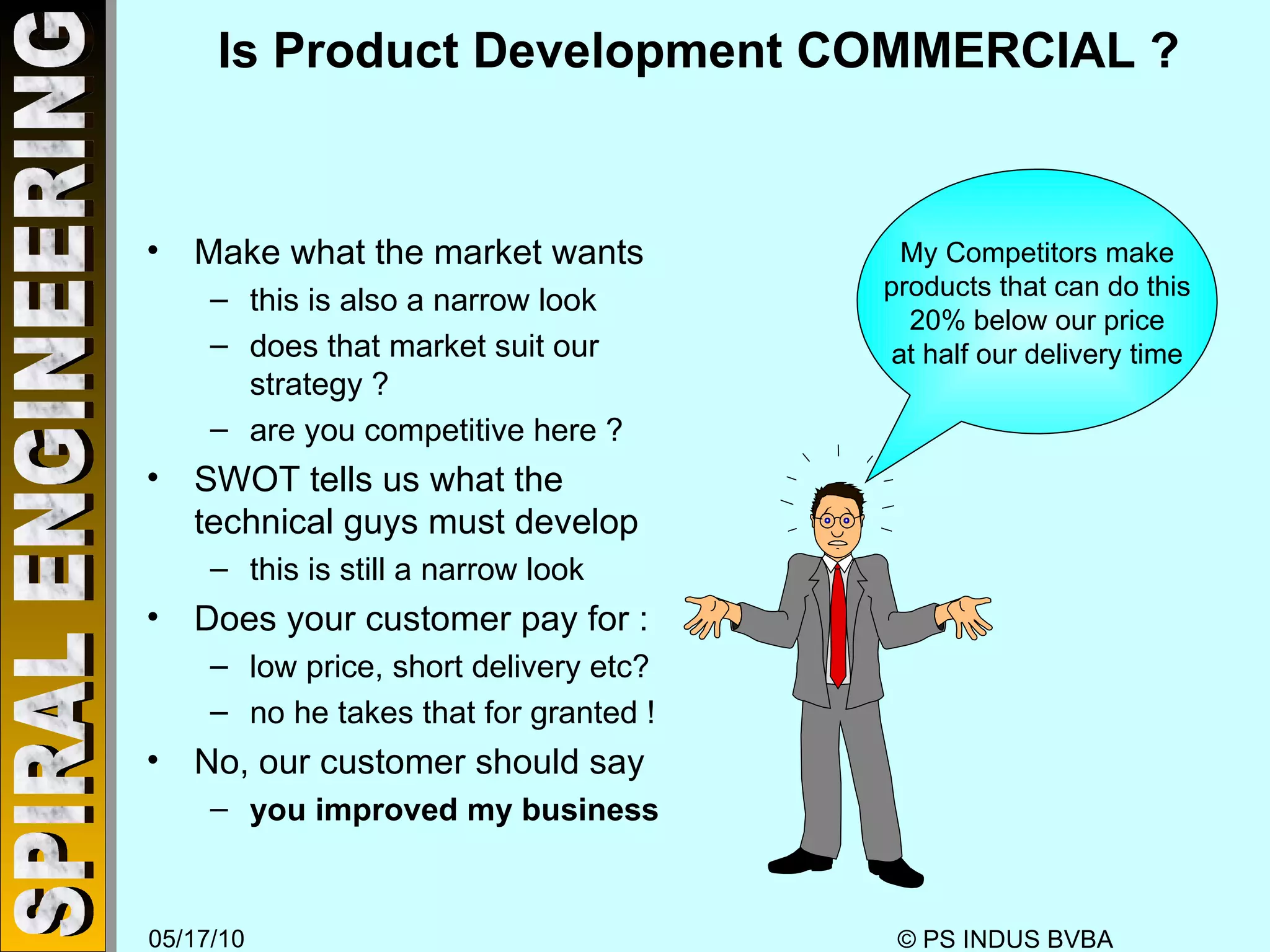
Is Product Development COMMERCIAL ? Make what the market wants this is also a narrow look does that market suit our strategy ? are you competitive here ? SWOT tells us what the technical guys must develop this is still a narrow look Does your customer pay for : low price, short delivery etc? no he takes that for granted ! No, our customer should say you improved my business My Competitors make products that can do this 20% below our price at half our delivery time
Solutions to manage product development Sequential Engineering define the tasks from prototype to product execute these one after the other often: “development is an engineering discipline” Parallel Engineering execute the tasks simultaneously as far as possible often: “product-market combination development” Spiral Engineering Be quick and dirty in the beginning Detail out the product in parallel Involve departments with a relation to the product Be: “creative, thorough, manageable and fast”
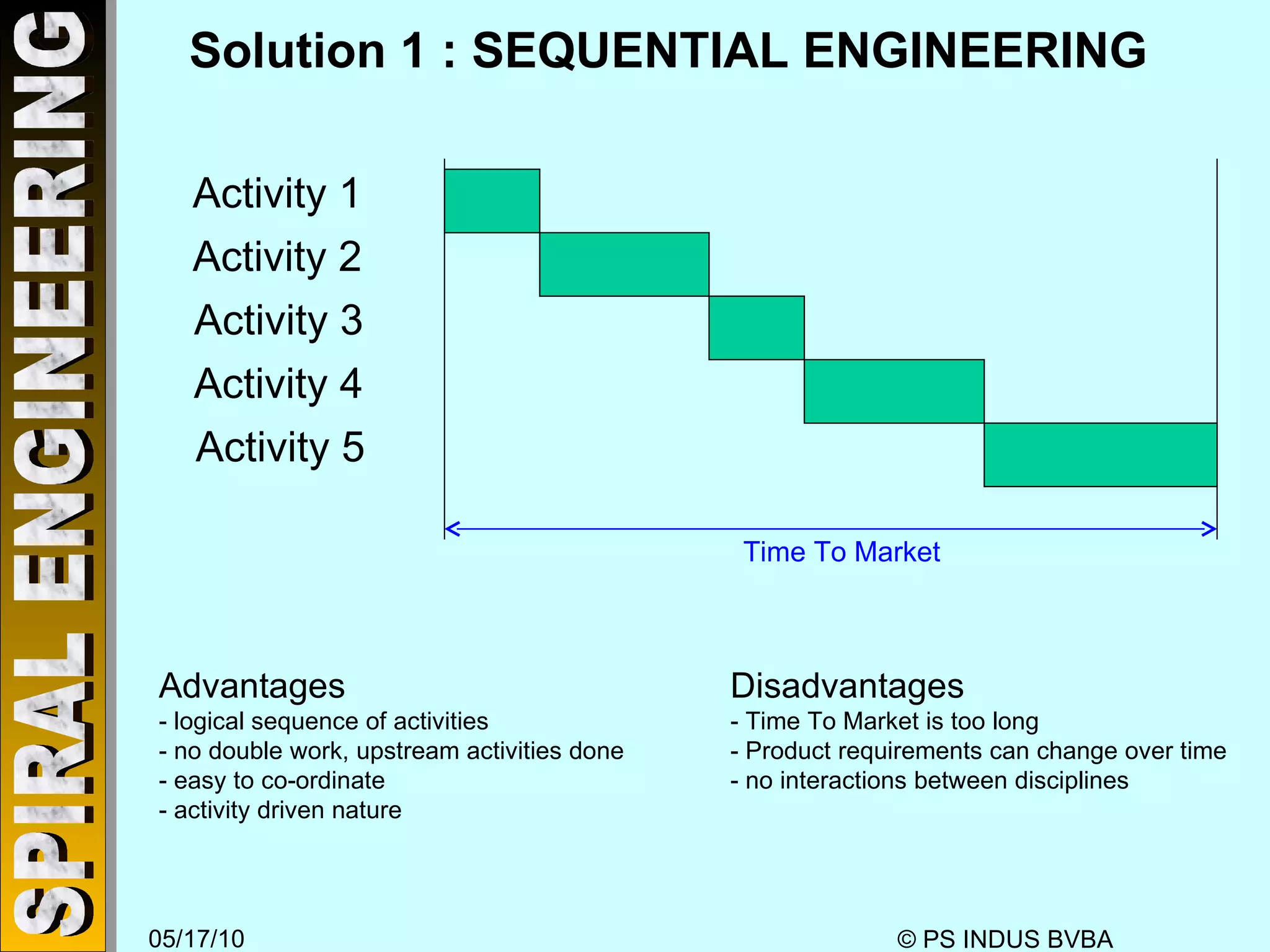
Solution 1 : SEQUENTIAL ENGINEERING Activity 1 Activity 2 Activity 3 Activity 4 Activity 5 Disadvantages - Time To Market is too long - Product requirements can change over time - no interactions between disciplines Advantages - logical sequence of activities - no double work, upstream activities done - easy to co-ordinate - activity driven nature Time To Market
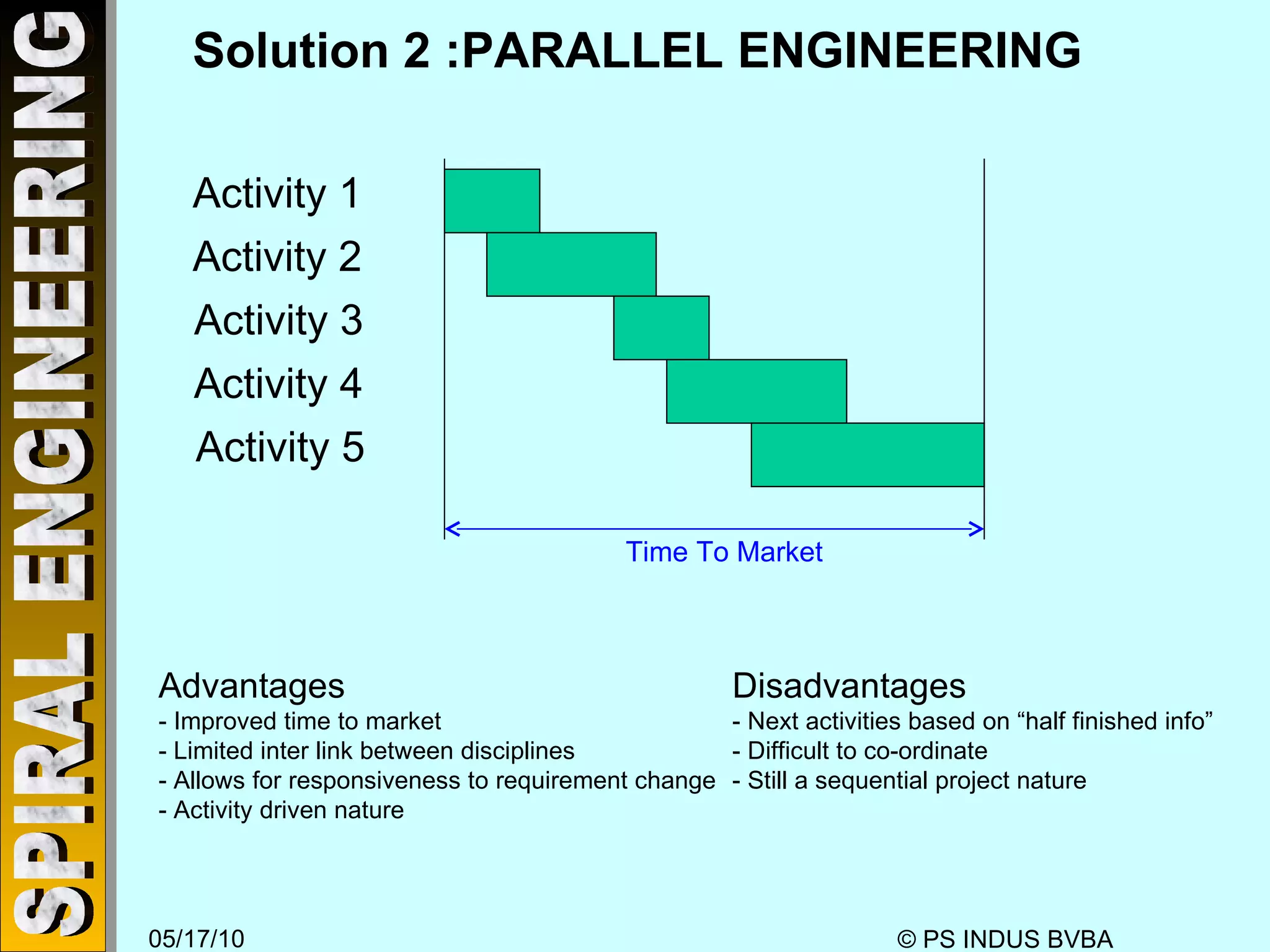
Solution 2 :PARALLEL ENGINEERING Activity 1 Activity 2 Activity 3 Activity 4 Activity 5 Disadvantages - Next activities based on “half finished info” - Difficult to co-ordinate - Still a sequential project nature Advantages - Improved time to market - Limited inter link between disciplines - Allows for responsiveness to requirement change - Activity driven nature Time To Market
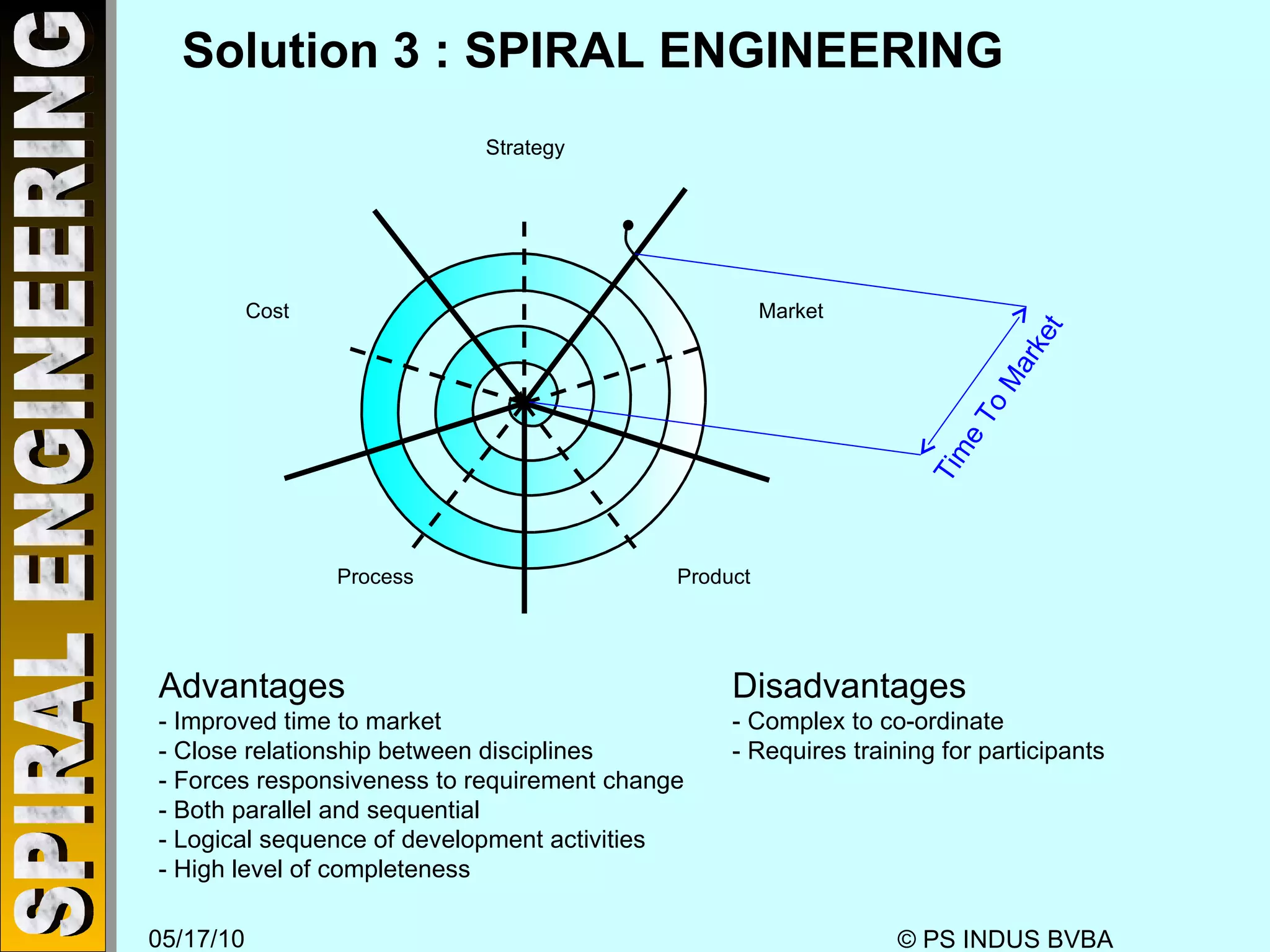
Solution 3 : SPIRAL ENGINEERING Disadvantages - Complex to co-ordinate - Requires training for participants Advantages - Improved time to market - Close relationship between disciplines - Forces responsiveness to requirement change - Both parallel and sequential - Logical sequence of development activities - High level of completeness Time To Market Strategy Market Product Process Cost
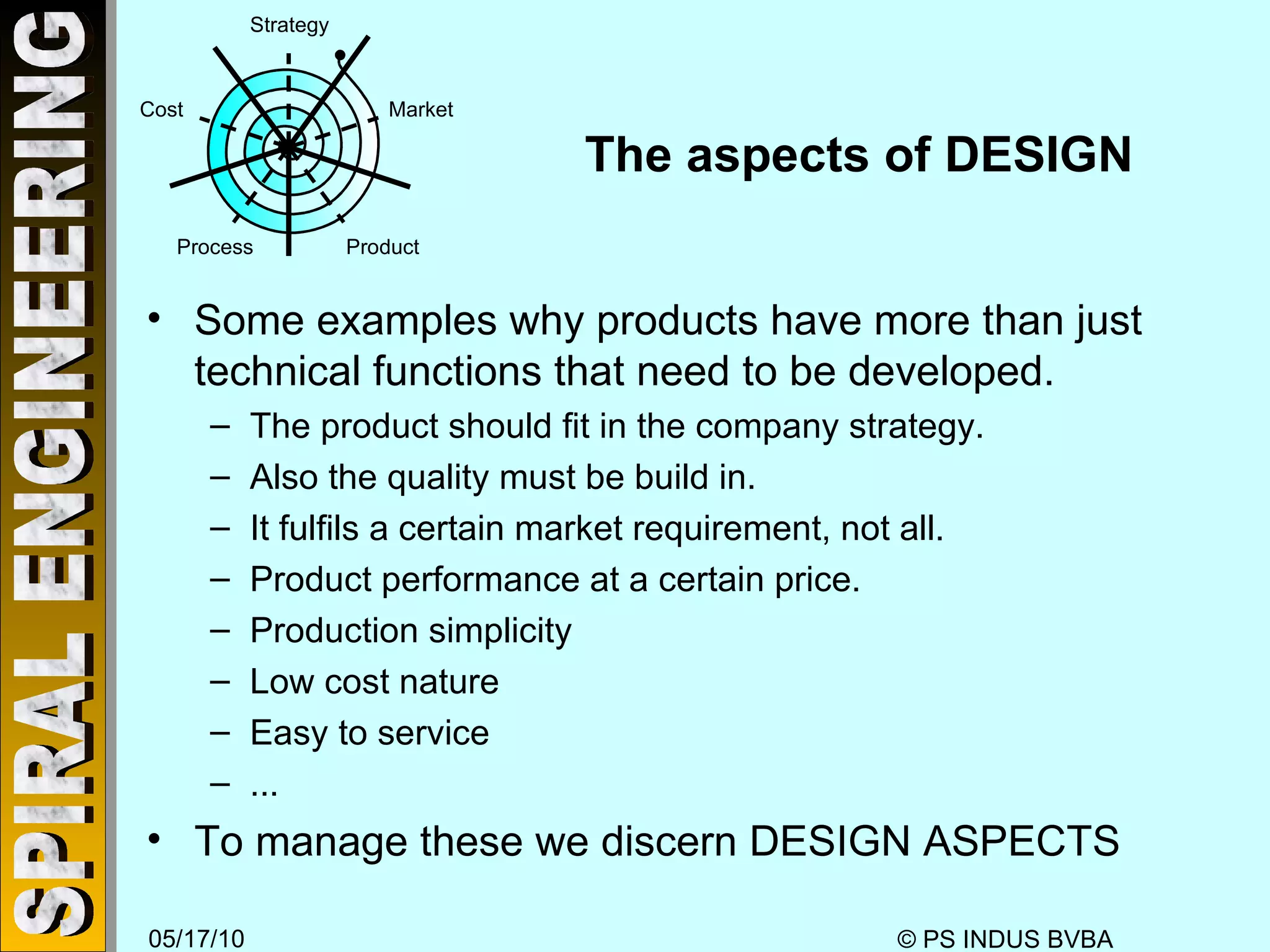
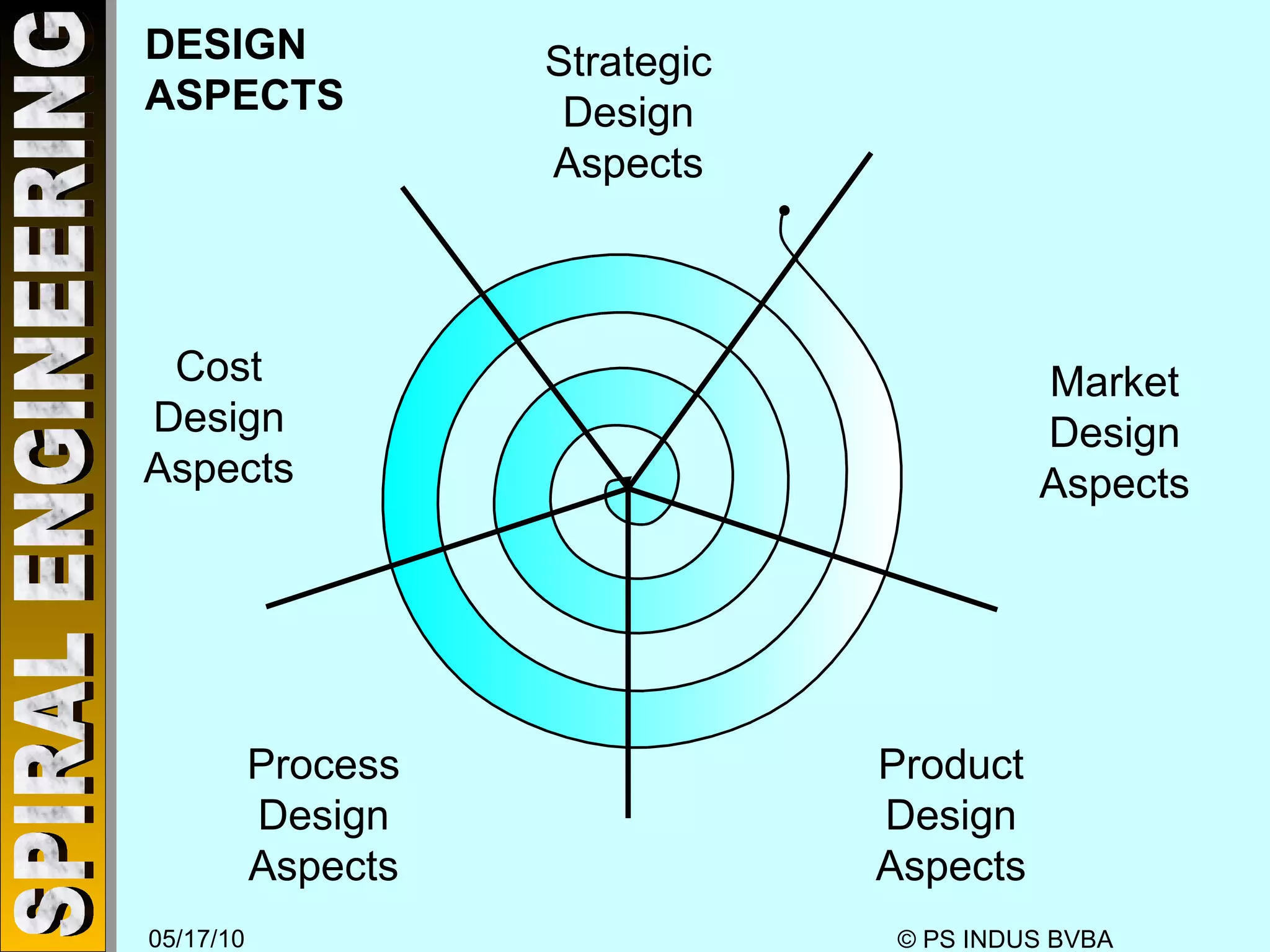
The aspects of DESIGN Some examples why products have more than just technical functions that need to be developed. The product should fit in the company strategy. Also the quality must be build in. It fulfils a certain market requirement, not all. Product performance at a certain price. Production simplicity Low cost nature Easy to service ... To manage these we discern DESIGN ASPECTS Strategy Market Product Process Cost
DESIGN ASPECTS Strategic Design Aspects Market Design Aspects Product Design Aspects Process Design Aspects Cost Design Aspects
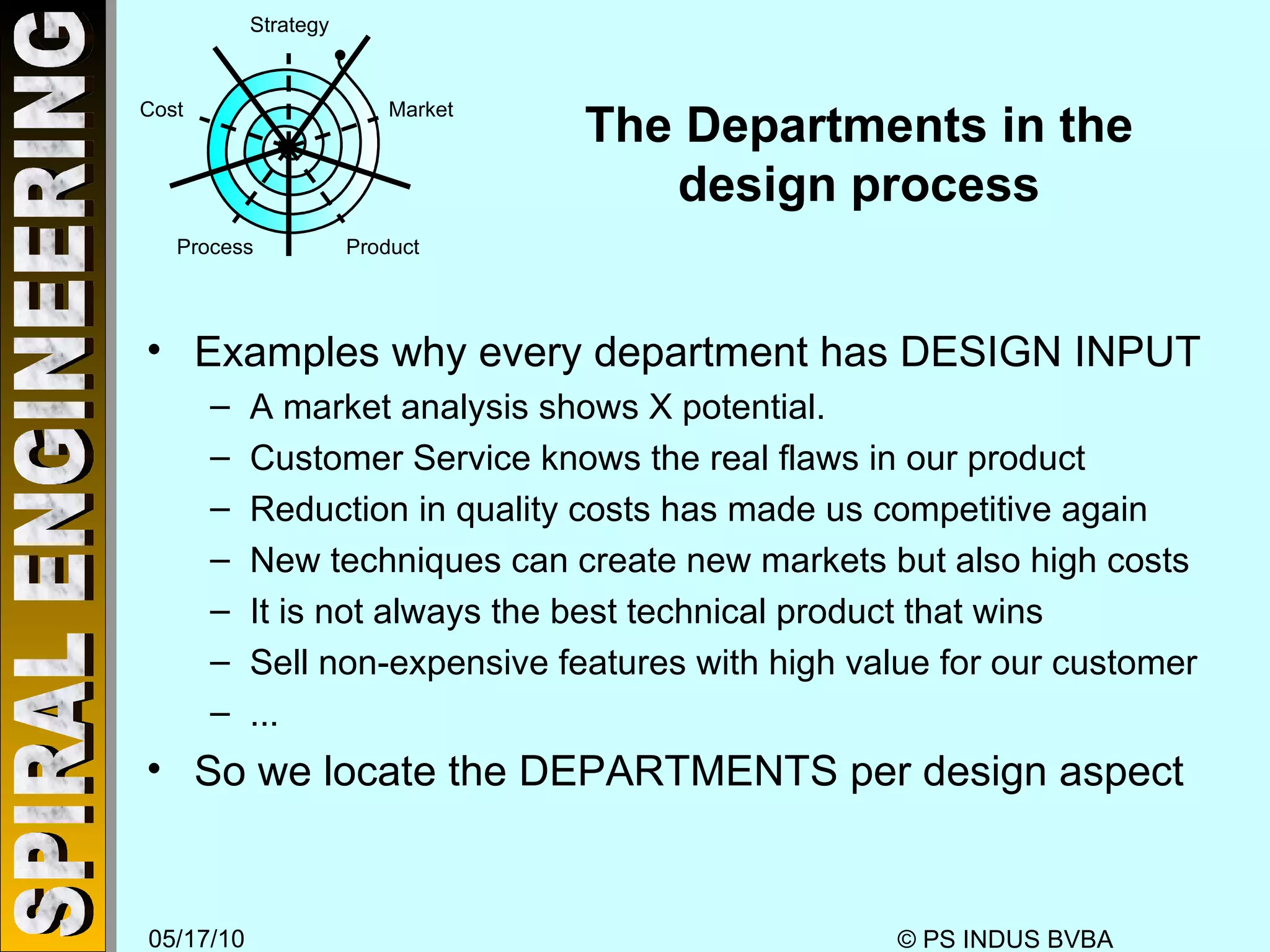
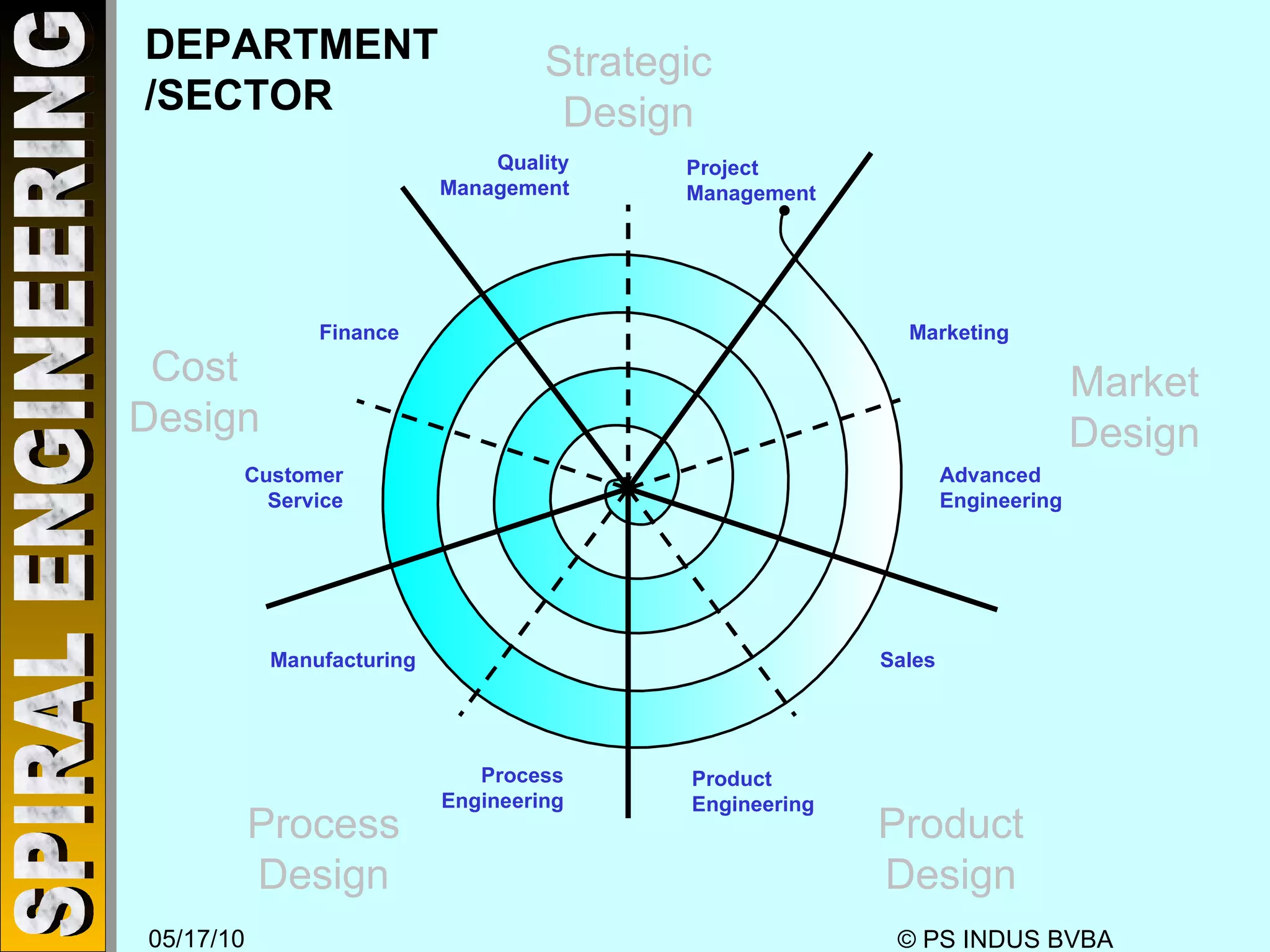
The Departments in the design process Examples why every department has DESIGN INPUT A market analysis shows X potential.  Customer Service knows the real flaws in our product Reduction in quality costs has made us competitive again New techniques can create new markets but also high costs It is not always the best technical product that wins Sell non-expensive features with high value for our customer ... So we locate the DEPARTMENTS per design aspect Strategy Market Product Process Cost
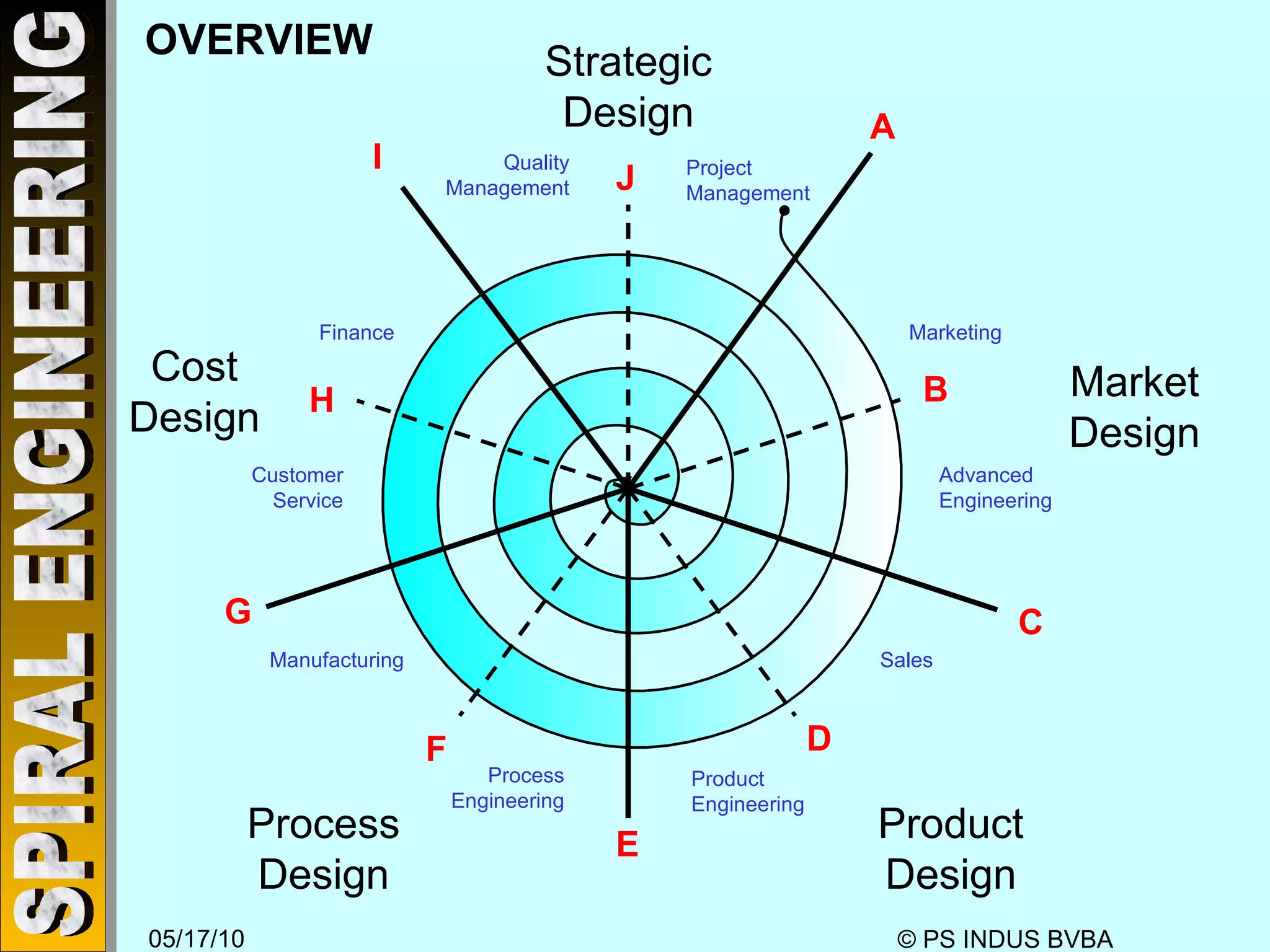
DEPARTMENT /SECTOR Strategic Design Market Design Product Design Process Design Cost Design Project Management Quality Management Marketing Finance Customer Service Manufacturing Process Engineering Product Engineering Sales Advanced Engineering
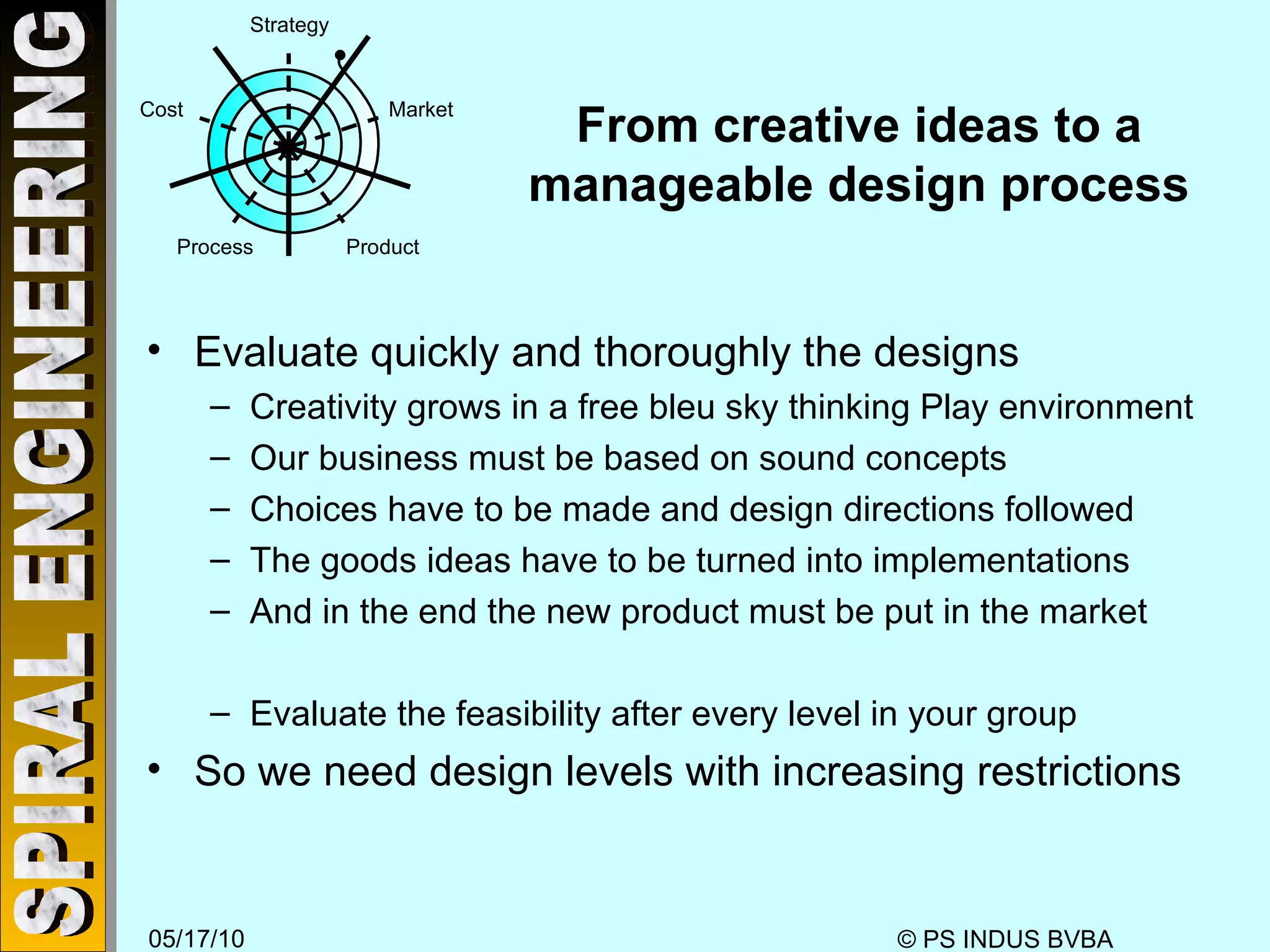
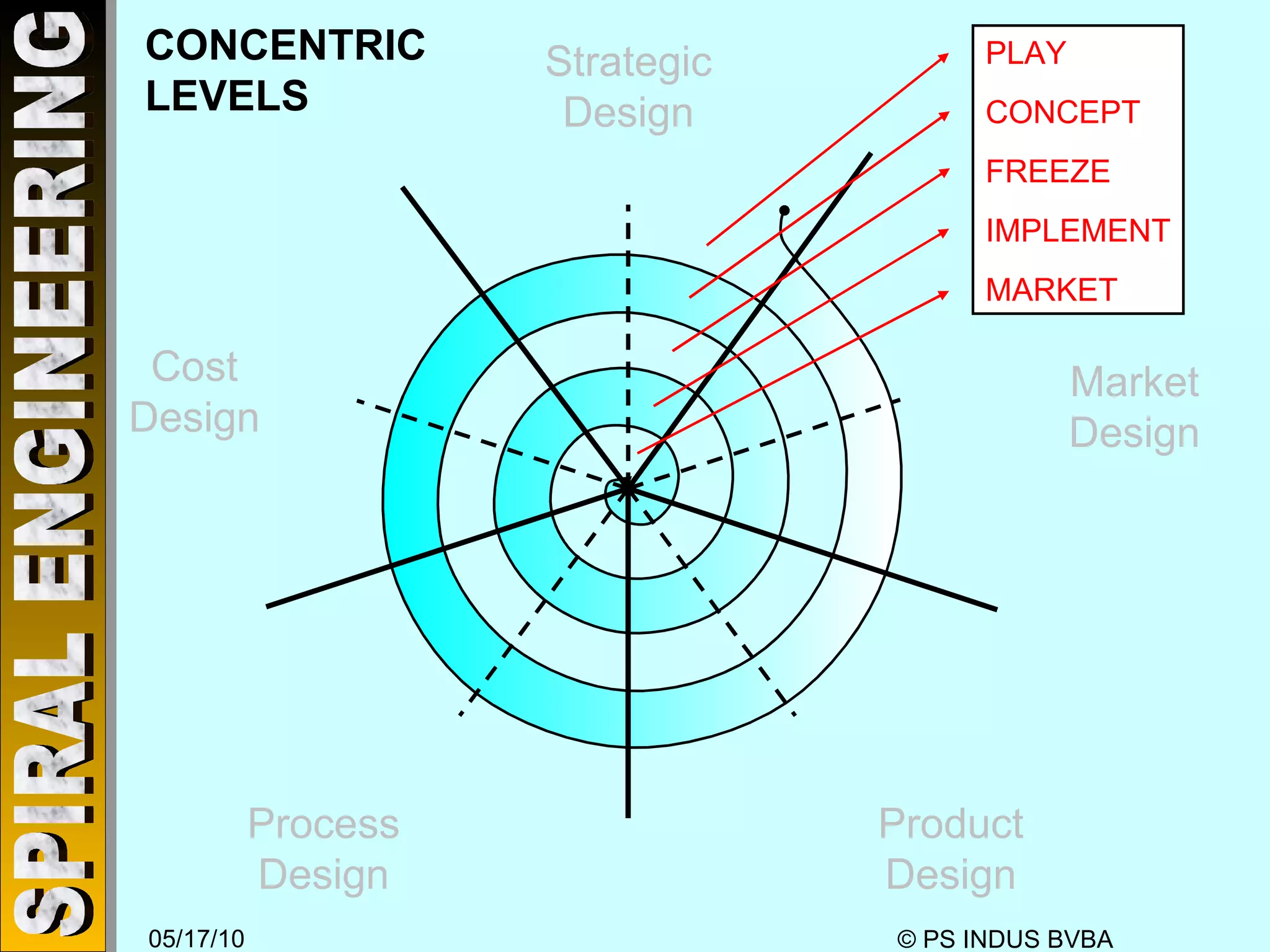
From creative ideas to a manageable design process Evaluate quickly and thoroughly the designs Creativity grows in a free bleu sky thinking Play environment Our business must be based on sound concepts Choices have to be made and design directions followed The goods ideas have to be turned into implementations And in the end the new product must be put in the market Evaluate the feasibility after every level in your group So we need design levels with increasing restrictions Strategy Market Product Process Cost
CONCENTRIC LEVELS Strategic Design Market Design Product Design Process Design Cost Design PLAY CONCEPT FREEZE IMPLEMENT MARKET
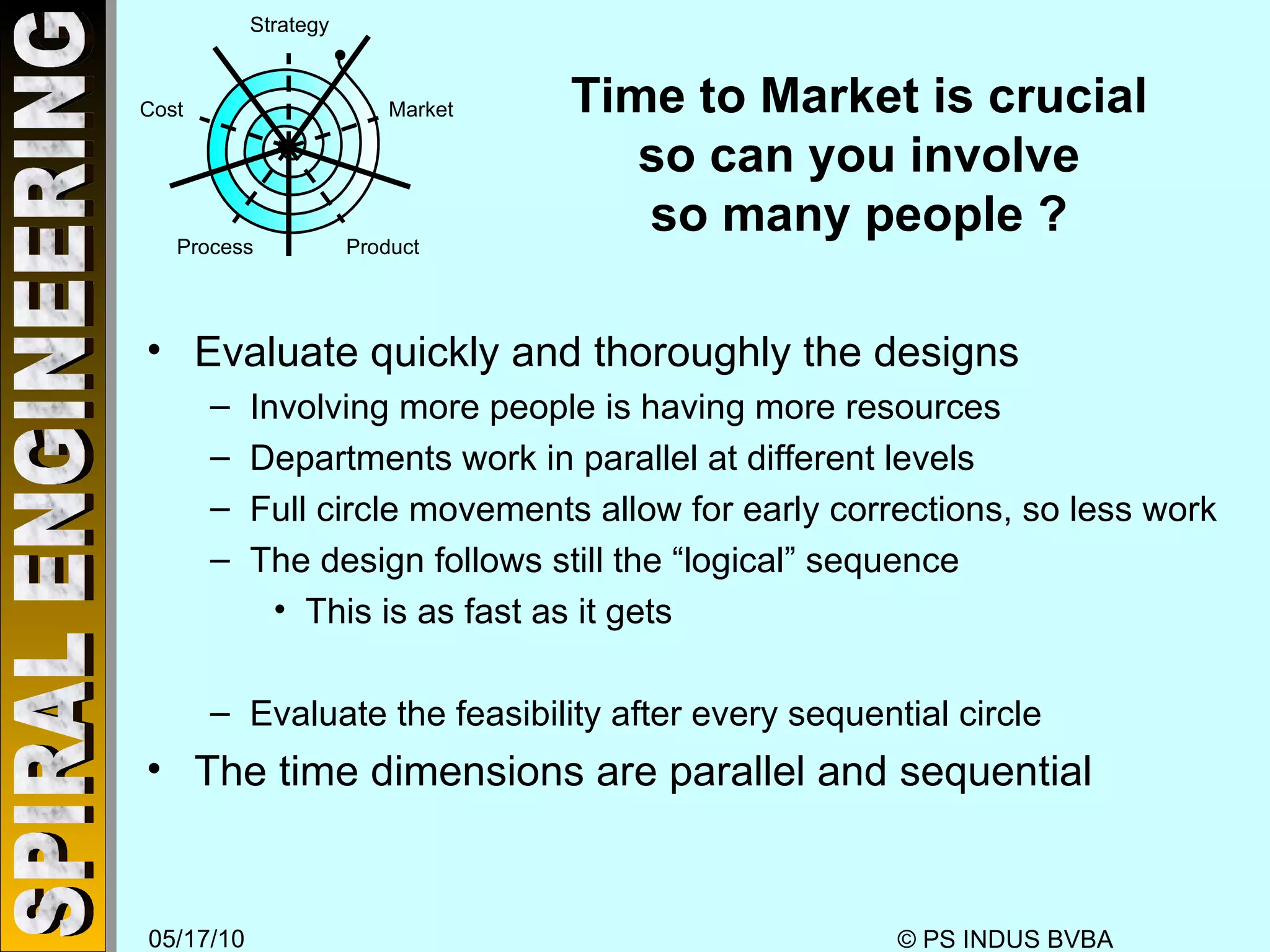
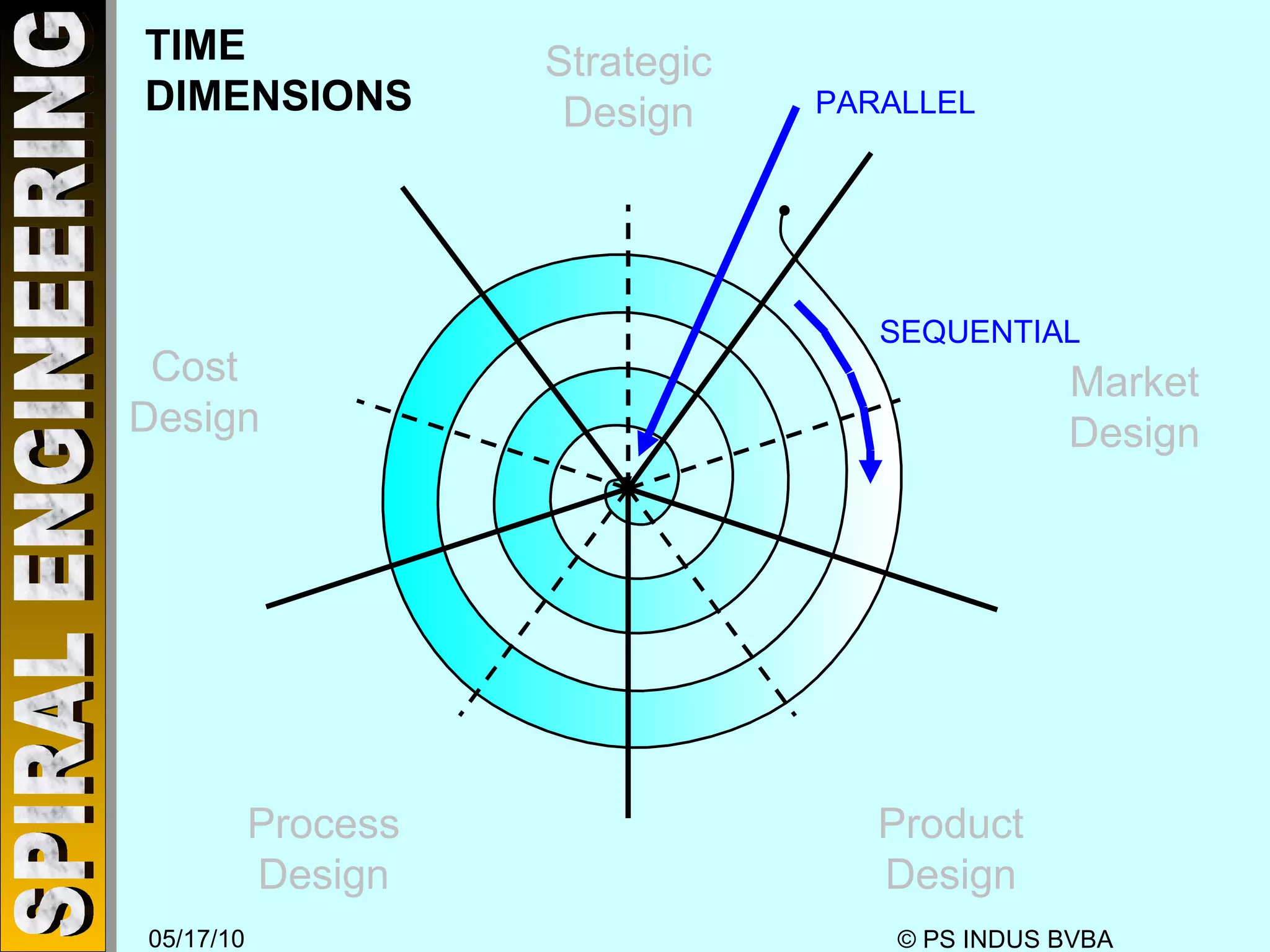
Time to Market is crucial so can you involve so many people ? Evaluate quickly and thoroughly the designs Involving more people is having more resources Departments work in parallel at different levels Full circle movements allow for early corrections, so less work The design follows still the “logical” sequence This is as fast as it gets Evaluate the feasibility after every sequential circle The time dimensions are parallel and sequential Strategy Market Product Process Cost
TIME DIMENSIONS Strategic Design Market Design Product Design Process Design Cost Design PARALLEL SEQUENTIAL
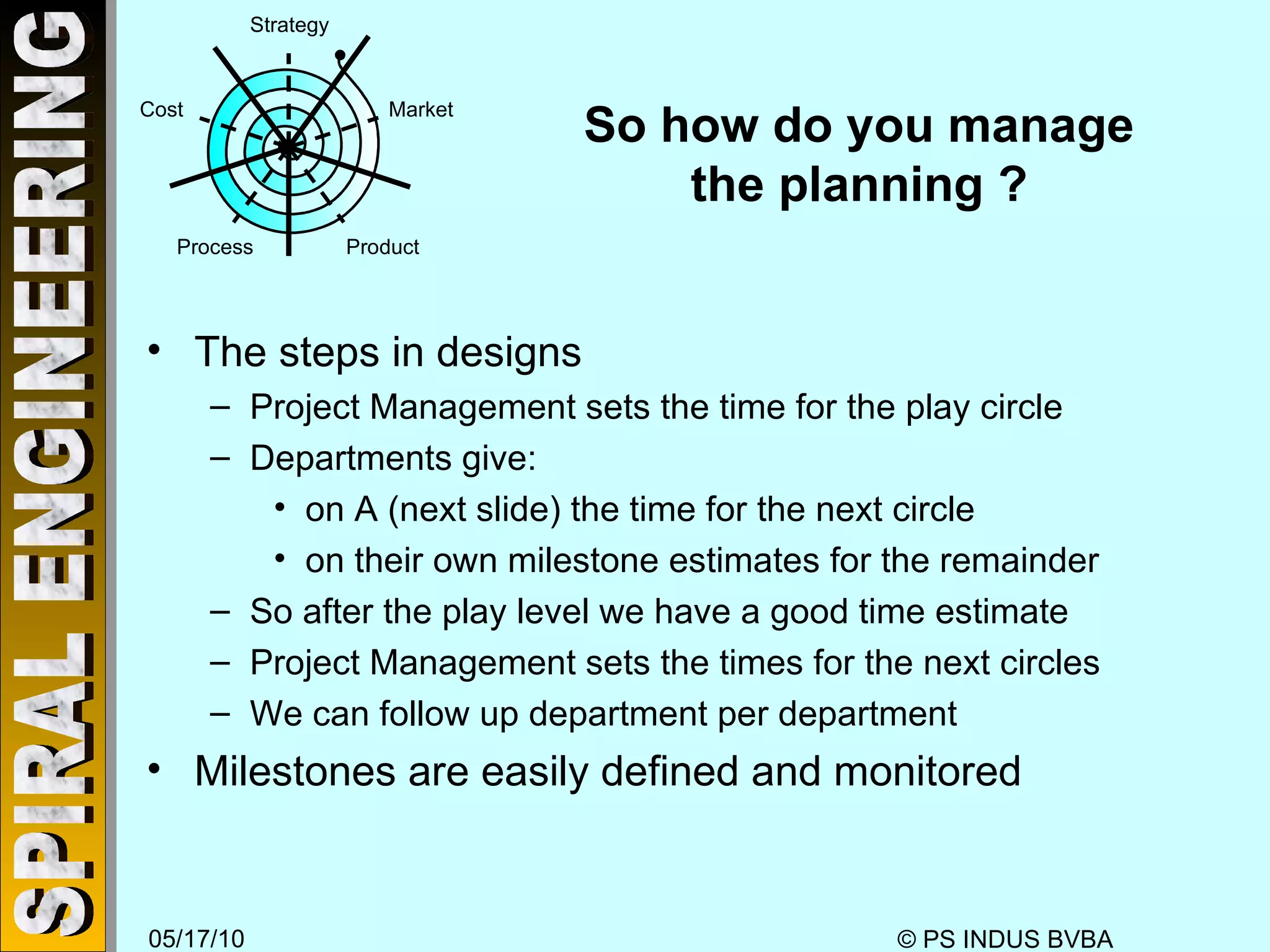
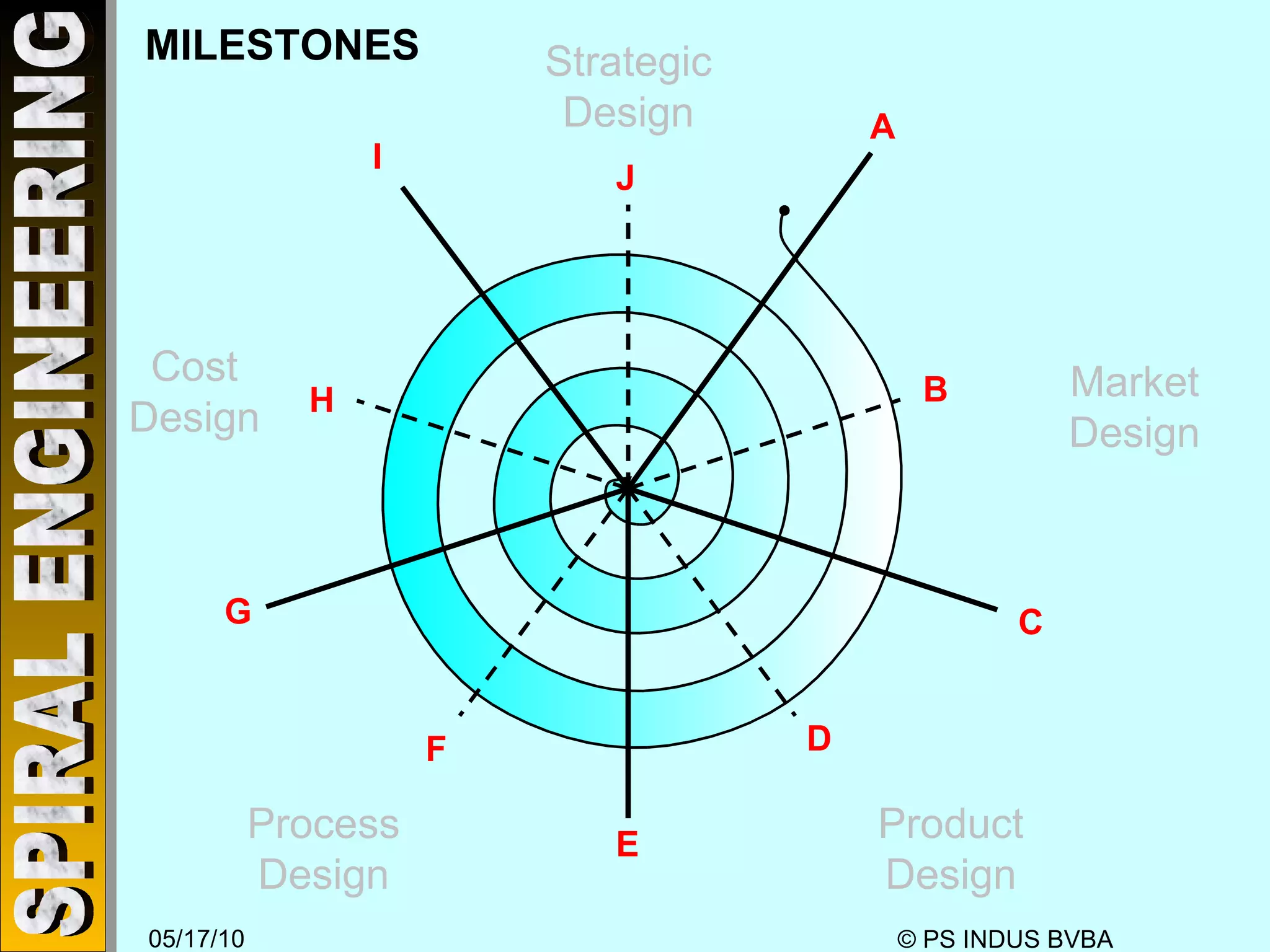
So how do you manage the planning ? The steps in designs Project Management sets the time for the play circle Departments give: on A (next slide) the time for the next circle on their own milestone estimates for the remainder So after the play level we have a good time estimate Project Management sets the times for the next circles We can follow up department per department Milestones are easily defined and monitored Strategy Market Product Process Cost
MILESTONES Strategic Design Market Design Product Design Process Design Cost Design A C B D E F G H I J
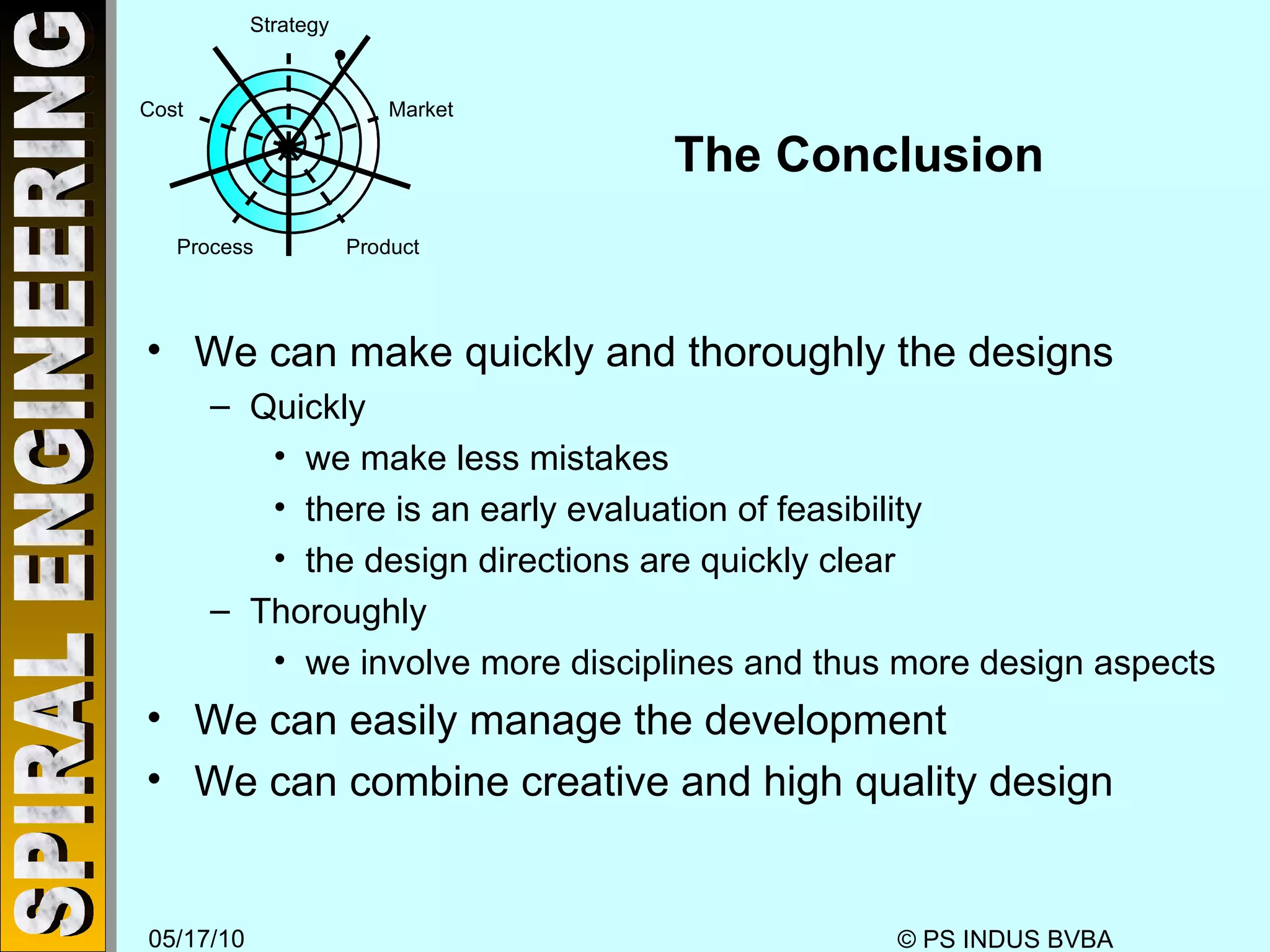
The Conclusion We can make quickly and thoroughly the designs Quickly we make less mistakes there is an early evaluation of feasibility the design directions are quickly clear Thoroughly we involve more disciplines and thus more design aspects We can easily manage the development We can combine creative and high quality design Strategy Market Product Process Cost
OVERVIEW Strategic Design Market Design Product Design Process Design Cost Design Project Management Quality Management Marketing Finance Customer Service Manufacturing Process Engineering Product Engineering Sales Advanced Engineering A C B D E F G H I J

Spiral Engineering V1.1

  • 1.
    Spiral Engineering Howto develop products that put you and your customer in a win-win situation Strategy Market Product Process Cost
  • 2.
    Some Reflections onproduct development What comes up in your mind with the words “product development” Improved technical functionality ? Sexy Product Market combinations ? Nicer looking Designs ? Creative ideas ? Engineering stuff ? But how about ? Develop a product to cost less Addressing flaws identified by customer service Reduce your Time to Market Manage the development process Integrate strategic thinking in the development process.
  • 3.
    Is Product DevelopmentTECHNICAL ? It is often seen as a technical discipline this is a narrow look the technical-commercial dimension is seen is the consideration of Product-Market combinations this is still a narrow look All departments have a relation with the product so why not involve them? Our Sales sell sheep with 5 feet at the wrong price that cannot be made
  • 4.
    Is Product DevelopmentCOMMERCIAL ? Make what the market wants this is also a narrow look does that market suit our strategy ? are you competitive here ? SWOT tells us what the technical guys must develop this is still a narrow look Does your customer pay for : low price, short delivery etc? no he takes that for granted ! No, our customer should say you improved my business My Competitors make products that can do this 20% below our price at half our delivery time
  • 5.
    Solutions to manageproduct development Sequential Engineering define the tasks from prototype to product execute these one after the other often: “development is an engineering discipline” Parallel Engineering execute the tasks simultaneously as far as possible often: “product-market combination development” Spiral Engineering Be quick and dirty in the beginning Detail out the product in parallel Involve departments with a relation to the product Be: “creative, thorough, manageable and fast”
  • 6.
    Solution 1 :SEQUENTIAL ENGINEERING Activity 1 Activity 2 Activity 3 Activity 4 Activity 5 Disadvantages - Time To Market is too long - Product requirements can change over time - no interactions between disciplines Advantages - logical sequence of activities - no double work, upstream activities done - easy to co-ordinate - activity driven nature Time To Market
  • 7.
    Solution 2 :PARALLELENGINEERING Activity 1 Activity 2 Activity 3 Activity 4 Activity 5 Disadvantages - Next activities based on “half finished info” - Difficult to co-ordinate - Still a sequential project nature Advantages - Improved time to market - Limited inter link between disciplines - Allows for responsiveness to requirement change - Activity driven nature Time To Market
  • 8.
    Solution 3 :SPIRAL ENGINEERING Disadvantages - Complex to co-ordinate - Requires training for participants Advantages - Improved time to market - Close relationship between disciplines - Forces responsiveness to requirement change - Both parallel and sequential - Logical sequence of development activities - High level of completeness Time To Market Strategy Market Product Process Cost
  • 9.
    The aspects ofDESIGN Some examples why products have more than just technical functions that need to be developed. The product should fit in the company strategy. Also the quality must be build in. It fulfils a certain market requirement, not all. Product performance at a certain price. Production simplicity Low cost nature Easy to service ... To manage these we discern DESIGN ASPECTS Strategy Market Product Process Cost
  • 10.
    DESIGN ASPECTS StrategicDesign Aspects Market Design Aspects Product Design Aspects Process Design Aspects Cost Design Aspects
  • 11.
    The Departments inthe design process Examples why every department has DESIGN INPUT A market analysis shows X potential. Customer Service knows the real flaws in our product Reduction in quality costs has made us competitive again New techniques can create new markets but also high costs It is not always the best technical product that wins Sell non-expensive features with high value for our customer ... So we locate the DEPARTMENTS per design aspect Strategy Market Product Process Cost
  • 12.
    DEPARTMENT /SECTOR StrategicDesign Market Design Product Design Process Design Cost Design Project Management Quality Management Marketing Finance Customer Service Manufacturing Process Engineering Product Engineering Sales Advanced Engineering
  • 13.
    From creative ideasto a manageable design process Evaluate quickly and thoroughly the designs Creativity grows in a free bleu sky thinking Play environment Our business must be based on sound concepts Choices have to be made and design directions followed The goods ideas have to be turned into implementations And in the end the new product must be put in the market Evaluate the feasibility after every level in your group So we need design levels with increasing restrictions Strategy Market Product Process Cost
  • 14.
    CONCENTRIC LEVELS StrategicDesign Market Design Product Design Process Design Cost Design PLAY CONCEPT FREEZE IMPLEMENT MARKET
  • 15.
    Time to Marketis crucial so can you involve so many people ? Evaluate quickly and thoroughly the designs Involving more people is having more resources Departments work in parallel at different levels Full circle movements allow for early corrections, so less work The design follows still the “logical” sequence This is as fast as it gets Evaluate the feasibility after every sequential circle The time dimensions are parallel and sequential Strategy Market Product Process Cost
  • 16.
    TIME DIMENSIONS StrategicDesign Market Design Product Design Process Design Cost Design PARALLEL SEQUENTIAL
  • 17.
    So how doyou manage the planning ? The steps in designs Project Management sets the time for the play circle Departments give: on A (next slide) the time for the next circle on their own milestone estimates for the remainder So after the play level we have a good time estimate Project Management sets the times for the next circles We can follow up department per department Milestones are easily defined and monitored Strategy Market Product Process Cost
  • 18.
    MILESTONES Strategic DesignMarket Design Product Design Process Design Cost Design A C B D E F G H I J
  • 19.
    The Conclusion Wecan make quickly and thoroughly the designs Quickly we make less mistakes there is an early evaluation of feasibility the design directions are quickly clear Thoroughly we involve more disciplines and thus more design aspects We can easily manage the development We can combine creative and high quality design Strategy Market Product Process Cost
  • 20.
    OVERVIEW Strategic DesignMarket Design Product Design Process Design Cost Design Project Management Quality Management Marketing Finance Customer Service Manufacturing Process Engineering Product Engineering Sales Advanced Engineering A C B D E F G H I J