1Jay Martin Month Year FileName.ppt
Date: May 2019
Presentation:
Chief Innovation
Jay Martin
Product Development
Random Slides
Product Development
Concepts & Cool Slides
2Jay Martin Month Year FileName.ppt
A typical Executive Team’s involvement in Product Development is
usually counter to the old adage “most bang for the buck.”
Product Development Management Attention and Influence
Knowledge
Acquisition
Concept
Investigation
Basic Design
Prototype
Building
Pilot
Production
Manufacturing
Ramp-up
Ability to Influence
the Outcome
Actual
Management
Activity Profile
Source: Wheelwright and Clark, Revolutionizing Product Development, Free Press, Page 33.
3Jay Martin Month Year FileName.ppt
The amount of effort for a project is a function of the level of change.
Product Development Four Types of Projects
Here you can see the complexity of the New Product challenge go up
with change, which is also a reflection of time and resources needed.
Derivative
(Enhancements, Hybrids, and
Cost Reduced Versions)
Breakthrough
or Radical
Platform or
Next Generation
Product Changes
Process Changes
New Core Product
Next-Generation
Product
Add-ons and
Enhancements
Addition to Product
Family
New Core
Process
Next-
Generation
Process
Single
Department
Upgrade
Tuning and
Incremental
Research and
Advanced
Development
(outside of box)
Source: Wheelwright and Clark, Revolutionizing Product Development, Free Press, Page 93.
4Jay Martin Month Year FileName.ppt
Below are the four major metrics for a Product Development initiative,
along with descriptions of the trade-offs possible between each.
Product Development The Six Trade-Offs
With these in mind, we can decide at the start exactly what the
optimal balance is, and adjust our actions during the process.
1
2
Developmen
t Speed
Product
Cost
Product
Performanc
e
Developmen
t Program
Expense
1
2
3
4
5
6
Speed vs. Performance
Spending more time in the process
to develop a superior product.
Speed vs. Product Cost
To invest development time to
reduce unit cost via DFM, etc..
Speed vs. Expenses
Load resources into areas to
shorten development time.
Performance vs. Cost
To include those attributes that
achieve optimize cost/performance.
Performance vs. Expenses
Invest more development resources
into creating a superior product.
Product Cost vs. Expenses
Invest more development resources
into creating a cheaper product.
3
34
4
5
6
Source: Smith and Reinertsen, Developing Products in Half the Time, VNR Publishing, Page 22.
5Jay Martin Month Year FileName.ppt
There are some general rules to abide by in writing Specifications for
a speedy development process.
Product Development Specification Writing
• Involve Customer(s) and User(s)
• Focus on Product Benefits, not just Features
• Do NOT restrict design options
• Involve ALL functions in the trade-offs
• Identify and deal with crucial factors
The book sourced below has an entire chapter dealing with the
importance of writing specs, but is not that comprehensive.
Source: Smith and Reinertsen, Developing Products in Half the Time, VNR Publishing.
6Jay Martin Month Year FileName.ppt
In resources planning, you must remember that the function
participation will gradually change from Concept to Introduction.
Product Development Assigning Resources
Staffing
Level
Manufacturing
Engineering
Marketing
Product
Concept
Product
Introduction
Source: Smith and Reinertsen, Developing Products in Half the Time, VNR Publishing, Page 162.
7Jay Martin Month Year FileName.ppt
Managing Risk in Product Development is covered in Chapter 12 of
the book below, but is not the only viewpoint from which to analyze.
Risk Management Types of Risk
• Two types of risk
1. Technical Risk – is the probability of failing to meet the performance, cost or
schedule targets of the specification. Poor technical execution, missing target.
• Technology fails to perform as expected
• Cost exceeding projections
• Unanticipated side effects that arise from a particular technical approach
• . . . . .these almost always result in a schedule delay!
2. Market Risk – is the probability of not meeting the needs of the market,
assuming that the specification has been satisfied. Selecting wrong target. To
reduce this: increase customer involvement, reduce dCT and stay flexible on
unresolved issues
Source: Smith and Reinertsen, Developing Products in Half the Time, VNR Publishing, Page 214.
We can also consider slicing risk as Schedule, Cost and Performance
risks to a Product Development initiative.
8Jay Martin Month Year FileName.ppt
High technical risk can delay a project, which in turn increases its
market risk.
Risk Management Technical and Market inter-relation
Development
schedule
delays
Reviews, testing, etc. to
control risk
Market
Risk
Technical
Risk
Time to fix
problems
Source: Smith and Reinertsen, Developing Products in Half the Time, VNR Publishing, Page 214.
9Jay Martin Month Year FileName.ppt
Techniques for Controlling Risk
Risk Management Controlling Risk
These are all spelled out more in detail in the book sourced below.
• Provide focus to management’s attention
• Work concurrently on Technical and Market Risk issues
• Maintain back-up positions
• In weak areas, Model and Test
Source: Smith and Reinertsen, Developing Products in Half the Time, VNR Publishing.
10Jay Martin Month Year FileName.ppt
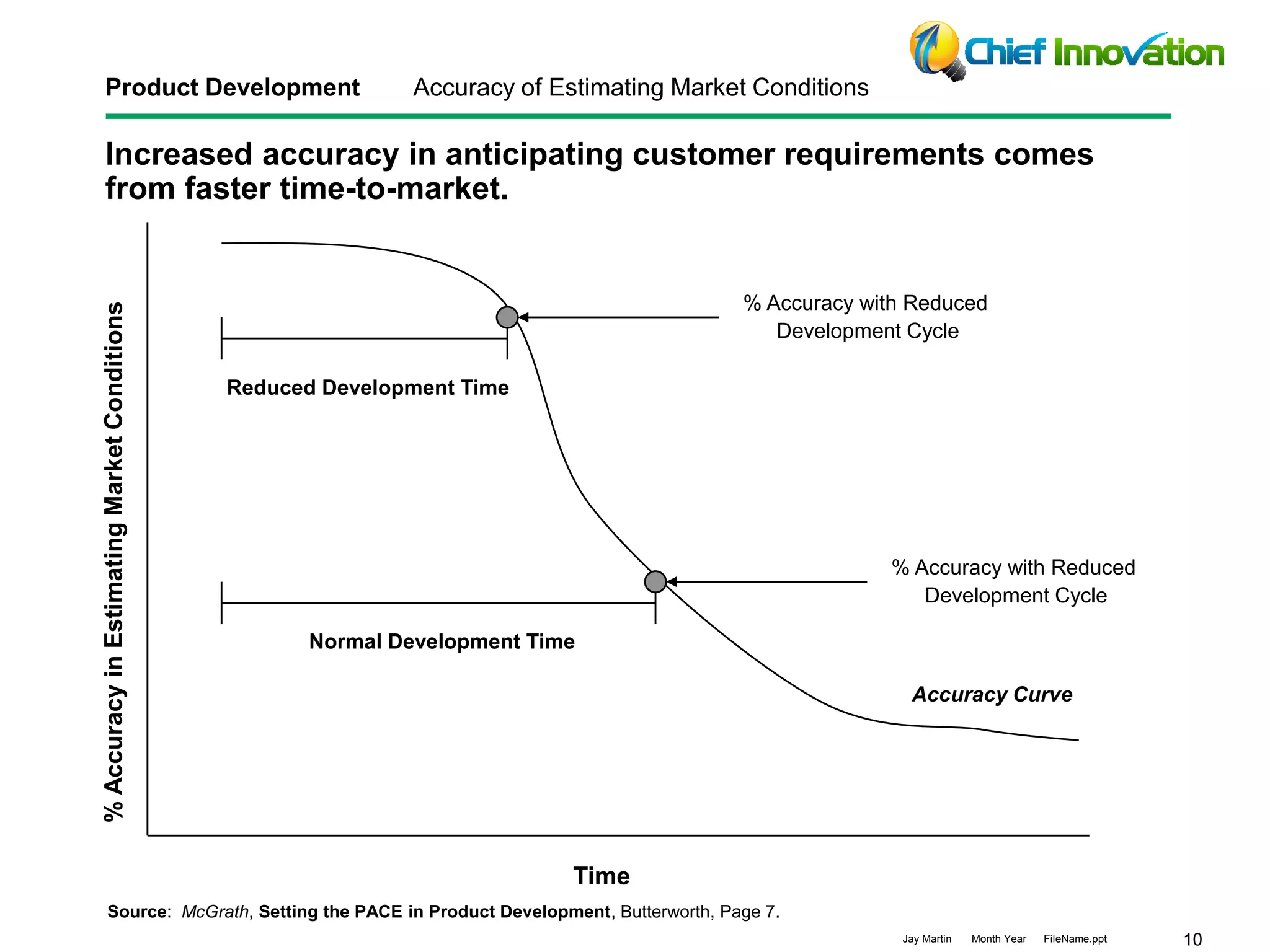
Increased accuracy in anticipating customer requirements comes
from faster time-to-market.
Product Development Accuracy of Estimating Market Conditions
Reduced Development Time
Normal Development Time
Accuracy Curve
% Accuracy with Reduced
Development Cycle
% Accuracy with Reduced
Development Cycle
Source: McGrath, Setting the PACE in Product Development, Butterworth, Page 7.
Time
%AccuracyinEstimatingMarketConditions
11Jay Martin Month Year FileName.ppt
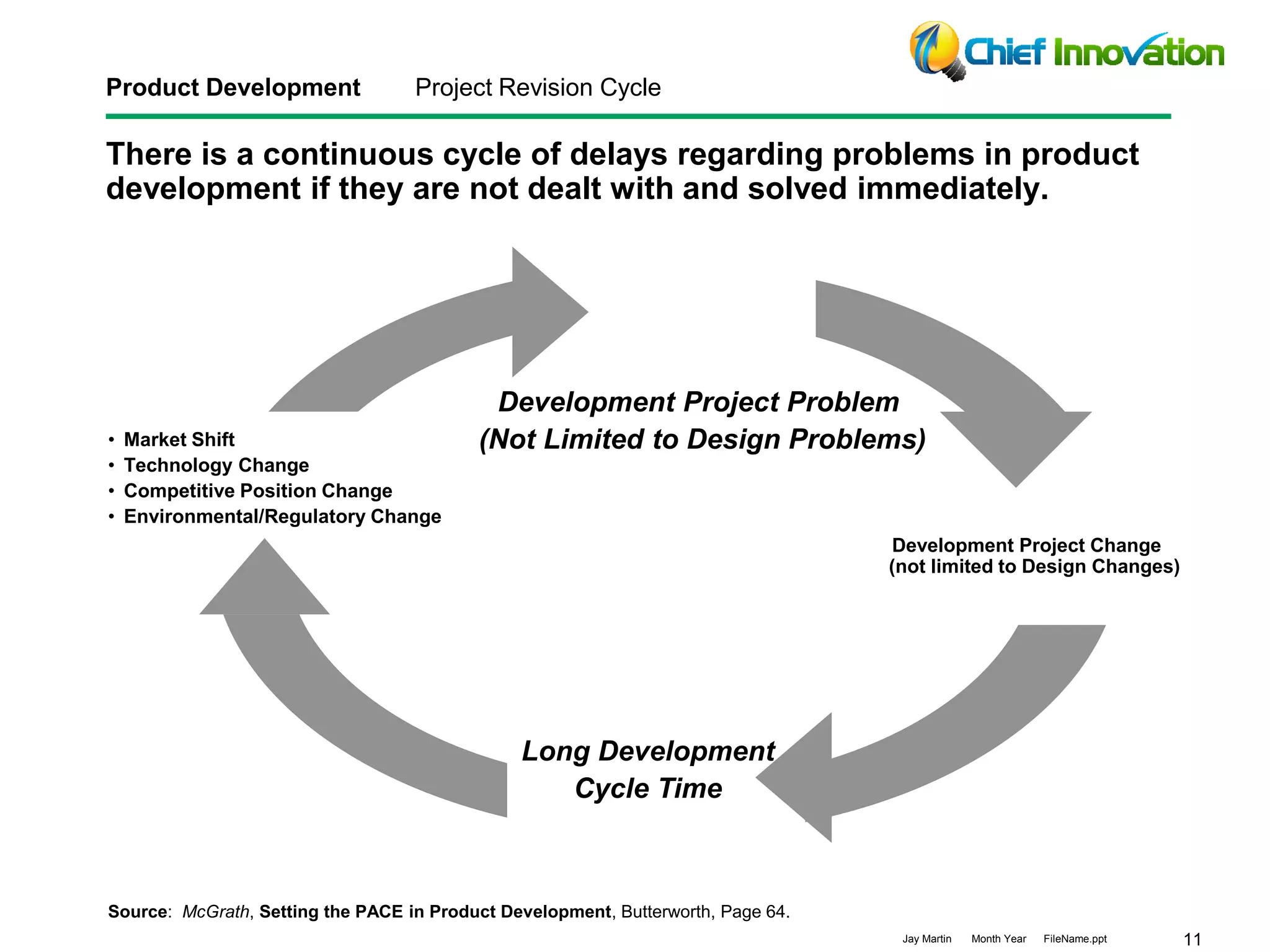
There is a continuous cycle of delays regarding problems in product
development if they are not dealt with and solved immediately.
Product Development Project Revision Cycle
Source: McGrath, Setting the PACE in Product Development, Butterworth, Page 64.
Long Development
Cycle Time
Development Project Problem
(Not Limited to Design Problems)• Market Shift
• Technology Change
• Competitive Position Change
• Environmental/Regulatory Change
Development Project Change
(not limited to Design Changes)
12Jay Martin Month Year FileName.ppt
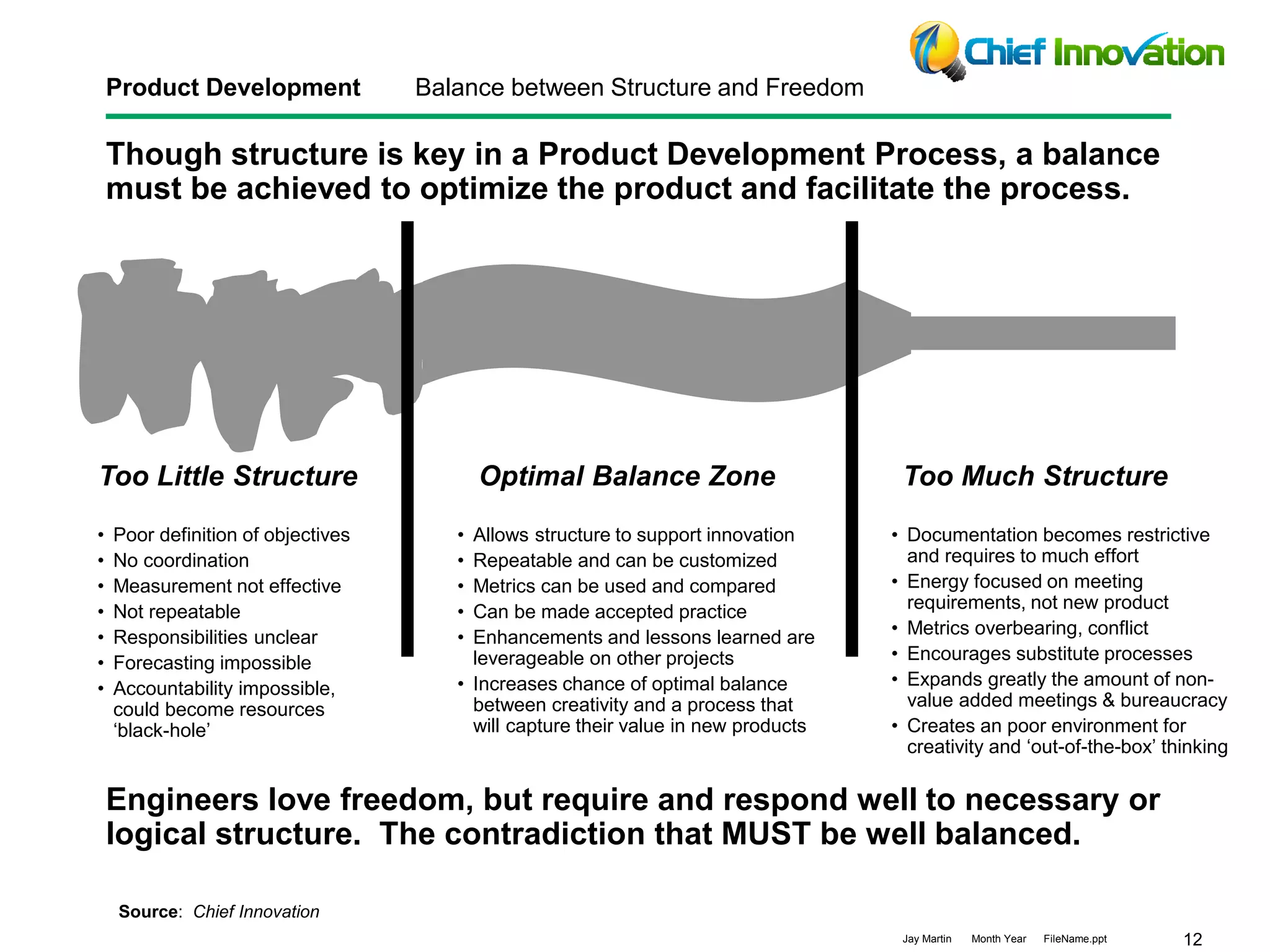
Though structure is key in a Product Development Process, a balance
must be achieved to optimize the product and facilitate the process.
Product Development Balance between Structure and Freedom
Engineers love freedom, but require and respond well to necessary or
logical structure. The contradiction that MUST be well balanced.
Too Little Structure Optimal Balance Zone Too Much Structure
• Poor definition of objectives
• No coordination
• Measurement not effective
• Not repeatable
• Responsibilities unclear
• Forecasting impossible
• Accountability impossible,
could become resources
‘black-hole’
• Allows structure to support innovation
• Repeatable and can be customized
• Metrics can be used and compared
• Can be made accepted practice
• Enhancements and lessons learned are
leverageable on other projects
• Increases chance of optimal balance
between creativity and a process that
will capture their value in new products
• Documentation becomes restrictive
and requires to much effort
• Energy focused on meeting
requirements, not new product
• Metrics overbearing, conflict
• Encourages substitute processes
• Expands greatly the amount of non-
value added meetings & bureaucracy
• Creates an poor environment for
creativity and ‘out-of-the-box’ thinking
Source: Chief Innovation
13Jay Martin Month Year FileName.ppt
Concurrent Engineering is meeting customer expectations by. . .
Product Development Concurrent Engineering
. . . the ending of ‘over the wall’ processes in Product Development.
. . . the early possible integration of the overall company’s knowledge, resources and
experience in:
• Design
• Development
• Marketing
• Manufacturing
• Sales
Source: Thomas Group
14Jay Martin Month Year FileName.ppt
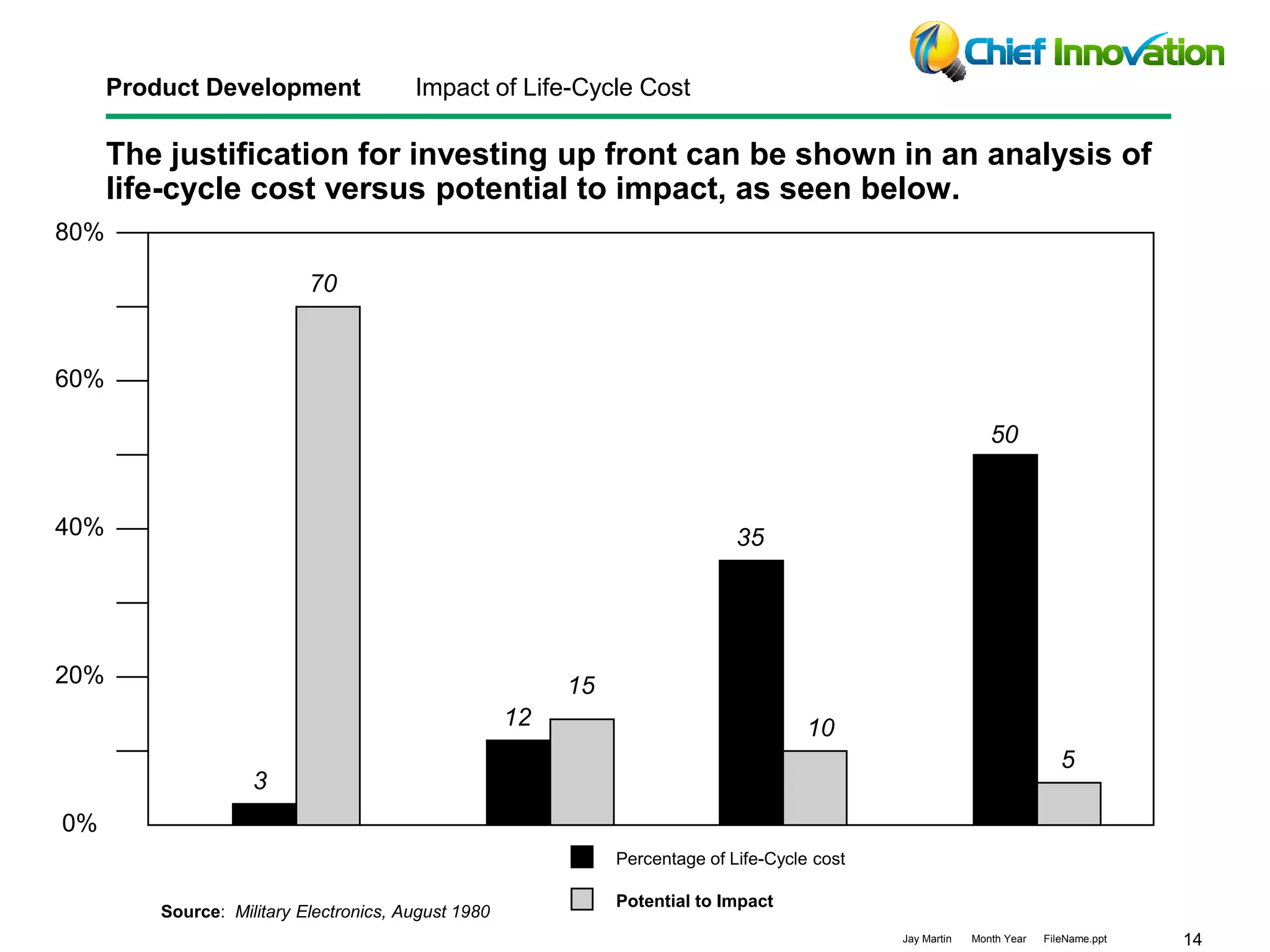
The justification for investing up front can be shown in an analysis of
life-cycle cost versus potential to impact, as seen below.
Product Development Impact of Life-Cycle Cost
Source: Military Electronics, August 1980
20%
0%
40%
60%
80%
3
70
12
15
35
10
50
5
Percentage of Life-Cycle cost
Potential to Impact
15Jay Martin Month Year FileName.ppt
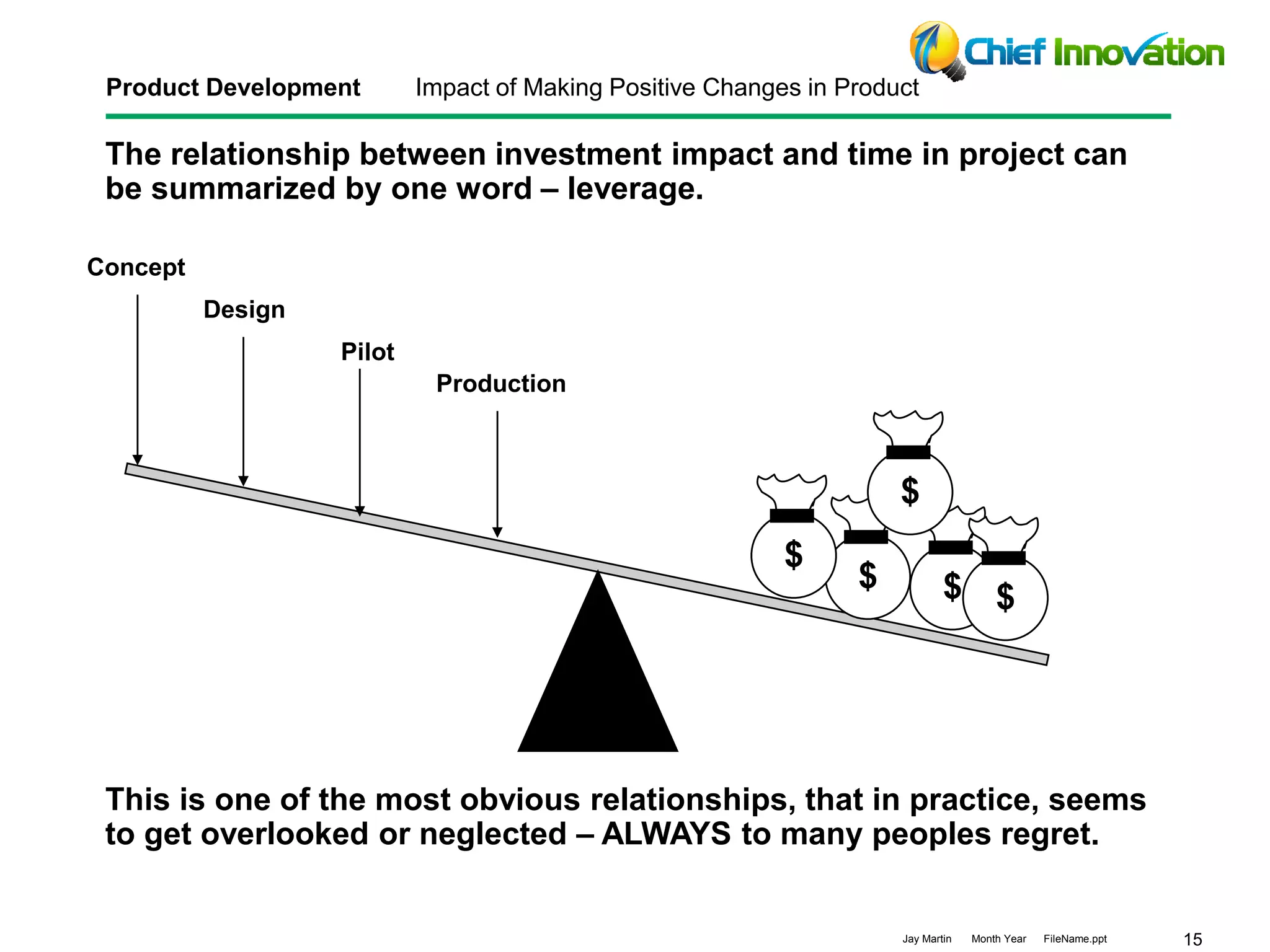
The relationship between investment impact and time in project can
be summarized by one word – leverage.
Product Development Impact of Making Positive Changes in Product
This is one of the most obvious relationships, that in practice, seems
to get overlooked or neglected – ALWAYS to many peoples regret.
Concept
Design
Pilot
Production
$ $
$
$
$
16Jay Martin Month Year FileName.ppt
Below you can see the impact on offering different performance
products to the market and the impact the ‘time’ has on their price.
Product Development Typical Price Performance Curves
Source: Shina “Concurrent Engineering & DFM for Electronic Products”, Page 28, Figure 2.2, Van Nostrand Reinhold.
TIME
PRICE
HI
MED
LO
A
A
B
B
B
In A, we see to obtain the same price in the
market, we would need to increase
performance level as time goes on.
In B, we see that for the same performance
level product, that the price we can obtain
declines as introduction moves out.

Product Development Concepts

  • 1.
    1Jay Martin MonthYear FileName.ppt Date: May 2019 Presentation: Chief Innovation Jay Martin Product Development Random Slides Product Development Concepts & Cool Slides
  • 2.
    2Jay Martin MonthYear FileName.ppt A typical Executive Team’s involvement in Product Development is usually counter to the old adage “most bang for the buck.” Product Development Management Attention and Influence Knowledge Acquisition Concept Investigation Basic Design Prototype Building Pilot Production Manufacturing Ramp-up Ability to Influence the Outcome Actual Management Activity Profile Source: Wheelwright and Clark, Revolutionizing Product Development, Free Press, Page 33.
  • 3.
    3Jay Martin MonthYear FileName.ppt The amount of effort for a project is a function of the level of change. Product Development Four Types of Projects Here you can see the complexity of the New Product challenge go up with change, which is also a reflection of time and resources needed. Derivative (Enhancements, Hybrids, and Cost Reduced Versions) Breakthrough or Radical Platform or Next Generation Product Changes Process Changes New Core Product Next-Generation Product Add-ons and Enhancements Addition to Product Family New Core Process Next- Generation Process Single Department Upgrade Tuning and Incremental Research and Advanced Development (outside of box) Source: Wheelwright and Clark, Revolutionizing Product Development, Free Press, Page 93.
  • 4.
    4Jay Martin MonthYear FileName.ppt Below are the four major metrics for a Product Development initiative, along with descriptions of the trade-offs possible between each. Product Development The Six Trade-Offs With these in mind, we can decide at the start exactly what the optimal balance is, and adjust our actions during the process. 1 2 Developmen t Speed Product Cost Product Performanc e Developmen t Program Expense 1 2 3 4 5 6 Speed vs. Performance Spending more time in the process to develop a superior product. Speed vs. Product Cost To invest development time to reduce unit cost via DFM, etc.. Speed vs. Expenses Load resources into areas to shorten development time. Performance vs. Cost To include those attributes that achieve optimize cost/performance. Performance vs. Expenses Invest more development resources into creating a superior product. Product Cost vs. Expenses Invest more development resources into creating a cheaper product. 3 34 4 5 6 Source: Smith and Reinertsen, Developing Products in Half the Time, VNR Publishing, Page 22.
  • 5.
    5Jay Martin MonthYear FileName.ppt There are some general rules to abide by in writing Specifications for a speedy development process. Product Development Specification Writing • Involve Customer(s) and User(s) • Focus on Product Benefits, not just Features • Do NOT restrict design options • Involve ALL functions in the trade-offs • Identify and deal with crucial factors The book sourced below has an entire chapter dealing with the importance of writing specs, but is not that comprehensive. Source: Smith and Reinertsen, Developing Products in Half the Time, VNR Publishing.
  • 6.
    6Jay Martin MonthYear FileName.ppt In resources planning, you must remember that the function participation will gradually change from Concept to Introduction. Product Development Assigning Resources Staffing Level Manufacturing Engineering Marketing Product Concept Product Introduction Source: Smith and Reinertsen, Developing Products in Half the Time, VNR Publishing, Page 162.
  • 7.
    7Jay Martin MonthYear FileName.ppt Managing Risk in Product Development is covered in Chapter 12 of the book below, but is not the only viewpoint from which to analyze. Risk Management Types of Risk • Two types of risk 1. Technical Risk – is the probability of failing to meet the performance, cost or schedule targets of the specification. Poor technical execution, missing target. • Technology fails to perform as expected • Cost exceeding projections • Unanticipated side effects that arise from a particular technical approach • . . . . .these almost always result in a schedule delay! 2. Market Risk – is the probability of not meeting the needs of the market, assuming that the specification has been satisfied. Selecting wrong target. To reduce this: increase customer involvement, reduce dCT and stay flexible on unresolved issues Source: Smith and Reinertsen, Developing Products in Half the Time, VNR Publishing, Page 214. We can also consider slicing risk as Schedule, Cost and Performance risks to a Product Development initiative.
  • 8.
    8Jay Martin MonthYear FileName.ppt High technical risk can delay a project, which in turn increases its market risk. Risk Management Technical and Market inter-relation Development schedule delays Reviews, testing, etc. to control risk Market Risk Technical Risk Time to fix problems Source: Smith and Reinertsen, Developing Products in Half the Time, VNR Publishing, Page 214.
  • 9.
    9Jay Martin MonthYear FileName.ppt Techniques for Controlling Risk Risk Management Controlling Risk These are all spelled out more in detail in the book sourced below. • Provide focus to management’s attention • Work concurrently on Technical and Market Risk issues • Maintain back-up positions • In weak areas, Model and Test Source: Smith and Reinertsen, Developing Products in Half the Time, VNR Publishing.
  • 10.
    10Jay Martin MonthYear FileName.ppt Increased accuracy in anticipating customer requirements comes from faster time-to-market. Product Development Accuracy of Estimating Market Conditions Reduced Development Time Normal Development Time Accuracy Curve % Accuracy with Reduced Development Cycle % Accuracy with Reduced Development Cycle Source: McGrath, Setting the PACE in Product Development, Butterworth, Page 7. Time %AccuracyinEstimatingMarketConditions
  • 11.
    11Jay Martin MonthYear FileName.ppt There is a continuous cycle of delays regarding problems in product development if they are not dealt with and solved immediately. Product Development Project Revision Cycle Source: McGrath, Setting the PACE in Product Development, Butterworth, Page 64. Long Development Cycle Time Development Project Problem (Not Limited to Design Problems)• Market Shift • Technology Change • Competitive Position Change • Environmental/Regulatory Change Development Project Change (not limited to Design Changes)
  • 12.
    12Jay Martin MonthYear FileName.ppt Though structure is key in a Product Development Process, a balance must be achieved to optimize the product and facilitate the process. Product Development Balance between Structure and Freedom Engineers love freedom, but require and respond well to necessary or logical structure. The contradiction that MUST be well balanced. Too Little Structure Optimal Balance Zone Too Much Structure • Poor definition of objectives • No coordination • Measurement not effective • Not repeatable • Responsibilities unclear • Forecasting impossible • Accountability impossible, could become resources ‘black-hole’ • Allows structure to support innovation • Repeatable and can be customized • Metrics can be used and compared • Can be made accepted practice • Enhancements and lessons learned are leverageable on other projects • Increases chance of optimal balance between creativity and a process that will capture their value in new products • Documentation becomes restrictive and requires to much effort • Energy focused on meeting requirements, not new product • Metrics overbearing, conflict • Encourages substitute processes • Expands greatly the amount of non- value added meetings & bureaucracy • Creates an poor environment for creativity and ‘out-of-the-box’ thinking Source: Chief Innovation
  • 13.
    13Jay Martin MonthYear FileName.ppt Concurrent Engineering is meeting customer expectations by. . . Product Development Concurrent Engineering . . . the ending of ‘over the wall’ processes in Product Development. . . . the early possible integration of the overall company’s knowledge, resources and experience in: • Design • Development • Marketing • Manufacturing • Sales Source: Thomas Group
  • 14.
    14Jay Martin MonthYear FileName.ppt The justification for investing up front can be shown in an analysis of life-cycle cost versus potential to impact, as seen below. Product Development Impact of Life-Cycle Cost Source: Military Electronics, August 1980 20% 0% 40% 60% 80% 3 70 12 15 35 10 50 5 Percentage of Life-Cycle cost Potential to Impact
  • 15.
    15Jay Martin MonthYear FileName.ppt The relationship between investment impact and time in project can be summarized by one word – leverage. Product Development Impact of Making Positive Changes in Product This is one of the most obvious relationships, that in practice, seems to get overlooked or neglected – ALWAYS to many peoples regret. Concept Design Pilot Production $ $ $ $ $
  • 16.
    16Jay Martin MonthYear FileName.ppt Below you can see the impact on offering different performance products to the market and the impact the ‘time’ has on their price. Product Development Typical Price Performance Curves Source: Shina “Concurrent Engineering & DFM for Electronic Products”, Page 28, Figure 2.2, Van Nostrand Reinhold. TIME PRICE HI MED LO A A B B B In A, we see to obtain the same price in the market, we would need to increase performance level as time goes on. In B, we see that for the same performance level product, that the price we can obtain declines as introduction moves out.