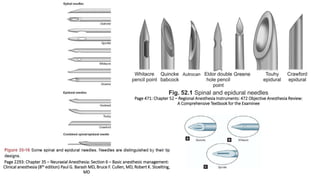
Page 2293: Chapter 35 – Neuraxial Anesthesia: Section 6 – Basic anesthesic management:
Clinical anesthesia (8th edition) Paul G. Barash MD, Bruce F. Cullen, MD, Robert K. Stoelting,
MD
Fig. 52.1 Spinal and epidural needles
Page 471: Chapter 52 – Regional Anesthesia Instruments: 472 Objective Anesthesia Review:
A Comprehensive Textbook for the Examinee
Page 415: Chapter 40 – Spinal, Epidural, and Combined Spinal–Epidural Anesthesia: Understanding Anesthetic Equipment & Procedures A Practical Approach:
Dwarkadas K Baheti MD
Fig. 7 Sprotte, Whitacre and
Quincke
spinal needles
Fig. 8 Sprottes spinal needle with introducer

Spinal needle pic.pptx

  • 1.
    Page 2293: Chapter35 – Neuraxial Anesthesia: Section 6 – Basic anesthesic management: Clinical anesthesia (8th edition) Paul G. Barash MD, Bruce F. Cullen, MD, Robert K. Stoelting, MD Fig. 52.1 Spinal and epidural needles Page 471: Chapter 52 – Regional Anesthesia Instruments: 472 Objective Anesthesia Review: A Comprehensive Textbook for the Examinee
  • 2.
    Page 415: Chapter40 – Spinal, Epidural, and Combined Spinal–Epidural Anesthesia: Understanding Anesthetic Equipment & Procedures A Practical Approach: Dwarkadas K Baheti MD Fig. 7 Sprotte, Whitacre and Quincke spinal needles Fig. 8 Sprottes spinal needle with introducer

Editor's Notes

  • #2 3 parts: hub, cannula ending in a tip, stylet Hub: stabilize the needle and has a pointer as aguide to the insert the bevel correctly during the procedure. All needles should have fitting removable stylet that completely occludes distal lumen and tip of cannula to avoid tracking epithelial cells into the subarachnoid space. Tip of cannula usually are made of stainless steel and have stiffness,flexibility ,resistance to prevent breakage Various sizes (from 16G to 30G): The luminal size of the cannula decreases as the size of the needle increases. Hence, bigger gauge needle have finer luminal opening which caries less chances of PDPH. Gauge of SN and colour coding 18 G – Pink 19 G - Ivory 20 G – Yellow 21 G- green 22 G - Black 23 G –Blue 25 G – Orange 26 G - Brown Various lengths: 3½–4 inches (8–10 cm) and 15 cm in obese patients. They can have sharp or blunt tip with either end injection or side injection and either sharp or blunt bevel edges. Spinal needle tip Types: Sharp/Dura cutting tip: Quincke-babcock &pitkin needle Blunt/ Dura splitting : whitacre & sporte, greene Side or end injection End inj: Quincke, pitkin, greene Side injection: Whitacre, sprotte Quincke-Babcock Spinal Needle • It is considered standard spinal needle • Consists of a small hub and sharp point with a medium length cutting bevel, end injection needle • There is fitted stylet with a matching bevelled tip. Luer-lock connector. Luer-lock: ensures the needle attached remains secured throughout the drug administration process. (tabbed hub on the female fitting which screws into threads in a sleeve on the male fitting.) 10. • PITKIN NEEDLE-it is cutting short sharp bevelled needle, pointed end injection. The stylet also has a short bevel and fits the tip of the cannula. Dura-splitting • GREENE NEEDLE- It has a small hub with non-cutting edges to the bevel which is of medium length. The stylet has a rounded tip to fill the opening point of the cannula. 8. Whitacre needle • pencil point type of bevel • No cutting edges • Orfice on one side 2.5mm proximal to tip • Saperates the fibres • (Exit port smaller than lumen,so great resistance is noted while giving the drug) 9. Sprotte needle • Blunt/non-cutting edge, side-injection needle with a long opening. • It has the advantage of more vigorous CSF flow compared with similar gauge needles. • However, this can lead to a failed block if the distal part of the opening is subarachnoid (with free flow CSF), the proximal part is not past the dura, and the full dose of medication is not delivered The use larger needles improves the tactile sense of needle placement. • The use of small needles reduces the incidence of post–spinal puncture headache
  • #3 Spinal introducers: They are used for the introduction of fine spinal needles. • They avoid bending and breaking of fine spinal needles. • There are less chances of infection from skin and subcutaneous tissue entering via the tip of fine spinal needles. Types of Introducers • Sise introducer—2 inches length (In 1910, Lincoln F Sise invented it) • Corning introducer • Lundy introducer.