templateversion1.0
HRM AND LEADERSHIP FOR GROWTH
Module Presentation
TRAINING OBJECTIVES AND CONTENTS
| 2
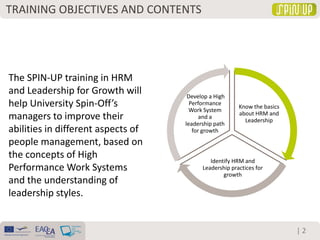
The SPIN-UP training in HRM
and Leadership for Growth will
help University Spin-Off’s
managers to improve their
abilities in different aspects of
people management, based on
the concepts of High
Performance Work Systems
and the understanding of
leadership styles.
Know the basics
about HRM and
Leadership
Identify HRM and
Leadership practices for
growth
Develop a High
Performance
Work System
and a
leadership path
for growth
| 3
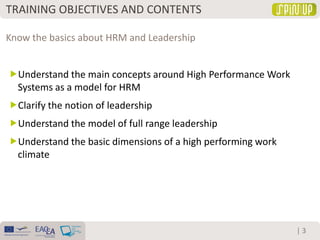
Understand the main concepts around High Performance Work
Systems as a model for HRM
Clarify the notion of leadership
Understand the model of full range leadership
Understand the basic dimensions of a high performing work
climate
Know the basics about HRM and Leadership
TRAINING OBJECTIVES AND CONTENTS
| 4
Know how a HPWS can support entrepreneurial growth
Understand the impact of different leadership styles on work
climate and entrepreneurial growth
Identifying HRM and Leadership practices for growth
TRAINING OBJECTIVES AND CONTENTS
• 1. training objectives and contents
| 5
Be able to apply the concepts of HPWS to own business
Be able to reflect on own leadership styles and their influence
on growth
Developing your own HPWS and leadership path for growth
| 6
 This module is not intended to prepare trainees
to be experts in HRM or Leadership.
 Instead, it appeals to the trainee common sense
and experience to understand how HRM
processes and leadership behaviors can be
optimized for effective people management,
that can enable further growth.
TRAINING OBJECTIVES AND CONTENTS
| 7
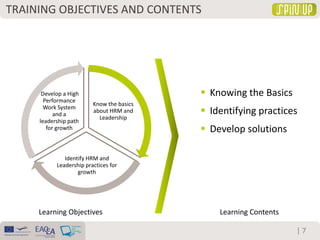
 Knowing the Basics
 Identifying practices
 Develop solutions
Learning Objectives Learning Contents
Know the basics
about HRM and
Leadership
Identify HRM and
Leadership practices for
growth
Develop a High
Performance
Work System
and a
leadership path
for growth
TRAINING OBJECTIVES AND CONTENTS
KNOWING THE BASICS
| 8HRM and Leadership
HRM AS A HIGH PERFORMANCE WORK SYSTEM
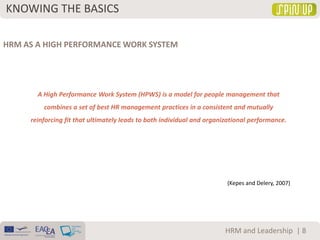
A High Performance Work System (HPWS) is a model for people management that
combines a set of best HR management practices in a consistent and mutually
reinforcing fit that ultimately leads to both individual and organizational performance.
(Kepes and Delery, 2007)
KNOWING THE BASICS
| 9HRM and Leadership
HRM AS A HIGH PERFORMANCE WORK SYSTEM
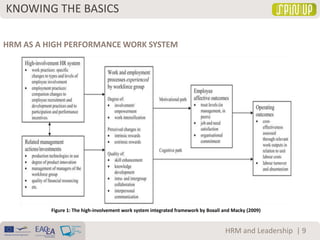
Figure 1: The high-involvement work system integrated framework by Boxall and Macky (2009)
KNOWING THE BASICS
| 10HRM and Leadership
HRM AS A HIGH PERFORMANCE WORK SYSTEM
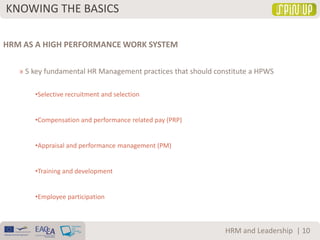
» 5 key fundamental HR Management practices that should constitute a HPWS
•Selective recruitment and selection
•Compensation and performance related pay (PRP)
•Appraisal and performance management (PM)
•Training and development
•Employee participation
KNOWING THE BASICS
| 11HRM and Leadership
HRM AS A HIGH PERFORMANCE WORK SYSTEM
» 5 key fundamental HR Management practices that should constitute a HPWS
•Selective recruitment and selection
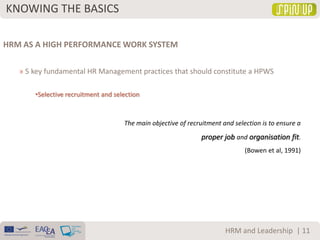
The main objective of recruitment and selection is to ensure a
proper job and organisation fit.
(Bowen et al, 1991)
KNOWING THE BASICS
| 12HRM and Leadership
HRM AS A HIGH PERFORMANCE WORK SYSTEM
» 5 key fundamental HR Management practices that should constitute a HPWS
•Compensation and performance related pay (PRP)
Is not only about salary or financial gains as it can encompass
a wider range of benefits and rewards that should be taken
also in account.
KNOWING THE BASICS
| 13HRM and Leadership
HRM AS A HIGH PERFORMANCE WORK SYSTEM
» 5 key fundamental HR Management practices that should constitute a HPWS
•Appraisal and performance management (PM)
Establishing and reinforcing the link between individual
performance and the organisational goals.
KNOWING THE BASICS
| 14HRM and Leadership
HRM AS A HIGH PERFORMANCE WORK SYSTEM
» 5 key fundamental HR Management practices that should constitute a HPWS
•Training and development
The development of the knowledge, competencies and
skills necessary for an organisation to function and achieve its
goals.
KNOWING THE BASICS
| 15HRM and Leadership
HRM AS A HIGH PERFORMANCE WORK SYSTEM
» 5 key fundamental HR Management practices that should constitute a HPWS
•Employee participation
The development of ownership, which is known to be a critical
factor for people to feel motivated to work in a given organisation.
KNOWING THE BASICS
| 16HRM and Leadership
LEADERSHIP
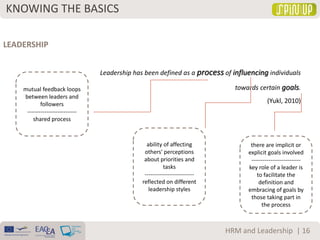
Leadership has been defined as a process of influencing individuals
towards certain goals.
(Yukl, 2010)
mutual feedback loops
between leaders and
followers
--------------------------
shared process
ability of affecting
others' perceptions
about priorities and
tasks
--------------------------
reflected on different
leadership styles
there are implicit or
explicit goals involved
--------------------------
key role of a leader is
to facilitate the
definition and
embracing of goals by
those taking part in
the process
KNOWING THE BASICS
| 17HRM and Leadership
LEADERSHIP
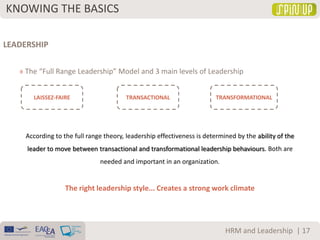
» The “Full Range Leadership” Model and 3 main levels of Leadership
According to the full range theory, leadership effectiveness is determined by the ability of the
leader to move between transactional and transformational leadership behaviours. Both are
needed and important in an organization.
The right leadership style... Creates a strong work climate
TRANSACTIONAL TRANSFORMATIONALLAISSEZ-FAIRE
KNOWING THE BASICS
| 18HRM and Leadership
LEADERSHIP
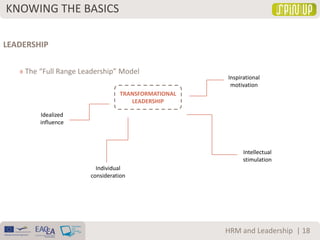
» The “Full Range Leadership” Model
TRANSFORMATIONAL
LEADERSHIP
Idealized
influence
Intellectual
stimulation
Inspirational
motivation
Individual
consideration
KNOWING THE BASICS
| 19HRM and Leadership
LEADERSHIP
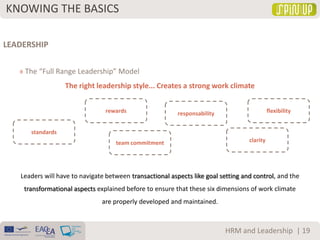
» The “Full Range Leadership” Model
The right leadership style... Creates a strong work climate
Leaders will have to navigate between transactional aspects like goal setting and control, and the
transformational aspects explained before to ensure that these six dimensions of work climate
are properly developed and maintained.
standards
team commitment
rewards responsability
clarity
flexibility
HRM AND LEADERSHIP FOR GROWTH
| 20HRM and Leadership
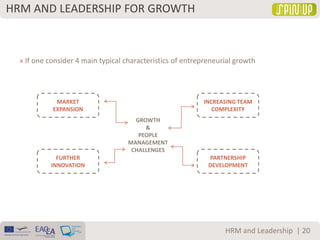
» If one consider 4 main typical characteristics of entrepreneurial growth
FURTHER
INNOVATION
PARTNERSHIP
DEVELOPMENT
MARKET
EXPANSION
INCREASING TEAM
COMPLEXITY
GROWTH
&
PEOPLE
MANAGEMENT
CHALLENGES
HRM AND LEADERSHIP FOR GROWTH
| 21HRM and Leadership
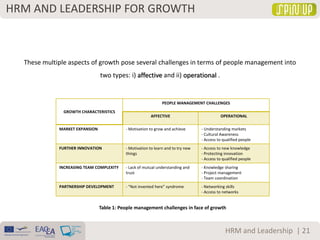
These multiple aspects of growth pose several challenges in terms of people management into
two types: i) affective and ii) operational .
GROWTH CHARACTERISTICS
PEOPLE MANAGEMENT CHALLENGES
AFFECTIVE OPERATIONAL
MARKET EXPANSION - Motivation to grow and achieve - Understanding markets
- Cultural Awareness
- Access to qualified people
FURTHER INNOVATION - Motivation to learn and to try new
things
- Access to new knowledge
- Protecting innovation
- Access to qualified people
INCREASING TEAM COMPLEXITY - Lack of mutual understanding and
trust
- Knowledge sharing
- Project management
- Team coordination
PARTNERSHIP DEVELOPMENT - “Not invented here” syndrome - Networking skills
- Access to networks
Table 1: People management challenges in face of growth
HRM AND LEADERSHIP FOR GROWTH
| 22HRM and Leadership
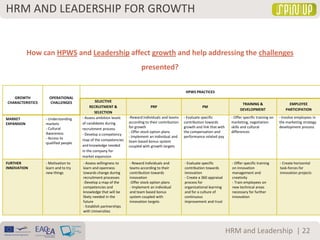
How can HPWS and Leadership affect growth and help addressing the challenges
presented?
GROWTH
CHARACTERISTICS
OPERATIONAL
CHALLENGES
HPWS PRACTICES
SELECTIVE
RECRUITMENT &
SELECTION
PRP PM
TRAINING &
DEVELOPMENT
EMPLOYEE
PARTICIPATION
MARKET
EXPANSION
- Understanding
markets
- Cultural
Awareness
- Access to
qualified people
- Assess ambition levels
of candidates during
recruitment process
- Develop a competency
map of the competencies
and knowledge needed
in the company for
market expansion
-Reward individuals and teams
according to their contribution
for growth
- Offer stock option plans
- Implement an individual and
team based bonus system
coupled with growth targets
- Evaluate specific
contribution towards
growth and link that with
the compensation and
performance related pay
- Offer specific training on
marketing, negotiation
skills and cultural
differences
- Involve employees in
the marketing strategy
development process
FURTHER
INNOVATION
- Motivation to
learn and to try
new things
- Assess willingness to
learn and openness
towards change during
recruitment processes
-Develop a map of the
competencies and
knowledge that will be
likely needed in the
future
- Establish partnerships
with Universities
- Reward individuals and
teams according to their
contribution towards
innovation
-Offer stock option plans
- Implement an individual
and team based bonus
system coupled with
innovation targets
- Evaluate specific
contribution towards
innovation
- Create a 360 appraisal
process for
organizational learning
and for a culture of
continuous
improvement and trust
- Offer specific training
on innovation
management and
creativity
- Train employees on
new technical areas
necessary for further
innovation
- Create horizontal
task-forces for
innovation projects
HRM AND LEADERSHIP FOR GROWTH
| 23HRM and Leadership
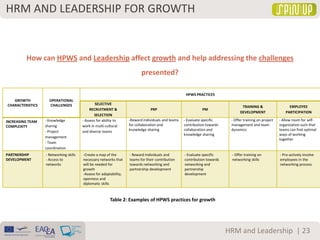
How can HPWS and Leadership affect growth and help addressing the challenges
presented?
GROWTH
CHARACTERISTICS
OPERATIONAL
CHALLENGES
HPWS PRACTICES
SELECTIVE
RECRUITMENT &
SELECTION
PRP PM
TRAINING &
DEVELOPMENT
EMPLOYEE
PARTICIPATION
INCREASING TEAM
COMPLEXITY
- Knowledge
sharing
- Project
management
- Team
coordination
- Assess for ability to
work in multi-cultural
and diverse teams
-Reward individuals and teams
for collaboration and
knowledge sharing
- Evaluate specific
contribution towards
collaboration and
knowledge sharing
- Offer training on project
management and team
dynamics
- Allow room for self-
organization such that
teams can find optimal
ways of working
together
PARTNERSHIP
DEVELOPMENT
- Networking skills
- Access to
networks
-Create a map of the
necessary networks that
will be needed for
growth
-Assess for adaptability,
openness and
diplomatic skills
- Reward individuals and
teams for their contribution
towards networking and
partnership development
- Evaluate specific
contribution towards
networking and
partnership
development
- Offer training on
networking skills
- Pro-actively involve
employees in the
networking process
Table 2: Examples of HPWS practices for growth
HRM AND LEADERSHIP FOR GROWTH
| 24HRM and Leadership
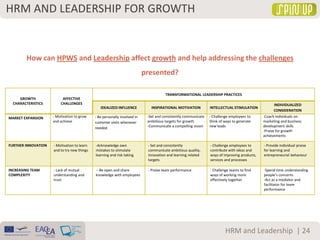
How can HPWS and Leadership affect growth and help addressing the challenges
presented?
GROWTH
CHARACTERISTICS
AFFECTIVE
CHALLENGES
TRANSFORMATIONAL LEADERSHIP PRACTICES
IDEALIZED INFLUENCE INSPIRATIONAL MOTIVATION INTELLECTUAL STIMULATION
INDIVIDUALIZED
CONSIDERATION
MARKET EXPANSION - Motivation to grow
and achieve
- Be personally involved in
customer visits whenever
needed
-Set and consistently communicate
ambitious targets for growth
-Communicate a compelling vision
- Challenge employees to
think of ways to generate
new leads
-Coach individuals on
marketing and business
development skills
-Praise for growth
achievements
FURTHER INNOVATION - Motivation to learn
and to try new things
-Acknowledge own
mistakes to stimulate
learning and risk taking
- Set and consistently
communicate ambitious quality,
innovation and learning related
targets
- Challenge employees to
contribute with ideas and
ways of improving products,
services and processes
- Provide individual praise
for learning and
entrepreneurial behaviour
INCREASING TEAM
COMPLEXITY
- Lack of mutual
understanding and
trust
-- Be open and share
knowledge with employees
- Praise team performance - Challenge teams to find
ways of working more
effectively together
-Spend time understanding
people’s concerns
-Act as a mediator and
facilitator for team
performance
HRM AND LEADERSHIP FOR GROWTH
| 25HRM and Leadership
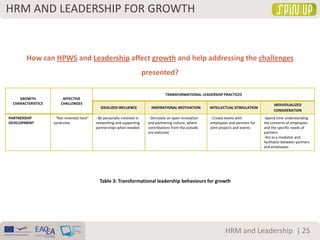
How can HPWS and Leadership affect growth and help addressing the challenges
presented?
GROWTH
CHARACTERISTICS
AFFECTIVE
CHALLENGES
TRANSFORMATIONAL LEADERSHIP PRACTICES
IDEALIZED INFLUENCE INSPIRATIONAL MOTIVATION INTELLECTUAL STIMULATION
INDIVIDUALIZED
CONSIDERATION
PARTNERSHIP
DEVELOPMENT
- “Not invented here”
syndrome
- Be personally involved in
networking and supporting
partnerships when needed
- Stimulate an open innovation
and partnering culture, where
contributions from the outside
are welcome
- Create teams with
employees and partners for
joint projects and events
-Spend time understanding
the concerns of employees
and the specific needs of
partners
-Act as a mediator and
facilitator between partners
and employees
Table 3: Transformational leadership behaviours for growth
HRM AND LEADERSHIP FOR GROWTH
| 26HRM and Leadership
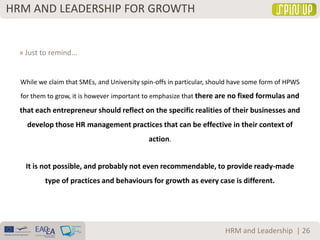
While we claim that SMEs, and University spin-offs in particular, should have some form of HPWS
for them to grow, it is however important to emphasize that there are no fixed formulas and
that each entrepreneur should reflect on the specific realities of their businesses and
develop those HR management practices that can be effective in their context of
action.
It is not possible, and probably not even recommendable, to provide ready-made
type of practices and behaviours for growth as every case is different.
» Just to remind...
URL . www.spin-up.eu
eMail . info@spin-up.eu

Human Resources Management and Leadership for Growth

  • 1.
    templateversion1.0 HRM AND LEADERSHIPFOR GROWTH Module Presentation
  • 2.
    TRAINING OBJECTIVES ANDCONTENTS | 2 The SPIN-UP training in HRM and Leadership for Growth will help University Spin-Off’s managers to improve their abilities in different aspects of people management, based on the concepts of High Performance Work Systems and the understanding of leadership styles. Know the basics about HRM and Leadership Identify HRM and Leadership practices for growth Develop a High Performance Work System and a leadership path for growth
  • 3.
    | 3 Understand themain concepts around High Performance Work Systems as a model for HRM Clarify the notion of leadership Understand the model of full range leadership Understand the basic dimensions of a high performing work climate Know the basics about HRM and Leadership TRAINING OBJECTIVES AND CONTENTS
  • 4.
    | 4 Know howa HPWS can support entrepreneurial growth Understand the impact of different leadership styles on work climate and entrepreneurial growth Identifying HRM and Leadership practices for growth TRAINING OBJECTIVES AND CONTENTS
  • 5.
    • 1. trainingobjectives and contents | 5 Be able to apply the concepts of HPWS to own business Be able to reflect on own leadership styles and their influence on growth Developing your own HPWS and leadership path for growth
  • 6.
    | 6  Thismodule is not intended to prepare trainees to be experts in HRM or Leadership.  Instead, it appeals to the trainee common sense and experience to understand how HRM processes and leadership behaviors can be optimized for effective people management, that can enable further growth. TRAINING OBJECTIVES AND CONTENTS
  • 7.
    | 7  Knowingthe Basics  Identifying practices  Develop solutions Learning Objectives Learning Contents Know the basics about HRM and Leadership Identify HRM and Leadership practices for growth Develop a High Performance Work System and a leadership path for growth TRAINING OBJECTIVES AND CONTENTS
  • 8.
    KNOWING THE BASICS |8HRM and Leadership HRM AS A HIGH PERFORMANCE WORK SYSTEM A High Performance Work System (HPWS) is a model for people management that combines a set of best HR management practices in a consistent and mutually reinforcing fit that ultimately leads to both individual and organizational performance. (Kepes and Delery, 2007)
  • 9.
    KNOWING THE BASICS |9HRM and Leadership HRM AS A HIGH PERFORMANCE WORK SYSTEM Figure 1: The high-involvement work system integrated framework by Boxall and Macky (2009)
  • 10.
    KNOWING THE BASICS |10HRM and Leadership HRM AS A HIGH PERFORMANCE WORK SYSTEM » 5 key fundamental HR Management practices that should constitute a HPWS •Selective recruitment and selection •Compensation and performance related pay (PRP) •Appraisal and performance management (PM) •Training and development •Employee participation
  • 11.
    KNOWING THE BASICS |11HRM and Leadership HRM AS A HIGH PERFORMANCE WORK SYSTEM » 5 key fundamental HR Management practices that should constitute a HPWS •Selective recruitment and selection The main objective of recruitment and selection is to ensure a proper job and organisation fit. (Bowen et al, 1991)
  • 12.
    KNOWING THE BASICS |12HRM and Leadership HRM AS A HIGH PERFORMANCE WORK SYSTEM » 5 key fundamental HR Management practices that should constitute a HPWS •Compensation and performance related pay (PRP) Is not only about salary or financial gains as it can encompass a wider range of benefits and rewards that should be taken also in account.
  • 13.
    KNOWING THE BASICS |13HRM and Leadership HRM AS A HIGH PERFORMANCE WORK SYSTEM » 5 key fundamental HR Management practices that should constitute a HPWS •Appraisal and performance management (PM) Establishing and reinforcing the link between individual performance and the organisational goals.
  • 14.
    KNOWING THE BASICS |14HRM and Leadership HRM AS A HIGH PERFORMANCE WORK SYSTEM » 5 key fundamental HR Management practices that should constitute a HPWS •Training and development The development of the knowledge, competencies and skills necessary for an organisation to function and achieve its goals.
  • 15.
    KNOWING THE BASICS |15HRM and Leadership HRM AS A HIGH PERFORMANCE WORK SYSTEM » 5 key fundamental HR Management practices that should constitute a HPWS •Employee participation The development of ownership, which is known to be a critical factor for people to feel motivated to work in a given organisation.
  • 16.
    KNOWING THE BASICS |16HRM and Leadership LEADERSHIP Leadership has been defined as a process of influencing individuals towards certain goals. (Yukl, 2010) mutual feedback loops between leaders and followers -------------------------- shared process ability of affecting others' perceptions about priorities and tasks -------------------------- reflected on different leadership styles there are implicit or explicit goals involved -------------------------- key role of a leader is to facilitate the definition and embracing of goals by those taking part in the process
  • 17.
    KNOWING THE BASICS |17HRM and Leadership LEADERSHIP » The “Full Range Leadership” Model and 3 main levels of Leadership According to the full range theory, leadership effectiveness is determined by the ability of the leader to move between transactional and transformational leadership behaviours. Both are needed and important in an organization. The right leadership style... Creates a strong work climate TRANSACTIONAL TRANSFORMATIONALLAISSEZ-FAIRE
  • 18.
    KNOWING THE BASICS |18HRM and Leadership LEADERSHIP » The “Full Range Leadership” Model TRANSFORMATIONAL LEADERSHIP Idealized influence Intellectual stimulation Inspirational motivation Individual consideration
  • 19.
    KNOWING THE BASICS |19HRM and Leadership LEADERSHIP » The “Full Range Leadership” Model The right leadership style... Creates a strong work climate Leaders will have to navigate between transactional aspects like goal setting and control, and the transformational aspects explained before to ensure that these six dimensions of work climate are properly developed and maintained. standards team commitment rewards responsability clarity flexibility
  • 20.
    HRM AND LEADERSHIPFOR GROWTH | 20HRM and Leadership » If one consider 4 main typical characteristics of entrepreneurial growth FURTHER INNOVATION PARTNERSHIP DEVELOPMENT MARKET EXPANSION INCREASING TEAM COMPLEXITY GROWTH & PEOPLE MANAGEMENT CHALLENGES
  • 21.
    HRM AND LEADERSHIPFOR GROWTH | 21HRM and Leadership These multiple aspects of growth pose several challenges in terms of people management into two types: i) affective and ii) operational . GROWTH CHARACTERISTICS PEOPLE MANAGEMENT CHALLENGES AFFECTIVE OPERATIONAL MARKET EXPANSION - Motivation to grow and achieve - Understanding markets - Cultural Awareness - Access to qualified people FURTHER INNOVATION - Motivation to learn and to try new things - Access to new knowledge - Protecting innovation - Access to qualified people INCREASING TEAM COMPLEXITY - Lack of mutual understanding and trust - Knowledge sharing - Project management - Team coordination PARTNERSHIP DEVELOPMENT - “Not invented here” syndrome - Networking skills - Access to networks Table 1: People management challenges in face of growth
  • 22.
    HRM AND LEADERSHIPFOR GROWTH | 22HRM and Leadership How can HPWS and Leadership affect growth and help addressing the challenges presented? GROWTH CHARACTERISTICS OPERATIONAL CHALLENGES HPWS PRACTICES SELECTIVE RECRUITMENT & SELECTION PRP PM TRAINING & DEVELOPMENT EMPLOYEE PARTICIPATION MARKET EXPANSION - Understanding markets - Cultural Awareness - Access to qualified people - Assess ambition levels of candidates during recruitment process - Develop a competency map of the competencies and knowledge needed in the company for market expansion -Reward individuals and teams according to their contribution for growth - Offer stock option plans - Implement an individual and team based bonus system coupled with growth targets - Evaluate specific contribution towards growth and link that with the compensation and performance related pay - Offer specific training on marketing, negotiation skills and cultural differences - Involve employees in the marketing strategy development process FURTHER INNOVATION - Motivation to learn and to try new things - Assess willingness to learn and openness towards change during recruitment processes -Develop a map of the competencies and knowledge that will be likely needed in the future - Establish partnerships with Universities - Reward individuals and teams according to their contribution towards innovation -Offer stock option plans - Implement an individual and team based bonus system coupled with innovation targets - Evaluate specific contribution towards innovation - Create a 360 appraisal process for organizational learning and for a culture of continuous improvement and trust - Offer specific training on innovation management and creativity - Train employees on new technical areas necessary for further innovation - Create horizontal task-forces for innovation projects
  • 23.
    HRM AND LEADERSHIPFOR GROWTH | 23HRM and Leadership How can HPWS and Leadership affect growth and help addressing the challenges presented? GROWTH CHARACTERISTICS OPERATIONAL CHALLENGES HPWS PRACTICES SELECTIVE RECRUITMENT & SELECTION PRP PM TRAINING & DEVELOPMENT EMPLOYEE PARTICIPATION INCREASING TEAM COMPLEXITY - Knowledge sharing - Project management - Team coordination - Assess for ability to work in multi-cultural and diverse teams -Reward individuals and teams for collaboration and knowledge sharing - Evaluate specific contribution towards collaboration and knowledge sharing - Offer training on project management and team dynamics - Allow room for self- organization such that teams can find optimal ways of working together PARTNERSHIP DEVELOPMENT - Networking skills - Access to networks -Create a map of the necessary networks that will be needed for growth -Assess for adaptability, openness and diplomatic skills - Reward individuals and teams for their contribution towards networking and partnership development - Evaluate specific contribution towards networking and partnership development - Offer training on networking skills - Pro-actively involve employees in the networking process Table 2: Examples of HPWS practices for growth
  • 24.
    HRM AND LEADERSHIPFOR GROWTH | 24HRM and Leadership How can HPWS and Leadership affect growth and help addressing the challenges presented? GROWTH CHARACTERISTICS AFFECTIVE CHALLENGES TRANSFORMATIONAL LEADERSHIP PRACTICES IDEALIZED INFLUENCE INSPIRATIONAL MOTIVATION INTELLECTUAL STIMULATION INDIVIDUALIZED CONSIDERATION MARKET EXPANSION - Motivation to grow and achieve - Be personally involved in customer visits whenever needed -Set and consistently communicate ambitious targets for growth -Communicate a compelling vision - Challenge employees to think of ways to generate new leads -Coach individuals on marketing and business development skills -Praise for growth achievements FURTHER INNOVATION - Motivation to learn and to try new things -Acknowledge own mistakes to stimulate learning and risk taking - Set and consistently communicate ambitious quality, innovation and learning related targets - Challenge employees to contribute with ideas and ways of improving products, services and processes - Provide individual praise for learning and entrepreneurial behaviour INCREASING TEAM COMPLEXITY - Lack of mutual understanding and trust -- Be open and share knowledge with employees - Praise team performance - Challenge teams to find ways of working more effectively together -Spend time understanding people’s concerns -Act as a mediator and facilitator for team performance
  • 25.
    HRM AND LEADERSHIPFOR GROWTH | 25HRM and Leadership How can HPWS and Leadership affect growth and help addressing the challenges presented? GROWTH CHARACTERISTICS AFFECTIVE CHALLENGES TRANSFORMATIONAL LEADERSHIP PRACTICES IDEALIZED INFLUENCE INSPIRATIONAL MOTIVATION INTELLECTUAL STIMULATION INDIVIDUALIZED CONSIDERATION PARTNERSHIP DEVELOPMENT - “Not invented here” syndrome - Be personally involved in networking and supporting partnerships when needed - Stimulate an open innovation and partnering culture, where contributions from the outside are welcome - Create teams with employees and partners for joint projects and events -Spend time understanding the concerns of employees and the specific needs of partners -Act as a mediator and facilitator between partners and employees Table 3: Transformational leadership behaviours for growth
  • 26.
    HRM AND LEADERSHIPFOR GROWTH | 26HRM and Leadership While we claim that SMEs, and University spin-offs in particular, should have some form of HPWS for them to grow, it is however important to emphasize that there are no fixed formulas and that each entrepreneur should reflect on the specific realities of their businesses and develop those HR management practices that can be effective in their context of action. It is not possible, and probably not even recommendable, to provide ready-made type of practices and behaviours for growth as every case is different. » Just to remind...
  • 27.
    URL . www.spin-up.eu eMail. info@spin-up.eu