
Bernadette Speiser MSN, CCRN
Cardiac Catheterization Laboratory
Palo Alto Veteran’s Hospital, California USA
 Clinical Advisor-Abiomed Corporation
 Clinical Advisor-Teleflex/Arrow Company
 Clinical Advisor-Terumo Company
 Clinical Advisor-Medicines Company
 Clinical Advisor-Acist Medical Systems
 Presenter-HMP Communications
 Presenter-Academy Medical
 Presenter-CFR
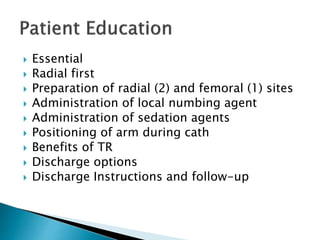
 Essential
 Radial first
 Preparation of radial (2) and femoral (1) sites
 Administration of local numbing agent
 Administration of sedation agents
 Positioning of arm during cath
 Benefits of TR
 Discharge options
 Discharge Instructions and follow-up
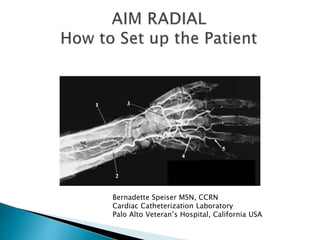
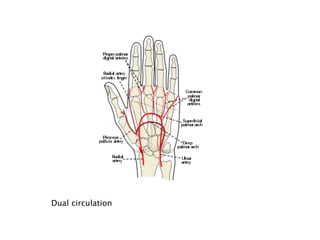
Dual circulation
 The wrist hair clipped at possible access sites
(right wrist, right femoral)
 IV access-contralateral-except if patient is also a
candidate for RHC
 Arm band/jewelry removed from access site
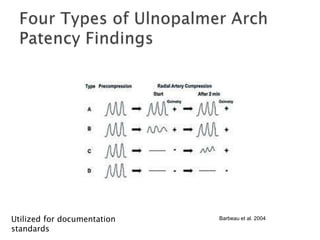
 Modified BarbeauTest: Objective measurement to
test dual circulation in hand
“Normal or Abnormal”
Objective
Oximetric recordings
Utilized for comparison pre/post
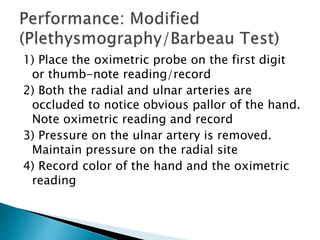
1) Place the oximetric probe on the first digit
or thumb-note reading/record
2) Both the radial and ulnar arteries are
occluded to notice obvious pallor of the hand.
Note oximetric reading and record
3) Pressure on the ulnar artery is removed.
Maintain pressure on the radial site
4) Record color of the hand and the oximetric
reading
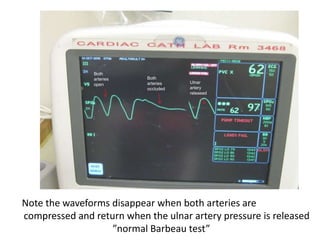
Note the waveforms disappear when both arteries are
compressed and return when the ulnar artery pressure is released
”normal Barbeau test”
Both
arteries
open
Both
arteries
occluded
Ulnar
artery
released
Barbeau et al. 2004Utilized for documentation
standards
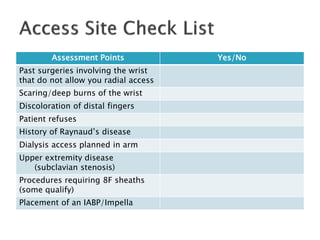
Assessment Points Yes/No
Past surgeries involving the wrist
that do not allow you radial access
Scaring/deep burns of the wrist
Discoloration of distal fingers
Patient refuses
History of Raynaud’s disease
Dialysis access planned in arm
Upper extremity disease
(subclavian stenosis)
Procedures requiring 8F sheaths
(some qualify)
Placement of an IABP/Impella
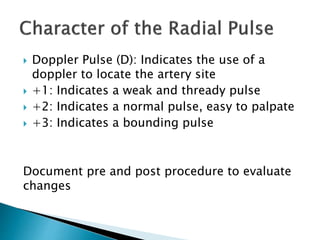
 Doppler Pulse (D): Indicates the use of a
doppler to locate the artery site
 +1: Indicates a weak and thready pulse
 +2: Indicates a normal pulse, easy to palpate
 +3: Indicates a bounding pulse
Document pre and post procedure to evaluate
changes
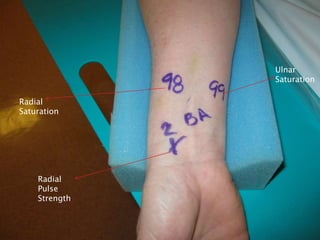
Radial
Saturation
Ulnar
Saturation
Radial
Pulse
Strength
 Pulse oximetry placed on the index finger or
thumb of access arm
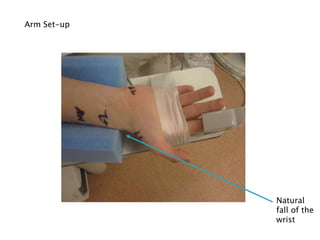
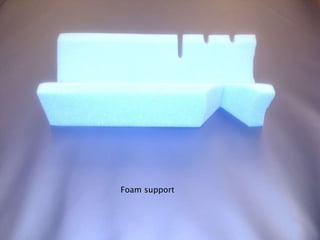
 Wrist should be only slightly “cocked” (small
towel, foam support, support devices)- Do
not overextend
 Tape the fingers down-prevents pronation
 Use the natural fall of the wrist
Arm Set-up
Natural
fall of the
wrist
Foam support
 Sheath-special radial sheaths
 Wires and needles for access
 Catheters-special radial catheters available
 Drape-special radial drapes
 Support Board
 Monitors with saturation waveforms for the
pre and post procedure areas
 Hemostasis device
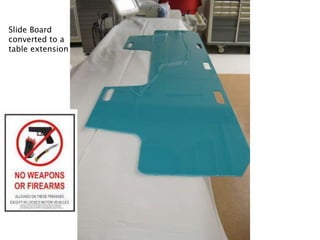
Slide Board
converted to a
table extension
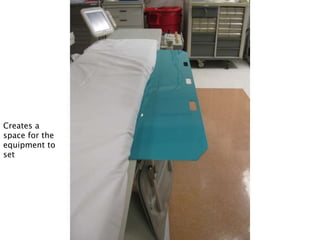
Creates a
space for the
equipment to
set
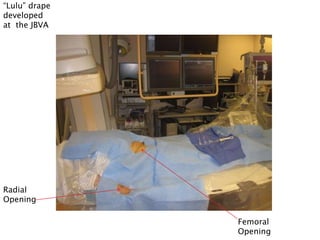
“Lulu” drape
developed
at the JBVA
Radial
Opening
Femoral
Opening
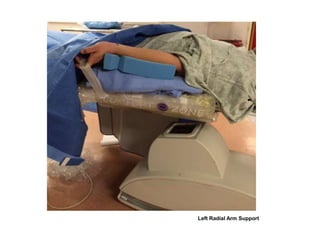
Left Radial Arm Support
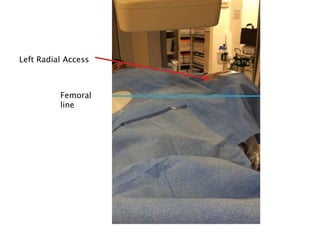
Left Radial Access
Femoral
line
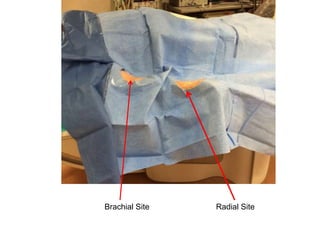
Brachial Site Radial Site
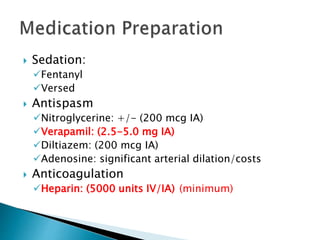
 Sedation:
Fentanyl
Versed
 Antispasm
Nitroglycerine: +/- (200 mcg IA)
Verapamil: (2.5-5.0 mg IA)
Diltiazem: (200 mcg IA)
Adenosine: significant arterial dilation/costs
 Anticoagulation
Heparin: (5000 units IV/IA) (minimum)
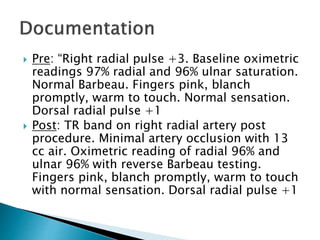
 Pre: “Right radial pulse +3. Baseline oximetric
readings 97% radial and 96% ulnar saturation.
Normal Barbeau. Fingers pink, blanch
promptly, warm to touch. Normal sensation.
Dorsal radial pulse +1
 Post: TR band on right radial artery post
procedure. Minimal artery occlusion with 13
cc air. Oximetric reading of radial 96% and
ulnar 96% with reverse Barbeau testing.
Fingers pink, blanch promptly, warm to touch
with normal sensation. Dorsal radial pulse +1
Patient Received 5,000 units
of Heparin or less
Patient Received Greater
Than 5,000 units of Heparin
or Angiomax
__ cc inflated @ ___________ __ cc inflated @ ___________
3 cc down 15 min @ ______________ 1 Hour
3 cc down @ ____________
3 cc down 25 min @ ______________ 30 Mins
3 cc down @ ______________
3 cc down 35 min @ ______________ 3 cc down @ ______________
3 cc down 45 min @ ______________ 3 cc down @ ______________
3 cc down @ ______________ 3 cc down @ ______________
Total deflated @ ___________ Total deflated @ ___________
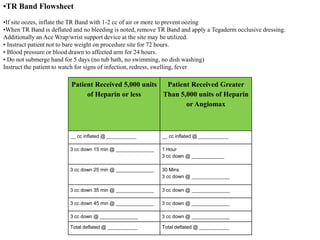
•TR Band Flowsheet
•If site oozes, inflate the TR Band with 1-2 cc of air or more to prevent oozing
•When TR Band is deflated and no bleeding is noted, remove TR Band and apply a Tegaderm occlusive dressing.
Additionally an Ace Wrap/wrist support device at the site may be utilized.
• Instruct patient not to bare weight on procedure site for 72 hours.
• Blood pressure or blood drawn to affected arm for 24 hours.
• Do not submerge hand for 5 days (no tub bath, no swimming, no dish washing)
Instruct the patient to watch for signs of infection, redress, swelling, fever
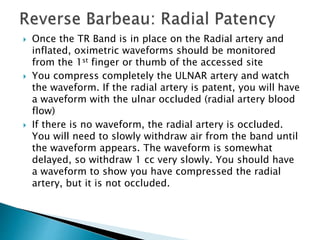
 Once the TR Band is in place on the Radial artery and
inflated, oximetric waveforms should be monitored
from the 1st finger or thumb of the accessed site
 You compress completely the ULNAR artery and watch
the waveform. If the radial artery is patent, you will have
a waveform with the ulnar occluded (radial artery blood
flow)
 If there is no waveform, the radial artery is occluded.
You will need to slowly withdraw air from the band until
the waveform appears. The waveform is somewhat
delayed, so withdraw 1 cc very slowly. You should have
a waveform to show you have compressed the radial
artery, but it is not occluded.
28
Standardization is the key to relaxed and confident staff

Speiser B - AIMRADIAL 2015 - Patient set-up

  • 1.
    Bernadette Speiser MSN,CCRN Cardiac Catheterization Laboratory Palo Alto Veteran’s Hospital, California USA
  • 2.
     Clinical Advisor-AbiomedCorporation  Clinical Advisor-Teleflex/Arrow Company  Clinical Advisor-Terumo Company  Clinical Advisor-Medicines Company  Clinical Advisor-Acist Medical Systems  Presenter-HMP Communications  Presenter-Academy Medical  Presenter-CFR
  • 3.
     Essential  Radialfirst  Preparation of radial (2) and femoral (1) sites  Administration of local numbing agent  Administration of sedation agents  Positioning of arm during cath  Benefits of TR  Discharge options  Discharge Instructions and follow-up
  • 4.
  • 5.
     The wristhair clipped at possible access sites (right wrist, right femoral)  IV access-contralateral-except if patient is also a candidate for RHC  Arm band/jewelry removed from access site  Modified BarbeauTest: Objective measurement to test dual circulation in hand “Normal or Abnormal” Objective Oximetric recordings Utilized for comparison pre/post
  • 6.
    1) Place theoximetric probe on the first digit or thumb-note reading/record 2) Both the radial and ulnar arteries are occluded to notice obvious pallor of the hand. Note oximetric reading and record 3) Pressure on the ulnar artery is removed. Maintain pressure on the radial site 4) Record color of the hand and the oximetric reading
  • 7.
    Note the waveformsdisappear when both arteries are compressed and return when the ulnar artery pressure is released ”normal Barbeau test” Both arteries open Both arteries occluded Ulnar artery released
  • 8.
    Barbeau et al.2004Utilized for documentation standards
  • 9.
    Assessment Points Yes/No Pastsurgeries involving the wrist that do not allow you radial access Scaring/deep burns of the wrist Discoloration of distal fingers Patient refuses History of Raynaud’s disease Dialysis access planned in arm Upper extremity disease (subclavian stenosis) Procedures requiring 8F sheaths (some qualify) Placement of an IABP/Impella
  • 10.
     Doppler Pulse(D): Indicates the use of a doppler to locate the artery site  +1: Indicates a weak and thready pulse  +2: Indicates a normal pulse, easy to palpate  +3: Indicates a bounding pulse Document pre and post procedure to evaluate changes
  • 11.
  • 12.
     Pulse oximetryplaced on the index finger or thumb of access arm  Wrist should be only slightly “cocked” (small towel, foam support, support devices)- Do not overextend  Tape the fingers down-prevents pronation  Use the natural fall of the wrist
  • 13.
  • 14.
  • 15.
     Sheath-special radialsheaths  Wires and needles for access  Catheters-special radial catheters available  Drape-special radial drapes  Support Board  Monitors with saturation waveforms for the pre and post procedure areas  Hemostasis device
  • 16.
    Slide Board converted toa table extension
  • 17.
    Creates a space forthe equipment to set
  • 20.
    “Lulu” drape developed at theJBVA Radial Opening Femoral Opening
  • 21.
  • 22.
  • 23.
  • 24.
     Sedation: Fentanyl Versed  Antispasm Nitroglycerine:+/- (200 mcg IA) Verapamil: (2.5-5.0 mg IA) Diltiazem: (200 mcg IA) Adenosine: significant arterial dilation/costs  Anticoagulation Heparin: (5000 units IV/IA) (minimum)
  • 25.
     Pre: “Rightradial pulse +3. Baseline oximetric readings 97% radial and 96% ulnar saturation. Normal Barbeau. Fingers pink, blanch promptly, warm to touch. Normal sensation. Dorsal radial pulse +1  Post: TR band on right radial artery post procedure. Minimal artery occlusion with 13 cc air. Oximetric reading of radial 96% and ulnar 96% with reverse Barbeau testing. Fingers pink, blanch promptly, warm to touch with normal sensation. Dorsal radial pulse +1
  • 26.
    Patient Received 5,000units of Heparin or less Patient Received Greater Than 5,000 units of Heparin or Angiomax __ cc inflated @ ___________ __ cc inflated @ ___________ 3 cc down 15 min @ ______________ 1 Hour 3 cc down @ ____________ 3 cc down 25 min @ ______________ 30 Mins 3 cc down @ ______________ 3 cc down 35 min @ ______________ 3 cc down @ ______________ 3 cc down 45 min @ ______________ 3 cc down @ ______________ 3 cc down @ ______________ 3 cc down @ ______________ Total deflated @ ___________ Total deflated @ ___________ •TR Band Flowsheet •If site oozes, inflate the TR Band with 1-2 cc of air or more to prevent oozing •When TR Band is deflated and no bleeding is noted, remove TR Band and apply a Tegaderm occlusive dressing. Additionally an Ace Wrap/wrist support device at the site may be utilized. • Instruct patient not to bare weight on procedure site for 72 hours. • Blood pressure or blood drawn to affected arm for 24 hours. • Do not submerge hand for 5 days (no tub bath, no swimming, no dish washing) Instruct the patient to watch for signs of infection, redress, swelling, fever
  • 27.
     Once theTR Band is in place on the Radial artery and inflated, oximetric waveforms should be monitored from the 1st finger or thumb of the accessed site  You compress completely the ULNAR artery and watch the waveform. If the radial artery is patent, you will have a waveform with the ulnar occluded (radial artery blood flow)  If there is no waveform, the radial artery is occluded. You will need to slowly withdraw air from the band until the waveform appears. The waveform is somewhat delayed, so withdraw 1 cc very slowly. You should have a waveform to show you have compressed the radial artery, but it is not occluded.
  • 28.
    28 Standardization is thekey to relaxed and confident staff