Speech Acts and Speech Events

              By:            http://www.kau.edu.sa/SBANJAR
      Dr. Shadia Y. Banjar   http://wwwdrshadiabanjar.blogspot.com


Dr. Shadia Y. Banjar                                                 1
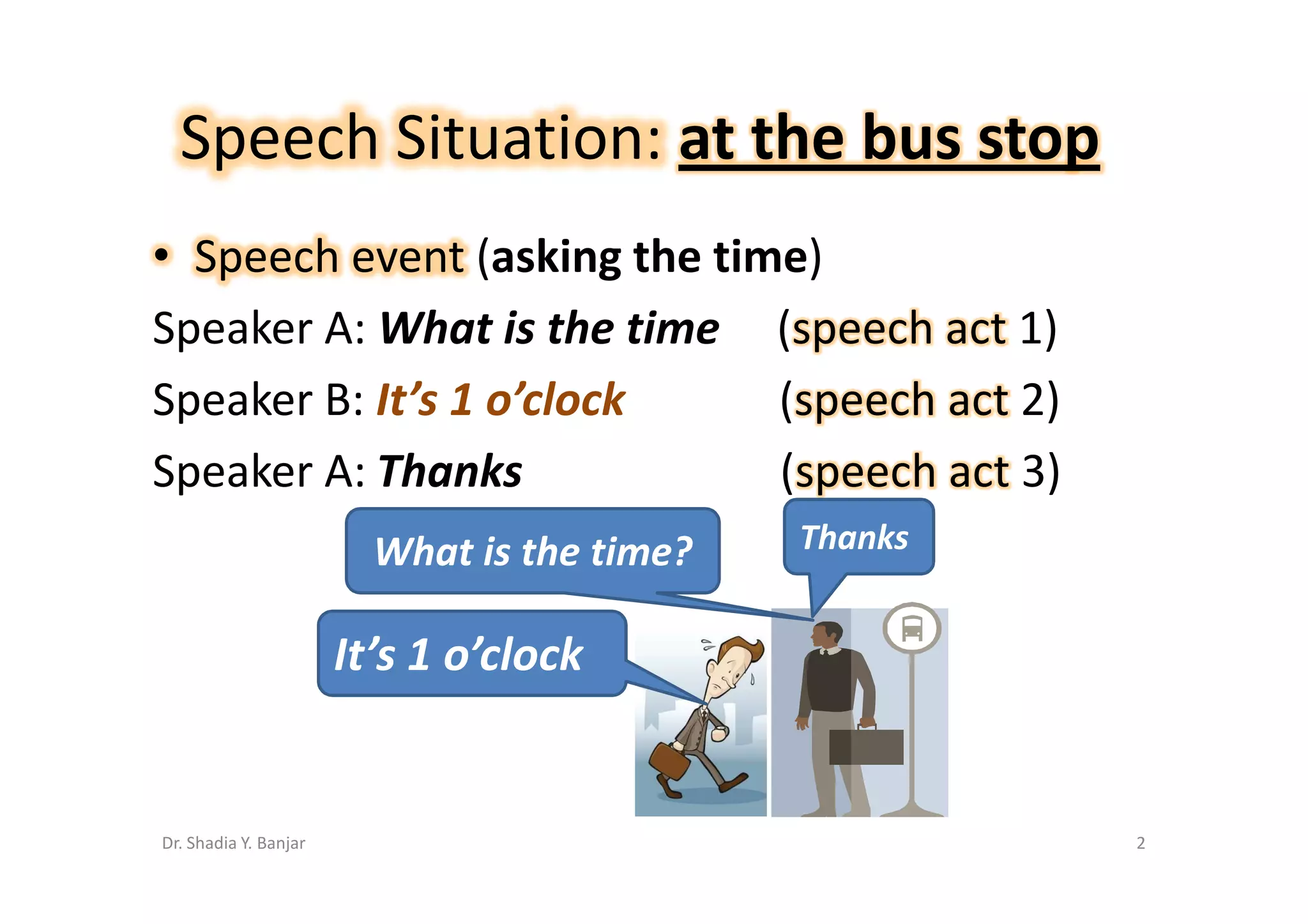
Speech Situation: at the bus stop
• Speech event (asking the time)
Speaker A: What is the time? (speech act 1)
Speaker B: It’s 1 o’clock     (speech act 2)
Speaker A: Thanks             (speech act 3)
                         What is the time?   Thanks


                       It’s 1 o’clock


Dr. Shadia Y. Banjar                                  2
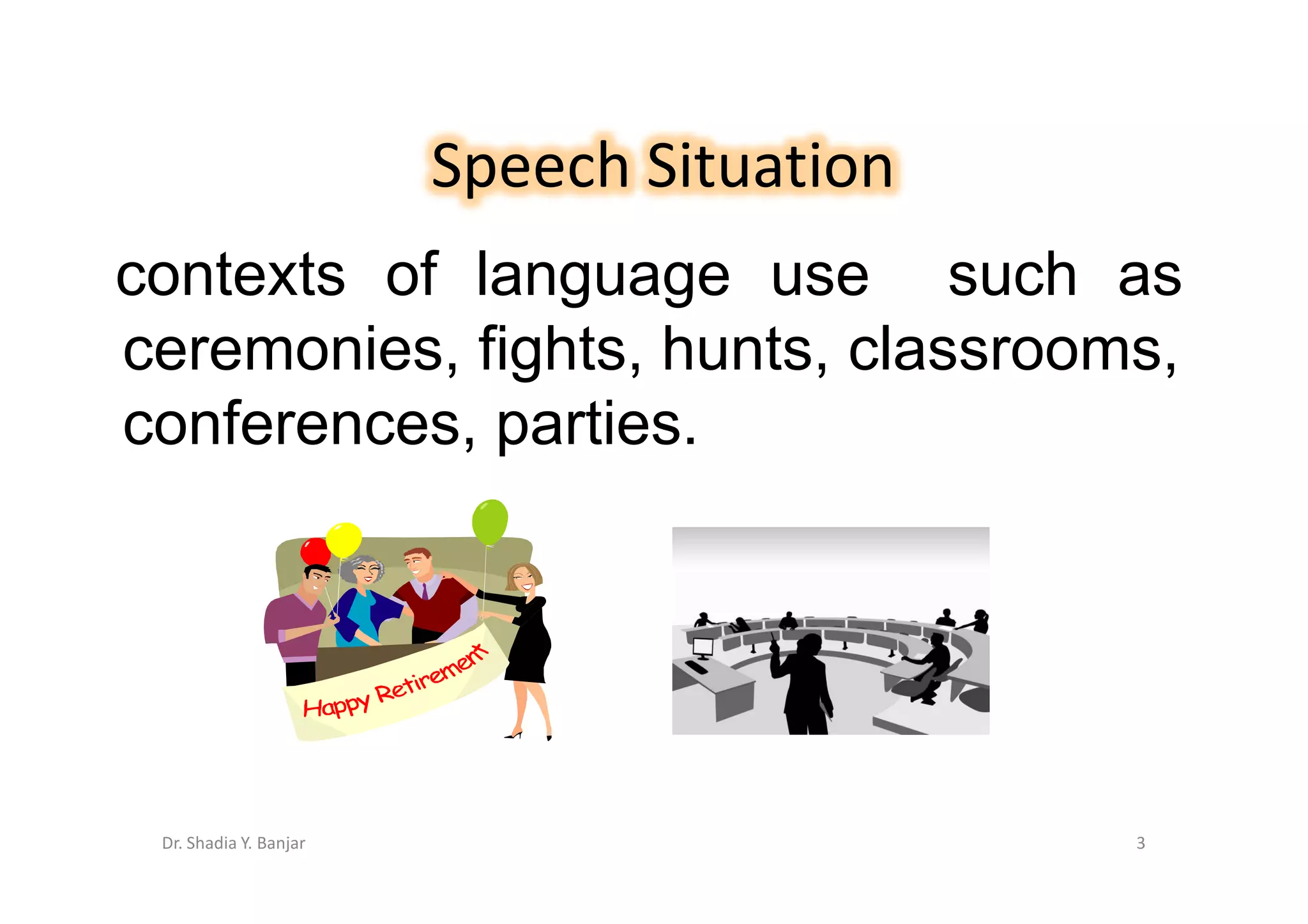
Speech Situation
contexts of language use such as
ceremonies, fights, hunts, classrooms,
conferences, parties.


 Dr. Shadia Y. Banjar                      3
Speech Events
       A Speech Event can be defined by a
        unified set of components through out:
           same purpose of communication
           same topic
           same participants
           same language variety (generally).
      For example: exchanging greetings, telling
      jokes, giving speeches.
Dr. Shadia Y. Banjar                          4
Communicative rule governed sequences.
  Knock knock jokes
  “Knock Knock”
  “Who’s There?”
  “Abby”
  “Abby who?”
  “Abby Birthday to you.”


Dr. Shadia Y. Banjar                     5
Speech Acts
                Speech Acts are group of utterances
                with a single interactional function.
                For example: a request, a command,
                a greeting, a promise, an apology.


Dr. Shadia Y. Banjar                                    6
Speech Acts & Speech Events
  Speech Acts
  • Functional unit at utterance level
  (e.g., thanking, requesting, etc.)
  (Cohen, 2002)
  Speech Events
  • Larger unit with multiple turns (e.g.,
  job interview, etc.) (Hatch, 1992)

Dr. Shadia Y. Banjar                         7
People perform actions via utterances.

[1]
“You’re fired.”

The boss’s utterance in [1]can perform
the act of ending your employment.


Dr. Shadia Y. Banjar                                    8
[2]
          You’re so delicious.
         (                       )
          You’re welcome.
         (                                   )
           You’re crazy.
         (                           )


Dr. Shadia Y. Banjar                     9
Actions performed via
utterances are generally
called speech acts.


Dr. Shadia Y. Banjar   10
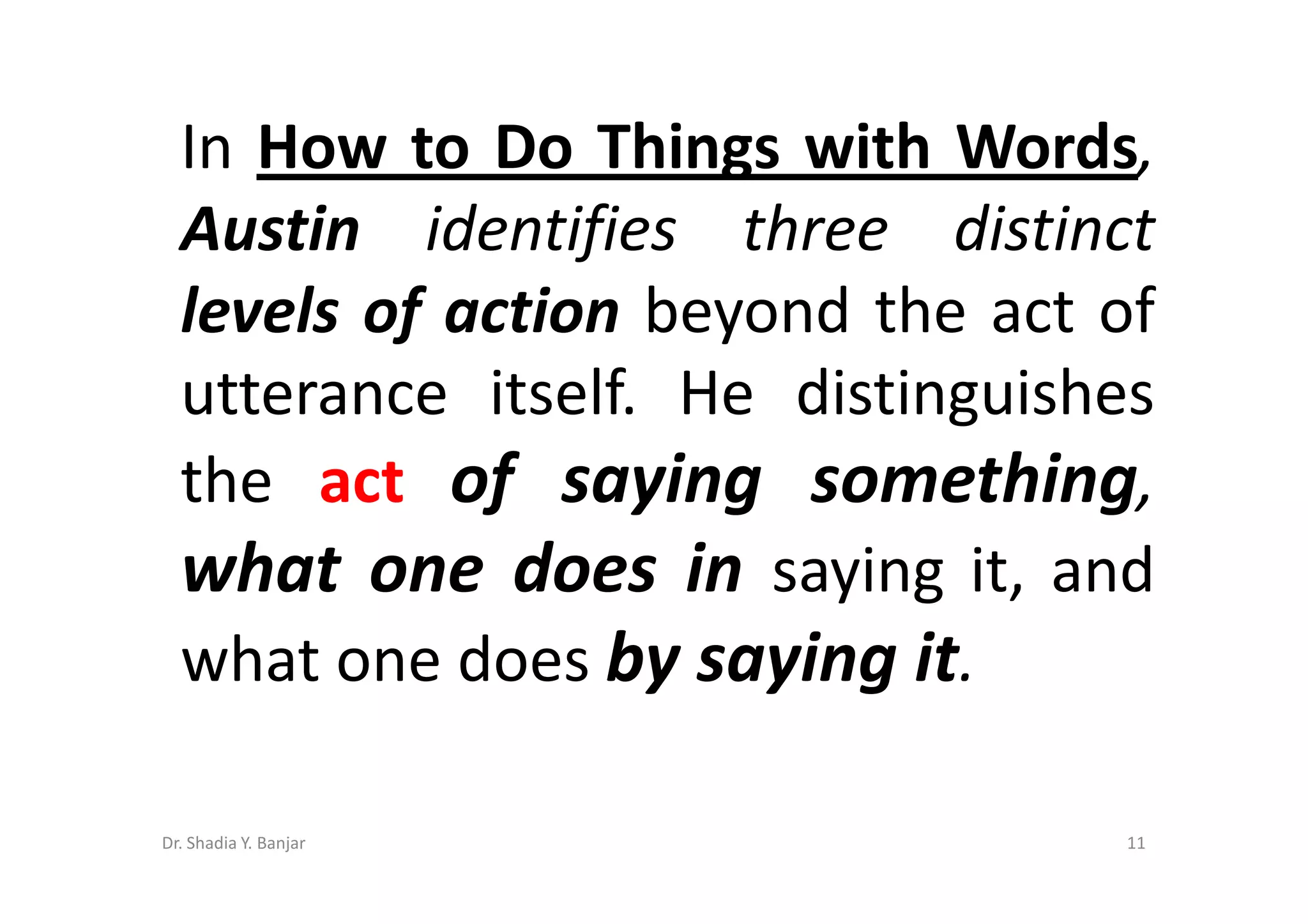
In How to Do Things with Words,
  Austin identifies three distinct
  levels of action beyond the act of
  utterance itself. He distinguishes
  the act of saying something,
  what one does in saying it, and
  what one does by saying it.

Dr. Shadia Y. Banjar               11
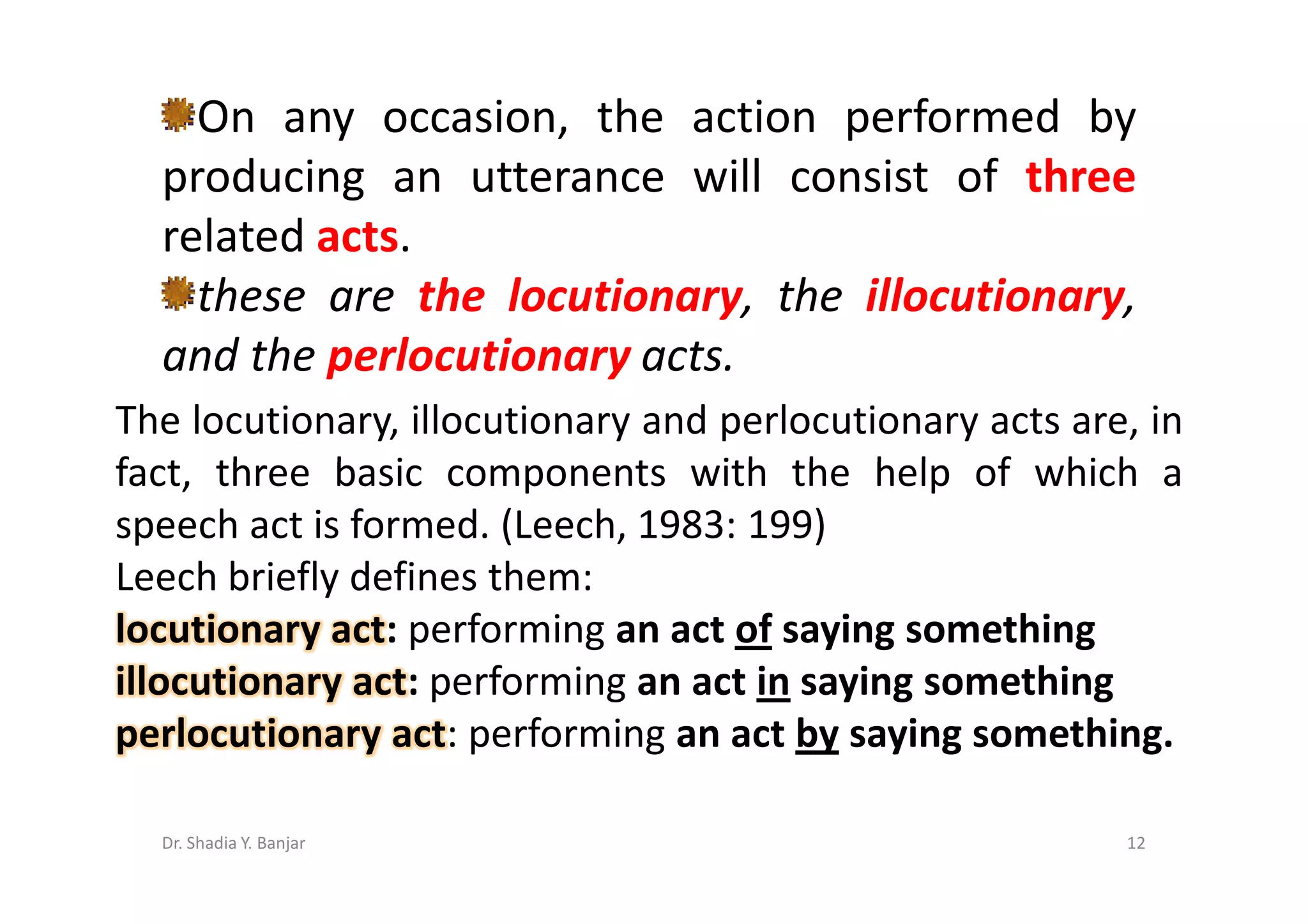
On any occasion, the action performed by
  producing an utterance will consist of three
  related acts.
    these are the locutionary, the illocutionary,
  and the perlocutionary acts.
The locutionary, illocutionary and perlocutionary acts are, in
fact, three basic components with the help of which a
speech act is formed. (Leech, 1983: 199)
Leech briefly defines them:
locutionary act: performing an act of saying something
illocutionary act: performing an act in saying something
perlocutionary act: performing an act by saying something.

  Dr. Shadia Y. Banjar                                    12
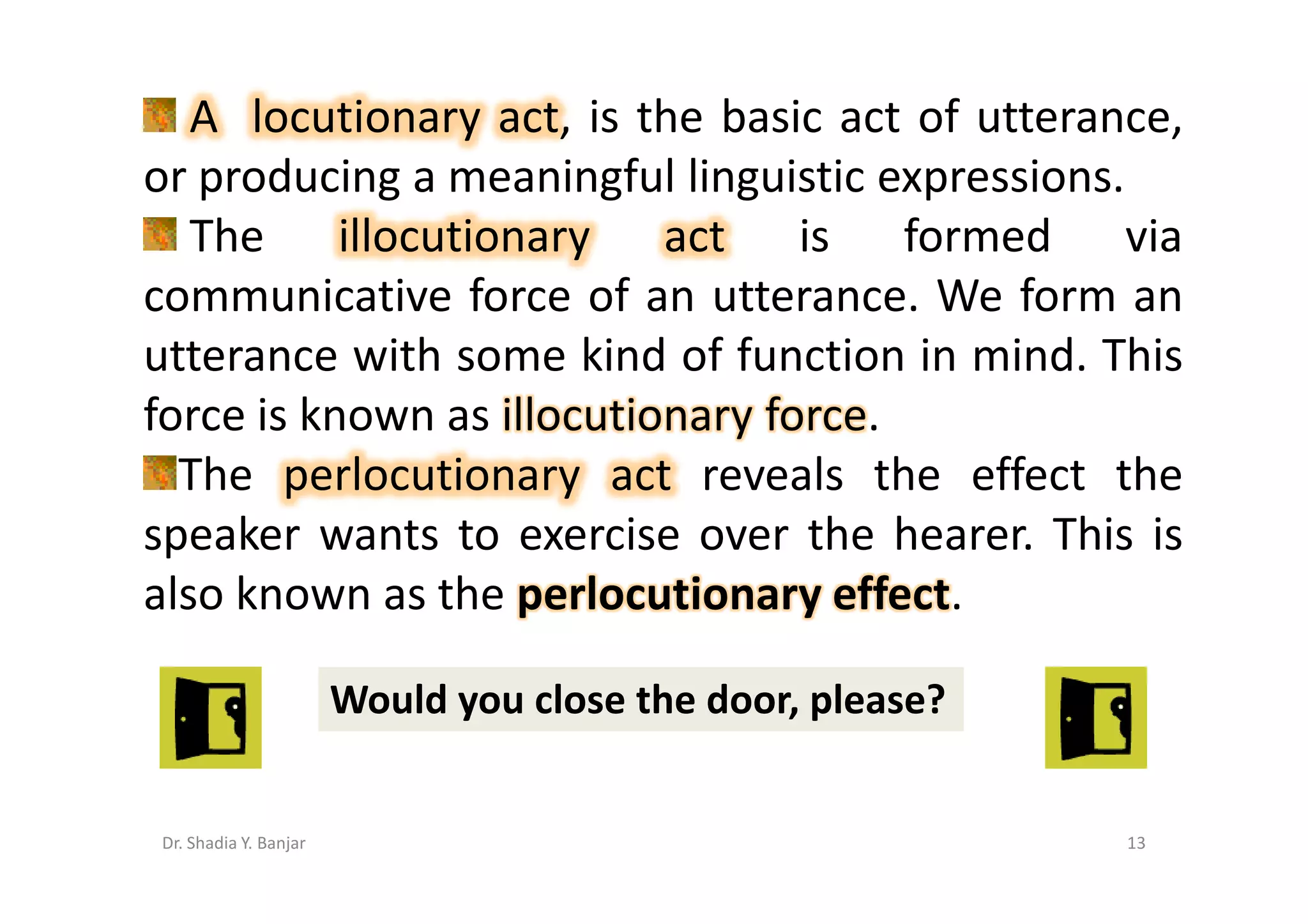
A locutionary act, is the basic act of utterance,
or producing a meaningful linguistic expressions.
   The illocutionary act is formed via
communicative force of an utterance. We form an
utterance with some kind of function in mind. This
force is known as illocutionary force.
  The perlocutionary act reveals the effect the
speaker wants to exercise over the hearer. This is
also known as the perlocutionary effect.

                       Would you close the door, please?


Dr. Shadia Y. Banjar                                       13
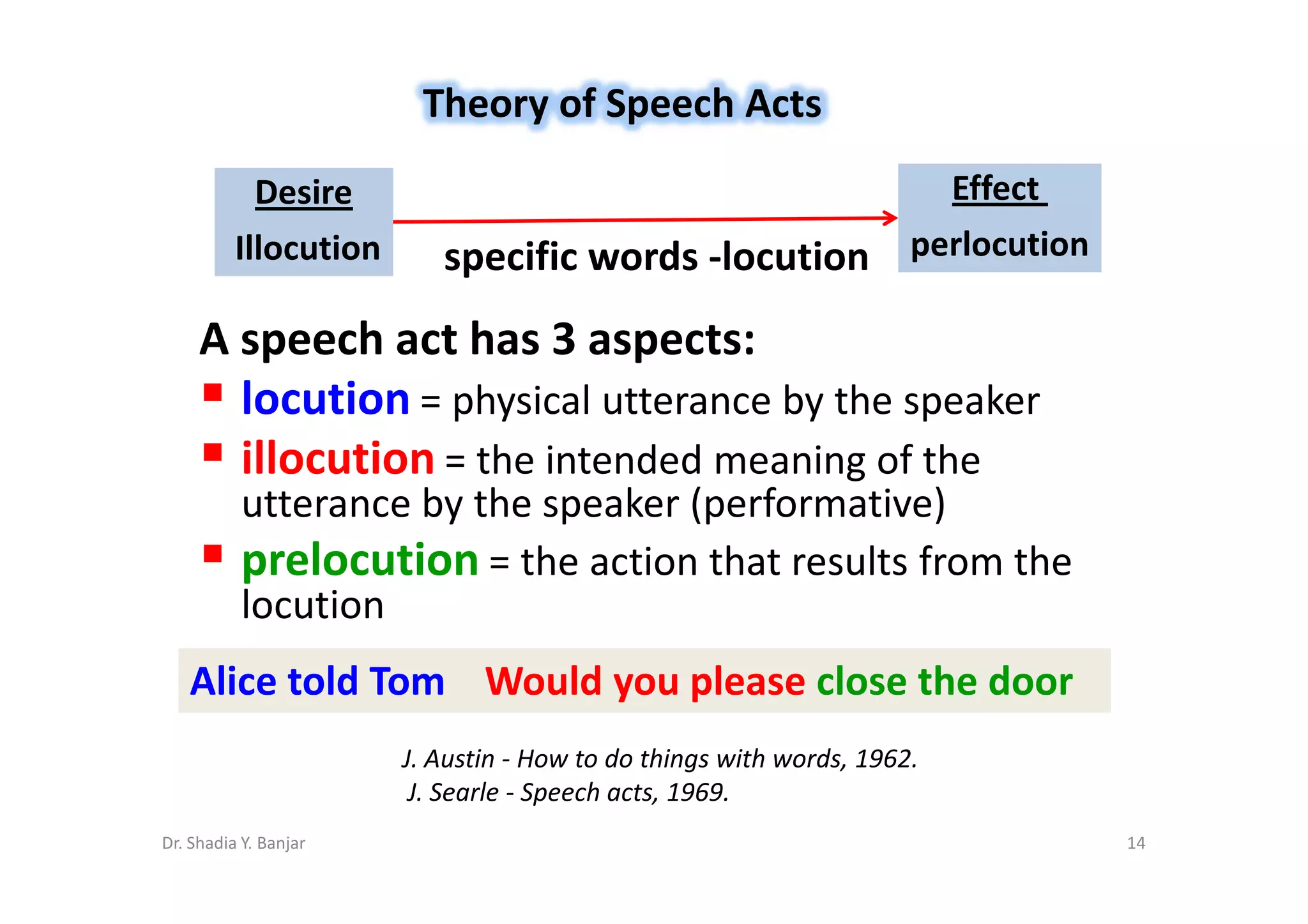
Theory of Speech Acts
            Desire                                                    Effect
          Illocution      specific words -locution                  perlocution

     A speech act has 3 aspects:
       locution = physical utterance by the speaker
       illocution = the intended meaning of the
           utterance by the speaker (performative)
           prelocution = the action that results from the
           locution
   Alice told Tom: "Would you please close the door“
                       J. Austin - How to do things with words, 1962.
                        J. Searle - Speech acts, 1969.
Dr. Shadia Y. Banjar                                                              14
ILLOCUTIONARY FORCE INDICATING DEVICES (IFIDS)
'illocutionary force indicating devices' (IFIDs), are supposed to
be elements, or aspects of linguistic devices which indicate
either (dependent on which conceptions of "illocutionary
force" and "illocutionary act" are adopted) that the utterance
is made with a certain illocutionary force, or else that it
constitutes the performance of a certain illocutionary act. In
English, for example, the interrogative mood is supposed to
indicate that the utterance is (intended as) a question; the
directive mood indicates that the utterance is (intended as) a
directive illocutionary act (an order, a request, etc.); the words
"I promise" are supposed to indicate that the utterance is
(intended as) a promise. Possible IFIDs in English include:
word order, stress, intonation contour, punctuation, the
mood of the verb, and performative verbs.
  Dr. Shadia Y. Banjar                                        15
Felicity Conditions
 Felicity conditions cover expected or appropriate
 circumstances for the performance of a speech
 act to be recognized as intended.
                  I sentence you to six months in prison.

The performance will be infelicitous (inappropriate)
if the speaker is not a specific person in a special
context (in this case, a judge in a courtroom).


 Dr. Shadia Y. Banjar                                       16
Yule proposes further classification of
 felicity conditions into five classes:
    general conditions,
    content conditions,
    preparatory conditions,
    sincerity conditions and
    essential conditions. (Yule, 1996: 50)


Dr. Shadia Y. Banjar                     17
General conditions presuppose the participants’
knowledge of the language being used and his non-
playacting,
    content conditions concern the appropriate content of
an utterance,
    preparatory conditions deal with differences of various
illocutionary acts (e.g. those of promising or warning),
   sincerity conditions count with speaker’s intention to
carry out a certain act, and
    essential conditions combine with a specification of
what must be in the utterance content, the context, and
the speaker’s intentions, in order for a specific act to be
appropriately (felicitously) performed. (Yule,1996:50)

Dr. Shadia Y. Banjar                                    18
It is Austin who comes up with a new category of utterances – the
performatives.
Austin defines a performative as an utterance which contains a
special type of verb (a performative verb) by force of which it
performs an action. In other words, in using a performative, a
person is not just saying something but is actually doing
something (Wardhaugh: 1992: 283). Austin further states that a
performative, unlike a constative, cannot be true or false
(it can only be felicitous or infelicitous) and that it does not
describe, report or constate anything.


 Dr. Shadia Y. Banjar                                         19
THE PERFORMATIVE HYPOTHESIS
He also claims that from the grammatical point of
view, a performative is a first person
indicative active sentence in the simple
present tense. In order to distinguish the
performative use from other possible uses of
first person indicative active pattern, Austin
introduces a hereby test since he finds out that
performative verbs only can collocate with this
adverb.

Dr. Shadia Y. Banjar                            20
U ( utterance)
            I (hereby) Vp you (that) U
1. a. I hereby resign from the post of the Manager of the Sport Club.
   b. I hereby get up at seven o’clock in the morning every day.

 While the first sentence would make sense under
 specific conditions, uttering of the second would
 be rather strange. From this it follows that (1a) is
 a performative, (1b) is not.


  Dr. Shadia Y. Banjar                                           21
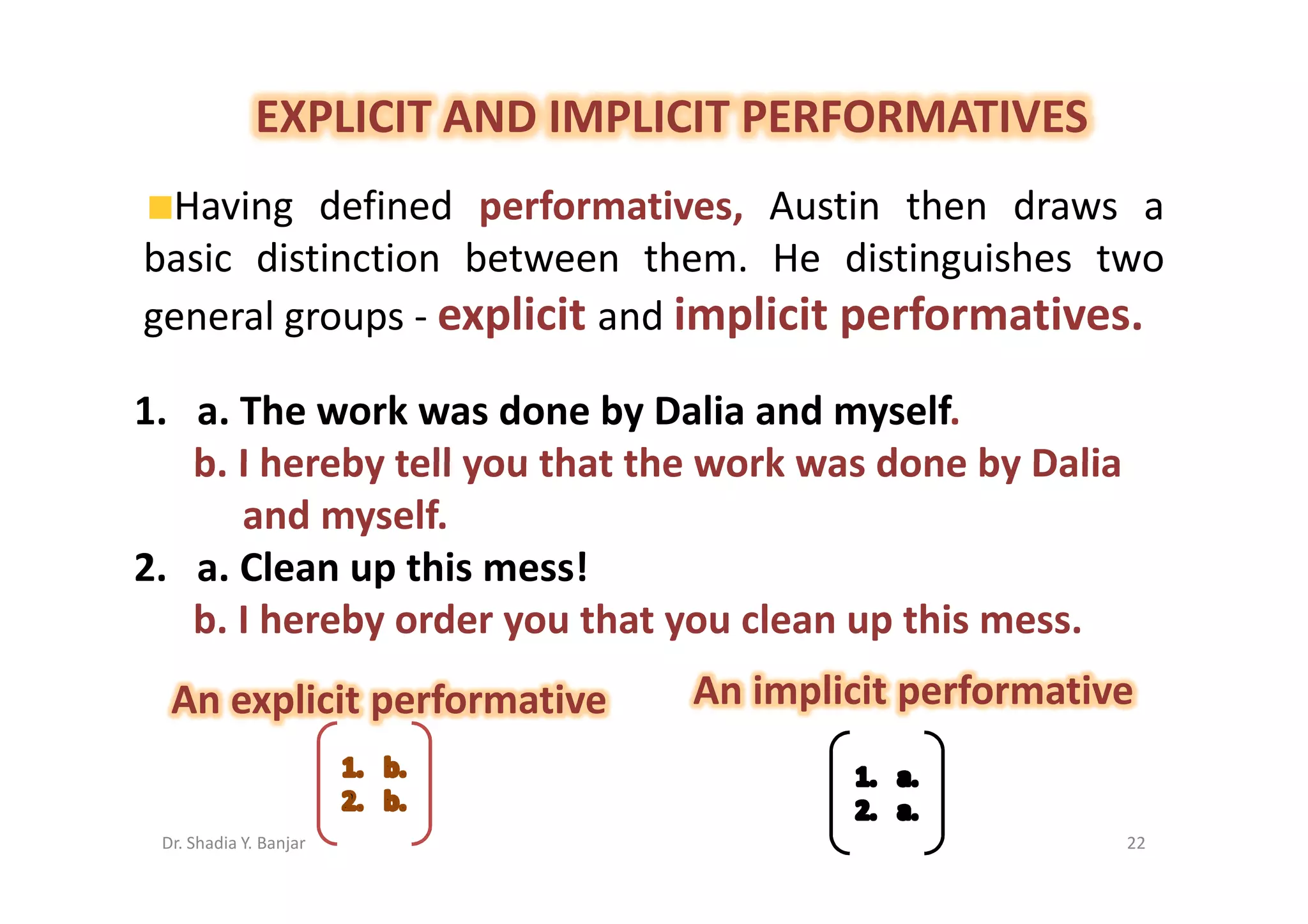
EXPLICIT AND IMPLICIT PERFORMATIVES
 Having defined performatives, Austin then draws a
basic distinction between them. He distinguishes two
general groups - explicit and implicit performatives.

1. a. The work was done by Dalia and myself.
   b. I hereby tell you that the work was done by Dalia
      and myself.
2. a. Clean up this mess!
   b. I hereby order you that you clean up this mess.
  An explicit performative     An implicit performative


 Dr. Shadia Y. Banjar                                     22
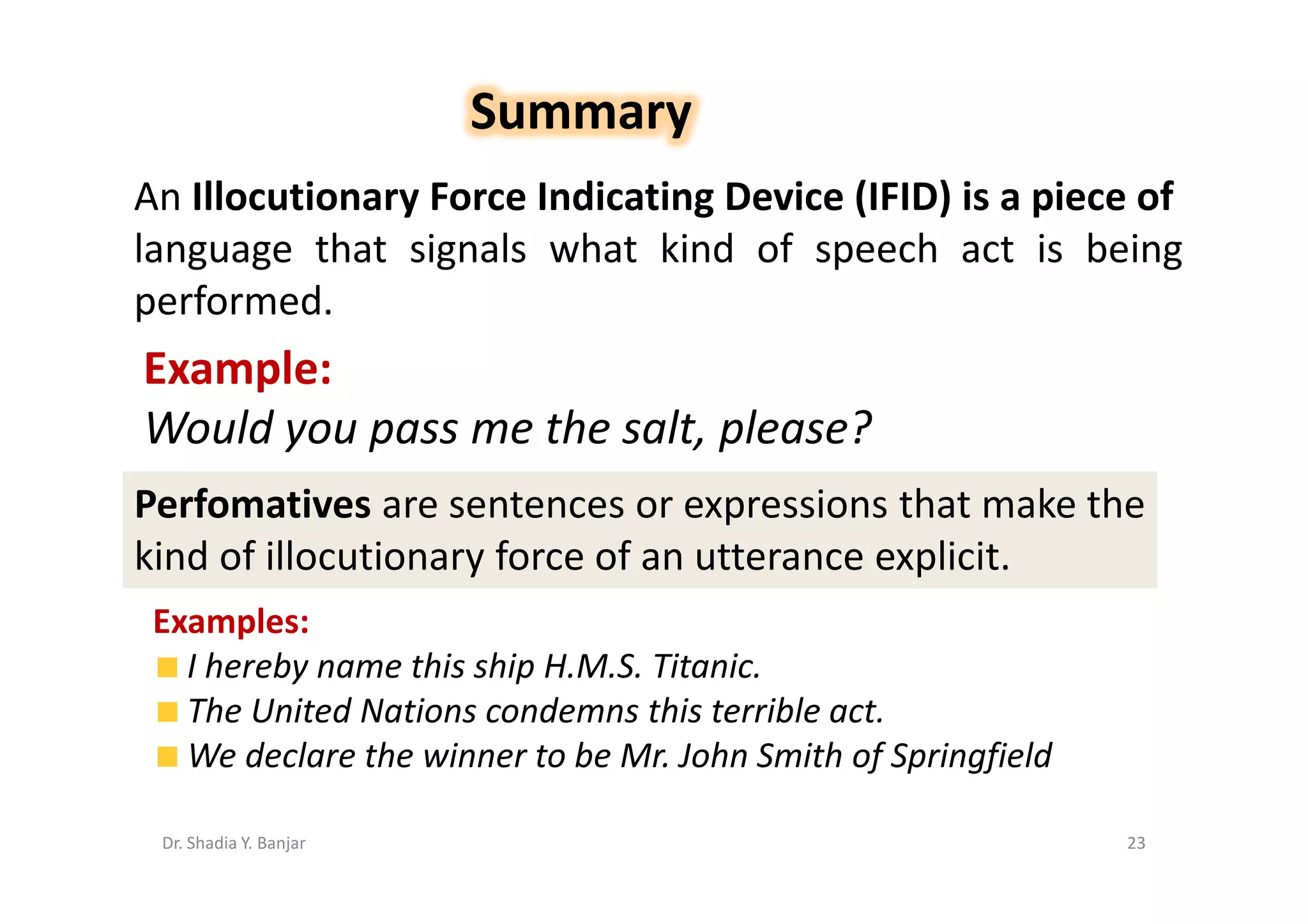
Summary
An Illocutionary Force Indicating Device (IFID) is a piece of
language that signals what kind of speech act is being
performed.
Example:
Would you pass me the salt, please?
Perfomatives are sentences or expressions that make the
kind of illocutionary force of an utterance explicit.
 Examples:
   I hereby name this ship H.M.S. Titanic.
   The United Nations condemns this terrible act.
   We declare the winner to be Mr. John Smith of Springfield

 Dr. Shadia Y. Banjar                                          23
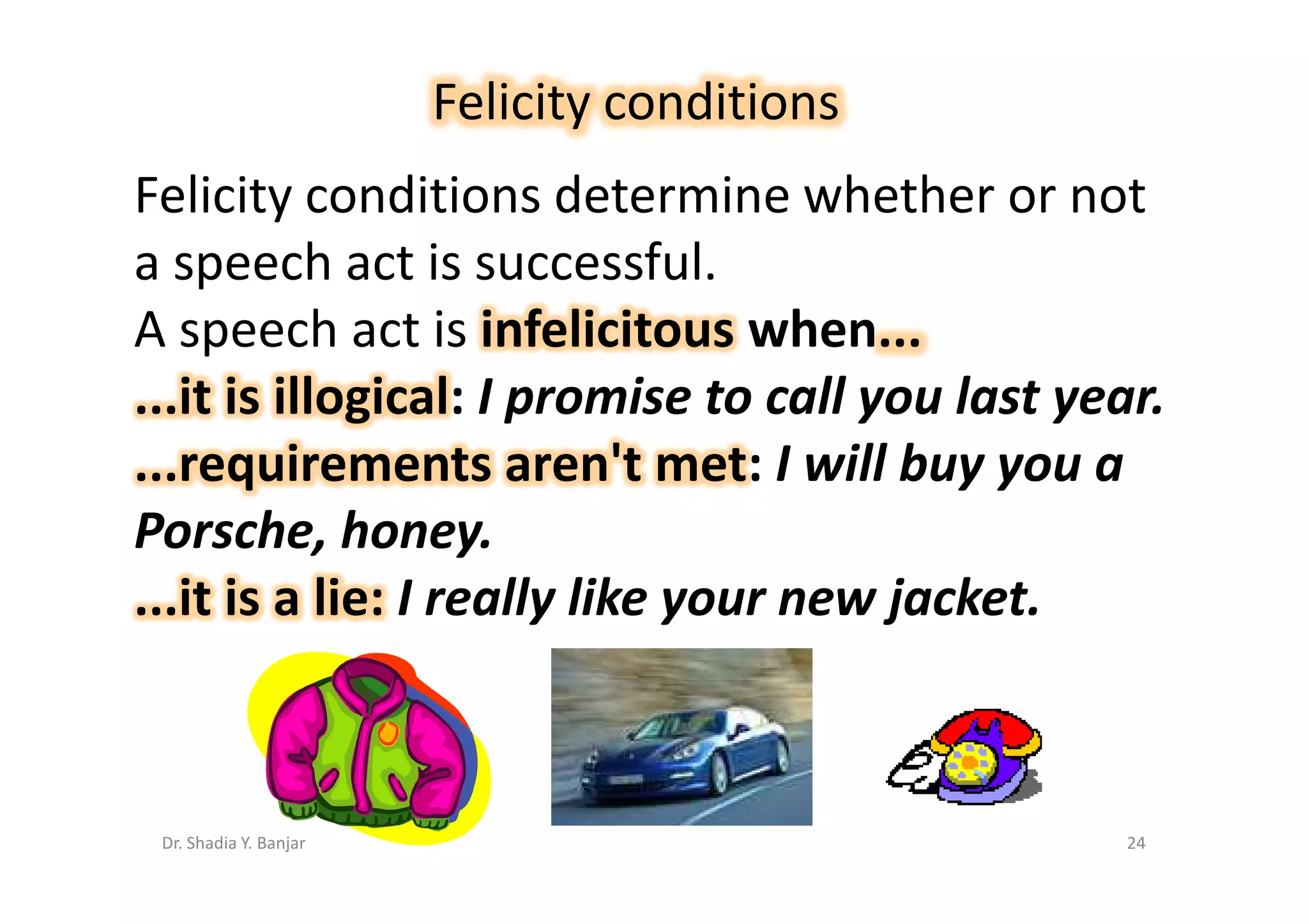
Felicity conditions
Felicity conditions determine whether or not
a speech act is successful.
A speech act is infelicitous when...
...it is illogical: I promise to call you last year.
...requirements aren't met: I will buy you a
Porsche, honey.
...it is a lie: I really like your new jacket.


 Dr. Shadia Y. Banjar                             24
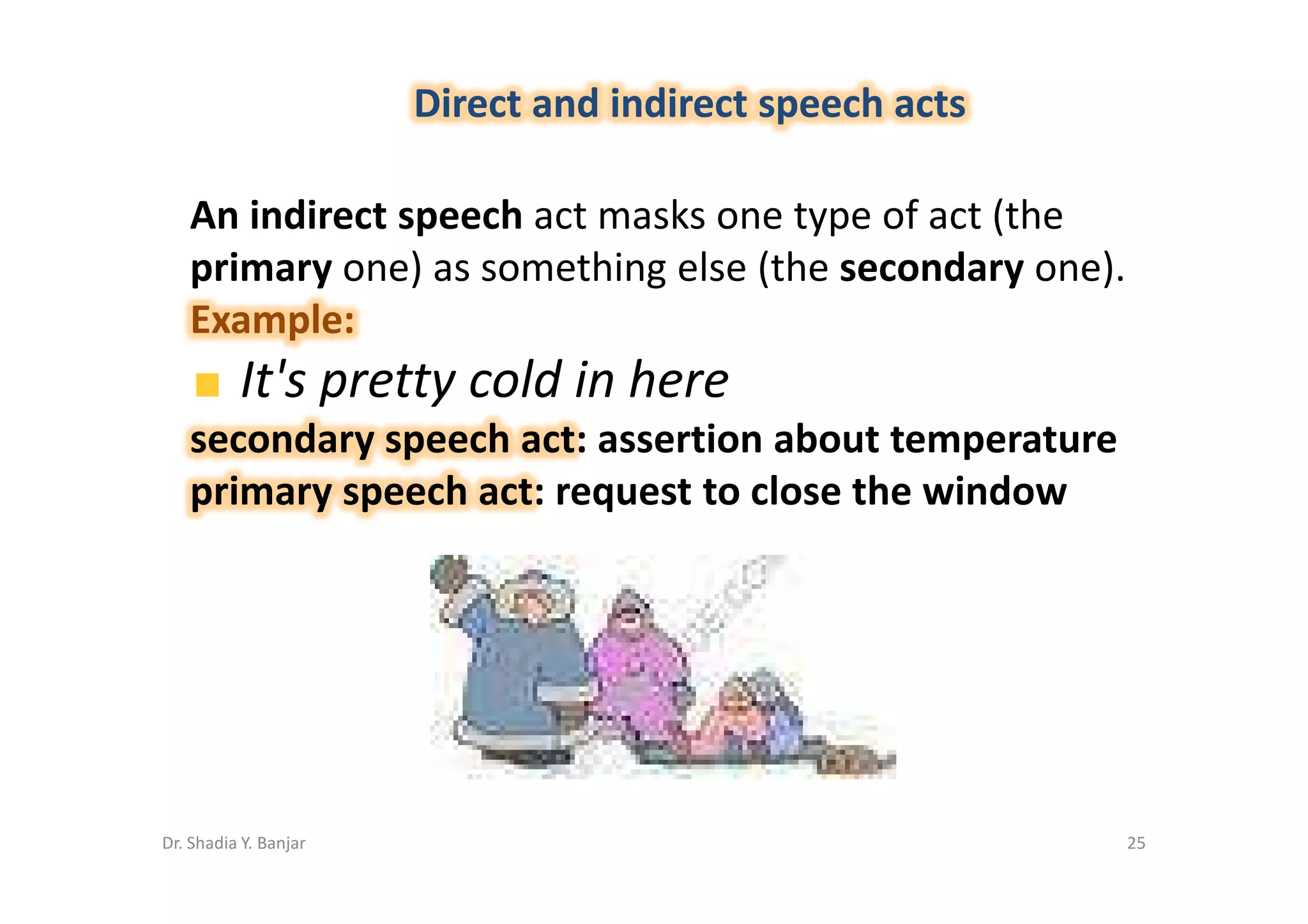
Direct and indirect speech acts

   An indirect speech act masks one type of act (the
   primary one) as something else (the secondary one).
   Example:
          It's pretty cold in here
   secondary speech act: assertion about temperature
   primary speech act: request to close the window


Dr. Shadia Y. Banjar                                     25
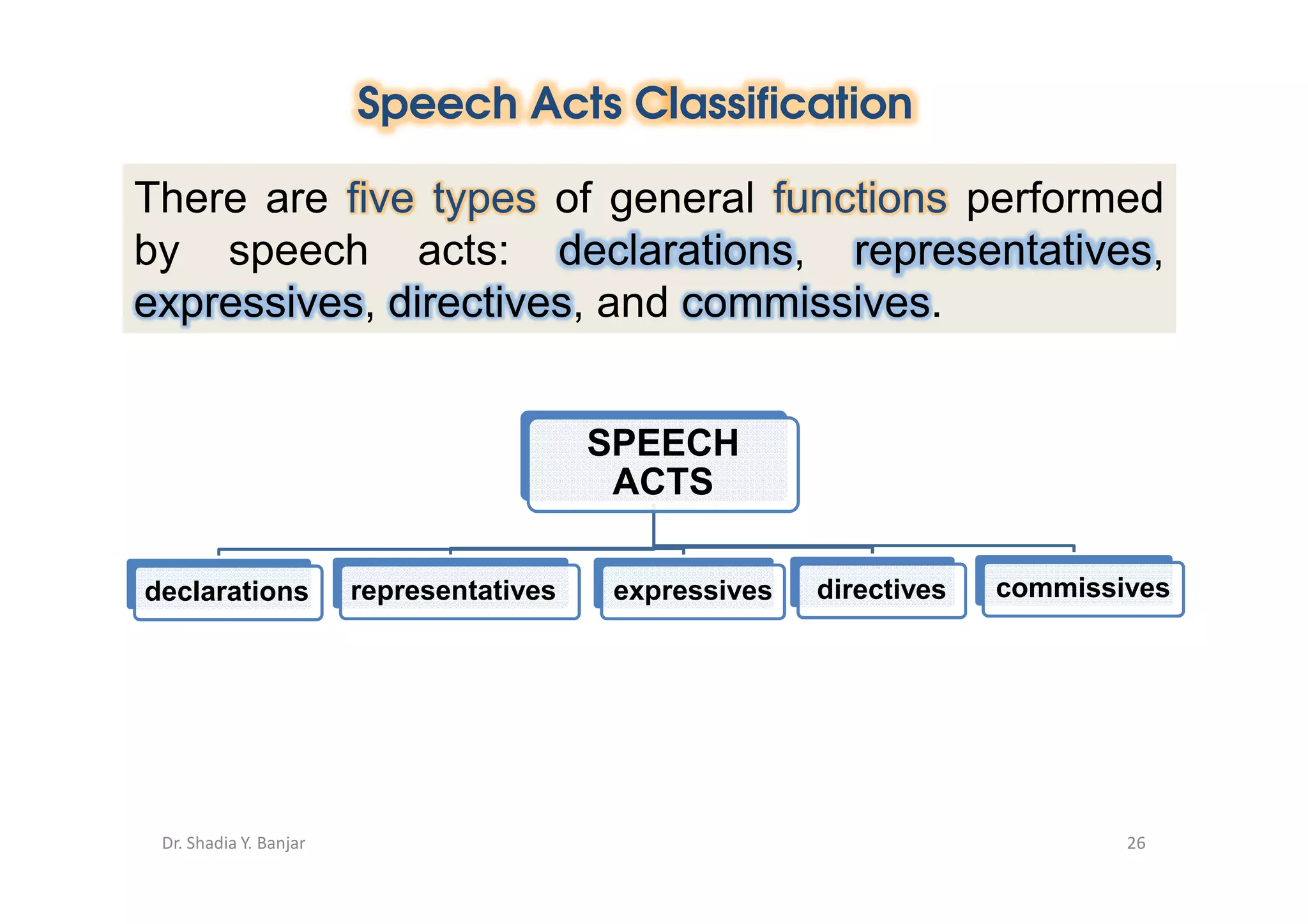
Speech Acts Classification

There are five types of general functions performed
by speech acts: declarations, representatives,
expressives, directives, and commissives.


                                          SPEECH
                                           ACTS

declarations            representatives    expressives   directives   commissives


 Dr. Shadia Y. Banjar                                                         26
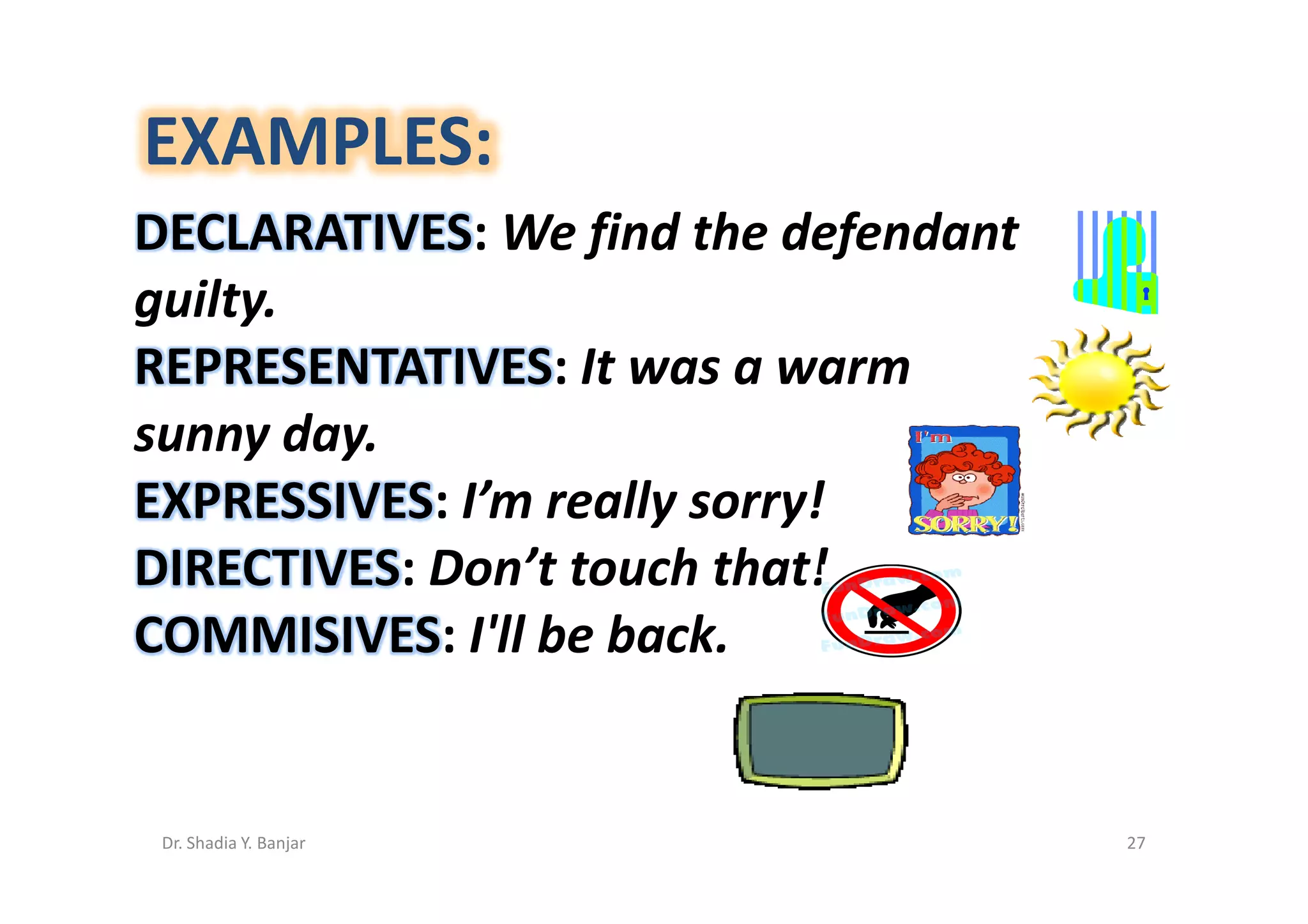
EXAMPLES:
DECLARATIVES: We find the defendant
guilty.
REPRESENTATIVES: It was a warm
sunny day.
EXPRESSIVES: I’m really sorry!
DIRECTIVES: Don’t touch that!
COMMISIVES: I'll be back.


 Dr. Shadia Y. Banjar                 27
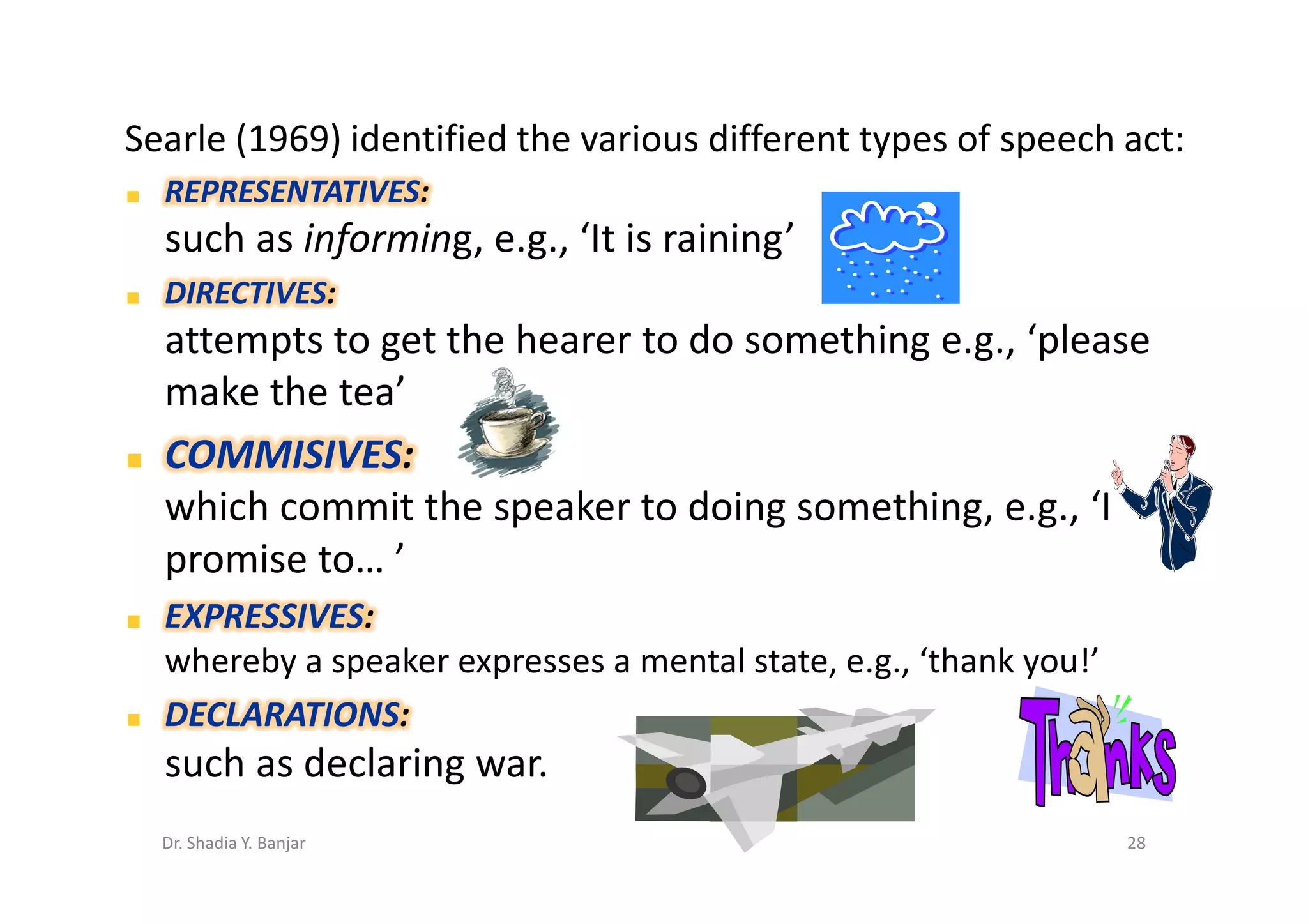
Searle (1969) identified the various different types of speech act:
  REPRESENTATIVES:
  such as informing, e.g., ‘It is raining’
  DIRECTIVES:
  attempts to get the hearer to do something e.g., ‘please
  make the tea’
  COMMISIVES:
  which commit the speaker to doing something, e.g., ‘I
  promise to… ’
  EXPRESSIVES:
  whereby a speaker expresses a mental state, e.g., ‘thank you!’
  DECLARATIONS:
  such as declaring war.
  Dr. Shadia Y. Banjar                                             28
Dr. Shadia Y. Banjar   29

Speechactsandspeechevent

  • 1.
    Speech Acts andSpeech Events By: http://www.kau.edu.sa/SBANJAR Dr. Shadia Y. Banjar http://wwwdrshadiabanjar.blogspot.com Dr. Shadia Y. Banjar 1
  • 2.
    Speech Situation: atthe bus stop • Speech event (asking the time) Speaker A: What is the time? (speech act 1) Speaker B: It’s 1 o’clock (speech act 2) Speaker A: Thanks (speech act 3) What is the time? Thanks It’s 1 o’clock Dr. Shadia Y. Banjar 2
  • 3.
    Speech Situation contexts oflanguage use such as ceremonies, fights, hunts, classrooms, conferences, parties. Dr. Shadia Y. Banjar 3
  • 4.
    Speech Events A Speech Event can be defined by a unified set of components through out: same purpose of communication same topic same participants same language variety (generally). For example: exchanging greetings, telling jokes, giving speeches. Dr. Shadia Y. Banjar 4
  • 5.
    Communicative rule governedsequences. Knock knock jokes “Knock Knock” “Who’s There?” “Abby” “Abby who?” “Abby Birthday to you.” Dr. Shadia Y. Banjar 5
  • 6.
    Speech Acts Speech Acts are group of utterances with a single interactional function. For example: a request, a command, a greeting, a promise, an apology. Dr. Shadia Y. Banjar 6
  • 7.
    Speech Acts &Speech Events Speech Acts • Functional unit at utterance level (e.g., thanking, requesting, etc.) (Cohen, 2002) Speech Events • Larger unit with multiple turns (e.g., job interview, etc.) (Hatch, 1992) Dr. Shadia Y. Banjar 7
  • 8.
    People perform actionsvia utterances. [1] “You’re fired.” The boss’s utterance in [1]can perform the act of ending your employment. Dr. Shadia Y. Banjar 8
  • 9.
    [2] You’re so delicious. ( ) You’re welcome. ( ) You’re crazy. ( ) Dr. Shadia Y. Banjar 9
  • 10.
    Actions performed via utterancesare generally called speech acts. Dr. Shadia Y. Banjar 10
  • 11.
    In How toDo Things with Words, Austin identifies three distinct levels of action beyond the act of utterance itself. He distinguishes the act of saying something, what one does in saying it, and what one does by saying it. Dr. Shadia Y. Banjar 11
  • 12.
    On any occasion,the action performed by producing an utterance will consist of three related acts. these are the locutionary, the illocutionary, and the perlocutionary acts. The locutionary, illocutionary and perlocutionary acts are, in fact, three basic components with the help of which a speech act is formed. (Leech, 1983: 199) Leech briefly defines them: locutionary act: performing an act of saying something illocutionary act: performing an act in saying something perlocutionary act: performing an act by saying something. Dr. Shadia Y. Banjar 12
  • 13.
    A locutionary act,is the basic act of utterance, or producing a meaningful linguistic expressions. The illocutionary act is formed via communicative force of an utterance. We form an utterance with some kind of function in mind. This force is known as illocutionary force. The perlocutionary act reveals the effect the speaker wants to exercise over the hearer. This is also known as the perlocutionary effect. Would you close the door, please? Dr. Shadia Y. Banjar 13
  • 14.
    Theory of SpeechActs Desire Effect Illocution specific words -locution perlocution A speech act has 3 aspects: locution = physical utterance by the speaker illocution = the intended meaning of the utterance by the speaker (performative) prelocution = the action that results from the locution Alice told Tom: "Would you please close the door“ J. Austin - How to do things with words, 1962. J. Searle - Speech acts, 1969. Dr. Shadia Y. Banjar 14
  • 15.
    ILLOCUTIONARY FORCE INDICATINGDEVICES (IFIDS) 'illocutionary force indicating devices' (IFIDs), are supposed to be elements, or aspects of linguistic devices which indicate either (dependent on which conceptions of "illocutionary force" and "illocutionary act" are adopted) that the utterance is made with a certain illocutionary force, or else that it constitutes the performance of a certain illocutionary act. In English, for example, the interrogative mood is supposed to indicate that the utterance is (intended as) a question; the directive mood indicates that the utterance is (intended as) a directive illocutionary act (an order, a request, etc.); the words "I promise" are supposed to indicate that the utterance is (intended as) a promise. Possible IFIDs in English include: word order, stress, intonation contour, punctuation, the mood of the verb, and performative verbs. Dr. Shadia Y. Banjar 15
  • 16.
    Felicity Conditions Felicityconditions cover expected or appropriate circumstances for the performance of a speech act to be recognized as intended. I sentence you to six months in prison. The performance will be infelicitous (inappropriate) if the speaker is not a specific person in a special context (in this case, a judge in a courtroom). Dr. Shadia Y. Banjar 16
  • 17.
    Yule proposes furtherclassification of felicity conditions into five classes: general conditions, content conditions, preparatory conditions, sincerity conditions and essential conditions. (Yule, 1996: 50) Dr. Shadia Y. Banjar 17
  • 18.
    General conditions presupposethe participants’ knowledge of the language being used and his non- playacting, content conditions concern the appropriate content of an utterance, preparatory conditions deal with differences of various illocutionary acts (e.g. those of promising or warning), sincerity conditions count with speaker’s intention to carry out a certain act, and essential conditions combine with a specification of what must be in the utterance content, the context, and the speaker’s intentions, in order for a specific act to be appropriately (felicitously) performed. (Yule,1996:50) Dr. Shadia Y. Banjar 18
  • 19.
    It is Austinwho comes up with a new category of utterances – the performatives. Austin defines a performative as an utterance which contains a special type of verb (a performative verb) by force of which it performs an action. In other words, in using a performative, a person is not just saying something but is actually doing something (Wardhaugh: 1992: 283). Austin further states that a performative, unlike a constative, cannot be true or false (it can only be felicitous or infelicitous) and that it does not describe, report or constate anything. Dr. Shadia Y. Banjar 19
  • 20.
    THE PERFORMATIVE HYPOTHESIS Healso claims that from the grammatical point of view, a performative is a first person indicative active sentence in the simple present tense. In order to distinguish the performative use from other possible uses of first person indicative active pattern, Austin introduces a hereby test since he finds out that performative verbs only can collocate with this adverb. Dr. Shadia Y. Banjar 20
  • 21.
    U ( utterance) I (hereby) Vp you (that) U 1. a. I hereby resign from the post of the Manager of the Sport Club. b. I hereby get up at seven o’clock in the morning every day. While the first sentence would make sense under specific conditions, uttering of the second would be rather strange. From this it follows that (1a) is a performative, (1b) is not. Dr. Shadia Y. Banjar 21
  • 22.
    EXPLICIT AND IMPLICITPERFORMATIVES Having defined performatives, Austin then draws a basic distinction between them. He distinguishes two general groups - explicit and implicit performatives. 1. a. The work was done by Dalia and myself. b. I hereby tell you that the work was done by Dalia and myself. 2. a. Clean up this mess! b. I hereby order you that you clean up this mess. An explicit performative An implicit performative Dr. Shadia Y. Banjar 22
  • 23.
    Summary An Illocutionary ForceIndicating Device (IFID) is a piece of language that signals what kind of speech act is being performed. Example: Would you pass me the salt, please? Perfomatives are sentences or expressions that make the kind of illocutionary force of an utterance explicit. Examples: I hereby name this ship H.M.S. Titanic. The United Nations condemns this terrible act. We declare the winner to be Mr. John Smith of Springfield Dr. Shadia Y. Banjar 23
  • 24.
    Felicity conditions Felicity conditionsdetermine whether or not a speech act is successful. A speech act is infelicitous when... ...it is illogical: I promise to call you last year. ...requirements aren't met: I will buy you a Porsche, honey. ...it is a lie: I really like your new jacket. Dr. Shadia Y. Banjar 24
  • 25.
    Direct and indirectspeech acts An indirect speech act masks one type of act (the primary one) as something else (the secondary one). Example: It's pretty cold in here secondary speech act: assertion about temperature primary speech act: request to close the window Dr. Shadia Y. Banjar 25
  • 26.
    Speech Acts Classification Thereare five types of general functions performed by speech acts: declarations, representatives, expressives, directives, and commissives. SPEECH ACTS declarations representatives expressives directives commissives Dr. Shadia Y. Banjar 26
  • 27.
    EXAMPLES: DECLARATIVES: We findthe defendant guilty. REPRESENTATIVES: It was a warm sunny day. EXPRESSIVES: I’m really sorry! DIRECTIVES: Don’t touch that! COMMISIVES: I'll be back. Dr. Shadia Y. Banjar 27
  • 28.
    Searle (1969) identifiedthe various different types of speech act: REPRESENTATIVES: such as informing, e.g., ‘It is raining’ DIRECTIVES: attempts to get the hearer to do something e.g., ‘please make the tea’ COMMISIVES: which commit the speaker to doing something, e.g., ‘I promise to… ’ EXPRESSIVES: whereby a speaker expresses a mental state, e.g., ‘thank you!’ DECLARATIONS: such as declaring war. Dr. Shadia Y. Banjar 28
  • 29.
    Dr. Shadia Y.Banjar 29