Building Fluency:  Do It Well and Do It Right! Archived Information
Session Outcomes Teachers will: Understand the role of fluency in word recognition, oral reading, silent reading, and comprehension. Define and identify examples of text at a student’s frustration, instructional, and independent reading level. Understand the stages of reading development and the consequences of practice and instruction.
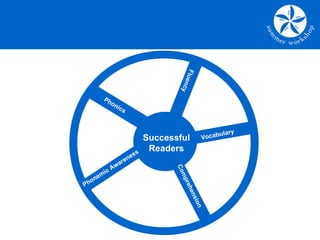
Phonemic Awareness Phonics Fluency Comprehension Successful Readers Vocabulary
Automaticity or Fluency? Automaticity:  Fast, effortless word recognition without expression. Fluency:  The ability to read accurately, quickly and with appropriate intonation and expression. (Put Reading First 2001, 22)
Fluent Readers … Recognize words automatically Read aloud effortlessly and with expression Do not have to concentrate on decoding Can focus on comprehension (Put Reading First 2001, 22)
What is Fluency? Speed + Accuracy = Fluency Reading quickly and in a meaningful way (prosody) Decoding and comprehending simultaneously Freedom from word identification problems Fluency  is derived from the Latin word  fluens  which means “to flow” Smooth and effortless reading
The fluent reader sounds good, is easy to listen to, and reads with enough expression to help the listener understand and enjoy  the material. ( Charles Clark 1999)
Why Fluency? “44 % of a representative sample of the nation’s fourth graders were low in fluency. (NAEP)” “Fluency is a neglected skill in many American classrooms, affecting many student’s reading comprehension.” “It provides a bridge between word recognition and comprehension.” (Put Reading First 2001, 22-23)
Indicators of Fluency Reading with expression Recall/Retelling Words per minute
Partner Activity Individually read one of the passages given to you aloud to a partner.  Switch roles. Discuss whether you read them fluently or not.  Identify the factors that may have inhibited fluent reading of the texts.
Some Factors that Inhibit Fluency... Unfamiliarity with text Limited vocabulary Difficulty with syntax Decoding breakdown
Partner Discussion Think about and discuss some ways a teacher might go about teaching the concept of fluency to students.
Assessing Reading Fluency Formally and informally Timed grade level passages Accuracy and speed Monitoring progress
Assessing Fluency Select a grade level passage. Student reads for one minute. Compute the number of words read in one minute. Count the number of errors. Subtract the number of errors from the number of words read.
What Skills do Students Need to be Fluent? Decoding  Comprehension
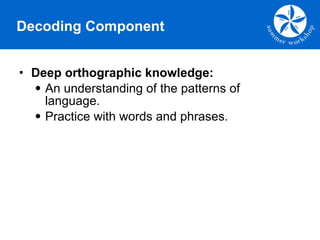
Decoding Component Deep orthographic knowledge: An understanding of the patterns of language. Practice with words and phrases.
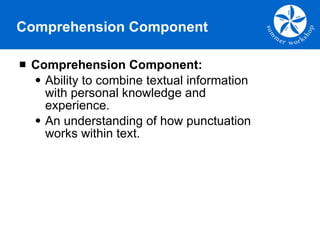
Comprehension Component Comprehension Component: Ability to combine textual information with personal knowledge and experience. An understanding of how punctuation works within text.
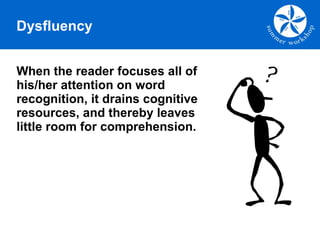
When the reader focuses all of his/her attention on word recognition, it drains cognitive resources, and thereby leaves little room for comprehension. Dysfluency
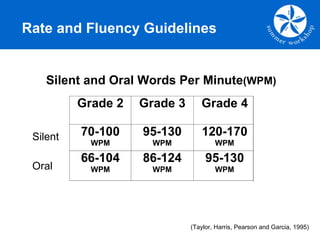
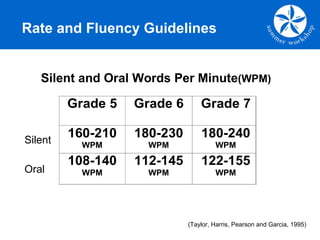
Rate and Fluency Guidelines Silent and Oral Words Per Minute (WPM) (Taylor, Harris, Pearson and Garcia, 1995) Silent Oral
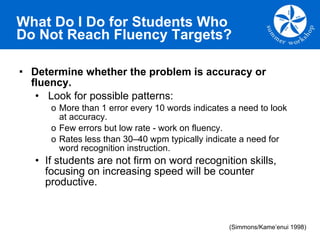
What Do I Do for Students Who Do Not Reach Fluency Targets? Determine whether the problem is accuracy or fluency. Look for possible patterns: More than 1 error every 10 words indicates a need to look at accuracy. Few errors but low rate - work on fluency. Rates less than 30–40 wpm typically indicate a need for word recognition instruction. If students are not firm on word recognition skills, focusing on increasing speed will be counter productive. (Simmons/Kame’enui 1998)
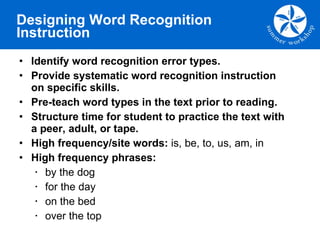
Designing Word Recognition Instruction Identify word recognition error types.  Provide systematic word recognition instruction on specific skills. Pre-teach word types in the text prior to reading.  Structure time for student to practice the text with a peer, adult, or tape. High frequency/site words:  is, be, to, us, am, in   High frequency phrases:  by the dog for the day  on the bed over the top
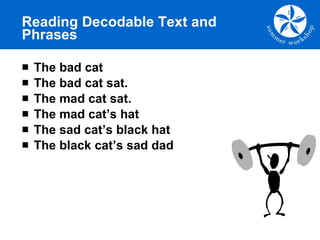
Reading Decodable Text and Phrases The bad cat The bad cat sat. The mad cat sat. The mad cat’s hat The sad cat’s black hat The black cat’s sad dad
If the Problem is Fluency... Students who read significantly below fluency targets will require: Fluency instruction and modeling Daily fluency practice
Teacher Instruction and Modeling Read aloud Think aloud Echo reading Choral reading
Teacher reads the text with and without prosody. Students analyze text for clues to prosody. Students add “signals” to text. Students practice reading. Prosody
Partner Activity With your partner, use the passages provided to practice the prosody instructional techniques.  Discuss how these could be adapted and/or develop other ideas for prosody instruction.
Reading Aloud With Guidance Repeated readings with guidance Text at their independent level With an adult, partner, group or a tape
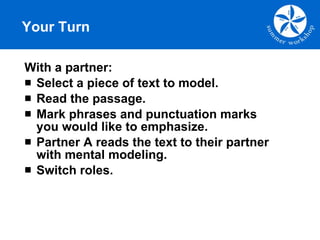
Your Turn With a partner: Select a piece of text to model. Read the passage. Mark phrases and punctuation marks you would like to emphasize.  Partner A reads the text to their partner with mental modeling. Switch roles.
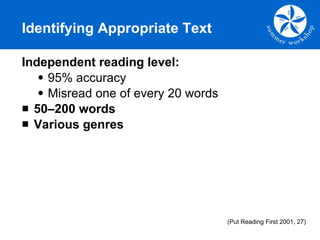
Identifying Appropriate Text Independent reading level: 95% accuracy Misread one of every 20 words 50–200 words Various genres (Put Reading First 2001, 27)
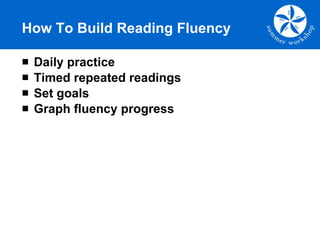
How To Build Reading Fluency Daily practice Timed repeated readings Set goals Graph fluency progress
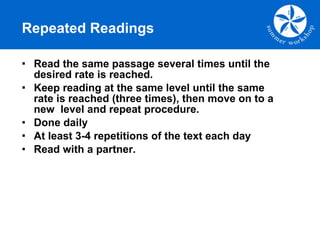
Read the same passage several times until the desired rate is reached.  Keep reading at the same level until the same rate is reached (three times), then move on to a new  level and repeat procedure.  Done daily At least 3-4 repetitions of the text each day  Read with a partner. Repeated Readings
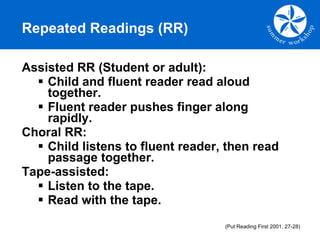
Assisted RR (Student or adult): Child and fluent reader read aloud  together. Fluent reader pushes finger along rapidly. Choral RR: Child listens to fluent reader, then read passage together. Tape-assisted: Listen to the tape. Read with the tape. Repeated Readings (RR) (Put Reading First 2001, 27-28)
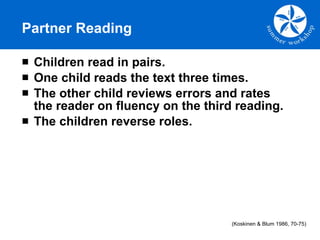
Partner Reading Children read in pairs. One child reads the text three times. The other child reviews errors and rates the reader on fluency on the third reading. The children reverse roles. (Koskinen & Blum 1986, 70-75)
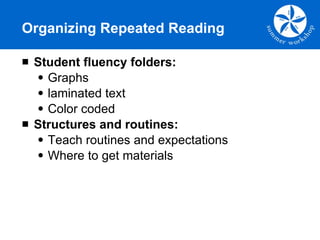
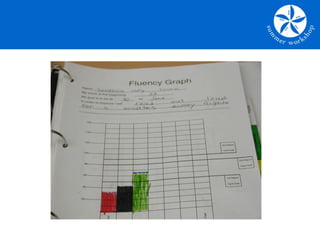
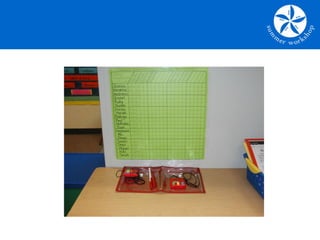
Organizing Repeated Reading Student fluency folders: Graphs laminated text Color coded Structures and routines: Teach routines and expectations Where to get materials


Why Repeated Reading? Fluency rate increases with each reading. Word recognition errors drop. Improves rate on the next passage.
Your Turn Practice repeated reading with a partner. Use the text provided. Graph your rate for three readings.
Home Reading Encourage students to read at home. Provide appropriate text when possible. Encourage students to continue repeated readings at home.
Closing Imagine a student that you are working with that is struggling with reading fluency. Select two or three instructional strategies that you learned today that you feel would be helpful in improving their fluency. Share with a partner what strategies you  have selected to assist this student.
Fluency

  • 1.
    Building Fluency: Do It Well and Do It Right! Archived Information
  • 2.
    Session Outcomes Teacherswill: Understand the role of fluency in word recognition, oral reading, silent reading, and comprehension. Define and identify examples of text at a student’s frustration, instructional, and independent reading level. Understand the stages of reading development and the consequences of practice and instruction.
  • 3.
    Phonemic Awareness PhonicsFluency Comprehension Successful Readers Vocabulary
  • 4.
    Automaticity or Fluency?Automaticity: Fast, effortless word recognition without expression. Fluency: The ability to read accurately, quickly and with appropriate intonation and expression. (Put Reading First 2001, 22)
  • 5.
    Fluent Readers …Recognize words automatically Read aloud effortlessly and with expression Do not have to concentrate on decoding Can focus on comprehension (Put Reading First 2001, 22)
  • 6.
    What is Fluency?Speed + Accuracy = Fluency Reading quickly and in a meaningful way (prosody) Decoding and comprehending simultaneously Freedom from word identification problems Fluency is derived from the Latin word fluens which means “to flow” Smooth and effortless reading
  • 7.
    The fluent readersounds good, is easy to listen to, and reads with enough expression to help the listener understand and enjoy the material. ( Charles Clark 1999)
  • 8.
    Why Fluency? “44% of a representative sample of the nation’s fourth graders were low in fluency. (NAEP)” “Fluency is a neglected skill in many American classrooms, affecting many student’s reading comprehension.” “It provides a bridge between word recognition and comprehension.” (Put Reading First 2001, 22-23)
  • 9.
    Indicators of FluencyReading with expression Recall/Retelling Words per minute
  • 10.
    Partner Activity Individuallyread one of the passages given to you aloud to a partner. Switch roles. Discuss whether you read them fluently or not. Identify the factors that may have inhibited fluent reading of the texts.
  • 11.
    Some Factors thatInhibit Fluency... Unfamiliarity with text Limited vocabulary Difficulty with syntax Decoding breakdown
  • 12.
    Partner Discussion Thinkabout and discuss some ways a teacher might go about teaching the concept of fluency to students.
  • 13.
    Assessing Reading FluencyFormally and informally Timed grade level passages Accuracy and speed Monitoring progress
  • 14.
    Assessing Fluency Selecta grade level passage. Student reads for one minute. Compute the number of words read in one minute. Count the number of errors. Subtract the number of errors from the number of words read.
  • 15.
    What Skills doStudents Need to be Fluent? Decoding Comprehension
  • 16.
    Decoding Component Deeporthographic knowledge: An understanding of the patterns of language. Practice with words and phrases.
  • 17.
    Comprehension Component ComprehensionComponent: Ability to combine textual information with personal knowledge and experience. An understanding of how punctuation works within text.
  • 18.
    When the readerfocuses all of his/her attention on word recognition, it drains cognitive resources, and thereby leaves little room for comprehension. Dysfluency
  • 19.
    Rate and FluencyGuidelines Silent and Oral Words Per Minute (WPM) (Taylor, Harris, Pearson and Garcia, 1995) Silent Oral
  • 20.
    Rate and FluencyGuidelines Silent and Oral Words Per Minute (WPM) (Taylor, Harris, Pearson and Garcia, 1995) Silent Oral
  • 21.
    What Do IDo for Students Who Do Not Reach Fluency Targets? Determine whether the problem is accuracy or fluency. Look for possible patterns: More than 1 error every 10 words indicates a need to look at accuracy. Few errors but low rate - work on fluency. Rates less than 30–40 wpm typically indicate a need for word recognition instruction. If students are not firm on word recognition skills, focusing on increasing speed will be counter productive. (Simmons/Kame’enui 1998)
  • 22.
    Designing Word RecognitionInstruction Identify word recognition error types. Provide systematic word recognition instruction on specific skills. Pre-teach word types in the text prior to reading. Structure time for student to practice the text with a peer, adult, or tape. High frequency/site words: is, be, to, us, am, in High frequency phrases: by the dog for the day on the bed over the top
  • 23.
    Reading Decodable Textand Phrases The bad cat The bad cat sat. The mad cat sat. The mad cat’s hat The sad cat’s black hat The black cat’s sad dad
  • 24.
    If the Problemis Fluency... Students who read significantly below fluency targets will require: Fluency instruction and modeling Daily fluency practice
  • 25.
    Teacher Instruction andModeling Read aloud Think aloud Echo reading Choral reading
  • 26.
    Teacher reads thetext with and without prosody. Students analyze text for clues to prosody. Students add “signals” to text. Students practice reading. Prosody
  • 27.
    Partner Activity Withyour partner, use the passages provided to practice the prosody instructional techniques. Discuss how these could be adapted and/or develop other ideas for prosody instruction.
  • 28.
    Reading Aloud WithGuidance Repeated readings with guidance Text at their independent level With an adult, partner, group or a tape
  • 29.
    Your Turn Witha partner: Select a piece of text to model. Read the passage. Mark phrases and punctuation marks you would like to emphasize. Partner A reads the text to their partner with mental modeling. Switch roles.
  • 30.
    Identifying Appropriate TextIndependent reading level: 95% accuracy Misread one of every 20 words 50–200 words Various genres (Put Reading First 2001, 27)
  • 31.
    How To BuildReading Fluency Daily practice Timed repeated readings Set goals Graph fluency progress
  • 32.
    Read the samepassage several times until the desired rate is reached. Keep reading at the same level until the same rate is reached (three times), then move on to a new level and repeat procedure. Done daily At least 3-4 repetitions of the text each day Read with a partner. Repeated Readings
  • 33.
    Assisted RR (Studentor adult): Child and fluent reader read aloud together. Fluent reader pushes finger along rapidly. Choral RR: Child listens to fluent reader, then read passage together. Tape-assisted: Listen to the tape. Read with the tape. Repeated Readings (RR) (Put Reading First 2001, 27-28)
  • 34.
    Partner Reading Childrenread in pairs. One child reads the text three times. The other child reviews errors and rates the reader on fluency on the third reading. The children reverse roles. (Koskinen & Blum 1986, 70-75)
  • 35.
    Organizing Repeated ReadingStudent fluency folders: Graphs laminated text Color coded Structures and routines: Teach routines and expectations Where to get materials
  • 36.
  • 37.
  • 38.
  • 39.
    Why Repeated Reading?Fluency rate increases with each reading. Word recognition errors drop. Improves rate on the next passage.
  • 40.
    Your Turn Practicerepeated reading with a partner. Use the text provided. Graph your rate for three readings.
  • 41.
    Home Reading Encouragestudents to read at home. Provide appropriate text when possible. Encourage students to continue repeated readings at home.
  • 42.
    Closing Imagine astudent that you are working with that is struggling with reading fluency. Select two or three instructional strategies that you learned today that you feel would be helpful in improving their fluency. Share with a partner what strategies you have selected to assist this student.