Infants and Toddlers
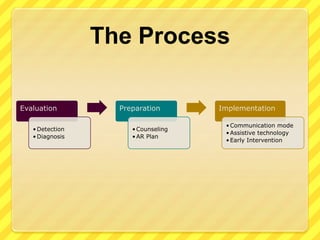
The Process
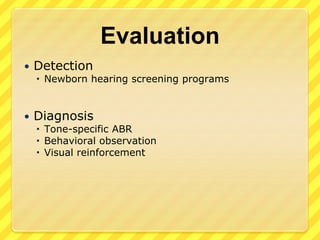
EvaluationDetectionNewborn hearing screening programsDiagnosisTone-specific ABRBehavioral observationVisual reinforcement
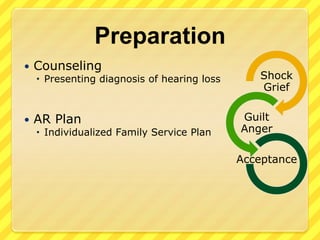
PreparationCounselingPresenting diagnosis of hearing lossAR PlanIndividualized Family Service Plan
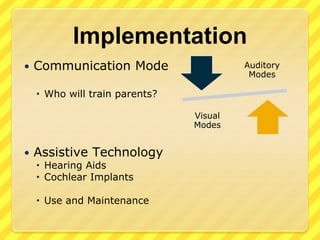
ImplementationCommunication ModeWho will train parents?Assistive TechnologyHearing AidsCochlear ImplantsUse and Maintenance
ImplementationConsistent Device UseAsk parents should track useExplore why device may not be used as much as recommendedChild compliance?Parent denial?Modeling good communicationListening goalsSound detectionMay need to link with visual stimulus then withdraw visual supportSound discriminationLarge contrasts (“hop hophop” vs. “Aaaaaaah”)Speech goalsBabble productionOne to two word utterances
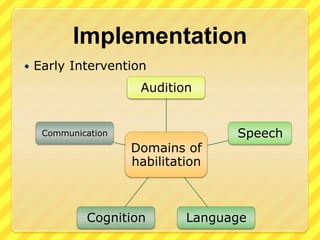
ImplementationEarly Intervention
Early Intervention TeamParentsPediatricianAudiologistSpeech-Language PathologistDevelopmental Therapist – HearingDeaf Mentor
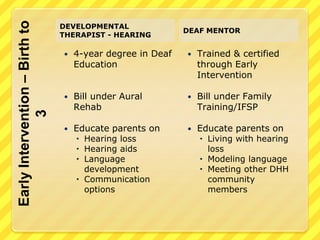
Early Intervention – Birth to 3Developmental Therapist - Hearing4-year degree in Deaf EducationBill under Aural RehabEducate parents onHearing lossHearing aidsLanguage developmentCommunication optionsDeaf mentorTrained & certified through Early InterventionBill under Family Training/IFSPEducate parents onLiving with hearing lossModeling languageMeeting other DHH community members
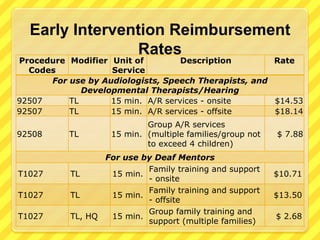
Early Intervention Reimbursement Rates
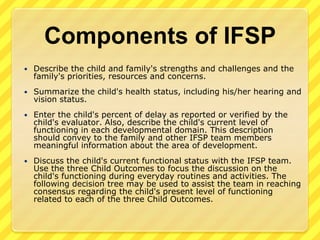
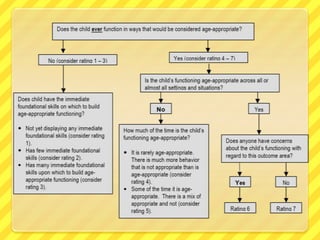
Components of IFSPDescribe the child and family's strengths and challenges and the family's priorities, resources and concerns. Summarize the child's health status, including his/her hearing and vision status. Enter the child's percent of delay as reported or verified by the child's evaluator. Also, describe the child's current level of functioning in each developmental domain. This description should convey to the family and other IFSP team members meaningful information about the area of development.Discuss the child's current functional status with the IFSP team. Use the three Child Outcomes to focus the discussion on the child's functioning during everyday routines and activities. The following decision tree may be used to assist the team in reaching consensus regarding the child's present level of functioning related to each of the three Child Outcomes.
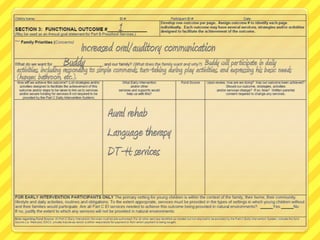
1Increased oral/auditory communicationBuddyBuddy will participate in daily activities, including responding to simple commands, turn-taking during play activities, and expressing his basic needs (hunger, bathroom, etc.).Aural rehabLanguage therapyDT-H services
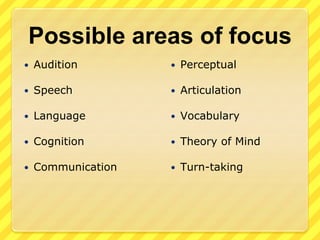
Possible areas of focusAuditionSpeechLanguageCognitionCommunicationPerceptualArticulationVocabularyTheory of MindTurn-taking
Infants and toddlers

Infants and toddlers

  • 1.
  • 2.
  • 3.
    EvaluationDetectionNewborn hearing screeningprogramsDiagnosisTone-specific ABRBehavioral observationVisual reinforcement
  • 4.
    PreparationCounselingPresenting diagnosis ofhearing lossAR PlanIndividualized Family Service Plan
  • 5.
    ImplementationCommunication ModeWho willtrain parents?Assistive TechnologyHearing AidsCochlear ImplantsUse and Maintenance
  • 6.
    ImplementationConsistent Device UseAskparents should track useExplore why device may not be used as much as recommendedChild compliance?Parent denial?Modeling good communicationListening goalsSound detectionMay need to link with visual stimulus then withdraw visual supportSound discriminationLarge contrasts (“hop hophop” vs. “Aaaaaaah”)Speech goalsBabble productionOne to two word utterances
  • 7.
  • 8.
    Early Intervention TeamParentsPediatricianAudiologistSpeech-LanguagePathologistDevelopmental Therapist – HearingDeaf Mentor
  • 9.
    Early Intervention –Birth to 3Developmental Therapist - Hearing4-year degree in Deaf EducationBill under Aural RehabEducate parents onHearing lossHearing aidsLanguage developmentCommunication optionsDeaf mentorTrained & certified through Early InterventionBill under Family Training/IFSPEducate parents onLiving with hearing lossModeling languageMeeting other DHH community members
  • 10.
  • 11.
    Components of IFSPDescribethe child and family's strengths and challenges and the family's priorities, resources and concerns. Summarize the child's health status, including his/her hearing and vision status. Enter the child's percent of delay as reported or verified by the child's evaluator. Also, describe the child's current level of functioning in each developmental domain. This description should convey to the family and other IFSP team members meaningful information about the area of development.Discuss the child's current functional status with the IFSP team. Use the three Child Outcomes to focus the discussion on the child's functioning during everyday routines and activities. The following decision tree may be used to assist the team in reaching consensus regarding the child's present level of functioning related to each of the three Child Outcomes.
  • 12.
    1Increased oral/auditory communicationBuddyBuddywill participate in daily activities, including responding to simple commands, turn-taking during play activities, and expressing his basic needs (hunger, bathroom, etc.).Aural rehabLanguage therapyDT-H services
  • 13.
    Possible areas offocusAuditionSpeechLanguageCognitionCommunicationPerceptualArticulationVocabularyTheory of MindTurn-taking

Editor's Notes