An Introduction to “Verge”
A general practice framework for 
futures work
Wolfson College, Oxford, UK
10/4/2013
Sponsored by the Association of Professional Futurists
Vision Foresight Strategy LLC
Chief executive officer
www.kikilo.biz
Institute for Political Futures
President
To support intelligent and critical discourse 
on the futures of governance, citizenship, 
and democracy.
To help others make better sense of the 
world around them so they can create the 
most desirable futures possible.
kaipo@kikilo.biz
@kikilo, @thethirdera
Richard A. K. Lum, PhD
AN INTRODUCTION TO VERGE
Six Domains of Human Experience
What is Verge?
Originally intended as an alternative taxonomy for environmental 
scanning, Verge has evolved through use into a general practice 
framework employed by foresight professionals at virtually every stage of 
futures research.
http://anticipatingchange.blogspot.com/2013/03/verge‐general‐practice‐framework‐for.html
It is a way to frame and explore changes in the world.
Stepping Outside the STEEP Box
Social
Technological
Economic
Environmental
Political
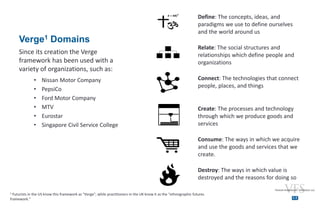
Verge1 Domains
Since its creation the Verge 
framework has been used with a 
variety of organizations, such as:
• Nissan Motor Company
• PepsiCo
• Ford Motor Company
• MTV
• Eurostar
• Singapore Civil Service College
Define: The concepts, ideas, and 
paradigms we use to define ourselves 
and the world around us
Relate: The social structures and 
relationships which define people and 
organizations
Connect: The technologies that connect 
people, places, and things
Create: The processes and technology 
through which we produce goods and 
services
Consume: The ways in which we acquire 
and use the goods and services that we 
create.
Destroy: The ways in which value is 
destroyed and the reasons for doing so
1 Futurists in the US know this framework as “Verge”, while practitioners in the UK know it as the “ethnographic futures 
framework.”
Define speaks to the concepts, ideas, and paradigms we use to define ourselves 
and the world around us.
Define
Examples of Changes Found within Define
• The shift from a Newtonian scientific worldview to one 
that sees Chaos, Complexity, and Quantum phenomena
• Active, interventionist government policies gaining favor 
over laissez faire economic theories
• People expanding their definition of “natural” to include 
human‐built structures
Things like:
• Worldview
• Paradigms
• Philosophy
• Archetypes
• Social values and attitudes
• Public policy
• Religion 
Relate deals with the social structures and relationships which define people and 
organizations.
Relate
Examples of Changes Found within Relate
• Networked enterprises eschewing traditional office 
work spaces and large full time staff in favor of 
collaboration and outsourcing via Web‐based tools
• Age cohort differences in family and child rearing 
patterns
• Young physicians opting for salaried employment rather 
than private practice
Things like:
• Family and lifestyle groups
• Work life
• Business models
• Social institutions
• Governance structures
The Connect domain encompasses the technologies and practices used to connect 
people, places, and things.
Connect
Examples of Changes Found within Connect
• Upward trend in individuals using mobile devices to 
access information and communicate
• Prevalence of internet‐based social network services
• Emerging community fault lines over proposed mass 
transit plans
Things like:
• Information technology
• Transportation and 
mobility
• Urban design
• Language
• Media 
Create is concerned with the technology and processes through which we produce 
goods and services.
Create
Examples of Changes Found within Create
• Rising popularity of the DIY ethos
• Extrapolating the uses for advanced 3D printing
• The push for “localization” and local sourcing emerging 
across several sectors
Things like:
• Manufacturing
• Biotechnology
• Nanotechnology
• Efficiency
• Work force
• Rule making
Consume is about the ways in which we acquire and use the goods and services 
we create.
Consume
Examples of Changes Found within Consume
• Business models based on the “sharing economy” 
premise
• Community efforts to reduce household water use
• Trends in the amount of disposable income controlled 
by youth
Things like:
• Modes of exchange
• Retail practices
• Consumer preferences
• Marketing
• Patterns of consumption
The domain of Destroy is about the ways in which we destroy value and the 
reasons for doing so.
Destroy
Examples of Changes Found within Destroy
• The falling trend of formally declared wars between 
established states
• Potential hazard of engineered nanoparticles on human 
health and the broader biological landscape
• “Cyber‐bullying” and the changing social dynamics for 
American youth
Things like:
• Violence and killing
• Damage
• Refuse
• Inefficiencies
• Attempts to undermine 
rules and norms
APPLICATIONS
Using the Verge lens to explore and interpret the world
Scanning
The Verge framework is used as an 
alternative to the classic STEEP 
categories for research.
To Organize a Scanning Effort
Used in its original application the 
Verge domains are used to organize an 
environmental scanning research 
effort, using the domains as research 
areas, within which researchers hunt 
for weak signals.
To Categorize Scanning Hits
Similarly, the Verge domains can be 
used to “bucket” the results of 
scanning and research, regardless of 
the organization of the research effort.
Verge domains used to organize an environmental scanning effort
Forecasting
Verge is often used in various ways 
during forecasting exercises.  Two 
methods include emerging issues 
analysis and interaction analysis.
Trend and Emerging Issues Analysis
Often related to a scanning effort, the 
Verge framework has been used to 
direct efforts to identify and forecast 
potential emerging issues.
Interaction Analysis
Verge interaction analysis involves 
forecasting the impact of changes in 
one domain as they cascade across 
other domains. This method can be 
used to generate entire scenarios.
RelateConnect
ConsumeDestroy
Basic heuristic for Verge interaction analysis, incorporating a 
version of layered analysis
Analysis
Using the Verge domains to structure 
the exploration of implications of 
trends, emerging issues, scenarios, and 
other forecasts.
Implications Wheels
Practitioners often use a version of the 
Futures Wheel to explore the 
implications of an emerging issue or 
scenario (rather than using it to build 
parts of a scenario or forecast).
Critique Forecasts
Interaction analysis can also be used to 
reconsider an existing scenario or 
forecast by exploring logical cross‐
domain impacts that might alter the 
basic forecast trajectory.
Demand for 
3D design 
courses
FedEx 
printing 
platform
DIY/Makers 
edged out 
of market
Consumer/ 
maker 
digital 
divide
Lots of new 
waste
Shopping at 
FedEx not 
Wal‐Mart
ICT more 
important 
than ever
People sell 
digital 
designs
Cheap to 
order more 
stuff
Define
Relate
Connect
Create
Consume
Destroy
A factory in 
every 
community
3D printing 
at FedEx 
Kinkos
Seen as 
critical for 
econ dev
Basic implications wheel framed by the Verge domains
The general practice framework can often be used in conjunction with other established 
futures methods and concepts.  Below, using Verge with a simple layered analysis of change in 
society.
Combining Frameworks
Surface Layer
Systems Layer
Worldview Layer
Define Relate Connect Create Consume Destroy
By combining the general practice framework with a framework like layered analysis (which identifies the different rates of 
change that occur at different “layers” of society), we add additional structure that improves our analysis of the many, 
subtle interrelationships both driving and responding to change.
Combining Frameworks
First Horizon Second Horizon Third Horizon
Define
Relate
Connect
Create
Consume
Destroy
Combining Verge with the Three Horizons2.
2 Andrew Curry and Anthony Hodgson. “Seeing in Multiple Horizons: Connecting Futures to Strategy.” Journal of Futures Studies. August 2008.
EXAMPLE: GOVERNANCE
Applying the framework to the futures of governance
First Horizon Second Horizon Third Horizon
Define Newtonian physics, popular 
sovereignty
Systems, complexity science, 
networks
?
Relate Representative government Online social networks machinarchy
Connect Mass media Internet, social media, mobile 
devices
Internet of things
Create F2F deliberation, bureaucratic 
administration; voting
Crowdsourcing, civic hacking, 
co‐production
Machines, algorithms, 
automation
Consume Go to government, use what 
is provided
Websites, mobile apps Ambient persistent 
governance
Destroy Political marginalization (lack 
of suffrage)
Party polarization, special 
interest groups, voter apathy
Democracy, human agency, 
rampant sabotage
Sample
Combining Verge with the Three Horizons to explore the futures of governance.
managers3 entrepreneurs visionaries
3 Categories from Bill Sharpe, via Wendy Schultz, PhD
Mahalo.
(thank you)
Richard Lum, PhD
Chief executive officer
kaipo@kikilo.biz

An Introduction to "Verge"